



High school soccer: State championship scores and schedule
At Matomas High, Sacramento
FRIDAY’S RESULTS
Boys
DIVISION II
San Ramon Valley 4, Mira Monte 1
DIVISION IV
Irvine University 3, Del Mar 2
Girls
DIVISION II
San Ramon Valley 1, Westlake 0
DIVISION IV
Marin Catholic 4, Coachella Valley 1
DIVISION V
Lowell 2, Coastal Academy 0
SATURDAY’S SCHEDULE
Boys
DIVISION I
Everett Alvarez vs. Santa Ana Mater Dei, 8 p.m.
DIVISION III
Watsonville vs. Los Alamitos, 3 p.m.
DIVISION V
Branson vs. Los Angeles Garfield, 10 a.m.
Girls
DIVISION I
Oakland Bishop O’Dowd vs. Santa Ana Mater Dei, 5:30 p.m.
DIVISION III
Salinas vs. Quartz Hill, 12:30 p.m.

Yemeni ports face shipping fee hike amid Iran conflict | US-Israel war on Iran News
Mukalla, Yemen – A reported decision to impose thousands of dollars in fees on shipping headed for Yemen has experts worried that the price of imported goods and food will increase in the war-torn country, as it starts to feel the economic impact of the United States and Israel’s conflict with Iran.
Local traders and officials have said that international shipping companies informed importers earlier this month of the imposition of new fees of about $3,000 on each container bound for Yemen, described as “war risk” fees. The surprise move prompted government officials to scramble to assess and address its potential repercussions.
Recommended Stories
list of 3 itemsend of list
Because Yemen imports nearly 90 percent of its food and other essential commodities, economists and humanitarian organisations warn that the rise in shipping and insurance costs could quickly translate into higher prices for fuel, food and other goods, further worsening an already dire humanitarian situation.
Mohsen al-Amri, transport minister in Yemen’s internationally-recognised government based in the southern city of Aden, said he had instructed that the fees not be paid by ships already docked at Yemeni ports or those bound for the country, insisting that the ports remain safe.
“Our ports are far from the areas of geopolitical tension in the Gulf and the Strait of Hormuz, making the imposition of ‘risk’ fees on shipments to these relatively safe areas unjustified from both operational and security perspectives,” he said in a social media post last week.
Al Jazeera has reached out to shipping companies to confirm details of the fee, but has yet to receive responses.
For more than a decade, Yemen has been gripped by a bloody war between the Saudi-backed government, based in Aden, and the Iran-aligned Houthi movement, which controls the capital, Sanaa. The conflict has killed and wounded thousands of people and displaced millions, creating what the United Nations once described as the world’s worst humanitarian crisis. Hostilities have significantly declined since April 2022, when the warring parties agreed to a temporary United Nations-brokered truce.
‘High-risk’
Abdulrab al-Khulaqui, deputy chairman of the Yemen Gulf of Aden Ports Corporation, said Yemeni ports have long been classified as high-risk, prompting shipping companies to impose war-risk surcharges. These can reach about $500 per each 20-foot container and $1,000 per each 40-foot container, on top of regular shipping costs.
Al-Khulaqui said that the $3,000 fee now being demanded was “very high and unusual”, but was justified by shipping companies because they regard Yemeni ports as unsafe, despite their distance from Iran.
Although the Houthis are allied to Iran and previously attacked shipping in the Red Sea following Israel’s genocidal war on Gaza, the Yemeni group has yet to intervene in the US-Israel-Iran conflict. Other Yemeni parties are also not involved, making Yemen one of the few regional countries yet to see any violence related to the fighting.
In addition to barring local traders from paying the new charges, the Yemeni government is considering other measures to pressure shipping companies to cancel the fees, including threatening to stop vessels belonging to those companies from docking at Yemeni ports. Authorities may also allow traders to contact exporters directly in countries of origin to negotiate any additional charges.
The new surcharges come as the United Nations has again sounded the alarm over Yemen’s worsening humanitarian situation, saying nearly 65.4 percent of the population – about 23.1 million people – will require urgent humanitarian assistance and protection services this year. This marks an increase of roughly 3.5 million people compared with 2025.
“Yemen continues to face an escalating food security crisis entering 2026,” the World Food Program said in its February Yemen Food Security Update, released on March 5. “January data revealed that 63 percent of households nationwide are struggling to meet their minimum food needs, including 36 percent facing severe food deprivation.”
Bypassing Yemen’s ports
In addition to rising insurance fees on shipments to Yemen, the war in Iran and potential disruptions in the Strait of Hormuz could cut vital supply routes from regional hub ports such as Jebel Ali in the United Arab Emirates.
Mustafa Nasr, head of the Studies and Economic Media Center, told Al Jazeera that shipping companies may begin seeking alternative hub ports to deliver goods to Yemen, which could increase costs and cause delays.
“The closure of Jebel Ali port would force shipping lines to seek alternative ports that may be farther away and involve significantly higher transportation costs,” he said.
Nabil Abdullah Bin Aifan, manager of the government-run Maritime Affairs Authority in Hadramout province and a maritime researcher, said most goods arriving at Mukalla port – the province’s main seaport – are transported on wooden dhows from Dubai.
He said that if disruptions occur in the Strait of Hormuz, traders may turn to alternative regional hub ports such as Salalah in Oman or Jeddah in Saudi Arabia.
“Large ships come to Dubai to unload their containers, and traders then unload the goods from the containers and load them onto those primitive ships, which have no insurance,” Bin Aifan told Al Jazeera.
For now, wheat shipments from Ukraine and goods transported from China to Yemen may see price increases due to rising insurance costs, while products imported from Gulf countries could disappear from the market.
Shipping lines may also consider routing cargo through the Cape of Good Hope rather than the Gulf, Bin Aifan said.
“Even before the recent developments involving Iran, ports in our region were considered high risk. However, after the relative calm that followed the halt to Houthi attacks in the Red Sea, confidence gradually returned and ships began sailing back to the region. Now, the war has brought the problem back again,” he said.
All of this means that Yemenis, already struggling with poverty and hunger after years of war, will likely have to pay more for imported food and goods.
Abdullah al-Hadad, an English teacher from the city of Taiz with 40 years of experience in the profession, said that his monthly salary – less than $80 – is already not enough to cover his basic needs. Meat and fish have become luxuries for his family, and he still owes nearly one million Yemeni riyals (about $670) to a local grocery shop.
To make ends meet, he works additional jobs as a taxi driver and in a grocery store, while his children also work after school to help support the family and pay for medication for his 10-year-old son, who has autism.
“What I suffer from as a government employee is the extremely low salary, which does not even cover basic necessities such as bread, tea, salt and sugar,” al-Hadad told Al Jazeera.
“Other foods that are essential for a healthy diet, like meat or fish, have become a distant dream.”

Rescuers blame weather and 'underprepared skiers' for rise in Alps avalanche deaths
The BBC joins a French Alps rescue team as the number of skiers killed this season passes 100.
Source link

SXSW 2026: On aliens and UFOs, Spielberg says, ‘We are not alone’
AUSTIN, Texas — One of the most anticipated events at this year’s SXSW Film & TV Festival wasn’t a movie at all, but a speaking appearance by director Steven Spielberg. The talk, a live taping of the podcast “The Big Picture” lead by co-host Sean Fennessey, covered many aspects of the Hollywood legend’s career, with a through line of sci-fi and space aliens in conjunction with Spielberg’s upcoming alien invasion thriller “Disclosure Day,” due June 12.
Though no real details about the new film were revealed, references to it peppered the conversation as if it were very much on Spielberg’s mind — the film he was ostensibly there to promote.
To an audience that included filmmakers Robert Rodriguez and Daniel Kwan, the event began with a clip reel that served as a reminder (as if anyone in the packed hotel ballroom needed one) of just how influential the 79-year-old filmmaker is. A selection of Spielberg’s work plays like a trailer for the idea of movies themselves; this one included “Jaws,” “Raiders of the Lost Ark,” “E.T.” “Schindler’s List,” “Jurassic Park,” “The Sugarland Express,” “Catch Me If You Can,” “Munich” and many more.
Fennessey noted that Spielberg wanted to make 1977’s “Close Encounters of the Third Kind,” his first sci-fi movie about the existence of aliens from other worlds, even before making 1975’s “Jaws.” Spielberg went further, saying he had actually wanted to make “Close Encounters” — then just referred to as “The UFO Movie” — even before 1974’s “Sugarland Express.”
Asked about President Obama’s recent comments about the possible existence of intelligent life elsewhere in the universe and how his own feelings may have evolved over the years, Spielberg said, “I think that for one thing, when President Obama made that comment, I thought, ‘Oh my God, this is so great for “Disclosure Day,”’ and then, two days later, he stepped back the comment and said what he believed in was life in the cosmos, which of course everybody should believe that because no one should ever think that we are the only intelligent civilization in the entire universe. So I’ve always believed, even as a kid, that we were not alone. So that just goes without saying. The big question is: Are we alone now?”
He added this interest was “reinvigorated” by a 2017 New York Times article about U.S. Navy pilots seeing unexplained aerial phenomenon, then by a 2023 Congressional subcommittee hearing on the topic.
“I don’t know any more than any of you do,” Spielberg said, “but I have a very strong, sticky suspicion that we are not alone here on Earth right now. And I made a movie about that.”

Spielberg and “The Big Picture” co-host Sean Fennessey taping a live podcast at SXSW on Friday.
(Tibrina Hobson / Getty Images)
As to how he feels about that possibility, Spielberg added, “I’m not afraid of any aliens, there or here. I have no fears about that, whatsoever. I think our movie does take into consideration, without giving too much away, the social dislocation that could occur, theologically, if it would be announced that there’s evidence — not only evidence, where it’s interaction that’s has been going on for decades, that we are not just now finding out about. It is going to cause a disruption in a lot of belief systems, but I don’t think it’s a lethal disruption at all.”
Among other topics that were discussed, Spielberg revealed he is developing a western that would shoot in Texas, though he was reluctant to discuss it in any further detail except to say it would contain “no tropes.”
He also said he is not on any social media, but did install Instagram on his phone once for two weeks and felt as if he had been abducted by aliens for the amount of time he lost.
To that end, he also noted, with comic frustration, how he himself has never had any sort of alien encounter.
”I made a movie called ‘Close Encounters of the Third Kind.’ I haven’t even had a close encounter of the first or second kind,” Spielberg said. “Where’s the justice in that? If you’re listening out there, I’m talking to you.”
There was a brief moment of confusion when Fennessey asked Spielberg for his thoughts on AI and Spielberg wasn’t clear if he was asking about his own 2001 movie or the broader topic of artificial intelligence.
Once that was cleared up (Fennessey meant the latter, a serious labor issue in Hollywood), Spielberg noted he has not used AI on any of his own films. “I don’t want to go into a whole rant about AI because I am for AI in many different disciplines. I am not for AI if it replaces a creative individual.”
Speaking to the theatrical experience, Spielberg made a brief allusion to the flare-up around comments by Timothée Chalamet regarding the popularity of opera and ballet in relation to the movies.
He noted that he does not decry the at-home streaming experience and that he works with Netflix, but that “for me, the real experience comes when we can influence a community to congregate in a strange dark space. All us are strangers and, at the end of a really good movie experience, we are all united with a whole bunch of feelings that we walk into the daylight with or into the nighttime with. And there’s nothing like that. I mean, it happens in movies, it happens at concerts and it happens in ballet and opera.”
Here there was a round of applause from the audience. “And we want that sustained and we want that to go forever.”
Spielberg noted how many of his favorite filmmakers, including David Lean and Billy Wilder and more recent examples such as Paul Thomas Anderson and Christopher Nolan, are always making films that feel different from what they have done before. He sees himself as part of that same school.
“If we’re just not making the same sequel over and over and over again and they’re not the same Marvel title over and over and over again, we all get a real chance to experience something, which is freshness,” Spielberg said. “And that is why I don’t judge my accomplishments based on a single film.”

I stayed at the UK holiday park ‘better than Center Parcs’ — I’d go back tomorrow
It also ranked ahead of heavyweights like Haven, Warner, Butlins and Parkdean.
My Full Bluestone National Park Resort Review
This remote corner of the UK is magical. It is steeped in history and home to the most beautiful landscapes. Stone burial chambers date back 4,000 years, standing stones inscribed with Latin and Ogham (an ancient Irish) dot the countryside and wrapped around it all is one of the most striking coastlines anywhere, where waves roll in over pristine sandy beaches or smash violently against towering rock faces.
At the heart of it all is the Bluestone National Park Resort, set within 500 acres of wild Welsh countryside. A holiday park it may be, but Bluestone wants you to feel like you are part of the Pembrokeshire panorama that surrounds you on all sides. So well-absorbed is the resort into its surroundings that despite its size and its hundreds of lodges you’d scarcely have any clue it was there until you were well inside.
But that’s not to say it’s not also a modern and luxurious holiday experience, especially where its new lodges are concerned. They took my breath away.
Bluestone in a nutshell
Most of Bluestone is made up of its 300 or so beautiful wooden lodges of various sizes dotted across hills not far from the pretty town of Narberth. The centre of the resort is its purpose-built village home to a couple of dozen charming, colourful stone cottages, a handful of restaurants, some shops (selling a wide range of Welsh foods, beers, spirits and toys), a spa and a pub with a beer garden conveniently a playground.
Also in the resort is a large indoor play area called The Hive (with one of the best features you’ll find in any indoor play area – more on that later), the Blue Lagoon, a large swimming area with indoor and outdoor slides and a wave machine, and the Serendome, a covered indoor-outdoor adventure play area featuring everything from a theatre to an extensive aerial adventure course. Generally speaking, the resort is probably better for younger children rather than teenagers (mine are 10 and under) but you can make your own call on that.
I’ve been holidaying here for a decade. My children have grown up coming here almost every year of their lives so it already holds a special place in my family’s hearts. We’ve just returned from our most recent visit, which coincided with winter turning to spring (though no one told the Welsh weather that). I’d go back tomorrow.
Accommodation: The lodges
There’s only one place to start and that’s with Bluestone’s new Platinum Collection lodges. Immaculate and beautifully-designed, these brand new lodges are on another level to any I’ve stayed in before. We stayed in a St Govan Lodge (named after one of the most striking parts of the nearby coastline) with three bedrooms sleeping six people, two bathrooms including one gorgeous en suite with rain shower, standalone bath, twin sinks and serene starlight effect lighting on the ceiling.
There was a spacious upstairs open-plan living area with a dining room, a “cwtch” (a snug room with two chairs and a TV for relaxing, working or giving the kids some quiet time) and a sun room, a stunning new feature for Bluestone lodges with two fully retractable glass walls. Even at winter’s end we opened them wide to breathe in the Pembrokeshire air and drink in those views. In summer, it would be heavenly drinking prosecco or a cold beer as well as the scenery.
The lodges come fully-equipped with an oven, microwave, fridge freezer, dishwasher and even an air fryer, which we made full use of for breakfasts and an evening meal around the six-seater dining table. After a home-cooked meal on our first night, we settled into the huge u-shaped sofa in front of a cosy electric fire.
The Platinum Lodges also come with their own electric buggy to help you get around the resort. This was the highlight of my five-year-old’s trip as we tootled along in our six-seater at 6mph engaging in the resort-wide game of “beep the horn at everyone you pass”. The lodges also have their own buggy charging point.
All Bluestone’s lodges, which sleep between two and 14 people, come with kitchen and open plan living areas, while the cottages in the village have one or two bedrooms.
Check-in
Check-in is effortless. For most of the park’s guests, it’s a drive-through process: arrive at the welcome lodge, drive around the one-way system to your own lodge, unload your car then return it to the car park at the resort’s edge and forget about it until it’s time to leave. Outside check-in and check-out times, Bluestone is a car-free resort so you can stroll the roads or drive your buggy in peace and safety.
For Platinum Collection guests, it’s even smoother. We had our own exclusive entrance, check-in lodge, car park and buggy pick-up point. There can’t have been more than five minutes between checking in and driving odoff in the buggy after a quick how-to guide.
Activities
A sign on the wall in Bluestone’s village says “there’s no bad weather in Pembrokeshire, just the wrong clothes”. As someone who visited on a weekend when the weather ran its full gamut from blue-skied bright sunshine to howling wind and driving rain, I could not agree more.
Bluestone has masses of outdoor activities for all the family, from stand-up paddleboarding on its lakes to cycling, archery, exploring its woodland trails, zip-lining or rustic outdoor eating and marshmallow-toasting at Steep Ravine and Camp Smokey (which reopen in June after storm damage forced them to close). You also have all of Pembrokeshire and its award-winning beaches on your doorstep.
But even when it rains (and it’s Wales so there’s a high chance of this) there are masses of activities under cover. My kids were entertained every minute of the day. Start the day with a swim at the Blue Lagoon Water Park, an indoor pool heated to perfection (using locally sourced biomass) with four flumes, a wave machine, toddler splash areas and a lazy river which takes you outside for a quick loop before returning indoors. It’s looking a bit tired in parts and could probably do with a bit of touching up in the not-too-distant future as it approaches its 20th birthday but that doesn’t detract from how much fun it is.
The Hive indoor activity centre has soft play, a huge bouncy castle, climbing walls, messy play, and a cafe-bar upstairs where parents can relax while the kids tire themselves out. But the highlight of my trip this time round was watching my two children try Adrenaline, a circular zipline suspended from the roof which they flew around high above the play area. They came off grinning from ear to ear.
The Serendome is an indoor-outdoor adventure play area housed under a giant transparent dome housing everything from a multi-level aerial adventure course in which kids (and adults) can ride a bike across a zipwire three storeys high to an amphitheatre-style theatre in which we watched a local male voice choir perform on St David’s Day and danced along to a silent disco. There’s also a bar and a few pop-up food stalls.
And there’s The Well Spa, a tranquil, adult-only spa offering thermal experiences, hydrotherapy, saunas, steam rooms and a range of luxury treatments. The kids’ mum headed here for two hours of peace while the youngsters used up some energy on the Serendome’s aerial adventure course.
Food and drink
One of the great joys of Bluestone for me is being able to prepare and eat a meal in a beautiful upstairs open-plan dining room with views of the countryside all around. Whether it’s breakfast in morning sunshine or a cosy evening meal and glass of red wine with the wind and rain howling outside, we always plan on having at least one family meal in the lodge.
But there are plenty of options for dining out too. Our go-to is the Farmhouse Grill, a casual and rustic restaurant serving steaks, burgers fish and kids’ dinners. The Oak Tree serves pizza and other Italian food, there’s pub food in the Knights Tafarn (where a roaring log fire keeps you warm on cold winter days and a beer garden lets you soak in the summer sunshine), fast food at the NRG Lab in The Hive and outdoor eating at Camp Smokey. The food’s not award-winning but it’s perfectly decent. There’s more refined dining at the gorgeous Black Pool Mill, a newer addition to Bluestone’s eating options which is off-site and a 20-minute walk along a well-marked path or very short drive away.
Things to do outside Bluestone
We didn’t spend a single second outside Bluestone during our three-night stay. We never do. But if you did fancy a change, Bluestone is the only UK holiday resort situated inside a national park so you’re not only immersed in protected landscapes but have easy access to land, sea and coast. You are spoilt for choice in all directions in one of the most naturally beautiful places in Britain. Five minutes down the road is the gorgeous town of Narberth, which is packed with independent shops, outstanding restaurants and has been named among the best places to live in the country.
The stunning seaside town of Tenby is 25 minutes away and is also brimming with places to eat and drink. It also has no less than four beaches within a few minutes’ walk of the town centre. The less famous, but equally charming, town of Saundersfoot is just a short drive along the coast.
A little further away you have the unique harbour village of Porthgain, which, despite being tiny and at the end of one road in and out, manages to have one of the best places to eat in Wales, as well as one of its best pubs. Also not too far away are Britain’s smallest city of St David’s, with its magnificent cathedral, the harbour village of Solva (yet another place in the area named among the best places to live), and the truly jaw-dropping St Govan’s Head, where a tiny chapel is built into the cliff face just above thundering waves below.
And then there are the world-class beaches: Barafundle, Whitesands, Freshwater West and East, Marloes Sands – it’s difficult to find the superlatives for them.
Better than Center Parcs
I have no hesitation in saying I prefer staying in Bluestone to Center Parcs. Of course, it’s all subjective but Bluestone has also been named the best holiday park in Wales (and third best in the UK) for the third year running by holidaymakers and Which? readers, beating heavyweights like Center Parcs, Haven, Warner, Butlins, Parkdean and more.
Costs
Bluestone’s prices vary by accommodation type and time of year. Here are examples of costs for the upcoming season:
- Weekend Easter break (arriving 10 April): from £645 for a 3‐night stay (up to 4 guests in a Ramsey Lodge or Caldey Deluxe).
- Midweek Spring breaks: from £300 for a 4‐night stay (up to 4 guests in a Caldey Lodge).
- The Mini Adventurer Break (from £300) is a deal designed especially for families with children under five and includes a bundle of free activities and entertainment during select midweek stays throughout the year. For qualifying dates, costs and included activities, visit https://www.bluestonewales.com/offers/free-activities-entertainment
- For any other costs, please get in touch or visit https://bookings.bluestonewales.com/search-rates
- All breaks include unlimited access to the Blue Lagoon water park, free indoor and outdoor play areas in The Hive, Serendome and village. Several activities do cost extra and need to be booked in advance: I would thoroughly recommend the 90-minute Sky Walk aerial adventure course (from £30, there’s also a Sky Walk Mini for smaller kids at £12.95), the Adrenaline circular zipline (£18 for two rounds) and the silent disco (from £5).
- A meal for four including drinks at the Knights Tafarn pub cost £73 while a meal for seven including drinks and a bottle of wine at Farmhouse Grill came in at £220.
- Access to the Celtic Thermal Suite to enjoy its steam rooms, sauna, ice pod and hydrotherapy pool costs from £20 and a Signature Massage costs from £75.

High school basketball: State championship results and schedule
CIF STATE BASKETBALL CHAMPIONSHIPS
At Golden 1 Center, Sacramento
FRIDAY’S RESULTS
Boys
DIVISION I
Damien 58, Folsom 55
DIVISION III
Antioch Cornerstone Christian 74, Birmingham 64
DIVISION V
San Marin 89, Sylmar 64
Girls
DIVISION I
Corona Centennial 73, Clovis 66
DIVISION III
Placentia El Dorado 42, San Jose Valley Christian 40
DIVISION V
Woodland Christian 63, Laguna Hills 30
SATURDAY’S SCHEDULE
Boys
OPEN DIVISION
Sierra Canyon (29-1) vs. Richmond Salesian (29-3), 8 p.m.
DIVISION II
Bakersfield Christian (24-11) vs. San Joaquin Memorial (27-7), 4 p.m.
DIVISION IV
San Juan Hills (21-14) vs. Atherton Sacred Heart Prep (20-11), 12 p.m.
Girls
OPEN DIVISION
Ontario Christian (33-2) vs. Archbishop Mitty (28-2), 6 p.m.
DIVISION II
Santa Maria St. Joseph (17-15) vs. Sierra Pacific (24-11), 2 p.m.
DIVISION IV
Palisades (16-13) vs. Yuba City Faith Christian (33-1), 10 a.m.
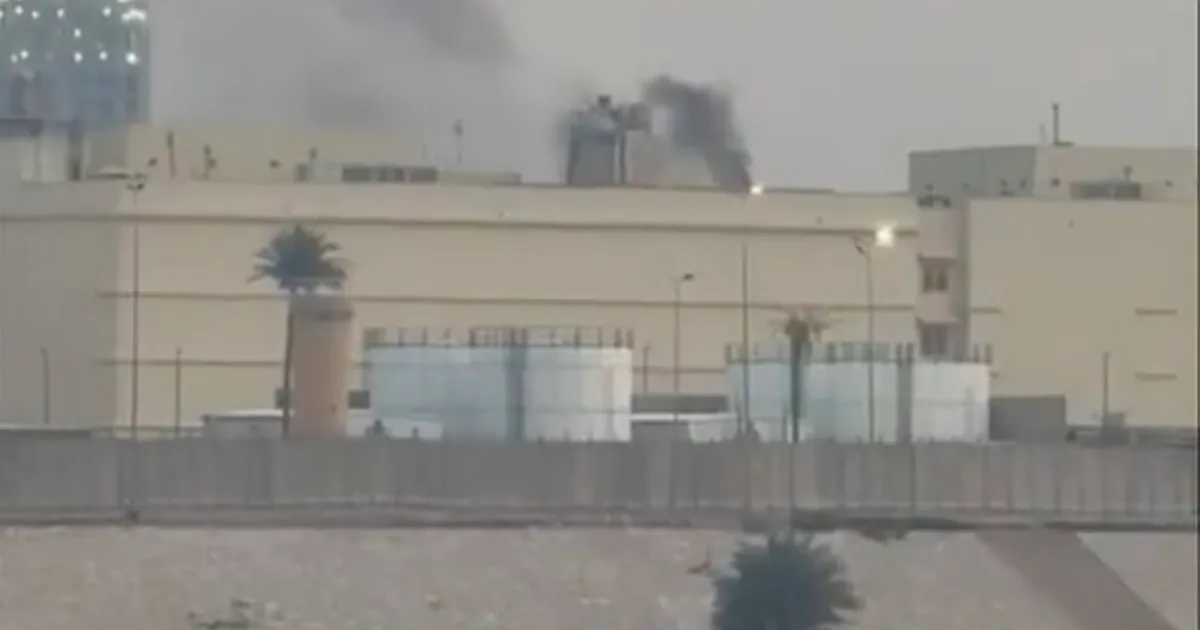
Smoke seen rising from US embassy in Baghdad | US-Israel war on Iran
Videos posted by social media users showed smoke rising from the US embassy in Baghdad after a reported attack. Iraqi officials said a helipad at the embassy was hit by a missile.
Published On 14 Mar 2026

Home Bargains ‘stylish’ and ‘durable’ £10 rucksack is ideal for work or travel
The discount retailer is selling an affordable bag that could be used for multiple travel destinations

Home Bargains is selling a versatile bag (stock photo)(Image: Getty)
Home Bargains is selling a ‘durable’ backpack that’s said to be ‘perfect for city travel’. The bag could therefore impress a range of shoppers. It could be just the ticket for commuters looking for a bag that will survive the journey to work. It could also impress travel fans who spend their weekends exploring new cities or catching the train to the countryside.
The discount retailer is selling the Salisburys PU Leather Rucksack for £9.99 online and in stores. Shoppers can choose between two colours when shopping online, as Home Bargains offers the bag in purple and cream.
Showcasing the rucksack, the bargain chain wrote: “Discover the Salisburys PU Leather Rucksack in vibrant purple – a lightweight, stylish companion perfect for city travel with multiple zipped compartments and a durable, fully lined interior.” The description notes that the ‘stylish bag’ measures approximately H58 x W28 x D14.5cm.
Sharing more information about the brand, the retailer added: “Salisburys presents its broadest line-up of tried and tested luggage solutions with contemporary features to help the modern tourist navigate the hurdles of the twenty-first century travel.
“Salisburys PU Leather range gifts you with all the necessities for modern-day commuter/city travel in a lightweight yet durable form. A clean modern design and durable materials that have been tested to protect your possessions from the testing environments that your luggage may encounter.”
Other products in the Salisburys range include the £9.99 Salisburys Carry-On Cabin Lightweight Backpack and the £6.99 Salisburys Weekend Bag. The cabin backpack could be better suited to travellers who fly regularly.
The product description explains: “Travel light and in style with the Salisburys Carry-On Cabin Lightweight Backpack in sleek black! Perfect for your adventures, this spacious yet compact backpack is designed for easy packing and effortless carrying.”
Meanwhile, the weekend bag might be the better pick for people travelling for one or two nights, who want the lightest luggage they can find. The description says: “Meet the Salisburys Weekend Bag, your ultimate travel companion! With its spacious design, handy trolley sleeve, and a zip-off bottom for easy packing, this stylish bag is perfect for weekend getaways or short trips.”
Another option for travellers could be the £9.99 Light Luggage Carry-On Cabin Luggage Wheeled Bag. The product description reads: “Travel light and breeze through the airport with the Light Luggage Carry-On Cabin Luggage Wheeled Bag!
“Its lightweight design, easy-glide wheels, and handy pockets mean you’ll skip the queues and arrive in style—just try not to look too smug!” While some shoppers prefer bags over cases, the added wheels could be helpful for people who don’t want to carry a bag but still need compact luggage.
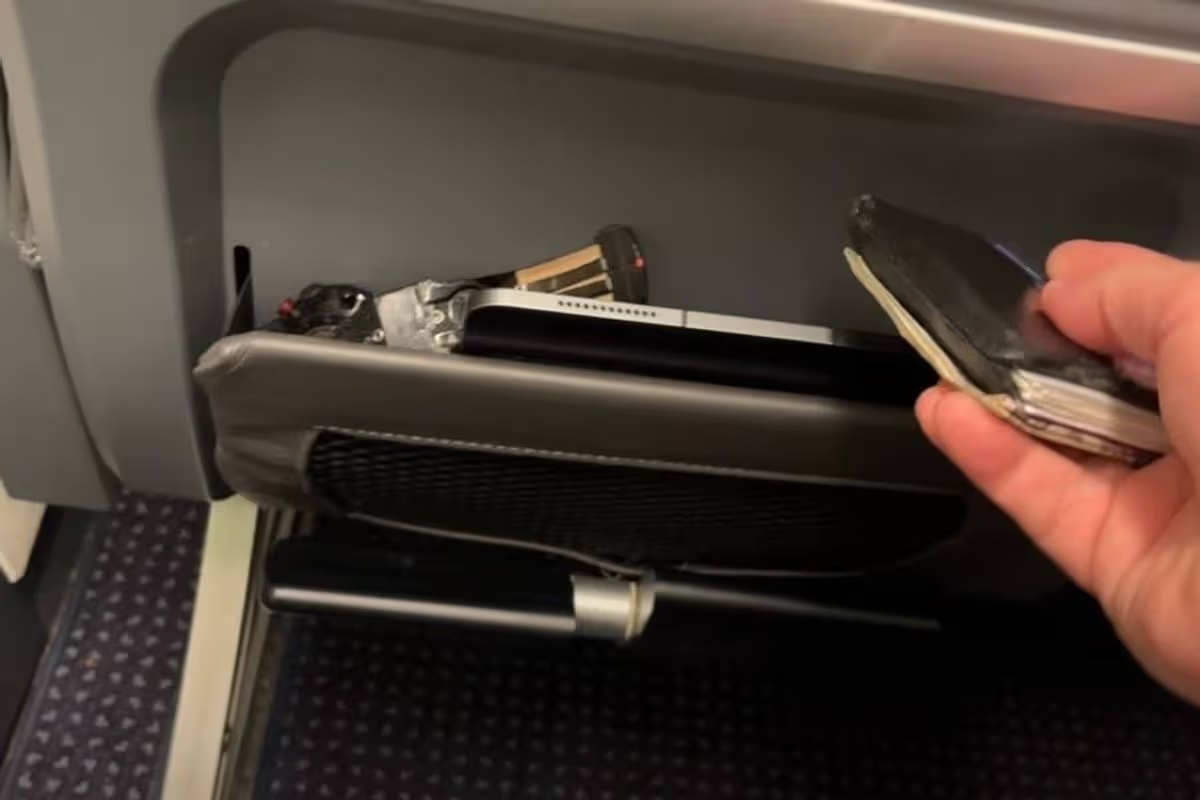
Passengers told ‘never use seat back pocket on planes’
American Airlines pilot Captain Steve Scheibner has shared crucial travel tips for passengers – warning them to avoid the seat back pocket he calls a “black hole of despair”

There is a hidden danger to using the back seat on planes, a pilot claims(Image: Captain Steeeve/YouTube)
An airline pilot has issued a stark warning to passengers never to stash their personal belongings in the rear pocket of plane seats for one straightforward reason.
Captain Steve Scheibner is an American Airlines pilot widely recognised by his huge YouTube following as Captain Steeeve. He revealed the advice in a recent video where he offered a string of travel tips for air travellers.
He regularly encounters people at the agent’s desk because of their use of the rear pocket during their journey, experiencing a “fingers crossed” situation where they face “diminishing” chances.
Captain Steve labelled the pocket the “black hole of despair” and cautioned people against placing anything valuable in it whilst they’re flying unless they “don’t ever want to see it again”.
He stated: “Stop putting personal items in the seat back pocket in front of you. If you want to lose it and never see it again, put it in that dark hole that is the seat back pocket in front of you.”
Captain Steve revealed he’d encountered numerous passengers who’d disembarked the aircraft but abandoned personal items in the seat pocket, and were subsequently unable to return to the flight to retrieve them.
He continued: “If the airplane is still at the gate, fingers crossed that somebody who cares can go out there and find the thing that you left in that seat back pocket.
“But the odds are diminishing with every minute that ticks by after you leave that seat and you leave it in that black hole of despair. So, my friends, do not put your personal items in that seat back pocket, unless of course, you don’t ever want to see it again.”
This comes as reports suggest budget airline passengers could soon experience a peculiar new way of flying – standing-only seats. The novel upright seats, allegedly designed for flights lasting under two hours, would allow passengers to lean rather than sit.
Initially unveiled by Italian company Aviointeriors back in 2018, the ‘Skyrider’ seats would enable airlines to “increase the passenger number by 20%”, resulting in “increased profits”, according to a company spokesperson.
They also maintained that the seats would provide an “increased upright passenger position” whilst ensuring “adequate comfort”. Nevertheless, one expert believes the seats could pose a challenge regarding “perception”.
Dr Akhil Bhardwaj, a former engineer and senior lecturer at the University of Bath’s School of Management, told the Express that such a development would demand “very strict oversight”.
Dr Bhardwaj stated: “The idea of a flying bus that packs passengers might seem appealing, but it might undermine the perception of how the industry thinks about safety. At the very least, such a move requires a very strict oversight and a very clear explanation to the flying public why this is safe.”
UK’s best spring beach named – it gets 8 hours of sun and has the best views
If you’re on the hunt for the perfect spring getaway, this beach needs to be on your radar.

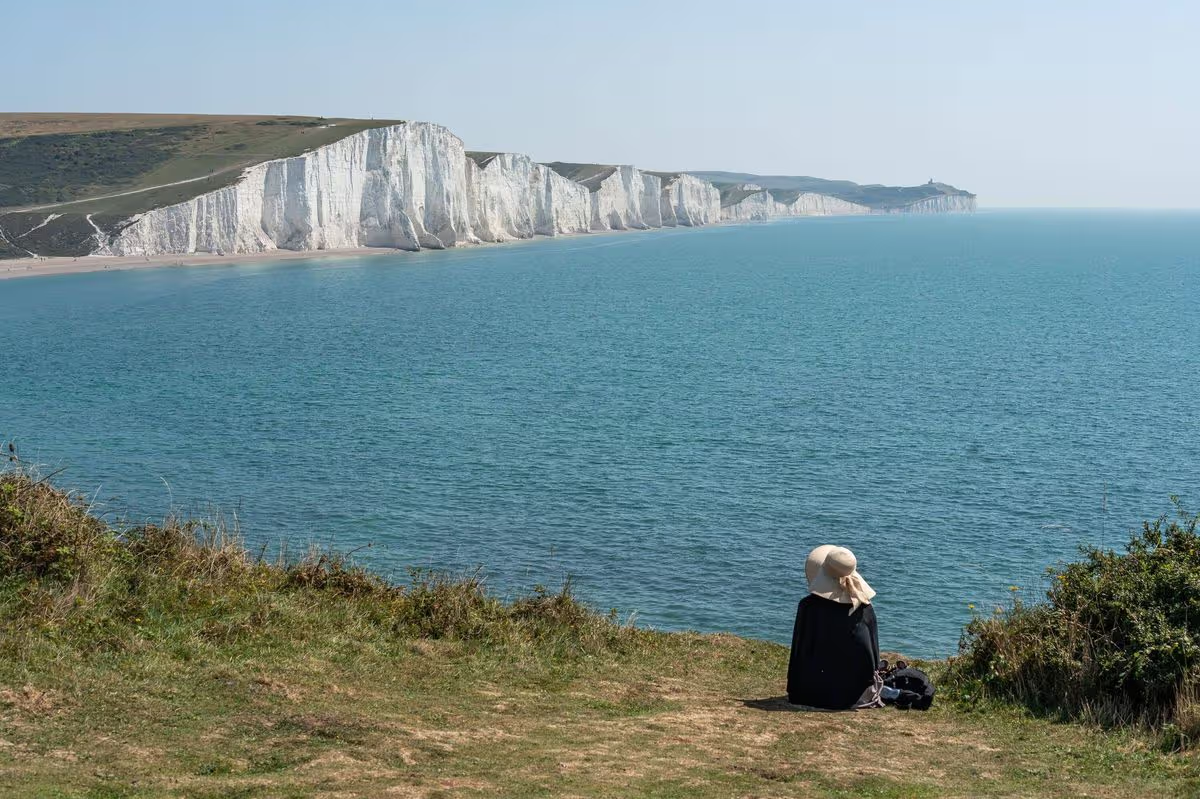
This spot has some of the best views in the country(Image: Getty)
As the UK welcomes warmer weather and springtime approaches, the allure of the beach becomes irresistible. With an abundance of stunning coastlines to choose from in the UK, deciding on the perfect spot can be a challenge.
Thankfully, the experts at Go Outdoors have done the hard work for you, compiling a list of the crème de la crème by analysing data from across the country. The research considered spring temperatures, rainfall records, sunshine hours and Google reviews of UK beaches, culminating in a definitive list of the nation’s top springtime beaches.
Taking the top spot is a breathtaking beach boasting 7.8 hours of daily sunshine during spring and minimal rainfall.
This idyllic location is none other than Cuckmere Haven in East Sussex, which achieved an impressive score of 9.60 out of ten in the Go Outdoors study. Visitors can enjoy picturesque river walks, a vast coastline and views of some of the country’s most renowned cliffs.
The beach itself is a sight to behold, but there’s also plenty to discover in the surrounding area. It offers one of the best vantage points of the Seven Sisters – England’s iconic white cliffs – and you can meander along the Cuckmere River towards the sea, reports the Express.
Praise for the beach abounds on TripAdvisor, with one gentleman enthusing: “Absolutely stunning scenery. Long walks and perfect for the family I loved every second of walking these beautiful cliffs. You can also see the Seven Sisters the whole time for those are into history.”
Another commented: “Wow – this iconic sight takes your breath away! The cliffs are blindingly white and the beach and surrounding countryside is so pretty. Everyone should see this once in their lifetime.”
Numerous visitors caution that some of the pathways around the beach can become muddy and slippery, so proper footwear is essential – though there are ample spots to pause and rest along your journey.
Calum Jones, author and outdoor enthusiast at GO Outdoors, advised: “When planning your spring beach trip, keep in mind that British weather can still be unpredictable. Bring a waterproof jacket to stay dry in case of sudden showers, choose supportive, waterproof footwear for any slippery sand or rocks, and layer your clothing so you can easily adjust to changing temperatures.
“Sun protection is also important, even in spring. Apply a generous layer of suncream before you head out, and don’t forget a cap and sunglasses to shield yourself from harmful UV rays.”

I’m a travel writer – there’s one £3 item I won’t fly without or I feel gross
Whether it’s a long-haul flight or a weekend city break, there’s one item I always ensure I pack, and it’s an absolute game-changer for feeling refreshed, and it costs just £3

I won’t fly anywhere without making sure I have one item in my hand luggage (Image: Amy Jones)
Before jetting off abroad, there are a few essentials I always make sure I pack, and there’s one particular item I can’t go without. While I thought it was pretty common, it turns out not everyone does, and I guarantee it’s a game-changer for feeling fresh after a flight.
Packing my hand luggage ahead of a flight, or any trip for that matter, has become something of a ritual. I’ll lay everything out on my bed, deciding between what is essential and what I can go without (in a bid to save space), tick everything off my mental checklist, and then stuff it neatly into my bag.
My noise-cancelling headphones are often top of the list, followed by my eye mask, my reusable water bottle, hydration tablets and a handful of skincare products, so I can feel somewhat restored, particularly after a long flight. Yet, nestled among my bag and packed alongside everything else is my toothbrush and toothpaste.
After every flight, without fail, I will brush my teeth. Whether that’s on the aeroplane or in the airport bathroom, it’s a lifesaver for feeling refreshed after a flight. And if I ever forget it, I’m a little out of sorts.
Aside from a simple skincare routine to level out the dryness, I guarantee that brushing your teeth before landing will leave you feeling like a new person. And if you’re concerned about using tap water on an aeroplane to brush your teeth, simply go to the bathroom and use bottled water.
I know it’s not glamorous, and I know there are other ways to leave feeling refreshed, but this small everyday item can really do wonders. Plus, there’s nothing worse than walking around worried that you have bad breath, and sometimes chewing gum just doesn’t quite cut it, especially after a long flight, and those G&Ts or red wines.
What’s more, it will barely take up any space in your hand luggage, as nifty travel toothbrushes are available on Amazon. Instead of packing my electric toothbrush, which is a bit unnecessary for a flight, I take a portable bamboo toothbrush that folds into a cylinder case, reducing it to half its size.
Not only does it ensure the toothbrush remains clean, but it also attaches the toothbrush head to the case, creating a standard-sized toothbrush. Plus, it’s good for the environment as it’s made from bamboo rather than plastic.
A pack of two portable bamboo toothbrushes is available from Amazon for £5.99, or just over £3 each. The travel toothbrushes are also handy for any trip, whether that’s a festival, a weekend away, or just having a spare in your bag whenever you want to clean your gnashers. (Boots also offers Bamboo toothbrushes from £3 ).
To accompany my travel toothbrush, I always pack a mini tube of toothpaste to save extra space. I often grab these from my local dentist, but they’re available at various shops, so it really couldn’t be easier to stay refreshed after your flight.
Do you have a travel story to share? Email webtravel@reachplc.com
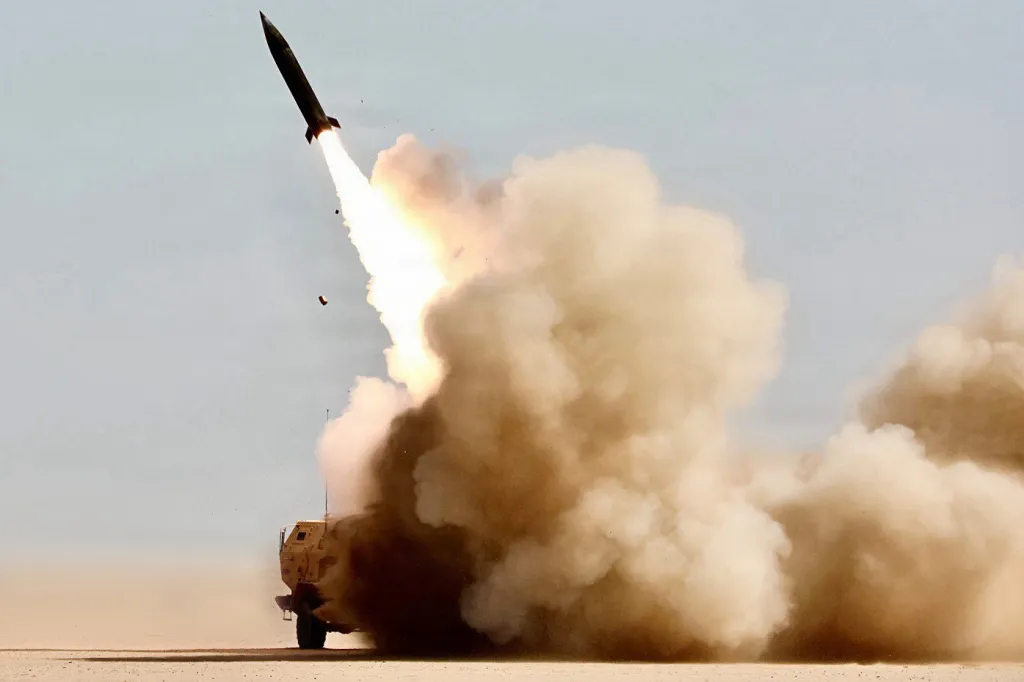
Iranian Submarine Sunk By ATACMS Short Range Ballistic Missile
A submarine is among the Iranian naval vessels that U.S. forces have struck with Army Tactical Missile System (ATACMS) short-range ballistic missiles. ATACMS cannot hit moving targets, so the submarine would have had to have been stationary in port when struck. TWZ was first to report earlier this week that M142 High Mobility Artillery Rocket System (HIMARS) launchers firing ATACMS, as well as Precision Strike Missile (PrSM) short-range ballistic missiles, had been aiding in the destruction of Iran’s Navy as part of Operation Epic Fury. The conflict has also marked the first combat use of PrSM, which brings a major boost in range over ATACMS.
Chairman of the Joint Chiefs of Staff U.S. Air Force Gen. Dan “Razin” Caine put a particular spotlight on the contributions of field artillery units in current operations against Iran at a press conference at the Pentagon this morning.

“Today, I’m going to talk about our incredible artillery force, comprised of American soldiers and Marines who’ve been sinking ships, [and] destroying depots,” Caine said. “Our Army and Marine artillerymen are hitting sites that Iran relies on to project power beyond their borders and protect our deployed [forces].”
“In just the first 13 days of this operation, our artillery forces have made history. They fired the first Precision Strike Missiles ever used in combat, reaching deep into enemy territory,” the Chairman continued. He also said that soldiers from the Army’s 3rd Battalion, 27th Field Artillery, part of the 18th Field Artillery Brigade based at Fort Bragg, North Carolina, were the ones to fire the first PrSMs against targets in Iran.
“They used Army ATACMS to sink multiple ships, including a submarine,” Caine added. “And they’ve done all of this with the precision and determination that comes from relentless training and trust in each other and in their weapon systems.”
“We’ve rendered the Iranian Navy combat ineffective,” but “continue to attack naval vessels,” Caine also said, speaking generally.
Caine did not name the Iranian submarine that was destroyed using ATACMS, nor did he say what class it was. TWZ has reached out for more information. There is no known operational version of ATACMS capable of hitting moving targets, so, as already noted, the missile would also have had to have been employed against a submarine in port or one that was otherwise stationary.
A review of satellite imagery in Planet Labs’ archive does show one of Iran’s three Russian-made Kilo class diesel-electric submarines sunk at Bandar Abbas as of March 4. The submarine had looked to be untouched in an earlier Planet Labs image taken on March 2 in the aftermath of a wave of strikes, as TWZ previously reported. Bandar Abbas is the Iranian Navy’s main base and occupies a particularly strategic position along the Strait of Hormuz.

In a video address on March 5, U.S. Navy Adm. Brad Cooper, head of U.S. Central Command (CENTCOM), had also said that “the most operational Iranian submarine … now has a hole in its side.” What submarine Cooper was referring to here remains unclear, but it may have been the Kilo class submarine struck at Bandar Abbas. At that time, his comments were also taken by many to be a reference to the IRIS Fateh, a domestically-produced diesel-electric coastal attack submarine that entered Iranian service in 2019. The fate of that boat remains unconfirmed.

On March 10, CENTCOM released the video seen below, showing strikes on various Iranian vessels at sea and in port, including what looks to be a Ghadir class diesel-electric midget submarine. That boat was struck by an AGM-114 Hellfire missile, a U.S. official told TWZ. How many Ghadir class submarines were in Iran’s inventory before the current conflict is not clear, but prior estimates had generally put the size of that fleet at between 16 and 20 hulls.
Regardless, it makes good sense that the U.S. military would focus on neutralizing Iran’s submarine force, and doing so in port if possible, as part of the larger objective of neutering the country’s naval capabilities. Finding, fixing, and engaging submerged submarines, even older and louder designs, can take significant time and effort, as you can read about in more detail in this past TWZ feature. Iranian submarines could have been used to discreetly lay mines, as well as to attempt attacks on friendly warships or commercial vessels. As it stands now, maritime traffic in and out of the Persian Gulf through the Strait of Hormuz has still ground to a virtual halt over concerns about mines and other remaining Iranian threats, which is already having global ramifications.
Chairman Caine’s comments today also reinforce the role that ATACMS and PrSM have been playing in the current conflict, in general. TWZ previously noted that this is a preview of what one would expect to see from U.S. forces in other future conflicts, especially when it comes to using ballistic missiles in the anti-ship role as part of a high-end fight with China in the Pacific. PrSM, which only began entering service in the past two years or so, offers significantly greater reach than ATACMS, allowing it to hold a much broader swath of territory at risk from any launch position.
Just yesterday, Lockheed Martin also announced the first test launch of a full-up Increment 2 PrSM, an anti-ship optimized version in development now. In that test, a HIMARS launcher fired the Increment 2 missile, which flew out to a range of around 217 and a half miles (350 kilometers), according to a company press release. The Increment 2 PrSM features an additional multi-mode seeker specifically designed to allow it to engage moving targets at sea. Lockheed Martin also released the rendering below as part of its announcement yesterday, which looks to show apertures for the seeker system around the nose.

Questions do remain about the anti-ship and/or moving target capabilities that might be found on baseline Increment 1 PrSMs. A pair of “early operational capability” PrSMs – a term generally understood to refer to Increment 1 missiles – were fired at what was described as a moving maritime target during a test in the Pacific back in 2024.
In the meantime, the older ATACMS, which PrSM is set to eventually replace, has now scored a hit against an enemy submarine, albeit one not on the move.
Contact the author: joe@twz.com
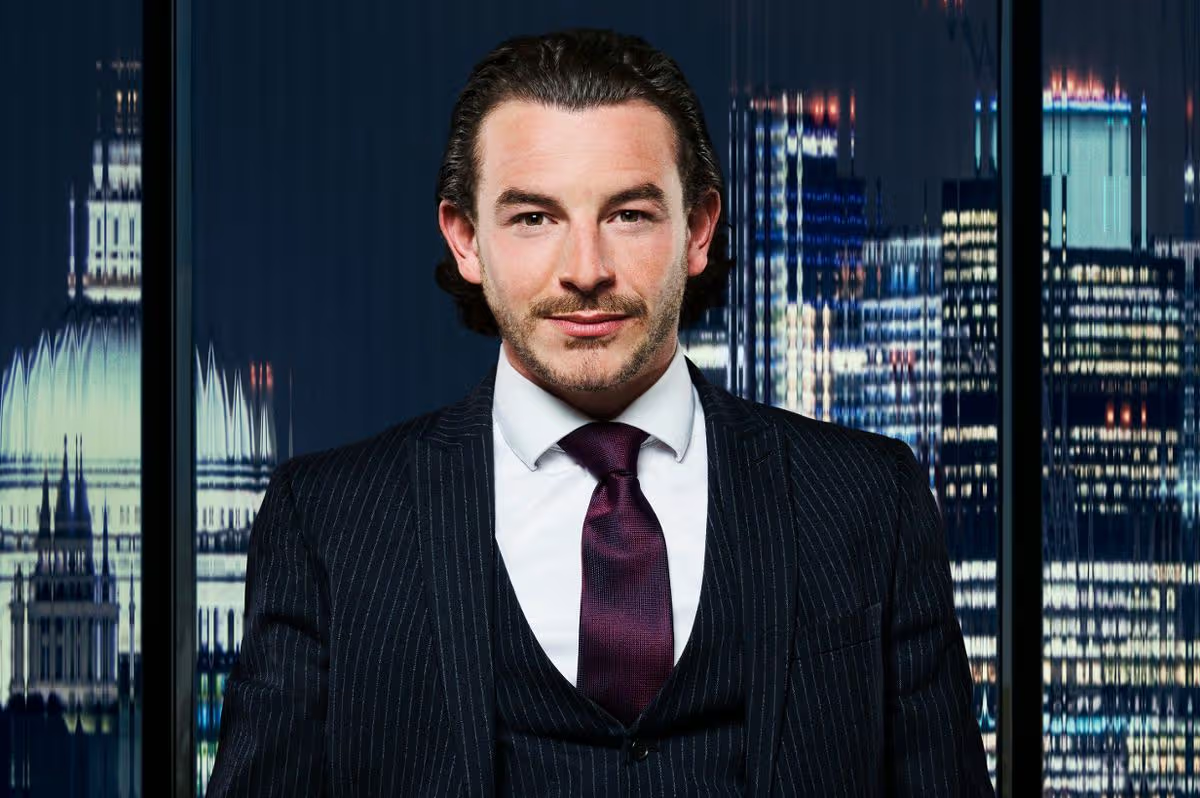
Apprentice star admits he spent £500 a week on cocaine addiction
The Apprentice star Kieran McCartney has candidly opened up on his drug addiction, admitting he would spend £400-£500 a week on cocaine

Kieran McCartney(Image: CREDIT LINE:BBC/Naked (A Freemantle Label)/Ray Burminston)
A favourite on The Apprentice has candidly revealed he battled a cocaine addiction and was left with suicidal thoughts. Kieran McCartney opened up on his £500-a-week drug addiction – and the one call that allowed him to change his life.
The TV contestant, who worked as an estate agent, revealed he used his work phone to message dealers in East London during company time – both before and after his time on the BBC show. And he has revealed he “probably wouldn’t be here”if it wasn’t for his mother.
He revealed how his friendship group dwindled as pals grew embarrassed by how he was behaving on drugs or alcohol. But he confessed Lord Alan Sugar’s “you’re fired” catchphrase proved to him that he was able to give it up.
READ MORE: Strictly Come Dancing ‘to have third host’ as final seven contenders revealedREAD MORE: Fears for William Shatner as star forced to undergo surgery at 94 after cancer fight
He admitted he would splurge £400-£500 on cocaine on a weekly basis, spending hours in the pub five times a week. Speaking to The Sun, Kieran said: “It always came if I had a few drinks. I couldn’t drink without doing it. I’d maybe have four pints. Then I might have a little bit. And then have another four pints.”
Ensure our latest headlines always appear at the top of your Google Search by making us a Preferred Source. Click here to activate or add us as your Preferred Source in your Google search settings.
He confessed that he would sometimes find himself still up in the early hours despite having work the next day. He admitted he would feel “awful” but would always go to work.
Kieran denies ever using the drug while filming the reality TV show. And he blasted those who said he looked “wired” during the series.
“The Apprentice was an amazing experience — mentally very stressful,” he said. “But I’m in a good place now. It didn’t even cross my mind once. I would have loved a beer, absolutely. It was summertime. It was hot.
“But drugs? No. Definitely not. I had about 200 cigarettes on me when I went into the house. That was it.” And he told those online to stop and “don’t judge a book by its cover”.
Fans of the show are watching as he continues his bid to get the deal with Lord Sugar. Before appearing on the show, the estate agent said he wanted to rehabilitate his profession’s reputation.
To do so, he said he needed Lord Sugar’s investment to help him to branch out on his own. He said at the time: “I know the property game inside out.
“The wins, the pressure, and the graft it takes to succeed. But now it’s time to stop building someone else’s business and start building my own.”
*Frank offers confidential advice about drugs and addiction (email frank@talktofrank.com, message 82111 or call 0300 123 6600) or the NHS has information about getting help.
*If you’re struggling and need to talk, the Samaritans operate a free helpline open 24/7 on 116 123. Alternatively, you can email jo@samaritans.org or visit their site to find your local branch
Like this story? For more of the latest showbiz news and gossip, follow Mirror Celebs on TikTok , Snapchat , Instagram , Twitter , Facebook , YouTube and Threads .

U.S. defeats Canada, will play Dominican Republic in WBC semifinals
HOUSTON — Aaron Judge doubled and Pete Crow-Armstrong and Brice Turang each had two hits as the United States beat Canada 5-3 on Friday night to reach the World Baseball Classic semifinals.
The U.S. squad rebounded after an 8-6 loss to Italy in pool play left them needing help to advance to this round.
The Americans move on to face the Dominican Republic in a semifinal on Sunday in Miami. It will be the team’s third straight appearance in the semifinals and the fourth overall.
It’s another big win for the U.S. over its neighbors to the north, coming after the U.S. hockey team beat Canada 2-1 in overtime to win the gold medal at the Milan Olympics last month.
Bo Naylor hit a two-run homer in Canada’s three-run sixth that cut the deficit to two runs. But the U.S. bullpen closed it out, capped by Mason Miller striking out the side in the ninth for the save.
Canada, which was in the quarterfinals for the first time, fell to 1-5 against the U.S. in the WBC.
Canada trailed by five runs when Owen Caissie walked with one out in the sixth and moved to second on a groundout by Abraham Toro. Tyler Black’s RBI single off Brad Keller cut the lead to 5-1.
Naylor’s shot to the second deck in right field came on Gabe Speier’s fifth pitch and got Canada within 5-3. It was the 10th home run the U.S. has yielded in five games in the tournament.
Canada had a shot to close the gap in the seventh when it had runners on second and third with no outs. But David Bednar retired the next three batters, with two strikeouts, to escape the jam.
U.S. starter Logan Webb gave up four hits and walked one with five strikeouts in 4⅔ innings.
Bobby Witt Jr. was on with one out in the first when Judge doubled before Witt scored on a groundout by Kyle Schwarber to give the U.S. an early lead. The double by Judge was the only extra-base hit of the night for the U.S.
Canada had a runner on first with two outs in the second when Witt made a leaping catch on a ball hit by Edouard Julien to end the inning.
The bases were loaded with two outs in the third when Alex Bregman singled on a groundball to Toro. His throw to first sailed over Josh Naylor’s head and into the dugout and two runs scored to make it 3-0.
Roman Anthony singled with one out in the sixth before a walk by Cal Raleigh. Turang singled on a grounder to center field to score Anthony and push the lead to 4-0. Crow-Armstrong sent the next pitch into center field for an RBI single before Witt grounded into a double play to end the inning.

Unification minister warns war preparation raises conflict risks

South Korean Unification Minister Chung Dong-young speaks to reporters at a press briefing in Seoul, South Korea, 18 February 2026. Chung said South Korea will seek to reinstate a no-fly zone over the border with North Korea under the suspended 2018 inter-Korean military pact aimed at easing tensions, and expressed regret over drones sent by South Korean civilians into North Korea earlier this month. Photo by YONHAP / EPA
March 13 (Asia Today) — South Korea’s Unification Minister Chung Dong-young warned Friday that preparing for war could increase the likelihood of conflict on the Korean Peninsula, emphasizing that “peace itself is the path forward.”
Chung made the remarks during the third meeting of the Korean Peninsula Peace Strategy Advisory Group held at the Inter-Korean Talks Headquarters in Seoul.
“People often speak lightly of war and repeat the phrase that if you want peace, you must prepare for war,” Chung said. “But preparing for war only raises the chances of war.”
Chung also pointed to growing global instability, citing the upcoming U.S.-China summit and tensions related to the Iran crisis.
“The Korean Peninsula sits on unstable ground and tends to sway whenever global events shift,” he said.
Noting the global interconnectedness of security issues, Chung said the distance between Seoul and Tehran is about 6,700 kilometers but developments in the Middle East can still affect the Korean Peninsula.
“A war 6,700 kilometers away is shaking the Korean Peninsula,” he said, adding that the situation underscored the importance of maintaining peace and stability in the region.
Experts attending the meeting suggested that North Korea’s recently proposed “two-state theory” should be reinterpreted in light of current conditions.
They proposed linking it to the inter-Korean confederation stage of South Korea’s long-standing National Community Unification Plan and called for the creation of a new peace roadmap for the Korean Peninsula reflecting changing security dynamics.
Participants also urged the government to shift from a “pace-maker” role to a more proactive “peace-maker” role by expanding diplomatic engagement.
They recommended exploring multilateral approaches involving neighboring countries and international organizations in addition to dialogue between the United States and China.
— Reported by Asia Today; translated by UPI
© Asia Today. Unauthorized reproduction or redistribution prohibited.
Original Korean report: https://www.asiatoday.co.kr/kn/view.php?key=20260313010004062
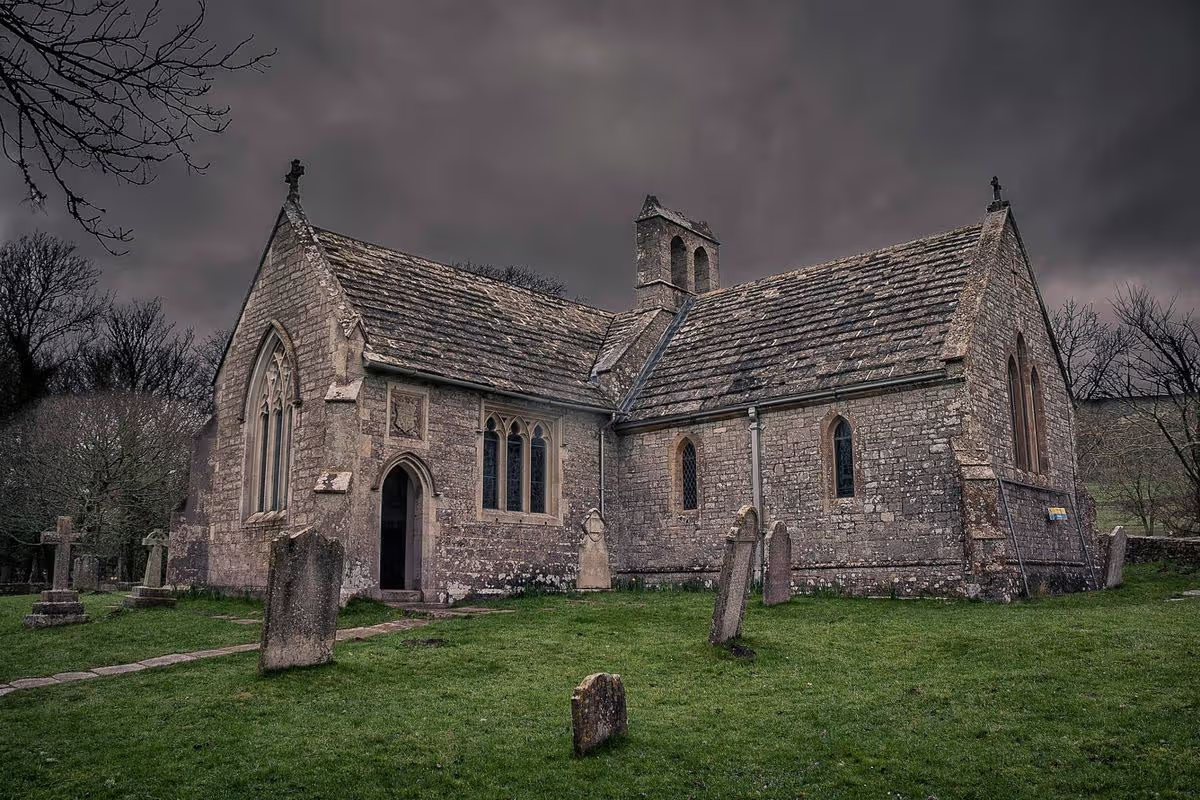
Ghost village where everyone forced to leave 80 years ago when time stopped
The village was evacuated in 1943 when residents were given just one month to leave – now frozen in time, it’s a haunting tourist attraction

The abandoned church in the ghost village of Tyneham in Dorset, where locals left a heart-wrenching note(Image: Getty Images/iStockphoto)
A deserted Dorset village stands as a unique place in Britain, a relic from the past that hasn’t been erased from memory. Tragic events forced inhabitants to abandon their cherished homes many decades ago.
Tucked away on Dorset’s breathtaking Jurassic Coast, a visit to Tyneham village feels like travelling through time. Visitors can catch a window into the existence of the residents who were compelled to desert the village during the Second World War.
It was 1943 when the thriving settlement of Tyneham saw their world turned upside down forever. Britain was deep into World War Two when the military commandeered the village for training operations.
This meant heartbroken locals were handed just one month’s warning to evacuate their properties where countless families had resided for centuries.
The wartime government seized Tyneham village and its surrounding territory to establish a training facility for the Allied forces, due to its proximity to the Lulworth firing range.
Residents were convinced they were sacrificing their properties for the nation’s benefit and expected to come back after the war ended.
A message was attached to the church door, which stated: “Please treat the church and houses with care. We have given up our homes where many of us have lived for generations, to help win the war to keep men free. We will return one day and thank you for treating the village kindly.”
Tragically however, the villagers were never able to return to their homes in Tyneham as even after World War Two concluded, the village and surrounding area remained a training ground for military exercises.
Today the village, still preserved in time after more than 80 years, serves as a ‘thought-provoking and interesting’ visitor attraction. It welcomes guests at certain periods throughout the year and tourists praise its ‘fascinating insights into the lives of residents’.
When the village closes to visitors, the gates preventing entry are secured at dusk each evening.
One TripAdvisor review states: “This deserted village has such an interesting history. The boards within the church detailing the villagers fight to be allowed to return to the village and the current position are very moving.”
Another TripAdvisor user called it ‘a wonderful place – very atmospheric and sad but in a way that keeps drawing you back to visit’.
Tyneham’s final resident, Peter Wellman passed away aged 100 in April this year – the centenarian made one last journey to the village in 2024, to revisit the location where he was born and raised.
During his 2024 visit to Tyneham, Peter recalled his early years, telling the Dorset Echo at the time: “We had no electricity, no mains gas and no running water – we had to pump that from near the church.
“I remember going to the beach and fishing and we often had mackerel. We were happy until we got moved out.”
Tyneham village sits within the Isle of Purbeck, though it’s not truly an island but rather a peninsula surrounded by the English Channel in Dorset.

Brits warned Middle East war could have ‘knock-on’ effect on wider travel including UK breaks
In a blow to Brits planning to get away for summer 2026, experts have revealed that the situation in the Middle East could cause holiday prices to rise, even in destinations not affected by the conflict

Brits could find their usual break is more expensive this year(Image: Getty Images)
Brits planning to get away overseas for Easter or summer this year are being warned they may need to expand their budget, as holiday prices could rise across all destinations.
Hannah Mayfield, a qualified financial advisor, has explained that the situation in the Middle East could have a “knock-on effect” on prices, following similar patterns seen during times of instability. Even those who opt for a UK-based staycation, or visit countries nowhere near the Middle East, could see higher prices for flights, accommodation, and even everyday spending.
Hannah explained: “Rising tensions in the Middle East can have a knock-on effect on holiday costs, even if you’re travelling somewhere completely different. But this isn’t a new phenomenon. We’ve seen similar patterns during previous periods of geopolitical instability, where travellers change their plans and demand shifts toward destinations perceived as safer.”
Hannah, who is working with travel insurers PayingTooMuch, gave the reasons why flight prices could rise: “Airlines can face higher operating costs during periods of geopolitical instability. If flights need to avoid certain airspaces, routes can become longer. At the same time, global oil prices usually rise during conflicts in major energy-producing regions, and that can eventually feed through into the price for fuel. For travellers, that might mean more expensive plane tickets.”
And it’s not just overseas jaunts that could become more expensive. Hannah said: “There’s also the potential impact on taking holidays, especially to destinations closer to home. If some holidaymakers decide not to travel as far afield, demand for popular destinations such as coastal towns, national parks and major cities can increase.
“When that happens, accommodation prices often rise during peak periods, particularly if availability is limited.” This could mean that, like during Covid, staycations could become pricier.
If you’re planning a trip, even to ‘safe’ destinations, you Hannah advises: “When travel feels more uncertain making sure you have the right level of cover for your trip becomes even more important, so you are less likely to face unexpected costs. Booking early, staying flexible with travel dates, comparing travel insurance policies and prices for flights can make a noticeable difference to the overall cost of a trip.”
She also had this warning: “Most standard travel insurance policies don’t cover acts of war, so conflicts itself may not typically have a direct impact on premiums. However, travellers should always check their policy details carefully, so they understand exactly what is and isn’t covered.
“Consider getting a policy that offers additional cover for travel disruptions which can offer another layer of protection in situations where official government travel advice changes and costs can’t be recovered elsewhere. It’s also worth noting that travel insurance does not cover events that are already known at the time the policy is purchased.”
Hannah, who also runs What is Wealth, which offers financial education for women, also gave some additional money saving tips for holidaymakers: “Keeping an eye on exchange rates and fuel prices can also help holidaymakers budget more accurately and avoid unexpected costs closer to their trip.”
Have a story you want to share? Email us at webtravel@reachplc.com

Ukrainian Companies Prohibited From Exporting Shahed Interceptor Drones
The makers of the Ukrainian Sting interceptor drone told The War Zone that despite growing interest in the Middle East for their product, they are not yet allowed to sell them outside the country. Other Ukrainian drone manufacturers, like SkyFall, are also reportedly interested in providing interceptors to the region.
In Ukraine, the small drones have proven to be a far cheaper alternative to munitions like Patriot interceptors and even far less advanced missiles for downing Shahed drones which have caused widespread destruction across Ukraine. Since the launch of Operation Epic Fury, that country has been firing Shaheds across the U.S. Central Command area of responsibility (AOR). That includes a March 1 strike on Kuwait that killed six U.S. Army soldiers.
“Our priority is Ukraine’s defense,” Wild Hornets spokesman Alex Roslin told us on Thursday. “Exports of drones are not permitted at this time.”

Відео 100 збиттів шахедів перехоплювачем #STING #wildhornets #дикішершні #fpv
However, “the Ukrainian government is engaged in bilateral discussions with partner countries about supplying drones,” he added.
Should the law change, Wild Hornets has the capacity to provide drones to foreign nations, Roslin explained.
“As part of those discussions, the Wild Hornets are ready to fulfill whatever need may fall on us to help Ukraine’s strategic partners if called on to do so.”
There seems to be a willingness to make key changes to the law to make it happen. Ukrainian President Volodymyr Zelensky stated that Ukrainian military experts were in the Middle East to share their experience after four years of bombardment by Russian Shaheds and that 11 nations are interested in obtaining these interceptors and other counter-drone systems.
It is no surprise that there would be wide interest in counter-drone drones. With a price tag of roughly between $1,000 and $2,500 a piece, they are a small fraction of the cost of the multi-million dollar Patriot interceptors or even less expensive types, still costing a million dollars or more, being used by the U.S. and allies.
Beyond cost, the interceptor drones, 3-D printed weapons that look like 1950’s-era toy rockets, are far easier and quicker to produce than surface-to-air missiles.
Small enough to fit inside a backpack, they can reach speeds of up to 173 miles an hour, according to Wild Hornets. Some of Ukraine’s interceptors “combine thermal imaging with radar tracking and AI-assisted guidance, with a human operator taking manual control for the final seconds of the intercept,” Military Times noted. Sting interceptors are manually operated by pilots, Roslin stated.
In a post on X, Wild Hornets denied it was in direct negotiations with Saudi Arabia to sell the Sting drones, a claim made Thursday by The Wall Street Journal.
“Recent reporting by The Wall Street Journal, citing anonymous sources, suggested that Saudi Aramco, the world’s largest oil company, is in negotiations with Wild Hornets regarding the purchase of interceptor drones to protect oil facilities from Iranian UAV attacks. This information does not reflect the current position or activities of our company. “
Wild Hornets “regularly receives inquiries from representatives of countries across the Middle East and the European Union regarding potential exports of the STING interceptor system, which has proven highly effective against Shahed-type drones in real combat conditions,” the X post continued.
Wild Hornets is reportedly one of at least two Ukrainian companies whose interceptors are garnering interest in the Middle East in the wake of Iranian Shahed attacks.
Earlier this week, another large Ukrainian drone producer called SkyFall said its manufacturing capacity had outgrown Ukraine’s ability to purchase its systems and the company was ready to export, according to Reuters.
“We have had interest and inquiries from our (allies) and countries in the Middle East,” a company representative told the outlet.

While these small drone interceptors have proven successful in Ukraine and show real promise for applications elsewhere, their baseline capabilities are quite different from an actual surface to air missile, especially medium and long-range types. They have to be distributed far more broadly in order to be able to effectively respond to incoming drone threats, whereas a SAM can cover a much larger area and respond far quicker to the threat due to their high-speeds.
The lack of response speed also means that early warning is more critical, especially for area defense duties, as opposed to defending a specific facility or small area of a population center. Regardless, their cost differential and ease of deployment can overcome many of these drawbacks, especially when paired with tailored tactics, in order to get the price of interceptors far down and putting more defenses in more areas.
There are other inexpensive alternatives to costly interceptors that have taken center stage in conflicts as of late.
As we have previously noted, air-to-air optimized versions of the 70mm Advanced Precision Kill Weapon System II (APKWS II) have become a principal air-to-air counter-drone weapon for U.S. forces, which began using the rockets in this way on F-16 Vipers back in 2024. That capability was extended to the F-15E Strike Eagle and A-10 Warthog and soon to the U.S. Marine Corps legacy F/A-18C/D Hornet.

The U.S. also has a ground-based system, called Vampire, that also uses these APKWS rockets. This system is deployed in small numbers to the Middle East and in larger numbers to Ukraine.

In addition, the U.S. reportedly sent 10,000 interceptor drones used in Ukraine to the Middle East.
Known as Merops, the system flies drones against drones, The Associated Press explained.
“It is small enough to fit in the back of a midsize pickup truck, can identify drones and close in on them, using artificial intelligence to navigate when satellite and electronic communications are jammed,” according to the wire service.

Last week, we asked Adm. Brad Cooper, commander of U.S. Central Command, about Ukrainian interceptors.
“I’m not familiar with the particular offer, but the interceptors in general, we’ve had a number of new capabilities being fielded,” Cooper told us during a press conference held at CENTCOM headquarters in Tampa. “Obviously, I’m not going to talk about it from the operational perspective of what those are, but I think you have seen over a period of time us kind of get on the other side of this cost curve on drones in general.”
“If I just walk back a couple of years, remember what you used to always hear, we’re shooting down a $50,000 drone with a $2 million missile,” he added. “These days, we’re spending a lot of time shooting down $100,000 drones with $10,000” weapons.
Meanwhile, President Donald Trump has dismissed the need for Ukrainian help in combating Iranian drones and War Secretary Pete Hegseth on Friday downplayed the threat from Iranian drones and missiles. He proclaimed that one of Epic Fury’s main goals is diminishing Iran’s capacity to launch and build these weapons.
“Their missile launchers and drones being destroyed or shot out of the sky,” he told reporters, including from The War Zone. “Their missile volume is down 90%. Their one way attack drones yesterday down 95%.”
Still, the interest in the Middle East for Ukrainian drone interceptors remains high.
“This phone has been ringing off the hook,” Oleg Rogynskyy, the chief executive of Uforce, a conglomerate of Ukrainian defense technology start-ups, told The New York Times.
Contact the author: howard@thewarzone.com
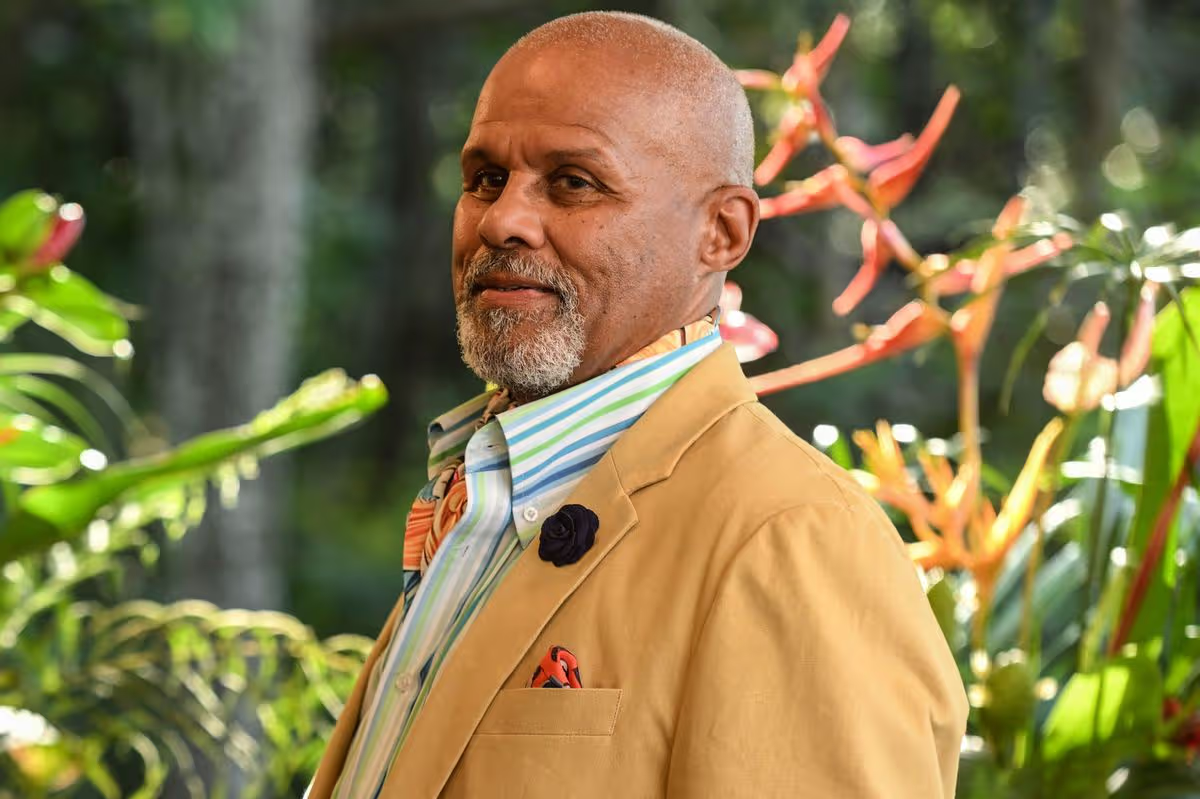
Death in Paradise fans say same thing as Gary Wilmot returns to BBC drama
Gary Wilmot reprised his role as journalist Anton Busette in the latest episode of Death in Paradise

Death in Paradise fans say same thing as Gary Wilmot returns to BBC drama(Image: BBC/Red Planet Pictures/Philippe Virapin)
Popular series Death in Paradise has announced the return of a familiar face, much to viewers’ delight.
The 15th series of the enduring detective drama is currently broadcasting on BBC One, with DI Mervin Wilson (Don Gilet) and his colleagues solving more puzzling deaths on Saint Marie.
After following Mervin, Naomi (portrayed by Shantol Jackson) and Selwyn’s (Don Warrington) escapades in Antigua, the penultimate episode shifted back to Saint Marie, with the protagonist grappling with his abduction and revelations about his brother.
Mervin swiftly resumed his duties following the murder of the island newspaper’s agony aunt, Hortense LeRoux (Anna Savva). At the start of the episode, the Commissioner and Mayor Bordey (Elizabeth Bourgine) attended Hortense’s leaving celebration. Tragically, the occasion ended in disaster when Hortense was poisoned the next day, whilst reading her final advice column, reports the Express.
Audiences also recognised a returning character at the gathering, with journalist Anton Busette (Gary Wilmot) making a notable appearance. This marks Anton’s second stint on the programme.
Fans will recall that he created considerable controversy earlier in the series through his attempts to undermine the police force and damage the Commissioner’s reputation. The character swiftly emerged as a suspect during Friday’s (March 13) instalment, given he was the former spouse of the murdered agony aunt.
Expressing her views on Anton, Mayor Bordey remarked: “Men like him [are] hungry lions, looking at you like you’re a tasty steak at a buffet.”
Despite his character’s shortcomings, Death in Paradise enthusiasts were thrilled to witness British legend Gary Wilmot reprising his role, with numerous viewers expressing their delight on social media. “Ooh! Gary Wilmot back on #DeathinParadise!” one viewer posted on X (formerly Twitter), whilst another contributed a string of celebratory emojis.
A third commented: “Keep thinking about how my dad has played football with Gary Wilmot and seeing him as Anton is so weird,” whilst another fan voiced apprehension about Gary’s character, stating: “I’m sensing bad vibes from Gary Wilmot’s character.”
Later in the episode, Mervin and Naomi persuaded Mayor Bordey to operate covertly and extract information from Anton, with the journalist promptly divulging some of his secrets.
Disclosing that Hortense’s daughter, Esme (Emma McDonald), wasn’t her biological offspring, Anton revealed: “She took her from Paris when she was a baby. Her mother wasn’t able to take care of her, a drug addict I believe… Hortense couldn’t have children.”
Anton went on to reveal that Hortense relocated to Saint Marie and falsified Esme’s birth certificate to make it appear as though she was her biological daughter. However, the atmosphere quickly changed when Anton discovered he was being recorded, with the journalist cautioning Mervin: “This won’t be the last you hear of me, I’ll be calling your Commissioner.” Was Anton responsible for his ex-wife’s death?
Death in Paradise is available to stream on BBC iPlayer
For the latest showbiz, TV, movie and streaming news, go to the new Everything Gossip website
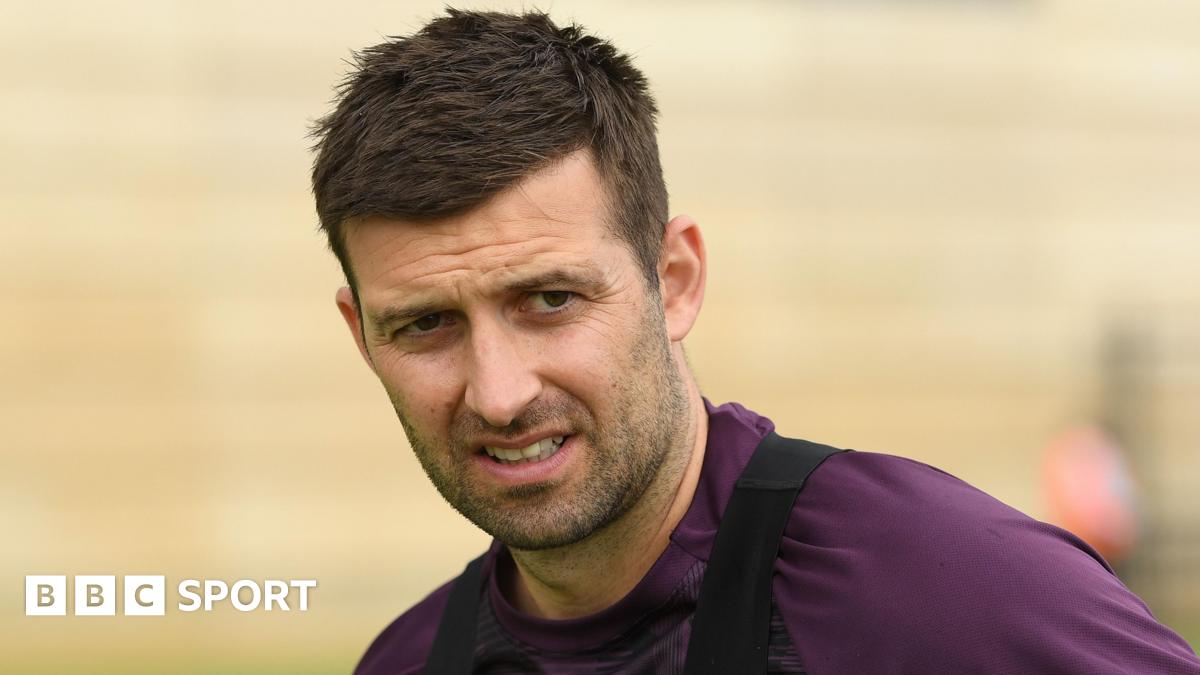
Mark Wood: Injured England bowler ‘improving’ but won’t push recovery
Wood has been plagued by injuries during his career – including multiple knee and elbow operations – which have robbed England for periods of one of their finest strike bowlers.
He spent seven months rehabilitating his knee in order to be fit for the Ashes and lamented not being able to play some games for his county before heading to Australia for the series.
“I tried to get back at certain points but my knee wasn’t quite ready,” he said.
“It’s easy in hindsight, even if I was at 80% then at least the game would have given us an indicator of where I was.”
He was thought to have been close to a return in the home summer, but ultimately did not take the field until England’s only Ashes warm-up game against the Lions at Lilac Hill in November.
He bowled eight overs but was only cleared to play in the first Test following a hamstring scan.
For now, although focused on his recovery, Wood said he has been thinking about life after cricket: “I’ve started thinking about other things, doing podcasts, doing my coaching badges.
“I’ve now started to try and think for the first time about what I should do if this doesn’t go well.”
Wood – regarded as one of the fastest bowlers to play for England – has taken 119 wickets in 38 Tests since making his debut in 2015.
He was part of the 2015 Ashes-winning side, lifted the 2019 50-over World Cup and won the T20 World Cup in 2022.

Experts doubt Hegseth claim no need to ‘worry about’ Hormuz | US-Israel war on Iran
“The US Navy at this point can’t even get anywhere close to the Strait of Hormuz without being attacked.” Experts are pouring cold water on Pete Hegseth’s claims that the US is working effectively to reopen the world’s most crucial shipping lane.
Published On 14 Mar 2026

Analysts say US threat of ‘no quarter’ for Iran violates international law | US-Israel war on Iran News
Rights groups have slammed United States Secretary of Defense Pete Hegseth for saying that “no quarter” will be shown to Iran, as the US and Israel continue their military campaign against the country.
“We will keep pressing. We will keep pushing, keep advancing. No quarter, no mercy for our enemies,” Hegseth told reporters on Friday.
Recommended Stories
list of 3 itemsend of list
Under the Hague Convention and other international treaties, it is illegal to threaten that no quarter will be given.
Domestic laws, such as the 1996 War Crimes Act, also prohibit such policies. US military manuals likewise warn that threats of “no quarter” are illegal.
Brian Finucane, a senior adviser at the International Crisis Group, a think tank, said Hegseth’s comments appear to run afoul of those standards.
“These comments are very striking,” Finucane told Al Jazeera over a phone call. “It raises questions about whether this belligerent, lawless rhetoric is being translated into how the war is being conducted on the battlefield.”
But Hegseth has publicly dismissed concerns about international law, claiming he would abide no “stupid rules of engagement” and no “politically correct wars”.
His rhetoric has provoked concern among some experts that measures designed to prevent civilian harm are being ignored in favour of a campaign of “maximum lethality”.
Hegseth’s remarks also come after a US strike on a girls’ school in southern Iran that killed more than 170 people, most of them children. The war has left at least 1,444 Iranians dead and millions more displaced.
‘Inhumane and counterproductive’
Prohibitions against declaring “no quarter” go back more than a century, part of an effort to impose restraints on conduct during war.
The Nuremberg trials after World War II upheld that legal standard, as Nazi officials were prosecuted, in some cases, for denying quarter to enemy forces.
“The basic idea is that it’s both inhumane and counterproductive to execute people who have laid down their arms,” said Finucane.
He added that the “mere announcement” of “no quarter” from a government official can itself be a war crime.
The US and Israel have already faced allegations of violating international law during their war against Iran. Experts have condemned their initial strike on February 28 as “unprovoked”, deeming the conflict an illegal war of aggression.
Iranian officials also protested after a US submarine sank a military vessel, the IRIS Dena, off the coast of Sri Lanka, as it returned from a ceremonial naval exercise in India. That attack killed at least 84 people.
While warships are considered legal military targets, Iran has said that the ship was not fully armed, raising questions about whether it could have been interdicted rather than sunk.
US forces also purportedly declined to help rescue sailors from the Dena, even though the Geneva Convention largely requires aid to the shipwrecked. The Sri Lankan navy ultimately helped collect survivors from the wreckage.
Responding to the attack, Hegseth described the sinking of the ship as a “quiet death”. He also told reporters, “We are fighting to win.”
US President Donald Trump himself remarked that he asked why the ship had been sunk, not captured.
“One of my generals said, ‘Sir, it’s a lot more fun doing it this way,’” Trump said.
‘Serious red flag’
The US military has faced criticism for killing civilians in military operations for decades.
That includes during the so-called “global war on terror”, when airstrikes resulted in thousands of civilian deaths, including a 2008 attack on a wedding party in Afghanistan.
Even before the war with Iran, the Trump administration had faced accusations that it violated international law by attacking alleged drug-trafficking vessels in the Caribbean Sea and eastern Pacific Ocean.
At least 157 people have been killed in those attacks since they started on September 2.
The Trump administration, however, has never identified the victims nor presented evidence against them. Scholars have condemned the attacks as a campaign of extrajudicial killings.
Analysts say that the Pentagon’s policies of emphasising lethality at the expense of human rights concerns has carried over into its war against Iran.
“Death and destruction from the sky all day long. We’re playing for keeps. Our warfighters have maximum authorities granted personally by the president and yours truly,” Hegseth said during a briefing on March 4.
“Our rules of engagement are bold, precise and designed to unleash American power, not shackle it.”
Sarah Yager, the Washington director at Human Rights Watch, called such rhetoric alarming.
“I’ve been engaging with the US military for two decades, and I’m shocked by this language. Rhetoric from senior leaders matters because it helps shape the command environment in which US forces operate,” Yager said.
“From an atrocity-prevention perspective, language that dismisses legal restraints is a serious red flag.”
While the impact of Hegseth’s rhetoric on combat operations is not certain, a recent report from the watchdog group Airwars found that the pace of the US and Israeli assault on Iran has far outstripped other military operations in modern history.
Reports indicate that the US dropped nearly $5.6bn worth of munitions in the first two days of the war alone. Airwars says the US and Israel hit more targets in the first 100 hours of the Iran war than in the first six months of the US campaign against ISIL (ISIS).
Following Hegseth’s remarks on Friday, Senator Jeff Merkley condemned the Pentagon chief as a “dangerous amateur”. He cited the attack on the Iranian girls’ school as an example of the consequences.
“His ‘no hesitation’ engagement rules set the stage for failing to distinguish a civilian school from a military target,” Merkley wrote in a social media post.
“The result, more than 150 dead schoolgirls and teachers from an American missile.”