


The Last Time A U.S. Navy Submarine Sunk An Enemy Ship In Combat
Today’s sinking of an Iranian warship by a U.S. Navy nuclear attack submarine is a hugely significant event in the annals of military history. After all, you have to go back to the final days of World War II to find the last time a U.S. submarine sank an enemy vessel. Since then, however, submarines under the flags of different navies have sunk vessels in combat.
You can catch up with our coverage of the sinking of the Iranian warship here.
In fact, there are some varying accounts as to which U.S. Navy submarine was the last to sink an enemy vessel. The situation at sea as World War II was drawing to a close in the Pacific was a chaotic one, with an increasingly deadly U.S. Navy submarine force tearing through the remnants of Japanese shipping, with subs racking up multiple victories in a short space of time.

With the Imperial Japanese Navy (IJN) in disarray and with Japan still reeling from the two atomic bombs dropped on it, what was left of its seagoing force provided relatively easy pickings for U.S. submarine commanders.
As such, it was on VJ-Day, or Victory over Japan Day, that U.S. subs claimed their last victims before today’s action.
According to available records, on August 14, 1945, the same day that saw President Harry S. Truman announce Japan’s unconditional surrender, two U.S. submarines sank three Japanese warships.
The first victim — a Japanese submarine — appears to have fallen to the USS Spikefish (SS-404).

Commissioned in June 1944, the Spikefish was a Balao class submarine, the Navy’s largest submarine class, with 120 boats completed. With a surfaced displacement of 1,526 tons, the Balao was around 311 feet long and had a speed of 20 knots surfaced, reduced to 8.75 knots submerged. Moving on the surface at a speed of 10 knots, the boats could cover 11,000 nautical miles.
As of the night of August 13, 1945, the IJN transport submarine I-373 was surfaced in the East China Sea, southeast of Shanghai. Transport submarines of this type were used by the Japanese to transport troops and supplies between mainland Japan and remote islands. Spikefish sighted the Japanese sub on its radar at 8:10 p.m. and also detected emissions from its air-search radar. Spikefish got closer before losing visual contact, after which the I-373 disappeared below the waves. Just after midnight, Spikefish regained radar contact. At 4:24 a.m., Spikefish fired a spread of six Mk 14 torpedoes at a range of 1,300 yards. Two of the torpedoes hit I-373, sinking it. Spikefish surfaced and found five survivors in the water, all of whom refused rescue, a grim reflection of the bitter fighting at this late stage of the Pacific conflict. One IJN crew member was forcibly brought aboard the U.S. sub; his 84 compatriots died.
In previous days, the USS Torsk, a Tench class submarine, commissioned in December 1944, had been marauding in and around the Tsushima Strait, which lies between Korea and Japan. Here, the boat had been picking off Japanese merchant vessels and warships.

The Tench class was essentially an improvement of the earlier Balao and Gato classes, moderately bigger but more strongly built and with more fuel. These boats had a surfaced displacement of 1,570 tons, were also around 311 feet long, and had similar surfaced and submerged speeds to the Balao. Thanks to their additional fuel capacity, the Tench boats had a range of around 16,000 nautical miles.
On August 14, Torsk encountered a medium-sized Japanese cargo ship accompanied by the Japanese Type C escort vessel CD-47, off Maizuru in the Sea of Japan. At 10:35 a.m., Torsk launched a Mk 28 torpedo, an experimental type with acoustic homing. The torpedo smashed a hole in the stern of the escort, which quickly went below the waves. An attempt was made to sink the cargo ship, too, as it entered harbor, but the torpedoes missed.

At around midday, a second Type C escort vessel, CD-13, arrived, apparently in pursuit of Torsk. After firing off a Mk 28 torpedo, Torsk dived for safety. From a depth of 400 feet, Torsk launched a Mk 27 torpedo, a weapon known as “CUTIE,” this time with passive homing. The hydrophone operator on the Torsk then detected a large explosion, indicating the Mk 28 had found its target. The Mk 27 impacted moments later.

While the timings are not entirely clear, CD-13 is widely identified as being the last Japanese warship to be sunk in World War II, and therefore the last enemy vessel to have been sunk by a U.S. submarine until today.
The war still wasn’t over for Torsk, however. With more patrol vessels arriving, plus patrol aircraft, the submarine had to remain submerged for more than seven hours after CD-13 went under. After this date, other Japanese vessels would continue to be sunk by mines that had been laid earlier, including by submarines.
Torsk received two battle stars for its World War II service and is today preserved in the Historic Ships collection in Baltimore.

At a press conference today, Secretary of War Pete Hegseth said that the sinking of an Iranian warship by an as-yet unidentified U.S. submarine marked the “first sinking of an enemy ship by a torpedo since World War II.”
This is not true.
The Torsk may have been the last U.S. submarine to have sunk an enemy ship prior to today, but other navies have achieved the same feat.
Back in 1971, during the Indo-Pakistan War, the Indian Navy frigate INS Khukri was sunk by the Pakistan Navy submarine PNS Hangor. The Khukri, with a displacement of around 1,200 tons, became the first warship anywhere to fall prey to a submarine since the end of World War II.

The Falklands War, fought in the South Atlantic in 1982, between the United Kingdom and Argentina, saw the first instance of a nuclear-powered submarine sinking an enemy vessel.
On May 2, 1982, in a somewhat controversial incident, the Argentine Navy cruiser ARA General Belgrano was sunk by a torpedo launched by the British nuclear-powered attack submarine HMS Conqueror, with the loss of over 300 crew.

The controversy around the incident centers upon the fact that General Belgrano was targeted when it was outside a so-called ‘total exclusion zone,’ covering a 200-nautical-mile radius from the Falklands. While there were subsequent protests about the legality of the action, the fact remains that the British had previously warned Argentina that any ships that posed a potential threat to its own task force would be sunk.

Until the sinking of the Russian Navy’s Slava class cruiser Moskva by Ukrainian anti-ship missiles in 2022, the sinking of the General Belgrano was the last time a cruiser was fully destroyed by enemy action.
Another disputed incident occurred in 2010, with the sinking of the South Korean warship ROKS Cheonan.
On March 26, 2010, the Cheonan, a Pohang class corvette, sank in the Yellow Sea, off the country’s west coast, killing 46 of the 104 personnel on board. Exactly why the warship sank remains a matter of conjecture, although a South Korean-led investigation concluded that the vessel was sunk by a North Korean torpedo fired by a midget submarine. The U.S. Navy also stated that the sinking was caused by a non-contact homing torpedo that exploded near the ship. North Korea denied responsibility.

The manner of the sinking certainly appears consistent with a torpedo hit, with an explosion reported near the stern of the ship that caused it to break in half soon afterward.
Since then, the closest we have come to seeing submarines destroying other vessels has been sinking exercises (SINKEX) and similar tests. At times, these have also provided a rare glimpse into the effects of potential adversaries’ submarine weapons capabilities. Case in point, the sinking of a decommissioned Chinese amphibious landing ship by a People’s Liberation Army Navy submarine, seen in the video below:
The cloak-and-dagger nature of submarine operations means that many details about their use in combat remain closely guarded secrets. In the case of the Cheonan, we may never exactly know what happened to it. For the time being, we also await more information about today’s sinking of the Iranian frigate. What is certain, however, is that this was an unprecedented event, at least as far as the modern U.S. Navy is concerned, and a truly rare action by any standards.
Contact the author: thomas@thewarzone.com

Thursday 5 March Missionary Day in French Polynesia
French Polynesia, the only overseas country of France, is a collection of over 100 islands and atolls in the South Pacific Ocean. Its remote location means it was one of the last places on Earth to become inhabited by humans.
The first inhabitants arrived from Western Polynesia in about 200 AD. The islands were sighted by the great Portuguese explorer Ferdinand Magellan in 1521.
Most of the major colonial powers explored the various islands and the islander’s first encounter with Christian missionaries was with Spanish priests who would stay on the islands for up to a year.
In March 1797, Protestant missionaries from the London Missionary Society (LMS) arrived, establishing a permanent presence in Polynesia.
The LMS had been formed a few years earlier with the intention of spreading Christianity across the world.
The ‘Duff’ arrived in Matavai Bay, Tahiti on March 5th 1797, with seventeen missionaries who intended to build friendships with the locals, build a mission house for sleeping and worship, and learn the native language. The missionaries faced initial resistance from the locals who had seen the arrival of earlier European ships bring new and unknown diseases to the islands. Eight of the seventeen missionaries left when the next British ship arrived in Tahiti.
The ones that stayed eventually had success in converting the locals including Pomare II, the king of Tahiti, who was converted from traditional beliefs to the Reformed tradition. This conversion formed the basis for the Maohi Protestant Church which is the largest in French Polynesia with followers accounting for more than half the population.

Anna and Mandi Vakili reveal plans to share their boyfriends’ identities after growing fed-up of keeping them secret
ANNA and Mandi Vakili admit they’re desperate to reveal their boyfriends’ identities after years of using nicknames to keep them secret.
The Sisters in the City podcast hosts’ other halves have been shielded from the public eye, with Anna referring to her man as ‘Cowslick’ while Mandi’s fella is known as ‘Gingerbeard’.
Neither had any say in the moniker they were given, and the girls admit they hate them.
But it might just be a matter of time before the pseudonyms are discarded.
Speaking exclusively to The Sun, Anna, 35, says: “I’m just so ready to put his face out there now.
“I just feel like this whole hiding his face has become such a long and annoying… like my poor editor has to keep blurring his face out in the YouTube vlogs and I want to take cute pictures with him and put it on my Instagram and I can’t do that, so I’m like maybe I’m past the stage of hiding his face.


Mandi, 34, adds: “I feel like the nickname though is kind of a comedic side of it and it’s stuck now. I love my boyfriend having a nickname. It just makes all of the serious stuff a little less serious when I’m calling him Gingerbeard.”
Chiming back in, Anna says: “But the only problem I have is that my boyfriend hates his nickname Cowslick, he’s really like recently he’s trying to like protest against his nickname.”
Her sister playfully jokes: “He has no choice though, he’s got no legal rights.”
It was four years ago that the girls came up with the names as they launched their podcast, which has grown massively and now has 108,000 subscribers on YouTube.
Initially, it was the boyfriends who were desperate to avoid any mention on the pod, and that was before listening figures began to soar.
They settled on the names to highlight parts of their appearance that differed from one another.
There have been ups and downs in Anna’s on/off relationship during that time, which she admits has had “toxic” moments, though things are currently going smoothly.
Last week, she bravely shared her most personal story to date, revealing she suffered a miscarriage just days after discovering she was pregnant. It was met by widespread support and praise from listeners who were moved by the story, as was Mandi beside her sibling in the studio.
Meanwhile, Mandi’s relationship has been stable throughout, with the odd bicker coming on holiday or off the back of pranks and other media appearances.
Reflecting on the early days of the podcast and deciding how much personal information to share, Anna says: “At the beginning there was arguments,” says Anna.
Mandi continues: “When it was like we were becoming really popular and everyone was starting to know that we’re talking, their friends and their community, then they were causing a scene about ‘we don’t want to be talked about’, and now are they have given up. They accept it now.”
She continues: “I’ve been thinking about this reveal, but it needs to be major. You know what, I thought about a really good reveal would be like come to our next tour because we’re going to do a Gingerbeard and Cowslick reveal on stage and sell tickets at the same time.”
While their other halves’ faces might be under wraps for now, Mandi and Anna’s certainly aren’t.
The duo have teamed up with Adored.by to create their own brow and lip edit so fans can replicate their flawless aesthetic.
The new range follows a previous release with beauty influencer Lottie Tomlinson, which the girls were a big fan of.
Anna says: “We liked how they tailor the collection to the influencer so it’s not like we just put our name on the product. It’s inspired by us, our podcast, our personality, our makeup looks, so it’s just literally us in a makeup brand.”
Mandi says: “We knew it was going to be like really unique and it wasn’t going to be the same as other ranges they do because they want influencers to create an edit which reflects them and their brand so that’s what Adored by has done with us right now.
“All of the products, the shade, the names, all of them have been chosen and tailored by us, so it’s really exciting.”
She called the importance of good brows and lips “game-changing” an said it could take a 10 out of 10 looker down to a two if not styled correctly, and vice versa.
The girls were committed to putting out products that they personally use and this is reflected in their combo kits.
Mandi says: “We chose shades that we love, you know there are so many shades and everybody likes a different shade but we chose Anna’s lip kit, my lip kit, is our sort of go-to and we always get asked like what’s your lip combo?
She continues: “They say men always notice a woman’s lips so lips are very important.”
But perfection isn’t the goal for the girls, it’s rather about feeling comfortable in your appearance whatever the situation or style.
Anna says: “I feel because of our podcast we’re quite relaxed attitude, because like what’s perfect? I think like that’s so like old news now, people like to relate to people that are real.”
“We love glamming up, we love doing our makeup but we’re in tracksuits on podcast.”
Mandi says: “When you do a podcast you’re just sort of in like an environment, you’re in a kind of dynamic where we’re sitting on a sofa gossiping together, we’re not like catwalk supermodels.
“People want to see the real us, they don’t want to see perfect looking two girls, they just want to see like two real people, but I feel like there’s a balance between being content with how you look but also wanting to glam up and do your makeup, put your heels on and get going.
“At the moment we’re just adorned by Adored By, you know, so we’re really excited about the launch and showing everyone how we do our lips and brows with these products.”
Anna and Mandi have collaborated with Adored.by on the newest makeup edit now available to shop on www.adoredby.com
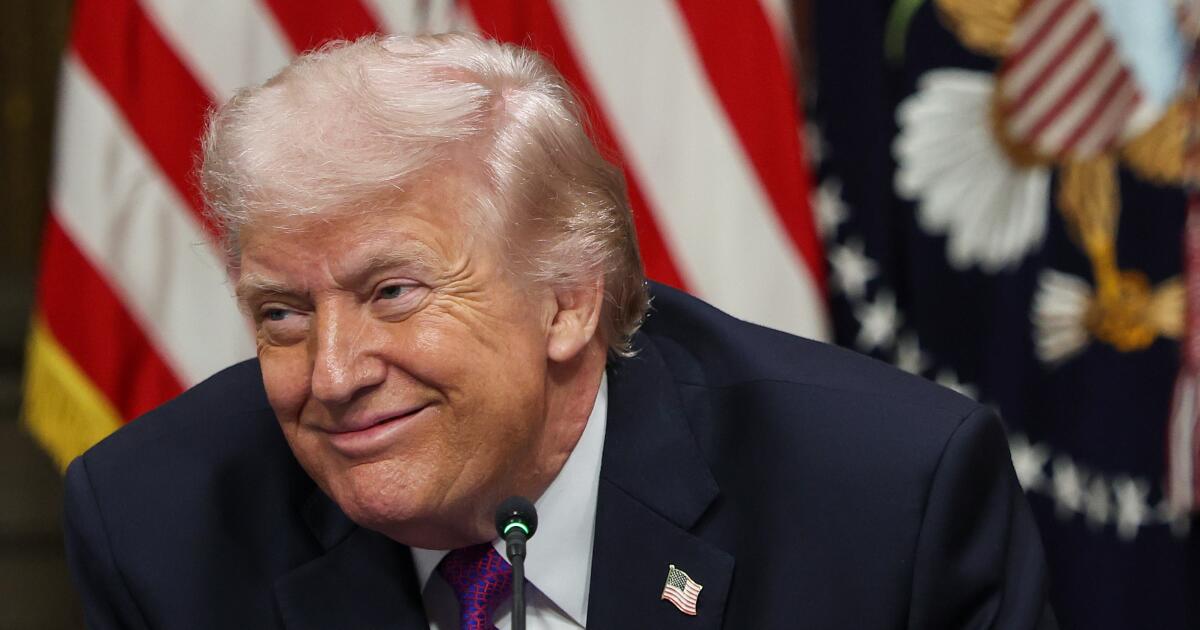
Senate rejects resolution to limit hostilities in Iran
WASHINGTON — Senate Republicans blocked a war powers resolution Wednesday designed to withdraw U.S. forces from hostilities in Iran, as the Trump administration accelerates its military campaign in a conflict that has killed hundreds, including at least six American service members.
The motion failed in a vote of 47-53.
In addition to pulling out military resources from the Middle East, the measure — introduced by Sens. Chuck Schumer (D-N.Y.), Adam Schiff (D-Calif.) and Tim Kaine (D-Va.) — would have required Congress’ explicit approval before future engagement with Iran, a power granted to the legislative branch in the Constitution.
The House, where Republicans also hold an advantage, is scheduled to weigh in on a similar measure Thursday. Even if both Democratic-led measures were to succeed, President Trump was widely expected to veto the legislation.
“We are doing very well on the war front, to put it mildly,” President Trump said at a White House event on Wednesday afternoon. The president, who has come under scrutiny for offering shifting explanations on the war’s endgame, said that if he was asked to scale the American military operation from one to 10, he would rate it a 15.
Democrats dispute that Trump possesses the authority to wage the ongoing operation in Iran without explicit congressional approval.
Acknowledging the measure was unlikely to succeed, they framed the vote as a strategy to force lawmakers to put their support for or opposition to the war on record.
“Today every senator — every single one — will pick a side,” Schumer said. “Do you stand with the American people who are exhausted with forever wars in the Middle East, or stand with Donald Trump and Pete Hegseth as they bumble us headfirst into another war?”
Senate Majority Leader John Thune (R-S.D.) and most of his Republican colleagues have maintained that the president carried out a “pre-emptive” and “defensive” strike in Iran, giving him full authority to continue unilateral military operations.
Republicans saw the vote as the “last roadblock” stopping Trump from carrying out his mission against the Islamic Republic.
“I think the president has the authority that he needs to conduct the activities and operations that are currently underway there. There are a lot of controversy and questions around the war powers act, but I think the president is acting in the best interest of the nation and our national security interests,” Thune said at a news conference.
Senators largely held to party loyalties, with the exception of Kentucky Republican Rand Paul, who broke ranks to support the measure, and Pennsylvania Democrat John Fetterman, who opposed it.
The vote comes as Defense Secretary Pete Hegseth said Wednesday that the war against Iran is “accelerating,” with American and Israeli forces expanding air operations into Iranian territory. He pointed to evidence released by U.S. Central Command of a submarine strike on an Iranian warship, and also lauded other strikes throughout the region as civilian casualties in Iran surpassed 1,000 on the fourth day of the conflict, according to rights groups.
“We’re going to continue to do well,” Trump said Wednesday. “We have the greatest military in the world by far and that was a tremendous threat to us for many years. Forty-seven years they’ve been killing our people and killing people all over the world, and we have great support.”
Republicans blocked a similar war powers vote in January after the president ordered U.S. special forces to capture and extradite Venezuelan President Nicolás Maduro in Caracas on drug trafficking charges.
GOP leaders argued that the outcome of that mission equated to a quick success in the Middle East, despite an uncertain timeline from the Department of Defense.
In the House, lawmakers will vote on a separate war powers effort Thursday. That bill is led by Rep. Ro Khanna (D-Calif.) and Rep. Thomas Massie (R-Ky.), the two lawmakers who authored the Epstein Files Transparency Act.
“Instead of sending billions overseas, we need to invest in jobs, healthcare, and education here,” Khanna said on X.
In addition to that proposal, moderate Democrats in the House have introduced a separate resolution that would give the administration a 30-day window to justify continued hostilities in the Middle East before requiring a formal declaration of war or authorization from Congress.
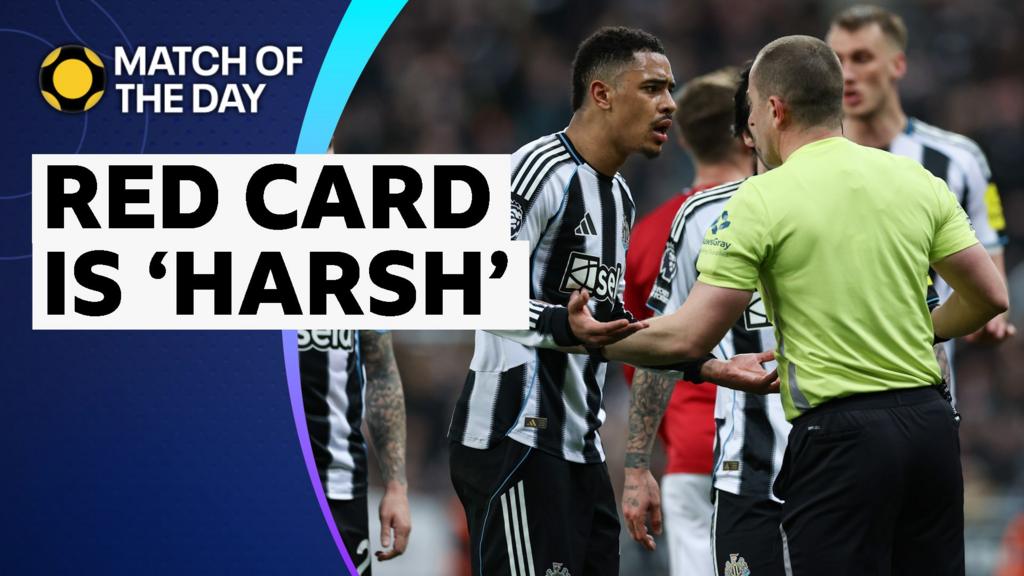
Did Ramsey deserve to be sent off?
Match of the Day pundits Micah Richards and Danny Murphy discuss if Newcastle’s Jacob Ramsey’s second yellow card for diving was deserved.
Source link
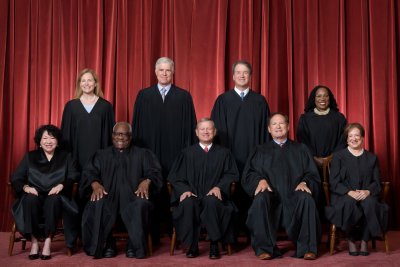
Supreme Court weighs freight broker liability in negligent hiring case

WASHINGTON, March 4 (UPI) — The Supreme Court on Wednesday considered whether the brokers who connect shippers with trucking companies can be held liable for irresponsible drivers.
The case, Montgomery vs. Caribe Transport II LLC, stems from a 2017 incident in which Shawn Montgomery, the petitioner, suffered significant injuries after a tractor-trailer hit his parked truck on the side of an Illinois highway.
A key part of the case is the interpretation of part of the Federal Aviation Administration Authorization Act of 1994. It prevents state laws “related to a price, route or service” of trucking companies or brokers that connect them to shippers.
However, the statute also provides an exception, stating that it will “not restrict the safety regulatory authority of a state with respect to motor vehicles.”
The outcome could redefine liability standards for freight brokers and impact the broader transportation industry and interstate commerce landscape.
The driver of the tractor-trailer, Yosniel Varela-Mojena, had been involved in a crash months earlier, but was still employed by Caribe Transport II, an interstate trucking company. Freight broker C.H. Robinson recruited Caribe II to deliver a cross-country shipment. After the crash, Montgomery sued the broker for negligent hiring under Illinois state laws.
During the arguments, the two sides disagreed about whether the phrase “with respect to motor vehicles” includes brokers.
“We do believe that ‘with respect to motor vehicles’ is the crucial question here,” said Theodore Boutrous Jr., Caribe II’s counsel. He argued Congress did not intend for brokers to be included.
The attorney for the United States agreed that the two different sections of the law being discussed should, in context, be taken altogether to mean that brokers are not included in the realm of “motor vehicles.”
“Paragraph one uses the phrase ‘with respect to the transportation of property,’ [and] paragraph two [says] ‘with respect to motor vehicles,'” said Sopan Joshi, assistant to the U.S. solicitor general. “That seems like a conscious choice that Congress made to parallel the language, but change the noun to a much narrower noun.”
Associate Justice Brett Kavanaugh questioned Paul Clement, Montgomery’s counsel, on how brokers would address safety concerns if the court were to rule in favor of Montgomery and say that brokers are liable for consequences of negligent hiring.
For instance, Kavanaugh suggested drivers should be proficient in English to ensure safety. In April 2025, President Donald Trump signed an executive order to enforce English-language requirements for commercial motor vehicle drivers.
“If you’re hiring drivers who can’t read the signs, that seems like a safety issue,” Kavanaugh said.
Clement said brokers could work with larger trucking companies with deeper pockets and check that they have adequate programs in place to test drivers for drug use, check on prior accidents and address other potential concerns.
“One of the reasons, I think, that you do want [brokers] to have some duty of care in these circumstances is this is a margin business,” Clement said. “If they don’t have any sort of incentive to internalize any of the cost of not asking the question, they really have no good reason to ask the question. They want the cheapest carrier.”
Associate Justice Ketanji Brown Jackson asked Joshi to explain why he thought Congress did not think brokers should share responsibility for safety given the language in the 1994 law.
“The problem, I think, with the argument in the way that you’ve set it up is that you are assuming away any responsibility that a broker might have for safety,” Jackson said.
Joshi argued that Congress did not intend for brokers to have responsibility regarding safety and could have worded the law differently if it did.
“Congress has an entire chapter, several chapters, of the U.S. Code in Title 49 that deal with safety addressing carriers, safety of motor vehicles, driver qualifications, and they’re all addressed at carriers,” Joshi said. “Not a single one is addressed at brokers.”
Joshi acknowledged that the Federal Motor Carrier Safety Administration is “understaffed,” “overworked” and unable to review all of the federally registered carriers. However, he said Congress has provided ways of bringing consequences against carriers who violate federal requirements and regulations.
In his closing rebuttal, Clement told the court that 94% of registered carriers on the road do not have meaningful federal safety inspections — a number derived from 2021 Federal Motor Carrier Safety Administration data.
He said state tort law could provide a “backstop to the federal system.”
“This case doesn’t have to be that hard. The thing that triggers state tort liability is an 80,000-pound motor vehicle. That’s what devastatingly injured my client,” Clement said.
The court is expected to issue a ruling by summer.

Iran live: US Senate backs Trump’s attacks on Tehran, Israel pounds Lebanon | Israel-Iran conflict News
Live updatesLive updates,
US and Israel bombard Iran as Israeli forces hammer Lebanon and the widening conflict causes energy prices to spike.
Published On 5 Mar 2026