



Trump’s failed strong-arming of allies on Iran shows that pressure is losing its effect
PARIS — We’ve long had your back, now it’s our turn. That is how the famously transactional President Trump is framing his demands that allies help him with the Iran war. He wants to call in IOUs for decades of U.S. security guarantees.
The string of refusals indicates his stock of European goodwill is low. He has put allies through the wringer since returning to the White House, bullying them over tariffs, Greenland and other issues, and disparaging the sacrifices their soldiers made alongside U.S. troops in Afghanistan.
Now he’s demanding — not just requesting — that they send warships to help the U.S. unblock the Strait of Hormuz, through which a fifth of the world’s traded oil passes — essentially mop up behind the conflagration that he and Israel ignited in the Middle East.
The reply has been a “global raspberry.”
That’s how a veteran French defense analyst, François Heisbourg, described allied responses.
No close ally has come forward with immediate help. Britain is flat-out refusing to be drawn into the war. France says the fighting would have to die down first. Others are non-committal. China, which is not an ally but was also asked to help, is ignoring Trump’s call.
“This is not Europe’s war. We didn’t start the war. We were not consulted,” European Union foreign policy chief Kaja Kallas said Tuesday.
Trump’s frustration with the ‘Rolls-Royce of allies’
Trump has singled out the refusal from the United Kingdom. Prime Minister Keir Starmer cultivated ties with Trump and reached an early trade deal with the administration, but is now among allies who refuse to join a regional war with no clear endgame.
The U.K. “was sort of considered the Rolls-Royce of allies,” Trump said Monday, adding that he’d asked for British minesweeping ships.
“I was not happy with the U.K,” Trump said. “They should be involved enthusiastically. We’ve been protecting these countries for years.”
Starmer said Britain “will not be drawn into the wider war” and that British troops require the backing of international law and “a proper thought-through plan” — suggesting those were not in place.
He initially refused to let U.S. bombers attack Iran from British bases before accepting their use for strikes on Iran’s ballistic missile program.
Retired Lt. Gen. Ben Hodges, former commanding general of the U.S. Army in Europe, said allies are “looking at the United States in a way that they never have before. And this is bad for the United States.”
Having previously appeased Trump, some European leaders are “starting to realize that there’s no benefit or value in using flattery,” he said.
European leaders say it’s not their war
Going to war without consulting allies was in keeping with Trump’s America-first outlook.
“My attitude is: We don’t need anybody. We’re the strongest nation in the world,” he said Monday.
But failing to get an international mandate, as the U.S. did before intervening in the 1990 Gulf War, is boomeranging.
“It is not our war; we did not start it,” German Defense Minister Boris Pistorius said. “We want diplomatic solutions and a swift end to the conflict. Sending more warships to the region will certainly not contribute to that.”
French President Emmanuel Macron envisions possible naval escorts in the Strait of Hormuz — but only once fighting has died down.
“France didn’t choose this war. We’re not taking part,” he said.
After bruising tariff battles with Trump last year, the first months of 2026 have further strained alliances. Trump’s renewed pressure for U.S. control of Greenland, including a tariff threat against eight European nations, and his false assertion that allied troops avoided front-line fighting in the Afghanistan War, upset partners in the NATO military alliance.
“Allies, or at least the Europeans, aren’t willing to be at the beck and call of a demand from Donald Trump,” said Sylvie Bermann, a French former ambassador to China, the U.K. and Russia.
“And even in asking for a helping hand, he is doing so in a brutal manner, saying: ‘You’re useless, we’re the strongest, we don’t need you, but come,’” she said.
A dangerous mission
Retired naval officers say that unblocking the Strait of Hormuz with military escorts while the war rages and without Iran’s consent would be dangerous.
France, which has rushed its Charles de Gaulle aircraft carrier to the Mediterranean, is working with other countries to prepare such a mission once the air war has subsided. French military spokesman Col. Guillaume Vernet said any escorting would be conditional on talks with Iran, and Macron has publicized two calls in eight days with Iranian President Masoud Pezeshkian.
That has won points with Trump.
“On a scale of zero to 10, I’d say he’s been an eight,” Trump said Monday. “Not perfect, but it’s France. We don’t expect perfect.”
But he’s fuming at other allies.
“We will protect them, but they will do nothing for us, in particular, in a time of need,” Trump said Tuesday.
Trump has leverage, including in Ukraine
Allies in Europe and Asia need oil, gas and other products from the Middle East to flow again. That gives Trump some leverage.
Allies also know from experience that resisting Trump carries risks of retaliation.
“It really could be anything. Are the Europeans prepared for that?” asked Ed Arnold, a former British army officer and now a researcher at the Royal United Services Institute, a London think tank.
European allies need Trump’s continued blessing for U.S. weaponry, intelligence, and other support for Ukraine, as well as financial pressure on Russia. The U.S. has started to chip away at some sanctions on Moscow by temporarily allowing shipments of Russian oil to ease shortages stemming from the Iran war. Allies also want him to reengage in talks to end the war.
“That was what kept European leaders quiet for a lot of last year in the face of the rhetoric and actions,” said Amanda Sloat, a former U.S. national security adviser who now teaches at Spain’s IE University.
“It is also the thing that is making them a little bit nervous now.”
Leicester and Burrows write for the Associated Press. Burrows reported from London. AP journalists Jill Lawless in London, Lorne Cook in Brussels, Suman Naishadham in Madrid, Geir Moulson and Kirsten Grieshaber in Berlin, Simina Mistreanu in Taipei, Taiwan, and Mari Yamaguchi in Tokyo contributed to this report.

Dodgers Dugout: Looking at the NL West first and second basemen
Hi, and welcome to another edition of Dodgers Dugout. My name is Houston Mitchell. Today we continue our series looking at the NL West, position by position.
NL West, the first basemen
Let’s look at the first and second basemen, ranked from best to worst. Click on the player’s name to be taken to their full stats page.
Dodgers
Freddie Freeman
Last season: .295/.367/.502, 39 doubles, 24 homers, 90 RBIs, 141 OPS+
Career: .300/.386/.511, 142 OPS+
Freeman’s ankle never seemed 100% last season, and he still put up solid numbers. He has said he wants to hit .300 again after failing to do so the past two seasons. There are only three current players (minimum 2,000 plate appearances) with a career batting average of at least .300: Freeman, Luis Arráez (.317) and Jose Altuve (.303). The top 10 in career batting average among active players:
1. Arráez, .317
2. Altuve, .303
3. Freeman, .300
4. Trea Turner, .297
5. Yordan Alvarez, .297
6. Bo Bichette, .294
7. Mike Trout, .294
8. Aaron Judge, .294
9. Mookie Betts, .290
10. Yandy Díaz, .290
San Francisco
Rafael Devers
Last season: .252/.372/.479, 33 doubles, 35 homers, 109 RBIs, 140 OPS+
Career: .276/.349/.506, 129 OPS+
Devers was acquired at the trade deadline from Boston. Oracle Park didn’t seem to dampen his numbers as much as it does to others, as he hit 11 homers there and 20 overall with the Giants. He’s not exactly Wes Parker at first base, but he is a solid run producer.
San Diego
Gavin Sheets
Last season: .252/.317/.429, 28 doubles, 19 homers, 71 RBIs, 105 OPS+
Career: .236/.301/.397, 94 OPS+
Sheets was a big surprise for the Padres last season, hitting better than he had in four seasons with the White Sox. He will get the majority of starts against right-handers, but could sit against tough lefties.
“The big thing for me has been controlling the strike zone, getting walks and being disciplined,” Sheets said about his improved hitting this spring. “You get swings like this and you build off the two of those things, you can really put the two of those things together.”
Arizona
Carlos Santana
Last season: .219/.308/.325, 11 doubles, 11 homers, 54 RBIs, 77 OPS+
Career: .241/.352/.425, 112 OPS+
How old is Carlos Santana? He was signed as an amateur free agent by the Dodgers in 2004. He was traded to Cleveland in 2008 for Casey Blake, who retired in 2011. He was a solid player for the then Indians, twice finishing in the top 20 in MVP voting, but he is well into his decline stage now.
Colorado
Edouard Julien
Last season: .220/.309/.324, 10 doubles, three homers, 12 RBIs, 76 OPS+
Career: .232/.336/.382, 99 OPS+
Julien finished seventh in rookie of the year voting in 2023 when he hit .263/.381/.459 for the Minnesota Twins in a little over half the season. It has been all downhill since then. The Twins traded him to Colorado in January, and the Rockies get to see if they can unlock whatever was working for him three years ago.
Second base
Arizona
Ketel Marte
Last season: .283/.376/.517, 28 doubles, 28 homers, 72 RBIs, 145 OPS+
Career: .281/.351/.472, 121 OPS+
He has won back-to-back NL Silver Sluggers, finished third in 2024 NL MVP balloting and had an OPS+ of 145 last season. He is the key to the Diamondbacks’ offense and one of the more underrated players in the game.
San Diego
Jake Cronenworth
Last season: .246/.367/.377, 20 doubles, 11 homers, 59 RBIs, 108 OPS+
Career: .247/.335/.406, 107 OPS+
Cronenworth is one of those guys who don’t make the headlines but quietly puts up steady production every day. Every team needs a player or two such as Cronenworth, a guy you can pencil into the lineup every day and not have to worry about him.
Dodgers
Miguel Rojas
Last season: .262/.318/.397, 18 doubles, seven homers, 27 RBIs, 100 OPS+
Career: .260/.314/.362, 86 OPS+
He apparently had some sort of big hit in the World Series last season. I must have missed it. Hyeseong Kim and Santiago Espinal could also get playing time at second until Tommy Edman is able to return.
San Francisco
Luis Arráez
Last season: .292/.327/.392, 30 doubles, eight homers, 61 RBIs, 99 OPS+
Career: .317/.363/.413, 115 OPS+
How valuable is a guy whose value lies almost entirely in his batting average? Arráez has won three batting titles, three years in a row, with three different teams. He is with a new team again this year. He has mild power, draws few walks, is terrible on defense. But he can get line drive singles all day long.
Colorado
Tyler Freeman
Last season: .281/.354/.361, 20 doubles, two homers, 31 RBIs, 92 OPS+
Career: .247/.324/.342, 85 OPS+
It appears, according to MLB.com, that Freeman has edged out Willi Castro for the job. Either one can play multiple positions and will probably get plenty of time everywhere on a team that is expected to lose 100 games again.
In case you missed it
Yoshinobu Yamamoto’s lead-up to Dodgers opening day ‘hard to put into words’
‘There’s endless possibilities.’ Mookie Betts embraces Yoshinobu Yamamoto’s training methods
And finally
Freddie Freeman hits the walk-off homer in Game 3 of the 2025 World Series. Watch and listen here.
Until next time….
Have a comment or something you’d like to see in a future Dodgers newsletter? Email me at houston.mitchell@latimes.com. To get this newsletter in your inbox, click here.

Trump wants to overthrow the Cuban president | Fidel Castro
The Trump administration says it wants to remove Cuba’s President Miguel Diaz-Canel by the end of the year.
So who is he? And why has Washington been trying to overthrow Cuba’s leaders for 65 years? Al Jazeera’s Marthe van der Wolf explains.
Published On 18 Mar 2026

UK weather: Temperatures reach 21C in warmest day of year so far
This time of year – close to the spring equinox – day length increases and the Sun moves higher in the sky. You might notice the Sun feeling stronger. With largely clear skies forecast, UV levels will rise to medium across England, Wales and eastern Scotland on Wednesday. Cloudier conditions will keep UV levels low elsewhere.
It is easy to get caught out in the spring months because, although temperatures aren’t as high as later in the summer, ultraviolet (UV) levels in late March are actually just as strong as they are in September.
Whilst exposure to small amounts of UV radiation is essential to produce vitamin D, the World Health Organization warns “overexposure may result in acute and chronic health effects on the skin, eye and immune system”.
Advice from the NHS, external is to “strike a balance between protecting yourself from the Sun and getting enough vitamin D from sunlight”. This includes spending time in the shade between 11am and 3pm, and covering up with suitable clothing and sunglasses.
Keep an eye on the UV forecast on the BBC Weather app or website.

‘The Pitt’ and a science show from Jimmy Kimmel get film tax credits
Even as California’s soundstages suffer from a slowdown in local production, the local economy may get a boost from the state’s expanded film tax credits.
Medical drama “The Pitt,” a “Family Guy” spin-off and a kids’ science competition show from late-night host Jimmy Kimmel are among the 16 shows that received tax credits for filming in the state, the California Film Commission said Wednesday.
In total, the projects represent $871 million in qualified in-state spending and are expected to generate $1.3 billion in economic activity in California. More than 4,500 cast and crew members will be employed across the 16 shows, along with more than 50,000 background actors, the film commission said.
New to this round of awardees are animated shows and competitions, which were added to the film and television tax credit program during its revamp last year. Under the program, producers can receive up to 25% of qualified production expenses back in the form of credits that they can apply toward tax bills they have in the state.
“California’s creative economy isn’t just part of who we are — it helps power this state forward,” Gov. Gavin Newsom said in a statement. “From the folks on the soundstage to the people designing the sets, these are jobs that anchor communities.”
HBO Max’s “The Pitt” received a credit of $24.2 million, while “Stewie,” a spin-off of Seth MacFarlane’s irreverent adult cartoon “Family Guy,” was awarded $6.4 million. Kimmel’s “Schooled!” competition show, which pits young scientists and their experiments against one another, secured $6.9 million.
Since the state’s production incentive program was bolstered last year, more than 100 films and TV projects have received tax credits.
But it has taken a while for those shows to jump-start local production, which has seen a sustained slump since the pandemic, the dual writers’ and actors’ strikes in 2023 and spending cutbacks at the studios.
That lag has affected the business of local soundstages.
For the first half of 2025, the average occupancy rate at Los Angeles County soundstages was 62%, slightly lower than the 63% average recorded in 2024, according to new data from the nonprofit FilmLA, which tracks local production.
Those figures mark a significant decline from the average occupancy rate of 90% seen from 2016 to 2022, according to FilmLA data.
That’s been a problem for local soundstage operators, which had aggressively funded development of new properties or acquired them only to see production slow.
Earlier this year, Hackman Capital Partners said it was turning over the historic Radford Studio Center in Studio City to Goldman Sachs.

The epic European theme park where kids go free until summer
IF you want a cheaper alternative theme park in Europe, then there’s one letting kids go free until summer.
Parc Astérix is a theme park in Plailly, France, based on the famous comic book series.
The theme park has over 50 attractions across six themed worlds like the Roman Empire, Greece and the Vikings.
And until May 7, the park is offering free admission to children under 12 years old.
The offer is valid from Monday to Friday for online bookings and must be booked with a dated adult ticket.
Tickets for children usually cost €53 (£45.81) each, so for a family of four it would be a saving of €106 (£91.62).
Read more on travel inspo


Adult tickets cost €56 (£48.40) each, when booked seven days in advance.
The park is open from 10am to 7pm each day, so it includes nine hours of fun.
But save your visit until next month if you want to see the new reinvented Egypt zone, which opens on April 4.
The zone is themed around Cleopatra and the Egyptian gods, with visitors able to immerse themselves in an Egyptian world.
The former Oxygénarium water raft ride has become The Descent of the Nile, with new theming to seem like you are cruising down the River Nile.
The Flying Chairs ride has now become The Flight of Ibis, where visitors swoop over the water garden, 10metres above the ground.
The ride also features water jets, greenery and themed decor.
The Egyptian zone is also home to the new dining experience, Les Fastes du Nil, which is a fast-food restaurant.
A new buffet restaurant called Épidemaïs’ Counter, with a range of Middle Eastern-inspired dishes, which will also open in June.
And launching this spring, there will be a new show called Cleopatra’s Gift – where she and her courtesans bring the OzIris esplanade to life with dance, music and guests interactions.
The refreshed zone is just part of Parc Astérix’ £218million makeover, due to be completed by 2030.
In 2028, the park will open a new British-themed land called Londinium.
In the land there will be an immersive roller coaster, an interactive family dark ride, a vertical playground, a pub and shops.
The park will open its fourth hotel as well, called The Odyssée Hotel which will feature 300 rooms and open in 2027.
There are currently three hotels at the park including Les Quais de Lutèce with 150 rooms in Gaul-inspired buildings.
There’s then La Cité Suspendue, which is Celtic-themed and made up of three ‘hamlets’ – potters, artists and druids.
And finally, the Les Trois Hiboux hotel is located in the forest.
Guests staying in the hotels get exclusive access to the attractions 30 minutes before they open to the public.
Also in 2027, the park will open a renovated Greek zone with two new family attractions, a playground and a restaurant.
The theme park is just 21 miles from Paris and whilst it is smaller than Disneyland Paris, it is cheaper to visit with Disneyland Paris tickets for this month costing from £80 per person.
Previous guests have raved about it too, with one writing: “I say it from the start: better than Disneyland!”
Another said: “We were counting and we did 35 rides each every day. If you are a theme park junkie then I would recommend it wholeheartedly.”
A third commented: “This park was a real discovery for me and my grown-up children who have been used to Disneyland for years.
“A warm atmosphere, sets worthy of movie studios, varied shows of high quality and attentive staff.”
In other theme park news, there’s a futuristic theme park just two hours from the UK that has been named one of the best in Europe – with an ‘Avatar-like’ waterpark.
Plus, an English seaside theme park has scrapped its entry fees and is opening a huge new ‘showstopper ride’.
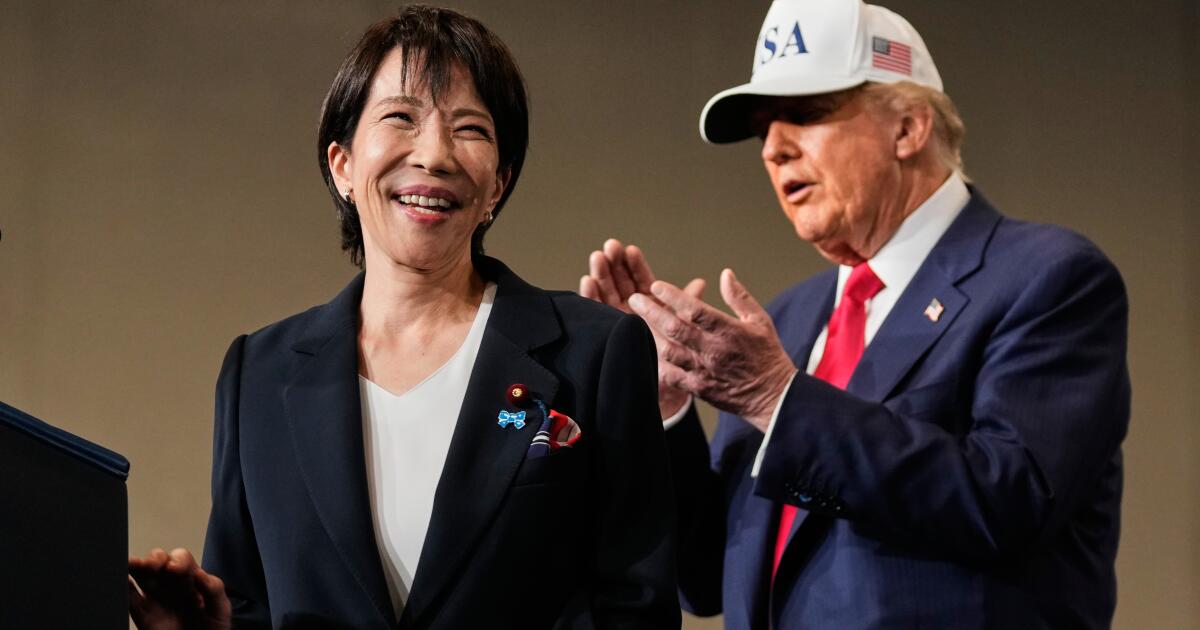
Japan’s leader heads to Washington for a visit complicated by the Iran war fallout
TOKYO — Japanese Prime Minister Sanae Takaichi is traveling Wednesday to the United States for what she expects to be a “very difficult” meeting with President Trump after he called on Japan and other allies to send warships to secure the Strait of Hormuz.
The three-day visit to Washington was originally expected to focus on trade and strengthening the U.S.-Japanese alliance as China’s influence grows in Asia. It is now expected to be overshadowed by the war the United States and Israel launched against Iran on Feb. 28.
”I think the U.S. visit will be a very difficult one, but I will do everything to maximize our national interest and to protect the daily lives of the people when the situation changes daily,” Takaichi told parliament on Wednesday, hours before her departure.
Takaichi held her first meeting with Trump in October in Tokyo, days after becoming Japan’s first female prime minister. A hard-line conservative, Takaichi is a protege of former leader Shinzo Abe, who developed a close friendship with Trump.
Her initial plan was to focus largely on China and strengthen the Japan-U.S. alliance ahead of Trump ‘s highly anticipated diplomatic trip to China that had been planned for months. The White House announced Tuesday that it is being delayed due to the war in the Middle East.
Takaichi will be in the hot seat figuring out what best to offer to Trump. Experts say showing commitment and progress in investment deals is key to a successful summit.
Japanese officials say the two sides will work to deepen cooperation in regional security, critical minerals, energy and dealing with China.
No plan to send warship to the Strait of Hormuz
A key U.S. ally in Asia, Japan has carefully avoided clear support for the U.S.-Israel strikes on Iran or a decision over a warship deployment. That’s mainly because of Japan’s constitutional constraints but also due to a legal question over the U.S. action and strong public opinion against it.
She told parliament that Japan hopes to see a de-escalation of the war, which has disrupted deliveries of oil and gas that Japan is highly dependent on.
“Without early de-escalation of the situation, our economy will be in trouble,” she said. “Early de-escalation is important for both the U.S. and global economy.”
Japan also hopes to secure its traditional ties with Iran, where most of Japanese oil imports come from.
Takaichi and her ministers have denied that Washington officially requested Japanese warships sent to the Strait of Hormuz. Trump on X asked a number of countries, including Japan, to volunteer. He then said he no longer needs them, complaining about a lack of enthusiasm.
That takes some pressure off Takaichi.
“We have no plans to send warships right now,” Takaichi told the parliamentary session Wednesday. A dispatch for survey and intelligence missions are possible but only after a ceasefire, she said. Some Japanese experts have commented that minesweeping would be a mission that the country could carry out when hostilities end.
“I will clearly explain what we can do and cannot do based on the Japanese law,” Takaichi said. “I’m sure (Trump) is fully aware of the Japanese law.”
China and security
Takaichi wants to discuss China’s security and economic coercion and ensure the U.S. commitment in the Indo-Pacific region, especially as some U.S. troops stationed in Japan are being shifted to the Middle East — a change seen by Japan as a potential risk for Asia as China’s clout grows.
Takaichi plans to reassure Trump of Japan’s military buildup, emphasizing the acceleration of long-range missile deployment to enhance offensive capabilities. This breaks from Japan’s postwar self-defense-only principle and reflects closer alignment with the U.S.
At the summit, Takaichi is expected to convey Japan’s interest in joining America’s “ Golden Dome “ multi-billion dollar, multi-layered missile defense system.
Japan considers China a growing security threat and has pushed a military buildup on southwestern islands near the East China Sea.
Takaichi has pledged to revise Japan’s security and defense policy by December and seeks to further bolster Japan’s military with unmanned combative weapons and long-range missiles.
Her government is to scrap a lethal arms exports ban in the coming weeks to promote Japan’s defense industry and cooperation with the United States and other friendly nations.
Oil in Alaska, rare earths in Japan
A resource-poor nation, Japan is seeking to diversify oil suppliers and is finalizing a Japanese investment for increased oil production in Alaska and stockpiles in Japan, according to media reports. A Japanese investment in small modular reactors and natural gas in the U.S. is also a possibility.
If agreed, the projects would be part of a $550 billion investment package that Japan pledged in October. In February, the two sides announced Japan’s commitment to the $36 billion first batch of projects — a natural gas plant in Ohio, a U.S. Gulf Coast crude oil export facility and a synthetic diamond manufacturing site — whose progress is also to be disccused with Trump.
Japan reportedly plans to propose a joint development of rare earths discovered in undersea soil around the remote Japanese island of Minamitorishima as part of the investment package.
Diplomatic and trade disputes have escalated further since Takaichi’s comment that any Chinese military action against Taiwan could be grounds for a Japanese military response.
Yamaguchi writes for the Associated Press.

Nico de Boinville: English jockey cleared of making racist comments to Declan Queally
Nico de Boinville has been cleared of making racist comments towards fellow jockey Declan Queally at the Cheltenham Festival.
De Boinville, 36, had “categorically” denied the accusation he used such language.
Irish amateur jockey Queally had alleged he was racially abused before the Novices’ Hurdle, when it was held up because of a false start on day two of the meeting.
Queally, riding I’ll Sort That, and Englishman De Boinville, on Act Of Innocence, could be seen exchanging words at the start line.
Queally later told ITV Racing he had received abuse and then told the Racing Post some of the abuse was racial in nature – though De Boinville denied this was the case.
The two then appeared on ITV Racing together and shook hands at the entrance of the weight room, where the Irishman said the matter was “all sorted”.
However, a British Horseracing Authority investigation had been opened. It has now concluded and found “no evidence to support the allegation made by Mr Queally of racist comments”.
“It is understood, and accepted, that strong language was used by De Boinville at the start and directed towards Mr Queally,” said a BHA statement.
“It was also stated that a number of riders were also verbally expressing their frustration at the start, away from the incident being enquired into.
“There was no audio evidence or verbal evidence given from any party during the course of the enquiry to corroborate that any language used was of a racist nature.”
While Queally’s complaint was not upheld, De Boinville was reminded of his “obligations and the expectations to ensure he behaves in a professional manner, and this includes when pressure is heightened at the start of high-profile fixtures”.

New Korea Hydro & Nuclear Power CEO vows to expand global footprint

Korea Hydro & Nuclear Power CEO Kim Hoe-chun speaks during his inauguration ceremony
at the state-run company’s head office in Gyeongju on Wednesday. Photo courtesy of Korea Hydro & Nuclear Power
March 18 (UPI) — Korea Hydro & Nuclear Power said Wednesday that new CEO Kim Hoe-chun has officially taken office to lead the state-run company over the next three years.
The chief executive said that he would establish a dual-track strategy of focusing on large-scale nuclear reactors and small modular reactors, or SMRs, at the same time to gain a stronger foothold in the global market.
SMRs refer to next-generation nuclear power plants, which are smaller but considered safer than traditional massive reactors. Korea Hydro & Nuclear Power, or KHNP, has worked on its own models, known as “innovative SMRs.”
“We will successfully carry out already secured overseas projects while pursuing tailored bidding strategies to enter new markets,” Kim said during an inauguration ceremony at the firm’s head office in Gyeongju, around 180 miles southeast of Seoul.
“We will develop the KHNP-style integrated management model as an export product and take a leading position in the international nuclear power market through innovative SMR technologies,” he said.
In June 2025, KHNP signed a contract to build two nuclear reactors in the Dukovany region of the Czech Republic. The agreement is estimated to be worth about $18 billion.
The company also has been competing with global players to win nuclear contracts in other countries.
Before taking the helm at KHNP, Kim spent decades at Korea Electric Power Corp., where he held a series of key positions after joining it in 1985. Between 2021 and 2024, he served as CEO of Korea South-East Power, an affiliate of KEPCO.

Amid ruins, Palestinians struggle to preserve Gaza’s historic markets | Israel-Palestine conflict News
Khan Younis, Gaza Strip – Historic landmarks often withstand centuries of volatile change, but when rockets and missiles fall, even the most enduring stones become fragile.
For generations of families in Gaza’s southern city of Khan Younis, the Grain Market was the first stop when they went shopping.
Recommended Stories
list of 3 itemsend of list
Reaching it meant walking past the historic Barquq Castle, a centuries-old structure dating back to 1387 and the very foundation of Khan Younis.
But for residents, the castle was more than an old monument; it was a familiar landmark marking the entrance to one of the city’s liveliest commercial spaces.
The aromatic scent of spices and dried herbs would accompany any walk towards the Grain Market.
But that was before Israel’s genocidal war on Gaza began. Israeli attacks inflicted heavy damage on the Grain Market and the Barquq Castle. The market has now been reduced to shattered alleys, with dust and heavy silence filling the air.
Sitting in his store along a row of damaged old shops, 60-year-old Nahed Barbakh, one of the city’s oldest and most well-known traders of staple food supplies, spent decades watching customers stream through the market. Now, only a handful pass by his shop.
“I’ve been in this spot for decades, day in and day out, watching people bring life to this place,” Nahed said. “Look at it now – it’s empty. These days, there shouldn’t even be space to walk because of the crowds preparing for Eid.”
He paused before gesturing towards the nearby castle.
“We always felt the weight of history here because we are so close to Barquq Castle. Now that history and life itself have been struck by the occupation.”
But Israeli fire did not take into account the market’s historic status. The Grain Market, long considered the economic heart of Khan Younis, was also among the first sites of destruction during the second month of Israel’s genocidal war on Gaza. More than two years of Israeli bombardment and repeated waves of displacement have left the market unrecognisable.
“The occupation killed many of our friends who worked here,” Nahed said quietly. “Those who survived have been financially broken. That’s why you see most of these shops are still closed.”
He pointed to some shelves behind him.
“My shop used to be fully stocked with goods at its high capacity. We even had extra warehouses to supply what people needed, especially during the busiest seasons.”
Before he could finish his sentence, a deafening blast interrupted him — the sound of an Israeli tank fire.
“And this is the biggest reason people are afraid to return,” Nahed said abruptly. “The yellow line is only a few hundred metres away from this street. At any moment, bullets can reach here.”
The yellow line is the name given to the demarcation line behind which Israeli forces withdrew as part of the first phase of October’s ceasefire agreement. It effectively divides Gaza into two, and Palestinians have repeatedly been shot for approaching it.
The yellow line has divided Khan Younis, dramatically reshaping the city’s geography. Israel has repeatedly shifted the line, moving it deeper into Gaza.
The Grain Market, once firmly at the centre of urban life, now sits close to the yellow line.
What used to be the city’s commercial heart has effectively turned into its edge, where people hesitate to walk, leaving the revival of daily commerce life a distant prospect.

Centuries of endurance
The Grain Market traces its origins to the late 14th century, when the Mamluk ruler Younis al-Nawruzi established Khan Younis in 1387 as a strategic stop along the trade route linking Egypt and the Levant.
Built as an extension of the Barquq Castle, which functioned as a caravanserai for travelling merchants, the market became a central commercial hub where traders and travellers exchanged goods, moving between Africa, the Levant and beyond.
The Grain Market occupies roughly 2,400sq metres (25,830sq feet). Its single-floor shops line a central street running east to west, intersected by narrow alleys branching towards smaller courtyards. The buildings preserve elements of their original construction, including sandstone walls and traditional binding materials that have survived centuries of repairs and modifications.
Over time, the market evolved into the primary commercial centre of Khan Younis, adapting to modern commerce while retaining its historic character.
But today, many of its shops stand damaged or shuttered.
According to Gaza’s Ministry of Tourism and Antiquities, the market is now among more than 200 heritage sites damaged in attacks by Israeli forces across the Gaza Strip since October 2023.
At the southern end of the Grain Market, where rows of vegetable stalls once overflowed with fresh produce, only one makeshift stand has opened.
Om Saed al-Farra, a local, stepped cautiously towards the stall, inspecting the small piles of vegetables laid out on a wooden crate. The expression on her face reflected more than surprise; it was disbelief at what the market had become.
“The market is deplorable now,” she said. “There used to be many stalls here and many choices for people.”
She gestured towards the empty stretch of the market’s vegetable section, once one of its busiest corners.
“These days were once filled with extensive joyful preparations for Eid, when families crowded the market to shop for food and essentials,” al-Farra said. “Now the market feels unusually gloomy, its stalls largely empty and its familiar vibrance gone. Everything is limited. Even if you have money, there are hardly any places left here for us to buy from.”

Economic collapse under fire
Although parts of the market’s infrastructure remain physically standing, many traders have not returned.
According to Khan Younis Mayor Alaa el-Din al-Batta, the Grain Market was once one of the city’s most vital economic lifelines.
“Just as it once connected continents, even under blockade, it continued to connect people across Gaza,” al-Batta said. “It holds a deep place in the memory of our residents. But once again, the occupation has brought destruction, targeting both our history and a critical lifeline for the people.”
For nearly two decades, Israel has controlled Gaza’s land crossings, airspace and coastline under a strict blockade. Since the genocide began in October 2023, restrictions have tightened further, pushing businesses and trade to collapse.
In a narrow western alley where scattered stones cover the ground, two cloaks hung outside a small shop. Inside, 57-year-old tailor Mohammad Abdul Ghafour leaned over his sewing machine, carefully stitching a torn shirt.
His shop was the only one open in the grey alley.
“I’ve been here since childhood,” Abdul Ghafour said. “My father opened this shop in 1956, and I grew up learning the profession right here in the market.”
Israel’s bombardment not only destroyed the place where he worked; it also killed dozens of his family members.
“On December 7, 2023, Israel committed a horrific massacre against my family,” he said. “I lost my father, my brothers, and more than 30 relatives.”
Burying his family members was only the beginning of the long, painful separation from the market and his shop.
“We were forced into displacement more than 12 times. I had many chances to leave as two of my children live in Europe,” Abdul Ghafour said. “But all I could think about was returning to my shop.”
When Israeli forces withdrew to the yellow line, he came back alone.
“I cleaned the street by myself. And if I had to do it again, I would. Whoever loves his land never abandons it,” he said. “I charge my batteries for my machine and come every day. My return encouraged some residents to come back too. But people still need shelter, water, and basic services before more families return.”
Resident Mohammad Shahwan stood in Nahed’s shop checking a list of items he hoped to buy.
“We left the crowded al-Mawasi as soon as we could to return to our damaged home,” he said, referring to the stretch of coastal Khan Younis that thousands of Palestinians have been forcibly displaced to. “But the number of residents here is still very small because of the destruction and lack of services.”
Still, Mohammad Shahwan said he was relieved to find the shop open at all.
“For the first time in two years, we’ll make traditional Eid biscuits,” he said, holding the list of ingredients. “The last two Eids were dark for my family after we lost my 17-year-old son, Salama. He and his aunt were killed by an Israeli strike.”
He could have bought the now-expensive supplies elsewhere, he said, but returning to the Grain Market carried its own meaning. “I wanted to buy them from here, just like we always did.”

Waiting for restoration
According to Mayor al-Batta, restoring the historic market will require a major reconstruction effort.
“The Grain Market needs a comprehensive restoration process to function again,” he said. “So far, our work has only been limited to clearing rubble and delivering limited water supplies for returning residents.”
The rebuilding process will require specialised materials and expert restoration work to preserve what is left of the historic structure. Municipal workers have already collected leftover stones from the ruins in the hope that they can one day be used in rebuilding parts of the market.
But reconstruction remains impossible under current conditions.
“More than five months have passed since the ceasefire began, yet not a single bag of cement has entered Gaza,” al-Batta said.
“We want to restore our historic identity and revive life for our people. But neither can happen while Israeli restrictions and violations continue.”

MS NOW shakes up daytime line-up; Ana Cabrera to exit
MS NOW is making sweeping changes to its daytime programming, moving hosts Stephanie Ruhle and Alicia Menendez to new time slots.
The changes include the departure of Ana Cabrera, who told viewers about her plans Wednesday. Carbera joined MS NOW — formerly MSNBC — from CNN in 2023. Chris Jansing, the current 11 a.m. Eastern host, will become chief political correspondent.

Stephanie Ruhle is the new anchor for MSNBC’s “The 11th Hour.”
(MSNBC)
The moves announced by MS NOW President Rebecca Kutler are aimed at improving daytime ratings on the network, which changed its name from MSNBC after being spun off from Comcast into a new company called Versant.
MS NOW has seen improved ratings in prime time with opinion programming since the network was re-branded in November. The politically progressive-leaning network will have hosts with a point-of-view in the daytime hours as well once the programming changes take effect in June.
In a memo to staff obtained by The Times, Kutler said the daytime programming will “still be rooted in hard news.”

Ana Cabrera speaks at The Common Good Forum & American Spirit Awards 2018 at The Common Good Forum on May 21, 2018 in New York City.
(Sylvain Gaboury / Patrick McMullan via Getty Images)
Ruhle will move from her 11 p.m. Eastern program “The 11th Hour” to a daytime shift from 9 a.m. to 11 a.m. Eastern. Her program will focus on money and politics.
Menendez will host two hours in the afternoon starting at noon Eastern.
The schedule changes will take effect in June.

Alicia Menendez, Michael Steele and Symone Sanders Townsend of MSNBC’s “The Weekend.”
(MSNBC/Virginia Sherwood/MSNBC)
Once Ruhle’s new program debuts, “Morning Joe” will return to a three-hour format. The program co-hosted by Joe Scarborough and Mika Brzezinski expanded to four hours in 2022. Although the expansion improved ratings, the hosts have asked to scale back so they can pursue other projects at the network.
Menendez has been part of the trio on “The Weeknight,” with Michael Steele and Simone Sanders-Townsend. Luke Russert will take her seat on the program as he returns to an on-air role. Russert had been part of the daytime MSNBC show “The Cycle,” and recently served as creative director for MS NOW’s live event series.
Ruhle will be replaced on “The 11th Hour” by Ali Velshi, who recently served as a weekend anchor. Jacob Soboroff, the network’s national correspondent, will take over Velshi’s anchor duties from 10 a.m. to 1 p.m. Eastern.
Kutler said there will be no job reductions related to the schedule changes, saying she expects to have “more people working at MS NOW by the end of 2026 than we do today.”
MS NOW is the second most-watched cable news network behind Fox News while leading CNN.

Travel expert Simon Calder warning for anyone with Dubai, UAE or Bahrain flights booked
He has just returned from the UAE with crucial advice

The war in the Middle East is having a major knock-on effect on international travel(Image: NurPhoto via Getty Images)
A travel expert has issued a warning to individuals with flights booked to or from the Middle East. The alert comes as tensions continue in the area, with Israel and the US maintaining their strikes on Iran which commenced over a fortnight ago.
Iran continues to hit back with drone and missile attacks on several neighbouring and nearby nations. This resulted in Dubai, a major hub for international travel and home to the world’s busiest airport, temporarily closing its airspace for the second time in 48 hours due to strikes in the vicinity.
Simon Calder, a journalist with the Independent, has just returned from the United Arab Emirates. He provided an update on the current situation for those flying to or from the Middle East, including passengers transiting through the region en route to other destinations.
He stated: “I’ve just arrived at London Heathrow Terminal 4 after a fairly normal flight from Abu Dhabi on Etihad. What wasn’t normal was just how quiet it was when I arrived. Terminal 4, the main hub for the Middle East from London, is frankly a bit of a ghost town. Many of the flights that you would normally expect to see multiple departures on Qatar Airways to Doha and on Etihad to Abu Dhabi are not flying, and there’s also, for instance, Gulf Air based in Bahrain who are not going there.
“Having said that, there’s perhaps more flights than you might expect, given that, for example, Qatar and the UAE are on the Foreign Office no-go list. There’s a departure this evening to Abu Dhabi on Etihad and one a little later on Qatar Airways overnight to Doha. As well as that, El Al is going out to Tel Aviv. Now, you might have heard that the airspace in Israel is closed; well, it kind of is, but if you’ve got permission, and El Al certainly has, then you can go in.
“And finally, Gulf Air is flying from here later on today, but not to the normal destination of Bahrain. Instead, it’s going to Dammam, which is very close by in Saudi Arabia, from where passengers can travel to that island quite happily over the causeway. But bear in mind that the UAE, Qatar, Kuwait, and Bahrain are all on the Foreign Office no-go list. If you choose to ignore that advice, then it’s likely your travel insurance will not be valid.
READ MORE: Travel expert issues holiday ‘rise’ warning as jet fuel price surges 70 per centREAD MORE: Simon Calder issues update for anyone flying with Emirates, Etihad or Qatar Airways
Unsurprisingly, the conflict has impacted international travel in numerous ways. Not only have passenger numbers and flights passing through the Middle East declined dramatically, but neighbouring countries favoured by Brits seeking spring sunshine, including Cyprus and Turkey, have also experienced a fall in visitor numbers.
Conversely, nations to the west boasting milder weather, including Spain and Portugal, have witnessed a surge in reservations – as has the Caribbean. The situation has not only left thousands of British holidaymakers stuck in the Middle East, but many are also anxious about their upcoming travel arrangements.
The Association of British Insurers attempted to address these worries with the following statement when questioned about whether insurance will cover the cancellation of a trip to the Middle East due to concerns over the conflict.
It stated: “As the situation evolves, we can understand why people may be reconsidering their future plans to travel to the region. If you wish to cancel your trip, contact your airline, accommodation provider or tour operator in the first instance. They may be able to rebook parts of your trip or offer a refund.
“Travel insurance may not cover cancellations linked to the conflict, depending on your policy’s terms, any war exclusions, and when you bought it. Policies differ, and insurers may take different approaches, so it’s important to check with your insurer to understand what’s covered.”

Wednesday 18 March National Anthem and Flag Day in Aruba
This text explores the historical journey of Aruba from a colonial territory to an autonomous state within the Kingdom of the Netherlands. It highlights the significance of March 18th, a date marking both the first formal proposal for self-governance in 1948 and the later adoption of national symbols in 1976. The source describes how the national flag and anthem serve as emblems of the island’s unique identity, with specific colors representing its diverse population and geographic beauty. Additionally, the article provides a broader look at global news, touching on international holidays, economic exchange rates, and current political events. By connecting past struggles for independence with modern celebrations, the text illustrates the cultura …

The two holiday islands with direct UK flights seeing ‘huge demand’ as Brits swerve from Dubai, says TUI boss
WITH the Iran crisis continuing, it’s no surprise that Brits are changing their holiday plans.
Destinations like Dubai and Doha remain off the travel list, and Brits are avoiding certain long-haul destinations that involve stopovers in the Middle East – but TUI says that other holiday spots are on the rise instead.
TUI has revealed that there’s been a change in demand when it comes to Brits booking holidays.
Instead, certain locations are being favoured as a result – in particular, two Caribbean islands.
TUI’s UK&I Managing Director Neil Swanson said: “We’re seeing particularly strong demand for our direct long-haul flights to the Caribbean – especially the Dominican Republic and Jamaica – where point‑to‑point routes give customers added confidence and help them keep their holiday plans on track.”
The islands are popular year-round with Brits thanks to their sunshine, high temperatures and beautiful coastlines.


Flights to the islands are direct and take between eight and ten hours.
They also don’t pass through the Middle East as they head over the North Atlantic Ocean instead.
TUI offers holidays to Jamaica from £899 per person.
In Jamaica, a popular spot is Negril, which is the capital of the island that sits along the western tip.
Over the years it has been visited by famous faces likes Bob Marley and even The Rolling Stones.
It has the Seven Mile Beach, which offers visitors to ride across the sand on horses, and go snorkelling.
TUI offers holidays to Montego Bay too, a destination which is known for being popular with tourists with all-inclusive resorts, white-sand beaches, and nightlife.
It also has breaks to Ocho Rios which has lots of green spaces like the Dunn’s River Falls, the Blue Hole – a natural limestone sinkhole that’s considered a hidden gem.
When it comes to Jamaica, the best months to visit are December through to April when it is at its warmest and most dry.
The best time to visit the Dominican Republic is the same, and TUI offers breaks from from £899 per person.
The Dominican Republic is also one of the cheapest islands to visit.
Laura Evans Fisk, Head of Digital & Engagement at eurochange said: “As we’ve seen transactions for the Dominican peso surge this year ahead of any other currency, we can definitely expect to see the Dominican Republic at the top of travel bucket lists for UK tourists in 2026.
Beaches are beautiful all around the island, but the Dominican Republic also has two of the best in the world – Canto de la Playa and Bahia de las Aguilas.
Santo Domingo is the island’s capital, where there are find plenty of bars – and average price of a local beer is 150DOP (£1.86).
Other destinations that are on the rise for travellers include Thailand’s Phuket and Goa in India.
He said the reason is that the long-haul flights from TUI “offer customers reassuring alternatives that avoid transiting through the region.”
Neil Swanson added: “Closer to home, destinations across Europe and the Mediterranean continue to perform well, with Spain, Portugal, Greece and Cape Verde seeing increased demand in recent days.”
For more on Cape Verde – here’s what you can do on the islands that have white sand beaches, no jet lag and cheap package holidays.
And a TUI expert reveals how to save hundreds on the same holiday and the little-known money saving tool.

Democrats face the possibility of a historic upset in California governor’s race, poll finds
Despite a long, entrenched Democratic reign over California politics, a new poll shows two Republicans leading by slim margins in the state’s 2026 race for governor as the June primary election fast approaches.
The confounding results appear to be mostly due to the state’s left-leaning electorate feeling uninspired by any single candidate in the crowded field of eight top Democrats. Because of California’s top-two primary rule, that lethargy could lead to Democrats being shut out of a November election that will determine the next leader of the largest state in the union, though that is still considered unlikely.
Conservative commentator Steve Hilton had the support of 17% of likely voters and Riverside County Sheriff Chad Bianco had the backing of 16%, according to a poll released Wednesday by UC Berkeley’s Institute of Governmental Studies and co-sponsored by The Times.

Following closely behind were Democrats Rep. Eric Swalwell of Northern California and former Orange County Rep. Katie Porter, both of whom had support from 13% of the likely voters surveyed. Aside from billionaire hedge fund founder and environmental activist Tom Steyer, who registered at 10% support after plowing tens of millions of dollars into his campaign, no other Democrat had won support from more than 5% of likely voters, the poll showed.
Mark DiCamillo, director of the poll, said he was stunned by how fractured voters are and how little knowledge they have about the candidates less than 60 days before ballots start arriving in Californians’ mailboxes.
“This is historic for me, and especially given that none of the candidates have really a positive image rating with voters, also startling. I mean, perhaps one of the reasons why voters are disengaged, they’re just not enthusiastic about any of the candidates,” he said. “They’re kind of sleepwalking to this election.”
Swalwell and Porter both hew toward the progressive wing of the party and rose to national prominence as frequent guests on cable news shows and as combative, at times theatrical, committee members during congressional oversight hearings. That notoriety prompted attacks from Republicans and the far right and increased their popularity among the Democratic base — both pivotal for voters seeking a strong candidate to challenge President Trump.
Porter slightly rebounded after a dip in polling in the fall after videos emerged of her berating an aide and a reporter. She also has the highest favorable rating of any candidate in the field at 34%.

According to the survey, Steyer’s support from likely voters increased to 10% from just 1% in Berkeley’s October poll. The momentum comes after Steyer spent about $50 million airing television ads since December, according to an analysis by data expert Paul Mitchell for Capitol Weekly.
Among the other top Democrats in the race: former U.S. Health and Human Services Secretary Xavier Becerra was backed by 5% of likely voters; former Los Angeles Mayor Antonio Villaraigosa and San José Mayor Matt Mahan by 4%, and former state Controller Betty Yee and state Supt. of Public Instruction Tony Thurmond by 1%.
The poll found that 16% of likely voters were either undecided or backed other, lesser-known candidates.
The splintered support for the Democrats hoping to become the state’s next governor has surfaced in other ways as well. On Monday, the powerful California Federation of Labor voted to endorse four gubernatorial candidates — half the Democratic field.
DiCamillo said he believes the poll’s inclusion of the candidates’ titles that voters will see on their ballots is crucial in a low-information contest.
“That really matters in a race where voters don’t have much information, or they say they don’t know much about the candidates,” he said, adding that it could particularly help Bianco, the Riverside County sheriff. “His job title is kind of impressive, and that voters think, well, that’s credible, so let me consider him.”
The fear of two Republicans winning the top two spots in the June 2 primary prompted California Democratic Party Chair Rusty Hicks to urge low-polling candidates to consider their viability and drop out if they didn’t see a path forward earlier this month.
Some candidates bristled, arguing that party leaders were in effect telling every candidate of color to leave the race. Aside from one candidate, all of the top Democrats in the race responded by quickly filing their campaign documents with the secretary of state’s office, meaning that their names will appear on the ballot.
The two candidates who receive the most votes in the primary are the only ones who advance to the November general election — regardless of their political party.
The odds that a Republican will become California’s next governor appear slim. No Republican has won a statewide election in California since 2006, the year Hollywood movie star Arnold Schwarzenegger was elected to a second term as governor. Democratic registered voters in the state outnumber Republicans by nearly 2 to 1.
Compared with prior gubernatorial races that had well-known Democratic front-runners, none of the candidates of either party are particularly well known by voters. Large numbers of voters have no opinion about any of the candidates — including roughly two-thirds of those asked about Mahan, Yee and Thurmond.
Voters were far more tuned in to the issues that they believe are most important for the state’s next governor to tackle.
Affordability was dominant among all voters, regardless of political ideology, the poll found. Four out of 10 voters said reducing the cost of living in California is among the top issues the next governor should prioritize, and smaller numbers also highlighted building affordable housing and lowering gas prices and utility rates.

Affordability “is the top issue for voters, both here in California and across the country. There’s no question,” DiCamillo said. “Perhaps it’s even of greater urgency here in California, just given our cost of living is higher than in most other places.”
Building new housing, paring back regulations to allow such construction quickly and to reduce the cost of buy a home, disincentivizing private firms from buying homes and reducing gas prices are among topics candidates frequently speak about on the campaign trail and in debates.
A notable split was evident among voters when asked about cutting waste, fraud and political corruption in state government, the poll found. Nearly 50% of Republicans said this was a top priority, compared with 10% of Democrats and a little over a quarter of voters who do not state a party preference.
DiCamillo said this sentiment aligns with President Trump’s messaging and what his administration has been pursuing in the federal government. Trump has repeatedly painted California as teeming with waste, fraud and abuse. On Monday, when he launched a task force to fight fraud that will be led by Vice President JD Vance, California was among the states he singled out as having insufficient oversight of federal funds.
GOP voters in California share similar sentiments, DiCamillo said.
In Washington, D.C., “they’re cutting back, trying to make government smaller, and … just cut the waste as well,” he said. California “Republicans, given the fact that Democrats have been controlling things for so long, they think … more of that is needed now here in California as well.”
The Berkeley IGS/Times poll surveyed 5,019 California registered voters online in English and Spanish from March 9 to 14. The results are estimated to have a margin of error of 2.5 percentage points in either direction in the overall sample, and larger numbers for subgroups.

The big hit? The WBC. Still looking for that big hit? Team USA.
MIAMI — The victors erupted onto the field and into multiple dogpiles. Some wore national flags around their shoulders. Within minutes, the Venezuelans wore T-shirts that read: “The Best Baseball in the World.”
The players from the United States watched from their dugout. Within minutes, they trudged back onto the field so a silver medal could be draped around their necks. Not every player wore the medal all the way back to the dugout.
You can say all you want about how the World Baseball Classic has matured into a must-see event for fans and a must-play event for the game’s elite players. You can salute Venezuela for a spirited and thrilling victory, and the Venezuelan fans for nine innings of joyful delirium.
But you also can say this: A U.S. team billed as featuring a killer lineup could not hit, and the U.S. could not use its best pitcher because the San Diego Padres said so. The result: For the second consecutive World Baseball Classic, the U.S. lost the championship by a 3-2 score.

U.S. captain Aaron Judge looks across the field after striking out against Velezuela at the World Baseball Classic Tuesday.
(Lynne Sladky / Associated Press)
“I’m not OK with winning silver,” Bryce Harper said. “I don’t want to win silver.
“I want to win gold, just like anybody else. But, at the end of the night, they did it, they won, all the congratulations to them. They fought hard. I’ve got nothing but respect for them.”
By the time the eighth inning rolled around, the mighty U.S. offense had not gotten a runner into scoring position on Tuesday, and had gone scoreless for 18 of its previous 19 innings. With two out in the eighth, and Venezuela up 2-0, Bobby Witt Jr. walked, and Harper followed with a 432-foot home run, so monstrous that Venezuelan pitcher Andres Machado could only watch the flight of the ball and smile.
Harper stood and watched too, then he flipped his bat toward the dugout. At third base, he stopped to give a salute, then spotted the cameraman trailing him around the bases and pointed to the American flag on his left sleeve.
“Just enjoying the moment,” Harper said. “Super grateful for it.”
With the game tied 2-2 entering the ninth, the pitcher trotting in from the U.S. bullpen should have been Mason Miller, who had not given up a hit in the WBC and struck out 10 of the 14 batters he had faced.
Before the game, U.S. manager Mark DeRosa had said Miller would be available. After the game, DeRosa said he and Miller’s employers, the Padres, had agreed Miller would only be used to protect a lead.
Once the game entered the ninth, Miller would not be able to protect a lead, since the U.S. was the home team and there could be no save situation for him. DeRosa nonetheless declined to use Miller.
“Honoring the Padres,” DeRosa said.
This is not on DeRosa, but that is nonsense. If a closer cannot be used three times in five days — with another week to ease into the regular season by throwing bullpens or in structured B games, or taking a few days off, or whatever — then he should stay home.
Venezuela scored the winning run in the ninth off Garrett Whitlock, on a walk, stolen base and RBI double by Eugenio Suárez.
In its final five WBC games — after routs of Brazil and Britain — the U.S. scored more than five runs once, with a two-run win, a two-run loss, a two-run win, a one-run win, and a one-run loss. In the semifinal and final, the U.S. combined to bat .159 and strike out 25 times, and every run came on a home run.
That — not any attempt at small ball — is American baseball. And the U.S. was outslugged by six other teams, including Australia and Italy. For glory, as the U.S. team hoodies said.
“A lot of pop ups, a lot of just-missed pitches,” U.S. captain Aaron Judge said. “I wouldn’t say we tensed up. We just didn’t execute when we needed to.”
Said DeRosa: “I mean, surprised because of the names at the back of the jersey, but not surprised because of where they’re at in spring training.
“Yeah, that’s my answer. I really don’t have a rhyme or reason to why. I just think you’re either hot or not in a seven-game blast like this.”

American Bryce Harper celebrates at home plate with teammates after hitting a two-run home run during the World Baseball Classic Tuesday in Miami.
(Lynne Sladky / Associated Press)
The WBC absolutely was a blast. The Venezuelan fans delivered concert-level noise all night long, without needing a silly stadium host or scoreboard command to do so. The WBC allowed fans to bring in 16 “permissible instruments,” including bongos, cowbells, maracas and trumpets.
“There’s bands playing,” Judge said. “There’s chants going on. You don’t usually hear that too much in the World Series games. That’s amazing. So much fun.”
More Americans watched the U.S.-Dominican Republic semifinal than watched last year’s NBA All-Star Game, according to Fox. The championship game almost certainly will have drawn more viewers than at least one game of last year’s NBA Finals.
In the 10 minutes I spent along the concourse before Tuesday’s game, I counted fans wearing the jerseys of many national teams and 17 MLB teams, plus the late and greatly beloved Montreal Expos. Japan did not qualify for the final four, but I nonetheless counted 11 fans in Japan jerseys with Shohei Ohtani’s name on the back. The advertisers believed too: DeRosa spoke in front of a banner displaying the logo of nine corporate sponsors, eight of them Japanese.
After such a lively event, can these players get fired up to go back to spring training, and then for the grind of a 162-game season?
“I’m always fired up for the Yankees, but I’m still pissed about this,” Judge said.
“I’m looking forward to the next time we get a chance to throw on the red, white and blue and take care of business.”
That would be the 2028 Olympics in Los Angeles, where Dave Roberts has expressed interest in managing Team USA at Dodger Stadium. The major leaguers are almost certainly coming, even if the details are still being worked out.
See you there, Bryce Harper?
“I hope so,” he said. “I really do.”

Israel says it killed Iranian intelligence chief Khatib | US-Israel war on Iran
Israel’s Defence Minister Israel Katz said an overnight strike killed Iran’s Intelligence Minister Esmail Khatib. There has been no confirmation from Iran but Katz says Israel’s military is authorised to target senior Iranian officials without additional approval from the government.
Published On 18 Mar 2026

Escape to Spain this spring with last minute deals at four-star hotels in 30C temps from £249pp
YOU can still get a dose of Spanish sunshine this spring with some pretty four-star hotels for less than £250 per person.
loveholidays has found some super cheap deals for seven night stays in the Canary Islands, Balearic Islands and Spain.
The most affordable, but still with everything you need for a sunshine filled break, is at the DWO Sirius -Adults Only hotel on the Costa Brava in Spain.
The hotel has 161 rooms all decked out with modern amenities and air conditioning – which you might need in May as average temperatures can be as high as 24C.
Take a dip in the outdoor freshwater swimming pool or relax on one of the sunloungers.
There’s a sun terrace too, restaurant, cafe, poolside snack bar, as well as an on-site gym – it’ll be quiet too as only guests age 16 and over are allowed.


When it comes to the beaches, Playa de Levante is just a two-minute walk away and it’s lined with shops, bars and restaurants to explore.
To stay at the DWO Sirius for seven nights from May 9, 2026 starts from just £249 per person.
Breakfast is included, as are return flights from London Luton with Ryanair.
Another is the Hotel Best Punta Dorada in Salou, Costa Dorada.
The Spanish resort is a popular destination near PortAventura World, a theme park with over 40 attractions and huge rollercoasters.
It’s also close to sandy beaches like Platja de Llevant, and the scenic Camí de Ronda coastal walk.
The hotel itself has rooms with air con, a TV, minibar and private bathroom.
It also has an outdoor swimming pool, restaurant, two bars along with evening entertainment and shows.
One visitor wrote: “Such lovely staff, food and hotel and we would go back again and didn’t want to leave.”
With loveholidays you can take a seven night break from May 2, 2026 from £269 per person.
This includes breakfast and return flights from London Stansted with Ryanair.
Or if you fancy jetting off to Tenerife, head to the Gara Suites Golf & Spa in Playa de las Americas.
In May, Tenerife temperatures can reach highs of 30C with around 10 hours of sunshine each day.
The Gara Suites Golf & Spa is a big resort with over 400 rooms as well as three outdoor pools and plenty of dining options.
It’s a top spot for families as it has a smaller pool especially for children, as well as a kids’ club and playground.
For golfing fans, there’s also a golf course short walk away – and the famous Siam Park waterpark is just a three-minutes drive away.
A seven night stay from May 14, 2026 starts from £339 per person – this includes breakfast and flights departing from London Stansted with Ryanair.
Another seven-night stay from £339 per person is available to book at the Samos Hotel in Magaluf.
The four-star Samos Hotel is right next to the beach and has a palm-tree-shaped lagoon pool.
It has 444 rooms spread across nine floors – some of which have sea views.
Inside there’s a spa with a small indoor pool, sauna, Jacuzzi and a range of spa treatments.
During the evening, there’s a full-on entertainment programme from shows to live music, bingo and karaoke.
The beach is an eight-minute walk away where there are lots of bars and restaurants.
You can eat at the hotel too as it has multiple bars, and restaurants that serve up classic Spanish food as well as international options too.
Majorca’s capital, Palma, is reachable within half an hour by car.
For more on holidays, here are the bucket list trips you should go on for every month of the year.
And the European holiday destinations Brits are flocking to instead of Turkey and Egypt due to Iran crisis.

Navy E-2D Hawkeyes Appear To Be Rushing To The Middle East
A group of at least five carrier-capable U.S. Navy E-2D Advanced Hawkeye airborne early warning and control planes arrived overnight in the Azores after crossing much of the Atlantic. The Azores is a common stopover point for U.S. military aircraft heading to the Middle East. The move is somewhat rare for the E-2 community, but it’s extremely logical, and likely highly urgent, considering what is going on in the Middle East.
In many respects, the E-2D is the most sensitive airborne ‘look-down’ radar platform in U.S. military service today. As far as we know, the only E-2Ds in the Middle East right now are supporting air wing operations of the USS Gerald R. Ford and USS Abraham Lincoln. Rushing more of them to the Persian Gulf for land-based operations to help spot low-flying Iranian kamikaze drones wreaking havoc on Arab Gulf States would make total sense.
We have seen a similar request accepted by the Royal Australian Air Force, which is sending one of its highly capable E-7 Wedgetail airborne early warning and control aircraft to the region for essentially the same purpose. Australia’s commitment is separate from current U.S.-Israeli operations. Both the E-2D and the E-7 aircraft can also spot low-flying cruise missiles, short-range ballistic missiles, and even maritime threats, making them ideal for the littoral operations against everything Iran is throwing at U.S. allies in the region. The Hawkeye and Wedgetail also offer additional battle management and networking capabilities, which U.S. forces engaged in operations against Iran are currently relying heavily on a strained fleet of aging E-3 Sentry jets to provide.

Pictures above and below show E-2Ds at Lajes on the island of Terceira in the Azores, a Portuguese archipelago, last night. Online flight tracking data had also shown the Hawkeyes heading there. We can also see that the Hawkeyes are upgraded versions capable of being refueled in flight, via a probe prominently mounted above the cockpit. In line with this, a pair of U.S. Air Force KC-46 Pegasus tankers had been tracked accompanying the Navy aircraft to Lajes, as well.

Previous tracking data shows the E-2Ds flew first from Norfolk, Virginia, to Bangor, Maine, last Friday. The Hawkeyes then departed Bangor yesterday, heading east across the Atlantic.
Markings visible in the pictures from Lajes show that at least some of the E-2Ds that touched down there are assigned to Carrier Airborne Early Warning Squadron 121 (VAW-121) based at Naval Air Station Norfolk (NAS Norfolk). There had been indications earlier that the contingent included Hawkeyes from VAW-126, also based at NAS Norfolk, but this appears to be unconfirmed at this time. VAW-121 and VAW-126 are assigned to Carrier Air Wing 17 (CVW-17) and CVW-1, respectively. CVW-17 was notably most recently attached to the supercarrier USS Nimitz, which had been scheduled to be put into mothballs in May, but is now slated to remain in service at least until March 2027.

It remains to be seen where exactly the E-2Ds head to now, but, as noted, U.S. military aircraft regularly pass through the Azores while transiting to the Middle East. Lajes was heavily utilized during the massive build-up of American airpower ahead of the start of U.S.-Israeli strikes on February 28. The American component of this campaign has been dubbed Operation Epic Fury.
The conflict has taken on a regional character, with Iranian missiles and drones having now fallen on a dozen countries across the Middle East and the Eastern Mediterranean. There is also a distinct maritime dimension to the fighting, with Iran choking off the highly strategic Strait of Hormuz with attacks on commercial vessels, and discussions now about how to reopen that critical waterway.
A deployment of E-2Ds could help provide much-needed additional eyes in the sky, as well as other capabilities, to help protect against Iranian retaliatory attacks, as well as support strikes on targets in and around Iran and/or any efforts to establish sea control in the region. In particular, the Hawkeyes are America’s best available tool for spotting low-flying, low-signature targets, such as kamikaze drones and cruise missiles, as well as small targets at sea like explosive-laden drone boats. The E-2D is also well-suited to performing these missions in littoral areas like the Persian Gulf, the Gulf of Oman, and the Strait of Hormuz in between. Hawkeyes performed similar missions in and around the Red Sea between late 2023 and early 2025.

As noted in the opening of this post, there is already an especially pronounced demand for additional assets, and more capable ones, to spot and track low-flying Iranian kamikaze drones and cruise missiles. This was already evidenced by the Australian government’s announcement last week that it was sending one of its E-7A Wedgetail airborne early warning and control aircraft to the region to help with defensive operations, something we will come back to later on.
In addition, from what is known now, U.S. forces taking part in operations over and around Iran are receiving airborne early and warning control support from U.S. Air Force E-3 Sentry AWACS (Airborne Warning and Control System) aircraft forward-deployed at Prince Sultan Air Base in Saudi Arabia. As noted, Navy Hawkeyes have also already been flying missions as part of Operation Epic Fury from the decks of carriers in the region.


Before the current conflict erupted, TWZ explored in detail the challenges and limitations that the aging E-3s face, including struggles just to keep the aircraft operational at all. On top of that, the total size of the Sentry fleet has dramatically shrunk in recent years, creating additional strain on the remaining jets, nearly 40 percent of which are now on the Arabian Peninsula. Based on available readiness data, this represents an even higher percentage of E-3s available for real-world mission tasking anywhere globally.
Just in terms of their radars, the E-2Ds with their active electronically scanned array (AESA) AN/APY-9s offer a major boost in capability over the older E-3s and their older passive electronically scanned array (PESA) types. In general, AESAs can scan faster, see farther, and produce more precise and otherwise higher fidelity tracks, even when it comes to smaller objects and/or stealthy ones with reduced radar signatures, than older types of arrays. The APY-9, specifically, also benefits from “space-time adaptive processing” functionality that “suppresses clutter, jamming, and other sources of electromagnetic interference, focusing on the target,” according to the manufacturer Lockheed Martin.
As such, with the added benefit of being able to look down from a high perch, the E-2D offers a particularly powerful tool for spotting and tracking smaller, lower, and slower-flying threats, such as Iranian kamikaze drones and cruise missiles. This capability was optimized for overwater and littoral operations to protect the carrier strike group. In addition, the APY-9 has a surface search mode that can be used for maritime surveillance, which, as already mentioned, is also very relevant in the context of the current conflict. Overall, these talents would fit in perfectly with what’s happening in the Persian Gulf and the Gulf of Oman.
Unlike older E-2s, Hawkeyes with aerial refueling capability can also fly out to operating areas further away from wherever they are based and stay on station much longer.

In Navy service, the E-2D is far more than just its radar, too. The aircraft have an extensive communications and networking suite that is tied in directly to the service’s Cooperative Engagement Capability (CEC) and Naval Integrated Fire Control-Counter-Air (NIFC-CA) architectures.

CEC – Cooperative Engagement Capability
As part of these Navy-specific networks, the Hawkeyes are deeply integrated in ‘kill webs’ that include an array of air and sea assets in the service’s inventory. For many years now, the Navy has used the example of E-2s enabling ships to fire long-range SM-6 surface-to-air interceptors at targets beyond the reach of their organic radars and other sensors to explain the benefits of these networked capabilities. CEC and NIFC-CA also just allow commanders to have a more detailed and complete picture of the battlespace around them, including friendly assets and threats, and offer a valuable boost in general situational awareness.

It should also be noted that while Navy E-2s more often operate as part of carrier air wings, the service’s Hawkeyes flying from bases on land is not new. Between 1995 and 2017, the service even had an explicitly land-based E-2 unit, VAW-77, which supported counter-drug operations in the Caribbean from bases in the United States and in Latin America. The majority of non-U.S. E-2 operators, past and present, have also operated their Hawkeyes as land-based aircraft. At the same time, since it was primarily designed around carrier operations, the Hawkeye also has the ability to fly from shorter runways and with a smaller logistics footprint compared to many other airborne early warning and control platforms.
TWZ actually already covered much of this in detail back in 2024 after U.S. Central Command (CENTCOM) released the video below, showing a Navy E-2D refueling from a U.S. Air Force HC-130J combat search and rescue aircraft somewhere in the region. At that time, we also explored how Hawkeyes could bring similar benefits to expeditionary and distributed operations elsewhere in the world, especially an island-hopping campaign in the Pacific, as you can read more about here.
It is also interesting to consider all of this now in the context of the Pentagon’s attempt last year to cancel the U.S. Air Force’s acquisition of new E-7s to replace a portion of its E-3s, and to fill interim capability gaps with additional E-2Ds instead. Questions about the Wedgetail’s survivability in a future high-end fight, such as one against China, as well as delays and cost overruns, were cited as key factors. Congress has since compelled the Air Force to proceed with the E-7A program as planned. Last Thursday, Boeing received two contract modifications, together valued at just over $2.4 billion, for an unspecified number of developmental Wedgetails, as well as materials related to the MESA sensor system.
There do continue to be some lingering questions about the future of the Air Force’s E-7 program. The service had resisted seeking any kind of direct replacement for the E-3 for years. The Air Force’s stated long-term goal remains to push most, if not all, of its airborne target warning sensor layer tasks into space, but this is still years away, at least, from becoming a reality.

As TWZ has explained in the past, while the E-2D is in many respects the most capable airborne early warning and control aircraft currently in U.S. inventory, the Wedgetail is arguably the most capable such aircraft anywhere globally at present. The jet-powered, Boeing 737-based, aerial refueling-capable Wedgetail with its large AESA Multi-role Electronically Scanned Array (MESA) sensor, can fly higher, faster, and further than the turboprop Hawkeye.

Northrop Grumman MESA Radar – Boeing E-7 AEWC
The E-7 is also just bigger and can accommodate a larger crew, making it even more adaptable to expanded mission needs, such as battle management and acting as a networking node using its own expansive communications and data-sharing suite. Any survivability concerns that apply to the E-7 would apply just as much to the E-2, as well. As noted earlier, the benefits of the E-7, including in the current context of operations against Iran, are underscored by Australia’s decision to send one of its Wedgetails to the Middle East. That aircraft is explicitly being deployed to help defend the United Arab Emirates and other countries in the region that have been subjected to Iranian drone and missile attacks.

The group of Navy E-2Ds now heading east across the Atlantic only further calls into question the Pentagon’s puzzling move to axe the E-7 program, as well as the Air Force’s previous dragging of its feet in settling on any plan to replace the aging E-3s. That additional Hawkeyes only appear to be headed to the Middle East now is also another sign that the scale and scope of Iranian retaliation on Gulf Arab States was somehow not expected, despite repeated threats from the regime in Tehran in the lead-up and supporting intelligence assessments to the current conflict. For many years, U.S. intelligence thought it was likely Iran would lash out at U.S. allies in the region, especially those housing U.S. military capabilities. It was a glaring likelihood we have discussed for years in our own reporting.
Regardless, additional Hawkeyes would provide a massive and very much-needed boost in aerial surveillance capability and capacity, as well as other benefits, to help defend against Iranian retaliatory attacks and otherwise support still-expanding U.S. operations against that country.
Special thanks to user @Azorean_Lion on X for sharing the pictures of the E-2D Hawkeyes at Lajes with us.
Contact the author: joe@twz.com

Junior Andre reveals mum Katie Price ‘crushed his dreams’ of being professional footballer after getting scouted
JUNIOR Andre has joked that his mum Katie Price “crushed his dreams” of becoming a professional footballer, after he was scouted as a child.
The 20-year-old, whose dad is Mysterious Girl singer Peter Andre, is now carving out a career for himself as a musician and actor.
But once upon a time, Junior had high hopes of becoming a footballer.
And he was even scouted by professional club Millwall, before trialing for premiere league side Chelsea, Junior has revealed.
Appearing on the Not My Bagg podcast, Junior said that glamour model mum Katie informed him he didn’t have the skills to make it big time in the sport.
“My mum crushed my dreams,” said Junior.


“She watched me play once and she says, ‘Junior, let’s be real, you’re not gonna be a footballer. You’re not good enough. Don’t worry, you’re gonna be an entertainer’.”
“But, also, equally, I wanted to be a musician and actor,” assured Junior.
Continuing that he would play Saturday league, he said: “I used to play every week and I loved it.
“When I was young I got scouted at Millwall, and I had a trial and Brighton and Chelsea and I was loving it.
“But I was never actually really that good, I was just above average.”
Just this month, Junior made his acting debut as he is starring in a new coming-of-age drama called Finding My Voice.
He stars alongside his dad Peter and EastEnders star Michelle Ryan in the flick.
Alongside acting, Junior has been in the studio working on new music, with the budding star seen recording in a recent episode of his sister’s reality show, The Princess Diaries.
Despite his famous parents, it’s not all been glamorous for Junior, who revealed in the TV show that he had also been working full time for TFL while his music was on hold.
Junior revealed he worked through the nights, full time, while he sorted out “differences” with his record label.
Speaking on his secret TFL job, Junior said: “It’s been a long time coming, it’s been hard, you know I’ve obviously had to do nine-to-five, Monday to Friday.
“I found a night job basically just working on the London underground, grafting, lifting heavy metals, cutting, filing, painting. I got them jobs so I could do my music career, so I could fund it.”
Princess, 18, gushed over her brother for following his dreams self- sufficiently.
The reality TV star said: “So proud of Junior, his last two singles went in at number one , but while he was sorting differences out with his label he went to work through the nights and work a full time job so he was fully self sufficient. Which I’m super proud of.”

My horrendous 3-hour wait at Spanish airport is a warning shot for all Brit holidaymakers this summer
SPANISH sun and a sense of calm was what I was expecting to greet me at Lanzarote Airport – instead I spend the first three hours of my holiday queuing to get out of the arrivals hall.
Because thousands of travellers like myself were stuck in huge queues, thanks to the new EES system – and with Easter and summer season on the way, I can see it getting worse.
My Jet2 flight landed at half past one on a Thursday afternoon in early March and I didn’t get out until just after half past four.
The queues stretched along the corridor and zigzagged all the way through the arrivals hall that took passengers to EES registration.
I’d already signed up to EES, having visited Lithuania a few months ago – but that was no use at all.
There was no separate queue for – or any staff for that matter – advising those who have registered to head straight to the passport e-gates.


While this was frustrating, what was even more so was that only half of the EES machines were actually working.
When I finally made it to my bus transfer, even the Jet2Holidays rep said she’d ‘never seen delays this bad’.
While Lanzarote has had a bad rep for lengthy queues in recent weeks, they are by no means the only ones.
The Sun travel team has been to various airports across Europe since the start of 2026 and many of them have had much longer queues than usual.
Like in Lanzarote, in some places only half the EES machines are working.
In other destinations, all of the machines are switched off until around midday. So it’ s pure luck as to whether you’ll even get to sign up.
Thanks to its winter sun offering, Lanzarote is one of the first airports to really show what an issue the new system could be for Brits this summer – when millions of visitors arrive for their annual holidays across Europe.
Lanzarote Airport has been subject to ‘bottlenecking’ which is a term used when there are too many flights at once and it causes congestion in the airport.
It’s no surprise really, Lanzarote is a small island with a small airport.
Around 100 planes land at the airport each day and over one million British tourists visit Lanzarote each year, with more heading there over the Easter and summer holidays.
Looking at planned flights on flightradar24 for Thursday 19 March 2026, there are almost 40 from the UK alone, with just under 100 flights in total scheduled for the day.
Between 2pm and 3pm there are 10 flights due from the UK.
Two from Glasgow arrive at the same time, and others are within five and ten-minute intervals.
With the queues in Lanzarote reportedly reaching four hours, I’ve seen parents fearing travel chaos for their upcoming holiday.
One mum even started a forum on Mumsnet with the subject ‘Lanzarote airport actual chaos or exaggerated drama’.
In the comments, one recent visitor described the airport as a ‘madhouse’.
Another, who went on holiday around the same time as me, described it as an “absolute nightmare” and has even cancelled their booking in April as a result.
The lengthy wait times are likely to crop up at other European destinations too because of the new EES requirement.
Delays have been reported at airports like Brussels, Lisbon and Prague, and officials have even called for the EES to be delayed until after the summer holidays.
Other airports are looking for solutions.
At some operated by Aena, like Ibiza, Menorca, Malaga and Palma, Majorca – there could be a Brit only lane at border control to ease congestion.
As for Lanzarote, if you want to make the most of your arrival on the island, then I’d suggest booking an earlier flight so you’ll still have the afternoon to explore.
Otherwise all there is to do is line up and wait patiently.
Head of Sun Travel Lisa Minot reveals how EES will impact travellers during school holidays…
The impending deadline requiring all EU countries to be processing all passengers using the new Entry Exit System (EES) is looming and as Easter approaches we could see chaos across the continent.
We’ve seen significant disruption already as UK holidaymakers are caught up in hours-long queues to provide their details and unless the right staffing is in place, things could get much worse.
Speaking to the former boss of easyJet last year, he warned me airports could become overwhelmed and airlines may be forced to keep passengers on planes on arrival – throwing tight flight schedules into chaos.
The issue as far as I am concerned is the lack of joined up thinking and common systems. Every airport in every country I have travelled through since the system was launched has a different way of channelling passengers through the passport checking process.
At Rome last week, the kiosk I was directed to successfully took my biometric picture but seemed incapable of processing my fingerprints and I was directed to a customs agent for a traditional stamp.
Returning from Barcelona, no kiosks were in operation at all and we simply went through an e-Gate with no fingerprints checked and again, were directed to an agent for a stamp.
Bigger airports with the resources to invest in the costly equipment are probably going to be easy to travel through.
Whether that will be the same for smaller, regional airports that already struggle to cope with large crowds in busy periods remains to be seen.
Airlines and airports are lobbying the EU to allow the rules to be relaxed should large crowds start to build.
That seems imminently sensible to me as from may recent experiences, the system is not yet up and running efficiently – Head of Sun Travel, Lisa Minot
For more about the new travel requirements this summer – here’s everything you need to know about EES.
And for more travel inspiration, here are the bucket list 2026 holidays you should go on for every month of the year.

Ticking wrong box means man forced to be gay in new job
A MAN who accidentally ticked a box saying he was gay on his equalities form now feels compelled to go along with it, to be an ally.
34-year-old digital services manager Jim, not his real name, realised his error during orientation when he was welcomed to the team by his employer’s LGBTQ officer, and felt it was the wrong time to correct it.
He said: “I don’t want to offend anyone by being straight. But on the other hand, the longer this goes on the worse it gets.
“Maybe at six months, after I finish my probation? But that will make the rainbow lanyard I’m now wearing a lie and the expenditure on sending me to that Gay In Tech conference fraudulent. And that sounds like it’ll be fun.
“It’s too late to explain my sexuality is a typo, and saying I’ve had a rethink and I like fanny now isn’t going to convince anyone. So I’ve started binging Drag Race to learn the slang and called the Q1 accounts ‘iconic’.
“I get to sit with the girls at lunch, I get a day off to go to Pride, I get compliments on my casual Friday outfits. All in all it’s a positive experience and I’m demolishing gay stereotypes by being a bit fat with bad skin.
“Will from estates has invited me to a gay bar. I’d pull out but I’m in too deep. I hope they serve real ale.”