



‘Bluey’ experience opens at Disneyland. Here’s what it’s like
Animated Australian sensation “Bluey” has arrived in Disneyland, and the titular anthropomorphic pastel-coated canine has come ready to play. And dance. And to race some “barky boats.”
The Walt Disney Co. first teased that the Blue Heeler puppy and her younger sister Bingo would be coming to the Anaheim theme park in 2024. Bluey is now the star of a performance-focused takeover of the park’s Fantasyland Theatre, which officially opened Sunday.
Two shows, games and spontaneous dance parties are hallmarks of the experience, as Disneyland’s live entertainment team sought to translate the show’s particular broadcast-based appeal to the real world.
“Bluey” works because it’s charmed children and grown-ups alike, emphasizing imaginative parenting skills as much as it does Bluey’s playful spirit. Though only about seven minutes, each core “Bluey” episode unfolds patiently, often centered on make-believe, wonder and childlike ingenuity. Subtle life lessons, such as cooperation, understanding one’s self-worth, overcoming a fear of the unknown and much more, dot seemingly simple scenarios.
In many episodes, Bluey’s mom (Chilli) and dad (Bandit) indulge in their daughters’ penchant to play pretend, so much so that a friend of mine with a young girl joked that she needed to watch the show to learn how to be a better mom.
I arrived at “Bluey’s Best Day Ever!” as a childless columnist, and yet I came away enchanted by what Disneyland’s live entertainment team, led by Susana Tubert, had concocted. It’s a little silly and corny, yes, but manages to vary the tempo and can even tug at one’s heartstrings by showing the bond between siblings.
Theme park fare, especially when aimed at a preschool set, tends to fall back on high-energy, photo-op-based treatments, and while there’s plenty of amped-up goofiness here, “Bluey’s Best Day Ever!” understands that’s not why the series was the most-streamed program in 2025, according to data from research firm Nielsen.
Two core shows are featured in the experience, and some “Bluey” regulars make an appearance. The overbearing, bratty hand-puppet Unicorse, for instance, plays key roles in launching each performance. Set to play continuously throughout the day, with breaks for Bluey and Bingo to appear on stage and dance or play with youngsters, each has a slightly different tone and feel.
One emphasizes an adventure story, its themes encouraging Bluey to flash some bravery and dispel stereotypes. The other takes a lighter touch, with some of the softer, almost ballad-like songs from the show, such as “Rain (Boldly in the Pretend),” highlighted, seeking to emphasize the bond between Bluey and Bingo. Here, I thought of Bluey’s more tender moments — those, for instance, that emphasize becoming comfortable with growing older and letting go.

“Bluey’s Best Day Ever!” features live music, puppets and dance breakouts.
(Mark Potts / Los Angeles Times)
“We try to hit the humor, the play — shared play — and some of the more profound experiences that these characters go through,” Tubert says. “At the end of the second show, you’ll see a moment that is really quite beautiful. It’s a tribute to sisterhood, and how these two characters of Bluey and Bingo connect with one another.”
While one can certainly sit in the Fantasyland Theatre’s stands and simply take in the two shows, there are plenty of moments geared at getting audiences moving. Dances, for instance, may mimic animal behaviors, or reference popular moments from the series, such as getting grannies to floss.
A nod to the attention-seeking fairies — here, less Tinker Bell and more a metaphor for being noticed — inspires a “Riverdance”-like breakout. The five-piece, brass-heavy band gets a workout when Bluey’s impossible-to-control toy Chattermax has a cameo. The squawking plaything can test even Bluey’s patience.
Throughout, performers walk a line between teaching the maneuvers to the crowd and getting lost in the moment themselves. The challenge for Disney choreographer Taylor Worden was to create dance moves that also doubled as audience encouragement.
Spin, for instance, like a flower in the wind, or lightly snap your fingers to recall the sound of rain. Bounce with your hands in front of you as if you’re driving a car down a rocky street, or put your hand above your head and try for an elegant, ballerina-inspired twirl.
“It actually was letting go of all of those technical things that I’ve learned and letting that inner child come out,” Worden says. “As imaginative as Bluey and Bingo are, I wanted to hone in on that. I want everybody to enjoy, have fun and play. Play is at the forefront of everything. It’s so easy to get set in our ways, and even as an adult, it’s so hard to actually play nowadays. This has been such an experience to get to a childlike state.”

“Bluey’s Best Day Ever!” references many show moments from the series, including one with nods to the fairies.
(Mark Potts / Los Angeles Times)
There’s more, however, to “Bluey’s Best Day Ever!” than the two performances. The Fantasyland Theatre has been outfitted with pop-up installations. Some are purely photo ops, such as an opportunity for little ones to take a class photo with Bluey and her pals, while others aim to inspire exploration, such as a mini gnome village or fairy garden.
Taken as a whole, the feel is something of a fair, like hanging out with Bluey and Bingo at a backyard barbecue. The theater’s walk-up food window is serving pizza-inspired baked potatoes, a colored chocolate pretzel meant to mimic an asparagus pretzel wand, and more.
There’s also a place to race some “barky boats.” In the show, barky boats is a game that takes place on a tiny stream with tree bark, but there’s no water here. Instead, look for a track in a nook above the seating area, where one can race wooden blocks affixed with wheels — think Pinewood Derby — down a track painted to mimic a waterway. Throughout the theater, the colors are springlike and muted, pastels that are lightly bright and storybook-inspired. Even the dance costumes adopt this soft, crayon-like color palette.

“Bluey’s Best Day Ever!” at the Disneyland Resort invites audience participation.
(Mark Potts / Los Angeles Times)
“The color palette works perfectly with the set,” says Trevor Rush, a manager with costume design and development. “Lots of pastel colors. ‘Bluey,’ that world, focuses very much in that primary world. You won’t see a lot of black represented.”
“Bluey’s Best Day Ever!” does not currently have an end date, but is expected to be a Disneyland staple throughout the spring and summer seasons, with showtimes currently set for the late morning and early afternoons. For Tubert, who has an extensive background in theater, “Bluey’s Best Day Ever!” is meant to highlight the theme park as a place of play, where one can be a bit silly, and maybe even a little vulnerable.
“There’s a nonjudgmental safe space that we’ve created in ‘Bluey’s Best Day Ever!’ that invites everyone to feel uninhibited and the joy of playfulness,” Tubert says.

The Times’ top 25 high school baseball rankings
A look at The Times’ top 25 high school baseball rankings for the Southland after the fifth week of the season:
Rk. School (Rec.); Comment; ranking last week
1. ST. JOHN BOSCO (7-0): Five shutouts in seven games; 1
2. SHERMAN OAKS NOTRE DAME (10-0): Big week for Malayke Matsumoto; 4
3. CORONA (7-0): Anthony Murphy hits for cycle, then comes close again; 2
4. ORANGE LUTHERAN (3-1): Headed to North Carolina for National Invitational; 3
5. NORCO (7-1): Three-game series with King this week; 5
6. HARVARD-WESTLAKE (8-3): Bishop Alemany exposes pitching issues; 6
7. HUNTINGTON BEACH (7-2-1): 6-0 start in Sunset League; 8
8. GAHR (5-4-1): Three-game series with La Mirada; 7
9. SIERRA CANYON (9-3): Brayden Goldstein has become a top hitter; 9
10. ROYAL (9-1): Sixteen-strikeout performance from Dustin Dunwoody vs. Simi Valley; 10
11. AQUINAS (6-0): Three-game sweep of Arrowhead Christian; 11
12. SANTA MARGARITA (9-2): Freshman Cooper Holland provides lift after losing Brody Schumaker to injury; 12
13. BISHOP ALEMANY (8-3): Warriors about to get stronger by adding Mikey Martinez on Friday; NR
14. OAKS CHRISTIAN (8-2): Opens Marmonte League vs. Newbury Park; 15
15. SOUTH HILLS (10-1): Big series vs. San Dimas this week; 16
16. CYPRESS (8-3): League showdown this week with Foothill; 17
17. LA MIRADA (8-2): Kaden Corns is 3-0 with 2.17 ERA; 18
18. AYALA (8-1): Three-game series with Glendora; 19
19. EL DORADO (8-5): Xavi Cadena has four home runs; 14
20. THOUSAND OAKS (10-0): Three-game series vs. Calabasas; 21
21. NEWPORT HARBOR (9-2): Took two of three from Corona del Mar; 22
22. SOUTH TORRANCE (10-0): Two-game series with El Segundo this week; 24
23. FOOTHILL (9-3): Pitching has been outstanding; NR
24. SERVITE (7-3): Three-game series with Santa Margarita this week; NR
25. CORONA SANTIAGO (9-2): Striker Pence is contributing with his arm and bat; NR
U.S. Supreme Court to consider mail-in ballot deadline case Monday
Supreme Court Chief Justice John Roberts, Supreme Court Justice Elena Kagan, Supreme Court Justice Brett Kavanaugh, and Supreme Court Justice Amy Coney Barrett listen as President Donald Trump delivers his State of the Union address during a joint session of Congress in the House Chamber at the U.S. Capitol in Washington, DC on February 24. Photo by Annabelle Gordon/UPI | License Photo
March 22 (UPI) — The U.S. Supreme Court is scheduled to hear Watson vs. Republican Nation Committee, a legal case that could have ramifications on mail-in balloting deadlines in the upcoming mid-term elections, on Monday.
About 30 percent of voters cast their ballots by mail in 2024.
CBS noted that 14 states and the District of Columbia have extended deadlines for counting mail-in ballots that are postmarked by Election Day.
Illinois, for instance, counts ballots received up to two weeks after Election Day, while California has a grace period of seven days.
This week’s case will look at whether extended deadlines violate federal statutes recognizing Election Day as a specific date.
“The longer the period over which the election is conducted, the greater the opportunity for and risk of fraud,” USA Today quoted conservative groups, backing the RNC’s attempt to count only ballots received by Election Day, as saying in the court filing.
Marc Elias, a Democratic elections attorney representing Vet Voices and the Alliance for Retired Americans, told the newspaper eliminating grace periods could disproportionately impact Democrats because they are more likely to vote by mail than Republicans.
“People are being stripped of their voting rights through no fault of their own,” Elias said, noting delays in the U.S. Postal Service might be one reason ballots don’t arrive at their local polling places until after Election Day.
The case will be heard as U.S. President Trump continues to pressure the Senate to pass the SAVE America Act, which would require those registering to vote to show proof of citizenship with passports or birth certificates.
“THE SAVE AMERICA ACT MUST BE PASSED BY THE SENATE. THERE IS NOTHING THAT IS MORE IMPORTANT FOR THE U.S.A. Voter I.D., Proof of Citizenship, etc. Get it done and watch all of the good things that will happen!!!” Trump wrote on X Friday.
A recent Harvard CAPS/Harris poll showed that 71 percent of voters support the SAVE Act.

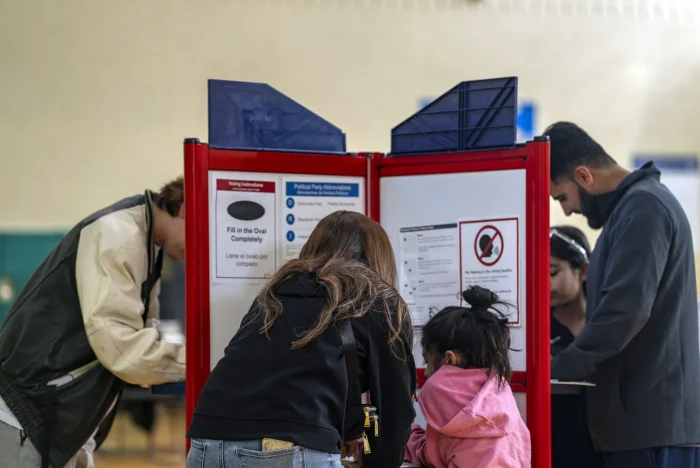
Virginians cast their ballots at Walter Reed Recreation Center in Arlington, Va., on Election Day on November 4, 2025. Photo by Bonnie Cash/UPI | License Photo
Ukraine’s Zelenskyy urges allies to pressure Russia ahead of US talks | Russia-Ukraine war News
With US-Ukraine talks set to resume in Florida, Volodymyr Zelenskyy warns that Russia is increasing its oil revenues through shadow fleets.

Published On 22 Mar 2026
President Volodymyr Zelenskyy has urged allies to keep up sanctions pressure on Russia’s economy ahead of a second day of talks between Ukraine and United States officials on ways to end the more-than-four-year Russia-Ukraine war.
Russia’s representatives were not present at the talks, which opened on Saturday in Florida. They were originally expected to attend the negotiations, which had been due to take place in the United Arab Emirates, before the US-Israeli war on Iran.
Recommended Stories
list of 3 itemsend of list
The US delegation is being led by special envoy Steve Witkoff and Jared Kushner, US President Donald Trump’s son-in-law.
In a post on X on Sunday, Zelenskyy called for tougher action against Moscow’s so-called shadow fleet of tankers and for it to be denied oil revenues.
“Over the past week, Russia launched nearly 1,550 attack drones against Ukraine, more than 1,260 guided aerial bombs, and two missiles. Over that same week, due to the easing of sanctions, Russia increased its crude oil sales to finance its war,” Zelenskyy wrote.
“Revenues give Russia a sense of impunity and the ability to continue the war. That is why pressure must continue, and sanctions must work. Russia’s shadow fleet must not feel safe in European waters or anywhere else,” he said.
The Ukrainian president added that tankers that “serve the war budget can and must be stopped and blocked, not just let go”.
The so-called shadow fleet is a network of vessels that continue to export oil and gas despite Western sanctions due to the ongoing war with Ukraine.
Last week, the French Navy seized an oil tanker in the Western Mediterranean, which France’s President Emmanuel Macron said was part of Russia’s shadow fleet, a network of vessels used to export oil despite Western sanctions.
The shadow fleet, which has grown following Western sanctions on Russia aimed at curbing Moscow’s oil revenues, has helped to keep Russian oil exports flowing.
Talks continue
The last time the Ukrainian and Russian delegations met was in February in the Swiss city of Geneva, but no progress was made, as key issues surrounding territory remain unresolved.
Moscow has repeatedly said it will not agree to a peace deal that gives up the Ukrainian territory it has captured during the war. In contrast, Kyiv has said it will not agree to a deal that does not lead to the return of its territory.
Elements of the peace plan being promoted by the US include a presidential election in Ukraine, alongside territorial concessions.
Zelenskyy, whose term has already expired, is under renewed pressure from Trump to hold a vote as Washington pushes Kyiv towards a peace deal.
Ukrainian law bars wartime elections, but Zelenskyy has said Ukraine would be ready to hold democratic elections if the US secured a two-month ceasefire to allow time to prepare infrastructure and put security guarantees in place.

Pregnant Sophie Kasaei admits she’s in a ‘living nightmare’ as she reveals fears amid Jordan Brook’s meningitis battle
PREGNANT Sophie Kasaei revealed every day feels like a living nightmare as boyfriend Jordan Brook battles viral meningitis.
The Towie star, 31, has been in hospital for two weeks and has swelling on the brain after falling ill with the serious condition.
Worried Sophie, 36, was only able to see Jordan for the first time two days ago following his admission and admits she’s never felt so much fear as he goes through treatment.
Alongside loved-up photos of them together, she wrote on Instagram: “Life can come at you really fast. Literally in the blink of an eye.
“One minute you’re dreaming about your future together… and the next, you’re sitting in a hospital room, holding onto hope with everything you have.
“Watching the person I love in pain and fear, something I can’t fight for them is the hardest thing I’ve ever known. And through all this I’m carrying the tiniest piece of us, a reminder that even in the darkest moments, life is still growing, still holding on.”
READ MORE ON SOPHIE KASAEI


Sophie continued: “I never imagined I’d feel this much fear and this much love all at once. Life really can change in the blink of an eye. Please don’t take a single moment, a single person, for granted.
“Everyday I fall in love with you more and more @jordanbrook11 this whole thing feels like I’m living in a nightmare waiting to be woke up by you next to me in bed but I’m just grateful your here and fighting for your family.
“Our little baby boy is what is keeping this family going. I love you @jordanbrook11.”
Jordan replied in the comments and vowed he would give everything to recover.
“My darling girl,” he wrote. “I can’t thank you enough for the strength to help me battle this. I will not give up on us.
“I love you more and more every single day.
“‘This too Shal pass’ – we will smile again with our special boy and family.”
The devastating diagnosis came months after the couple revealed they were expecting their first baby after two years of IVF treatment.
They were supported by friends and fans in the comments, who were moved by their situation.
Love Island‘s Shaughna Phillips said: “So beautifully written Soph, thinking of you both and wishing Jordan a super speedy recovery xxxx.”
Geordie Shore‘s Chloe Ferry left loveheart emojis, while Scarlett Moffatt said: “Sending love and strength.”
Jordan was rushed to hospital earlier this month after falling seriously ill with a mystery illness now known to be viral meningitis and encephalitis.
The conditions are potentially life threatening, causing inflammation of the brain and spinal cord lining.
In a video posted from his hospital bed, Jordan said: “This is the first time I’ve really been able to speak strong enough about what’s going on.
“I’ve been diagnosed with not one but two joining viruses that are attacking a similar part of my body. I have got viral meningitis and encephalitis together.
“That’s the inflammation of the brain and the lining around it. So this isn’t something small or minor.”
He has had CT scans, MRI lumbar scans, and lumbar punctures — the extraction of cerebrospinal fluid from the lower vertebrae — to find out what is wrong.
Jordan continued: “I’m on IV drips, everything antiviral, pain management, physio, seizure monitoring, to minimise seizure risk at the minute.”
The star added: “But unfortunately the swelling on my brain is getting worse. Really, really tough, even with the simple day-to-day activities and normal things that aren’t easy right now.
“So this is what I’m dealing with day-today.”
What is meningitis?
It can be mistaken as the flu or even a hangover – but knowing the symptoms of potentially deadly meningitis could save your life.
It is the inflammation of the membranes that surround and protect the brain and spinal cord and can be caused by meningococcal bacteria and viral meningitis.
If it is not treated quickly, meningitis can cause life-threatening septicaemia (blood poisoning) and result in permanent damage to the brain or nerves.
The two forms of the disease have different symptoms.
Around 3,200 people a year get bacterial meningitis. One in 10 die and many more are left with life-changing disabilities.
Viral forms of meningitis are less common and rarely life-threatening, but can have lifelong effects.
Infections peak during winter when bugs spread more easily in confined spaces.
Meningitis is usually passed on from people who carry the virus or bacterial form in their throat or nose, but aren’t ill themselves.
It can be spread through kissing, sneezing, coughing and sharing household items such as toothbrushes or cutlery.
It is thought that the bacteria are able to invade the body more easily via the nose and throat during winter due to recent infection with flu virus.
The illness can be caught from someone who is ill with meningitis but this is more rare.
The symptoms of meningitis develop suddenly and include:
- A high fever over 37.5 degrees – the average human temperature
- being sick
- a headache
- a blotchy rash that doesn’t fade when a glass is rolled over it
- stiffness, especially in the neck
- sensitivity to bright lights
- drowsiness, irritability or lack of energy
- cold hands and feet
- seizures

Alex Freeland beats Hyeseong Kim for Dodgers roster spot
ANAHEIM — Dodgers infielder Alex Freeland punctuated his case to make the opening day roster with a home run in the team’s last Cactus League game Saturday.
Then on Sunday, before the first game of the Freeway Series with the Angels, the Dodgers announced the results of the spring training position battle between Freeland and Hyeseong Kim: the team optioned Kim to Triple-A Oklahoma City.
“It’s one of those things that you could argue both sides of either decision, as far as Alex or Hyeseong,” manager Dave Roberts said Friday. “And so I just don’t think it’s clear cut. We still haven’t seen Hyeseong a bunch. Alex, I think he’s taken great at-bats, the numbers, the surface line certainly isn’t there, but it’s still spring training. There’s just deeper conversations that are going to be had.”
Kim started off the spring swinging a hot bat. But he went 1-for-12 in the World Baseball Classic. Freeland finished Cactus League play with a .116 batting average.
Utility player Tommy Edman’s offseason ankle surgery left open the roster spot. He’s progressing but set to start the season on the injured list.
The Dodgers also reassigned utility man Nick Senzel, outfielder Jack Suwinski and catcher Seby Zavala to minor-league camp.
LIVE: Real Madrid vs Atletico Madrid – La Liga | Football News
Live MatchLive Match,
Follow the build-up, analysis and live text commentary of the Madrid derby as Real host Atletico at the Bernabeu.


Published On 22 Mar 2026

‘We do it together, in confidence’: Netanyahu backs US strikes on Iran | US-Israel war on Iran
“Whatever we do, we do together, and as far as possible, in confidence.”
Israeli Prime Minister Benjamin Netanyahu has vowed to back US strikes on Iran’s power grid if Tehran does not reopen the Strait of Hormuz, as he visited the site of an Iranian strike in Arad. He urged world leaders to join the war effort as US-Israeli attacks on Iran have killed more than 1,500 people and injured thousands.
Published On 22 Mar 2026

‘Ready or Not 2: Here I Come’: Samara Weaving is a scream
Scream queen Samara Weaving has an extraordinary yell: shrill, feral and ferocious, like a mongoose before it goes on the attack. Its vibrato fury bursts out only when she’s fighting for her life. Otherwise, her newly wed (and newly widowed) Grace MacCaullay stays quiet when being hunted, hence surviving a killer game of hide-and-go-seek in Matt Bettinelli-Olpin and Tyler Gillett’s 2019 hit “Ready or Not,” only to be forced to play again in their echoey sequel “Ready or Not 2: Here I Come.”
In the tradition of “Halloween II,” this one picks up the very second the last one ended. Grace, her white lace dress blackened with blood, is smoking a cigarette outside of an incinerated mansion that belongs to her in-laws, the Le Domas, who are all dead. On this bride’s wedding night, her groom permitted his relatives to sacrifice her to a demon, believing the lore that a wicked spirit named Le Bail gave the family its staggering fortune. They failed; she triumphed.
The first film teased the idea that the family might be superstitious crackpots only to merrily reveal at the climax that the devil is actually real — and that, when disappointed, he makes his minions explode like a shaken bottle of Dom Pérignon. That gag no longer comes as a total shock, but returning screenwriters Guy Busick and R. Christopher Murphy find that the suspense of who is going to pop, and when and why, works just as well. “It’s always surprising,” Grace says with grim humor. (Between this and “Sirāt,” human combustion is the morbid punchline of the year.)
This very silly slasher doesn’t take much seriously, although I appreciated that once Grace exhales her tobacco, passes out and comes to in a hospital bed, she’s been handcuffed to the railing by a detective (Grant Nickalls) who wants to arrest her on suspicion of arson and murder. One real-world rule holds true: Someone’s gotta take the fall when this many rich people die, even if it’s their victim.
Now, four more posh families want to get in good with Le Bail by competing to see who can kill Grace first. Did the screenwriters toss around a dozen other playground games — killer dodgeball, killer cornhole, killer freeze tag — before sticking with the same hide-and-seek set-up? The only change is that there’s more of everything, including more prey as Grace’s estranged sister Faith (Kathryn Newton) gets yoked into the action, grousing that her sibling’s “negative” energy has once again upended her life.
The host of the massacre is the powerful tycoon Chester Danforth (filmmaker David Cronenberg), a hotel and casino impresario, who entrusts the actual event planning to his adult children, twins Ursula and Titus (Sarah Michelle Gellar and Shawn Hatosy). The director of “The Fly” and “Videodrome” isn’t in the film long, but he bequeaths prestige upon these splat-hijinks that they don’t quite deserve. The paterfamilias of gut-wrenchingly emotional body horror would never make a movie like this himself, although I do think he’d be impressed when the visual-effects team makes a human face dissolve like a bath bomb.
The rest of the ensemble represents titans of some vague industry or another from around the globe: the Rajans of London, the El Caídos of Madrid and the Wans of Shanghai, each arriving with multiple family members as backup. A mobbed-up type, Wilkinson (Kevin Durand) of Atlantic City, also pursues Grace as a solo renegade. There’s not much comic zing in the idea that a handful of selfish families rule the world. Still, it’s amusing to watch these soulless ghouls refer to Grace and Faith as “things” and shrug off each other’s deaths, too. Generation by generation, this greedy lot appears to be getting lazier, intoning “Hail Satan” as offhandedly as ordering their butler to fetch them a martini.
Individual characters don’t pop (except, of course, when they quite literally do). The movie would be a bit more interesting if we knew something about each family’s backstory. The one teasing bit of historical intrigue comes when Le Bail’s lawyer (Elijah Wood) insists that the rules state each clan must attack Grace and Faith using weapons from the era in which their ancestors made their satanic pact. It never gets mentioned again, but I spun restless fictions seeing the Danforths stab the girls with railroad spikes while Olivia Cheng’s more modern Chinese heiress chased them with a drone.
There’s still an awful lot of random gunfire and not much enticement to hang onto, nor any sort of a story in this dashed-off, deadly spin on “Succession.” I’ll note that the demon is a more honest and fair negotiator than his vassals, who occasionally cheat and are punished in exactly the way you’re hoping to see.
Hatosy’s Titus is the Danforths’ disappointing fail son and the actor keeps his face in a delightfully foolish little pout. But Titus’ fever to prove that he’s his own man makes him unpredictable and dangerous — and makes him the only villain with more layers than one. Still, my favorite of the ensemble is Maia Jae’s Francesca El Caído, the jilted former lover of Grace’s late husband, who struts into the film like a hellcat, fighting for her own ego as much as Le Bail’s tempting offer of world domination. Her sloppy showdown with Grace is the action highlight.
None of this is scary. The directors, who have also dabbled in the “Scream” franchise, would rather get a laugh than a gasp. Their favorite move is a gasp-laugh, as when they flash a gruesome image on screen that’s so disgusting you can’t help but giggle.
Yet, the prankish tone keeps Grace from having much of a personality, other than a rebellious screw this. Whenever a scene gives her a chance to catch her breath, it squanders it on a go-nowhere running joke about her desperate search for a cigarette.
At least Weaving has her scream and Newton, her impressive ability to take punishment. While new to this particular series, Newton is a skilled cartographer of comedy-horror terrain as the star of “Freaky,” “Lisa Frankenstein,” and the directors’ previous film, “Abigail.” Her kooky chipmunk moxie lets her get through any script relatively unscathed, including this one. And she has one of the best laugh lines in the movie when she bats her eyes at the baddies and tries to placate them with, “You guys seem like good people.”
The sisters’ mutual antagonism has a few clever beats, like when they bicker over who had the superior working-class restaurant job, Grace waiting tables or Faith as a hostess. But the few times they’re forced to play their hurt feelings sincerely are as forced as the moment when Grace zips her gory wedding gown back on before it’s even been washed.
Nevertheless, kudos to the costume team for a different outfit that Grace wears in the second half of the film that’s an absolute jaw-dropper of goth couture with black netting and a tiara. It pairs majestically with Weaving’s defiant chin and gleaming eyes. Despite this sequel’s thin and rote stretches, it once again closes strong with a few images that will stick in your head for at least a week or two. No spoilers, but it’s no coincidence that “Here I Come” finally gets more interesting once it tires of hide and seek. Finding a fresh plot twist is the only way it ekes out a draw.
‘Ready or Not 2: Here I Come’
Rated: R, for strong bloody violence, gore, pervasive language and brief drug use
Running time: 1 hour, 48 minutes
Playing: Opens Friday, March 20 in wide release
Biden’s pledge to leave Afghanistan is years in the making
This is the April 21, 2021, edition of the Essential Politics newsletter. Like what you’re reading? Sign up to get it in your inbox three times a week.
Outgoing presidents often leave decisions for their successors to take on.
Over the last two decades, and four presidents, how to end America’s longest war — in Afghanistan — has been among the largest open questions. President Biden inherited it from President Trump, who inherited it from President Obama, who took it from President George W. Bush. Unpopular, seemingly unending and unwinnable, the war is a case study in how the choices of one administration echo into the next.
Last week, Biden formally announced a deadline of Sept. 11 — the 20th anniversary of the terrorist attacks that provoked the U.S. invasion of Afghanistan — to end military involvement in the country.
“War in Afghanistan was never meant to be a multigenerational undertaking,” he said.
The prospective exit also has been years in the works. Obama promised to scale back U.S. involvement, but first he sent a surge of troops. Trump vowed several times to withdraw all troops, making chaotic progress that stopped short of a full exit. Biden is now the third president to make a similar commitment.
Whether he will follow through remains to be seen. My colleagues David S. Cloud and Tracy Wilkinson have extensively covered the American involvement in Afghanistan, from Trump’s growing tensions with the Pentagon over withdrawal to the lives of Afghanistan’s youngest generation, which was born into U.S. occupation.
Taken together, their work over the last few years reveals the deep roots of Biden’s promise, and the complicated history that will color his path forward.
The long path to leaving
January 2017: A president who promised peace leaves office after eight years of war
During his first presidential campaign, Obama pledged to end the war in Afghanistan, as well as in Iraq. He ended his presidency as the first two-term president to see U.S. forces at war for all eight years.
Experts saw his legacy as mixed. He did reduce the number of troops in Afghanistan, cutting their ranks to 8,400, and his administration reduced American deaths — if not Afghanis’ — by relying on diplomacy and on drones to launch airstrikes. Yet intelligence officials said the U.S. faced more threats in more places than the country had seen since the Cold War. “We’re now wrapped up in all these different conflicts, at a low level and with no end in sight,” one expert told The Times.
August 2017: Trump presides over a stalemate and negotiated settlement
Trump the candidate ran as a tough-on-the-Taliban leader, promising a hard-fought and fast victory to end U.S. engagement. But Trump the president softened when it came time to reveal formal plans, Cloud and Wilkinson wrote with former Times reporter W.J. Hennigan. Fighting continued — to show U.S. forces could not be pushed out — while Trump promised that the 16-year war might end “some day” in a negotiated settlement. It was an acknowledgment that victory would elude a president who loved to win and refused to concede defeat.
“This entire effort is intended to put pressure on the Taliban, to have the Taliban understand you will not win a battlefield victory,” then-Secretary of State Rex Tillerson said. “We may not win one, but neither will you. So at some point, we have to come to the negotiating table and find a way to bring this to an end.”
By February 2018, the Trump administration proposed a defense budget that increased spending in Afghanistan by almost $2 billion, for a total of $48.9 billion in the next fiscal year.
December 2018: Trump presses for peace talks and announces a withdrawal of half of troops
That month, a series of announcements signaled Trump’s growing dissatisfaction with involvement in Afghanistan. Increased Taliban attacks had caused hundreds of Afghan civilian and military casualties a month, prompting Trump administration officials to press for a cease-fire agreement, but with dim prospects, Cloud wrote.
Less than two weeks later, administration officials announced a drastic plan: withdraw up to half of the 14,000 American troops serving in Afghanistan, potentially by summer. The backlash was swift from U.S. lawmakers, allies and even the Pentagon. Defense Secretary James N. Mattis was so furious that Trump would abandon allies in Syria and Afghanistan that he resigned in protest, as Cloud reported.
February-May 2020: A truce and a landmark agreement to withdraw
With 12,000 troops still in Afghanistan, the Trump administration brokered a temporary deal with the Taliban to reduce violence for a week in February, Wilkinson reported. The test was a success, and on Feb. 29, U.S. and Taliban officials signed an accord to end the war. The Taliban would prevent Al Qaeda and other terrorist groups from using Afghan territory to threaten the U.S., without renouncing its terrorist ties. In return, the U.S. would withdraw its troops within 14 months, setting a deadline of May 1, 2021.
The plan again drew backlash, from former Trump and Obama administration officials, who warned a complete withdrawal could backfire, Cloud, Wilkinson and Stefanie Glinksi reported. Even as conflict continued between the Taliban and the Afghan government into May, the Trump administration remained committed to removing troops.
November 2020: Hopes of exiting before the election dashed
Trump, hoping that a full exit in 2020 would boost his reelection prospects, made clear to advisors that he cared little about conditions in Afghanistan, Cloud and Wilkinson reported. He wanted out, period. By July, the number of troops on the ground had shrunk to 8,600.
But as the peace talks the U.S. hoped to broker struggled to get off the ground, administration officials said about 4,000 troops would have to remain into November. The Pentagon said too rapid a withdrawal would doom the talks, invite violence and cause American forces to have to abandon valuable equipment. Trump said he wanted a withdrawal by the end of his term in January, and in November — as he refused to concede his loss to Biden — he ordered troop levels reduced in Iraq and Afghanistan, to 2,500 in each country.
Trump’s relationship with Congress further deteriorated in December, in part over the bipartisan pushback to his withdrawal plans. It was among the reasons he cited in vetoing the annual National Defense Authorization Act, Cloud and Jennifer Haberkorn wrote.
April 2021: Biden says it’s “time to end the forever war.”
When Biden took the oath of office on Jan. 20, 2,500 troops remained in Afghanistan. But the new president faced the decision of whether to honor Trump’s May 1 deadline for withdrawing them — the final exit from the war, Cloud wrote. Once again, Defense Department officials pressured the president to delay a full withdrawal as the deadline the Trump administration negotiated with the Taliban approached.
On April 14, Biden made his decision public: The drawdown would proceed, but not so quickly. The U.S. would fully exit by Sept. 11, Cloud and David Lauter wrote.
“I am now the fourth United States president to preside over an American troop presence in Afghanistan. Two Republicans. Two Democrats,” Biden said. “I will not pass this responsibility onto a fifth.”

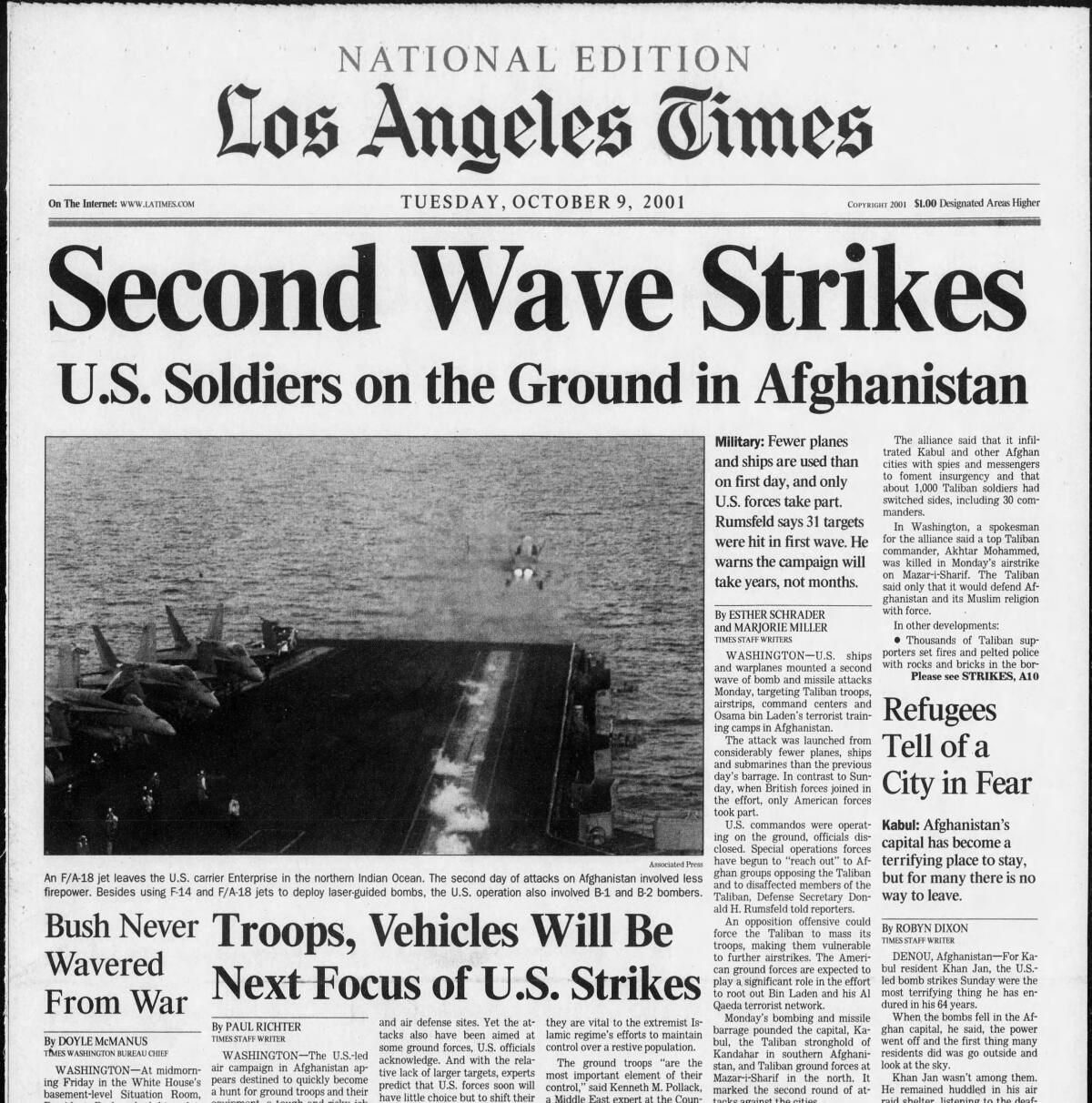
The top half of the front page of the Los Angeles Times on Oct. 9, 2001.
(Los Angeles Times)
Enjoying this newsletter? Consider subscribing to the Los Angeles Times
Your support helps us deliver the news that matters most. Become a subscriber.
Policing, policy and the Minneapolis verdict
— The conviction of former Police Officer Derek Chauvin for the murder of George Floyd reenergized a push for sweeping criminal justice reform by President Biden and leading Democrats, who said Tuesday’s verdict was just the first step on the path to national healing, report Evan Halper, Eli Stokols and Sarah D. Wire.
— Anticipating an uproar, Facebook said it would crack down on violent content, hate speech and harassment ahead of the Chauvin verdict. But as Brian Contreras reports, critics are wondering why the platform doesn’t take those precautions all the time.
The latest on the environment
— China, Japan and South Korea are the world’s biggest funders of coal-fired power plants around the globe — and the Biden administration is looking to win their agreement to deep cuts in their greenhouse gas emissions by the end of the decade, write Anna M. Phillips and Wilkinson.
— Biden will convene leaders from around the world on Thursday and Friday as he marks the United States’ return to the global fight against climate change, Chris Megerian writes. Three people with knowledge of the White House plans say Biden will pledge to cut U.S. greenhouse gas emissions at least in half by 2030.
— Solar panels, wind turbines and electric cars will go far in helping California and the Biden administration meet their aggressive climate goals — but not far enough. As time runs short, scientists and government officials say the moment to break out the giant vacuums has arrived, Halper writes.
More from Washington
— Vice President Kamala Harris traveled to North Carolina on Monday to talk about economic opportunities and electric school buses as part of the Biden administration’s efforts to promote its roughly $2-trillion infrastructure, clean energy and jobs plan, Noah Bierman writes.
— The Supreme Court is weighing whether immigrants granted temporary protected status can get green cards — and if the Biden administration will make that decision, David G. Savage reports.
— The Justice Department has brought charges against hundreds of people who stormed the Capitol during the Jan. 6 riot, but one of its most pivotal potential cases involves a man who never set foot inside the building, writes Del Quentin Wilber.
— After Jan. 6, many of the nation’s largest corporations pledged that they would suspend donations to elected officials who opposed the certification of Joe Biden’s victory, hindered the peaceful transfer of power or incited violence. The vast majority kept their word, report Seema Mehta, Maloy Moore and Matt Stiles.
— What is there left to say about House Speaker Nancy Pelosi? Plenty, it turns out. In a new biography, Pelosi dishes on chiding Rep. Alexandria Ocasio-Cortez and using the nickname “Moscow Mitch,” writes Wire.

Boys’ basketball coach of the year: Mike LeDuc of Damien
Coaching high school basketball since the 1979-80 season and being the second-winningest coach in state history with 1,127 victories, Mike LeDuc is one of those old-school coaches who likes to push his players forward and fade into the background when team success comes.
This season at Damien, LeDuc can take a bow for guiding the Spartans to the state Division I championship with little size but a group of players who loved to shoot threes, never stopped hustling on defense and executed close to perfection on the biggest stage at Golden 1 Center and during his team’s playoff run.
For turning a group of players he fondly called “overachievers” into champions, LeDuc is The Times’ boys’ basketball coach of the year.
Through his many years of coaching at Damien and previously at Glendora, he’s mentored such outstanding players as Tracy Murray, Casey Jacobsen and Cameron Murray. Now Cameron’s sophomore son, CJ, plays for Damien. It’s a full circle moment for LeDuc, who was holding his granddaughter at the awards ceremony in Sacramento.
As the years go by and the game keeps changing, LeDuc continues to adapt, adjust and power on.
LeDuc‘s answer is, “Basketball is a real simple game. It’s a game of repetition and if you do it over and over, you expect it to be done perfectly.”

The Gaza Tribunal: A question of complicity | Genocide
What role has the United Kingdom played in Israel’s war on Gaza? We meet those who say it’s complicit in atrocities committed there.
During the Gaza war, protesters have flooded the streets of major British cities, calling on their leaders to cut off the supply of weapons and other military hardware to Israel.
The United Kingdom’s relationship with its ally is under scrutiny. Jeremy Corbyn, a British MP, set up the Gaza Tribunal to examine whether the UK’s support for Israel amounts to complicity. Doctors and aid workers gave emotional accounts of the horrors they saw while working in the Gaza Strip, and journalists presented evidence of weapons shipments and spy flights allegedly operating from a nearby British air force base. All were making the case that the UK’s unwavering support for Israel is no longer legally or morally justifiable.
In its final report, published on March 16, the Gaza Tribunal said the UK has failed in its duty to prevent genocide and has been complicit in atrocities. It also recommended that the UK end all military cooperation with Israel.
The UK government has yet to comment on the allegations.
Published On 22 Mar 2026
Did Israel miscalculate Iranian military capabilities? | US-Israel war on Iran News
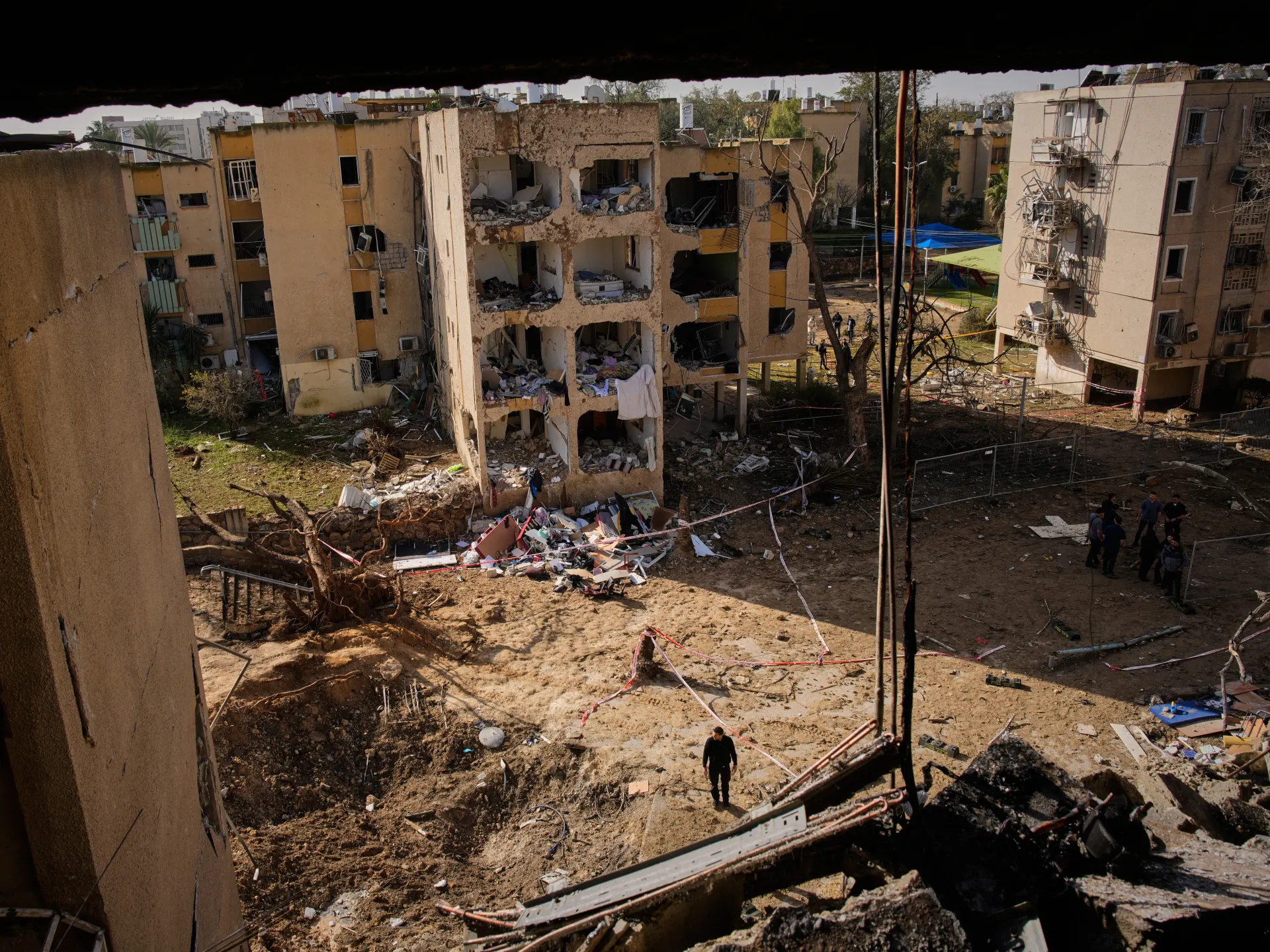
Iranian missiles have struck the towns of Arad and Dimona near an Israeli nuclear research centre in what Iran says was a response to an Israeli attack on its Natanz nuclear facility in Isfahan province.
At least 180 people were wounded in Saturday’s attack, and hundreds of people have been evacuated from the strategic towns as the Israeli-United States war on Iran is seemingly entering a new, more lethal phase of fighting.
Recommended Stories
list of 3 itemsend of list
Israeli Prime Minister Benjamin Netanyahu said his country had a “very difficult evening in the battle for our future”. There have been at least 4,564 people wounded in Israel, according to the Ministry of Health, since the start of the war on February 28.
Analysts said that while Israel has regularly waged military campaigns on Gaza, the occupied West Bank, Lebanon and elsewhere, it is rare for the Israeli public to feel the effects of war like it has over the past three weeks.
In Palestinian territory, including Gaza, Israeli forces have used disproportionate force against armed groups, who use rudimentary rockets to fire at Israel. Israel’s war on Gaza has been called a genocide by scholars and rights groups.
With Saturday’s high casualty count, the attacks in Arad and Dimona raise a question: Has Israel underestimated Iranian military capabilities?
What weapons is Iran using?
Defence analysts described Iran’s missile programme as the Middle East’s largest and most varied. Developed over decades, it contains ballistic and cruise missiles and is designed to give Tehran reach even despite its lack of a modern air force.
Iran has short- and medium-range missile systems and longer-range land-attack and antiship cruise missiles.
Iran’s short-range ballistic missiles have a range of roughly 150km to 800km (93 to 500 miles) and are built for nearby military targets and rapid regional strikes.
Their core systems include the Fateh variants: Zolfaghar, Qiam-1 and older Shahab-1/2 missiles. Their shorter range can be an advantage in a crisis. They can be launched in volleys, compressing warning times and making pre-emption harder.
Those medium-range systems include the Shahab-3, Emad, Ghadr-1, the Khorramshahr variants and Sejjil. They also have newer designs like Kheibar Shekan and Haj Qassem.
Iran’s land-attack and antiship cruise missiles include the Soumar, Ya-Ali and the Quds variants, Hoveyzeh, Paveh and Ra’ad.
The longest reaching ballistic missiles, the Soumar, have a range of 2,000km to 2,500km (1,243 to 1,553 miles). However, it was reported that two Iranian missiles were fired late on Thursday or early on Friday on Diego Garcia, the site of a joint US-United Kingdom military base in the Indian Ocean that is 4,000km (2,485 miles) from Iran. The UK said the attack failed, and an Iranian official denied firing the missile.
Former Iranian Supreme Leader Ali Khamenei had previously limited Iranian missile ranges to 2,200km (1,367 miles) but removed that limit after Israel’s 12-day war on Iran in June. The US joined Israel in that war as well, carrying out one day of attacks on Iran’s three main nuclear facilities.
“Iran has also used cluster munitions in its attacks on Israel. Each kind of warhead the Iranians have also uses a cluster warhead,” Uzi Rubin, founding director of Israel’s missile defence programme and a senior fellow at the Jerusalem Institute for Strategy and Security, told the US news agency Media Line.
What is a cluster munition or warhead?
Instead of a single explosive payload, a cluster warhead disperses multiple bomblets.
“The tip of the missile, instead of containing a big barrel of explosives, contains a mechanism which holds on to a lot of small bombs. And when the missile approaches the target, it opens its skin, it peels off and it spins around and the bomblets are released and released into space and fall on the ground,” Rubin told Media Line.
He added that Iranian cluster warheads may contain 20 to 30 bomblets or 70 to 80, depending on the missile.
These munitions are not new for Iran either. Iran reportedly also used cluster munitions in the 12-day war.
Amnesty International called Iran’s use of cluster munitions during that war a flagrant violation of international humanitarian law while Israel has also been accused of using cluster bombs in Lebanon.
Cluster munitions were banned in 2008 when the Convention on Cluster Munitions was adopted. Neither Iran nor Israel are signatories to the convention.
Why are they making an impact now?
An Israeli military spokesman said Israel’s air defence systems failed to intercept some of the Iranian missiles that hit Arad and Dimona despite being activated. He said Iran’s weaponry was not “special or unfamiliar” and an investigation was under way.
So why are these cluster munitions now making an impact? There are a few reasons.
For a ballistic missile equipped with cluster bomblets to be intercepted, it must happen before the payload opens and releases the submunitions. After the payload opens, the missile goes from a single point of attack to multiple points, making it difficult to stop.
On Thursday, The Times of Israel reported that the Israeli air force will start conserving interceptors. Military officials reportedly said at the time that Iranian cluster bombs are unlikely to cause significant harm if people have taken shelter and, therefore, may avoid shooting down some of them.
What is next?
In the next stage of the war, Iran, the US and Israel may continue to target important infrastructure.
The US and Israel struck Iran’s Natanz nuclear facility on Saturday, according to the Iranian Atomic Energy Organisation. This facility in central Iran is one of the country’s most important uranium enrichment sites, about 220km (135 miles) southeast of Tehran.
In response, Iran launched the attacks on Arad and Dimona, home to Israel’s main nuclear facility.
Israel previously struck fuel storage facilities in Tehran, leading to vast, toxic smoke over the Iranian capital. For its part, the US previously hit Kharg Island, Iran’s oil export hub, and threatened to do it again.
Iran has essentially closed the Strait of Hormuz, a vital chokepoint for global shipping and oil transport, and has targeted military bases and crucial energy infrastructure across Arab Gulf countries.
US President Donald Trump demanded the reopening of the strait and threatened to begin hitting energy infrastructure should Iran not comply.
“If Iran doesn’t FULLY OPEN, WITHOUT THREAT, the Strait of Hormuz, within 48 HOURS from this exact point in time, the United States of America will hit and obliterate their various POWER PLANTS, STARTING WITH THE BIGGEST ONE FIRST,” Trump wrote on Truth Social at 23:44 GMT on Saturday.

Jessie J rushed to hospital for MRI scan after fears she’d ‘broken her neck’ following car injury
JESSIE J has been rushed to hospital following a car injury which left her with fears she’d ‘broken her neck’.
The singer, 37, has undergone an MRI scan following the incident as she updated fans on her health scare.
Jessie is currently in China for her No Secrets Tour and suffered an unlikely injury after hitting her head on the roof of a car.
Taking to Instagram, the Price Tag hitmaker shared a clip of her climbing into a black vehicle at her latest concert, whilst admitting she “didn’t mind squashing in the back”.
The video then cuts to Jessie in hospital undergoing an MRI scan after suffering the neck injury.
In an additional update, whilst backstage at one of her shows, Jessie goes on to relay the severity of her condition.


She said: “Yeah, I just can’t move my head. I’m alright. I’ll just have to take some painkillers and march right through it.”
“I thought I’d broken my neck, but I haven’t. But I have really hurt my neck and my back.”
Later, shots show the star trying on a stunning gold jumpsuit and embracing her young son Sky.
Jessie didn’t let the injury stop her putting on a stellar performance as she’s filmed singing her iconic tracks on stage.
Fans flocked to the comments with messages of love and well wishes for the singer.
One user penned: “Take care of yourself (heart emoji)”
“And yet nobody noticed until you told us you hurt yourself!! POPSTARRRR mode was activated,” added another.
A third chimed: “Feel better soon girl you are such a vibe even if you are in pain such an awesome human being.”
“Sending you lots of love and light (heart emoji)” wrote a fourth.
The music star was diagnosed with breast cancer last year and shared news of her early-stage diagnosis publicly via social media in June 2025.
Jessie underwent two surgeries during her health battle, which included a mastectomy that same year.
In August, she was taken to hospital with an infection and fluid on her lungs six weeks post-surgery.
But the star now seems to be doing well and is back performing shows just under a year since her diagnosis.

Putting D.C. Online – Los Angeles Times
In 1994, then House Speaker Newt Gingrich promised to post all congressional proceedings on the Internet as a way of launching what he called a “civilizational upheaval” in which “regular people in little towns”–not well-moneyed lobbyists–would manage affairs in Washington. In 1996, the representative from Georgia, swayed by the futurism of writer Alvin Toffler, helped pass the Electronic Freedom of Information Act, which required federal agencies to grant Americans prompt access to any information in their databases that could help “ensure an informed citizenry.”
Three years later, Gingrich’s revolution, far from online, is nowhere in sight. Rather than complying with the 1996 law, most parts of the executive, legislative and judicial branches of the U.S. government stand in blatant violation of it.
While the Supreme Court of Mongolia has its own official Web site, the U.S. Supreme Court doesn’t, forcing Americans to search through unofficial Web sites in hope of finding its briefs and opinions. While the Congressional Research Service makes its reports on vital issues like HMO reform instantly available online to legislators, taxpayers, who fund those studies, can get them only through the mail from their members of Congress.
If you are a soldier who believes he was made ill by the military’s anthrax vaccine, for example, you might want to know what was said in Tuesday’s hearing of the House Committee on Government Reform, in which Rep. Henry A. Waxman (D-Los Angeles) and leading scientists discussed how the government should weigh a vaccine’s risks against its benefits. The full text of the hearing was available Tuesday to anyone who could afford a subscription to a private online data service.
Those hoping to access such supposedly public information on the Web, however, were out of luck. The House Government Reform Committee’s Web site lists transcripts from only a hodgepodge of committee hearings. The most recent transcript available at that site is from June.
Today, Sens. Patrick J. Leahy (D-Vt.) and John McCain (R-Ariz.) plan to hold a press conference in which they will release a study by two Washington public-interest groups on how federal agencies have failed to comply with the 1996 law. McCain and Leahy, along with David E. Price (D-N.C.) and Christopher Shays (R-Conn.) in the House, have introduced similar bills to require Congress to put Congressional Research Service documents online within 30 days. The measures currently are in the House and Senate rules committees.
Fundamental change won’t occur until national leaders like President Clinton, Senate Majority Leader Trent Lott (R-Miss.) and House Speaker J. Dennis Hastert (R-Ill.) call upon all government agencies to honor the letter and spirit of the 1996 law.
Reforming the Congressional Research Service is only a baby step toward the revolution that legislators promised so bombastically. But it’s as good a place as any to start.
To Take Action: Rep. David Dreier (R-San Dimas), chairman, House Committee on Rules, (202) 225-2305, www.house.gov/dreier, click on “Feedback”; Sen. Mitch McConnell (R-Ky.), chairman, Senate Committee on Rules and Administration, (202) 224-2541, e-mail, senator@mcconnell.senate.gov

Girls’ basketball player of the year: Kaleena Smith of Ontario Christian
Kaleena Smith averaged 31 points, seven assists and four steals a game this season while playing for the No. 1 program in the Southland, but her expanded leadership role is what earns her the honor of The Times’ girls’ basketball player of the year.
The 5-foot-6 junior point guard marshaled Ontario Christian to the CIF state championships in Sacramento for the first time in the program’s history and along the way her voice spoke almost as loudly as her game — surprising for someone who is not talkative by nature.
“Her numbers speak for themselves but the biggest difference in Kaleena this season has been her leadership,” Knights coach Aundre Cummings, said. “She’s always coming to practice first and leaving last, which teammates respect, but also knowing when to speak up.”
Smith has been nicknamed “Special K” for her talent and charisma, traits that make her one of the top national recruits in the class of 2027. She is garnering attention from multiple college programs. USC women’s coach Lindsay Gottlieb was even on hand to witness Smith score 23 points and contribute six assists in the Southern California regional semifinals against Etiwanda on March 8 and the state championship game against Archbishop Mitty at Golden 1 Center in Sacramento.
“I’m being more vocal, yes, because I’m gonna have to do that in college,” said Smith, who spent countless hours refining her mid-range jumper this winter. “As captain it’s one of my responsibilities.”
One hundred games into her high school career, Smith is living up to the hype thrust upon her when she was named MaxPreps’ national freshman of the Year in 2024. She passed the 2,000-point plateau when she scored 51 points against Esperanza in November.
Smith paced Ontario Christian to the Southern Section Open Division title as a sophomore and although the Knights were denied a repeat (she had 30 points and five assists in a finals defeat to Sierra Canyon) her stats are better in every significant category. Intertwined with her competitive spirit and winning mindset is the maturity and confidence of an upperclassman.
“Her leadership is what stands out,” sophomore teammate Tatianna Griffin said. “She’s a very quiet person. I’m not sure it comes naturally or not but when she says something we listen.”
Griffin’s own game has blossomed because of Smith’s willingness to give her the ball in clutch situations, and Smith has been a mentor to freshman Chloe Jenkins, who led the team in rebounds (11.3 per game).
Adding leadership to her basketball IQ, court vision, defense, quickness, shooting, passing and dribbling has made Smith a complete player, one who is poised for a senior season worth talking about.

Trump’s changing messages on Iran war: What does it say about US strategy? | Explainer News
As the United States-Israeli war on Iran enters its fourth week, the conflict seems to have escalated beyond President Donald Trump’s control.
The Iranian government has been able to endure the killings of its top political and military leaders and has launched retaliatory attacks on Israel and Gulf countries despite weeks of air strikes.
Recommended Stories
list of 4 itemsend of list
Tehran has also been able to impose a de facto blockade of the Strait of Hormuz, a narrow waterway through which a fifth of the world’s oil and liquefied natural gas supplies pass, sending oil prices soaring. Analysts said the conflict risks unleashing a global recession. And that has put pressure on Trump, prompting his administration to allow the sale of sanctioned Russian oil to try to ease the energy crisis and pressure allies to police the strait, so far unsuccessfully.
Trump’s response in how to deal with the situation has been anything but coherent.
On Saturday, Trump upped the ante, issuing a threat to “obliterate” Iran’s power plants if Tehran does not reopen the Strait of Hormuz within 48 hours. This came a day after he said the US was “winding down” its military operations in Iran.
Analysts said Trump launched the war without a clear goal and misjudged how Tehran would respond. The conflict has expanded across the Middle East.
So is Trump looking to exit the war – or escalate it?

Trump’s mixed messaging on the Iran war
Here’s a brief look at the changing statements from Washington:
Is the war winding up or widening?
While one statement from Trump signalled that the US is considering “winding down” the war on Iran, another one indicated that the conflict would widen in the coming days.
On Saturday, Trump posted on his Truth Social platform that Washington was “very close to meeting our objectives as we consider winding down our great Military efforts in the Middle East with respect to the Terrorist Regime of Iran”.
Trump listed the goals of the war as: completely degrading Iran’s missile capability, destroying its defence industrial base, eliminating the Iranian navy and air force, never allowing Iran to get even close to having nuclear weapons, protecting Middle Eastern allies, and guarding and policing the Strait of Hormuz.
Both Trump and Israeli Prime Minister Benjamin Netanyahu have claimed repeatedly in the past few days that Iranian military capabilities have been “completely destroyed” even as Tehran continues to retaliate against Israel and strike countries in the region.
US military officials said they have carried out heavy bombardments of Iran’s coast, including with bunker buster bombs, but still have not been able to limit Tehran’s capacity to disrupt the Strait of Hormuz.
On Saturday, Trump said the US “has blown Iran off of the map” and insisted that he has “met my own goals … and weeks ahead of schedule!” He also reiterated that Iran’s “leadership is gone, their navy and air force are dead, they have absolutely no defense, and they want to make a deal”.
Iranian leaders have consistently denied reaching out to the US with a ceasefire offer.
Just an hour later, Trump returned to his Truth Social platform with a warning for Iran.
“If Iran doesn’t FULLY OPEN, WITHOUT THREAT, the Strait of Hormuz, within 48 HOURS from this exact point in time, the United States of America will hit and obliterate their various POWER PLANTS, STARTING WITH THE BIGGEST ONE FIRST!” Trump wrote.
Iran has since responded by saying it will hit energy sites across the Middle East if its power facilities are targeted. It has already fired hundreds of missiles and drones on Gulf countries, targeting US assets as well as energy facilities.
Between Trump’s claims to be “winding down” operations and upping the ante later, his administration announced it is sending three more warships to the Middle East with about 2,500 additional Marines.
The US military said about 50,000 military personnel are already deployed for the war against Iran.

When will the war on Iran end?
That has been among the foremost questions posed to US officials, including Trump, since the war on Iran was launched on February 28.
The next day, Trump told the Daily Mail that “it will be four weeks or so. It’s always been about a four-week process.” A day later, Trump said at the White House: “We projected four to five weeks, but we have capability to go far longer than that.”
On March 8, Defense Secretary Pete Hegseth told the CBS TV network’s 60 Minutes programme: “This is only just the beginning.” The next day, the US president told the same channel that he thinks “the war is very complete, pretty much.” And the US military operation was “way ahead of schedule”.
Then, on March 9, Trump said one could say the war is “both complete and just beginning”. Later the same day, the president said: “We’ve already won in many ways, but we haven’t won enough” and promised to go further and harsher against Iran.
On March 11, Trump said: “We don’t want to leave early, do we? We’ve got to finish the job.”
Why did US and Israel launch strikes on Iran?
Responses to this question are perhaps the most telling about US posturing in the war against Iran.
On March 2, Hegseth said the attacks were aimed at ending “47 long years” of war by “the expansionist and Islamist regime in Tehran” and were launched because Iran refused to negotiate with the US.
Hours later, Marco Rubio, the secretary of state, told reporters the US knew Israel was about to strike Iran, adding that the Trump administration believed the US needed to launch a pre-emptive strike before Iran’s retaliation potentially targeted US forces. “We went proactively in a defensive way to prevent them from inflicting higher damage,” he said.
This sparked a massive row in Washington with critics saying Israel had forced the US into war with Iran. Soon Trump rebutted his top diplomat, saying: “They [Iran] were going to attack. If we didn’t do it, they were going to attack first. … So if anything, I might have forced Israel’s hand.”
The next day, the White House press secretary, Karoline Leavitt, concluded that Trump just had a “good feeling” that Iran would strike so Washington attacked Tehran.
The launch of the war came as Washington and Tehran were scheduled to meet for another round of talks that were started late last year. Before the war, their Omani mediator said a deal was “within reach”.
The US and Israeli assertion that Tehran was on the verge of making a nuclear bomb has not been backed up by the United Nations nuclear watchdog. Last week, US Director of National Intelligence Tulsi Gabbard also told Congress that Iran was not in a position to make an atomic bomb.
Some analysts said the Trump administration was convinced to go to war by Netanyahu, who has been seeking US military intervention in Iran for decades. They said Trump was buoyed by a swift US military operation in Venezuela and did not think through Iran’s strengths before going into the war. In January, the US military abducted President Nicolas Maduro in a military operation in Caracas that took two and a half hours.

What does the conflicting messaging mean for US strategy?
Analysts said the moving goalposts in the Iran war show the policy limits of the current Trump administration as well as its strategy, to some extent, of keeping off-ramps available.
Zeidon Alkinani, a Middle East analyst at the Arab Perspectives Institute, told Al Jazeera that in the earlier days of the hostilities, there appeared to be clearer targets and limited objectives.
“There now seems to be a more chaotic reaction,” he said. He described the attacks as increasingly reciprocal, suggesting strikes on oil or energy facilities could prompt further escalation.
Last week, Iran attacked energy facilities in Qatar and caused “significant damage”, knocking out 17 percent of Qatar’s liquefied natural gas (LNG) export capacity. Qatar produces 20 percent of global LNG supplies. Iran said the attack was in retaliation for Israeli attacks on a gas plant.
Paolo von Schirach, president of the Global Policy Institute, told Al Jazeera that Trump changes his mind “very quickly” and it is hard to predict what his next step could be in the war on Iran.
The analyst said it was unclear to him what “tools” Trump has to end the war.
“We look at his message saying the war is winding down. OK, good. Things are quiet. Maybe there is an off-ramp somehow. But now he says that if the Iranians don’t open the Strait of Hormuz, then we [the US] are going to unleash hell and what have you,” von Schirach noted.
“It is not quite clear to me what he wants and what the tools are to accomplish this.”
Von Schirach added that it would be difficult to predict whether the US could force Iran into submission, given its size and population. Using as a reference Iraq, where 150,000 American soldiers were deployed during the Second Gulf War, the analyst predicted that the US might need as many as half a million soldiers if Trump “wants to take over Iran”.
Iranian authorities taunt US, Israel, EU amid strikes and assassinations | US-Israel war on Iran News
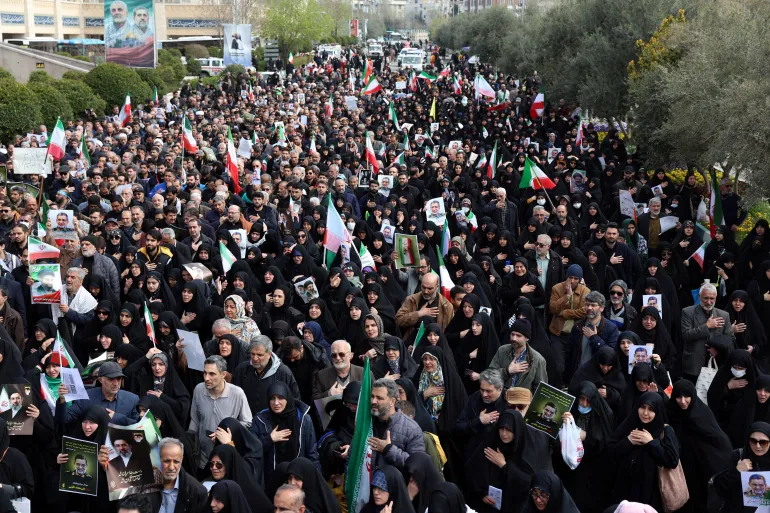
Tehran, Iran – Military and political authorities in Iran are projecting a message that “victory” is near as war with the United States and Israel continues to escalate, and air strikes and assassination attempts are reported across the country.
Massive joint US-Israeli air raids were recorded in multiple areas of the capital Tehran overnight into Sunday, and in central Iran’s Isfahan city in the morning, a day after Dezful and Andimeshk in western Khuzestan and several other cities were hit.
Recommended Stories
list of 4 itemsend of list
Israeli warplanes also conducted two separate sets of precision strikes on privately-owned residential units located in small towns in the green provinces of Gilan and Mazandaran to the north on Saturday, which appeared to be assassination attempts on officials.
Local authorities confirmed that several people were killed, but did not elaborate. Israeli and US media said a senior drone commander is believed to have been killed.
Nevertheless, top officials in Tehran said they were unyielding and focused on retaliatory attacks.
Parliament speaker and former Islamic Revolutionary Guard Corps (IRGC) commander Mohammad Bagher Ghalibaf said the fact that Iranian missiles struck Israel’s Dimona overnight shows that a “new stage of battle” has started where “Israel’s skies are defenceless”.
Majid Mousavi, aerospace commander of the IRGC, echoed the same statement about control over Israeli skies in a post on X on Saturday night, which came in response to the US and Israel declaring dominance over Iranian airspace.
“Pinpoint precision Seyed Majid, hit Dimona again,” chanted flag-waving pro-establishment supporters shown on state television broadcasts, calling on Mousavi for action.
Israel said more than 180 people were injured in Dimona, a southern city where its key nuclear facilities are also located, in addition to nearby Arad.
Ahmad-Reza Radan – Iran’s hardline police chief, who has been cited by Israeli media as being a target for assassination along with Mousavi, Ghalibaf and others – was seen briefly addressing a group of supporters in Tehran on Saturday night.
“Trump first threatened the European Union, then begged. Today, he has said he will come take Greenland if the Europeans don’t come. I want to tell the European Union that if they can’t hold on to Greenland, then send a request and we will come preserve it,” he said, followed by chants of “Alla akbar” (God is greatest).
Defence Ministry spokesman Reza Talaei-Nik said in a statement that attacks across the region will continue “until the complete halt and surrender of the enemy”.
The taunts are in line with the state’s messaging in recent days, including a written statement attributed to Mojtaba Khamenei, who was selected as the supreme leader after his father Ayatollah Ali Khamenei was assassinated on the first day of the war, but who has not been seen or heard.
The message said Iran’s enemies were being “defeated” and there is “particular unity” among supporters of the theocratic establishment.
Over the past week, the country’s top security official, commanders of the paramilitary Basij force of the IRGC, the government’s intelligence minister, and a number of other military and security personnel have been among those killed.
The government reports that a large number of residential buildings, hospitals, schools and other civilian facilities have also been impacted during the war, as state supporters control the city streets, squares and mosques to counter potential anti-government protests.
‘Say goodbye to electricity!’
The Iranian rhetoric quickly escalated on Sunday after US President Donald Trump issued a 48-hour ultimatum for Tehran to reopen the strategic Strait of Hormuz, a key water route for global energy export, or face strikes on its power plants.
In response, Iranian politicians and armed forces said they would strike back harder against the region’s energy facilities.
The IRGC-affiliated Mehr news agency released a map with graphics that showed power plants across the region, including in the United Arab Emirates, Saudi Arabia, Qatar and Kuwait, that could be attacked if Iranian facilities are hit. An accompanying message read, “Say goodbye to electricity!”
On Saturday night, state and IRGC-affiliated media circulated a different map, showing Doha and also marking the central offices of Al Jazeera network as potential targets, and said all residents of the Qatari capital were advised to evacuate immediately.
State television quickly issued a retraction and cited unnamed sources as saying the map was not official, but no explanation was provided about who circulated the image and why.

The all-around promises of escalation, particularly around bombing electricity facilities and other critical civilian infrastructure, have created additional concerns among many Iranians about the impact on daily lives and implications on the country’s future.
“If the main power plants are bombed, it’s not going to be just a brief disruption; it could stop the flow of everything from water to gas,” a Tehran resident told Al Jazeera, asking to remain anonymous due to security concerns. “It would be foolish to just punish the population like that.”
The US-Israeli forces have also struck natural gas facilities in southern Iran and bombed fuel reserves across Tehran, but authorities said fires and damage were contained quickly without creating major disruptions.
In an Instagram post to mark Nowruz, the Persian New Year, iconic footballer and nationally respected figure Ali Daei said this year’s celebrations were different because Iran is grieving for its people killed in the war.
“Wishing for a prosperous and free Iran, away from war and bloodshed, all about welfare and calm,” he wrote, drawing the ire of a number of state media, including the IRGC-affiliated Tasnim, which criticised Daei for not specifically condemning the US and Israel.
Proclamations, warnings under blackout
Meanwhile, the internet remains cut for more than 92 million Iranians for a 23rd day, becoming the longest shutdown in the country’s history, trailed only by a 20-day blackout imposed during the killing of thousands of anti-government protesters in January.
State media outlets continue to focus on successful IRGC attacks and present Iran as a country on the brink of being recognised as a world power, as they refrain from communicating details about the US and Israeli attacks or significant damage sustained.
Alaeddin Boroujerdi, a member of the national security committee of Iran’s parliament, told the state television on Sunday that the IRGC’s overnight attacks against Israel “opened a new page in shifting the balance of power and showed the victory of the Islamic Republic in this imposed war”.
The parliamentary committee’s spokesman, Ebrahim Rezaei, stretched the same line of thinking even further, and said in a post on X that Iran should demand to become a veto-yielding permanent member of the United Nations Security Council as a condition for ending the war. The lawmaker did not say how or when he expected that to happen.
Iran’s government has also demanded war reparations and guarantees against future aggression, but the US and Israel have been pushing to overthrow the Islamic Republic that came to power in a 1979 revolution.
Intelligence authorities advised the Iranian population on Saturday that even being a member of foreign-based news and war footage channels on Telegram and all other social media outlets banned by the state could violate national security laws.
The Iranian judiciary said that such channels are considered “terrorist” outlets and that sending any videos of impact sites or armed state checkpoints on the streets to them could carry maximum penalties like confiscation of assets and even execution.
State security authorities have emphasised that anyone who engages in anti-establishment protests will be treated as an “enemy”.

Amanda Holden’s co-star sets record straight on pair’s ‘fake’ chemistry after show snub
It’s not the first time the comedian has spoken out about his friendship with Britain’s Got Talent judge Amanda Holden, after fans raised the same question

Amanda Holden was surprised that fans had doubted their chemistry
Amanda Holden‘s co-star and friend Alan Carr has set the record straight about their on-screen chemistry. The duo front a BBC travel series, in which they help renovate properties across Greece, Italy, and Spain. Along with their hard work, viewers have warmed to the pair’s humorous ways and heartfelt conversations – including a recent sad discussion about Amanda’s stillborn son Theo.
Joining Alan on the latest edition of his podcast, Life Is A Beach, Bob Mortimer discussed what it was like working with his co-star Paul Whitehouse on their series Mortimer and Whitehouse: Gone Fishing.
After admitting that they couldn’t present in a traditional way, he said the duo decided to take a more natural approach – one that has worked well over the years. “They just like it when we’re chatting,” he told Alan, to which he agreed.
“Yes, that’s true – it’s the chemistry people want, and you can’t fake that,” he went on to say.
Alan added that he’s often asked whether he genuinely likes Amanda, despite their obvious camaraderie on TV. “I mean, people go, ‘Do you really like Amanda?’ I couldn’t be in 40-degree heat in Greece knocking down a partition wall with someone I hate.
“Why would I sign up for that? You have to actually like the person, more than like, you have to really go, ‘Oh hello Amanda, right let’s have a laugh, what have you been up to?’ And I think you can’t actually fake that,” he clarified.
This isn’t the first time Alan has addressed questions about their friendship. On a previous episode of the show, Amanda was surprised that fans had doubted their chemistry.
Alan joked that viewers often comment on her distinctive laugh and ask how he “puts up” with it, to which she quipped: “This is an outrage!”.
Clarifying any lingering doubts, Alan added: “No, no, no. We couldn’t do this job if we didn’t like each other – it would be hell.” Amanda added: “There’s not a single other person I could do it with,” to which he replied: “No, it would have to be you.”
While the pair have enjoyed a successful run on the BBC show, they recently snubbed the idea of presenting Strictly Come Dancing together.
Amid speculation that they might replace Tess Daly and Claudia Winkleman, Amanda confirmed on her Heart Radio Breakfast Show with Jamie Theakston: “I want to say now that me and Alan are 100 per cent not doing Strictly. We’re so flattered to be in that mix, but we both are not doing it.”
Speaking to The Daily Mail, the Britain’s Got Talent judge insisted she also wouldn’t be able to fit the role into her already busy schedule juggling family life and her career.
“You see, I am already part of a big show, and I’ll happily carry on watching Strictly from the comfort of my lounge, but it takes up too many weekends, I’ve got to remember that I have children and a husband,” she revealed.
“But I just hope that they still have two females doing it, that’s my big thing. They need somebody super funny, and somebody that you wouldn’t expect.”
Putting forward who she believes could be good for the positions, she suggested The One Show’s Alex Jones, BBC Radio star Zoe Ball and comedians Katherine Ryan and Daisy May Cooper.
24-Hour Stopgap Funding Approved, but the Budget Impasse Remains
WASHINGTON — In session for rare weekend votes with the election fast approaching, Congress acted Saturday to keep the government running for another 24 hours but made little apparent progress in breaking a budget impasse.
Despite the action of the House and the Senate on the eighth stopgap spending measure since the fiscal year began Oct. 1, a weird limbo enveloped the Capitol as neither Republicans nor Democrats predicted a quick deal. Gone for the time being was the usual year-end pressure to adjourn. Instead, both sides seemed willing to wait to see who would blink first.
Negotiations focused on the handful of issues still dividing the parties, issues that might or might not influence voters at the polls Nov. 7. Among them were tax credits for school construction, proposed workplace safety regulations and measures to ease immigration law.
President Clinton, who forced the weekend votes by insisting that lawmakers pass daily stopgap budget measures, urged the Republican-led Congress to wrap up its budget work and include an increase in the federal minimum wage.
“I’m not trying to harass [Congress],” Clinton said at a news conference. “I’m just trying to get them to finish their job and go home.”
Clinton cited an agriculture spending bill he signed Saturday as a model of bipartisanship. The president said he signed the bill–which included milestone language easing a decades-old trade embargo on Cuba to allow U.S. agricultural exports–even though he was critical of provisions that would limit the effect of the trade opening.
In a GOP radio address, New Jersey Gov. Christine Todd Whitman called the budget showdown “a case in point” of Washington gridlock that voters will punish.
“I think we are ready for a change,” Whitman said. “And the difference between the parties is striking. Republicans at all levels of government work with people to accomplish results–not make excuses for why we can’t even try to solve them.”
Republican congressional leaders note that they wrapped a minimum-wage increase Clinton supports into tax legislation that he is holding up with a promised veto. And they accuse the White House of constantly shifting its goals on the two government spending bills for fiscal 2001 that have not been finalized.
“I tell you, I’ve reached the end of my rope,” said Sen. Ted Stevens (R-Alaska), chairman of the Senate Appropriations Committee. To illustrate his frustration, Stevens said in an interview on the Capitol steps that the administration had sought $3.5 billion in extra spending on a bill containing $106.8 billion for discretionary spending on education, health and other programs. Then $4 billion. Then $4.1 billion. And now, he said, the demand is up to $4.5 billion.
“What can you do?” Stevens asked.
To register his protest, Stevens was one of two senators to vote against the daily budget resolution. The other was Sen. Patrick J. Leahy (D-Vt.). Sixty-seven senators voted for the resolution.
Thirty-one senators–11 Democrats and 20 Republicans–were absent for what the chamber regarded as a ritual vote. Many missed it because of campaign events, a few for health reasons. California’s Democratic senators, Dianne Feinstein–who is running for reelection–and Barbara Boxer, were both absent.
The House vote for the stopgap measure was 339 to 7. All seven dissenters were Democrats, including Rep. George Miller of Martinez. Of the 86 representatives who were absent, 42 were Republicans and 44 Democrats.
Twelve of California’s 52-member House delegation did not vote. They were Feinstein’s opponent in the Senate race, GOP Rep. Tom Campbell of San Jose, and Reps. Brian P. Bilbray (R-San Diego), Ken Calvert (R-Riverside), Christopher Cox (R-Newport Beach), Matthew G. Martinez (R-Monterey Park), Howard P. “Buck” McKeon (R-Santa Clarita), George P. Radanovich (R-Mariposa), Joe Baca (D-Rialto), Xavier Becerra (D-Los Angeles), Tom Lantos (D-San Mateo), Pete Stark (D-Hayward) and Maxine Waters (D-Los Angeles).
The roll call showed the political importance of the vote to many House members–all wary of the potential charge that their absence would reflect an insensitivity to the possibility of a government shutdown.
Bilbray was the only California absentee in a tough reelection race. Other California incumbents in contested races, such as Reps. James E. Rogan (R-Glendale), Steven T. Kuykendall (R-Rancho Palos Verdes), Calvin Dooley (D-Visalia), Lois Capps (D-Santa Barbara) and Stephen Horn (R-Long Beach), all eschewed campaign events to remain in Washington for the vote.
More stopgap budget votes were expected today.

World Open: Thepchaiya Un-Nooh scores 147 in final win over Ronnie O’Sullivan
Thailand’s Thepchaiya Un-Nooh produced the snooker of his life, firing in a maximum 147 break and finishing with three consecutive centuries to beat Ronnie O’Sullivan 10-7 in the final of the World Open in Yushan.
The 41st seed toppled world number one Judd Trump in the semi-finals and came back from 4-0 down to beat arguably the sport’s greatest ever player in the final.
O’Sullivan hit the sport’s highest ever break of 153 on his run to a 66th ranking final and the 50-year-old Englishman had looked back to something approaching his best as he hunted down a 42nd ranking title – and first since January 2024.
“I just wanted to try my best because I didn’t know when I might be in another final again,” said 40-year-old Un-Nooh, whose only previous title came in the 2019 Shoot Out.
Seven-time world champion O’Sullivan had started the final quickly, reeling off the opening four frames in a run that included a 124 break, but the Thai world number 39 rattled off six consecutive frames thanks to some heavy scoring that included five breaks over 50.
O’Sullivan countered with three consecutive century breaks – 114, 116 and 136 – to regain the lead in a match of the highest quality, only for his opponent to level with a break of 77 then score three centuries of his own to clinch victory.
Un-Nooh’s unbelievable burst of scoring included breaks of 132 and 131, either side of his nerveless 147 in the penultimate frame, to provide a fitting climax.
The performance earned Un-Nooh a £175,000 purse in a season when he had failed to make it past the last 16 in any other tournament, while O’Sullivan had to be content with a £75,000 prize for the highest break.
“I just want to say well done to Thepchaiya who played unbelievable snooker,” O’Sullivan told the Yushan crowd.
“I watched him play against Judd Trump last night and he made the number one player in the world look second best. I was hoping he wouldn’t play like that today but he did – he gave me a good hiding, really.”

Canada’s Supreme Court must strike down Quebec’s Bill 21 | Human Rights
Under the guise of preserving secularism, this law allows the exclusion of people based on their religious identity.
On Monday, the Supreme Court of Canada will begin a four-day hearing for one of the most consequential constitutional cases in the country’s recent history. At issue is Quebec’s so-called “secularism law”, known as Bill 21 – a law enacted in 2019 that prohibits certain public sector workers from wearing visible religious symbols at work.
It bars many public sector employees, including teachers, prosecutors, police officers, and judges, from wearing religious symbols such as hijabs, turbans, kippahs, and other visible expressions of faith while at work.
There is much at stake in this case that raises fundamental questions about religious freedom, equality, and the limits of state power in a constitutional democracy. In addition, another significant issue is that to get the bill passed, Quebec’s government had used the “notwithstanding clause”, a unique provision in Canadian law that allows it to override fundamental rights and freedoms. No other constitutional democracy in the world has a similar blanket override of fundamental rights and freedoms.
The Quebec government claims that the law is necessary to preserve the religious neutrality of the state. Yet Bill 21 does the opposite: by forcing some individuals to choose between their profession and their religious identity, the Quebec government is not remaining neutral – it is effectively excluding people of faith from public sector employment.
The use of this extraordinary, and until recently rarely used, constitutional mechanism has turned the spotlight on Bill 21 beyond the borders of Quebec and the debate over secularism and religious freedoms. It has become a test of how far a democratic government can go in limiting fundamental rights and freedoms.
Evidence before the courts shows that Bill 21 affects religious people of many faiths, including Jewish men who wear kippahs and Sikh men and women who wear turbans; but its impact falls particularly heavily on Muslim women who wear the hijab. For many Muslim women who wear headscarves, teaching and other public service careers have effectively been closed off.
The message of exclusion that this law sends to young people is especially troubling. Generations of young people in Quebec are being told that their full participation in public life requires abandoning visible aspects of their identity.
This is why the National Council of Canadian Muslims and the Canadian Civil Liberties Association launched the constitutional challenge against Bill 21. The Supreme Court of Canada must consider the implications, and possible limitations, of allowing governments to sidestep rights protections through pre-emptive use of constitutional override powers. The court’s decision will help determine whether constitutional rights in Canada remain meaningful constraints on government power, or whether they can be suspended whenever politically convenient.
These questions extend far beyond Canada. Across Europe and elsewhere, debates about secularism have increasingly centred on restrictions targeting religious expression, often impacting Muslim women in particular.
Canada often prides itself on being a model of multicultural democracy, one that accommodates diversity. Bill 21 challenges that reputation by testing whether neutrality can coexist with policies that effectively exclude people of visible faith from public service.
True secularism does not demand the erasure of religious identity. A neutral state does not require citizens to shed visible expressions of belief in order to participate fully in public life.
The Supreme Court of Canada now has the opportunity to reaffirm these principles and clarify that constitutional rights cannot be easily set aside. At a time when countries around the world are grappling with questions of belonging, pluralism, and the rights of minorities, the Canadian court’s ruling will send an important signal about whether liberal democracies are willing to uphold their commitments to freedom and equality.
We say this is not an abstract idea, but an imperative to demonstrate that commitments to freedom and equality are more than mere words.
The views expressed in this article are the author’s own and do not necessarily reflect Al Jazeera’s editorial stance.