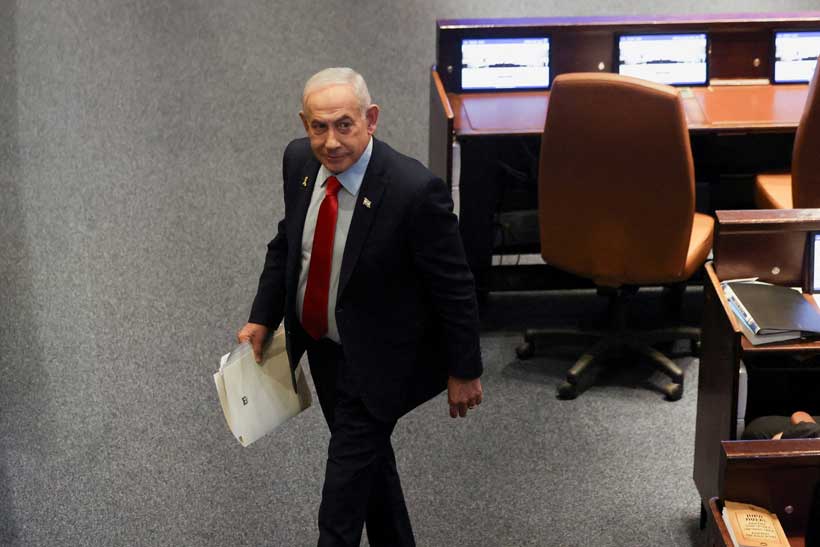
Israel will head to national elections on October 27, marking the country’s first vote since the October 7, 2023 Hamas attack that triggered the Gaza war and later expanded into conflicts with Lebanon and Iran. The election is widely seen as a defining moment for Prime Minister Benjamin Netanyahu, whose political future faces its toughest test in years.
Although opinion polls suggest Netanyahu is heading toward defeat, Israel’s fragmented parliamentary system means election outcomes often depend on coalition negotiations rather than outright victories, leaving several possible paths to power.
Polls Signal Trouble for Netanyahu
Recent surveys indicate declining public confidence in Netanyahu, whose long standing reputation as Israel’s security leader suffered after the October 7 attack.
Stay ahead of the geopolitical week.
MD Briefing delivers expert analysis across five global fronts — the Indo-Pacific, energy, geoeconomics, European security, and the Middle East — every Monday morning. Free.
While many Israelis have supported military operations against Hamas, Hezbollah, and Iran, dissatisfaction has grown over the government’s handling of domestic issues, including the relationship between religion and the state.
Despite the unfavorable polling, Netanyahu remains one of Israel’s most experienced political figures and has repeatedly returned to power after seemingly insurmountable political setbacks.
Who Are Netanyahu’s Main Challengers?
Several political figures are seeking to capitalize on Netanyahu’s weakened position.
Former military chief Gadi Eisenkot has emerged as one of the strongest contenders. Having lost his son during the Gaza conflict, Eisenkot has built a reputation as a respected security figure while portraying himself as an honest alternative to the current leadership.
Former prime ministers Naftali Bennett and Yair Lapid have reunited politically after previously forming the coalition that briefly removed Netanyahu from office in 2021. Their earlier government brought together parties from across Israel’s political spectrum, although it lasted only 18 months.
Another challenger is former Defense Minister Avigdor Lieberman, once a close Netanyahu ally. Lieberman later became one of his fiercest critics, accusing him of failing to adopt a sufficiently tough security policy.
How Israel’s Election System Works
Israel elects its 120 member Knesset through a nationwide system of proportional representation.
Rather than voting directly for a prime minister, citizens vote for political parties. Seats are distributed according to each party’s share of the national vote, provided they receive at least 3.25 percent, the equivalent of four parliamentary seats.
Because no party has ever secured an outright majority, governments are always formed through coalition negotiations among multiple parties.
This coalition system gives smaller parties significant influence over government formation and policymaking, often making them decisive kingmakers after elections.
Why Coalition Politics Matter
Coalition governments have become a defining feature of Israeli politics.
Since 2019, repeated political deadlock produced multiple elections before Netanyahu returned to power in 2022 with the country’s most right wing coalition to date.
His governing alliance has relied heavily on ultra Orthodox Jewish parties, whose demands, particularly regarding exemptions from compulsory military service, have generated growing public controversy during wartime.
Following disagreements, some coalition partners have already left the government, although they have continued providing parliamentary support on key votes.
The Main Parties in the Election
Netanyahu’s coalition includes:
- Likud
- Religious Zionism
- Jewish Power
The opposition currently consists of:
- Yashar, led by Gadi Eisenkot
- Together, the alliance between Naftali Bennett and Yair Lapid
- Israel Our Home, led by Avigdor Lieberman
- Arab parties including Hadash, Taal, Raam, and Balad
- The left wing Democrats, headed by former general Yair Golan
The political landscape could still change before candidate registration closes, as parties may merge, split, or withdraw from the race.
Why This Election Matters
The October election will shape Israel’s political direction at a time when the country remains engaged in multiple regional conflicts and faces mounting domestic challenges. While polls currently favor opposition forces, Israel’s coalition based electoral system means the final outcome will depend less on which party wins the most votes and more on which leader can assemble a governing majority in parliament.
Analysis
The 2026 Israeli election is not simply a referendum on Benjamin Netanyahu but a broader test of whether Israeli voters want continuity or political renewal after years of conflict and instability. Netanyahu enters the race weakened by security failures linked to the October 7 attacks and growing public frustration over domestic governance, yet his long record of coalition building means he cannot be discounted. Even if his Likud party falls short, post election negotiations could still determine his political survival.
For the opposition, electoral success alone may not be enough. Parties ranging from centrists to left wing and Arab factions must overcome ideological divisions to build a stable coalition, a challenge that has repeatedly undermined previous governments. The election therefore highlights a recurring feature of Israeli politics: governments are decided not only at the ballot box but also through complex coalition bargaining that can reshape leadership long after votes are counted.
With information from Reuters.