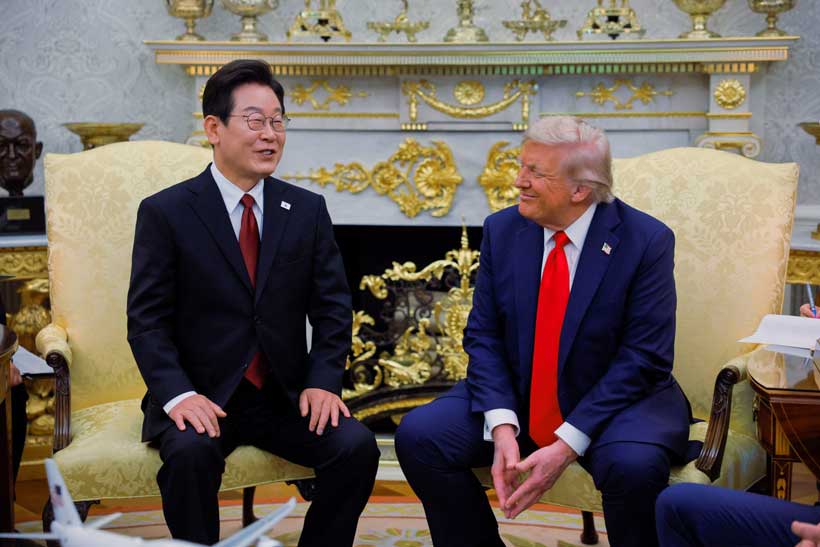
Yes. The US South Korea relationship has not broken down under Donald Trump, but it has become more transactional, cost focused and strategically uncertain. The latest decision to scale back joint military exercises highlights a broader evolution in which Washington increasingly expects Seoul to shoulder more of the alliance burden while seeking greater flexibility for US forces across the region.
From deterrence to deal making
Trump’s approach to South Korea has been shaped heavily by his personal diplomacy with North Korean leader Kim Jong Un. His first term moved rapidly from threats of “fire and fury” to unprecedented summits with Kim, followed by the suspension or redesign of major US South Korean military exercises.
Although the Hanoi summit collapsed without a denuclearisation agreement, Trump has continued to emphasise his relationship with Kim. His latest instruction to reduce joint exercises therefore carries significance beyond cost savings. It signals that Washington may once again be willing to modify elements of its alliance posture in pursuit of diplomatic space with Pyongyang.
The strategic environment, however, is very different from 2018. North Korea has expanded its nuclear and missile capabilities and strengthened military cooperation with Russia. Reducing exercises therefore creates a more complicated calculation for Seoul: diplomatic engagement with Pyongyang may reduce tensions temporarily, but weaker military preparedness could also increase the risks associated with North Korea’s growing capabilities.
Stay ahead of the geopolitical week.
MD Briefing delivers expert analysis across five global fronts — the Indo-Pacific, energy, geoeconomics, European security, and the Middle East — every Monday morning. Free.
The alliance is becoming more transactional
The clearest transformation under Trump is arguably the growing emphasis on burden sharing.
Trump has repeatedly questioned the cost of maintaining roughly 28,500 US troops in South Korea and has pushed Seoul to contribute more to its own defence. The existing cost sharing agreement requires South Korea to contribute about 1.52 trillion won this year toward the upkeep of US forces.
For Washington, the argument is straightforward: South Korea is wealthy enough to assume a greater share of the financial and military burden. For Seoul, however, the US military presence remains central to deterring North Korea.
This creates a fundamental tension. The alliance is still strategically valuable to both sides, but Trump increasingly approaches it through a cost benefit framework rather than solely through traditional alliance commitments.
Defence cooperation is expanding even as exercises face pressure
The apparent contradiction is important. Trump is seeking to reduce certain military exercises while South Korea itself is increasing defence spending.
President Lee Jae Myung has pledged a larger security role and increased defence spending, while continuing to insist that Washington’s security commitment remains firm. Seoul has also sought greater strategic autonomy, including greater latitude over nuclear fuel technology and faster progress toward transferring wartime operational control.
This suggests that the alliance may be evolving rather than simply weakening.
South Korea appears to be preparing to assume greater responsibility for its own defence, while Washington wants the alliance to become more flexible and potentially address security challenges beyond the Korean Peninsula.
That latter objective is particularly sensitive for Seoul. The United States increasingly views its Asian alliances through the broader strategic competition with China, while South Korea remains primarily focused on the immediate threat from North Korea.
Trade has become inseparable from security
Under Trump, economic relations have also become an increasingly important component of the alliance.
Washington’s tariff pressure has pushed Seoul toward major investment commitments in the United States, including the $350 billion investment pledge associated with tariff relief. South Korean companies have already invested heavily in US semiconductors, batteries, electric vehicles and shipbuilding.
But disagreements over how the investment should be structured have exposed the limits of Trump’s transactional approach. Seoul has warned that demands for large upfront cash commitments could place pressure on its economy.
The detention of hundreds of South Korean workers during an immigration raid at a Hyundai LG battery project in Georgia further demonstrated how economic and political tensions can spill directly into the strategic relationship.
The result is an alliance in which security guarantees, trade concessions, investment and troop costs increasingly form one interconnected negotiation.
The deeper problem is strategic uncertainty
The central challenge for Seoul is not simply whether Trump wants fewer exercises. It is whether Washington’s definition of the alliance is changing.
For decades, the US South Korea alliance rested on a relatively clear bargain: Washington provided extended deterrence and military forces, while Seoul contributed financially and militarily to maintaining the security architecture.
Trump’s approach introduces more conditionality into that bargain.
If military exercises can be reduced because they are considered too expensive or diplomatically inconvenient, Seoul has to consider how predictable the US commitment remains. At the same time, Washington expects South Korea to spend more, invest more and potentially assume greater responsibility.
This could ultimately produce a stronger South Korean military, but it could also create greater uncertainty about the role of the United States.
What this means for China and the Indo Pacific
The evolution of the alliance also has implications far beyond the Korean Peninsula.
Washington wants greater flexibility for US forces stationed in South Korea to respond to regional contingencies, particularly those involving China. Seoul, however, has historically been reluctant to become directly involved in a confrontation over Taiwan.
That creates a structural divergence in strategic priorities.
For Washington, South Korea is increasingly part of a broader Indo Pacific security network. For Seoul, the primary purpose of the alliance remains deterrence against North Korea.
Trump’s transactional approach therefore forces South Korea to navigate between two competing imperatives: maintaining the American security umbrella while avoiding excessive strategic dependence on Washington’s wider confrontation with Beijing.
The alliance has changed, but it has not collapsed
Trump has not dismantled the US South Korea alliance. Instead, he is redefining its terms.
Military exercises are being reconsidered, defence burden sharing remains contentious, trade and investment have become bargaining instruments, and Washington increasingly expects Seoul to assume greater responsibility for regional security.
For South Korea, this creates both a risk and an opportunity. Greater defence spending and military autonomy could make Seoul less dependent on American forces. But if Washington simultaneously reduces visible commitments while demanding greater financial and strategic contributions, Seoul could find itself paying more for an alliance that feels less predictable.
The most important question, therefore, is not whether Trump is weakening the alliance. It is whether he is transforming it from a traditional security partnership into a transactional strategic bargain.
If that transformation continues, the US South Korea alliance could survive Trump, but it may emerge fundamentally different from the alliance Washington and Seoul built over the past seven decades.
With information from Reuters.