The Dodgers are better than you. They’re smarter than you. They’re richer and deeper and more popular than you. You know it, they know it, there’s no point pretending otherwise.
So, yes, they went into the National League Divisional Series looking past the threadbare Atlanta Braves and thinking about the National League Championship Series.
Who does that? In the playoffs?
Your two-time World Series champions with the world’s best starting pitching rotation and a 1-0 NLDS series lead, that’s who.
The way the Dodgers did the math, it made sense to save their ace of aces, Yoshinobu Yamamoto — who last postseason went 5-1, had an ERA of 1.45 and 33 strikeouts in six appearances and won the World Series MVP — for Game 3 of the NLDS.
Not for the tone-setting Game 1 and, potentially, Game 5 on regular rest.
But Game 3.
Because to the Dodgers, that’s not even much of a calculated risk. It was a math problem specific to them, before they beat the Atlanta Braves 5-3 in Game 1 in 100-degree heat Saturday afternoon.
They figured they’d be able to throw two consecutive left-handers at the lefty-averse Braves lineup, starting Saturday with recently acquired two-time Cy Young winner Tarik Skubal, followed Sunday by Blake Snell, also a two-time Cy Young winner.
Additionally, this way they could have Yamamoto pitch Tuesday on the road, where his ERA is 1.77 instead of at home, where it’s 3.13. And where he’s given up 14 home runs compared with six on the road, where he’s made four fewer starts.
But mostly the Dodgers’ calculus was that having Yamamoto pitch Game 3 means it will line up so that they’ll have him for Game 2 in the NLCS and, if necessary, Game 6 against the Milwaukee Brewers or San Diego Padres. (Or, if you really want to plan ahead — and the Dodgers with their leaky bullpen absolutely should not — for Game 1 of the World Series.)

“That just sets up the rotation and Yamamoto better looking forward,” Dodgers manager Dave Roberts explained before Saturday’s game.
“Not discounting this series, because you’ve got to win this series first, but you start from the fact that they’re all going to pitch — the three [Skubal, Snell and Yamamoto] are going to pitch for sure … and then what sets them up going forward.”
It feels like a faux pas, to be that forward-thinking, and to be saying the quiet part out loud!
“If you can kind of line it up in such a way to give guys ample rest, it puts you in a better position for more options down the road,” Roberts said. “That’s kind of some of the math we had.”
I mean, it adds up. And for these Dodgers — whose fourth starter, Tyler Glasnow, was a key cog in last year’s World Series-winning rotation — it’s a fair assessment.
Though it’s nice of Roberts to pay enough lip service that he’s not totally discounting the best-of-five current series they’re in.
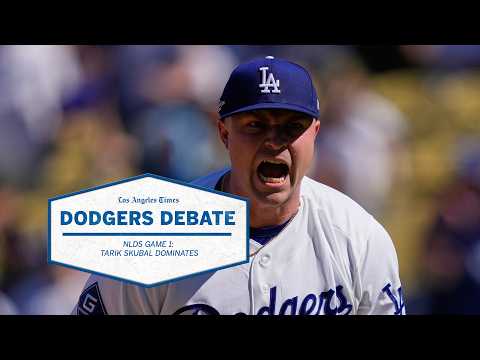
Predictably on Saturday, Skubal, who previously had a 2.04 ERA, a 0.73 WHIP and 56 strikeouts in 39⅔ playoff innings for the Detroit Tigers, brought his own October heat.
The 29-year-old from Kingman, Ariz., gave up just one run and two hits, walked two and struck out seven — giving him 64 in the postseason, the second most in his first seven postseason appearances behind only Bob Gibson (74), per MLB’s Sarah Langs.
Skubal retired 15 consecutive, hit 101 on the radar gun in the second inning and didn’t have a three-ball count until the fifth inning.
“We knew,” Braves manager Walt Weiss said, “it was going to be a rough ride.”
But Weiss did not know, immediately after Saturday’s loss, when he’d be able to deploy his sole ace, 37-year-old Chris Sale, the 10-time All-Star who just pitched in the Braves’ Game 3 wild-card closeout.
“To me it’s not that big a deal when he pitches,” Weiss said. “The Dodgers can’t win it in two.”
A true statement and a matter of fact: The Dodgers can’t win in two, but they’re not shy about expecting to win.
“It’s prudent to kind of map out potentially how they could line up,” Roberts said Friday. “And that’s just doing your due diligence.
“We are very fortunate because we have four guys essentially that you could really kind of pick through to figure out what’s the best way to deploy all four starters, that’s the exercise. But it starts with having four talented guys.”
Andrew Friedman, the Dodgers’ president of baseball operations, reveled in the notion that his club might actually be disproving the rule that you can never have enough pitching — at least when it comes to their elite quartet of starters.
And that, Friedman said, “is very impactful for quality of life.”
And the Dodgers aren’t afraid to say it.