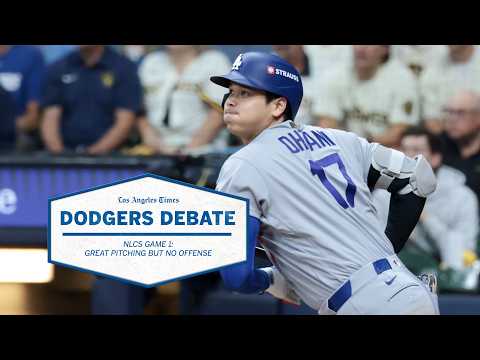
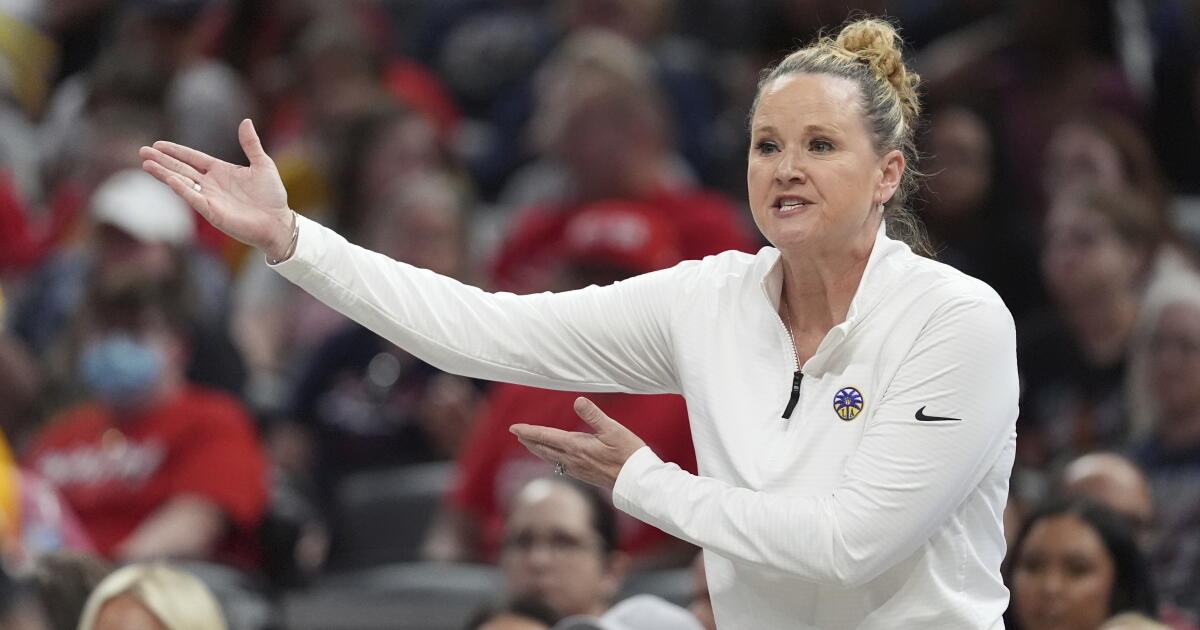
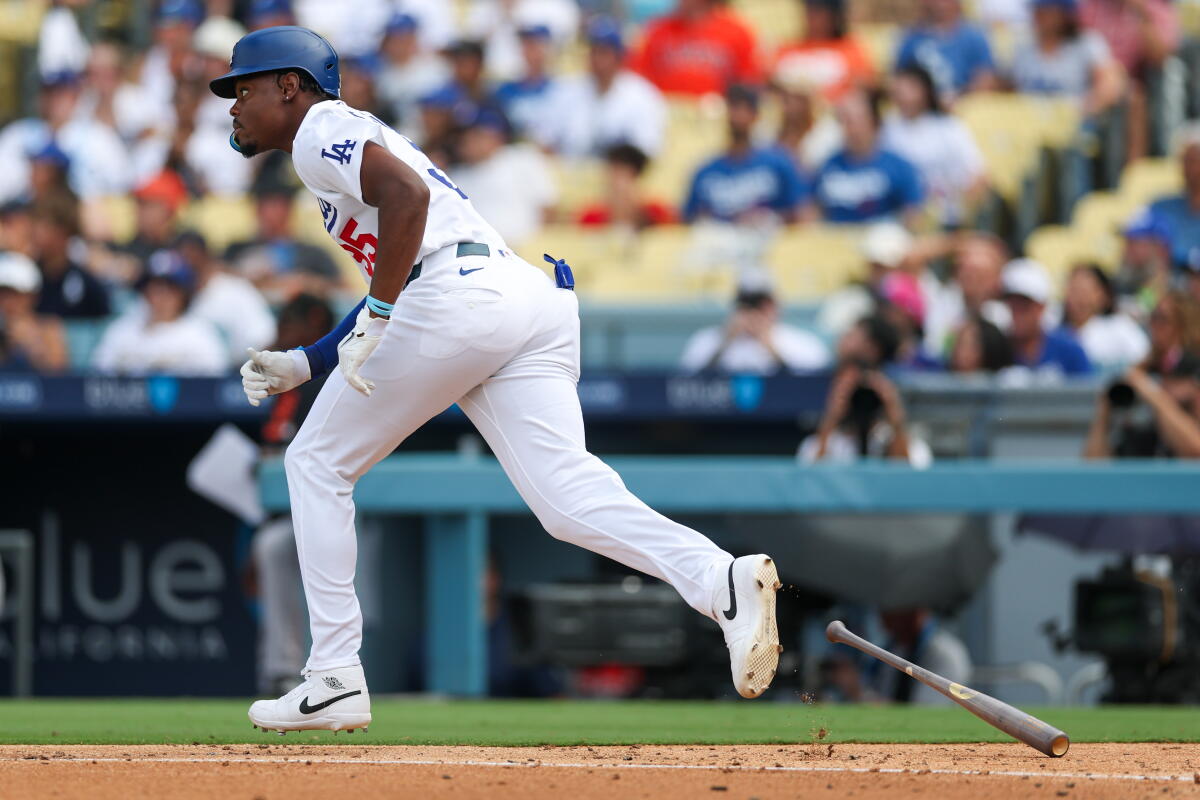
Let’s take you through the critical decisions Roberts made Wednesday night, the ones you second-guessed at home. They all pretty much backfired on him.
Situation: In the third inning, and again in the fifth inning, Tommy Edman comes to bat with Miguel Rojas on first base, none out, and the Dodgers trailing, 1-0. By the end of the fifth, the Dodgers had gone nine consecutive innings without scoring, and with a game plan of getting ahead before the Brewers’ vaunted bullpen could take over. Roberts does not ask Edman, one of the team’s most accomplished bunters, to sacrifice the runner into scoring position.
Roberts: “I just didn’t feel like giving up an out right there. … We could have bunted, but I felt I wanted to give Tommy an opportunity to drive in a run. … We haven’t been getting hits with runners in scoring position (3 for 32 in the postseason). To give up an out, to bank on getting a hit with runners in scoring position, I’d rather just try to maybe slug, hit a double.”
Result: Edman flied out both times. The Dodgers did not score in either inning.
———
Situation: In the sixth inning, with the Dodgers still trailing, 1-0, the Brewers turn to Abner Uribe, who had faced 26 batters and walked two in the postseason. Uribe walks the first two batters, and Roberts deploys his primary left-handed bench threat, Max Muncy. That takes right-handed Andy Pages out of the game; the only Dodgers with more hits than Pages this October are Kyle Tucker and Mookie Betts.
Roberts: “Abner is death on righties. You’re trying to guard against — you want to keep the inning going, and you don’t want a double play ball. Muncy’s not starting, and you want to fire that bullet in a leverage spot. First and second base, nobody out, it gives us the best chance to keep the inning going, in my opinion, and it gets Shohei up, and you have a chance to build an inning.”
Result: Muncy struck out.
———
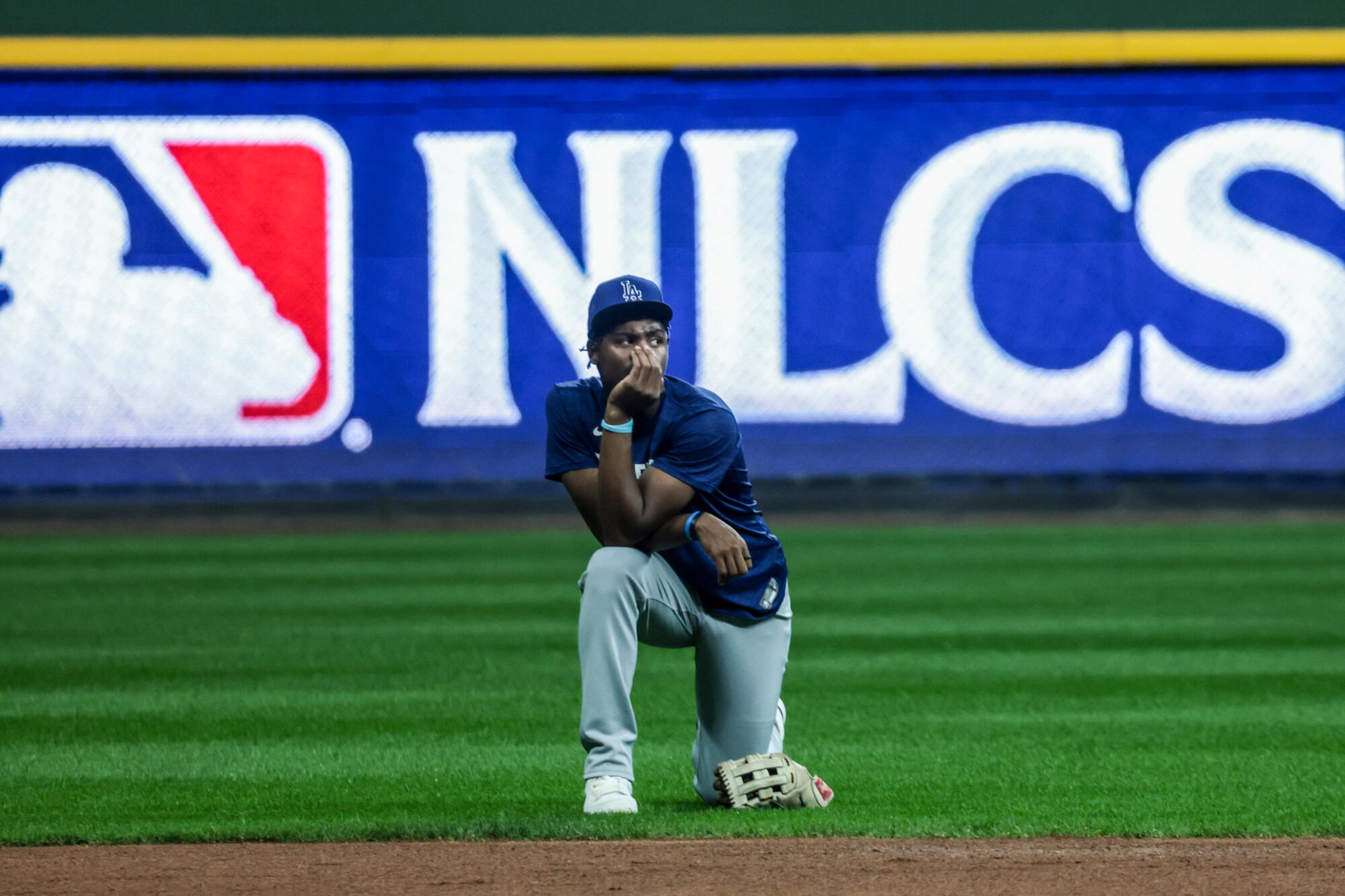
Josue DePaula’s presence was wasted in Game 3.
(Robert Gauthier/Los Angeles Times)
Situation: After Muncy, Ohtani walks to load the bases, and Will Smith follows with a two-run double to give the Dodgers a 2-1 lead. With the right-handed Rojas due up, Roberts opts for the left-handed Josue De Paula as a pinch-hitter. Brewers manager Pat Murphy promptly replaces Uribe with left-hander DL Hall, who had been warming up. Roberts counters with the right-handed Kiké Hernández.
Roberts: “It’s a decision: Do I want Uribe facing Rojas? Then I chose De Paula, and they made the move. At that point in time, I felt we had the matchup advantage with Kiké. … For me, all the experience that Kiké’s had, I feel very confident with Kiké taking a bat with a guy on second and third, infield in.”
Result: Hernandez struck out, and so did Edman. The inning was over, and the Dodgers would not advance another man past first base the rest of the evening. The Dodgers could have used De Paula to bat against right-handed closer Trevor Megill in the ninth inning, but Roberts had already burned him.
Murphy said Uribe was coming out after Smith’s double no matter what — at that point, Uribe had thrown six strikes and 14 balls — so Roberts could have saved De Paula had he waited to see what Murphy would do.
———
Situation: Blake Snell has retired 14 consecutive batters entering the seventh inning, with the Dodgers leading, 2-1. It’s the first time the left-handed Snell has pitched beyond the sixth inning this season, with the right-handed Andrew Vaughn leading off and the left-handed Jake Bauers and Garrett Mitchell to follow. Evan Phillips is warming up in the Dodgers bullpen.
Roberts: “His stuff was really good. I don’t think they were seeing him well. I was trying to get him three more hitters. We had Evan for that fourth hitter.”
Result: Vaughn walks, on six pitches. Bauers homers, on 11 pitches. The Brewers have the lead, 3-2.
Roberts: “Hasn’t given up a homer all year, but it just — it’s baseball. For me, I felt good with where Blake’s stuff was at. You’ve got to give Bauers credit.”
Situation: By that time, Snell is at 99 pitches, two shy of his season high, after the exhausting battles with Vaughn and Bauers. Roberts sticks to his plan: Snell for Mitchell, then Phillips for the right-handed Cooper Pratt.
Result: Mitchell homers, giving the Brewers a 4-2 lead. Hall and Megill combine for 3 1/3 innings of scoreless relief, and the Dodgers are one defeat from winter vacation.
The Dodgers never waver in their game plan for the regular season: win enough games to secure a bye in the opening round of the playoffs and, in so doing, afford players all the down time they need during the summer to be in top form come fall. They do not need to hurry anyone off the injured list so they can squeak out another National League West title.
Unfortunately for the Dodgers and their increasingly perilous hope of a three-peat, they did not follow that game plan with Shohei Ohtani. The Dodgers failed Ohtani this summer, and now all that remains is for them to cross their collective fingers and hope for the best.
Hope, as they say, is not a strategy.
The Dodgers should drop Ohtani from the postseason roster.
Amid headlines about how the Dodgers might have benched Ohtani for Game 3 of the NL Championship Series, manager Dave Roberts said the thinking was more about coupling Tuesday’s day off with a second consecutive day of rest.
“It was never a benching,” Roberts said.
Roberts drew a parallel between what might have happened with Ohtani and what did happen with Freddie Freeman during the NLCS two years ago, when the Dodgers provided what the manager called a “reset” — a day off for the team, followed by a rest day for Freeman.
“And he ends up winning the MVP in the World Series,” Roberts said.
Freeman had been playing with a bad ankle for three weeks, and even then he had been more productive that October than Ohtani has been in this one. Ohtani has been playing with a bad knee and biceps for three months, and the Dodgers already have tried intermittent rest.
They tried that in September, twice. They touted their bye week before the start of the playoffs. They talked up their three days off before the start of the NLCS.
They went 0 for 4. Enough already.
Roberts said the Dodgers — not just Ohtani, but the coaching staff and the training staff — see progress. True, no doubt. But we’ve heard similarly encouraging words after each of Ohtani’s rest breaks.
“We’re listening to Shohei, and we’re going to support the crap out of him and believe in him,” Roberts said, “and that’s it.”
Ohtani said Tuesday that his symptoms have subsided since the Dodgers put him on the injured list, for the minimum stay. That was a month ago.
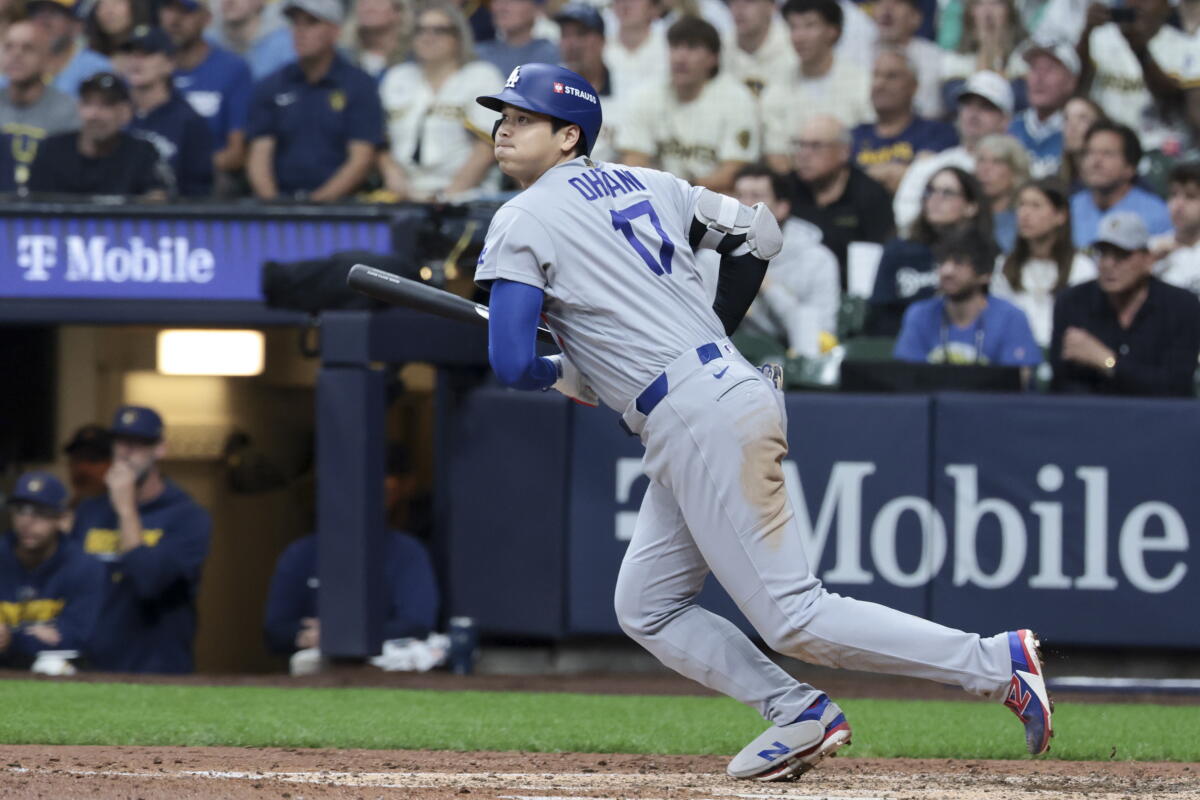
Shohei Ohtani is just three for 20 this postseason.
(Robert Gauthier / Los Angeles Times)
On Tuesday, he said his approaches can alternate between “focusing on reducing the symptoms and getting rid of the pain and/or just making sure that I’m moving well in the swing.”
There is no evidence so far that this might work, and an uncomfortable and increasing body of evidence that it might not.
Ohtani is batting .150 in the playoffs, with three hits in 20 at-bats. Of the 39 players with at least 20 at-bats this postseason entering play Tuesday, only three have a lower OPS than Ohtani’s .411.
One of them, Dodgers catcher Will Smith, has one hit in 23 at-bats. But he is hitting the ball hard: in the NLCS, one ball hit at 102 mph, another at 101, and every ball hit harder than the one Ohtani hit the hardest.
That exit velocity: 86 mph.
He has not pulled a ball in the series for a hit, or for an out.
Over his major league career, he has homered once every 14 at-bats.
He has not hit a home run since Aug. 18, a span of 107 at-bats. He has driven in one run since then; the Dodgers batted him cleanup in Game 2.
And, since hitting that last home run, Ohtani is batting .036 against fastballs thrown 95 mph or harder. The average fastball in this postseason: 96.2 mph, according to analyst Mike Petriello’s close-up of all the different ways Ohtani’s swing is fouled up.
When Ohtani spoke with reporters before the playoffs started, he said he might not know the full extent of his injuries or what he might need to do to rehabilitate them until after the postseason.
“I haven’t been able to get a good grasp of the root cause of all this,” he said then. “I think that process is going to happen during the offseason, when I’m going to have a little bit more time to be able to address it. But as of now, it’s something I’m just going to have to manage.”
The Dodgers did not need Ohtani to win the NL West. They needed to shut him down for an extended period to maximize their chances of winning in October.
They failed to do that. They believed a few days of rest would allow them to nurse Ohtani through the rest of the season.
Shohei Ohtani emerged from the visiting dugout at American Family Field with a bat in his hand, and the mass of media members scattered in foul territory up the third-base line shifted his way, pulled by the magnetic force that is Ohtani’s stardom.
Monday marked the third straight day Ohtani had hit on the field, after a multi-round session off the pitching machine on the workout day and batting practice before each of the first two games of the National League Championship series against the Milwaukee Brewers. But the novelty of the move — Ohtani only took batting practice on the field a few times during the regular season, always in the midst of a slump — had yet to fully wear off.
“The results, take full responsibility,” Ohtani said through interpreter Will Ireton on Tuesday. “That’s all I can really say, why the results haven’t been where I wanted it to be. But I think there’s different approaches to this, whether that be focusing on reducing the symptoms and getting rid of the pain and/or just making sure that I’m moving well in the swing.”
That break of routine for the start of the NLCS did not pay off in terms of results. But after a conversation with Ohtani, manager Dave Roberts said Tuesday that he felt “great” about playing Ohtani in Game 3 of the NLCS, even though Ohtani is still physically compromised by nagging right biceps and left knee problems.
“He’s adamant he feels good enough to be in there,” Roberts said. “He’s close to finding something with his swing. … Yeah, he wants to be in there and help us win a ballgame and win a championship. Great conversation, and I’m excited about having him in there.”
Roberts made clear that he wasn’t ever considering “benching” Ohtani, but rather weighing whether it would make sense to give him a couple days to “reset,” similar to how they approached Freddie Freeman’s ankle injury in 2024, giving him two days off during that postseason run.
“The symptoms have subdued a lot, especially when I was on the IL, spending that time just being able to reduce the symptoms,” Ohtani said. “As of now with the swing, it’s a daily process of trying different things, different feel on a daily basis.”
Though Ohtani’s arrival kicked off the Dodgers’ back-to-back championships, this isn’t his first time slumping in the postseason. His bat went quiet in the 2024 World Series (two for 19). And between his two-homer game to open last year’s wild-card round, and Game 4 of the NLCS when the two-way star authored the best individual game ever played, he went four for 33.
The difference this time is Ohtani, who has hit three singles in 20 postseason at-bats, isn’t fully healthy. But he was adamant that he would still be able to find a way to produce regardless.
“Over the course of this long season, there’s only really a short period of time when my mechanics is completely in sync,” he said. “So it’s just really kind of just going back and forth, finding the right parts of the swing and managing just the different parts of the swing. So it’s a constant, ongoing process that’s headed in the right direction.”
When healthy, Ohtani has the ability to break out of even the most dire of slumps with an otherworldly performance, like that three-homer (as a hitter), 10-strikeout (as a pitcher) all-timer. Opposing pitchers still have taken a cautious approach to facing him.
This version of Ohtani, however, hasn’t hit a home run since Aug. 18, a little over three weeks before he landed on the injured list. He’d played through nagging knee and biceps injuries for most of the season. But by the first week of September, the Dodgers could no longer argue that his poor performance wasn’t necessarily connected to his ailments.
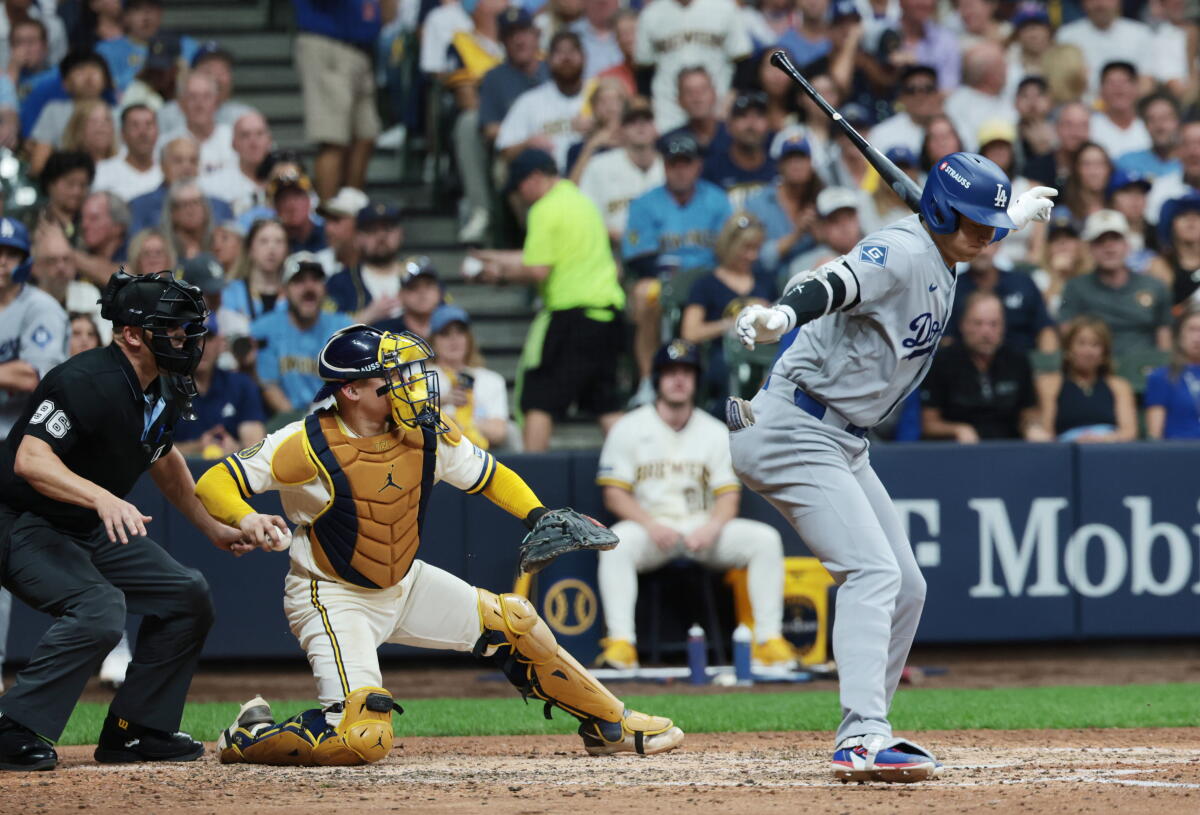
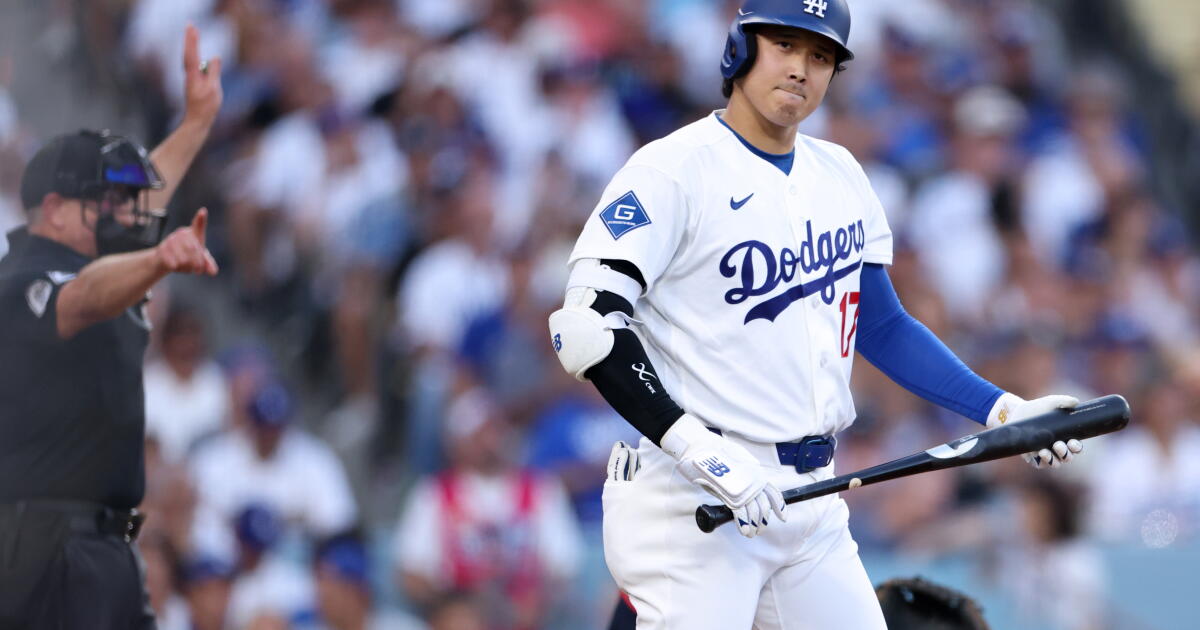
Shohei Ohtani strikes out during the sixth inning of Game 2.
(Robert Gauthier / Los Angeles Times)
Now, the stakes are as high as ever. Trailing the Brewers 2-0 in the best-of-seven series, the Dodgers desperately need to put themselves in the best possible position to win Game 3 and avoid four straight win-or-go-home contests. And to do so, they need to know what kind of production Ohtani is physically capable of.
“I’ve never wavered in my belief in him,” Roberts said. “The work that he’s putting in — shoot, he squared the bunt in Game 2 to potentially get on base. That just speaks to whatever it takes to help the team win. He’s always been about the team, whether it’s hitting first, second, fourth, or wherever, right? So for me, just hearing his conviction, that’s what I wanted to hear.”
The communication between Ohtani and the team on injuries has been a work in progress in his third year with the Dodgers.
“We certainly had a lot of communication with him throughout the year, and worked together really well in terms of how to go about this,” president of baseball operations Andrew Friedman said in late September.
“And I think in his mind, he just thought that what he was dealing with was more minor, because it wasn’t like he would see a doctor and go, ‘Oh my God, you have this ailment.’ There were just a number of different things that were bothering him. And I think in his mind, he thought the best way to help the team was to go out and play, which I respect. But us staying really connected and sharing that information, I think, will be really important going forward.
“And again, the communication back and forth has been awesome. The fully sharing exactly how he’s feeling, maybe not as awesome. But again, I would rather [have] that with a guy than the other side of that.”
So, Ohtani kept trying to work his way back to the mound for weeks after receiving a lubricating Orthovisc injection in his knee at the beginning of the All-Star break. And when his biceps injury flared again, and the discomfort extended up through his neck, the Dodgers put off an IL move as long as possible.
Roberts said Ohtani’s conviction lined up with what the manager was hearing from the Dodgers hitting coaches and medical staff.
“No one knows what’s going to happen tomorrow and the ensuing days,” Roberts said. “At the end of the day in this big moment, we’re listening to Shohei, and we’re going to support the crap out of him and believe in him, and that’s it.”
Strictly Come Dancing star Lawrence Robb has filmed his temporary exit as Mack Boyd on the ITV soap, and now scenes have confirmed how he is leaving as he takes a break
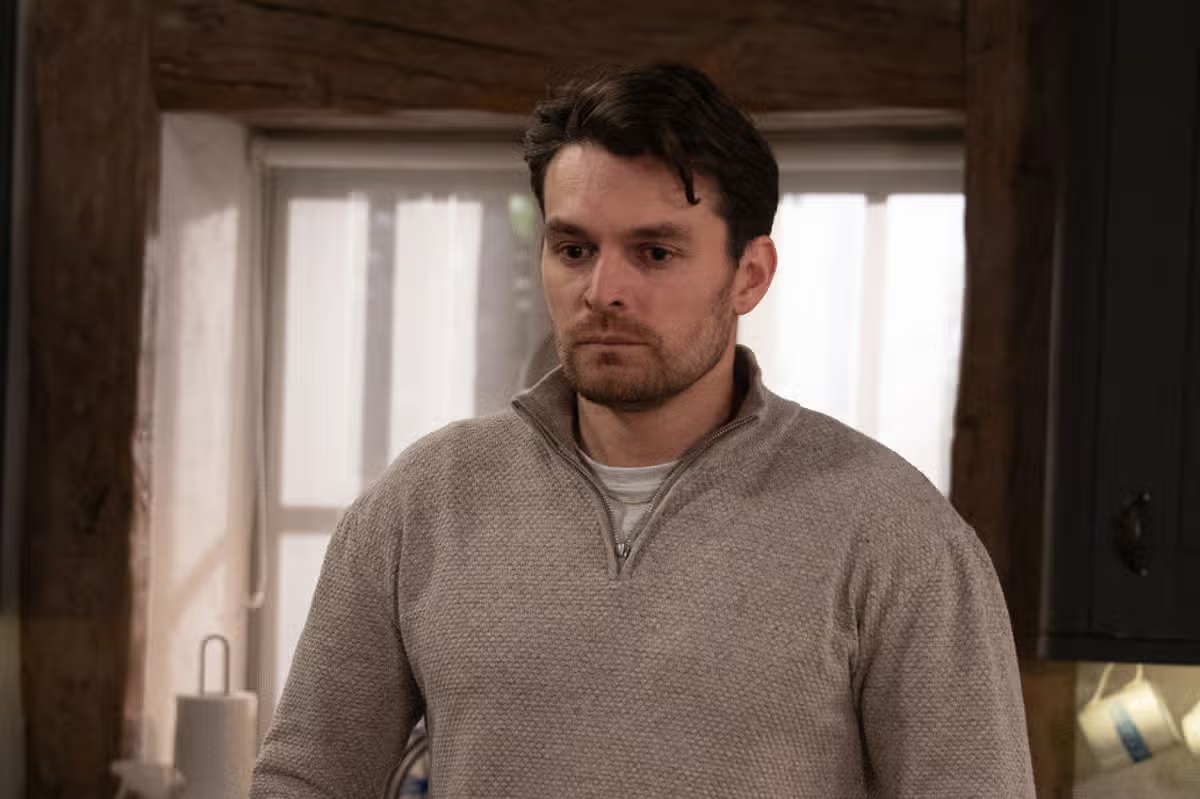
Mack in Emmerdale is leaving the village very soon, and now we know his exit plot(Image: ITV)
Mack in Emmerdale is leaving the village very soon, and now we know his exit plot.
Actor Lawrence Robb is currently taking part in Strictly Come Dancing, and so he’s taking some time out from filming. He will be offscreen for a few months, and now the latest episode has explained what happens to Mack.
It’s all Robert Sugden’s decision for him to leave the village, and not everyone is happy about it. It’s a pretty random exit, but it appears farm owner Robert is paying for Mack to go on a course in Germany.
In the episode, Robert told his partner Aaron Dingle and Mack’s nephew Matty Barton that he was sending Mack on the course the next day. They were shocked as he said he was sending him to Germany for the course to benefit the farm.
Later in the episode, Mack sat down with his wife Charity Dingle and repeated the news to her. Charity said Robert could “get stuffed”, and told her husband not to go, amid her drama with her prison ordeal.
Mack explained it would be good for him and the farm, and would help him in the future. He was keen to go and Charity reluctantly accepted it.
She then confessed she would be happy to visit him in Germany while he was away, with her son Noah Dingle leaving there. Mack explained it would be for a few months and he would then return.
So that’s it, this is exit confirmation for Mack. This confirms exactly why and how he is leaving, paving the way for actor Lawrence to film BBC’s Strictly.
Recently, the Mirror caught up with Lawrence’s co-stars Jeff Hordley and Katie Hill about Lawrence taking on the series. Speaking about their co-star, Katie shared: “I think he was brilliant.
“I think everyone will love him. He’s such a lovable person. He’s so positive. He’ll give it his best go. I think he’s going to be incredible.” Jeff added: “He’s a joy. I share a dressing room with him, and he’s just such a lovely man.
“We all love him and we all want him to do brilliantly, and I think he will because he’s a really dedicated human being. He’ll give it 110 per cent. He’s done musical theatre so he’ll know how to shake those hips.”
When asked if they were backing Lawrence, Jeff quipped: “If it goes on a personality contest, Lawrence will win hands down. I don’t know about the dancing, but we’ll see.”
MILWAUKEE — The Dodgers have a big hole in the middle of their batting order, and it’s not Shohei Ohtani.
If anything, Ohtani has reemerged as an offensive force in the cleanup spot, singling, walking and scoring the Dodgers’ only run Sunday in a 2-1 loss to the Milwaukee Brewers in Game 1 of the National League Championship Series.
The problem is with the guy hitting in front of Ohtani.
Will Smith walked in four plate appearances, marking just the second time he’s reached base in the postseason. In the four division series games against the Atlanta Braves, he had a single in 16 at-bats, striking out seven times. He’s hitting .053 in the playoffs — only Cleveland’s Ángel Martínez has a lower average among players with at least nine at-bats.
But there’s not much the Dodgers can do about it. They are built to win with pitching and Smith, the catcher, is the guy they rely on to guide those pitchers through games.
Dalton Rushing, who started just five fewer games behind the plate than Smith this season, is injured and not on the roster. Hunter Feduccia, who did make the team, caught just 15 complete games this season and isn’t an option to start in the playoffs.
“I’m not going to put Feduccia in place of Will Smith,” Dodgers manager Dave Roberts said. “That’s just not going to happen.”
So Roberts and the Dodgers are left to muddle on with Smith regardless of how much he struggles offensively. That’s because he’s far more valuable crouching behind the plate than standing next to it.
“I don’t even know how he’s performing offensively,” said Tarik Skubal, who took the loss Sunday. “Catchers, I think it’s the most important position on the field. They’re the ones calling pitches, dictating game flow, rhythm, all that type of stuff. I’m going to trust those guys always.”
Smith appears to be executing his catching duties very well, since opponents have scored just 10 runs and are hitting .160 against the Dodgers this postseason. Only Tampa Bay, which has played two fewer games, has done better.
As for what Smith thinks, that’s unknown because the Dodgers did not make him available to the media Sunday. But since he’s not coming out of the lineup, the next-best solution might be moving him to another spot in the order.
That worked with Ohtani, who had as many strikeouts as hits in the first two games of the division series, when he batted second. Since being dropped in the order, he has reached base four times in three games, stolen a base and scored twice.
“There’s always lineup construction. I can think it through. He’s not swinging the bat well,” Roberts said of Smith. “It’s hard because of the body of work, he just has that knack to get a hit, to get a big hit.”
Smith was on the injured list for 86 days this summer because of neck disk inflammation, returning for the final month when he slashed .290/.400/.548. He has cooled off considerably in October, just as he did last year, when he returned from a right hand contusion three games into the playoffs and got just two hits in his first 14 at-bats.
He recovered to bat .400 in last year’s NLCS win over Milwaukee, then broke a 4-4 tie with his winning homer against the Toronto Blue Jays. Just as important, though, Smith caught all but 11 innings in the Dodgers’ final 15 postseason games — including two 11-inning games and another that lasted 18 innings.
Smith rarely has hit well in the postseason, batting just .206 in 18 series, which may explain Roberts’ lack of panic. Plus, Roberts knows his All-Star catcher has helped him win three World Series rings, and if the Dodgers are to get another, it will be on the strength of their pitching, not their hitting.
And that side of Smith’s game is as strong as ever.
“To be honest, that’s not where my focus is with Will,” Skubal said of his catcher’s hitting. “My focus is what he’s doing behind the dish and he’s very important. He’s very important to the entire pitching staff.”
ATLANTA — Dodgers superstar Shohei Ohtani took the news that he was hitting fifth in Game 3 of the National League Division Series so well that he responded with a joke.
As manager Dave Roberts tells it, when he laid out his thoughts on the lineup against Braves ace Chris Sale, Ohtani said, “In all honesty, I was going to come to you in September and say, why don’t you hit me seventh?”
Regardless of how poorly Ohtani has hit lately, the news came as a shock on Tuesday. And it reflected the aggressive read-and-react approach Roberts is going to take with the best-of-five series tied through two games.
Fifth is the lowest Ohtani has ever hit in the Dodgers’ starting lineup. He hasn’t hit fifth or lower in a starting lineup since 2020 with the Angels.
For most of the season, through ups, downs and injuries, Ohtani has led off. When he returned from the injured list with five games left in the season, Roberts started batting him second against left-handed pitchers, with right-handed hitting Mookie Betts batting ahead of him.
But in eight postseason at-bats so far, Ohtani has recorded just two hits, both singles.
“This is just a Sale thing, and also who I feel is going to come out of the bullpen tonight,” Roberts said, making clear that he doesn’t plan to bat Ohtani fifth against all left-handed pitchers in the postseason. “So [Wednesday] versus [right-hander Tyler] Mahle, it will look different.”
Against Mahle, however, Roberts said Ohtani won’t necessarily lead off, citing Mahle’s neutral-to-reverse platoon splits. But Ohtani won’t hit fifth, Roberts said. Sale is a special case.
The last time the Dodgers faced Sale, he shut them out for nine innings. All time, Ohtani has a .517 OPS against Sale in the regular season, and he went one for seven against him this year.
“It might give him a different look, let the game come to him a little bit later,” Roberts said. “I don’t think it’s a pressure thing. I do think it’s something where he wants to do more. But in that same breath, I do think that there’s going to be a couple big spots today where he’s going to be at bat.”
In the Dodgers’ first two postseason games, Ohtani’s plate discipline has wavered, making it difficult to pinpoint the root of his struggles. Does it all come down to approach? Could his nagging left knee and right biceps problems be contributing to his poor performance?
The Dodgers aren’t looking for him to be the hero every game, and trying to do so could even exacerbate his problems at the plate. For the lineup to click, however, he does need to be more productive.
“He’s a very good self-evaluator, a very extremely high competitor and expects a lot from himself,” Roberts said. “I still think he’s very confident. But Sale’s a different monster. He’s tough, certainly against lefties.
“But I still think [Ohtani’s] confident. So now with that, just getting him back in the zone — and that’s easier said than done, I understand that.”
On Tuesday, Roberts also inserted right-handed hitting Kiké Hernández into the lineup, batting ninth and playing third base. And he kept right-handed hitter Miguel Rojas in the lineup, moving him from third to second and starting utility player Tommy Edman on the bench. Left-handed hitting third baseman Max Muncy will also be available off the bench.
“Tommy, he’s been going through it in the last couple of months, and it’s been a grind for him on both sides of the plate,” Roberts said. “Hasn’t had a whole lot of success against Sale — the heater up, the ball down below, with a flat swing. … Getting Kiké involved right now, I think it’s added intensity, urgency. I just think he’s going to put forth some good at-bats, and you’re not giving up anything on the defensive side.”
ATLANTA — As the Dodgers mull potential lineup changes for Game 3 of the National League Division Series, manager Dave Roberts said he is “open” to moving Shohei Ohtani lower in the batting order.
In his three seasons with the Dodgers, Ohtani has batted first or second in every game he has started. However, as he has admitted he is trying to “manage” in the aftermath of knee and arm injuries, and as Roberts has acknowledged Ohtani is “not 100%,” the lack of success could compel the manager to replace him at the top of the lineup with a more productive hitter at some point.
“I would,” Roberts said Monday. “I would. I think it’s something that, you know, I think moving him from 1 to 2 — but going further than that? I’m open to it.
“And it’s something that if I do, I would obviously have the conversation with Shohei to explain why. And at the end of the day every conversation I’ve had with him is whatever’s best for the team, he’s all-in on. So I know that undoubtedly.”
The Dodgers are batting .215 through the first two games of the NLDS, with the Atlanta Braves scheduled to pitch left-handed ace Chris Sale in Game 3 on Tuesday. If the Dodgers lose, they would need to win back-to-back elimination games to advance beyond this series.
Roberts said the lineup changes he would consider include starting Kiké Hernández and Miguel Rojas, both of whom hit well against left-handers. That could mean infielders Max Muncy (0 for 7 against Sale, with five strikeouts) and Tommy Edman (0 for 11 against Sale) might not start.
Center fielder Andy Pages, who batted so poorly last October he was benched for the final three games of the World Series, is hitless in seven at-bats in this series, with four strikeouts.
“I’m gonna continue to give Andy leash,” Roberts said. “I believe in him. I feel that for us to win the World Series this year, we’re gonna need him to be an active part of our team.
Roberts said he did not envision benching catcher Will Smith, who is 0 for 8 in the series. The Dodgers’ backup catcher, Hunter Feduccia, is a career .205 hitter with no postseason experience.
But, even with the Dodgers’ star-studded lineup, the spotlight shines brightest on Ohtani.
Ohtani has not homered since Aug. 18. He hit .157 between then and the end of the regular season, striking out in 41% of his at-bats. In this series, he has two hits and two strikeouts in eight at-bats, and his inability to refrain from swinging at pitches outside the strike zone has become a glaring weakness.
“He’s not 100%,” Roberts said. “But, at the end of the day, he can still do a better job of staying in the strike zone.”
Ohtani hasn’t given the Braves a reason to challenge him within the strike zone.
“Everything orbits around Shohei, in the sense of his talent,” Roberts said. “And the Braves are going to enter with caution. And, so, knowing that, they’re going to continue to expand as long as we keep giving that to them. So until we show some discipline, they’re going to continue to kind of use that playbook.”
The Dodgers are better than you. They’re smarter than you. They’re richer and deeper and more popular than you. You know it, they know it, there’s no point pretending otherwise.
So, yes, they went into the National League Divisional Series looking past the threadbare Atlanta Braves and thinking about the National League Championship Series.
Who does that? In the playoffs?
Your two-time World Series champions with the world’s best starting pitching rotation and a 1-0 NLDS series lead, that’s who.
The way the Dodgers did the math, it made sense to save their ace of aces, Yoshinobu Yamamoto — who last postseason went 5-1, had an ERA of 1.45 and 33 strikeouts in six appearances and won the World Series MVP — for Game 3 of the NLDS.
Not for the tone-setting Game 1 and, potentially, Game 5 on regular rest.
But Game 3.
Because to the Dodgers, that’s not even much of a calculated risk. It was a math problem specific to them, before they beat the Atlanta Braves 5-3 in Game 1 in 100-degree heat Saturday afternoon.
They figured they’d be able to throw two consecutive left-handers at the lefty-averse Braves lineup, starting Saturday with recently acquired two-time Cy Young winner Tarik Skubal, followed Sunday by Blake Snell, also a two-time Cy Young winner.
Additionally, this way they could have Yamamoto pitch Tuesday on the road, where his ERA is 1.77 instead of at home, where it’s 3.13. And where he’s given up 14 home runs compared with six on the road, where he’s made four fewer starts.
But mostly the Dodgers’ calculus was that having Yamamoto pitch Game 3 means it will line up so that they’ll have him for Game 2 in the NLCS and, if necessary, Game 6 against the Milwaukee Brewers or San Diego Padres. (Or, if you really want to plan ahead — and the Dodgers with their leaky bullpen absolutely should not — for Game 1 of the World Series.)
“That just sets up the rotation and Yamamoto better looking forward,” Dodgers manager Dave Roberts explained before Saturday’s game.
“Not discounting this series, because you’ve got to win this series first, but you start from the fact that they’re all going to pitch — the three [Skubal, Snell and Yamamoto] are going to pitch for sure … and then what sets them up going forward.”
It feels like a faux pas, to be that forward-thinking, and to be saying the quiet part out loud!
“If you can kind of line it up in such a way to give guys ample rest, it puts you in a better position for more options down the road,” Roberts said. “That’s kind of some of the math we had.”
I mean, it adds up. And for these Dodgers — whose fourth starter, Tyler Glasnow, was a key cog in last year’s World Series-winning rotation — it’s a fair assessment.
Though it’s nice of Roberts to pay enough lip service that he’s not totally discounting the best-of-five current series they’re in.
Predictably on Saturday, Skubal, who previously had a 2.04 ERA, a 0.73 WHIP and 56 strikeouts in 39⅔ playoff innings for the Detroit Tigers, brought his own October heat.
The 29-year-old from Kingman, Ariz., gave up just one run and two hits, walked two and struck out seven — giving him 64 in the postseason, the second most in his first seven postseason appearances behind only Bob Gibson (74), per MLB’s Sarah Langs.
Skubal retired 15 consecutive, hit 101 on the radar gun in the second inning and didn’t have a three-ball count until the fifth inning.
“We knew,” Braves manager Walt Weiss said, “it was going to be a rough ride.”
But Weiss did not know, immediately after Saturday’s loss, when he’d be able to deploy his sole ace, 37-year-old Chris Sale, the 10-time All-Star who just pitched in the Braves’ Game 3 wild-card closeout.
“To me it’s not that big a deal when he pitches,” Weiss said. “The Dodgers can’t win it in two.”
A true statement and a matter of fact: The Dodgers can’t win in two, but they’re not shy about expecting to win.
“It’s prudent to kind of map out potentially how they could line up,” Roberts said Friday. “And that’s just doing your due diligence.
“We are very fortunate because we have four guys essentially that you could really kind of pick through to figure out what’s the best way to deploy all four starters, that’s the exercise. But it starts with having four talented guys.”
Andrew Friedman, the Dodgers’ president of baseball operations, reveled in the notion that his club might actually be disproving the rule that you can never have enough pitching — at least when it comes to their elite quartet of starters.
And that, Friedman said, “is very impactful for quality of life.”
Dodgers right fielder Kyle Tucker has never shied away from just how bad his performance at the plate was for much of his first season in Los Angeles.
For the first five months of the season, when he’d show brief glimpses of progress before sinking back into an extended slump, Tucker’s .683 OPS was the third-worst among Dodgers hitters with at least 100 plate appearances, better than only Hyeseong Kim and Kyle Freeland, who both spent time in triple A.
In September, however, he found a sustainable adjustment. He fixed his bat path, extending through the ball more consistently instead of pulling off of it. He posted a .889 OPS in September, on par with his four straight All-Star seasons before signing with the Dodgers.
Now, all of a sudden, he looks like a potential difference-maker in the postseason.
“The last month or so is more or less what I expect out of myself,” Tucker said in a recent conversation with The Times. “The biggest thing is we have an opportunity now being in the playoffs to win another World Series. Once the playoffs start, you can forget about any stats or personal numbers. The only one that really matters is the win column. So that’s just what I’m gonna try and contribute towards.”
The Dodgers offense had a lot of success stories like Tucker’s in the final month of the regular season. He helped carry the offense, along with Teoscar Hernández and Mookie Betts, who turned around their seasons down the stretch, and Will Smith, who returned from the IL and quickly found his home run swing.
The Dodgers’ starting rotation is their biggest strength going into the postseason. But the offense’s performance against elite pitching, and the bullpen’s execution in tight games, could make or break a series.
Here’s how some other key players are trending going into the postseason:
Designated hitter Shohei Ohtani: Fortunate to have the bye
Shohei Ohtani appears on the right track for a successful postseason.
(Gina Ferazzi / Los Angeles Times)
Ohtani returned from the IL with five games left in the season, and he went five for 21 with one extra-base hit.
All indications from general manager Brandon Gomes and manager Dave Roberts in video conference calls before the Dodgers’ closed workout Tuesday were that Ohtani was feeling good physically.
“I feel confident that you’re going to see the best version of Shohei of the last two months,” Roberts said. “I know that’s sort of a low bar given his injury, but I do think that he’s as healthy as he’s been in quite some time, and every day from the training staff, it keeps getting better. So, number one, he’ll be a threat being in the lineup, but I do think that the performance piece will be what we’re hoping for.”
First baseman Freddie Freeman: Ice cold
Freddie Freeman did not hit well in September.
(Ronaldo Bolaños / Los Angeles Times)
Freeman, who pushed through a bout with tendinitis in his right knee earlier this month, hit just .184 in September and went 0-for-7 in his last two games.
On Tuesday, Freeman said he had no pain in his knee. But finally acknowledged that the injury could have affected his swing mechanics, while again emphasizing that he wouldn’t use that as an excuse.
Freeman has a plan for the bye week that he hopes will set him in the right direction for the playoffs.
“I’m going to hit on the field every day,” he said Sunday. “I already know how my Tuesday is going to go. There’s going to be a lot of blocked balls to left [field], a lot of flares into left. I’m hoping as Tuesday goes Wednesday, I’ll come back and those will be put down a little more. Thursday they’ll be moved over to shortstop and by Friday I will be feeling good. That is how my head is thinking right now.”
Center fielder Andy Pages: Out of the gate running
It was hard to predict how the center fielder would look at the plate when he returned from a fracture in his left hand. He recorded a 1.181 OPS in six games and homered twice in the final regular-season series against the San Francisco Giants.
“He went into last October really scuffling, and it sort of bled into October,” Roberts said over the weekend. “Where, I think right now he feels really confident, swinging the bat well, and the hope is that this one bleeds into October as well.”
Reliever Edgardo Henriquez: Healthy
Henriquez is “trending really well” after throwing live batting practice, Gomes said. If this week continues to go smoothly, the flame-throwing right-hander is expected to be on the NLDS roster.
“Given the body of work, what he’s done, the unique skill set,” Roberts said, “could be huge for us — will be huge for us.”
Reliever Edwin Díaz: Strong finish
Díaz made five appearances after his latest return from the IL (neck). He gave up just one hit in those games, with a 52.9% strikeout rate.
“I don’t know if we could have asked much more out of Edwin,” Gomes said. “Felt like each outing was more and more sharp and looking more like himself. So feel that he’s in a great place right now. Stuff out of hand is as good as it’s been all year. And we know that he has pitched in the hottest of hot games in the past and in any role, especially in the postseason. So he’s looked great, and glad that he’s in the position that he’s in and was able to bounce back after the IL stint.”
NLDS weather: Sweltering
Los Angeles’ weather forecast for this weekend, when the Dodgers are set to host the first two games of the NLDS, shows temperatures reaching the high 90s. The Dodgers are scheduled to play Game 2 at 5 p.m. on Sunday. But Saturday’s game time will depend on the results of the wild-card round. First pitch for Game 1 could be at 1 p.m. or 6 p.m.
Those Yankees had a Hall of Fame closer. In 1998, Mariano Rivera got the final four outs of the clincher. In 1999, he got the final four outs. In 2000, he got the final three outs.
These Dodgers? Their closer? Your guess is as good as theirs.
“I do not know,” said Andrew Friedman, the Dodgers’ president of baseball operations.
This might be a good time to know, no? The regular season is over. The postseason is upon us.
“I feel very confident that we’re going to be going into October with arguably the deepest and best pitching staff that we’ve had,” he said. “Exactly what their roles will be and how things will be ordered, I don’t know right now.”
Perhaps the Dodgers are overthinking this. They have done that before.
Tanner Scott converted 25 of 29 save opportunities this season, including saves Friday and Saturday.
But the strongest hitters on the Dodgers’ possible division series opponents are left-handed — Matt Olson, Drake Baldwin and Michael Harris II on the Atlanta Braves; Bryce Harper and Kyle Schwarber on the Philadelphia Phillies — and the Dodgers may not hesitate to use the left-handed Scott against those guys in the seventh or eighth inning.
In theory, these Dodgers have three candidates as closer: Scott, their marquee closer signing for 2025 and actual closer for most of 2026; Edwin Díaz, their marquee closer signing for 2026; and Roki Sasaki, their accidental closer last October.
Yet Friedman said he could envision scenarios where Evan Phillips could close, or even Brock Stewart, or perhaps Alex Vesia against a run of left-handed hitters. The Dodgers hope to activate Edgardo Henriquez for the playoffs. The starters could close, too, especially a well-rested Tyler Glasnow early in the first round.
“We’ve got a number of guys that we really trust,” Friedman said. “Depending on who we’re playing, how deep our starter goes, there are a lot of factors that would go into it. But, more than who will be that pitcher on the mound, is the fact that we have so many candidates we feel really good about.”
That the Dodgers have improvised an October relief corps, transformed a rookie starter into a postseason closer and run bullpen games in elimination games might lead you to conclude Friedman does not really believe in the concept of a designated closer. In a world where “high leverage” is the trendy jargon, maybe a closer is more of an anachronism than a necessity.
That the Dodgers invested $72 million in Scott and $69 million in Díaz in consecutive winters would lead you to conclude Friedman does indeed believe in the concept of a designated closer. In fact, he does.
“I think it’s extremely helpful,” he said.
The Dodgers do not hold splashy news conferences to introduce closer candidates. When the Dodgers introduced Díaz last December, Friedman proudly introduced the three-time All-Star as the closer.
“For us, we have a high bar,” Friedman said then. “To name someone the closer, you have to be one of the best. You have to be elite and dominant at what you do.”
Díaz’s season went awry, limited to 18⅔ innings after elbow surgery and then a neck injury. But in five September appearances since his activation from the injured list, he gave up no runs and one hit in five innings, striking out nine of the 17 batters he faced. (In the same span, Scott has given up no runs and two hits in five innings, striking out nine of the 19 batters he faced.)
Dodgers reliever Edwin Díaz high-fives teammates in the dugout after pitching against the San Diego Padres on Sept. 22.
(Gina Ferazzi / Los Angeles Times)
“What we’ve seen out of Díaz recently has been really encouraging,” Dodgers manager Dave Roberts said. “What that ultimately means, we don’t know yet.
“Of course, if you have a reliever who is really hot in October, that can be extremely valuable. It doesn’t mean you use him exclusively in the ninth. But, by and large, that’s how you would use him.”
Roberts saluted Díaz for working hard to get back to an uncertain assignment.
“I’m really proud of Edwin, given the deal he signed, to work it out, to go to the minors, to come back and pitch in whatever role we ask of him, that shows a lot of character,” Roberts said.
“He could have mailed this year in. That’s something that has not gone unnoticed. And we’ll see how October plays out.”
The Dodgers could be forgiven for believing it will all work out in the end. Their final pitcher in each of the World Series clinchers under Friedman, all starters: Julio Urías in 2020, Walker Buehler in 2024, Yoshinobu Yamamoto in 2025.
The pitchers to record a postseason save in those championship seasons: Kenley Jansen, Joe Kelly, Brusdar Graterol, Blake Treinen and Urias in 2020; Alex Vesia, Treinen and Buehler in 2024; Glasnow, Sasaki and Treinen in 2025.
The organizational flexibility can lead to some uncomfortable discussions within the clubhouse, as Roberts and coaches keep the relievers updated on the latest plan for how they might be used.
“It is tricky,” Roberts said. “These are constant conversations. They are ever-evolving. They are ongoing.”
If all goes right for the Dodgers, those conversations will be ongoing for another month.
SAN FRANCISCO — The result of Blake Snell’s final pitch Saturday, a fastball that San Francisco Giants third baseman Shay Whitcomb lined into left field, mattered far less than the fact that the left-hander had passed the 75-pitch mark without incident.
Dodgers left fielder Teoscar Hernández threw out Whitcomb at second. And Snell walked off the field to complete a four-inning start in the Dodgers’ 4-3 win.
“Definitely needed to pitch today,” Snell said of his first start in a week and a half. “Definitely showed that. I was trying to go up and in, I was missing up and away. Even the last pitch of the game, I try to go up and in and miss right down the middle. I don’t know the last time I did that. It’s been a while.”
The Dodgers (99-62) entered locked in as a No. 2 seed for the playoffs. So, the stakes of their last two games of the regular season boiled down to health and preparation for the postseason. There was no better example of that give-and-take than Snell’s five-hit, one-run start.
Because Snell left his previous start with tightness in his left groin, the Dodgers planned for a short outing Saturday, prioritizing his health for the postseason.
“We were confident,” Roberts said of Snell’s recovery from the injury. “But it’s still good to see it. And it’s good also that we got it out of the way, that rust off — versus whatever game in the postseason, then he’s rusty, and you’ve got to kind of pick up the pieces in a playoff game. So I thought today it was really best-case scenario.”
The only run Snell gave up was the result of a double, stolen base and sacrifice fly in the third. He had three strikeouts and no walks.
Snell’s changeup was about two miles per hour faster than usual, something he wants to address before his next start. And he wants to hone the release on his curveball. But his slider, the pitch he would be most worried about if his groin injury wasn’t resolved, had promising velocity and shape.
“To throw a 92 [mph] with good horizontal break, and to see the trust I had in the back leg when throwing that, that’s a really good sign,” Snell said.
Dodgers pitcher Blake Snell throws against the San Francisco Giants in the first inning Saturday.
(Jeff Chiu / Associated Press)
Snell said he thinks he’s fully past the injury, and didn’t even think about it during the start.
“Definitely happy about where I’m at,” he said. “Now, it’s a big week for me. Catch has to be great, bullpens have to be great. I’ve really got to focus on getting in my legs, and the consistency of every throw. So to be able to pitch today and learn all of that is bigger than I could ever really express.”
Snell, who missed time because of a late spring training build-up and arthroscopic surgery in May to remove loose bodies from his left elbow, finished the regular season with just 42⅔ innings pitched. But he posted an impressive 1.90 ERA in that time.
The team considered replacing Snell’s start Saturday with a live batting practice session, Roberts said, which would have still given Snell feedback from hitters, but in a more controlled environment.
“We gave him and the training staff every out to do so,” Roberts said. “But there was a lot of confidence that he’s in a great spot.”
Snell’s recent workload was another reason for the Dodgers to be conservative with his workload Saturday. Over the past two weeks, he’s only thrown one inning.
“So there’s a balance between getting your work in, making sure you feel good coming out of it,” Roberts said. “Even for example, I could’ve pushed Tarik [Skubal in his start Friday], given his efficiency. But to me, to what end?”
Snell should be full-go for the playoffs, Roberts said. But count Snell among the Dodgers players who can benefit from the wild-card bye.
“This is still an important one,” Roberts said of Snell’s start Saturday, “to go into it feeling good, to then take that extra six, seven, eight days.”
Six to eight days off would line Snell up to start Game 2 or 3 of the National League Division Series. But Roberts declined to tip his hand on rotation order. The days off give the Dodgers extra flexibility to line up their pitching.
Mookie Betts celebrates after hitting a home run for the Dodgers in the third inning Saturday against the Giants.
(Jeff Chiu / Associated Press)
“You’re looking at, the first series, who could pitch on regular [rest], who needs extra, how potentially the next series lines up,” Roberts said. “How you can … maximize those four guys. And I do think with those four guys, it doesn’t matter the opponent, so that’s not a variable.”
Roberts also said alternating between right- and left-handers was not a variable.
“To be honest with you, you could put them all in a hat, and you could make a case for any order you put them in,” Roberts said.
Right-hander Yoshinobu Yamamoto, the stalwart of the rotation, certainly has performed to the level of a Game 1 starter, both this season and in a heroic World Series run last year.
For Game 2, it would make sense to choose a pitcher who’s comfortable starting on four days rest. Then, thanks to a pair of off days built into the series, both the Game 1 and Game 2 starters could be available to throw in an if-necessary Game 5.
Skubal has pitched on regular rest this season more than any of his rotation mates, making him a strong option to take the ball in the second game.
If the Dodgers do, indeed, go in that direction for Games 1 and 2, Snell would then be the natural choice for Game 3, on eight days’ rest. And right-hander Tyler Glasnow could take an if-necessary Game 4.
The Dodgers, however, don’t need to finalize their pitching decisions just yet.
“I love our starters,” Snell said. “I love the staff, the way we push for each other to be great and support each other. So, I can’t wait. It’s what we’ve all been waiting for, and now it’s time to prove it.”
SAN FRANCISCO — Dodgers reliever Blake Treinen is likely out for the postseason, after injuring his right shoulder warming up in the bullpen Saturday.
“I don’t know if it was a complete blowout, but really unfortunate,” manager Dave Roberts said after the Dodgers’ 4-3 win against the San Francisco Giants.
The Dodgers plan to put Treinen on the injured list Sunday, Roberts said. And he’ll undergo imaging to diagnose the injury.
“It just popped up,” Roberts said.
Treinen, 38, is the longest-tenured Dodgers pitcher on the roster. He spent over two months on the IL earlier this season with inflammation in his right elbow. But in 36 appearances this season, he posted a 3.64 ERA.
Treinen has a history of shoulder injuries and underwent right shoulder labrum and rotator cuff repair surgery after the 2022 season.
The Sparks fired head coach Lynne Roberts, ending her tenure Friday after two seasons as the franchise continues its search for a return to championship contention.
The move comes after the Sparks finished 16-28 in 2026, missing the playoffs for the sixth consecutive season. Roberts compiled a 36-49 record with Los Angeles after being hired ahead of the 2025 season after nearly a decade leading the women’s basketball program at Utah.
The team has not announced an interim head coach but will conduct a search this offseason.
“We are grateful to Lynne for the commitment and determination she brought to the role, which was evident all the way through our last game last night,” said Sparks special advisor Farhan Zaidi. “Lynne has cared deeply about our organization and for our players and their development. We sincerely thank her for everything she has invested in the Sparks and wish her and her family the best moving forward.”
Roberts arrived in Los Angeles with a reputation as one of college basketball’s top offensive minds after leading Utah to three consecutive NCAA tournament appearances and back-to-back Sweet 16 berths. The Sparks hoped she could oversee a rebuild around a young core led by Cameron Brink and Rickea Jackson while making one of the league’s flagship franchises a contender again.
Instead, the turnaround never materialized.
Los Angeles struggled to find consistency on both ends of the court during Roberts’ tenure, dealing with injuries, roster turnover and uneven play while remaining outside the WNBA playoff picture. Despite flashes from its young talent, the Sparks were unable to build sustained momentum, even after acquiring All-Star guard Kelsey Plum, whom they eventually traded before the deadline in July.
The Sparks fired general manager Raegan Pebley midseason after her offseason trade of Jackson to Chicago for Ariel Atkins, a two-time All-Star who is now on a three-year deal.
Before Thursday’s loss to Golden State, Roberts said she believed she should stay the team’s head coach.
“I think what this org needs is some stability, and a vision and a direction, like a plan,” she said. “Not that we haven’t had one, but I think now that we’ve got people in place, just give us a goalpost, and we’ll march down the field in that way.”
Roberts became the latest coaching change for a franchise that has been searching for stability since its last championship in 2016 under coach Brian Agler. Since then, the Sparks have cycled through four head coaches while missing the postseason every year since 2021.
The decision raises questions about the direction of the franchise entering the offseason with several long-term deals for veterans such as Atkins and Dearica Hamby, but also one of the best young players in the league in Brink.
Only the Pirates and Cubs have met more often than the Dodgers and Giants, who faced off for the first time in 1889. And over all that time, the Dodgers are just two games better, with 1,294 wins to the Giants’ 1,292.
The Dodgers and Giants have also won more pennants, made more World Series appearances and have more players wearing their caps in the Hall of Fame than any other National League teams, all of which fueled a rivalry that was once among the most visceral and passionate in American sports.
But that was then and this is now.
After Sunday’s 3-1 victory over the Giants, the Dodgers’ 14th win in their last 17 games, the team could finish a season with 100 wins for the fourth time in six years. The Giants have had just one winning record in that time.
The Dodgers (96-60), who have won five straight division titles, are headed to the postseason for a record-tying 14th consecutive year. The Giants will miss the playoffs for a fifth straight season.
So is the rivalry dead? That depends on who you ask.
“It’s always a rivalry,” Giants pitcher Logan Webb. “We’d like to make it a little closer when it comes to the standings. But I definitely feel it when I throw against them.”
But then Webb, who is from Northern California, grew up with the rivalry and, as the longest-tenured Giant, pitched against the Dodgers in games that mattered. Giants coach Ron Washington, who made his major league debut with the Dodgers when the rivalry was still a thing, said many players on San Francisco’s roster don’t know that background.
“It should be a rivalry. But I don’t think the young kids we got know anything about a rivalry. They’re not history buffs.”
Webb said it’s the responsibility of the veterans on both sides to keep that history alive by explaining the enmity to the young players.
“I think there are still guys that came up in the system that know what it’s like,” he said. “It’s my job to kind of hype these guys up to play a game like this.”
Dodgers manager Dave Roberts, who played for the Dodgers and Giants during his 10-year career, agrees the rivalry now exists more in the history books than the current standings, where the Giants have been overtaken by the San Diego Padres, who will finish second to the Dodgers in the N.L. West for the fourth time in five seasons.
“It’s certainly a rivalry in the sense of the history, the fan bases,” Roberts said. “But obviously it’s about relevancy. The Padres have been successful the last handful of years, and so it’s certainly built some momentum. The geography lends itself to that too.
“But Dodgers-Giants is always fun.”
It hasn’t been so much fun for the Giants lately. San Francisco hasn’t won the season series with the Dodgers since 2021 and has lost more than 90 games this year for the first time in nine seasons.
On Sunday they went in front three batters into the game with Johan Cox working Dodger opener Jack Dreyer for a leadoff walk, then making his way around the bases on Dreyer’s throwing error, a stolen base and a one-one single by Victor Bericoto.
San Francisco would get just one more hit — a single by Jung Hoo Lee with one out in the sixth.
That allowed the Dodgers to tie the score in the bottom of the sixth on Tommy Edman’s seventh home run of the season just inside the right-field foul pole. An inning later they went ahead to stay when Max Muncy singled under a sliding Cox at second, moved to third on a single by rookie Josue De Paula and scored on Kiké Hernández’s double to center.
Josue de Paula hits a double in the fifth inning Sunday.
(Ronaldo Bolaños / Los Angeles Times)
A two-out single by Muncy, his second of the game, scored Teoscar Hernández, who also had two hits, in the eighth inning with the final run.
Even the slumping Freddie Freeman contributed to the Dodgers’ 11-hit attack, ending an 0-for-11 slide with a broken-bat single in the fourth then singling again in the eighth.
Sunday’s result helped clarify the Dodgers’ once-muddy playoff picture. With six games left in the regular season, the Dodgers lead Atlanta by four games in the race for the second seed in the National League playoffs, which would give them a first-round bye and the homefield advantage in the division series.
The team’s postseason roster may be getting clearer as well. Right-hander Emmet Sheehan, who made 22 starts this season, came out of the bullpen for the first time Sunday and was brilliant in his audition for the playoffs.
“If there is a role in the postseason, it will be out of the [bull]pen,” Roberts said of Sheehan, who gave up just a hit and walk, striking out nine — one off his season high — in 5 1/3 innings.
De Paula, meanwhile, whose third multihit game extended his modest hitting streak to four games, appears to have secured a job as the team’s left-handed bat off the bench while utility player Hyeseong Kim, who has spent the last four months in the minors, will rejoin the Dodgers after the triple-A playoffs and be considered for a roster spot as a pinch-runner and late-inning defensive replacement.
“My expectation is that Hyeseong will be here during the off week and potentially be a conversation for the postseason because he has the ability to run, play defense, and steal a base,” Roberts said.
After Monday’s off day, the final break of the regular season for the Dodgers, the team is expected to activate Andy Pages, Roki Sasaki and Shohei Ohtani from the injured list during its three-game series with the Padres.
“We’ll get Andy back on Tuesday, which will be great, and then shortly thereafter we’ll get Shohei back. So yeah, things are starting to come together,” Roberts said. “We’re in a good spot.”