After a concertgoer died in the audience at a Carson music festival on Saturday, an artist is outraged the show continued while the deceased was still on-site.
On Saturday, at Carson’s Anderson Memorial Park, Shari Sanders of Altadena was found unconscious in the VIP section of the city’s annual jazz festival.
Dr. Dionne Leslie, a festival attendee, told KTLA that she performed CPR on Sanders before paramedics arrived. “[I was] just trying to breathe air into that woman and for her to look up in that moment, I just thought that she was going to make it,” Leslie told KTLA.
Sanders was later pronounced dead after what her family described as a heat-related illness. The cause of death is still under investigation.
Representatives for the city of Carson and the Los Angeles County Sheriff’s Carson station did not immediately return requests for information or comment.
Now Sheila E., a legendary percussionist and frontwoman who headlined the festival, has criticized promoters, she said, for allowing the show to continue before Sanders’ body was removed around 5 p.m.
“I would have never, never gotten onstage if I would have known that her body was still sitting there with her family surrounding her,” Sheila E. said in video statement after the festival. “Production, whoever, the city, the mayor was there. All of you guys should have stopped the festival. I’m sorry. You should have stopped the festival.”
The drummer said she was distressed by the paucity of water stations available, and feared the triple-digit heat was a risk for fans.
“We heard that … there was only one water station, which was unfortunate because there was just not enough water for everyone,” she said. “Carson, you guys have to do better. This was horrible. Horrible. And I’m so sorry that I played because I would not have gotten onstage knowing that she was still there.”
LAS VEGAS, NV. — Metallica had a tender moment at Sphere on Thursday, just after a wretched sea monster mangled the Las Vegas skyline.
On the opening night of its “Life Burns Faster” stand, Metallica had a 16k-resolution arsenal to match the bombast of its music. While the quartet — the first metal band to perform at Sphere — tore through the instrumental deep cut “The Call of Ktulu,” that drippy leviathan swatted at life-sized fighter jets on the screen.
When the leathery beast slunk off, singer James Hetfield dedicated the track to the band’s founding bassist, who died in a tour bus crash in 1986. “In honor of our fallen brother, Mr. Clifford Lee Burton,” Hetfield said, to a bellowing crowd. “We love you, and we miss you, brother.”
Metallica, the biggest band in metal, thrives in that tension between the genre’s outrageous grandeur, grimy nihilism and outlaw camaraderie. At “Life Burns Faster,” a series of two-night engagements that stretches into March next year, they stayed fleshy and ferocious as a band beneath the digital carnage.
Metal, even when siloed off from broader music culture, has always been a commercial powerhouse. Metallica remains its flagship live act. In 2023 alone, they closed out the all-star Power Trip festival at the Empire Polo Grounds, and still played two in-the-round nights at SoFi Stadium.
They’ve been enormous for generations, and made no bones about their ambitions. The band’s ongoing “M72” tour is hovering around the 10 highest grossing tours ever. So it was only a matter of time before the band – Hetfield, guitarist Kirk Hammett, bassist Robert Trujillo and drummer Lars Ulrich – got curious about the rare venue that could go toe-to-toe with them for sheer firepower. (Onstage and at the box office – Metallica knows counterculture can be both sincere and extremely lucrative).
“We’re grateful you’ve taken the time, energy and the cash” to attend opening weekend, Hetfield said onstage on Saturday. Nice of him to acknowledge the table stakes.
By day, there was much charm in seeing nearly 20,000 metal fans swarming the Vegas strip in Metallica gear, flying in with buddies, spouses, kids and grandkids no matter the four-figure tickets and obligatory crates of merch. (The old adage that metal fans are nice people pretending to be mean held up). On Sphere’s escalators, grey-bearded lifers hugged in shredded battle jackets; tween girls in “Master of Puppets” hoodies drummed along to every fill; accents came from eastern Europe, Latin America and all the world over. My cab driver effusively recounted sneaking in to see Metallica at Ruthie’s Inn in Berkeley in 1983.
Classic rock and jam bands like the Eagles and Dead & Co. largely use Sphere’s A/V capabilities as a psychedelic background to stately tunes. Metallica is larger-than-life as is — they need little more than a Hetfield snarl or Hammett solo to feel tectonic. On Thursday and Saturday nights, they were nasty and resonant as a live band, even beneath 160,000 square feet of LED mayhem.
Metallica has one of the deepest catalogs and intensely-attached fandoms in rock. Sequencing the first Sphere shows would be a global statement, and the band played stellar ones on Thursday and Saturday. From the howitzer of opener “Battery” through the white-knuckle turns of “Creeping Death,” they knew they were still playing to the faithful, albeit in a whole new sort of arena.
As with all Sphere acts, that visual wattage can absolutely grip you, or it can feel using a flamethrower to grill. (I texted some “Ktulu” footage to a serious metalhead friend, who replied “Lol,” then “Sick,” which seemed apt).
Some backdrops were creepy set dressing, while others had tactile brutality — Sphere often had the rumble-seat effect blaring. Metallica locked into the martial imagery around “The Shortest Straw,” “Sad But True” and the MTV-era hit “The Memory Remains.” “Wherever I May Roam” used gulp-inducing hairpin turns, and fans flinched when the statue from “…And Justice For All” collapsed in pieces (an apropos image, these days!)
While the band surely didn’t intend this coincidence, for anyone watching the Christa Pike saga, it was surreal to hear Hetfield scream ”Death in the air, strapped in the electric chair / This can’t be happening to me” on “Ride The Lighting” inside a gigantic execution chamber.
The set snaked through freewheeling Hammett and Trujillo jams, the recent single “Lux Æterna” and the ballad “Nothing Else Matters” (Metallica writes aching melodies and forlon guitar lines, too). They closed Thursday with “Seek & Destroy,” a roiling cut from their 1983 debut “Kill ‘Em All,” and “Master of Puppets,” given new life as a major plot point in the horror-thriller series “Stranger Things.”
On Saturday, the band reprised its recent two-nights/no-repeats gambit with a completely different setlist. Equally rangy, if perhaps more ruminative.
Peeling out of the gate with “Blackened,” framed as massive silhouettes on a white field, they roared through “Fuel” and lurched into “Leper Messiah” and “Welcome Home (Sanitarium),” each great, grinding cuts from “Puppets.” “Devil’s Dance” and the reicide-themed visuals of “King Nothing” framed their controversial “Load”/”Reload” period as a core transition. Newer cuts “72 Seasons” and “Hardwired” channeled the old viciousness.
They played a lovely “The Unforgiven” and dedicated an exploratory take on “Orion” to Cliff Burton again, followed by Thin Lizzy’s “Whiskey In The Jar,” a major influence on their riffing. But the set came into its full power with a duel of “For Whom the Bell Tolls” and “One,” framed around WWI-era bombing footage and parades of mangled skeleton soldiers. Metallica’s always been more existential than topical, but haven’t we all scrolled our feeds recently and muttered – “Darkness imprisoning me / All that I see, absolute horror.”
They closed on “Enter Sandman,” the only real choice for their inaugural Vegas weekend. Two perfectly-tuned sets, retrofitted for this decadent monolith.
Is it a little weird that metal is now welcome as an elite Las Vegas entertainment commodity? Perhaps. But the genre’s been a cunning spectacle since Ozzy’s first crucifix (or Venom getting in league with Satan). Metallica’s generations of disaffected dirtbags — this writer among them — were primed for this gig. Metal’s always been escapist, even at its grittiest. Now it’s a five-star vacation destination too.
The knives were already out. The boos were already ringing.
At the end of an already brutal week at USC, during which the nation was ready to dance on the graves of the Trojans and their coach, it seemed for much of Saturday that any last shreds of faith in coach Lincoln Riley might melt away in the beating Southern California sun. Not only had the aftermath of their Oregon loss gone as poorly as possible, but now the Trojans were tripping over themselves again, trailing Washington, a middling Big Ten team down to its fourth-string running back, and a chant began to rise above the fray, from the USC student section.
“FIRE LINCOLN!” they roared.
That refrain had only been heard in hushed tones until this past week. But Saturday, before the No. 18 Trojans pulled away with a 25-21 victory, it felt as if their embattled coach stood at the edge of a certain Rubicon, one he may not return from with one wrong step.
That tension still hung thick over the Coliseum until late in the third quarter, when linebacker Elijah Newby came roaring around the edge toward Washington quarterback Demond Williams Jr. He swatted the ball out of his right hand, and defensive tackle Jahkeem Stewart scooped it up. He sprinted 48 yards on a sore foot for a go-ahead score — and joked afterward that he hit 22 mph on his scoring scamper.
Just two minutes earlier, the Trojans had been down 21-10, and it wasn’t hard to envision how their season could continue spiraling from there. One mistake, one missed opportunity, one penalty after another brought them to this point, despite the fact that the Huskies actually struggled to move the ball on USC’s defense throughout.
It looked, for most of Saturday, like that unit took a step forward after the past two weeks, when both Rutgers and Oregon marched on them. Through one half, USC held Washington to just 44 passing yards. Through three quarters, Washington was averaging fewer than six yards per play.
“The bounce back was huge for us,” freshman defensive end Luke Wafle said.
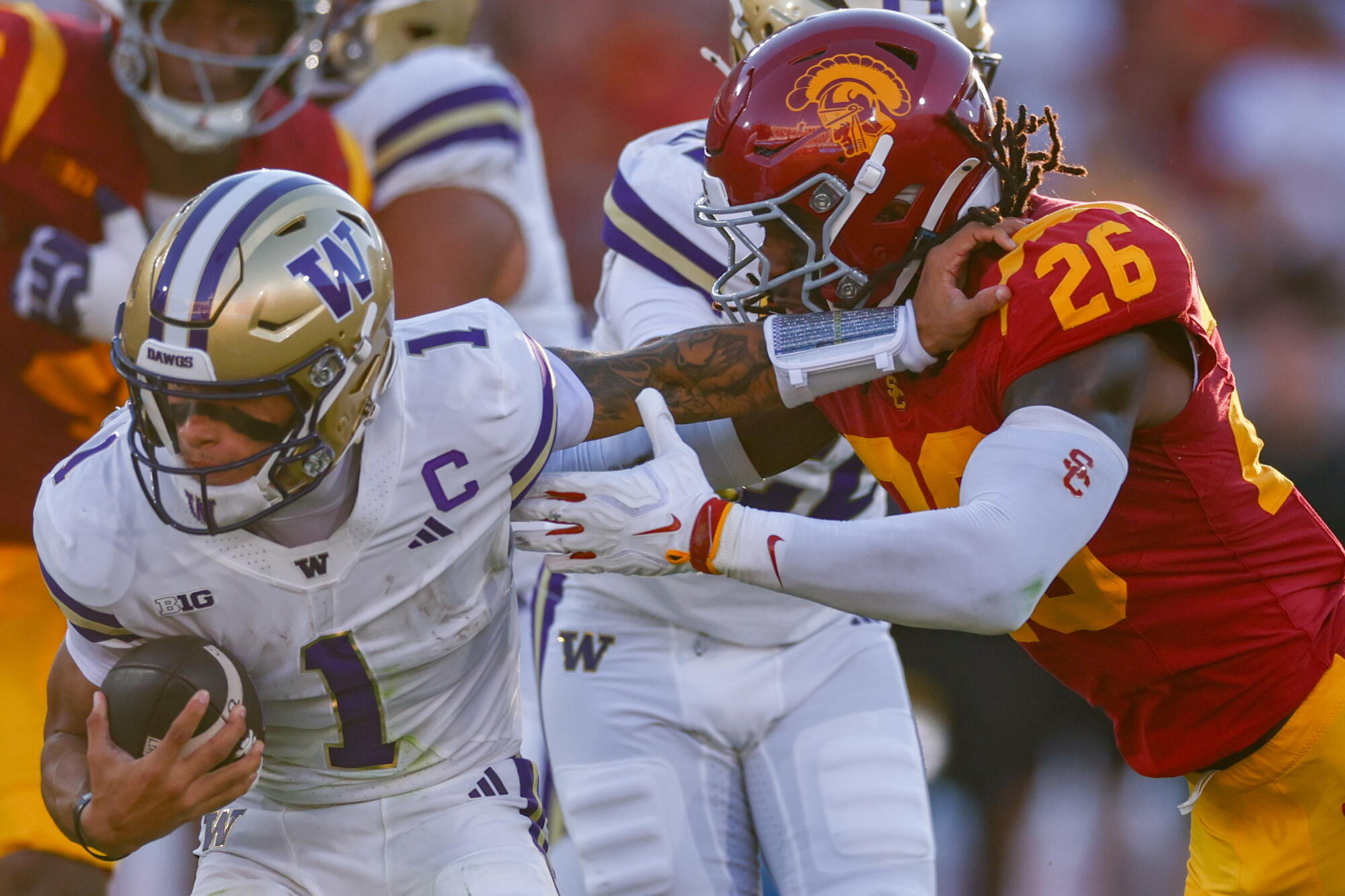
Washington quarterback Demond Williams Jr., left, tries to fend off USC linebacker Elijah Newby during the second quarter Saturday at the Coliseum.
(Ronaldo Bolaños / Los Angeles Times)
USC’s defense nearly came apart in the fourth quarter, though, at the worst possible time. Washington hadn’t converted a single third down until its final drive, when Williams converted a third-and-11 pass, then hit a fourth-and-two bomb for 43 yards. The Huskies got as close as the USC 12-yard line, before the Trojans finally shut the door.
“We had to dig deep for this one,” Riley said. “Especially as sloppy as we played.”
USC (5-1, 2-1) did try something a little different on defense, with defensive coordinator Gary Patterson calling the game from the press box instead of the sideline. Riley said the decision was akin to “trying to just move the chess pieces to get everyone in the right position.” He also added that Patterson’s former staff at Texas Christian had a lot more familiarity with Patterson’s scheme, and thus he handled things differently with that staff.
But the communication issues of past weeks appeared less of a problem on defense. The real concerns Saturday actually came on offense, where the Trojans uncharacteristically sputtered. Jayden Maiava was 21 of 34 for 245 yards, with a touchdown and an interception.
Still, judging by the box score alone, you’d be hard-pressed to understand how USC could have nearly squandered a game in which they piled up far more yards (360 to 319) and had the ball for far longer (34:58 to 25:02) and dominated on third down.
“We’re gonna fix it,” Stewart said. “No team comes out perfect. It takes time.”
After a disappointing few weeks on the defensive end, USC actually opened the game by forcing Washington (3-2, 0-2) into back-to-back three and outs.
But the Trojans managed a measly three points from those stops. Their first drive, stalled in the red zone. The next one backed up USC to the one-yard line after wideout Terrell Anderson muffed a punt.
Washington took advantage of the field position on its next drive. Faced with a fourth and seven in USC territory, Williams slipped past pressure and scampered to a first down. It was the first sign of life from the Huskies’ offense, which found its way into the end zone four plays later.
Then, USC gave the ball right back. On the run, Maiava launched a pass off his back foot under heavy pressure. It fell well short of its target and was picked off.
USC’s defense held strong, forcing a third three and out in the Huskies’ first four drives. And its offense finally held up its end of the bargain, with Waymond Jordan punching in an eight-yard touchdown.
USC quarterback Jayden Maiava scrambles during the first half against Washington at the Coliseum on Saturday.
(Ronaldo Bolaños / Los Angeles Times)
Washington continued to struggle moving the ball, but mistakes from USC helped its cause. An illegal formation penalty wiped away a deep Trojan touchdown pass to Kayden Dixon-Wyatt. Then on the ensuing possession, Wafle grabbed Williams’ face mask as he pulled him down for a sack.
USC had more penalty yards (50) than Washington had passing yards (44) in the first half. And those penalties gave the Huskies life at the end of the half, as they drove the length of the field and scored again.
“We felt like we were outplaying them,” Riley said. “We just couldn’t get out of our own way a little bit. That’s probably going to be a defining thing for this team going forward, how much we can do that.”
With a chance to regroup, the Trojans tripped over themselves out of the half too. An unsportsmanlike penalty killed their opening drive. Then, Washington tight end Decker DeGraaf caught a pass and took off down the sideline, running through two feeble-arm tackles on the way to an inexplicable 42-yard touchdown.
After that, the Riley chants rang out from the student section. But the Trojans’ offense mounted a 13-play scoring drive in response. Tanook Hines tore the ball away from a Washington defender in the end zone.
USC coach Lincoln Riley walks back to the sideline after speaking with his players during a timeout in the first half Saturday.
(Ronaldo Bolaños / Los Angeles Times)
Less than two minutes later, Stewart scooped up the fumble and took off. His 48-yard return completed a 12-point swing for the Trojans.
“To overcome all that and still win shows me some of the guts and toughness and culture in this room right here,” Riley said. “We could’ve folded.”
Still, USC couldn’t put Washington away. Down to their last drive, the Huskies converted a third and 11 and two fourth downs to drive deep into Trojan territory late.
But Kameryn Crawford pulled Williams down for a sack — the Trojans’ fifth of the game — and the defense held. And USC, at the end of a long, brutal week, breathed a sigh of relief.
The Dodgers are better than you. They’re smarter than you. They’re richer and deeper and more popular than you. You know it, they know it, there’s no point pretending otherwise.
So, yes, they went into the National League Divisional Series looking past the threadbare Atlanta Braves and thinking about the National League Championship Series.
Who does that? In the playoffs?
Your two-time World Series champions with the world’s best starting pitching rotation and a 1-0 NLDS series lead, that’s who.
The way the Dodgers did the math, it made sense to save their ace of aces, Yoshinobu Yamamoto — who last postseason went 5-1, had an ERA of 1.45 and 33 strikeouts in six appearances and won the World Series MVP — for Game 3 of the NLDS.
Not for the tone-setting Game 1 and, potentially, Game 5 on regular rest.
But Game 3.
Because to the Dodgers, that’s not even much of a calculated risk. It was a math problem specific to them, before they beat the Atlanta Braves 5-3 in Game 1 in 100-degree heat Saturday afternoon.
They figured they’d be able to throw two consecutive left-handers at the lefty-averse Braves lineup, starting Saturday with recently acquired two-time Cy Young winner Tarik Skubal, followed Sunday by Blake Snell, also a two-time Cy Young winner.
Additionally, this way they could have Yamamoto pitch Tuesday on the road, where his ERA is 1.77 instead of at home, where it’s 3.13. And where he’s given up 14 home runs compared with six on the road, where he’s made four fewer starts.
But mostly the Dodgers’ calculus was that having Yamamoto pitch Game 3 means it will line up so that they’ll have him for Game 2 in the NLCS and, if necessary, Game 6 against the Milwaukee Brewers or San Diego Padres. (Or, if you really want to plan ahead — and the Dodgers with their leaky bullpen absolutely should not — for Game 1 of the World Series.)
“That just sets up the rotation and Yamamoto better looking forward,” Dodgers manager Dave Roberts explained before Saturday’s game.
“Not discounting this series, because you’ve got to win this series first, but you start from the fact that they’re all going to pitch — the three [Skubal, Snell and Yamamoto] are going to pitch for sure … and then what sets them up going forward.”
It feels like a faux pas, to be that forward-thinking, and to be saying the quiet part out loud!
“If you can kind of line it up in such a way to give guys ample rest, it puts you in a better position for more options down the road,” Roberts said. “That’s kind of some of the math we had.”
I mean, it adds up. And for these Dodgers — whose fourth starter, Tyler Glasnow, was a key cog in last year’s World Series-winning rotation — it’s a fair assessment.
Though it’s nice of Roberts to pay enough lip service that he’s not totally discounting the best-of-five current series they’re in.
Predictably on Saturday, Skubal, who previously had a 2.04 ERA, a 0.73 WHIP and 56 strikeouts in 39⅔ playoff innings for the Detroit Tigers, brought his own October heat.
The 29-year-old from Kingman, Ariz., gave up just one run and two hits, walked two and struck out seven — giving him 64 in the postseason, the second most in his first seven postseason appearances behind only Bob Gibson (74), per MLB’s Sarah Langs.
Skubal retired 15 consecutive, hit 101 on the radar gun in the second inning and didn’t have a three-ball count until the fifth inning.
“We knew,” Braves manager Walt Weiss said, “it was going to be a rough ride.”
But Weiss did not know, immediately after Saturday’s loss, when he’d be able to deploy his sole ace, 37-year-old Chris Sale, the 10-time All-Star who just pitched in the Braves’ Game 3 wild-card closeout.
“To me it’s not that big a deal when he pitches,” Weiss said. “The Dodgers can’t win it in two.”
A true statement and a matter of fact: The Dodgers can’t win in two, but they’re not shy about expecting to win.
“It’s prudent to kind of map out potentially how they could line up,” Roberts said Friday. “And that’s just doing your due diligence.
“We are very fortunate because we have four guys essentially that you could really kind of pick through to figure out what’s the best way to deploy all four starters, that’s the exercise. But it starts with having four talented guys.”
Andrew Friedman, the Dodgers’ president of baseball operations, reveled in the notion that his club might actually be disproving the rule that you can never have enough pitching — at least when it comes to their elite quartet of starters.
And that, Friedman said, “is very impactful for quality of life.”
It was so hot a team that averaged nearly 50,000 fans for often meaningless regular-season games beat the Atlanta Braves 5-3 in its first postseason game before thousands of empty seats — some of which were literally too hot to sit in.
It was so hot the Dodgers set up pallets of bottled water near the gates and anyone brave enough to enter the stadium was given a plastic 16-ounce Dasini bottle. Gatorade also set up a cooling tent under the right-field pavilion.
It was so hot Nicolas Gonzalez, a fan sitting in the shade of the reserved level, saw a stadium attendant, overcome by heat, stretchered before the game even started. She wasn’t the only one. By the later innings, other fans on the reserved level were reportedly seeking medical attention on the concourse.
The Dodgers declined comment.
So how hot was it?
The game started 45 minutes after the National Weather Service issued an extreme heat warning, cautioning against “extremely dangerous heat conditions” as the temperature reached 100 degrees at first pitch. By the third inning, the temperature reading atop the left-field scoreboard peaked at 103 degrees, matching the highest first-pitch temperature at 64-year-old Dodger Stadium.
“I’ve been coming to games my whole life and this is easily the hottest game I’ve ever been to,” said Gonzalez, 38, of Culver City. “Having a game in these conditions feels like we’re flying too close to the sun, both literally and figuratively.”
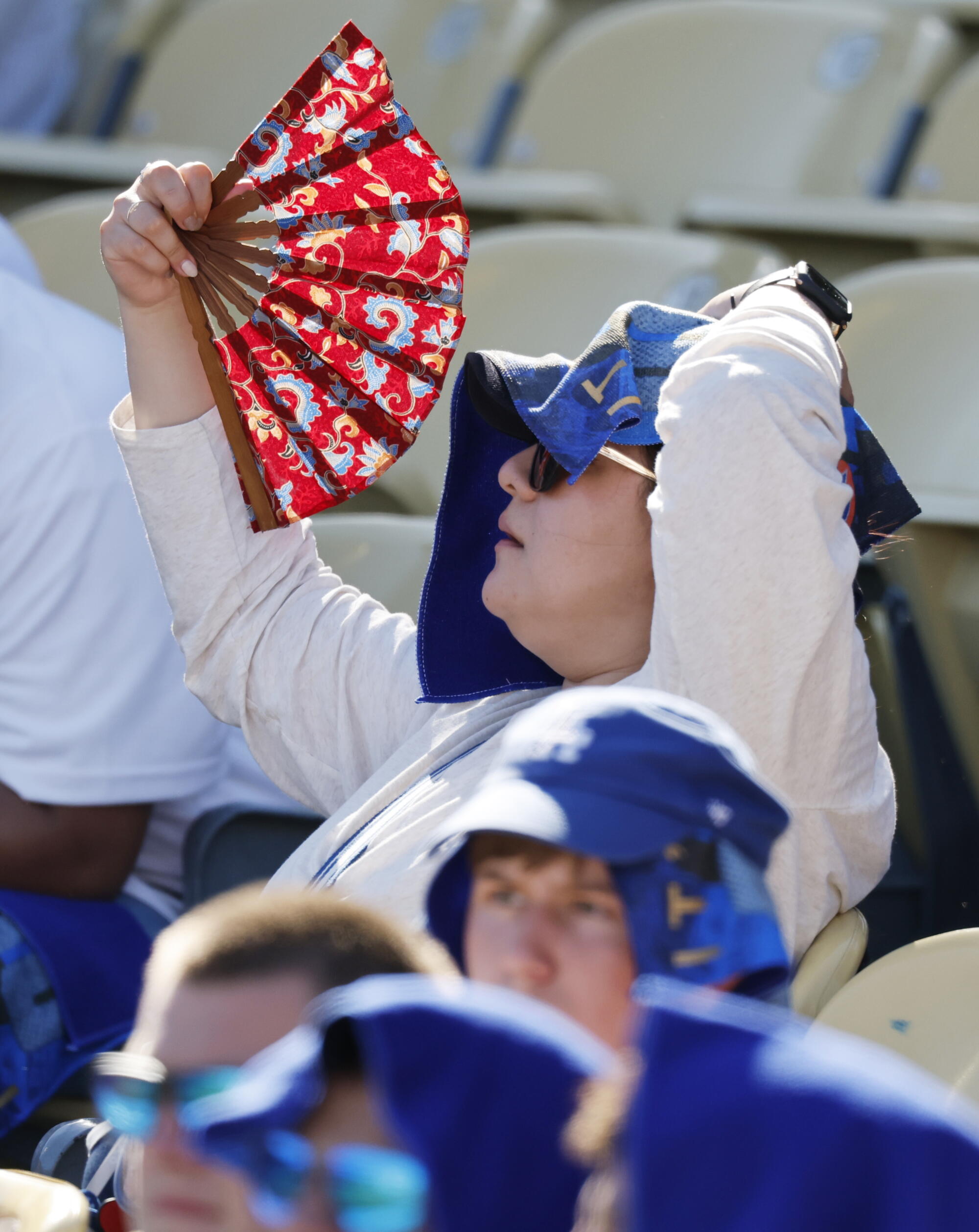
A fan tries to stay cool during Game 1 of the NLDS between the Dodgers and Atlanta Braves at Dodger Stadium on Saturday.
(Gina Ferazzi / Los Angeles Times)
Around him, fans tried to cool themselves by waving makeshift fans. It didn’t work.
But the weather didn’t just effect the way the game was watched. It effected the way it was played, too. The cloudless skies made every pop-up an adventure and the warm, dense air reduced drag, allowing batted balls to travel further. As a result, the teams combined for five homers, accounting for all eight runs.
“That’s probably one of the hottest games that we’ve ever had here. And so shout out to the Dodger fans; they were amazing,” said Max Muncy, who hit of those five homers.
“My feet were hot. Really hot.”
The Dodgers wound up with an early afternoon game in the middle of a historic heat wave because MLB and the TV networks — in this case Fox and TBS — set conditional start times for the four Division Series games before the teams and matchups were known. When the San Diego Padres eliminated the Chicago Cubs in the wild-card round, Saturday’s early NL game went to the Dodgers.
Left-hander Tarik Skubal, who gave up just a run on two hits in six innings to get the win in his Dodger postseason debut, said he didn’t really notice the heat until he came out of the game.
“I walked back into the dugout, and I asked — I forget who, I think it was [Blake] Snell — I was like, ‘has it been this hot all game?’ It’s amazing what your brain can do in certain circumstances and moments,” he said.
“I actually didn’t think it was horrible when I was pitching.”
But then Skubal pitched in much hotter conditions as a kid growing up in northern Arizona.
“I played a Little League game in 127 [degrees]. Lake Havasu,” he said. “[Saturday’s] up there with as hot a baseball game that you can play in.
“Every team’s playing in it, right? They’re playing in the same conditions we are. It shouldn’t really impact how you are mentally or how it’s going to impact how you pitch. Just go out there and play baseball and try to drink water. That’s really it.”
At least Skubal got to drink his water in the relative cool of the dugout between innings. Umpire Roberto Ortiz, wearing 10 pounds of protective gear and a black-and-gray uniform, got no such relief. He had to stand behind the plate for 2 hours 44 minutes and all 290 pitches, one of which smoked him in the seventh inning.
That’s why his five fellow umpires made a point of patting him on the back or shoulder before jogging to their positions for the first pitch.
“He stayed tough,” Dodger catcher Will Smith said of Ortiz. “I’m sure he’ll rehydrate and be ready for tomorrow.”
Speaking of tomorrow, the Dodgers, Braves and the umpires will all get some relief for Game 2. At first pitch Sunday afternoon the Weather Channel is forecasting a temperature of just 97 degrees.
“The dark silver lining,” Gonzalez, the heat-weary fan said in a nod to global warming, “is this might be the coolest October of the rest of our lives.”
Saturday Kitchen Live underwent a huge schedule shake-up during the latest episode of the BBC One cooking show
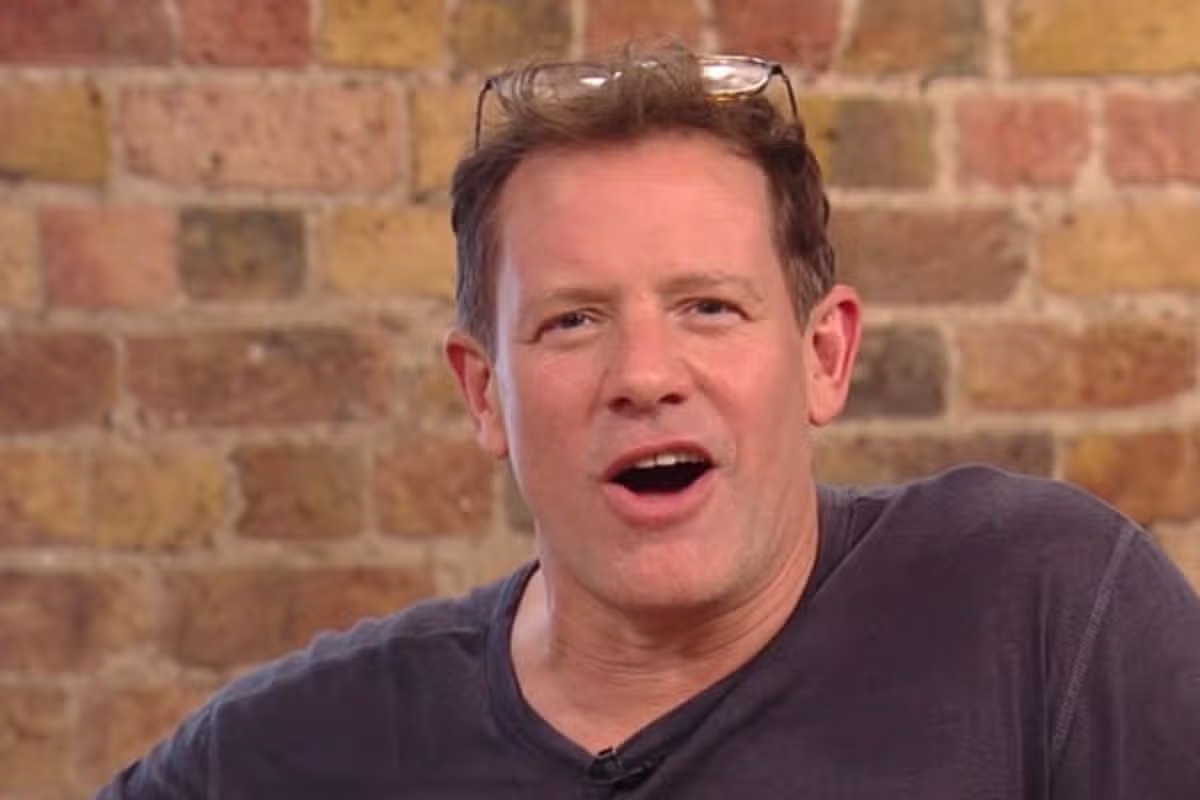
BBC Saturday Kitchen host, Matt Tebbutt, was absent on the latest episode (Image: BBC)
Saturday Kitchen Live saw a new presenter on today’s episode.
The hit BBC One cooking show was back with a new instalment, welcoming chefs Jamie Oliver, Gennaro Contaldo and Julie Lin, as well as Stranger Things actor Gaten Matarazzo, in the studio.
However, viewers expecting host Matt Tebbutt got a surprise to see the presenter absent and instead Donal Skehan in presenting duties.
Addressing Matt’s, 52, absence, Donal, 40, said: “Welcome to the show, Matt is away, so Donal can play!”
It appears that Matt is busy on another project as he posted updates to his Instagram Story about working on The Go To Food Podcast, writing: “Did a fun thing with these two smashers! Coming soooooonnn!”
Prior to Saturday Kitchen Live airing, BBC Breakfast spoke to Donal to hear what the show had coming up, where Naga Munchetty spoke about Matt’s absence.
Naga, 51, said: “Donal! Good morning to you!” with Donal responding: “Good morning, Naga, this might be a nice little palate cleanser for you. You know, no Matt this week, but I’m here!”
With Naga joking: “Well, yeah, this is definitely a palate cleanser, in terms of no Matt!” the BBC Breakfast host then put Donal on the spot, asking if anyone had ever told him his recipe hadn’t worked after releasing an impressive 13 cook books.
A shocked Donal responded: “Never. Why?” with Naga admitting: “Because I don’t think… I don’t think they’re always accurate. Especially when it, you know, comes to time and whatever. What do you think?”
With Donal replying: “Naga! Well, I think you’re completely wrong, firstly, and we have Jamie Oliver in the house to prove you wrong, because we’re going to do 20 minutes of straight-through cooking, showing you can make anything delicious in no time at all!
“So, er, my cookbooks aren’t tested like that, but Jamie’s are, and we’re going to… we’re going to do great things, and hopefully prove you wrong.”
Donal then quipped: “I thought you were going to be nice to me after Matt’s out of the seat!” with Naga joking in response: “That was nice!”
Saturday Kitchen Live continues on BBC One and BBC iPlayer
During a 24-hour visit, Bethany Gavaghan discovered the market town’s independent shops, cafes and winding old streets — and left wanting more
08:32, 01 Oct 2026Updated 08:41, 01 Oct 2026
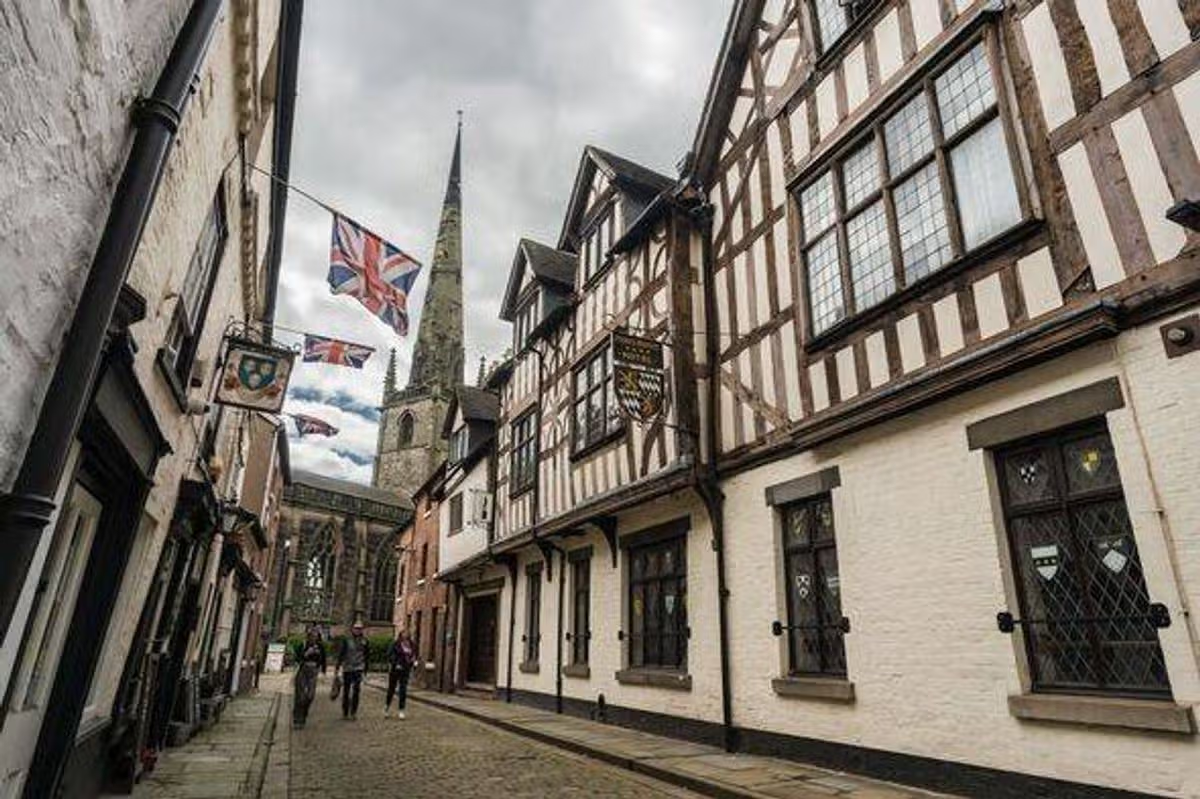
Reach’s Bethany Gavagha had no idea of what to expect from the market town(Image: Getty)
If you thought you had to travel hundreds of miles to cities such as Edinburgh for old town charm and a sense of being swept into a Harry Potter novel, think again — there are destinations far closer to home that are well worth a visit.
Reach’s Bethany Gavagha had never set foot in Shrewsbury in Shropshire and, despite having spotted some gorgeous photographs, she arrived with very little in the way of expectations. Writing for the Express, Bethany shared how she always preferred to keep an open mind when visiting somewhere new, and as she hadn’t done much reading or come across a great deal of content about it, she genuinely had no idea what to expect.
Shrewsbury was, however, previously crowned the town with the best high street in the UK by The Telegraph, which described it as a “beacon of light piercing the gloom”.
It noted that Shrewsbury boasted a healthy selection of quirky and independent businesses that give shoppers a “fine reason to escape the tyranny of Amazon”. Locals spoke with great pride about their town as a result.
Bethany shared: “I was there for almost exactly 24 hours, and I found out quickly that is the ideal sweet spot if you’re someone just passing through, as everything is conveniently located and easy to get to. “
Things to do in Shrewsbury
Shrewsbury is the kind of place where history is impossible to miss. The medieval market town sits within a loop of the River Severn, close to the Welsh border, with its winding streets, timber-framed buildings and hidden passageways giving the centre plenty of character.
The town’s location once made it strategically important, and Shrewsbury was first recorded in a charter in 901. Today, though, it’s the independent shops, cafés, markets and historic sights that make it such an appealing place to explore.
Shrewsbury has a particularly strong independent shopping scene. According to Visit Shropshire, independent retailers outnumber big chains by almost 50%, with boutiques and quirky shops tucked into the town’s medieval streets and narrow passages.
One of the biggest draws is Shrewsbury Market Hall, which has been voted Britain’s Favourite Market. The bustling hall is packed with food stalls, cafés, independent traders, arts and crafts and fresh produce, making it an easy place to spend far longer than planned.
There’s plenty to see between shopping stops, too.
Shrewsbury Castle is a Norman fortress sitting right beside the railway station, making it an easy addition to a wander around the town. For a completely different experience, The Quarry offers 29 acres of riverside parkland and nature reserve inside the loop of the Severn – a peaceful escape from the busy streets.
History buffs can visit Shrewsbury Abbey, founded in 1083 and made famous to many readers by Ellis Peters’ Brother Cadfael novels.
Then there are the medieval passages themselves. Narrow lanes and little cut-throughs lead off the main streets, making exploring Shrewsbury feel more like an adventure than a conventional shopping trip.
Bethany’s stay
Bethany stayed in a room that was somewhere between a hotel and an Airbnb, called Boutique Shrewsbury Rooms, tucked away in a peaceful corner of the town, just across the river and through a small park — just about manageable on foot from the train station if you’re lugging a heavy suitcase.
“I’d definitely recommend staying there if you enjoy a no-fuss approach to holidays, as you just let yourself in with a keypad and the room and the location were both gorgeous,” she wrote.
A coffee machine stocked with a variety of pods also earned a big thumbs-up from her.
Come morning, the first stop on Bethany’s agenda was a café boasting “with some of the friendliest staff”. The Shrewsbury Coffeehouse is warm and inviting, full of charm in its décor, with generous seating spread across two floors.
She opted for avocado on sourdough toast, which proved to be a perfect brunch choice — packed with flavour and finished with a scattering of chilli flakes for an added kick. Exactly what you need to set yourself up for a full day of sightseeing.
During her visit, the weather was far from kind. She said: “In fact, we actually received what I think might have been the biggest deluge of rain I’ve seen all year, but this led me to realise just how much you can still do indoors, which I normally find quite rare in older towns like this.”
Bethany kicked things off with a visit to the Shrewsbury Museum and Art Gallery, which offered a brilliant glimpse into the local area. She discovered that woolly mammoths once roamed the fields surrounding Shrewsbury — a fact Bethany found utterly captivating — and the vintage fashion collections were absolutely stunning to take in.
The town is a genuine must-visit for anyone who loves independent shops and cafés. There was even an outdoor food market offering everything from freshly baked goods to Indian cuisine.
“One place that caught my eye was the Old Market Hall cinema, which puts on everything from ballets to dramas and more,” Bethany said.
Noting the building looked “fascinating”, she added: “We didn’t manage to go in this time, but it’s firmly on my list for our next visit.”
In need of something sweet, her next port of call was a coffee shop called the Cat’s Pyjamas. It was a brilliantly quirky space — cocktails on the menu too — and a perfect haunt for indie and creative types. Bethany opted for their red velvet lamington, which was a solid 10/10.
“I would absolutely go back for more without any persuasion needed,” she said.
With a free afternoon to spare, Bethany loved wandering through the winding cobbled streets. “It was surprisingly calm for a Saturday, which only added to its charm. Maybe the weather played a part, but it definitely had that hidden gem feel compared to more hyped medieval towns like Wells, which have gone viral on social media.”
The birthplace of Charles Darwin, Shrewsbury is home to around 77,000 people and reportedly boasts more than 500 independent retailers and hospitality venues. That’s what “makes the town centre really stand out,” said Seb Slater, executive director at Shrewsbury BID.
Bethany said: “My favourite shop was a huge underground shop selling antique items, Shrewsbury Antiques Centre, which has been going for more than 30 years. I never buy anything from places like this but just walking around is an experience in itself.
With more than 50 individual traders, the range on offer is enormous.
Her final port of call was a pizza restaurant that she had strolled past earlier and earmarked as somewhere that looked well worth a visit. You can catch the mouth-watering aromas from several doors away, so it was an absolute no-brainer.
Dough and Oil has built its reputation on sourdough pizza, homemade sides and desserts, and boasts a fun-filled interior complete with a photobooth and mini football table. It ticked every single box.
She had said it before, but Bethany firmly believes the only true way to judge a pizza restaurant is to sample their margherita first — and she would give it 100% recommendation. With the visit drawing to a close, it was time to head back.
The train station was just a short walk downhill from there. She concluded: “All in all, it was a successful 24 hours, and definitely somewhere I’d like to learn more about and get to know again, hopefully with better weather next time.”
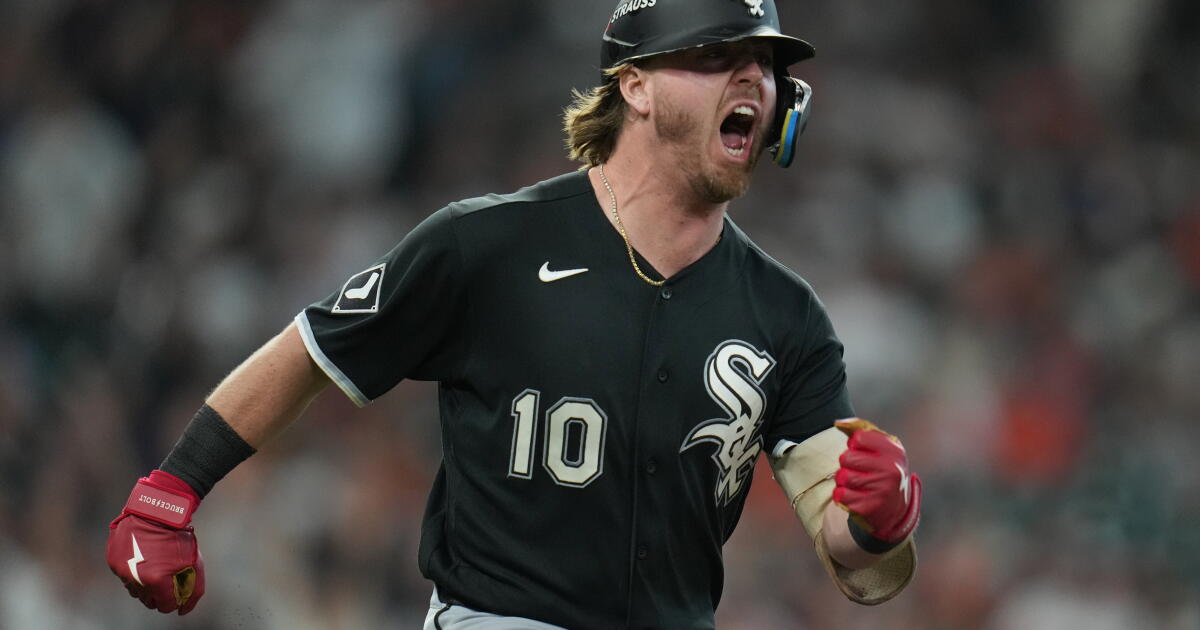
The Chicago White Sox used a big first inning and a three-run homer from Chase Meidroth to propel them to a 7-3 win over the Houston Astros on Wednesday to sweep their AL Wild Card Series.
It’s the first time Chicago has won a playoff series since beating Houston in the World Series in 2005. Under the direction of second-year skipper Will Venable and with a letter of support from Pope Leo XIV, the White Sox advanced to face AL Central champion Cleveland in the AL Division Series beginning Saturday in Cleveland.
The White Sox, who lost 100 games in each of the last three seasons, are the only team in major league history to follow consecutive 100-loss seasons with a playoff berth.
The AL West-winning Astros went 81-81 to become the first team to reach the postseason without a winning record. Their recent playoff woes in Houston continued Wednesday as they dropped their ninth straight home playoff game in a ninth trip to the postseason in the last 10 years.
Chicago pounced on the Astros for four runs in the first inning a day after scoring three in the first two innings of a 6-3 win. Houston ace Hunter Brown was lifted after getting just two outs and wasn’t helped by a sloppy defense which committed two first-inning errors.
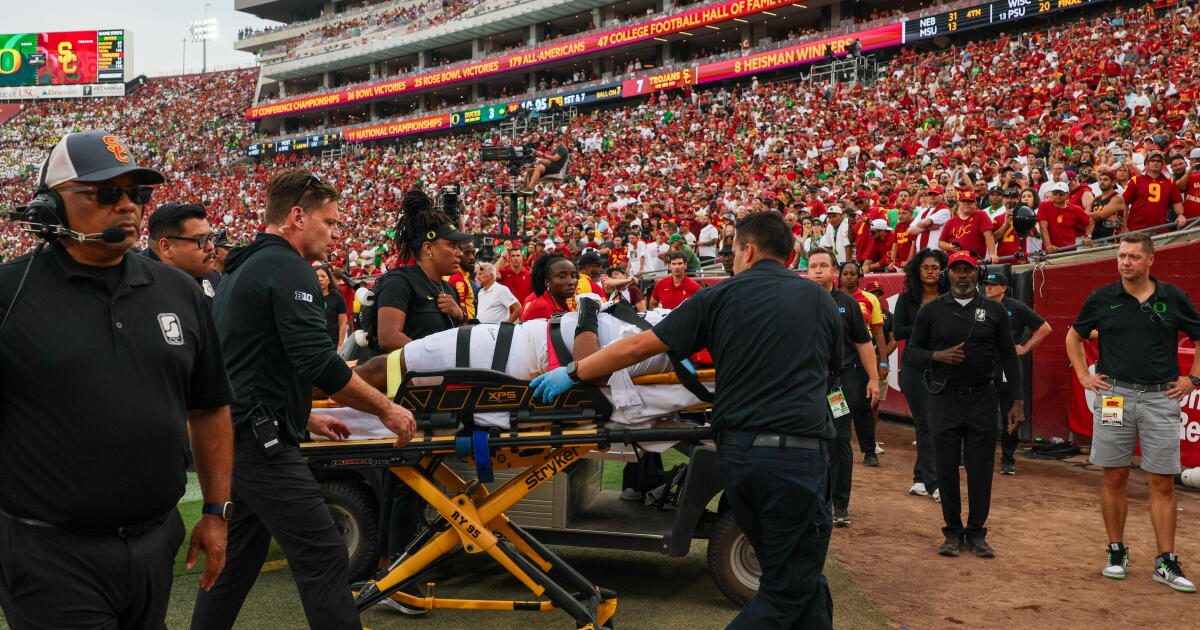
If there’s one positive to come out of the controversial play and video from Saturday’s USC vs. Oregon football game during which Oregon quarterback Dante Moore suffered a concussion after a late hit by USC’s Desman Stephens, it’s that high school football coaches are using it as a teachable moment on how not to react after a player is injured.
Stephens received a one-game suspension from USC after he was seen celebrating when hitting Moore in the head as he gave himself up on a slide to end a running play.
Whittier coach Lorenzo Hernandez said he reminded his players, “You’re always in someone’s lens.”
“You have to be compassionate about someone being injured,” he said.
St. John Bosco coach Jason Negro said there were plenty of lessons to point out to his players.
Negro said in a text, “As mentors, educators, and coaches we are constantly using moments like this to educate our players on how not to be. Football is a small fraternity and regardless of rivalries or spirited competitions we have to respect the health and safety of our opponents. Celebrating in a moment like that is disheartening and would never be tolerated here at Bosco.
“It wasn’t just the Dante Moore situation. It was also the situation from the Texas vs Tennessee game, too, with the unnecessary antics that draw penalties.
“We have to do better in making our kids realize there is a proper way to conduct yourself in an athletic contest. Personal character is revealed in these moments so choose wisely when you plan your actions after you make a good play.”
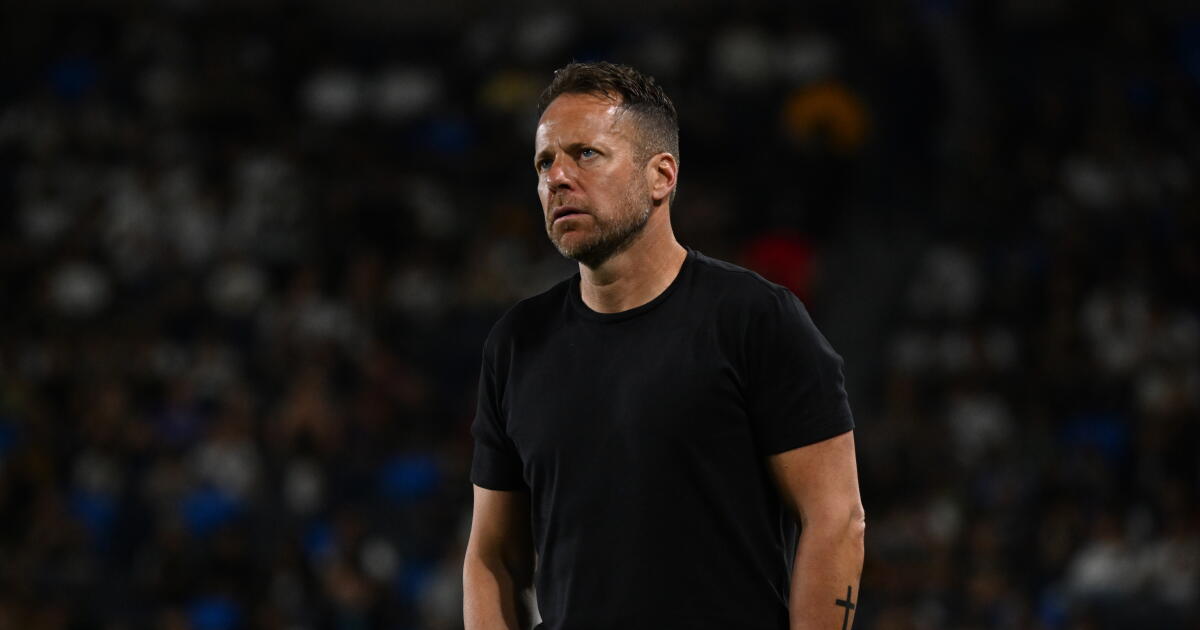
LAFC, mired in a slump having won just two of its last 13 games in all competition, fired first-year coach Marc Dos Santos on Sunday with six matches left in the MLS regular season.
The firing, announced in a three-paragraph statement, comes less than 24 hours after Saturday’s 1-0 loss to FC Dallas dropped the team to sixth in the Western Conference table.
“Marc has given a great deal to this club over the years, and we are grateful for his commitment, care and contributions to LAFC,” said John Thorrington, the team’s president of soccer operations, in the release. “We wish Marc and his family all the best moving forward.”
LAFC (11-9-8) said it will begin the search for a new manager immediately but didn’t say who would coach the team in its next game on Oct. 10, after the two-week FIFA international break.
Dos Santos, 49, was an assistant on Bob Bradley’s staff in LAFC’s inaugural season in 2018. He left after the season to take over the Vancouver Whitecaps but struggled to a 22-39-20 record in 2 ½ years that were heavily affected by the COVID-19 pandemic, which forced the team to play many of its games on the road.
Dos Santos returned to LAFC as an assistant in 2022, this time for Steve Cherundolo, helping the team to a Supporters’ Shield and MLS Cup. When Cherundolo stepped down after last season, Dos Santos was given the head coaching job just two weeks later, becoming the third manager in the team‘s history.
His two stints as an assistant at LAFC taught him that the team’s fans are among the most demanding in MLS, something he said he embraced.
“It’s a privilege when you coach a team in Los Angeles,” he said at the time. “Every sport here is pressure. Every team here is win, win.
“It’s a winning city and the culture of the city. So I understand that.”
Dos Santos, who is fluent in four languages, was born in Montreal and split his childhood between Quebec and Portugal. With the exception of Vancouver, he has won everywhere he’s managed, from the Ottawa Fury of the NASL, where he was named the league’s coach of the year in 2015, to the San Francisco Deltas, whom he guided to an NASL title.
LAFC was unbeaten in its first 11 matches in all competition under Dos Santos, outscoring opponents 27-3 and advancing to the semifinals of the CONCACAF Champions Cup, where it lost to Mexico’s Toluca, the eventual winner. But the team has gone 6-9-7 in MLS play since then, including Saturday’s loss when Dos Santos was without six key players — including leading scorer Denis Bouanga and captain Son Heung-min — who were with their national teams.
Afterward, he spoke about his plans for the two-week international break.
“It’s a hard moment right now for us. And we have to face it,” said Dos Santos, who was popular with his players. “It’s been hard for us to get wins. A lot of draws, a lot of close games.
“We need to have everybody together and start working on what this team can be. That’s the big objective during the break.”
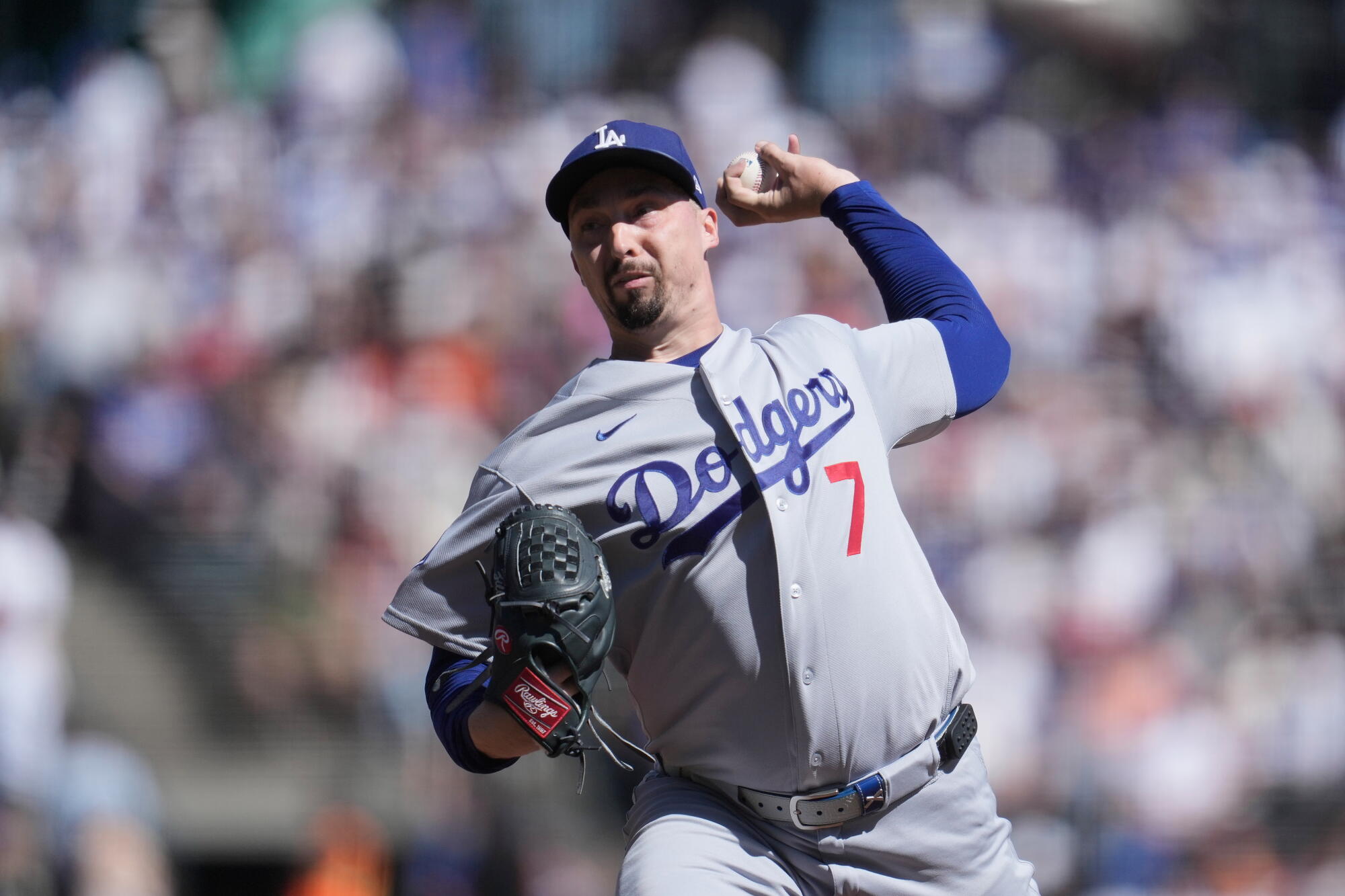
SAN FRANCISCO — The result of Blake Snell’s final pitch Saturday, a fastball that San Francisco Giants third baseman Shay Whitcomb lined into left field, mattered far less than the fact that the left-hander had passed the 75-pitch mark without incident.
Dodgers left fielder Teoscar Hernández threw out Whitcomb at second. And Snell walked off the field to complete a four-inning start in the Dodgers’ 4-3 win.
“Definitely needed to pitch today,” Snell said of his first start in a week and a half. “Definitely showed that. I was trying to go up and in, I was missing up and away. Even the last pitch of the game, I try to go up and in and miss right down the middle. I don’t know the last time I did that. It’s been a while.”
The Dodgers (99-62) entered locked in as a No. 2 seed for the playoffs. So, the stakes of their last two games of the regular season boiled down to health and preparation for the postseason. There was no better example of that give-and-take than Snell’s five-hit, one-run start.
Because Snell left his previous start with tightness in his left groin, the Dodgers planned for a short outing Saturday, prioritizing his health for the postseason.
“We were confident,” Roberts said of Snell’s recovery from the injury. “But it’s still good to see it. And it’s good also that we got it out of the way, that rust off — versus whatever game in the postseason, then he’s rusty, and you’ve got to kind of pick up the pieces in a playoff game. So I thought today it was really best-case scenario.”
The only run Snell gave up was the result of a double, stolen base and sacrifice fly in the third. He had three strikeouts and no walks.
Snell’s changeup was about two miles per hour faster than usual, something he wants to address before his next start. And he wants to hone the release on his curveball. But his slider, the pitch he would be most worried about if his groin injury wasn’t resolved, had promising velocity and shape.
“To throw a 92 [mph] with good horizontal break, and to see the trust I had in the back leg when throwing that, that’s a really good sign,” Snell said.
Dodgers pitcher Blake Snell throws against the San Francisco Giants in the first inning Saturday.
(Jeff Chiu / Associated Press)
Snell said he thinks he’s fully past the injury, and didn’t even think about it during the start.
“Definitely happy about where I’m at,” he said. “Now, it’s a big week for me. Catch has to be great, bullpens have to be great. I’ve really got to focus on getting in my legs, and the consistency of every throw. So to be able to pitch today and learn all of that is bigger than I could ever really express.”
Snell, who missed time because of a late spring training build-up and arthroscopic surgery in May to remove loose bodies from his left elbow, finished the regular season with just 42⅔ innings pitched. But he posted an impressive 1.90 ERA in that time.
The team considered replacing Snell’s start Saturday with a live batting practice session, Roberts said, which would have still given Snell feedback from hitters, but in a more controlled environment.
“We gave him and the training staff every out to do so,” Roberts said. “But there was a lot of confidence that he’s in a great spot.”
Snell’s recent workload was another reason for the Dodgers to be conservative with his workload Saturday. Over the past two weeks, he’s only thrown one inning.
“So there’s a balance between getting your work in, making sure you feel good coming out of it,” Roberts said. “Even for example, I could’ve pushed Tarik [Skubal in his start Friday], given his efficiency. But to me, to what end?”
Snell should be full-go for the playoffs, Roberts said. But count Snell among the Dodgers players who can benefit from the wild-card bye.
“This is still an important one,” Roberts said of Snell’s start Saturday, “to go into it feeling good, to then take that extra six, seven, eight days.”
Six to eight days off would line Snell up to start Game 2 or 3 of the National League Division Series. But Roberts declined to tip his hand on rotation order. The days off give the Dodgers extra flexibility to line up their pitching.
Mookie Betts celebrates after hitting a home run for the Dodgers in the third inning Saturday against the Giants.
(Jeff Chiu / Associated Press)
“You’re looking at, the first series, who could pitch on regular [rest], who needs extra, how potentially the next series lines up,” Roberts said. “How you can … maximize those four guys. And I do think with those four guys, it doesn’t matter the opponent, so that’s not a variable.”
Roberts also said alternating between right- and left-handers was not a variable.
“To be honest with you, you could put them all in a hat, and you could make a case for any order you put them in,” Roberts said.
Right-hander Yoshinobu Yamamoto, the stalwart of the rotation, certainly has performed to the level of a Game 1 starter, both this season and in a heroic World Series run last year.
For Game 2, it would make sense to choose a pitcher who’s comfortable starting on four days rest. Then, thanks to a pair of off days built into the series, both the Game 1 and Game 2 starters could be available to throw in an if-necessary Game 5.
Skubal has pitched on regular rest this season more than any of his rotation mates, making him a strong option to take the ball in the second game.
If the Dodgers do, indeed, go in that direction for Games 1 and 2, Snell would then be the natural choice for Game 3, on eight days’ rest. And right-hander Tyler Glasnow could take an if-necessary Game 4.
The Dodgers, however, don’t need to finalize their pitching decisions just yet.
“I love our starters,” Snell said. “I love the staff, the way we push for each other to be great and support each other. So, I can’t wait. It’s what we’ve all been waiting for, and now it’s time to prove it.”
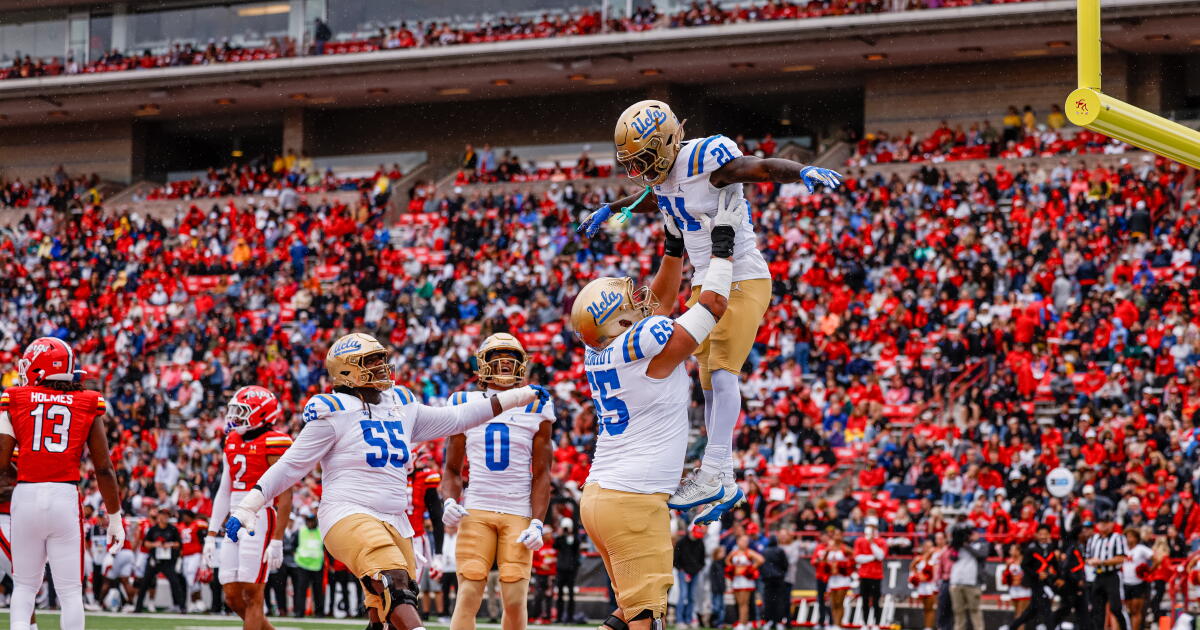
COLLEGE PARK, Md. — Bob Chesney’s friend nicknamed “Juice” led the effort to bus in supporters from the first-year UCLA coach’s hometown of Kulpmont, Pa., to watch the Bruins put the squeeze on Maryland in a 54-3 victory on Saturday.
Thomas Letcavage, the man known as “Juice,” brought four buses filled with 160 Chesney fans to watch their friend cook the Terrapins.
With the victory, Chesney became the second UCLA head coach to win his first four games at the helm, matching the start by College Football Hall of Fame inductee Red Sanders in 1949. But Chesney accomplished something Sanders couldn’t: beating Maryland on the road. Saturday marked UCLA’s first game here since the No. 1 Bruins fell to the fifth-ranked Terrapins in September 1955.
It was clear by halftime that another Terrapins upset wasn’t likely as the hot seat for Maryland coach Mike Locksley warmed as light rain fell consistently at SECU Stadium. After opening the season 2-0, the Terrapins’ home losses to Virginia Tech and UCLA will no doubt lead to more calls for the dismissal of Locksley, who is coming off consecutive 4-8 seasons and has an overall record of 39-51.
After failing to score on their first three possessions that included their first lost fumble of the season, the Bruins’ offense reeled off touchdowns on their next three possessions. The first was set up by UCLA defensive back Mason Rivera’s interception late in the first quarter.
Three plays after Maryland’s first turnover of the season, Wayne Knight opened the scoring with a 45-yard touchdown run. Anthony Woods and Jaivian Thomas followed with short touchdown runs as the Bruins scored 20 unanswered points to open the game. Troy Leigber added a 63-yard rushing touchdown with four minutes left in regulation.
Maryland quarterback Malik Washington tossed three more interceptions in the second half, the first two returned for touchdowns as Ta’Shawn James and Scooter Jackson scampered in from 39 and 65 yards, respectively.
UCLA quarterback Nico Iamaleava put a scare into the Bruins’ cheering section as he was slow to get up after he was hit delivering a pass to Aidan Mizellfor an 83-yard touchdown.
Iamaleava didn’t appear to be injured on the play, although with a huge lead, backup Madden Iamaleava took over the offense and helped the Bruins coast to the victory.
The rout marked the first time the Bruins have scored 50 during back-to-back games since 1993.
In No. 12 USC football’s first three dominant wins of the season, its opponents combined to convert about one-third of third-down attempts and made one fourth-down conversion in three attempts.
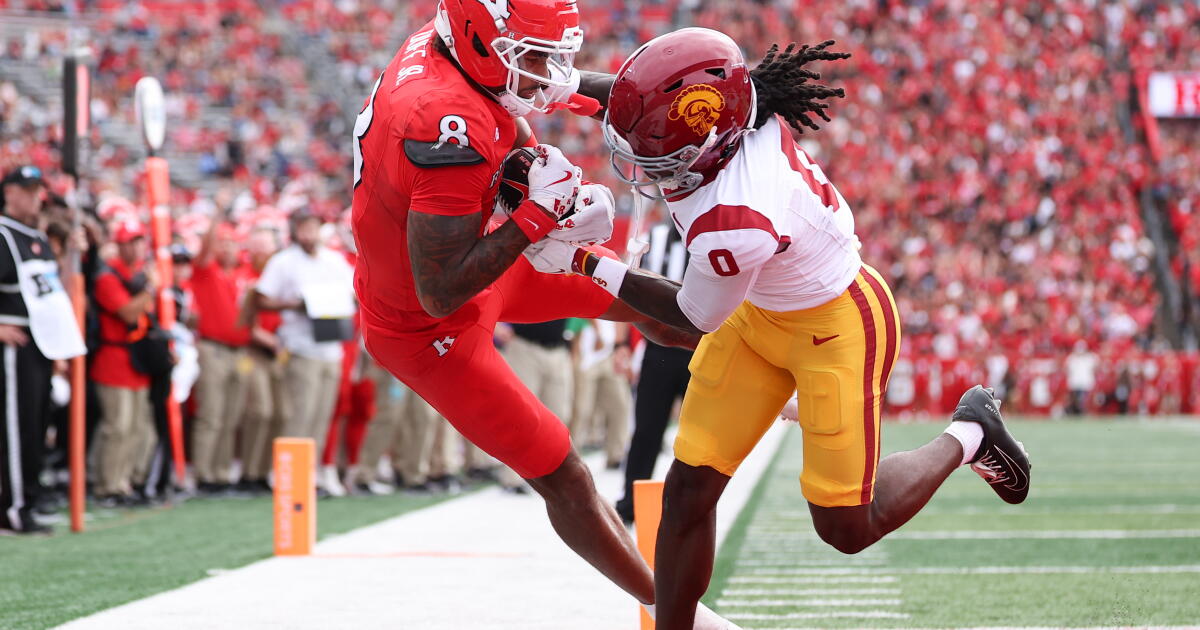
On Saturday, in a rocky 42-35 win over Rutgers (0-3, 0-1 Big Ten) that saw the Trojans give up 292 passing yards, nearly get outgained overall and suffer multiple injuries in the secondary, the Scarlet Knights converted 6-of-11 third downs and made 3-of-4 fourth-down tries.
Against one of the worst teams in the Big Ten, USC’s high-powered offense and a clutch pick-6 from cornerback Prophet Brown were enough to survive the defense’s late-down struggles for a fourth consecutive win. However, with No. 20 Oregon (2-1) coming to Los Angeles Memorial Coliseum on Saturday with a star veteran quarterback in Dante Moore, that might not be possible.
“As a secondary, we’ve got to be a little bit tighter in those situations. We’ve got to make those competitive plays,” Trojans coach Lincoln Riley said Tuesday of third- and fourth-down situations. “We have a good defensive line. We have a group that can rush the passer. We’ve got to make guys hold onto that ball, make our pass rush work and make those plays when we get to the point of attack.”
USC hasn’t beaten Oregon in two matchups under Riley, including a 42-27 loss that all but eliminated the Trojans from College Football Playoff contention late last season, and has only won two of the teams’ last 10 meetings. A second loss this season for the Ducks or a loss this early in USC’s loaded conference schedule could make either team’s CFP path more difficult moving forward.
Though Brown echoed a common team sentiment that Saturday’s game is just like any other despite the potential CFP stakes, he said third- and fourth-down defense could be a deciding factor.
“Great defenses find a way to get off the field on third and fourth down,” Brown said. “Going into this game, it’s definitely going to be a big indicator on how it’s going to go, how we do on third and fourth down.”
Secondary, wide receiver groups dealing with injuries
During the Rutgers game, both cornerback Jontez Williams and safety Alex Graham appeared to be dealing with injuries, which Riley acknowledged Monday on Trojans Live. Riley said on the show that he was hoping to get both back “right away.”
Williams did not appear on USC’s initial availability report released Wednesday evening after telling reporters Tuesday that he was “ready to go.”
Graham, however, was listed as questionable on the report, which is updated daily from Wednesday through Saturday during a typical game week.
Standout freshman wide receiver Trent Mosley, who racked up 13 catches, 255 yards, four receiving touchdowns and a punt-return touchdown in his first three games with USC, was listed as doubtful. Mosley missed the Rutgers game after appearing to favor his right knee after a third-quarter touchdown the week prior against Louisiana.
On Tuesday, Riley deferred a question about Mosley’s return timetable to the availability report. Last week, Riley said he didn’t expect Mosley to be out “extremely long term,” but did not offer specifics.
Another of USC’s top receiving options, Corey Simms, was listed as out. Simms had at least two receptions in each of the Trojans’ first four games for nearly 200 yards and caught a touchdown against Rutgers.
Standout sophomore defensive tackle Jahkeem Stewart was also listed as questionable after missing the first four games of the season with a foot injury. Stewart dressed for the game against Louisiana on Sept. 12, but Riley said the team “made the decision to pull him back a little bit” after seeing him warm up for that game.
“He’s definitely getting better and better each week,” Riley said Tuesday.
Special teams an emphasis in practice
Hours before their playoff hopes were dashed, the 2025 Trojans had the ball and were as in it as they could be.
More specifically, the then-No. 15 Trojans were tied with then-No. 7 Oregon 14-14 early in the second quarter and playing well on the road. Should they have won the game, USC would have had a reasonable argument to the CFP selection committee to make the 12-team field.
The Trojan offense stalled and was set to punt. Oregon’s Malik Benson took a line-drive punt 85 yards to the end zone to give the Ducks a lead. The Trojans compounded mistakes and fell convincingly afterward.
“It was a huge, huge play in the game,” Riley said after the game. “You definitely don’t want to give them something like that.”
Last week, the play that kept Rutgers in the game near the end of the first half also came from a punt formation, but with the roles reversed.
The Scarlet Knights ran a fake punt to convert a fourth-and-21 for a 44-yard gain that sparked a touchdown drive to close the gap to 3 points.
“The special teams play last year (against Oregon) really turned the game. The one the other day did too,” Riley said. “In these big games, when you’ve got two really good teams going at it, it always feels like there’s a couple of just really, really impactful special teams plays.”
With last year and last week in mind, how much emphasis did Riley and company place on special teams with a critical matchup with Oregon upcoming?
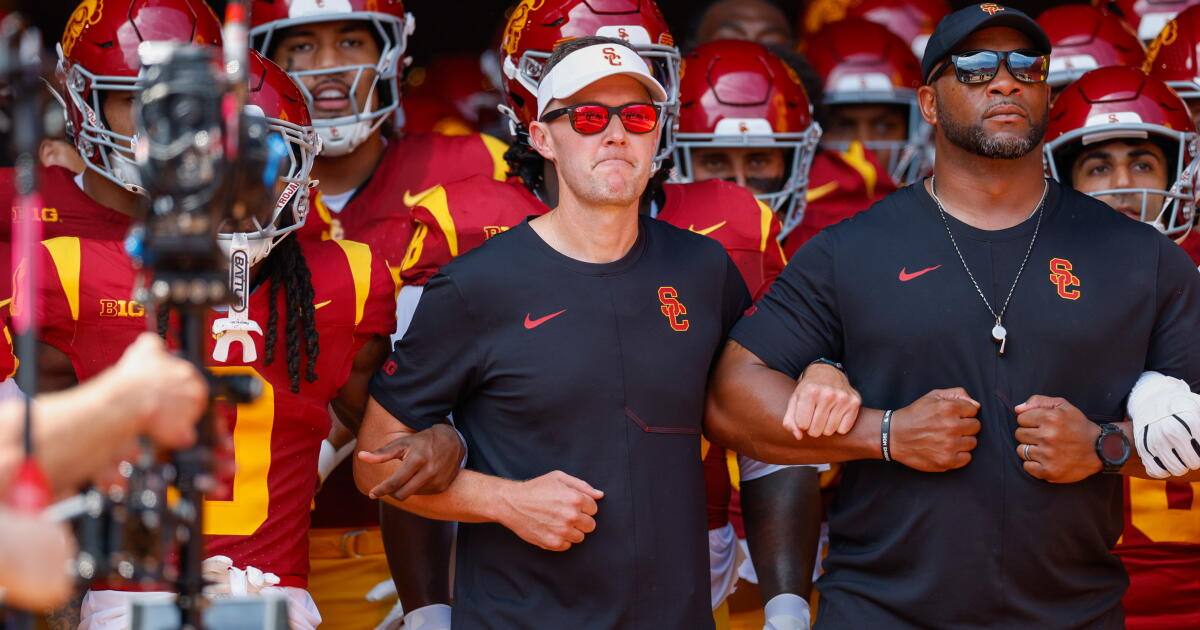
When USC and Oregon meet Saturday at the Coliseum, the stakes couldn’t be higher for Trojans coach Lincoln Riley. A win could catapult USC into serious contention for the College Football Playoff. A loss could send its season into a sudden spiral. And looming over it all are questions about the coach’s future — questions that could be answered, at least in part, by the Trojans’ performance this week.
“It’s definitely an important game,” Riley said Tuesday. “There’s no question about it.”
But ask his star quarterback if there’s any extra motivation this week to beat Oregon, and you won’t exactly get the same sentiment.
“Eh, not really,” Jayden Maiava said. “We’re just kind of attacking it the same every single week.”
Or what about the Trojans starting left tackle?
“It’s the exact same [this week],” senior Elijah Paige said. “We treat every opponent the exact same.”
At the start of arguably the most consequential week of their season, the Trojans certainly gave their best efforts not to make a big deal out of the big game with Oregon. Cliches were wielded like shields Tuesday, protecting against the imminent threat of social clips construed as bulletin board material.
But there’s no hiding from the significance of Saturday’s meeting for USC. Not when the messaging all off-season, like the billboards all around town, suggest that “the time is now.”
That’s definitely true right now for the Trojans, who face a gauntlet of a schedule in the coming weeks after Oregon. Three of their next five opponents after Oregon are ranked in the top 13, with two of those games on the road.
“This game should have a lot riding on it,” Riley said. “You kind of look forward and look ahead, it feels like a game that’s going to be relevant for a long time. I think it’s good for college football. It’s good for the West Coast.”
The rivalry between the two teams has grown especially heated in recent years. But on the football field, it hasn’t really been much of a matchup over the past two decades. USC has beat Oregon just twice in their last 10 meetings. And while USC has yet to play in the College Football Playoff, Oregon has already made three appearances and finished once as runner-up.
Oregon coach Dan Lanning has bested Riley in both of their head-to-head meetings, too. But the Ducks have not been at their best so far this season. After barely squeaking by Boise State in the season opener, they were upset on the road by Oklahoma State, which had previously lost 12 in a row.
Plus, they haven’t played at the Coliseum since the pandemic-shortened 2020 season, when they beat USC in L.A. for the Pac-12 title.
“It’s certainly not just another game,” Lanning said of the matchup with USC. “It’s as intense as it gets, when you talk about two teams that are competitive, that want to be really good, that have great talent. It means a ton to the fanbase. It means a lot to our team.”
The same is true at USC, even if no Trojan players are willing to admit it at the moment.
Though Paige did seem to let some enthusiasm slip Tuesday, when asked what it would be like to beat Oregon in his final opportunity to do so.
“It’d be awesome,” Paige said, before snapping back to attention.
“It’s an awesome game,” he continued. “We play a lot of awesome games.”
Injured DL Jahkeem Stewart still ‘touch and go’
Standout sophomore defensive lineman Jahkeem Stewart was dressed and looking ready to return at the start of USC’s Week 2 win over Louisiana. But after being a late scratch in that game, Stewart was ruled out early of USC’s Big Ten opener against Rutgers.
So what exactly changed in between?
Riley assured Tuesday that there was “no setback” with Stewart’s foot injury, which has held him out since the start of the season, but that USC “made the decision to pull him back a little bit” after seeing him warm up during Week 2.
Stewart is “hopefully not too far away,” Riley said. But his status for this Saturday certainly doesn’t sound optimistic.
“He’s continuing to rest, continuing to get healthier,” Riley said. “We do feel like we’re going to have him here at some point. But it’s a little bit kind of touch-and-go as that goes on, trying to manage … the time to rest without being too conservative with it. And so we’re definitely making progress. He’s definitely getting better and better each week.”
SACRAMENTO — Gov. Gavin Newsom on Saturday signed legislation to increase security for the state’s voting systems and protect Californians’ ability to cast ballots in an effort to guard against potential interference in the Nov. 3 election, including by the Trump administration.
Newsom pointed to the Trump administration’s recent effort to restrict mail-in voting through the U.S. Postal Service, which was struck down by the U.S. Supreme Court, and the presence of federal monitors at California polls last year as evidence that Trump “will continue his efforts to interfere with the November election.”
“Donald Trump won’t stop until he can exert dictatorial control over your free vote and disenfranchise millions of people this November. California will stop him at every opportunity,” Newsom said in a statement.”We have no bigger task than fighting to protect the right to vote from interference and meddling — the future of democracy is on the line. These bills today build upon the wall California has built to safeguard our electoral process.”
The governor signed the package of bills at the Japanese American National Museum in Little Tokyo, where a year earlier federal agents gathered outside a political rally he was hosting. Then Border Patrol Sector Chief Gregory Bovino, who had been leading the immigration operations in California, was among those outside the event, joined by agents in helmets, camouflage, masks and holding guns. Newsom described their presence as political intimidation.
One bill Newsom signed Saturday cites efforts to “weaponize law enforcement authority for political purposes,” including Republican “Sheriff Chad Bianco’s seizure of ballots in Riverside County,” and the election monitors sent by the U.S. Justice Department to polling sites in five counties during a 2025 special election on redistricting.
Such moves “have given rise to unprecedented concerns about law enforcement interference” in elections and “[demonstrate] that these threats are not merely hypothetical,” the bill by Sen. Tom Umberg (D-Santa Ana) reads.
The law, Senate Bill 884, which takes effect immediately, requires counties to open ballot drop-off locations 30 days before an election — two days earlier than usual — and allows counties to ban electioneering, or trying to influence voters’ decisions, within up to 200 feet of polling sites. It also bans police from making arrests near voting locations except for crimes against people, property, or disrupting the voting process.
Bianco, a GOP candidate for governor who placed fourth in the primary, drew swift condemnation and legal challenges this spring after he ordered deputies to seize more than 650,000 ballots from the Riverside County elections office. Voting rights groups and Atty. Gen. Rob Bonta challenged the move, which is being decided by the California Supreme Court.
Bianco carted off truckloads of ballots from the Riverside County Registrar of Voters in February after securing a warrant based on claims that the office allowed fraudulent votes in the special election to redraw California’s congressional districts under Proposition 50 in 2025.
Earlier this year, Newsom signed a bill preventing local and federal law enforcement agencies from taking ballots without a warrant.
On Saturday the Democratic governor signed a bill making it a felony to seize or order the seizure of ballots, election records or voting machines. Future seizures could be punishable by up to four years in prison.
“The federal administration and those seeking to spread lies about our democracy continue to call for interference in elections in ways we have never seen before in this country,” Assemblymember Gail Pellerin (D-Santa Cruz), the bill’s author and a former longtime county elections chief, said last month. “AB 282 helps ensure that every lawfully cast vote can be counted, and that the will of the voters of every political party will be respected.”
Republican lawmakers argued in previous hearings that the bill is unnecessary because it is already a crime to steal ballots.
Another bill, Senate Bill 259, makes it a crime to interfere with a mail ballot on the way to or from a voter or order the seizure of ballots that are in transit to a local elections office.
Newsom signed Assembly Bill 1664, which requires elections officials to immediately notify the attorney general and secretary of state immediately upon learning of any warrants, subpoenas or law enforcement investigations involving election records or voting equipment.
Newsom also signed bills to boost protections under the California Voting Rights Act, including an explicit ban on voter suppression and expanded access to election materials in languages other than English.
The governor also signed legislation to require more transparency from social media influencers who are paid by political campaigns. The measure, Assembly Bill 1130, came in the wake of a controversy in the June primary election when social media influencers took on a more visible role in the campaigns.
Candidates including Democratic billionaire Tom Steyer paid thousands of dollars to influencers who posted videos endorsing Steyer or talking about him in a positive light. These videos did not always disclose that influencers were paid by a candidate’s campaign.
In the evening, Nike has flown in a custom-made outdoor volleyball court so Sherman Oaks Notre Dame can host Harvard-Westlake in a 7 p.m. girls’ volleyball match played on the Notre Dame baseball field. There will be food trucks, music and other surprises.
Girls Volleyball: Pools Are Set For “The Classic” 39th Annual Venice Invitational Tournament. 20 @CIFLACS Teams Will Compete Across 3-Sites… Venice, Le Lycée & University. Action Begins Friday At 3:00PM With Several Intriguing Opening-Day Matchups. #RepTheCitypic.twitter.com/2zgrqTKrmK
There’s also the Venice girls volleyball tournament taking place at Venice High and the Woodbridge Classic cross-country meet at the Great Park in Irvine.
This is a daily look at the positive happenings in high school sports. To submit any news, please email eric.sondheimer@latimes.com.