SEATTLE — Gabriel Pec had a goal and an assist to back goalkeeper JT Marcinkowski and the Galaxy beat Seattle 2-0 on Saturday night, ending the Sounders’ 22-match unbeaten streak at home as well as a nine-match unbeaten run this season.
Greg Vanney led Los Angeles to its first victory in Seattle since July 9, 2016 — Bruce Arena’s final season as the Galaxy’s coach.
Pec used assists from Marco Reus and defender Miki Yamane in the 23rd minute to score his fifth goal of the season, giving the Galaxy a 1-0 lead that stood through halftime. It was his fourth goal in the last three matches and his 27th in 75 career appearances.
Reus’ assist was his fifth this season, while Yamane collected his first.
Pec and Edwin Cerrillo set up Matheus Nascimento’s first goal this season two minutes into stoppage time to clinch the victory. Cerrillo entered in the 89th minute before snagging his first assist and Pec’s helper was his fourth.
Marcinkowski stopped six shots for the Galaxy (5-5-4). It was his first clean sheet in his 10th start this season.
Andrew Thomas finished without a save for Seattle (7-2-3), whose only other loss came in its road opener at Real Salt Lake on Feb. 28.
The Galaxy extended the league’s longest current streak with at least one goal scored to 23.
Seattle was the last team to shut out the Galaxy, doing so with a 4-0 road win on Aug. 10 last season.
The Sounders were coming off a 3-2 victory over Arena’s San Jose Earthquakes on Wednesday, while the Galaxy lost to Sporting Kansas City — whose only other victory to that point came against the Galaxy on the road.
The Galaxy lead the all-time series with the Sounders 16-11-15, including a 5-8-8 record in Seattle.
The Sounders fall to 4-1-1 at home and the Galaxy improve to 3-3-2 on the road.
CHICAGO — President-elect Bill Clinton used a community college in Chicago Monday to try out an updated economic message that Americans will be hearing frequently from him in the weeks to come: We’re not out of the woods yet.
“When you read that things are getting better with the unemployment rate, inflation rate, housing starts, things of that kind, that’s a good thing,” Clinton told an audience of some 150 students at Wilbur Wright Community College on this city’s northwest side. But, he warned, those improvements are merely part of the short-term business cycle.
“Underneath that,” he said, are “20 years of problems.”
“We may or may not be coming out of the recession,” Clinton said. “There are some good indicators that we are, but the long-term problems are there and that is what I have to address.”
Clinton’s statements reflect a basic dilemma that he faces: He relied on a bad economy to help him get elected. And while he would like to see improvements, he must rely on continued worries about the economy to get his programs enacted over what is certain to be fierce opposition from vested interests in Washington. In addition, of course, having defeated President Bush on the issue of the economy, Clinton would like to be able to say that economic improvements occurred on his watch, not on that of his predecessor.
With the economy showing steady signs of improvement, those factors have impelled Clinton and his aides to try with increasing diligence to focus public attention on the long-term trends of economic stagnation–and his long-term agenda to change them–rather than on talk of a short-term stimulus to help an economy that may well be moving out of recession on its own.
The emphasis on the long-term agenda will be central to the economic conference that Clinton plans to convene in Little Rock next week. Aides envision the conclave in large part as a tutorial to explain to Americans why the country needs Clinton’s agenda of raising taxes, revamping the health care system, and increasing spending on education, training and new technologies to reduce the deficit.
In answering questions from the students, Clinton provided the most detailed view since the election of how he intends to form a coherent agenda out of the many promises he made in the campaign.
Repeatedly he referred to two key proposals: His plan for a national service trust fund to let Americans finance their educations by borrowing money and paying part of it back through public-service work, and his plans to reform the nation’s health care system.
Changing the health care system is the one thing that he would do “if I could wave a magic wand,” Clinton said, reminding the students of the effect that rising health care costs have had on the ability of American companies to compete.
At the same time, the session with the students showcased a shift in Clinton’s rhetoric from the language of the campaign to the sterner realities of governing. During the campaign, Clinton struggled against his natural tendency to give four-part answers to all questions. Now he appears to have given up that fight.
And repeatedly, as the students asked Clinton for more federal money for program after program, the President-elect, mindful of the massive deficit he soon will inherit, responded with a polite version of “no.”
One woman asked if he would provide special incentives for minority students to attend college. No, Clinton said, the goal should be to make loans and scholarship funds broadly available and then recruit in minority communities. A nursing student asked about special incentives to encourage people to pursue nursing careers. No, Clinton replied, noting that nursing salaries have gone up because of shortages.
Still another noted that some of the classes he wanted to take have been canceled due to a lack of funds. Could the federal government help? he asked. “The federal government, with the huge deficits we are now facing, does not have the capacity to take over substantial funding of the community college system,” Clinton replied.
Despite that, Clinton seemed to win the student’s enthusiasm simply by having shown up.
“He could have just gone to Princeton or Yale and spoken in their auditorium. Instead he came here,” said Erika Marie Dimitrijevic, a 35-year-old mother who attends an ultrasound training program at the school. “I think he wants to get closer to the people.”
Dimitrijevic is in many ways representative of the school, whose average student is a 31-year-old woman. Roughly 50% of the 14,000 Wright students are white, while 20% are black and 30% are Latino. About 15% are women who head households.
The President-elect also used the occasion to score some points with the area’s political leaders, who were crucial in his battles to win his party’s nomination and to defeat President Bush. They will be equally important to whatever success he manages in the next four years. Clinton took time to meet with Chicago Mayor Richard M. Daley, along with Daley’s brother William, who has been touted in Chicago as a potential secretary of transportation in the Clinton Administration.
And in speaking to the students, Clinton made a point of praising their local congressman, Rep. Dan Rostenkowski, chairman of the House Ways and Means Committee, whose panel will have jurisdiction over much of Clinton’s economic and health care proposals and whose help Clinton has courted assiduously in recent weeks.
If he succeeds in changing the nation’s health care system, “it will be in no small measure because of Danny Rostenkowski’s leadership,” he said.
Later in the day, Clinton arrived in Washington and courted members of Congress by attending a reception for newly elected freshmen.
He will spend most of today on Capitol Hill, meeting with freshmen congressmen again as well as with congressional committee chairmen.
Clinton’s attempts to woo members of Congress, both the powerful and the new, are in sharp–and deliberate–contrast to the approach of Jimmy Carter, the last Democratic President, whose relations with Capitol Hill were tense and troubled. Clinton and his aides, by contrast, have taken every possible opportunity to try to bring members of Congress onto his team, an effort which is likely to include appointing several to his Cabinet.
The first of those expected Cabinet appointments are expected later this week.
As Clinton left the White House guest quarters at Blair House Monday night, en route to a party at the home of Washington Post Co. Chairwoman Katharine Graham, he was accompanied by several members of his transition team and Lawrence Summers, a World Bank economist, who is considered a possible choice for economic security adviser.
After a scheduled return to Little Rock tonight, Clinton likely will resign from the post of governor Wednesday, closing a 12-year chapter of his life. He is also expected to release new ethics guidelines for his Administration.
Researcher Tracy Shryer in Chicago contributed to this story.
IN the weeks before we lost The Beach Boys’ Brian Wilson on June 11 last year, he had two special visitors.
They were the group’s surviving founder members, his first cousin Mike Love, and his best friend from college, Al Jardine.
Sign up for the Showbiz newsletter
Thank you!
The Beach Boys pose at San Diego Zoo in cover shoot for Pet SoundsCredit: public domain // public domain // Date TBDIn the weeks before Brian Wilson’s death last year, Beach Boys founders Mike Love and Al Jardine made emotional final visits to see himCredit: public domain // public domain // Date TBD
It was their chance to say goodbye to the man who, above anyone, brought “good vibrations” to the world and created their 1966 magnum opus Pet Sounds.
First to venture up the drive at Brian’s Beverly Hills mansion for one last time was Jardine.
“I last saw him at the very end,” he says. “I came up to the house and he just pointed at me.
“He said, ‘You started the band’, and I went, ‘Wait, come on, Brian, I’m sure you had a little something to do with it!’
“He was very direct at times — he could be very unfiltered — but I think our friendship meant a lot to him.
“He was always my best friend, right from when we started out.”
Despite Brian’s well-documented struggles with mental health, Jardine insists that his old buddy never lost his passion for music.
“His reputation remains solid,” he adds, before supplying an answer to his own question: “What’s the term? Legend.
Surviving founder Mike LoveCredit: public domain // public domain // Date TBDAl Jardine is also surviving founder member of the Beach BoysCredit: public domain // public domain // Date TBD
“His work will be appreciated for centuries to come. He had his own style. Just listen to his arrangements and his chord changes — they’re just so unusual.
“His brother Dennis actually said it first, ‘Brian is The Beach Boys’. He created our sound and, as Mike Love would say, he heard things we couldn’t hear.”
Of his last visit to Brian, Love says: “A couple of weeks before he passed away, I was able to go and see him.
“We had a great time. We sang together, actually, which was a lot of fun.”
Love leads the latest incarnation of The Beach Boys, keeping their songs alive in concert, including Pet Sounds classics God Only Knows, Wouldn’t It Be Nice and Sloop John B.
“Brian’s still with us every night in that music,” he affirms
If Brian, younger brothers Carl and Dennis, Mike and Al started out by singing about surfing, girls and open-top cars in the California sun, it was the elder Wilson sibling who took things to the next level with Pet Sounds.
A themed song cycle employing pioneering production techniques, sublime harmonies, divine melodies and darker, soul-searching lyrics, it is regarded as Brian’s masterpiece.
Dennis Wilson, the family rebel who played the drumsCredit: public domain // public domain // Date TBDCarl Wilson is credited as being the band’s ‘musical director on stage’ and the ‘most proficient musician in the group’Credit: public domain // public domain // Date TBD
He had been impressed with The Beatles’ sonic adventures on Rubber Soul — now he was pushing The Beach Boys to raise the bar higher, in turn inspiring their chart rivals to make Sgt. Pepper’s Lonely Hearts Club Band.
Paul McCartney maintains that God Only Knows is his favourite song and that Pet Sounds is among his top three albums.
He once enthused: “The musical invention on that is, like, ‘Wow!’
“I just thought, ‘Oh dear me, this is THE album of all time, what the hell are we gonna do?’”
To mark its 60th anniversary, The Pet Sounds Sessions — including demos, alternate takes and outtakes — are receiving digital, CD and vinyl editions. They feature a host of a cappella tracks shining the spotlight on the breathtaking harmonies.
Which is why I’m speaking to Brian’s bandmates via video calls that seem entirely appropriate for singers who epitomise California’s sunny beach vibes.
As we’re connected, Love, 85, reports that he’s “driving down the Pacific Coast Highway outside of Malibu”.
In a separate call, Jardine, 83, is sitting in his solarium under clear blue skies in Monterey, gateway to the rugged Big Sur coastal region.
The band lays down vocals for Pet SoundsCredit: UnknownDespite Brian’s well-documented struggles with mental health, Jardine, above, insists that his old buddy never lost his passion for musicCredit: Unknown
First, Love gives me insights into his Beach Boys journey, leading up to the groundbreaking Pet Sounds.
His mother Glee was the sister of Murry Wilson, father of Brian, Carl and Dennis, “so every holiday — Thanksgiving, Christmas, New Year’s, Fourth of July — and birthday was celebrated with music.
“When Brian and I were teens, we’d get together and sing or listen to the radio, hearing groups like The Everly Brothers.”
When they formed The Beach Boys, the clean-cut image involving surfing, sun and girls was, he says, “environmental because we lived a few miles from the sea”.
Love continues: “We would often go to the beach for family outings. There, you’d find people who dressed a certain way, talked a certain way and had a certain attitude.
“They were the surfers who inspired our first song, Surfin’ [released in 1961].”
As to whether The Beach Boys joined the craze, he adds: “Dennis, Al and I had surfboards but we weren’t the greatest athletes. We appreciated it though, and we gave it a shot.
“I’m not sure Brian ever tried it. He could only hear out of one ear and didn’t have much balance. You need all the balance you can get when you’re surfing.”
Love, above, recalls writing lyrics with Brian Wilson for Beach Boys classics including Surfin’ USA, I Get Around and Fun Fun FunCredit: UnknownBrian in the studioCredit: Unknown
Love recalls how he would “sit down at the piano with Brian while he figured out chord progressions, tempos and melodies.
“I felt it was up to me to come up with lyrics and sing lead on songs we were working on together such as Surfin’ USA, I Get Around and Fun Fun Fun.”
Jardine, who currently fronts The Pet Sounds Band of ace Brian Wilson associates, also casts his mind back to the early days but is interrupted by “actual pet sounds”.
“Hang on a second, we have a little dog outside and he’s barking — I gotta shut him up,” he reports.
When calm returns, I ask Jardine how he came to form a band with three brothers and their cousin in 1961.
He answers: “Well, Brian and I were classmates in high school but didn’t really know each other.
“We were on the football team — he was quarterback and I was full back. He would call the plays, either pitching the ball to me or somebody else.
“But we didn’t interact until we went to college. I’d heard him in concert and, in our second year, I bumped into him on campus and said, ‘We gotta start a band’.
“We walked over to the music room and started playing music for each other.
“I’d already been in a folk group and, when he heard me sing, he realised I had a gift.
“Then he said, ‘I’ve got my little brothers and my cousin, Mike. I’ll introduce you to them. I rented instruments from a local music store but we didn’t know how to express ourselves at first, so we just sang a cappella.
“Once we finally got around the piano, we were off and running.
“I soon realised that Brian was a fine-tuned instrument. He had a great voice, a great knack for composition and already had a duet thing going on with Mike.”
As for the surfer image, Jardine credits Dennis Wilson, the family rebel who played the drums. He says: “Dennis was a surfer and the rest of us were land lovers. He taught me how to surf but I sank like a stone.
“But surfing was the craze so we put lyrics to our first song and called it Surfin’.”
In 1964, Brian dropped the bombshell that he was stepping back from touring to concentrate on studio work.
Love provides this insight into his cousin’s state of mind: “Brian wasn’t comfortable on the road — he got nervous and unhappy. He missed home and he missed the studio.
“It was a drag to see him leave the live group but it was in his best interests.”
Afforded fewer distractions, Brian applied himself to Pet Sounds and, in tandem with it, the sophisticated sonic miracle Good Vibrations — a standalone hit deemed not a good fit for the album.
This period coincided with his experiments with LSD and marijuana.
He once stated that drugs helped him achieve a deeper level of creativity but later expressed regrets over the damage to his mental health.
Because of the complexity, Brian needed longer than usual to finish Pet Sounds so The Beach Boys released a stopgap party album, yielding one of their biggest hits, Barbara Ann.
Then, after a tour of Japan in January 1966, with Bruce Johnston taking Brian’s place, Carl, Dennis, Mike, Al and Bruce returned for the momentous sessions.
In their absence, Brian had employed lyricist Tony Asher and crack session musicians the Wrecking Crew, including, among many, Glen Campbell on guitar and banjo.
Love says: “The tracks Brian had done were completely amazing. Our main job was to finish them vocally and we worked very hard.”
One of the songs was God Only Knows, which he says was “sung so beautifully by my cousin Carl”.
“We lost him many years ago to lung cancer. For concerts these days, my son Christian sings lead.”
So what was Carl like? “He was our musical director on stage and the most proficient musician in the group,” replies Love.
Jardine adds: “Carl could knock it out of the park. He was right in the centre of our harmonies with Mike’s baritone below and me higher, with Brian higher still.”
And what about Dennis, who had a wild reputation and later befriended cult leader and killer Charles Manson?
Love says: “He lived a dangerous life because of the alcohol and drugs he got involved with. He died [from drowning] in 1983.”
Jardine adds: “Dennis was our Keith Moon. Oh boy, all he had to do was just stand up on stage and the crowd would go nuts.”
It was self-confessed folkie Jardine who brought Bahamian sea shanty Sloop John B to Brian. He says: “I was a Kingston Trio fan. They were big Capitol Records guys, same label as us, and they wore striped shirts.
“Learning all their songs was my musical training. When the time came to start The Beach Boys, I went out and bought striped shirts for us.
“Sloop John B was my idea. I said, ‘Brian, if we add one major and one minor chord, it’ll sound like us instead of The Kingston Trio’.
“He put it to good use. It became Pet Sounds’ lead single. Capitol always wanted a hit to sell an album.”
Recalling the sessions, Jardine says that Brian’s abilities had been “growing exponentially” while they’d been away.
“In spite of our jet lag, we were in the studio the day after we got home from Japan. We were extremely impressed with Brian’s arrangements.
“People forget that he was a masterful producer. He knew the language. He could go into a studio and the studio became an instrument for him.”
That said, it wasn’t all plain sailing, as Jardine explains: “Mike didn’t like the lyrics on some songs so he insisted on changing a couple around.
“He thought a song called Hang On To Your Ego was too sophisticated for our crowd so he changed it to I Know There’s An Answer.”
The story of Pet Sounds wouldn’t be complete without mention of the album title and cover shot of the boys among the goats at San Diego Zoo. Love says: “Brian didn’t know what to call the album.
“At the end [of final track Caroline, No], you hear a train going by and dogs are barking.
“Those were Brian and [first wife] Marilyn’s dogs. So I said, ‘Why don’t we call it Pet Sounds? It was a double entendre, of course — and it stuck.”
Jardine picks up the story of the photo shoot: “It was a total mystery to me.
“We had to drive to San Diego, which was 200 miles away. We had our own zoo in Los Angeles, for God’s sake!”
The resulting album cover has a quaint charm but it’s not exactly up there with Sgt Pepper’s iconic Peter Blake design.
Love smiles at the memory and says: “I was in India at the Maharishi’s place when Paul McCartney and I had a conversation one night.
“He was saying, ‘Mike, you ought to take more care with your album covers’.
“So I told him, ‘Paul, you’re absolutely right.
We should’.
“But we always felt that what went into the sleeve was more important than the cover itself.”
And speaking of goats, to many including Macca, Pet Sounds is the GOAT.
THE BEACH BOYS
The Pet Sounds Session Highlights
★★★★★
The Pet Sounds Sessions Highlights is out in the UK on 15 May
CLEVELAND — Angel Martinez homered and Cleveland’s pitchers struck out 13 as the Guardians kept up their home mastery of the Angels with a 3-2 victory on Tuesday night.
Martinez, Patrick Bailey and Bryan Rocchio drove in runs for Cleveland, which improved to 29-4 against the Angels at Progressive Field since 2015. The Guardians have won the first two games in the series despite being outhit twice.
Vaughn Grissom homered for the Angels, who dropped to 8-17 on the road.
Cleveland starter Slade Cecconi held LA scoreless for four innings while striking out a season-high seven. Hunter Gaddis (1-1) worked 1 1/3 innings and Cade Smith got his second four-out save this season and 12th im 14 chances overall.
Martinez put the Guardians up in the third against Walbert Ureña (1-4) with his sixth homer, a shot into the right-field seats.
He nearly homered again in the fifth, but was robbed by right fielder Jo Adell, who made a leaping catch at the wall. However, the shot advanced Daniel Schneeman to third and he scored on Bailey’s groundout.
The Angels pulled to 2-1 in the sixth on pinch-hitter Oswald Peraza’s triple and a sacrifice fly from Adell.
Los Angeles threatened in the seventh against Eric Sabrowski, who yielded two walks but struck out the side.
Rocchio’s sac fly in the seventh made it 3-1 before Grissom’s second homer pulled the Angels within one in the eighth.
Guardians manager Stephen Vogt was back in the dugout after missing two games with an upper respiratory issue.
The Guardians announced the death of longtime ballpark public address announcer Bob Tayek. He had been the in-game voice at Progressive Field since 1999 before stepping away this season for health reasons.
UP NEXT
Angels LHP Reid Detmers (1-3, 4.33 ERA) starts the series finale against LHP Parker Messick (4-1, 2.30), who faces the Angels for the first time.
The problem is not where to find photos on Route 66. The problem is putting down the camera, especially during this centennial year, when the road is dressed up with more lights, banners, murals and fresh paint than it has seen for decades.
Stories, photos and travel recommendations from America’s Mother Road
Travelers may be tempted to just keep snapping. But for better results on every level, say hello and ask questions first. Here are a few more photo tips along with an east-to-west gallery of what our photographers and I found on the road:
You can’t be everywhere at dusk, when the neon signs blaze, so be strategic (and maybe plan for an early dinner or a late one).
Use a solid tripod (for long exposures), stay off the road, and be sure to try a variety of exposure times. (Neon is tricky.)
If you see a roadside image that needs your attention, pull over, park legally and step away from the vehicle. The result will be better and all will be safer.
Besides the freedom of road-tripping, the spirit of Route 66 is about independent businesses bucking the odds on the road less traveled. If we all take pictures without spending, those businesses won’t last long.
Views from Navy Pier in Chicago.
Millennium Park in Chicago.
Route 66 begins in downtown Chicago at Adams Street and Michigan Avenue. Early alignments put it on Jackson Boulevard. Signs mark the spot across the street from the Art Institute of Chicago.
Art Institute of Chicago.
Cigars and Stripes BBQ in Berwyn, Ill., features a Muffler Man smoking a cigar and holding a jumbo bottle of barbecue sauce.
The Gemini Giant stands along Route 66 in Wilmington, Ill.
Atlanta, Ill., is home to the American Giants Museum — which celebrates the Muffler Men and Uniroyal Gals that were common roadside advertising features in the middle 20th century.
Springfield, Ill., is home to the Abraham Lincoln Presidential Museum and Library. Exhibits takes Lincoln from his Illinois childhood through to the Civil War and his assassination in 1865.
A barn along Route 66 near Carlinville, Ill.
The Wagon Wheel Motel on Route 66 in Cuba, Mo.
The Route 66 Car Museum’s collection includes about 70 vehicles, especially American and European sports cars. Pictured is a 1967 Pontiac Bonneville.
Gary’s Gay Parita, once a service station, won fame over the decades for its hosts’ hospitality. It’s still a popular stop, 25 miles west of Springfield, Mo.
Rockwood Motor Court in Springfield, Mo., dates to 1929. It has been restored and continues to operate.
The Meadow Gold District in Tulsa, Okla.
This fiberglass Rosie the Riveter figure went up on 11th Street in Tulsa in 2025.
Buck Atom’s Cosmic Curios occupies a former service station on 11th Street — a.k.a. Route 66 — in Tulsa.
Soda pop bottles line the walls of Pops 66 in Arcadia, Okla.
A car travels down a stretch of the Meadow Gold District in Tulsa, Okla.
The Cyrus Avery Centennial Plaza features a bronze sculpture called “East Meets West,” just off the now-closed Cyrus Avery Route 66 Memorial Bridge.
The Round Barn in Arcadia, Okla., stands along Route 66.
National Route 66 Museum and Elk City Museum Complex, Elk City, Okla.
The fastidiously restored U-Drop Inn, a Streamline Moderne filling station and cafe in Shamrock, Texas, is one of the architectural standouts of Route 66. It doesn’t sell gas, though.
Visitors to the Cadillac Ranch art installation in Amarillo, Texas, are allowed to spray-paint the 10 Cadillacs half-buried in the ground there.
The Midpoint Cafe in Vegas, Texas, celebrates the halfway point along Route 66 between Chicago and Los Angeles.
A license plate spotted in Albuquerque.
La Cita, a sombrero-topped restaurant, is one of the most popular eateries in Tucumcari, N.M. It was founded in 1940 and moved to its current location in 1961.
Motel Safari in Tucumcari, N.M., is one among a handful in town that have renovated and upgraded to attract contemporary travelers along Route 66.
Michela Franceschilli and her mom, Carla, came from Rome for their second trip exploring Route 66. They are standing by the Blue Swallow Motel, in Tucumcari, N.M.
From Old Highway 66 near Laguna, N.M., Casa Blanca Road leads to Enchanted Mesa and Acoma Village.
The exterior of Duran Central Pharmacy in Albuquerque.
The combination plate, Christmas-style, at Duran Central Pharmacy.
El Vado Motel is a rescue-and-recovery story on Central Avenue in Albuquerque.
Signs and murals line the roadside as Old Highway 66 passes through Grants, N.M.
The West Theatre in Grants, N.M.
The Painted Desert Trading Post stand west of Chambers, Ariz. The restored building and a stretch of old Route 66 are on private property behind a gate. Travelers call or text a number on the gate to ask for access.
Signage along old Route 66 in Holbrook, Ariz.
The Painted Desert portion of Petrified Forest National Park includes broad vistas and richly varied mineral colors.
Scenes from Route 66 in Williams, Ariz.
Angel & Vilma Delgadillo’s Original Route 66 Gift Shop on Route 66 through Seligman, Ariz.
Aztec Motel and Creative Space in Seligman, Ariz.
Route 66 merch in Seligman, Ariz.
Tin Can Alley is a compound of five rental Airstream trailers in Kingman, Ariz.
The stretch of old Route 66 between Kingman and Topock in western Arizona is known as “Arizona Sidewinder” for its 191 turns, often without guardrails. The old mining town of Oatman, known for its feral donkeys, is on the way.
Oatman, Ariz., is known for its roaming burros, Old West-style storefronts and busy weekends. It stands on a curvy stretch of Route 66 that attracts many motorcyclists and off-road enthusiasts.
El Rancho Motel Sign on the outskirts of Barstow, Calif.
Wigwam Motel off Route 66.
The iconic Roy’s sign stands over old Route 66 at Amboy, Calif., in San Bernardino County. These days Roy’s operates as a gas station, gift shop and snack bar, not a cafe or motel.
The fiberglass statue known as Chicken Boy stands on the roof of artist, designer and gallerist Amy Inouye’s studio on Figueroa Street in Highland Park.
The interior of the Magic Lamp Inn.
The Magic Lamp Inn in Rancho Cucamonga.
Mitla’s Cafe in San Bernardino.
Foothill Drive-In sign on the campus of Azusa Pacific University.
A portion of Route 66 that runs parallel with I-15.
Signs of Route 66 through the town of Oro Grande, Calif.
Elmer’s Bottle Tree Ranch.
The interior of the Formosa Cafe in West Hollywood.
The historic train car at the Formosa Cafe.
Mel’s Drive-In diner in Santa Monica.
Route 66 memorabilia at Mel’s Drive-in diner.
Route 66 Burger at Mel’s Drive-In, a popular stop for Route 66 travelers.
The Santa Monica Pier, which marks the western end of Route 66.
Memorabilia for sale on the Santa Monica Pier.
Scenes from the Santa Monica Pier and the end of Route 66.
A sign marking the end of Route 66 on the Santa Monica Pier.
Two-thousand, four-hundred and forty-eight miles. That was the span of Route 66 when highway officials stitched it together to link Chicago, Los Angeles and countless cities and towns in between. But as an enduring American symbol, this highway reaches much further than that, inspiring books, songs, movies and countless road trips.
It turns 100 this year, so with summer coming, we drove it all.
Across eight states, we scouted out vintage motels, new businesses, neon signs, friendly Muffler Men, road food, vivid characters and 20th century ruins. We also kept our eyes open for hints of the road’s evolution, from the Dust Bowl years, segregation and the postwar boom to the freeway-era slump and the reemergence of Route 66 as a long, winding and living historic landmark.
Now we’re taking you along for the ride. If you’ve ever daydreamed about covering some part of the famous roadway, hop on in and let’s get our kicks, shall we?
Route 66 was 20 years old and World War II had just ended when Bobby Troup, an aspiring songwriter from Pennsylvania, decided to go west. As it turned out, that drive in early 1946 did more than anyone could have imagined to establish the road as a symbol of footloose American freedom.
Stories, photos and travel recommendations from America’s Mother Road
Troup, 25 at the time, had already earned an economics degree from the University of Pennsylvania, written a hit song (1941’s “Daddy,” sung by Sammy Kaye), worked for bandleader Tommy Dorsey and served as a Marine through the war years. But to restart his career as a songwriter and actor, he believed that he needed to be in Los Angeles. So he and his wife, Cynthia, pointed their 1941 Buick toward California.
They started on U.S. 40, then picked up Route 66 in Illinois. Along the way, as Troup told author Michael Wallis in the book “Route 66: The Mother Road,” Cynthia came up with a phrase she thought was songworthy.
Bobby Troup, composer of the hit song “Route 66” and grand marshal of Duarte, Calif.’s Salute to Route 66 parade, rides in a 1948 Buick convertible and waves to fans in 1996.
(Louisa Gauerke / Associated Press)
“Get your kicks on Route 66,” she said.
Troup took it from there, creating “a kind of musical map of the highway.”
As Troup later recalled in an introduction to a Route 66 book by Tom Snyder, they heard Louis Armstrong play a club in St. Louis, stopped at Meramec Caverns in Missouri and found that “a good part of the highway was absolutely miserable — narrow, just two lanes, and very twisting through the Ozarks and Kansas.” Then came a snowstorm in Texas.
By the end of the drive, the up-tempo tune was half-done. Then, not quite a week after arrival, Troup landed a chance to pitch a few songs to Nat “King” Cole, who had already won fame with hits including “Sweet Lorraine” and “Straighten Up and Fly Right.”
They were sitting by a piano on stage — after Cole’s last set of the night at the Trocadero on Sunset Strip — when the nervous young songwriter decided to share his unfinished road song.
“I got up on the riser, pulled the piano bench back a little bit — and it went over the side and I fell over backwards,” Troup confessed in a later interview.
Still, Cole “loved it,” Troup recalled. “As a matter of fact, he got on the piano with me and played it.”
This was February. By mid-March, the song was done and Cole was recording it in a studio on Santa Monica Boulevard, part of Route 66.
The finished version name-checked a dozen cities along the route, including these words:
Now you go through Saint Looey
Joplin, Missouri,
And Oklahoma City is mighty pretty.
You see Amarillo,
Gallup, New Mexico,
Flagstaff, Arizona.
Don’t forget Winona,
Kingman, Barstow, San Bernardino.
Won’t you get hip to this timely tip
When you make that California trip
Get your kicks on Route 66.
In April, Capitol Records released “(Get Your Kicks on) Route 66” and the tune quickly rose to #11 on the Billboard chart of top-selling singles. Before 1946 was out, it had been recorded again, this time by Bing Crosby with the Andrews Sisters. That version went to #14.
Musicians Nat “King” Cole, left, and Bing Crosby, circa 1945.
(NBC / NBCU Photo Bank / NBCUniversal via Getty Images via Getty Images)
Coming just as postwar America was rediscovering leisure travel, the song was a big hit — and for many, a painful irony. Even with guidance from the Green Book used by many African American travelers in those days, it would have been deeply risky — and illegal in some places — for any Black man, Nat King Cole included, to eat and sleep on Route 66. This was a year before Jackie Robinson integrated baseball’s major leagues, two years before the U.S. Army was integrated.
As Candacy Taylor puts it in her 2020 book “Overground Railroad: The Green Book and the Roots of Black Travel in America,” “the open road wasn’t open to all.” Into the 1950s, Taylor writes, “about 35% of the counties on Route 66 didn’t allow Black motorists after 6 p.m.” and six of the eight states on the route still had segregation laws. Cole may have helped sell Route 66, Taylor writes, but “the carefree adventure he was promoting was not meant for him.”
Documentary photographer Candacy Taylor at the New Aster Motel in Los Angeles in 2016. In her book “Overground Railroad,” she writes about the discrimination Black travelers faced while driving on Route 66.
(Brian van der Brug / Los Angeles Times)
Two years after recording the song, when the increasingly wealthy Cole and his family bought a Hancock Park mansion and became the neighborhood’s first Black homeowners, many neighbors tried to keep him out, poisoned the family dog and burned racist insults into his lawn.
The Coles stayed put. The family was still in that home on South Muirfield Road in 1956, when Cole became the first African American to host a network television show, and in 1965, when Cole died of cancer at 45.
Troup, who later was divorced from Cynthia and married singer/actor Julie London, went on to record more than a dozen albums and had other songs recorded by Little Richard and Miles Davis. As an actor, Troup filled many guest-star roles on television, played Dr. Joe Early on the 1970s TV show “Emergency!” and had a small part in Robert Altman’s 1970 film “MASH.”
Meanwhile, the song kept rolling. As years passed, Perry Como, Sammy Davis Jr., Chuck Berry, the Rolling Stones, the Manhattan Transfer, Michael Martin Murphey, Asleep at the Wheel, Buckwheat Zydeco, Depeche Mode, Glenn Frey, the Brian Setzer Orchestra and John Mayer recorded versions. At different points in the 2006 movie “Cars,” you hear Berry’s and Mayer’s versions. Troup, who died in 1999, never forgot the difference the song made, both in his life and the way people think about the road.
“On the basis of that song, I was able to go out and buy a house and stay in California,” Troup told Wallis. “I never realized when I was putting it together that I was writing about the most famous highway in the world. I just thought I was writing about a road — not a legend.”
The Rolling Stones are among the countless musicians who have recorded versions of “Route 66.”
Richard Mitchell, 84, of Albuquerque in 2016. Mitchell used the Green Book to drive across the United States in 1964. The travel guide “assured protection for Negro travelers.”
(Photo by Craig Fritz / For The Times )
Forty-four of the 89 counties along Route 66 were sundown towns, communities where it was encouraged for Black people to leave before dark — or else. Route 66 diners, motels and gas stations routinely refused service to Black travelers. In 1936, a Harlem postal worker named Victor Green began publishing the Negro Motorist Green Book, a guide to the hotels, restaurants and gas stations along the route that would serve Black travelers. More than 1,400 tourist homes (private residences that took in guests when hotels wouldn’t) were listed during the guide’s run.
For Black families on Route 66, the Green Book was as essential as a spare tire. In Tulsa, the Greenwood District was once known as “Black Wall Street.” White thugs destroyed it in the 1921 Race Massacre. The community rebuilt and became a hub of Black commerce near the route. Springfield, Ill., was one of the first cities on Route 66 to offer services to Black travelers. It was also the site of the 1908 Race Riot, which helped spur the founding of the NAACP.
A vintage photo of the Hayes Motel in Los Angeles. It was featured in the Green Book, which listed places that served African Americans during the era of segregation.
(Brian van der Brug / Los Angeles Times)
See what remains today: Only about 30% of Green Book sites along Route 66 are still standing. The DuBeau in Flagstaff, Ariz., once a Green Book listing, now operates as a motel. The recently shuttered Clifton’s in downtown Los Angeles sits at 7th and Broadway, the original terminus of Route 66. Route History Museum in Springfield is the only museum in the country dedicated to the Black experience on Route 66, housed in a 1930s Texaco station one block off the road. It offers a virtual reality experience that walks visitors through the Green Book cities of Illinois, including sundown towns.
Beyond the Green Book, other businesses that are worth a visit include Threatt Filling Station in Oklahoma, a Black-owned gas station (and safe haven for Black travelers) during the era of segregation, and the neon sign from Graham’s Rib Station, a beloved Black-owned restaurant for many years. It’s located at the local History Museum on the Square in Springfield, Mo.
Friends, motorists, fellow Americans: The road ahead is far from straight. But it will take us through eight states and dozens of small towns, past Muffler Men and Patel motels, beneath the bright lights of Tulsa and Tucumcari, up close to Edward Hopper’s “Nighthawks” and Angel Delgadillo’s barber chair.
In other words, it’s Route 66, an American artifact that turns 100 in November and seems to contain more curiosities and paradoxes than the Midwest has cornstalks.
To see all that up close and catch America’s Main Street making ready for its centennial summer, I drove the entire stretch — from Chicago to Albuquerque in one trip, then Albuquerque to Santa Monica in another, a combined 17 days on the road.
Share via
Even before that first day of driving brought me to Springfield, Ill., I’d realized that more days would have been better. As traveler Leonidas Georgiou of Greece told me, “This is a lifetime journey.”
You quickly see that this 2,448-mile route is actually a medley of rural highways, small-town main streets, frontage roads and inescapable bits of Interstate 40. You roll from Midwest farmland to Southwest desert to the Pacific, rising and falling between sea level and 7,000 feet. The roadside signs and buildings, restored and ruined, cry out for more than a drive-by snap. And people are happy to see you, because Route 66 is what keeps some of these towns alive.
Beginning with your first miles — and a cup of coffee at Lou Mitchell’s diner in Chicago — you meet all sorts of travelers. A mother and daughter from New York. The California couple who just retired from the Air Force. The European cop who persuaded his mom to come along, then had her sleep in the car to save money. The “roadies,” many of them retired, who return every year. Some come for the scenery, some for the signage, some for the conversations.
Depending on whom you ask, this might be the most famous highway in the world. It is the inspiration for a short, happy song that’s lasted 80 years (Bobby Troup’s “[Get Your Kicks on] Route 66”) and a long, sad book that’s lasted 87 (John Steinbeck’s “The Grapes of Wrath”). Then again, if you were born in this century, you probably know the road’s story best from the 2006 Disney-Pixar movie “Cars.”
As the miles go by, you realize that Route 66 hasn’t been strictly American for a long time. Many Route 66 merchants and hoteliers say that most of their customers are travelers from abroad. Beyond that, many Route 66 entrepreneurs are from families that came to the U.S. in the last 50 years. I met a restaurateur from Lebanon, one motel owner from the Netherlands and four more motel owners, all named Patel, whose families arrived from India after 1965.
Route 66 west of Seligman, Ariz.
(Christopher Reynolds / Los Angeles Times)
“You never know what language or accent you’re going to hear,” says Rhys Martin, Tulsa, Okla.-based manager for the National Trust for Historic Preservation’s Preserve Route 66 initiative. “You’ve got new business owners. You’ve got unique cuisine. You’ve got this cultural diversity. You’ve got the African American experience. It’s more complicated than just a trip back in time.”
And this year is especially complicated.
Hundreds of small businesses along the route have been investing in centennial upgrades and celebrations, including a 19-day national caravan that begins June 6 in Santa Monica. But 2025 was slow on 66, in part because many Canadian visitors stayed away after President Trump proposed taking over their country.
1.) Views of the Chicago skyline from Navy Pier. 2.) Millennium Park, Chicago.(Christopher Reynolds / Los Angeles Times)
Now, on the brink of summer, soaring gasoline prices could keep many Americans home, and President Trump’s America-first rhetoric and nonresident fees might drive more international travelers elsewhere.
“We all worry about that,” says Terri Ryburn, owner of Ryburn Place Gifts & Gab in a 1930s gas station in Normal, Ill.
“We need new roadies,” says Anna Marie Gonzalez, co-owner of the Aztec Motel & Creative Space in Seligman, Ariz. “And the roadies need to be American this year.”
Now my rented Ford Escape SUV is rolling and my windshield is full of rural Illinois. Water towers, grain elevators, flags on barns. Black and white cows.
The skyline view from Chicago’s Navy Pier is half a day behind me, as are the crowds around the big silver bean in Millennium Park and the great American artworks in the Art Institute of Chicago (where “Nighthawks” hangs).
Experts say that about 85% of the old highway is still drivable. But some states post more signs than others. And everywhere, people steal signs.
Ah, but not these signs. One for a barn sale off Stripmine Road. A warning that Funks Grove has sold out of pure maple syrup. Somebody selling deer pee to hunters.
When I cross the state line, I face a billboard pitching “Uranus Fudge Factory, Missouri’s No. 2 Attraction.”
After I pass the exit comes the sequel message: “Uranus is behind you.”
The Wagon Wheel Motel stands along Route 66 in Cuba, Mo.
(Christopher Reynolds / Los Angeles Times)
The Route 66 timeline starts in November 1926. That’s when state and federal transportation officials embraced the idea of connecting scores of cities and small towns with one long, paved road.
As I pull over for a barbecue dinner in tiny Cuba, Mo., the 90-year-old Wagon Wheel Motel pops up like a slideshow illustration of that time. The stone-walled motel looks unchanged in decades, but sleepy.
“Never closed,” says a sign in the window with a phone number. “If office locked we are close by.”
The Rockwood Motor Court in Springfield, Mo., is a window into the same era. Built in 1929, my $77 room is compact and the plumbing is delicate, but all the vintage vibes are present. Phyllis Ferguson, desk clerk, owner and “old building hugger,” is full of tips on roadside businesses and where to stay, because “I know these little tourist courts are getting fewer and farther between.”
Boots Court motel opened in 1939 to capitalize on Route 66 traffic in Carthage, Mo.
(Christopher Reynolds / Los Angeles Times)
In Carthage, Mo., at Boots Court, desk clerk Jason Shelfer shows me a splendidly restored 1939 room where Clark Gable slept and tells me he never appreciated the reach of Route 66 until now.
“When people from Brazil come to Carthage, Missouri,” Shelfer says, “something magical is happening.”
And there’s another side to this magic: 66 can also be invisible up close. Not just because of missing signs, but because it has aliases everywhere. It’s Jackson Boulevard in parts of Chicago, Garrison Avenue in Carthage and Main Street in Galena, Ks., where 18-year-old cashier Kassidy Kell welcomes me into Gearhead Curios.
“Before my job,” she confesses, “I had no idea what the thing was with Route 66.”
It was John Steinbeck who called 66 the Mother Road. But if the Mother Road has a father, it’s probably Cyrus Avery, a Tulsa businessman and big wheel on the Oklahoma Highway Commission in the 1920s. Avery, who now has his own plaza in Tulsa, campaigned for a Chicago-Los Angeles route through his hometown. Little did he know what was coming.
The Cyrus Avery Centennial Plaza features a bronze sculpture called “East Meets West,” just off the now-closed Cyrus Avery Route 66 Memorial Bridge in Tulsa, Okla.
(Mike Simons / For The Times)
Within a decade, drought and Depression had forced legions of Dust Bowl migrants from Oklahoma and beyond on desperate journeys west, using Route 66.
A decade beyond that, the end of World War II in 1945 filled the road again, this time with happy travelers.
That postwar era is what many people now think of as a simpler time, and perhaps a better one. But segregation and “sundown towns” were still in place along much of the route. For travelers of color, a carefree road trip would have been impossible. And for many Native Americans, the roadside proliferation of cowboy/Indian caricatures would have been nothing to smile at.
But these were years that reshaped the look of Route 66. Hundreds of motels, shops and gas stations rose along the road, often designed in bold geometry and bright colors.
Mary Beth Babcock at her shop Buck Atom’s Cosmic Curios in Tulsa, Okla. In the background is her giant, Stella Atom.
(Mike Simons / For The Times)
Flash forward now to Tulsa’s Meadow Gold District, a.k.a. “land of the giants.” In 2018, retailing veteran Mary Beth Babcock took over an old gas station, dubbed it Buck Atom’s Cosmic Curios on 66, and soon opened more shops nearby.
Then, to get attention and make drivers smile, she put up a few “muffler men” — roadside fiberglass giants. She started with Buck and Stella Atom, a space cowboy and cowgirl who loom over 11th Street, looking to the past and future.
“Americana!” says Babcock. “Road trip! Who wouldn’t want to do that?”
Near the east edge of the Texas panhandle stands the most elegant gas station you’ll ever see: the 1936 U-Drop Inn and Tower Station in Shamrock, which drips with Art Deco style. (No, you can’t get gas there. But you can eat at the cafe inside or charge your Tesla in back.)
In Groom, stopping for gas, I spy the largest cross I have ever seen — 190 feet high and 110 feet wide. Nearby, I glimpse a crooked water tower — built to attract tourists and billed as the Leaning Tower of Texas.
Sorry, Groom. I’m not stopping.
The fastidiously restored U-Drop Inn, a Streamline Moderne filling station and cafe in Shamrock, Texas, is one of the architectural standouts of Route 66. It doesn’t sell gas, though.
(Christopher Reynolds / Los Angeles Times)
I reach Amarillo just in time, grab paint cans and hustle out to the field where a line of 10 old Cadillacs stand half-buried. As the sun sets, they throw 50-foot shadows while the scent of spray paint fills the air.
This is Cadillac Ranch, an art installation from the 1970s where visitors are free to add their own paint, whatever they like. Mine says “Read Something.”
Next comes Tucumcari, N.M., one of the few places to sleep between Albuquerque and Amarillo. Because of that, it used to get thousands of road-trippers. They’d slowly roll down the main drag, choosing favorites from a riot of snappy names and caricatures lit in gleaming neon.
“They tell me it was like driving into a little Las Vegas,” says Gar Engman, owner of Tee Pee Curios.
But I-40 changed everything.
In 1956, President Eisenhower called for a better interstate highway system. By the mid-1960s, wider, faster interstates started opening, flanked by chain hotels and restaurants. After I-40 bypassed Tucumcari in 1981, and train service dropped off as well, Tucumcari crashed. Just about every town along 66 has a version of this story, especially in New Mexico and Arizona.
Visitors to the Cadillac Ranch art installation in Amarillo, Texas, are allowed to spray-paint the 10 Cadillacs half-buried in the ground there.
(Christopher Reynolds / Los Angeles Times)
So is Tucumcari a ghost town? Not exactly. Many buildings stand empty and the Apache Motel’s vintage sign rests flat in a parking lot like a fallen soldier. But several motels are clearly doing fine, as is Tee Pee Curios. At night you still see a great set of signs. Most dramatic is the Blue Swallow Motel with its bird in flight, cursive letters and promise of “100% refrigerated air” — maybe the most photographed sign on 66. But you can’t ignore Motel Safari, the Roadrunner Lodge and La Cita restaurant, which wears a red sombrero and serves a fine Frito pie.
In Newkirk, N.M., four turkeys cross the road, leaving me groping for a punch line.
In Santa Rosa, N.M., I tiptoe into the Blue Hole, an artesian well that’s always 62 degrees, then tiptoe out again.
Turkeys on Route 66, Newkirk, N.M.
(Christopher Reynolds / Los Angeles Times)
In Albuquerque, I roll past many blighted blocks on Central Avenue, then jog 65 miles northwest to sample the art and wealth of Santa Fe.
In the farmers market there, I give public poet William Curius $20 to pound out a Route 66 poem on his Royal typewriter. In 20 minutes, he comes up with a solid effort, but it’s nothing compared to his answer when I ask his age.
“I don’t identify with age. This is how you die. Counting each year.”
In Petrified Forest National Park — the only national park directly on the route — I hike among red rocks and howling wind.
By the time I reach Williams, Ariz., several people have told me that the European travelers know more about Route 66 than the Americans do. So when I see four guys from Greece on the sidewalk, I try that idea on them. Alex Andros, age 30, nods immediately.
“If you come to Greece,” he says,”you probably know more Greek mythology than us. So that makes sense.”
Now we arrive at Seligman, Ariz. It’s tiny, with a population south of 800. But in the lore of Route 66, Seligman is big. Because of Angel Delgadillo.
By 1985, though the roadway was still mostly intact, Route 66 was officially obsolete, decommissioned as a federal highway. Starved for visitors, Seligman was dying. But Delgadillo, a barber with deep roots in the town, had an idea. He and his wife, Vilma, rallied business people from nearby towns to seek historic status for their stretch of Route 66. After they prevailed, they started a statewide organization and set a national movement in motion.
Angel & Vilma Delgadillo’s Original Route 66 Gift Shop on Route 66 through Seligman, Ariz. (Mark Lipczynski / For The Times)
Scenes from Route 66 in Williams, Ariz. (Mark Lipczynski / For The Times)
The Delgadillos’ business, now a gift shop, endures on Seligman’s main drag, as do Vilma and Angel, who celebrated his 99th birthday in April. Two daughters help run the shop, which includes an old barber chair where you can sit for a selfie.
The westernmost stretch of 66 in Arizona is a driver’s dream and a magnet for motorcycles. Those 158 miles make up the longest-surviving continuous stretch of Old 66, beginning just east of Seligman, veering away from the railroad tracks, cutting through Kingman, twisting and turning through Oatman and the Black Mountains, eventually rejoining I-40 at the state line.
Then it’s time to cross the Colorado River. Roar through Needles. Pause at the Roy’s sign in Amboy for dusk. Crash for the night in Barstow.
At San Bernardino’s Wigwam Motel, I wind up chatting with a mother-daughter duo of Canadian travelers.
“I was against coming down,” admits Sharon Prinz, 75, of British Columbia.
1.) The stretch of old Route 66 between Kingman and Topock in western Arizona is known as “Arizona Sidewinder” for its 191 turns, often without guardrails. The old mining town of Oatman, known for its roaming donkeys, is on the way. (Christopher Reynolds / Los Angeles Times)2.) The Magic Lamp Inn in Rancho Cucamonga. (David Fouts / For The Times)3.) Foothill Drive-In sign on the campus of Azusa Pacific University. (David Fouts / For The Times)
“It’s a timing thing,” says Wendy Prinz, 51, who talked her mom into coming. “If you put off something for a year, you might never get the chance.”
The end is near, and I’m feeling like a marathoner at Mile 25. Creeping along Foothill, Colorado, Sunset and Santa Monica boulevards, I scan the scene for old signs. Rancho Cucamonga’s Magic Lamp Inn! Azusa’s Foothill Drive-In! (But there is no drive-in, just the sign.)
And then, at dusk, it appears: the Santa Monica Pier and the sign declaring I’ve reached the “end of the trail.”
All those miles. Yet already, I’m making a mental list of stops to add and detours to try next time.
A sign marking the end of Route 66 on the Santa Monica Pier.
(David Fouts / For The Times)
“It’s so easy to use up all your time and end up running behind,” says Ian Bowen, manager of the pier’s 66 to Cali kiosk. “It took me six years to do the whole road.” And then, he adds, “you become part of the community.”
And you see how, in so many ways, the road is one long small town. When Brenda at the Midpoint Cafe in Texas sends a guest westward with a coconut cream pie for Robert and Dawn at the Blue Swallow Motel, Robert and Dawn thank her on Facebook (“It’s like a hug in a box”) and scores of roadies applaud. When Angel Delgadillo turns 99, West Side Lilo’s Cafe is ready with carrot cake. After Beth Hilburn adds a giant outside her Hi-Way Cafe, Mary Beth Babcock heads over from Tulsa to Vinita to say hi.
And when a rookie roadie finishes his first 66 trip, he has to wonder: Who will be out there this summer? Will it be enough to keep this fragile recovery going?
If this is the story of America’s Main Street, what’s the next chapter?
PORTLAND, Ore. — Appealing to voters’ anxieties about the soaring cost of living is central to Democrats’ messaging in their hopes of big wins in this year’s midterm elections. In Oregon, a question on the primary ballot is complicating that strategy.
The Democratic-controlled Legislature raised the state gas tax and a range of fees last fall as a way to pay for road improvements and plug a hole in the state’s transportation budget. Republicans responded with a petition to repeal the increases, leading to a referendum that will land before voters just as the Iran war is causing the price of gas to skyrocket around the United States.
“It is a hell of a time to be raising gas taxes on people,” said Jeanine Holly, filling up her tank on a recent morning in Portland.
The gas tax repeal on the state’s May 19 primary ballot comes amid widespread disruptions in the oil industry from the war with Iran started by Israel and President Trump. Discontent is high among U.S. consumers across the political spectrum, with the price of gas topping $4.50 a gallon nationally on Friday and averaging about 80 cents more per gallon in Oregon.
The referendum will give voters a chance to weigh in on a hot-button issue hitting them directly in the pocketbook at a time when prices remain elevated for everything from housing to groceries. Nationally, Democrats have focused on the affordability concerns similar to those that helped propel Trump to victory in 2024. Some of their candidates have even proposed ways to cut taxes as a way to promote their agenda and counter a traditional GOP strategy.
“It’s difficult to imagine a worse situation for … a gas tax increase than right now in American politics,” said Chris Koski, professor of political science and environmental studies at Portland’s Reed College.
Republicans sense an opportunity
Republicans wasted no time in appealing to voters after the Legislature and Democratic governor signed off on the tax increase, which also included a higher payroll tax for transit projects and a boost in vehicle registration and title fees.
They needed 78,000 voter signatures to qualify the referendum for the ballot. They quickly got 250,000.
“That is a remarkable number,” Republican strategist Rebecca Tweed said.
Republicans in Oregon have countered Democrats’ affordability messaging by portraying the tax and fee increases as further fueling the high cost of living.
“Do Oregonians want to pay more? The answer is no,” said GOP state Sen. Bruce Starr, who helped lead the referendum campaign. “Everything they’re looking at is expensive.”
Under the legislation, Oregon’s gas tax would rise from 40 cents to 46 cents a gallon. That would make it tied with Maryland for the eighth-highest gas tax of any state when factoring in other state taxes and fees, according to figures from the U.S. Energy Information Administration.
At the Portland gas station, Michael Burch said he used to spend $70 to fill three-quarters of his pickup truck’s tank, but now pays $80 for just over half a tank.
“I’m sick and tired of taxes,” the 76-year-old retiree said. “Gas is certainly dampening the spirits and the coffers of folks that aren’t as well off.”
Hannah Coe, a 30-year-old student, said she was not sure how she would vote on the primary ballot referendum.
“I think I would be in favor of it if it was going to go to the things that it was saying it was going to go to, such as fixing our roads,” she said. “I also kind of feel like that’s just a grab at trying to get more money from the people who live here.”
Democrats blame the Iran war
Oregon Democrats spent much of last year fighting to pass a transportation funding bill to help raise money for services such as road paving and snow plowing. The debate came amid projections of declining gas tax revenue as more people adopt electric, hybrid and fuel-efficient cars.
They finally passed a narrower version of their plan during a special session called by Gov. Tina Kotek.
She recently acknowledged the challenging timing of the referendum.
“Certainly, the conversation at the ballot this year … is a tough sell right now, because I think everyone is feeling a pinch on their household budgets,” she told reporters.
But she and other Democrats said the root cause of the jump in gas prices is Trump’s decision to go to war with Iran. She suggested the federal government consider reducing the federal 18-cent-a-gallon gas tax if it wants to provide relief at the pump for Americans.
Some Oregonians are receptive to the Democrats’ reason for passing the legislation last year. Kurt Borneman, 68, said he would support the gas tax increase, even though he’s now paying at least $10 more to fill up his tank.
“I realize that money’s tight and roads need to be improved,” he said at the Portland gas station. “I want less government, but I also want nice roads.”
Democratic state Rep. Paul Evans said his party lost the battle over how to frame the gas tax increase to the public. So far, there has been no organized effort from Democrats and their allies to oppose the ballot referendum.
“When anything is reduced to, ‘Do you want a tax or not?’ Most people are going to say no,” he said. “The messaging got away from us, and it became focused upon the price instead of the value.”
From castles and coastlines to moorland views, we drove the Northumberland 250 in an electric car to see how easy it was to manage the rural route
Octavia Lillywhite Acting beauty and wellness editor
07:30, 10 May 2026
Possibly the most beautiful road trip in the country, with amazing views all along the route(Image: Getty Images/iStockphoto)
‘We’re driving the Northumberland 250,’ I told my husband. He looked at me cautiously.
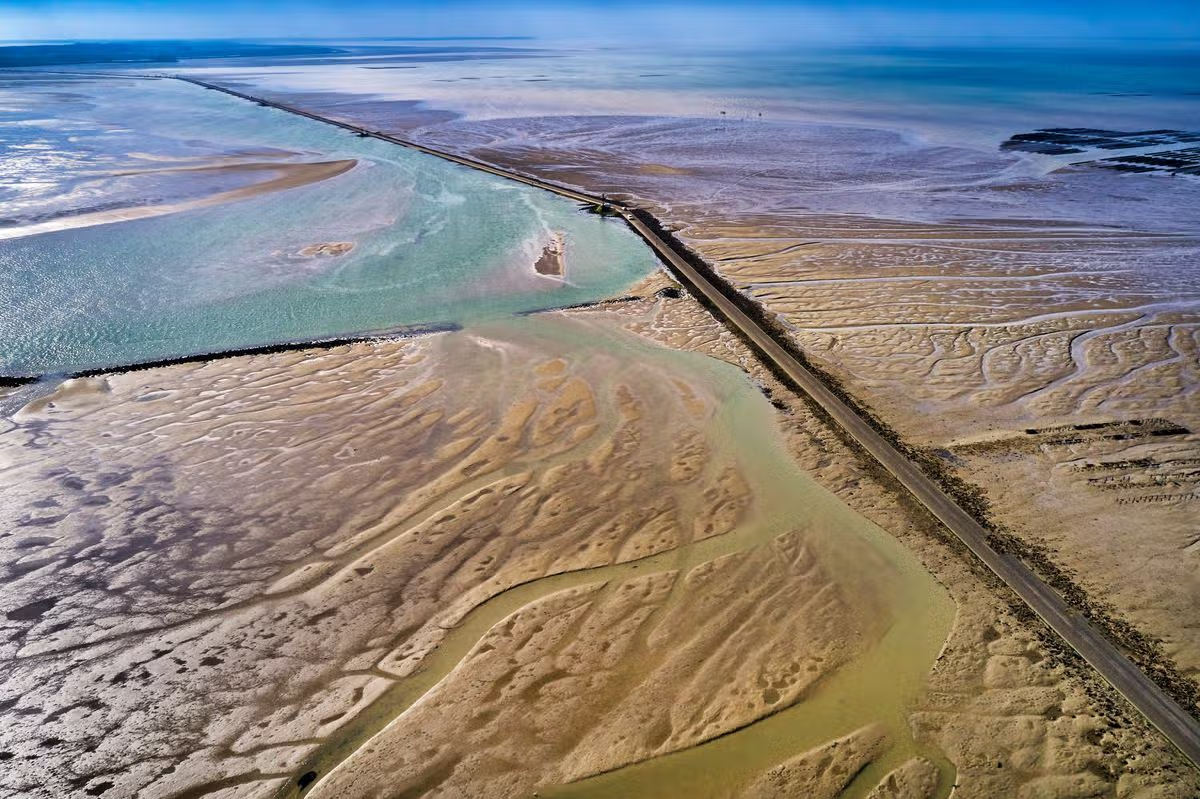
‘It’s the most spectacular route in England, past more than 20 castles, up the Northumberland coast and over the Lindisfarne causeway – which you can only drive at low tide. Then it nips over to Scotland, to a town where Mary Queen of Scots stayed, and back down through England’s biggest forest and the UK Dark Sky Reserve, and along Hadrian’s Wall.’
‘That does actually sound brilliant,’ he said.
‘We’re doing it in an electric car so we can see how easy it is.’
‘Oh no,’ he said.
With petrol prices rocketing, a road trip feels like a luxury too far at the moment, and I liked the environmental appeal of not bringing our exhaust fumes all the way north with us. But we don’t actually have an electric car so – confident that we would find enough charging points – we borrowed one.
Our Škoda Enyaq was a nippy SUV, that made short work of brine-soaked causeways, forest track off-roading and 20% hills, even with junctions at the top (oh, hill starts with an electric engine – where have you been all my life?). It promised as much as 300 miles on a full charge but, bearing in mind that most road trips end up at at least double the loop mileage, we plotted two charging points every day, and kept our fingers crossed that they would a) be working, and b) not have petrol cars parked in them.
Electric car charging on a UK road trip: what to expect
Charging electric cars is still a bit of a lottery – slightly different at every machine. You never rock up at a petrol station forecourt and wonder, ‘how does this pump work, then?’ – but you do with chargers. Most have an app you have to download to use them, so there are moments standing in the rain trying to get signal. A saving grace is other electric car users who are amazingly helpful. Less helpful are petrol drivers who park on the charging spaces.
Charging anxiety got me once, as I poured over the map on our way to Jedburgh, where only one charger showed as working, and nothing else was reachable, but it turned out fine – it was a fast charger so we only had to wait 15 minutes for the previous car to top up before we could.
The Northumberland 250 route: castles, coast and countryside
Northumberland has so many castles. One could get castle-fatigue if they weren’t so incredibly impressive. Bamburgh makes a play for Most Spectacular Castle Anywhere. Alnwick is where Harry Potter learns to fly his Nimbus 2000. Lindisfarne is so remote it becomes an island twice a day. Most deserve at least half a day to do them (and their entrance fee) justice, so my advice is pick one or two and see the rest in passing.
Dunstanburgh was my favourite – a mighty, atmospheric ruin we saw on a sunset walk from the fishing village of Craster. It felt like going back in time – there wasn’t another soul about. But I also loved smaller, free-to-visit places like Edlingham and Twizzel. In Alnwick we skipped the castle in favour of super-sized cherry scones at the Strawberry Lounge café and at Bamburgh we marvelled at the fortress from the beach, but visited The Potted Lobster for lunch instead (one of my best decisions: the Smoked Haddock Chowder).
Holy Island (Lindisfarne) took a little planning around tide times and we arrived in a rainstorm (a rare letdown in a sunny trip). Too wet to even leave the car, we returned the next day to see it in sunshine – the causeway was worth driving four times.
Leaving the coast at Berwick-upon-Tweed I worried the best was behind us, but the drive only got more beautiful. We skipped back and forth over the Scottish border, and headed through Kielder Forest along the 12-mile off-road track, Forest Drive, then down to the wide horizons of the North Pennines.
Where to stay on the Northumberland 250: hotels, lodges and pubs
Picking our pitstops was one of the highlights of the trip. I favoured places with EV charging, but in the end, we only plugged-in for one overnight, fast-charging instead in towns where we lunched. There is a charger on Holy Island, for instance, and one at Kielder Castle – remoteness is no obstacle. I loved the pace this brought to the trip, forcing stops in places we’d normally have driven straight through. It meant we discovered little gems, like Fountain Cottage Café in Bellingham.
We stayed in the lakeside lodge at Blossom Plantation (no EV charging), and drank cava in the hot tub under the stars. The Most Northerly Hotel in England, Marshall Meadows just beyond Berwick, is a ritzy venue and country house hotel. The Pheasant Inn at Kielder Water is everything you could want from a cosy fireside pub, family run with home cooking by Robin, favouring local ingredients – some from their own garden.
I finished the trip with three revelatory resolutions. One, that Northumberland was an epic holiday destination, offering far more than you can pack into five days. Two, that driving the route in an electric car is not only possible, but adds something unexpected – a more thoughtful way to travel. And three, that my next car will be electric.
The Northumberland 250 Itinerary: 5-day trip breakdown
Day 1
Newcastle to Dunstanburgh, via Alnwick, Warksworth and Craster
Highlights and stops: Edlingham Castle (free), Alnwick town for cream tea at The Strawberry Louge, Warkworth Castle, Alnmouth village and beach, Caster village and walk to Dunstanburgh Castle.
Dunstanburgh to Berwick-up-Tweed, via Bamburgh and Lindisfarne
Highlights and stops: Holy Island causeway / Lindisfarne (first thing, due to tide times), Bamburgh Castle, beach and lighthouse, lunch at The Potted Lobster. Berwick-up-Tweed for fish and chips.
Overnight: Marshall Meadows Manor House Hotel, Scottish Border
Day 3
Berwick to Kielder Water, via Twizel, Jedburgh and the Kielder Forest Drive (with a quick return visit to Lindisfarne first thing)
Highlights and stops: Norham Castle, Kirk O’Steil church, Twizel Caslte and river walk to Twizel Viaduct, Jedburgh town, Hindhope Linn waterfall, Kielder Forest Drive
A rider has died after an accident in Superbike qualifying for the North West 200 international road race on Thursday.
The incident happened at Station Corner and a red flag brought the session to a close.
The rider has not been named due to the wishes of his family.
“The session was immediately red flagged and emergency services attended the scene but unfortunately the rider succumbed to his injuries,” said North West 200 organisers in a statement.
“The family have given their approval for the event to continue but have requested that the rider not be named at this time.
“Coleraine and District Motor Club, the organisers of the races, offer our sincere condolences to the family and team.”
Superbike qualifying was the first session of the day and the remaining sessions in the afternoon did not take place.
The qualifying sessions have been moved to Thursday night to replace the planned opening three races, and it has not yet been confirmed by race organisers if Saturday’s schedule will contain any additional races on top of the planned six.
The fatality is the first at the North West 200 since Malachi Mitchell-Thomas was killed in a Supertwins race in 2016, and the 20th rider to lose their life in the 97-year history of the event.
The event is an international road race that takes place on 8.97 miles of closed public roads.
Hi, and welcome to another edition of Dodgers Dugout. My name is Houston Mitchell, and it still amazes me every season how some fans are ready to throw in the towel at the first sign of distress.
Are you a true-blue fan?
Get our Dodgers Dugout newsletter for insights, news and much more.
By continuing, you agree to our Terms of Service, which include arbitration and a class action waiver. You agree that we and our third-party vendors may collect and use your information, including through cookies, pixels and similar technologies, for the purposes set forth in our Privacy Policy such as personalizing your experience and ads.
So, the Dodgers’ offense has been sputtering as of late. Since April 21, a span of 12 games, they have scored two runs in a game three times, one run in a game twice and have been shut out once. They are 5-7 in that time and lost four in a row before winning Sunday.
Is that good? Of course not, but it’s nothing to get overly concerned about. Every team goes through highs and lows on offense. In that same time, they also scored 12 runs in a game and beat the Chicago Cubs, who had a 10-game winning streak, twice.
When they opened the season 15-4, they were averaging almost six runs a game. No one was bowing down and handing them the World Series trophy just for that, just like no one should write them off because of a bad stretch of games.
Let’s look at the Dodgers’ offense each year since 2017, with the number of times the team scored two runs or fewer in a game each season.
2026 Two runs: 6 times One run: 3 times No runs: 1 time Season record: 21-13 Average runs per game: 5.15 Longest losing streak: 4 games
The Dodgers project to score two or fewer runs 47 times this season, which is higher than the last few seasons, but it’s a relatively small sample size and projections are a bit wonky this early. This is looking more and more like a repeat of last season. Streaky offense, erratic bullpen, solid (for the most part) starting pitching.
2025 Two runs: 13 times One run: 16 times No runs: 8 times Season record: 93-69 Average runs per game: 5.09 Longest losing streak: 7 games
2024 Two runs: 15 times One run: 14 times No runs: 5 times Season record: 98-64 Average runs per game: 5.20 Longest losing streak: 5 games
2023 Two runs: 12 times One run: 14 times No runs: 4 times Season record: 100-62 Average runs per game: 5.59 Longest losing streak: 4 games
2022 Two runs: 12 times One run: 13 times No runs: 7 times Season record: 111-51 Average runs per game: 5.23 Longest losing streak: 4 games
2021 Two runs: 22 times One run: 14 times No runs: 5 times Season record: 106-56 Average runs per game: 5.12 Longest losing streak: 4 games
2020 Two runs: 7 times One run: 2 times No runs: 0 times Season record: 43-17 Average runs per game: 5.82 Longest losing streak: 2 games
2020 was the COVID-shortened season.
2019 Two runs: 22 times One run: 11 times No runs: 6 times Season record: 106-56 Average runs per game: 5.47 Longest losing streak: 6 games
2018 Two runs: 19 times One run: 17 times No runs: 8 times Season record: 92-71 Average runs per game: 4.93 Longest losing streak: 6 games
2017 Two runs: 14 times One run: 20 times No runs: 8 times Season record: 104-58 Average runs per game: 4.75 Longest losing streak: 11 games
So, there’s nothing really unusual going on so far this season. Now, if we reach May 20 or so and they still are slumping, then we can worry more. At some point, this team will age out. Mookie Betts seems to be injury prone, and Freddie Freeman has slowed some. At some point, this team will fail to make the postseason. But not this season.
The biggest obstacle this team faces is expectations. Some in the media proclaimed this the best offense in history. It was never going to be that. But it raised expectations, making them almost impossible to beat.
Heck, last season’s Dodgers went 0-6 against the Angels. They went 3-6 in one stretch, losing one of those games 16-0. They went through another stretch of the season in which they went 2-10, scored two or fewer runs seven times and averaged 3.5 runs per game. And last time I checked, they won the World Series.
So, this is nothing new.
When will Blake Snell be back?
Blake Snell, whom the Dodgers should start encasing in bubble wrap when he’s not pitching, is on a rehab assignment. In three games (two for class-A Ontario, one for triple-A Oklahoma City) he has pitched eight innings, giving up six hits, four runs and two walks while striking out 10. If all goes well, he will be back in mid-to-late May.
And who goes out of the rotation when he comes back? Yoshinobu Yamamoto, Shohei Ohtani and Tyler Glasnow aren’t going anywhere, so that leaves Emmet Sheehan, Justin Wrobleski and Roki Sasaki. If you go by results, then it has to be either Sheehan or Sasaki. How these guys pitch over the next couple of weeks will solidify that answer, but as for now, I’d remove Sasaki from the rotation.
Justin Turner, manager?
With three World Series titles, Dave Roberts will be Dodgers manager for a long time. But when he does step down, could Justin Turner be next?
Turner’s wife, Kourtney, recently appeared on the “Foul Territory” podcast and had this to say when asked if she believes Justin will become a manager after retiring.
“I do. I think it will be more nerve-wracking than his playing days for me, though, because I think it’s a tough job. Because if things are going well, not everyone looks to the manager. But then if there’s a decision that doesn’t pan out, I think it falls back on the manager.
“So I’ll have to stay off Twitter and all the comments for that one. I think he has such a good understanding of the game. I think he has good feel. I think he does a really good job.
“I’m always in awe when he goes to these new teams. And then I see him in the dugout the first or the second game of the season, and he’s already meshing so well. He just has that ability to reach, I think, every single guy there. And I think that’s what makes him so special.”
Turner is currently playing for Tijuana in the Mexican League.
These names seem familiar
How notable players who were with the Dodgers the last couple of seasons are doing with their new teams. Click on the player’s name to be taken to their full stats page:
Vin Scully tells a story on how a player’s career was influenced by … well, you have to see it to believe it. Watch and listen here.
Until next time…
Have a comment or something you’d like to see in a future Dodgers newsletter? Email me at houston.mitchell@latimes.com. To get this newsletter in your inbox, click here.
Islamabad, Pakistan – Pakistan has opened six overland transit routes for goods destined for Iran, formalising a road corridor through its territory as thousands of containers remain stranded at Karachi port because of the United States blockade of Iranian ports and ships trying to pass through the Strait of Hormuz.
The Ministry of Commerce issued the Transit of Goods through Territory of Pakistan Order 2026 on April 25, bringing it into immediate effect. The order allows goods originating from third countries to be transported through Pakistan and delivered to Iran by road.
Recommended Stories
list of 4 itemsend of list
The announcement coincided with Iranian Foreign Minister Abbas Araghchi’s visit to Islamabad for talks with Prime Minister Shehbaz Sharif and army chief Asim Munir, the latest in a series of diplomatic engagements as Pakistan seeks to mediate an end to the two-month war between Washington and Tehran.
Federal Minister for Commerce Jam Kamal Khan described the initiative as “a significant step toward promoting regional trade and enhancing Pakistan’s role as a key trade corridor”.
Iran has not publicly commented on the move, and Al Jazeera’s query to the Iranian embassy in Islamabad went unanswered.
The notification does not extend to Indian-origin goods. A separate Commerce Ministry order issued in May 2025, following the India-Pakistan aerial war that month, bans the transit of goods from India through Pakistan by any mode and remains in force.
Routes and regulations
The six designated routes link Pakistan’s main ports, Karachi, Port Qasim and Gwadar, with two Iranian border crossings, Gabd and Taftan, passing through Balochistan via Turbat, Panjgur, Khuzdar, Quetta and Dalbandin.
The shortest route, the Gwadar-Gabd corridor, reduces travel time to the Iranian border to between two and three hours, compared with the 16 to 18 hours it takes from Karachi – Pakistan’s biggest port – to the Iranian border. The Gwadar-Gabd route could cut transport costs by 45 to 55 percent compared with costs from Karachi port, according to officials.
But for Iran, firms sending their goods to the country, and transporters, all routes into Iranian territory today are viable options, with the principal maritime passage they have traditionally used – the Strait of Hormuz – blockaded by the US Navy.
Corridor shaped by conflict
The current US-Iran war began on February 28, when US and Israeli forces launched attacks on Iran.
In the weeks that followed, Iran restricted commercial navigation through the Strait of Hormuz, the narrow waterway through which roughly a fifth of the world’s oil and gas passes during peacetime, disrupting one of the most critical arteries of global trade.
Pakistan brokered a ceasefire on April 8 and hosted the first round of direct US-Iran talks on April 11, in Islamabad. The negotiations lasted nearly a day but ended without a deal. Two days later, Washington imposed a naval blockade on Iranian ports, throttling Tehran’s maritime access.
A second round of talks has since stalled. US President Donald Trump cancelled a planned visit to Islamabad by special envoys Steve Witkoff and Jared Kushner last weekend.
Iran has ruled out direct negotiations with Washington while the blockade remains in place, though Araghchi told Pakistani officials that Tehran would continue engaging with Islamabad’s mediation efforts “until a result is achieved”.
The transit order appears to be a direct economic response to that impasse.
More than 3,000 containers destined for Iran have been stuck at Karachi port for several days, with vessels unable to collect the cargo. War-risk insurance premiums have surged from about 0.12 percent of a vessel’s value before the conflict to roughly 5 percent, making shipping to the region too expensive for many operators.
Shifting regional dynamics
The corridor also signals a shift away from Afghanistan, whose relations with Pakistan have deteriorated sharply.
The two sides engaged in clashes in October 2025 and again in February and March this year, with skirmishes continuing along the northwestern and southwestern borders.
The Torkham and Chaman crossings have ceased to function as reliable commercial routes since tensions escalated, limiting Pakistan’s overland access to Central Asian markets.
“This is a paradigmatic shift. Pakistan’s relations with the Afghan Taliban, the de facto rulers in Kabul, have no reset switch,” Iftikhar Firdous, cofounder of The Khorasan Diary, told Al Jazeera.
“Kabul has been diversifying away from Pakistan towards Iran and Central Asia, but this move flips the equation. Pakistan can now bypass Afghanistan entirely for westbound trade. The impact on Kabul’s transit relevance and revenue is strategic, not immediate – but it is real.”
Firdous said the implications extend beyond bilateral ties.
“This corridor also reduces Pakistan’s reliance on longer maritime routes through the Gulf. Geopolitics, security, and infrastructure will ultimately determine which corridors dominate, but it places Pakistan as the main overland gateway for China-backed trade routes into West Asia and beyond,” he said.
Minhas Majeed Marwat, a Peshawar-based academic and geopolitical analyst, urged caution. “A cornered Afghanistan is a destabilised Afghanistan, and Pakistan knows better than most what that costs,” she wrote on X on April 27.
“The opportunity here is real. So is the risk. Security on the northwestern and southwestern borders remains the variable that could unravel everything. Pakistan is positioned well. It is not yet positioned safely. Those are different things.”
Marco Reus scored two goals, the second one on a penalty kick in the 85th minute, to rally the Galaxy to a 2-1 victory over Real Salt Lake on Sunday.
Reus scored from 21 yards out off a free kick to give the Galaxy a 1-0 lead in the ninth minute. The kick was awarded after Gabriel Pec was fouled by Real Salt Lake midfielder Stijn Spierings.
Galaxy goalkeeper JT Marcinkowski was charged with an own goal in the final minute of stoppage time, tying it 1-1 at halftime. The ball deflected off the post and into the net when he dove to make a save on Zavier Gozo’s shot.
Reus scored the winner on a PK after a foul on Sam Junqua for shoving Elijah Wynder in the back on a corner kick. It was the fourth goal this season for Reus and his 10th in 37 career appearances.
Marcinkowski saved nine shots for the Galaxy (3-4-3).
Rafael Cabral totaled four saves for Real Salt Lake (5-3-1).
Real Salt Lake went 5-0-1 in a six-match stretch before losing 2-0 to visiting Inter Miami on Wednesday. The club falls to 1-2-1 on the road.
The Galaxy were coming off a 1-1-1 road trip and improve to 2-2-1 at home.
The RAC has named the best cars on the market for a road trip in the UK, with an unexpected vehicle coming out on top thanks to its fuel efficiency and fun driving experience
The RAC has announced the best road trip car (stock)(Image: Andrew Merry via Getty Images)
Despite soaring fuel costs, motorists across the UK will still be eager to hit the open road this summer and enjoy a good old-fashioned road trip.
Whether it’s a group of mates touring Cornwall, tackling Scotland‘s legendary North Coast 500, or conquering the Welsh hills, there’s no shortage of thrilling routes to choose from.
With this in mind, the RAC has compiled a list of the finest road trip cars currently on sale in the UK. However, the top pick may well raise a few eyebrows – and so might the runner-up.
Taking the top spot is the £17,095 Kia Picanto city car which, while not an obvious choice, the RAC’s Lawrence Allan explained how its compact performance made it more exhilarating to drive than many far pricier and more powerful alternatives on the market.
He explained: “Road trips are rarely dull when you’re pushing a car to its limits, and you can do that in the little Kia and still be under the speed limit. You’ll sip fuel, too – a bonus with unpredictable fuel prices.
“What’s more, the Picanto is good fun to drive on the kind of tight, twisty roads that are found in most of our top 10 best road trips in the UK. Then, when you head into a nearby town for dinner, parking is a doddle.”
Pipped to second place behind the Kia Picanto was the electric variant of the Mercedes-Benz CLA, which Lawrence described as the ultimate electric vehicle for hitting the road.
Lawrence cited the primary reason for this as the distance the £45,615 car could cover on a single charge, boasting a range of up to 484 miles — sufficient to travel from London all the way to Dundee in Scotland.
He further noted that the vehicle impressed with its efficiency and rapid charging capability, making pit stops noticeably less lengthy than those required by other electric cars over the past decade.
Taking third place was the £34,875 Nissan Qashqai e-Power. Lawrence attributed its bronze position partly to its efficiency, which allows drivers to achieve over 770 miles from a tank of fuel, as well as its outstanding practicality.
While the Kia and Mercedes offer 255 and 407 litres of boot space respectively, the Nissan boasts a generous 504 litres. The Nissan also edges ahead of the Kia on fuel economy, with the Kia capable of 51.4mpg compared to the Nissan’s 64.2mpg — a crucial factor during a period of rising fuel costs.
On the subject of fuel, some experts have cautioned against filling up between 10am and 2pm, amongst them Interfuels’ Gordon Walllis.
He explained to the Express: “By late morning, many retailers have already adjusted their prices to reflect overnight changes in wholesale costs. That means drivers filling up around midday are often paying a premium.
“Late morning and early afternoon tend to be busy periods, with people stopping during errands, commutes or lunch breaks. When demand is steady, there is less pressure on retailers to keep prices low.”
Their steamroll hit a speed bump as they squandered opportunities in Saturday’s 4-3 loss to the Colorado Rockies at Coors Field.
Even the hottest of Dodgers’ hitters cooled off as the night did. Collectively, they went 0-for-6 with runners in scoring position and left eight runners on base, including two in the ninth inning.
Now 15-5, it was their first loss in five games and their first all season to a National League opponent.
Kyle Tucker, the Dodgers’ pricey new right fielder, had three hits, including his third home run this season. And backup catcher Dalton Rushing hit his fifth home run.
But that was all the damage the Dodgers did in support of starter Emmet Sheehan, who left with a one-run lead that reliever Will Klein relinquished in a matter of three batters in the sixth inning.
Shohei Ohtani also saw his career-best on-base streak reach 50 when he singled in the ninth inning to tie Willie Keeler’s 50-game mark established in 1901.
The two-time reining World Series champs threw the proverbial first punch when Tucker launched a 435-foot two-run home run into the second deck, making it 2-0 two batters into the game.
Tucker’s third home run as a Dodger drove home Ohtani, who chopped the first pitch he saw to Troy Johnston and would have been out at first if not for the errant throw by the first baseman.
In the bottom of the first, the Rockies responded when Mickey Moniak doubled and TJ Rumfield drove him in with a single to cut the lead in half, 2-1.
Dodgers catcher Dalton Rushing follows the flight of his solo home run off Colorado pitcher Ryan Feltner Saturday in Denver.
(David Zalubowski / Associated Press)
The Dodgers came right back in the second inning, when Rushing — in his one expected start behind the plate this series — kept crushing, launching a 1-1 pitch 371 feet over the right field wall to make it 3-1. It was his fifth home run in 18 at-bats until that point.
The Dodgers’ two home runs in the first two innings gave them multiple homers in 10 of their first 20 games this season — and ran their MLB-leading season total to 37 as a team.
But the Rockies returned serve in the bottom of the second, when Johnston scored on a Kyle Karros sacrifice fly to stay within a run, 3-2.
That’s how it stayed for the next three innings, as Sheehan got out of the third and fourth unscathed, despite the Rockies putting runners in scoring position in both the third and fourth. His only 1-2-3 inning was the nine-pitch fifth.
His control wasn’t as sharp as in his prior outing, but he left after five innings with the lead, having thrown 77 pitches, allowed four hits, two runs, struck out four and walked two.
The Dodgers got something going again in the sixth inning when Freddie Freeman hit a one-out triple into the gap in the expansive Colorado outfield, just beyond the grasp of diving center fielder Brenton Doyle.
A batter later, the Rockies’ diving third baseman Karros made a nifty play to throw out Teoscar Hernández after he drilled a ball up the line — holding Freeman at third in the process.
Then left-hander Brennan Bernardino came on in relief and tied up a clearly frustrated Max Muncy with a curveball, striking him out and ending a scoreless inning with Freeman stranded on third.
Klein took the loss after taking over for the Dodgers in the sixth and immediately gave up a double to Hunter Goodman before Ezequiel Tovar’s grounder ricocheted off Klein’s left foot and right knee. Tovar reached before Freeman could corral the ball and get it to Klein at first.
Both runners scored on a no-out double by Johnston and Colorado had a 4-3 lead that would stand.
In the eighth, “Let’s go Dodgers” chants picked up with Andy Pages at bat and Ohtani and Tucker on first and second base. But Pages struck out on a strike that was determined to find the bottom of the zone by baseball’s new ABS system.
Hernández then walked to load the bases but Muncy grounded out to second base, leaving more runners stranded.
There are scenes of celebration on roads in southern Lebanon as people begin driving back to their homes as the ceasefire with Israel takes hold. Israeli forces had continued to bomb the south up until the midnight truce began.
The drop-off in Belfast is an issue when it comes to Antrim’s future.
In December 2024, the county launched a new five-year strategic plan, addressing a range of issues including player retention and development.
At present, there are 51 clubs in Antrim, comprising of approximately 20,000 members of which 15,000 are players, but when it’s considered the population of west Belfast alone is over 100,000, there is potential for much more.
Since St Gall’s record-breaking run of of eight county titles in a row ended in 2014, the Padraig MacNamee Cup has been in Belfast just once when Cunningham’s Lamh Dhearg triumphed in 2017.
“There is a question of participation levels, but the standard of underage football in Belfast is quite poor and there’s no point dressing it up,” Cunningham insists.
“Aside from St Brigid’s and St Paul’s who can compete at U16 and minor level because of the numbers they have, the rest – and I include my own club – are scrapping to get teams out on the pitch.”
No school from within the county plays in the Ulster Colleges MacRory Cup and exposure to top-level competition at a young age is one area Cunningham, a teacher at St Mary’s CBGS, feels is vital to raising standards which will feed into county teams.
“There is no school competing at colleges’ ‘A’ football apart from St Louis [Ballymena] in Year Nine.
“If the Gaelfast, Belfast city combined team is harnessed correctly over a number of years, there is something in that, but it requires buy-in.
“They’ve piloted it this year with Year Nine and Year 12, but does that continue into Year 10 next year? It needs to be continued with the same panel or else by the time they get to Year 12, you’re back to square one as it takes time for a squad to gel.
“It needs to be piloted from Year Eight right through to Year 14 to see how it goes.”
The European Commission on Wednesday imposed anti-dumping duties on glass fibre —a key input for the EU’s renewable industry— produced by Chinese companies operating in Egypt, Bahrain and Thailand.
ADVERTISEMENT
ADVERTISEMENT
The move confirms the EU’s push to curb Chinese imports entering the bloc via Belt and Road routes to sidestep tariffs on products officially labelled “made in China.”
Brussels seeks to shield its market from a surge of low-cost imports from the Asian giant, targeting goods it considers heavily subsidized or sold in the EU below production cost in China.
The tariffs on glass fibre from the three countries will range from 11% to 25.4% of the product’s value.
“The investigation confirms the existence of unfair practice, which is an important signal,” Ludovic Piraux, President of Glass Fibre Europe, said.
But he added that the measures adopted “remain insufficient to fully address the predatory strategies pursued through these investments in third countries.”
Job losses loom
China has invested $1 trillion through the Belt and Road initiative – a large-scale infrastructure programme which replaced the former silk road initiative and is aimed at strengthening connectivity, trade and communication across Eurasia, Latin America and Africa. The programme spans more than 150 countries, supporting infrastructure, transport, raw materials extraction and the relocation of industries and state-owned enterprises abroad.
As early as 2010, following an industry complaint, the Commission imposed anti-dumping duties on Chinese glass fibre imports. In the years that followed, Chinese producers established factories in Bahrain and Egypt, from which exports to the EU resumed.
By 2024, glass fibre imports from those countries, along with Thailand, accounted for 24% of the EU market. Egyptian imports alone reached 18%, with Glass Fibre Europe warning the situation could worsen.
This is not the first time the Commission has targeted Chinese products made in third countries under Belt and Road arrangements. It has previously imposed measures on aluminium foil from Thailand and glass fibre produced in Türkiye.
European glass fibre manufacturers have been pushing for action for more than a decade, alongside unions seeking to protect jobs in the sector.
The complaint which lead to Wednesday’s anti-dumping duties was first reported by Euronews in January 2025.
The industry directly employs more than 4,500 workers in the EU and says it supports hundreds of thousands of indirect jobs along the value chain.
Judith Kirton-Darling, General secretary of industriAll Europe, warned that “in the longer term”, the situation could worsen if the EU does not take “a stronger” stance on Chinese dumping.
“It is more than likely that we will face plant closures in Europe which will fundamentally undermine our industry,” she said.