The moment came on about day four. A cloud-like mist was drenching our faces, hair and clothes, despite the thick canopy of trees overhead. My six-year-old daughter silently trudged uphill pushing her bike, her mouth set in a grim line. I looked again at the blue blob on Google Maps, which seemed, unfeasibly, to indicate we were on the right path. I thought, again, about the diminishing supply of chocolate in my backpack.
“See! I told you! We’re having an adventure,” I said with forced jollity. She didn’t even look up.
“This is not an adventure,” she said. “This is just pushing your bike up a big hill.”
Adventure. Such an intoxicating word. And so easy to achieve … when you’re young. But with two kids, within the constraints of the summer holiday? Well, that’s more of a challenge.
It was with that quest in mind that we found ourselves lost up a lush, densely wooded mountain in the Spanish Basque Country, on a track unsuited to bikes, as part of the first stage of a three-week road trip from Bilbao in northwest Spain to Saint-Malo in Brittany, north-west France.
I’ve always loved a road trip, and was hoping to recreate – in some limited way – a classic that I had done in my 20s. After living in Paris for two years, I and my then-boyfriend meandered across France for a month in my nan’s old Peugeot, camping in different places virtually every night. We stayed in fields where we were the only people for miles and watched eagles swooping as the sky darkened; we begged the manager of a stuffed-to-the-gills campsite to move his car so we could camp on his front lawn.
Bilbao’s Plaza Nueva. Photograph: Peter Eastland/Alamy
This would, of course, be different. My partner is deeply sceptical of camping. The kids still shudder at the memory of the toilets on the first campsite we ever stayed at. So how do you have a somewhat unstructured, kind-of-spontaneous road trip with kids?
We decided on a mixture of home swaps and posh camping, and started with a journey that is an adventure in itself. On board the two-night ferry from Portsmouth to Bilbao on Brittany Ferries’ Galicia, we spent hours watching pods of dolphins, reading our books, and sneaking back to our cabin for naps. It’s worth noting that while entrance to the first-class Commodore lounge isn’t cheap (prices vary by ferry; it’s £79 a person on the Portsmouth to Bilbao crossing), the excellent buffet is endlessly replenished; all drinks, including wine at meal times, are included; and the lounge is a peaceful haven.
Alexandra’s children on a bike ride in the Spanish Basque country. Photograph: Alexandra Topping
We rolled off the ferry, kicking off our escapade in Bilbao on the opening day of Aste Nagusia, the city’s annual nine-day party. After a stroll around the Guggenheim – arguably the best modern art museum in Europe – we headed to the Plaza Nueva in Bilbao’s Casco Viejo, where the pintxo bars were rammed with locals wearing blue and white checked scarves and shouting for more cider. The Spanish know how to live, but the Basques? They know how to party.
Full of anchovies, olives and salt cod, we drove north along winding roads up into the verdant mountains of the province of Gipuzkoa to our first stop, an apartment in the small hamlet of Berastegi, about 25 minutes from San Sebastián – a stay organised through the home swapping website Home Exchange. We are evangelical about home swapping, having saved thousands of pounds since 2022 with brilliant holidays in Spain, France, Denmark and the UK.
You frequently discover fabulous places you might never have heard of too, often on the recommendation of your hosts – such as Casa Julian, in charmingly sleepy Tolosa, where we ate a steak so good as to render all future steaks redundant. A devastating steak, frankly. A meal for four cost €234, and I would happily sell my car to eat there again.
Staying in Berastegi also allowed us to visit the bustling city of Pamplona, a 40-minute drive away, where we drank unctuous hot chocolate in Café Iruña, Hemingway’s old haunt, before learning about the running of the bulls on a grimly fascinating tour.
A view over San Sebastián from Monte Igueldo. Photograph: Sonia Bonet/Alamy
The money saved on accommodation also meant we could afford a night in a hotel in San Sebastián, where we ate, strolled, swam, then ate again. The city’s claim to have the greatest density of Michelin stars in the world is disputed, but when you are drinking a glass of cold txakoli and hollowing out a stuffed txangurro (spider crab) that hardly seems to matter. Kid-friendly trips to the cool aquarium (vital information: it has axolotls) and the 113-year-old Monte Igueldo amusement park were interspersed with a copious €20 menúdel día at Aldaba. Something for them, something for us.
Full, again, we took to the road, driving away from the mountains via the delightful French Basque coastal village of Bidart to our next stop en route to the French Atlantic coast.
Two hours from the traditional timber-framed baserri (farmhouses) of south-western France, the mist-shrouded mountains give way to the open flatlands of western France, long wide roads lined with pine trees and dunes that rise up from the crashing waves of the turbulent ocean.
We stopped in Arcachon at the Huttopia site, one of a family-run chain of nature-immersed campsites. The handsome seaside resort, with its 19th-century Arcachonnaise villas with names such as Esmerelda and Denis Papin, feels like the stately grand dame of the Atlantic coast.
Our luxury “évasion” chalet, with its nice toilet, strong shower and comfortable beds, was not, let’s face it, camping. But, nestled among the pines and deep in the forest, we sat on our deck listening to the soothing throb of crickets and got similar benefits, only without the discomfort. When we climbed the awesome Dune du Pilat, it felt like landing on the moon, and when we held hands and hurtled down it again, like we were taking off into space.
Three days later, the landscape transformed again as we drove to the flat salt plains of the Île de Noirmoutier, about one-and-a-half hours from Nantes, and set up home in a well-stocked Huttopia wood and canvas desert tent, next to the water’s edge and a short walk from the village of tiny white bougainvillaea-draped houses and restaurants. That night, as I sat outside the tent listening to the waves and the wind in the trees, I looked at the stars stretched out across the inky sky – and I remembered those eagles.
Cancale is celebrated as the oyster capital of Brittany. Photograph: Yurii Zym/Getty Images
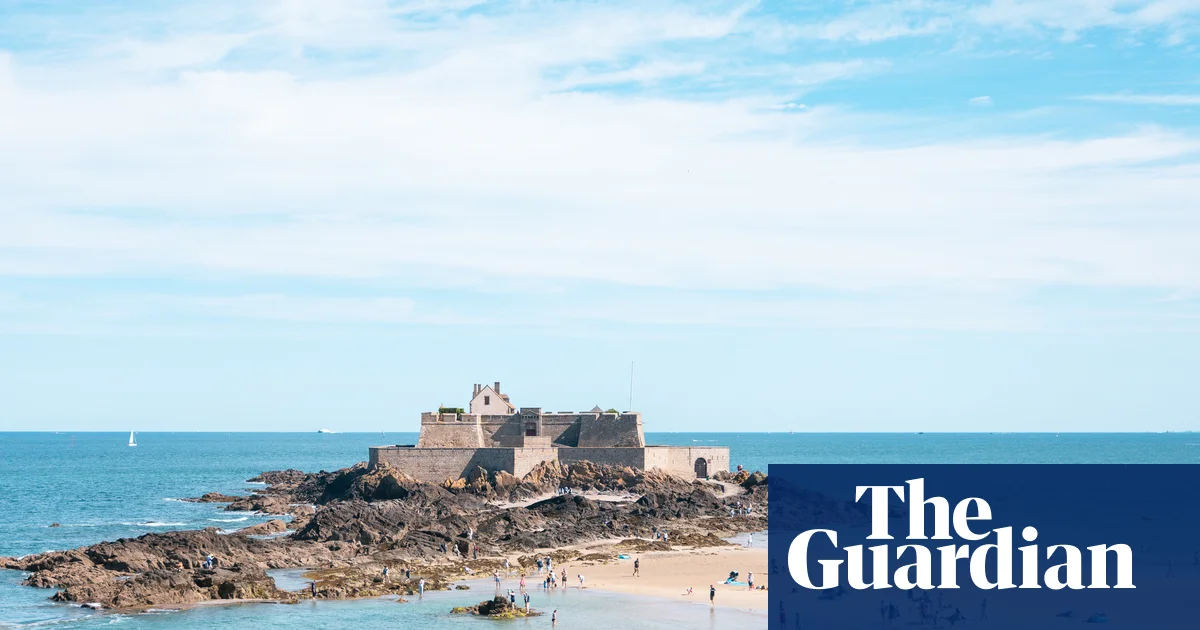
To complete this family odyssey, we spent four days at another home exchange in the underrated Breton port of Saint-Malo, which has a wealth of charm, great food and delicious cider – as well as the most delightful coastal pool I have ever swum in.
On our last day, we went to Cancale, where I had tasted oysters for the first time, scooping them up from a plastic tray, with a glass of sancerre, on the beach. This time we opted for a restaurant, and while my son learned to slurp oysters, my daughter tried her first mussels. As she used an empty shell to pinch their juicy flesh and pop them into her mouth, I recognised that I get as much pleasure from their discoveries as from my own. And, I thought, maybe the adventure isn’t over after all.
Accommodation at Arcachon and Noirmoutier was provided by Huttopia: Chalet Évasion from €75; Toile & Bois tent from €69. Transport was provided by Brittany Ferries: Portsmouth to Bilbao for a car, four people and an ensuite cabin from £490 one-way; St Malo to Portsmouth from £225 one-way for a car plus four people. Home Exchange membership is £190 a year
One of my favourite recent photographs is of me (unusually), perched on the bonnet of our car, about to set off on a solo, two-week road trip from our Sussex home to the wilds of Scotland, taking in Eryri (Snowdonia), Lancashire, the Lake District and Yorkshire. I had no idea that the research trip I was about to embark on – for my book, which traces the story of British holidays over 400 years – was going to reveal my homeland as somewhere I barely knew.
As a southerner, it was the northern half of Britain that I needed to discover. I’d stitched together my route with visits to museums, archives and classic seaside resorts that had once blazed so brightly. I’d visited Cumbria before, but the Conwy coast, the Lancashire countryside, Blackpool, Morecambe, Scarborough? All these were unknowns.
My first stop was Eryri, where it turned out my hotel, the Royal Oak in Betws-y-Coed, had been welcoming artists such as JMW Turner since the late 18th century. Fifty years later, it became the hub of the country’s first artists’ colony, drawn here by the dramatic beauty of the dense, bottle-green swathes of the Gwydir Forest and the spectacular peaks of the Glyderau range and Moel Siabod.
Llandudno has one of the most complete Victorian promenades in the UK. Photograph: James Clarke/Alamy
Over coffee, hotel manager Katie Valentine told me about the artists who called the area home – David Cox, Henry Clarence Whaite and Thomas Collier among others – at least until Betws railway station opened in 1868. “At that point,” she said, “many moved to houses further up the valley, grumbling that the place was becoming flooded with tourists.” As I would discover on this journey, it seems overtourism is far from a contemporary travel trend.
From Eryri, it was a short hop to Llandudno, a beach town so pristine it felt a little like a Victorian theme park resort. “In some ways it is,” Judith Phillips, trustee of the Llandudno Museum, told me. “The family who built Llandudno in the mid-19th century – the Mostyns – still own much of it now, and control everything from what colours people can paint their hotels to what businesses are allowed on the promenade.”
The Llandudno Museum made plain that much of our history is not in the great city museums, but in libraries, archives and small museums on quiet high streets, often run by passionate volunteers with an encyclopaedic knowledge of their local heritage.
Driving from Llandudno up to Lancashire along the North Wales Expressway, I whipped in and out of tunnels, emerging to see great swathes of the cobalt-blue Irish Sea stretching to the horizon.
Further into my journey, I was pointed towards early editions of the very first guidebooks to the Lake District, written by Thomas West and William Wordsworth, at the Armitt Library in Ambleside; shown handwritten letters by Queen Victoria at Blair Castle (including her personal recipe for potato salad); and told wonderful stories of Wakes Week holidays in Blackpool by the dapper Richard Croisdale at Blackburn Museum – their longest-serving volunteer, at a sprightly 90 years old.
Annabelle Thorpe drove up from Sussex to the Highlands via north Wales and Lancashire. Photograph: Annabelle Thorpe
Blackburn’s grandiose Victorian museum and Bolton’s neoclassical town hall stand as legacies of the era when Lancashire towns were affluent manufacturing bases home to tens of thousands of factory workers. The Georgian streets of Richmond are like a mini Bath, but steeped in Yorkshire heritage. But perhaps nowhere confounded my expectations more than Blackpool.
Arriving on a Friday night, the promenade buzzed with lights and life; the illuminations blazing all the way to the tower, kids skipping along the seafront entirely unaware they had been brought to one of the most deprived towns in the country. “We are a town of extremes,” said Claire Smith, co-owner of the chic Number One South Beach B&B. “We have pockets of absolute joy next to complete caverns of woe. There’s no blending. It’s either amazing or awful.”
Claire and husband Mark shared stories of Blackpool in the 1970s, not least his coming back from the pub as a teenager to find his parents had let his bedroom – along with their own – to guests, leaving them to sleep in the lounge. This was the era when guests queued in their dressing gowns to use the bathrooms, landladies locked the doors between mealtimes, and peach Melba was the height of culinary flair.
“They were simpler times, people expected much less,” Claire told me, a little wistfully. “But I do think people were happier.” There’s still plenty of joy to be found, though. When I visit the Pleasure Beach as it opens on a Sunday morning, families are streaming in; the first coasters rattling skywards; a general air of giddy excitement that is a stark counterpoint to the rundown streets elsewhere in the town.
So many of my preconceptions were corrected or reversed: the elegant St George’s Hotel in Llandudno showed me that not all grand dame seaside hotels are faded or old-fashioned. And while we do love to run down our own seaside resorts, I saw beaches to rival anything the Med has to offer, from Scarborough’s South Bay to Morecambe’s vast, empty sandscapes.
Nowhere confounded Annabelle’s expectations more than Blackpool. Photograph: Alex West/Getty Images
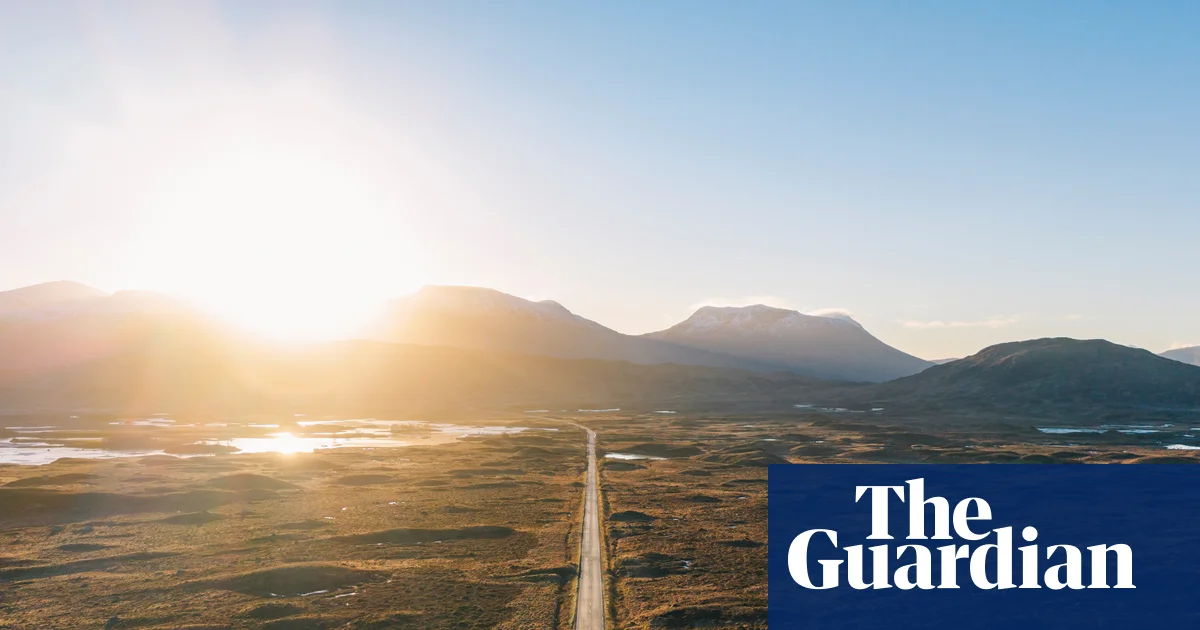
Beyond the seaside, it was Scotland that really blew my mind. Following in the footsteps of William and Dorothy Wordsworth, who toured the Highlands and Lowlands for six weeks in 1803, I headed up the western flank of Loch Lomond, entirely unprepared for what I was about to discover. Dusk was falling as I drove across Rannoch Moor – a silent, pockmarked moonscape that seemed entirely bereft of life, save for a lone pair of car headlights, somewhere up ahead. And then, in the distance, great, hulking mountains began to rise up, guarding the entrance to Glen Coe. It is a landscape so forbidding that when I pulled up at the Three Sisters viewpoint, I was genuinely relieved to see another couple, so I didn’t have to stand alone among the ominous peaks.
Scotland had stories, too: from the spruce and redwood trees planted in Glen Coe by Lord Strathcona in the 1890s to make his Canadian wife feel at home, to Queen Victoria taking the first ever fly-and-flop (train-and-flop, perhaps more accurately) at Blair Castle in 1844. Her visit was hosted by the 6th Duke of Atholl, who promised the security of his own private army (and who had to move out of his own castle during the royal stay). It was the beginning of a royal love affair with Scotland that led to the purchase of Balmoral in 1852.
When I got home from the long road trip – 13 days and 1,600 miles later – my husband took the same photograph of me perched on the car. It had been more of an adventure than I could have ever imagined – to lands unknown on the island I call home.
The Great Escape: Britain’s 400-Year Love Affair with Holidays by Annabelle Thorpe (£18.99, DK Red) is available now. To support the Guardian, buy a copy from guardianbookshop.com for £17.09
It’s midnight, in June. Powder pink and dark grey clouds drift across a pallid sky, the palette reflecting in the motionless water of Lake Inari. Islets of pine and just-budding birch create pools of distorted shade close to the horizon of this 420 sq mile (1,080 sq km) lake in Lapland, northern Finland. There is not a sound. It’s so silent, I barely breathe to avoid disturbance. Only me, the lake and a moonbeam-coloured moth, whose wingbeat is inaudible.
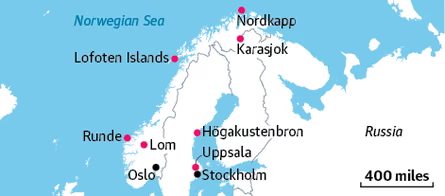
I am sat beside my car-sized campervan, with mesmerised reverence for the rose-tinged panorama. I do not wish to go to bed and miss this moment. And I am loving the wild freedom and deliciousness of being entirely alone, with nobody in the world knowing my exact whereabouts. Ordinarily, I would be long asleep by midnight, exhausted after a day of work and family life. But I have left my husband and (adult) children at home in England for an eight-week solo camping adventure through Denmark, Sweden, Finland and Norway, with the singular aim of reaching Nordkapp (North Cape) and Knivskjellodden, Europe’s northernmost point at the top of Norway, in time for midsummer.
Earlier in the day, I’d met Father Christmas. “If you’re driving north, be careful of the reindeer,” the costumed gentleman said as I sat beside him at Santa Claus’s Main Post Office in Rovaniemi, the capital of Finnish Lapland, a place considered over-touristy in winter, but certainly not during my summer visit.
“We have 230,000 reindeer here in Finland, but only one of them has a red nose.” As it happens, I see countless reindeer, in Finland, as well as Norway and Sweden, creeping through forests and grazing at the coast. Not Rudolph to my knowledge, but many females with calves, all legs and ears.
A pitstop along the way – off-grid camping is legal in Norway.
My meetings with reindeer and the night beside Lake Inari are two of many memorable experiences on my road trip through the Land of the Midnight Sun, so called because north of the Arctic Circle the sun doesn’t set below the horizon during the summer months. It doesn’t set for long south of it either, including in Denmark, where (after I’d driven my campervan from the UK via Germany) my Nordic adventure started in Rødby, on the island of Lolland.
Other than reaching Nordkapp, I have no plan; no accommodation booked either. Instead, I am utilising the popular practice of Allemansretten (everybody’s right, as it’s known in Norway), which is also legal in Finland and Sweden: the right to stop off-grid overnight on uncultivated land, leaving without a trace. On my journey I’m able to park up and stay overlooking fjords, beside mountain passes, with lake or coastal views.
From the flat plains of Lolland, Denmark’s fourth-largest island, my route north takes me to Helsingør for the ferry across the Øresund to Helsingborg in Sweden, leaving a rear-view image of Kronborg Slot – “Hamlet’s Castle” – at dawn.
Luminous lupins and puce pinks litter the roadsides of my 370-mile cross-country route to Sigtuna, 30 miles north-west of Stockholm. The lakeside settlement of colourful timber houses is Sweden’s oldest town. Half an hour’s drive north is Linnaeus’ Hammarby, a pretty 18th-century farm that once belonged to Carl Linnaeus, the botanist who developed the binomial system of naming species we use today.
Watching the midnight sun from Nordkapp.
Hammarby is wonderfully representative of this Uppland region of Sweden. I walk 10 miles through the cultivated countryside along the Dannmark Trail between Linnaeus’s farm and Uppsala, a route he would walk with his biology students for nature studies. Students at Uppsala University (where Linnaeus was a professor) are celebrating finals when I arrive, mingling around ice-cream cafes and in floral parks and botanical gardens. Nearby, the vast twin spires of the city’s rust-red cathedral protrude above blossoming rowan trees.
From Uppsala, I follow the E4, a road that reaches the border with Finland, covering more than 600 miles over six days. Along the way I cross Scandinavia’s longest suspension bridge, the Högakustenbron, at the Höga Kusten, or High Coast, a Unesco world heritage site.
Vast stretches of empty road lined with little but pine trees provide a chance for contemplation. But it’s not until I arrive in the colourful town of Karasjok days later, having crossed from Finland into Norway, that I truly understand the scale of the Nordics. For Karasjok feels very far north, yet it is still a four-hour drive to Nordkapp.
Karasjok is the Norwegian administrative centre for the indigenous Sámi population of Sápmi, the cross-border cultural region that includes parts of Norway, Sweden, Finland and Russia. The parliament building resembles a traditional lavvu tent and, nearby, Sápmi Park offers an introduction to Sámi traditions.
Leaving Karasjok, the road winds its way alongside Porsangerfjorden, passing fishing hamlets, waterfalls, shaly mountain cliffs and tremendous viewpoints before dipping beneath the Arctic Ocean by tunnel to reach Magerøya, the island upon which Nordkapp sits. I chance upon fine weather as I climb beyond Honningsvåg, one of Norway’s northernmost towns, over snowy mountain plateaux to reach Nordkapp. A tear forms in the corner of my eye. I am alone, about 2,500 miles from home by the quickest route, and I wish my family could see what I can. But this is a solo adventure, and I have reached my goal, staying up all night to watch as the midnight sun sends orange beams across the Arctic Ocean. Captivating.
The writer on a windswept plateau near Nordkapp.
It is not by the quickest route that I return home, though. My journey back south through Norway (and ultimately Sweden and Denmark, too) is contorted, meandering west and east. Picnics beside turquoise sea coves on the Lofoten Islands, watching pods of dolphins in the Norwegian Sea. Bulging rivers and thundering waterfalls in Saltfjellet national park. Then small farms and meadows with emerald stripes of hay, amassed buttercups, and long lakes through the region of Trøndelag. It is Norway bursting into colour after the bleached landscapes of the north. Occasionally I’ll put in a long stretch in one day – 200 miles or so. Other days, I simply stay put, enjoying the view or stepping out for long walks.
Atlanterhavsvegen – a 22-mile national scenic route across skerries and strung together by bridges – is captivating. Then Runde, one of Norway’s westernmost islands, renowned for a colony of puffins that breed on the cliffs here. A steep mountain walk across the island reveals clusters of people perching on cliff edges in the hope of witnessing the spectacle of birds coming in to roost.
But it is the east of the island where I park up and sit alone for days, watching an otter swimming among the lichen-speckled black rocks, alerted by a clatter of ducks and ducklings, shelducks, wigeon and oystercatchers. Keeping my distance, I observe parent gulls sheltering fluffed-up chicks as curlew call overhead. Orchids, sea campion, clover and a host of other flowers smother the coastal ground. A memorable time.
View from the campervan while overnighting on Norway’s Atlanterhavsvegen scenic route.
So, too, my wild camp at the summit of Sognefjellet mountain pass, the highest road in Scandinavia. I set out from Lom, an attractive town that sits between three national parks and possesses a famous stave church and the fascinating Norwegian Mountain Centre. The road, also a designated national scenic route, runs alongside the pretty Bovra River initially, then climbs into some of Norway’s wildest scenery. My overnight is cold, with huge frozen lakes of glacial blue and roadside snow above the height of the campervan. In the morning, as Nordic skiers and a pack of snowmobiles head out to nearby glaciers, I brush snowflakes from my windscreen to begin the descent to the green and luscious Sognefjord. It’s as if I have stepped through a wardrobe and imagined the wintry summer scene.
I appreciate that being alone by choice is entirely different to loneliness. I am often asked of my solo travels, “Don’t you ever get lonely?” I can feel lonelier, I explain, in a crowded room than camping in the wild. Yes, leaving family behind creates a sense of “wish you were here”; special moments I’d like to share. Then again, this adventure is understanding that the memory is mine alone. The thrill, the excitement, the calm and occasionally the trepidation. I’d do it all again tomorrow.
The writer travelled in her own campervan, using Scandlinesferries between Puttgarden, Germany, and Rødby, Denmark.In the UK and Europe, hire of Roadsurfer’s smaller vehicles starts at £49 a night
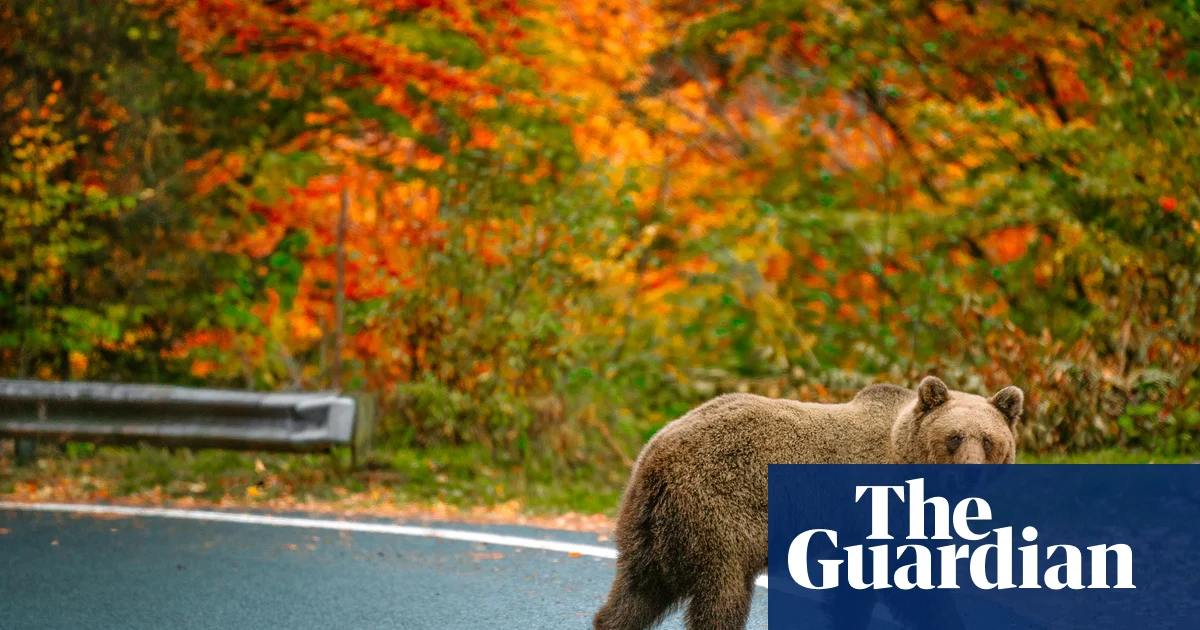
Jeremy Clarkson described Romania’s Transfăgărășan Highway as “one unbroken grey ribbon of motoring perfection”. The route (the second highest in Romania after the Transalpina) with its hairpin bends and climbs over the mountain was thrilling. Although we’d been told bear sightings were possible, we didn’t anticipate spotting them literally on the roadside, with one hanging over a stone wall posing for photographs, taken through the car window. Because of the harsh winters in the southern Carpathian Mountains, the section of the road to Bâlea Lake is open only for a few summer months – it proved particularly beautiful. Helen Jackson
Profile
Readers’ tips: send a tip for a chance to win a £200 voucher for a Coolstays break
Show
Guardian Travel readers’ tips
Every week we ask our readers for recommendations from their travels. A selection of tips will be featured online and may appear in print. To enter the latest competition visit the readers’ tips homepage
–
Highlights of Ireland
The karst landscape of the Burren. Photograph: Hemis/Alamy
In 2022 my wife and I set off on a 1,000-mile road trip around the island of Ireland after taking the overnight ferry from Liverpool to Belfast. After exploring Belfast, we stopped in Dublin, Kilkenny, Waterford, Cork, Dingle, Ennis, Galway, Castlebar, Sligo, Donegal, Derry and back to Belfast. We stayed in youth hostels, B&Bs, spare rooms, hotels (the Ellison Hotel in Castlebar was our favourite) and holiday lets. The scenery was incredibly varied, with the peninsula drive on the Ring of Kerry and the karst landscape of the Burren in Co Clare being particularly memorable. There were beautiful beaches (the wild sands of Glassilaun in Co Galway was our favourite), rich history and culture, superb food, characterful towns and cities, and, of course, the best pubs, and such friendly, warm people. Joe
Around the fjords of Norway
The Norwegian village of Flåm. Photograph: Beachmite Photography/Getty Images
My wife and I drove from Bergen to Vossevangen along the Hardangerfjord (the second-longest fjord in Norway), with a diversion to Flåm for a sauna and dip. Then we took the Myrkdalen road, which includes hairpin bends, waterfalls and an exciting descent into Vikøyri. We visited Nese, a secluded village on the western shore of the Arnafjorden. Then we took the car ferry over to Dragsvik, on to the village of Rysjedalsvika, then along the northern shore of the Sognefjord (Norway’s longest and deepest fjord) for another car ferry over to stay in Dingja on the coast, to do some fishing. Then all the way back to Bergen. Nick Martin
Geothermal bliss on Iceland’s ring road
View of Iceland’s southern mountains from Route 1. Photograph: Paul Brough/Getty Images
We started from Reykjavík and drove around the whole country on the ring road. We have done a few road trip holidays – this one was the most interesting. Every day we saw multiple dramatic landscapes and weather conditions, as well as very few other cars (we went in May). Iceland is an expensive country but being able to whale-watch and swim in geothermal pools made it worth it. Jess
The road to Orkney
Dunnet Head, Caithness. Photograph: Markus Keller/Getty Images
We drove up to Orkney, taking our time, stopping in Glasgow, Falkirk, Perth and Tain. As lovers of history and design, we stopped at the Falkirk Wheel and the Kelpies, as well as Scone Palace just outside Perth and Dunrobin Castle in Sutherland, the most northerly of Scotland’s great houses. But, really, you’re spoilt for choice with castles, brochs and standing stones. For us, the spectacular Caithness coastline was the main attraction – not least Dunnet Head, mainland Britain’s most northerly point. There are oodles of excellent eateries along the way – we loved the River Bothy in Berriedale and Paesano Pizza in Glasgow. Tania
Romance in Bavaria
Schloss Neuschwanstein castle in the Bavarian Alps. Photograph: Alamy
The Romantische Strasse (Romantic Road) was an early postwar successful example of a themed tourist route. It covers 286 miles through Bavaria from Würzburg to Schwangau. We drove the entire route, diligently following the tourist signs. On the way, we visited picturesque medieval towns, climbed the clock tower at the medieval walled town of Nördlingen – built entirely inside a meteor crater – and ended at the fairytale castle of Schloss Neuschwanstein. We sampled the hearty Bavarian cuisine, firmly centred on pork and sausages, enjoyed the local beer, and stayed in simple local hotels. Marilyn
Winning tip: traversing Italy’s Abruzzo Apennines
Lago di Barrea in the Abruzzo national park. Photograph: Valerio Mei/Getty Images
Abruzzo’s Valle del Sagittario snakes between narrow limestone cliffs, giving a peek into Italy’s wild heart. From vertiginous Anversa degli Abruzzi, head south to Scanno, pausing to solve its riddle of stone stairways and cobbled alleys, made famous by photographers and artists (including Maurits Cornelis Escher). Continue through mountain pastures, still traversed by shepherds and flocks and the region’s endangered brown bear population. Take a deep breath at the Godi mountain pass (1,630 metres) and relish the sparkling turquoise of Lago di Barrea below. As you begin the beech-clad descent into the national park, look out for the aptly named roadside hotel: Paradiso. Emma de Heveningham
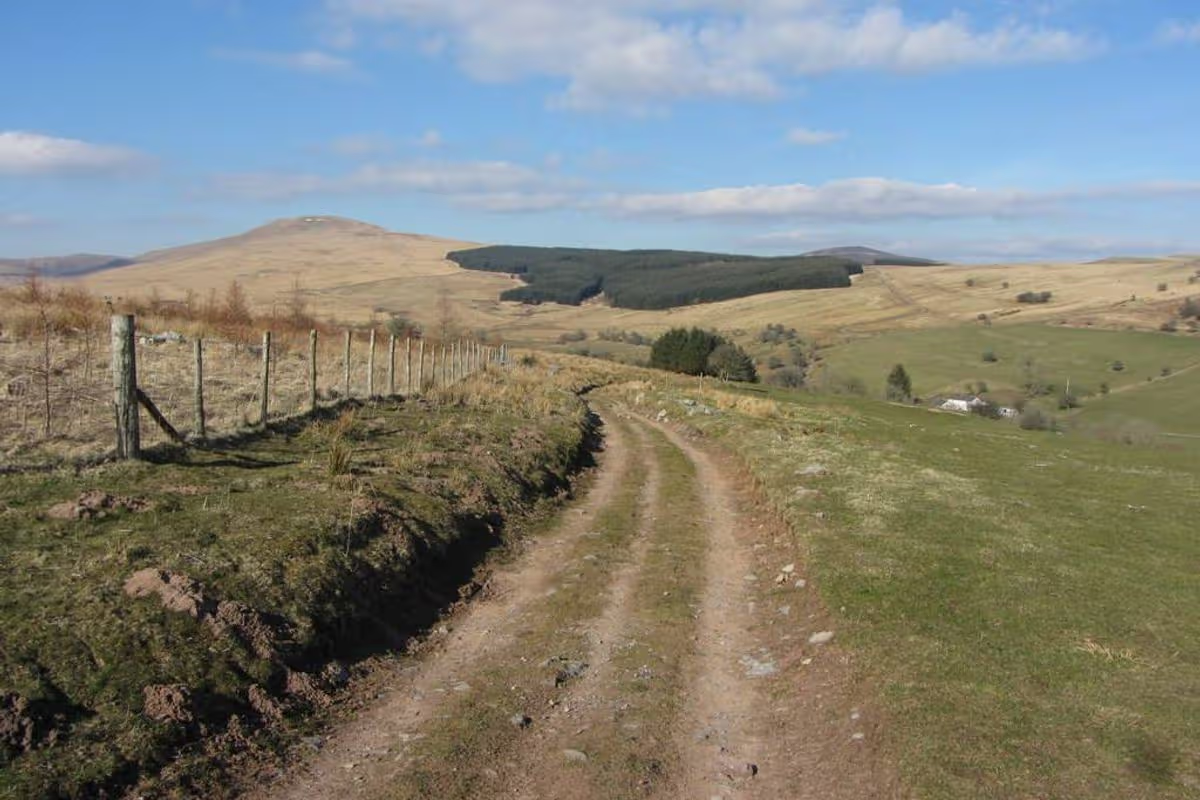
The Roman road is 2000 years old and takes you on a stunning journey filled with history
Sarn Helen near Fan Nedd, between Neath and Brecon(Image: Gareth James/CC BY-SA 2.0 DEED)
One of Wales‘ best-kept secrets is a living slice of history sitting right beneath our feet – yet even those who live along it remain largely unaware of its existence.
This ancient Roman road, running from Neath in the south all the way to Conwy in the north, is a remarkable, semi-hidden treasure.
Sarn Helen, among the most intact Roman roads in Wales, still reveals its cobbled stone foundations in places, laid bare by centuries of wear and tear. A firm favourite with ramblers, Sarn Helen was built nearly 2,000 years ago.
It’s believed to be named after Celtic princess Elen Lwy-ddawg – or Saint Elen, an early founder of churches across Wales – who married Magnus Maximus, the formidable Roman emperor who arrived in Britain around 368AD.
As the daughter of Romano-British ruler Octavius, legend has it she persuaded her husband to build roads throughout the country, allowing his troops to protect it more efficiently from would-be invaders.
Imposing standing stones, some soaring to 13ft in height and dating back long before the Roman conquest of Britain, are dotted along certain sections of the route.
One stone, known as Maen Madoc, still bears an ancient Latin inscription reading: “Dervacus, son of Justus. Here he lies.”
Nestled within the Bannau Brycheiniog National Park, it’s perfectly positioned in line with the area’s largest standing stone, Maen Llia, which sits at the head of the Llia Valley.
Indeed, were it not for the forestry in between, you could see one stone from the other with ease, despite them being roughly two miles apart.
Maen Llia is thought to date back to the Bronze Age. Considering a quarter of the stone is buried deep underground, the sheer effort needed to haul this enormous monument into place would have been immense.
What these stones were actually for remains hotly debated among experts, with suggestions including basic route markers, Stone Age boundary markers, or gravestones commemorating those who died by the wayside.
Yet while the theories surrounding them are as well-worn as Sarn Helen itself, the real answer probably lies just below the surface, frustratingly out of reach.
In 2020, writer Tom Bullough took on the challenge of walking the full length of Sarn Helen, starting his trek in Neath. At what was once the beginning point stands Roman Way, a modern housing estate, though locals there appeared oblivious to its historical importance when Tom asked around.
Next to the current road sits a small section of stone wall surrounded by railings, all that’s left of the ancient Roman fortification that once stood on the spot.
Bullough describes his journey in his book, fittingly entitled ‘Sarn Helen’, “It is not until you reach Hirfynydd, the hill running north-east away from Neath, that you first encounter Sarn Helen,” he observes.
“A grass-stripped track framed by broken walls, it follows the ridge through puddles and swamps, over occasional passages of stone once laid down by Roman legionaries. Some of them still have a distinct surface, with neat kerbs to either side.”
He goes on to detail the paths that meander gently among the wildlife and sheep, dating back to the early days of Roman occupation in Britain. The battle for dominance over South Wales was brutal, with the indigenous Silures tribe holding out for decades.
Ultimately, following their defeat of the second legion, the Romans founded Neath’s fort around AD74, placing the road’s construction at approximately that period. The route runs straight in sections, now marked by the trails of bikes and off-road vehicles.
The road terminates at the Conwy estuary, as Bullough writes: “Here, 1,900 years ago, the Roman galleys would ride the tides to land or collect their supplies and men. Here it was that Sarn Helen ended and the rest of the world began”.
Around 7 a.m. Saturday, in a lot beside the shuttered Santa Monica Civic Auditorium, a strange set of cars and trucks began to gather. Three Model A’s. A couple of ’60 convertibles. A 1964 Chevrolet Impala station wagon. Also, a big bull on trailer wheels.
“Am I in the right place?” asked a man in one of the Model A’s.
“Going to Chicago?” asked a guy in a white Denali.
“I wish I could do the whole thing,” said Joe Hernandez of Pasadena, wistfully standing by.
Share via
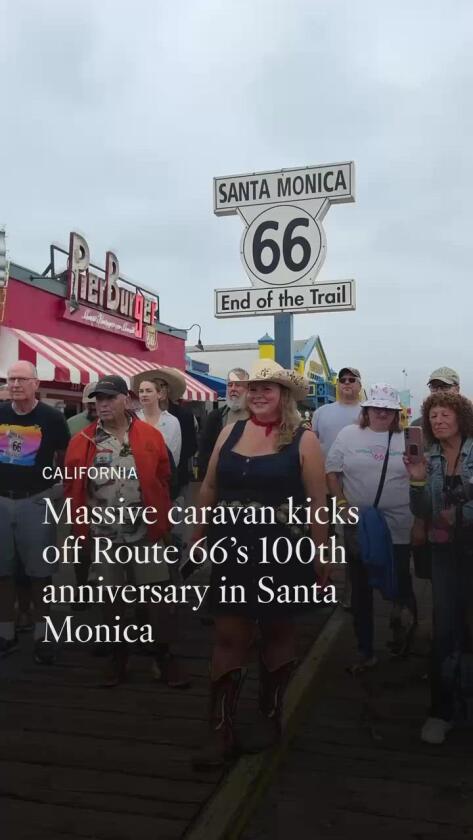
This was the starting line for roughly 70 drivers who gathered to celebrate the centennial of Route 66 with a 2,448-mile, 20-day caravan to Chicago. Most had come from outside California to share an adventure with fellow “roadies” and boost awareness of the classic scenery and independent businesses along the eight-state route.
But soaring gas prices and hesitant international travelers have added uncertainty to a trip that was always going to be a logistical challenge. Day 1 alone might terrify an L.A. commuter: From the Pacific to Pasadena by surface streets, including miles on Santa Monica and Colorado boulevards.
“I don’t know how it’s all going to happen,” said Gary Daggett, president of the Old Route 66 Assn. of Texas. But he and his wife, Stephanie, have more than a little Route 66 experience to draw upon.
Mike and Lisa Visket of Prescott, Ariz., pose in Santa Monica at the pier in their Route 66 clothing on June 6, 2026.
“This is our 30th trip over 20 years,” Daggett said. “You can’t see everything. There’s so much…. You start meeting the people, you get hooked on the people.”
Shortly before their 8:30 departure time, organizer Rhys Martin called drivers together.
“Leaving here is going to be a little complicated,” he said.
Martin, who is part of the Route 66 Road Ahead Partnership, is president of the Oklahoma Route 66 Assn., and serves as manager of the National Trust for Historic Preservation’s Preserve Route 66 initiative. For the journey, he is driving a ’64 Chevy Impala station wagon with a GPS unit inside so that armchair travelers can follow his journey on the web.
“It’s going to be impossible to keep everybody together,” he said during preparations. “We’re encouraging people to spread out and support independent businesses rather than all going to one place and demolishing the kitchen.”
William Cooke of Pinon Hills participates in a caravan from Santa Monica Pier to Chicago, celebrating the centennial of Route 66.
In song and literature, the route is celebrated as an east-to-west journey. This caravan, running in the opposite direction, will travel from California through Arizona, New Mexico, Texas, Oklahoma, Kansas and Missouri to Illinois.
From Santa Monica, the Day 1 schedule took drivers to Beverly Hills City Hall, Grand Central Market downtown for lunch, the Chicken Boy statue and Galco’s Soda Pop Stop in Highland Park, then an overnight in Pasadena.
Day 2 takes the group from Pasadena to Barstow. Day 3, from Barstow to Needles. On June 25, the caravan is due to arrive in downtown Chicago.
The loose procession was led by a core group of 15 cars, including representatives of all eight states on the route. Since anyone can join or leave the caravan at any time, the number of vehicles will vary by the hour.
Through the decades, the road has grown from an American artifact into a global symbol of small-town Americana. Many merchants, restaurateurs and hoteliers along 66 now say that their summer customers are mostly travelers from abroad, especially Europe. One of the caravan’s drivers, in a rented pickup truck, was Dries Bessels, co-founder of the Dutch Route 66 Assn.
Brady Wilson of Amarillo, Texas, displays an assortment of Route 66 pins on his cowboy hat. Wilson is part of a caravan of Route 66 enthusiasts who set out from Santa Monica Pier on June 6, 2026, for Chicago.
Though the Model A’s will surely raise eyebrows on the road, the caravan’s most startling element is the fiberglass bull representing the Amarillo-based Big Texan Steak Ranch restaurant, one of the event’s sponsors.
“It’s the same one my dad brought home in ’71. His name is Big Moo,” said Danny Lee, who co-owns the restaurant with his brother, Bobby Lee. “He’s 12 and a half feet high. About 500 pounds. It’s all fiberglass.”
In 21 cities along the drive, the Big Texan team aims to stage nightly steak-eating contests, giving free dinners to anyone who can eat 72 ounces of steak, a baked potato, three shrimp, a side salad and a roll in 60 minutes.
The caravan’s first challenge came at the Santa Monica Pier, where there was no room for the cars due to a construction project, World Cup preparations and a Children’s Hospital fundraiser. Instead, the caravan gathered by the Santa Monica Civic Auditorium. Drivers strolled over the pier for a photo op, then returned to their cars.
“Herding cats,” said George Kulakowski of Huntington Beach, at the wheel of a 1931 Ford Model A Panel Delivery truck.
Participants in a Route 66 centennial caravan pose for a photo before they depart from Santa Monica Pier on June 2, 2026, for Chicago along the historic highway.
Another challenge awaited in West Hollywood, where Santa Monica Boulevard (aka Route 66) was busy with crowds for the city’s WeHo Pride Street Fair. By plans laid ahead of time, most caravan vehicles detoured around the party while select caravan cars followed a police escort through the action.
This way, Martin said, “another community along Route 66 gets to share its identity with the community at large.”
Allison Lehn of Boston participates in a caravan from Santa Monica Pier to Chicago, celebrating the centennial of Route 66.
By 11:15 a.m., Martin’s car had reached Sunset Boulevard in Silver Lake. Meanwhile, assorted other parades and caravans are traveling Route 66 in other states this year; most of them concentrate on short segments.
By 12:45 p.m., caravaners had met the mayor of Beverly Hills and rolled through West Hollywood’s Pride festivities, arriving at Grand Central Market, running slightly ahead of time.
On May 30, an estimated 3,596 classic cars joined a “Capital Cruise” on Route 66 in Tulsa, Okla., becoming a Guinness Book of World Records holder for the largest parade of classic cars, drawing an estimated 100,000 spectators and overwhelming local traffic.
In Arizona, the Williams Historic Route 66 Car Show was set for Friday and Saturday. In Texas, the Amarillo-based Texas Route 66 Festival is running Thursday through June 13.
William Cooke of Pinon Hills, left, and Sarah Jane Woodall of Tecopa, Calif., drive along Wilshire Boulevard in a 1960 Edsel Ranger Convertible as part of a Route 66 centennial caravan.
In those states and beyond, the caravan from Santa Monica will find hotels and motels in every kind of condition, vintage neon, road food, blue states, red states and purple states.
As a package of Times stories described in May, some landmarks date to the highway’s days as a scene of Depression desperation in the 1930s, others to its giddy postwar years in the late 1940s and ‘50s.
Route 66 was created in 1926 as a highway stitching together hundreds of local roads. Nicknamed “the Main Street of America” by its boosters and “the Mother Road” by John Steinbeck in “The Grapes of Wrath,” the highway inspired Bobby Troup’s song “(Get Your Kicks on) Route 66” in 1946.
But economic life along Route 66 has been precarious since the late 1960s, when interstate highways and chain hotels began stealing traffic away from the older, slower road. After Route 66 was decommissioned as a highway in 1985, about 85% of the old route remained in use, often as small-town thoroughfares, country highways and frontage roads alongside Interstate 40.
Efforts to save and rebuild the route as a historic resource began in the late 1980s and gained ground after the 2006 release of the Pixar/Disney animated features “Cars,” which tells the story of the highway’s rise and fall. In small towns such as Tucumcari, N.M., and Seligman, Ariz., the highway remains central to local identity and economy.
A vehicle in the Route 66 caravan is photographed June 6, 2026.
This year’s centennial improvements along the route “are things that are going to go into the future,” Martin said. “The real impact is going to be next year and the years after.”