ace

Dodgers’ three-peat dreams are on life support after grim Game 2

Once brimming with life, the Dodgers’ historic quest has curled up into a withered heap.

The three-peat is dying.

The three-peat is slowly, agonizingly having the life squeezed out of it by a collection of hardscrabble Midwesterners with no regard for stardom or status.

Two games into the National League Championship Series, the three-peat was formally placed on life support Monday after the mighty Dodgers lost a second consecutive game to those little giants known as Milwaukee Brewers.

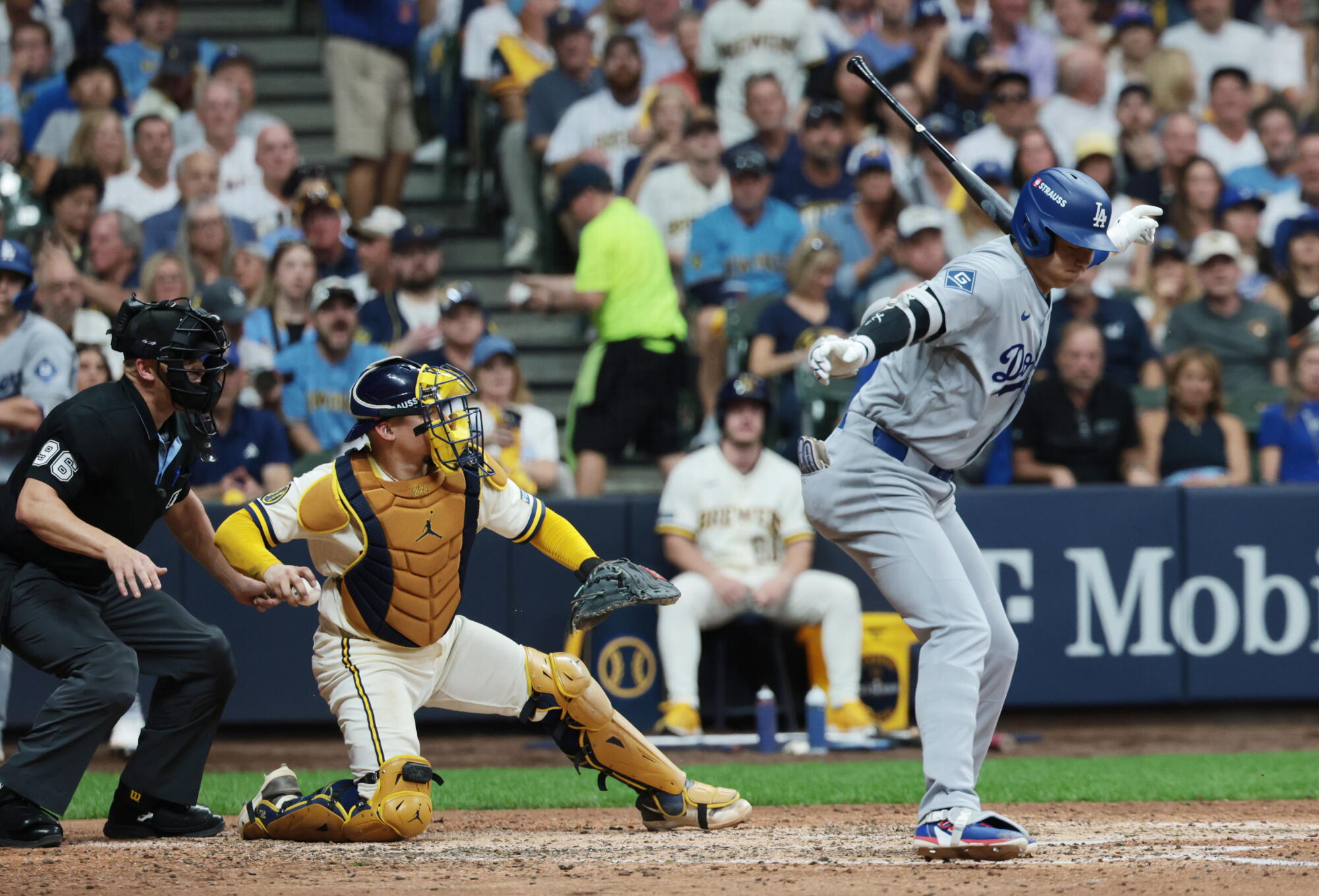
Dodgers designated hitter Shohei Ohtani strikes out during the sixth inning of Game 2 of the NLCS against the Brewers.

Shohei Ohtani strikes out during the sixth inning

(Robert Gauthier/Los Angeles Times)

This time the score was 7-4 after another devastating night at American Family Field, and now the Dodgers trail two games to none in a best-of-seven series that appears beyond their control.

For a second consecutive game, their ace was knocked out. For a second consecutive game, their powerful offense petered out.

For a second consecutive game, they looked like a weary, aging band of fallen stars that had stumbled into a surprisingly deep pothole and had no idea how to climb out.

For the Dodgers to win this series and continue their journey toward a third consecutive championship, they must beat the Brewers in four of the next five games, the last two of which would be played in Milwaukee.

It doesn’t seem likely. It doesn’t even seem possible.

Not once in in their previous two title seasons did they trail anybody two games to none, and they certainly don’t seem equipped to survive it now.

Look at how they lost Monday. On second thought, don’t look, because what you’ll see bears scant resemblance to the swaggering, self-assured Dodgers of postseasons past.

They pitched their October ace Yoshinobu Yamamoto, and he’s always saved them, right? Not this time. He couldn’t make it out of the third inning, battered by scattered wildness and scathing swings.

They were handed runs on two errors by the Brewers’ shaky rookie starter, Logan Henderson, and they’ve always capitalized, right? Not this time. They couldn’t make the Brewers pay for their clumsiness, managing just three hits, the slumps of their superstars ever deepening, Will Smith and Shohei Ohtani becoming absolute offensive liabilities.

Even with all this, they sent Henderson packing after four innings and took aim at a heavily used Brewers bullpen and surely they could summon the firepower to send at least one of those relievers running, right? Not this time, as four Brewers relievers set a postseason record by pitching five perfect innings.

The last two innings being a sad microcosm of the previous seven.

Entering the eighth inning, the Dodgers trailed only 4-3 and had the top of their order coming up in what still could have been a trademark Dodgers October comeback.

Dodgers shortstop Mookie Betts strikes out in the eighth inning during a loss to the Brewers in Game 2 of the NLCS.

Mookie Betts strikes out in the eighth inning.

(Robert Gauthier/Los Angeles Times)

Not so fast.

Facing Abner Uribe, Mookie Betts struck out. Facing Aaron Ashby, Freddie Freeman struck out and Teoscar Hernández grounded out. Yeah, with perhaps their season on the line, they couldn’t even get the ball out of the infield.

The Brewers, of course, sealed the deal with two runs on three singles in the bottom of the eighth, and the Dodgers went meekly 1-2-3 in the ninth.

It was surely, truly painful for Dodgers fans to witness the final out, a strikeout by … yep, last season’s World Series hero Miguel Rojas.

The three-peat is dying, and it’s almost unbearable to watch.

Having both of their aces beaten in Milwaukee, the Dodgers will come home with Blake Snell and Tyler Glasnow starting in Games 3 and 4, respectively.

In any other scenario, both pitchers are aces as well, and the Dodgers would have a huge advantage. But neither pitcher has looked great in the postseason, and both will be pitching while bearing the weight of a stressed-out Dodgers Nation.

“Yeah, it’s certainly a challenge,” manager Dave Roberts said. “I think that if you look at Game 3, I like where we’re at as far as in a vacuum, who’s pitching, where our bullpen is at, being at home. Then you’ve got to go from there.”

Perhaps the most frustrating thing about Game 2 is that the Dodgers led … then blew the lead … then led … then blew the lead … then led …then blew the lead.

The Brewers’ final tying blow came on William Contreras’ fifth-inning homer against Kris Bubic, who has struggled in this postseason and perhaps shouldn’t have been in the game. The Brewers’ final go-ahead run came in the sixth on Contreras’ bases-loaded single after Brice Turang surprisingly was intentionally walked in front of him.

But neither of those plate appearances was the game’s most important. The key moment that actually didn’t score any runs was Jake Bauers’ 12-pitch walk in the third inning.

That loaded the bases, and Christian Yelich then greeted an exhausted Yamamoto with a two-run single.

“Yeah, it just got to a certain point where it was straight compete mode, a little bit of like blackout, just kind of in the flow a little bit competing,” Bauers said. “It was fun. It was a fun at-bat. I knew that was a moment where the guys needed something, the team needed something.”

Funny, but those are the kind of things Dodgers hitters used to say, back when they were confident and full of life.

But Smith is one for 23, and Ohtani is three for 19, and the Dodgers have just one extra-base hit against the Brewers, and nobody is saying anything about the fun of competing.

In fact, things are so lousy, Roberts appeared to call out Smith for not using the ABS challenge in the early innings against Turang. Both times strikes were called balls, and Turang took advantage of the missed calls to double and walk and score twice.

Yamamoto also seemed annoyed that his catcher could be letting his batting woes affect his work behind the plate.

“Obviously in that spot, Will didn’t feel like it was a strike, but obviously if you look back, that’s a called third strike, he doesn’t double, and that changes the outing,” Roberts said of Turang’s first-inning at-bat.

Roberts still has hope. But he’s not looking past Game 3.

“As far as can we do it, absolutely, but it’s just you want to get that first one,” he said.

Dodger Stadium will be filled with fans in what could be a celebration. Or a wake.

Source link

Dodgers forcing Braves to make tough decision about Chris Sale

And now we present the forecast for the Atlanta Braves, brought to you by Yogi Berra: It gets late early out there.

The Dodgers can cloud the outlook for anyone. The Braves left Dodger Stadium in an uneasy spot Saturday, with one big decision to make: Do they risk putting themselves in the uncomfortable position of facing three consecutive elimination games without using their best pitcher in the first two games of this National League Division Series, or do they start Chris Sale on Sunday?

“We’re expecting to see him,” Dodgers infielder Tommy Edman said.

The Dodgers have four aces. The Braves have one.

“We’ve got the ace of all aces in Chris Sale,” Braves pitcher Brent Suter said.

So why were the Braves publicly noncommittal about using him?

The Braves deployed him Thursday, for the final four outs of the deciding game of the wild-card round. He started and pitched into the seventh inning on Tuesday.

The four days between starts is traditional — as is throwing once between starts, albeit generally in a pregame workout — but the 37-year-old Sale has not done that since April.

“The deciding factor is always going to be how Chris is feeling,” Atlanta manager Walt Weiss said. “When we came in the other night, the first words out of his mouth were ‘I feel amazing.’ If he were to come in [Sunday] morning and say ‘I feel amazing,’ there’s a chance he pitches.”

Sale, a 10-time All-Star, posted a 2.16 earned-run average this season, trailing only projected Cy Young winners Jacob Misiorowski and Cam Schlittler. In two appearances against the Dodgers, he posted a 1.13 ERA, with no walks and 18 strikeouts in 16 innings.

“He’s the ace over there, and we’re ready to see him two times this series, regardless of whether he is starting or coming out of the bullpen,” Dodgers infielder Miguel Rojas said. “We all know he is going to be out there at some point.

“If it’s [Sunday], we will be ready. If it’s Game 3, we will be ready. If it’s [Sunday] out of the ‘pen, we will be ready.”

Weiss should be concerned. If he is, he would not publicly admit to it.

“To me, it’s not that big a deal when he pitches,” Weiss said. “He’s going to pitch in this series.

“Dodgers can’t win it in two.”

The Braves risk overthinking this. If Sale starts Sunday, he also could start on traditional rest in a potential Game 5. If the Braves hold him back until Game 3, he presumably would not start a potential Game 5 on two days’ rest.

So, if the Braves get that far, would they want to limit Sale to, say, four outs?

“Even if he throws Game 3, I think he’s still available for Game 5 in some way, shape, or form,” Weiss said.

The Dodgers could push Yoshinobu Yamamoto to Game 3 because they had Tarik Skubal and Blake Snell to start the first two games. Money buys you the best of options.

The Braves’ most likely options for Game 2, if Sale does not start: a second consecutive bullpen game, or Grant Holmes, 30, a Dodgers first-round draft pick in 2014, and three years later, part of a three-prospect package sent to the Oakland Athletics for Rich Hill and Josh Reddick.

The way Weiss looks at it, he can win three out of the next four games with his top two starters (Sale and Tyler Mahle) yet to be used, and all his high-leverage relievers fresh.

The way we look at it, who says the series extends to four or five games? The Braves either try to win with Sale on Sunday, or risk needing to sweep three games started by Yamamoto, Tyler Glasnow and Skubal, in that order. Wouldn’t be prudent.

“We know Sale is their best pitcher,” Rojas said. “So we are ready for him, at some point.”

That point should be Sunday, a little after 5 p.m.

Source link

Dodgers’ rotation affords them to be audacious with playoff plan

The Dodgers are better than you. They’re smarter than you. They’re richer and deeper and more popular than you. You know it, they know it, there’s no point pretending otherwise.

So, yes, they went into the National League Divisional Series looking past the threadbare Atlanta Braves and thinking about the National League Championship Series.

Who does that? In the playoffs?

Your two-time World Series champions with the world’s best starting pitching rotation and a 1-0 NLDS series lead, that’s who.

The way the Dodgers did the math, it made sense to save their ace of aces, Yoshinobu Yamamoto — who last postseason went 5-1, had an ERA of 1.45 and 33 strikeouts in six appearances and won the World Series MVP — for Game 3 of the NLDS.

Not for the tone-setting Game 1 and, potentially, Game 5 on regular rest.

But Game 3.

Because to the Dodgers, that’s not even much of a calculated risk. It was a math problem specific to them, before they beat the Atlanta Braves 5-3 in Game 1 in 100-degree heat Saturday afternoon.

They figured they’d be able to throw two consecutive left-handers at the lefty-averse Braves lineup, starting Saturday with recently acquired two-time Cy Young winner Tarik Skubal, followed Sunday by Blake Snell, also a two-time Cy Young winner.

Additionally, this way they could have Yamamoto pitch Tuesday on the road, where his ERA is 1.77 instead of at home, where it’s 3.13. And where he’s given up 14 home runs compared with six on the road, where he’s made four fewer starts.

But mostly the Dodgers’ calculus was that having Yamamoto pitch Game 3 means it will line up so that they’ll have him for Game 2 in the NLCS and, if necessary, Game 6 against the Milwaukee Brewers or San Diego Padres. (Or, if you really want to plan ahead — and the Dodgers with their leaky bullpen absolutely should not — for Game 1 of the World Series.)

“That just sets up the rotation and Yamamoto better looking forward,” Dodgers manager Dave Roberts explained before Saturday’s game.

“Not discounting this series, because you’ve got to win this series first, but you start from the fact that they’re all going to pitch — the three [Skubal, Snell and Yamamoto] are going to pitch for sure … and then what sets them up going forward.”

It feels like a faux pas, to be that forward-thinking, and to be saying the quiet part out loud!

“If you can kind of line it up in such a way to give guys ample rest, it puts you in a better position for more options down the road,” Roberts said. “That’s kind of some of the math we had.”

I mean, it adds up. And for these Dodgers — whose fourth starter, Tyler Glasnow, was a key cog in last year’s World Series-winning rotation — it’s a fair assessment.

Though it’s nice of Roberts to pay enough lip service that he’s not totally discounting the best-of-five current series they’re in.

Predictably on Saturday, Skubal, who previously had a 2.04 ERA, a 0.73 WHIP and 56 strikeouts in 39⅔ playoff innings for the Detroit Tigers, brought his own October heat.

The 29-year-old from Kingman, Ariz., gave up just one run and two hits, walked two and struck out seven — giving him 64 in the postseason, the second most in his first seven postseason appearances behind only Bob Gibson (74), per MLB’s Sarah Langs.

Skubal retired 15 consecutive, hit 101 on the radar gun in the second inning and didn’t have a three-ball count until the fifth inning.

“We knew,” Braves manager Walt Weiss said, “it was going to be a rough ride.”

But Weiss did not know, immediately after Saturday’s loss, when he’d be able to deploy his sole ace, 37-year-old Chris Sale, the 10-time All-Star who just pitched in the Braves’ Game 3 wild-card closeout.

“To me it’s not that big a deal when he pitches,” Weiss said. “The Dodgers can’t win it in two.”

A true statement and a matter of fact: The Dodgers can’t win in two, but they’re not shy about expecting to win.

“It’s prudent to kind of map out potentially how they could line up,” Roberts said Friday. “And that’s just doing your due diligence.

“We are very fortunate because we have four guys essentially that you could really kind of pick through to figure out what’s the best way to deploy all four starters, that’s the exercise. But it starts with having four talented guys.”

Andrew Friedman, the Dodgers’ president of baseball operations, reveled in the notion that his club might actually be disproving the rule that you can never have enough pitching — at least when it comes to their elite quartet of starters.

And that, Friedman said, “is very impactful for quality of life.”

And the Dodgers aren’t afraid to say it.

Source link