A Los Angeles police officer who faced multiple felonies for recording his colleagues making racist, sexist and homophobic comments will now likely avoid jail time under a new agreement with prosecutors, Los Angeles County’s district attorney said Wednesday.
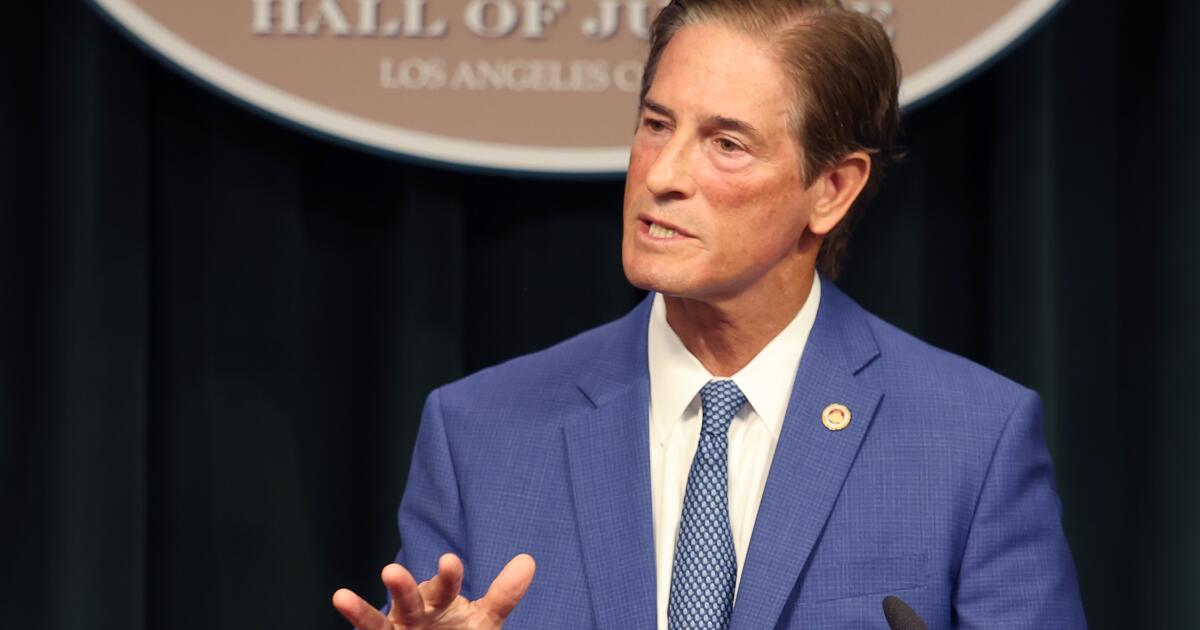
Dist. Atty. Nathan Hochman announced he would reduce 16 felony eavesdropping counts against Officer Daniel Flores to misdemeanors, and that the case would likely resolve in court through a diversion agreement.
The announcement came after Hochman faced backlash for the decision to prosecute Flores, with L.A. Mayor Karen Bass and even some of his own prosecutors criticizing the filing as “insane” and a deterrent for police looking to expose corruption and misconduct within their ranks.
The district attorney acknowledged the public reaction to the case as he spoke downtown Wednesday morning, and said he wanted to make “crystal clear” his intentions were to blunt illegal investigative practices by police, rather than discourage cops who want to report bad behavior.
“The message was not being clearly interpreted about us being protective of whistleblowers,” he said.
Flores’ attorney, ex-L.A. County prosecutor Alan Jackson, said he expected to request a diversion agreement for Flores in a downtown courtroom on Thursday.
“Following this disposition, 16 felonies will be dismissed with no plea, no punishment, and no record, because Daniel Flores told the troubling truth about what he heard inside his own department. As the investigators themselves concluded, there was no reasonable expectation of privacy in this open-plan LAPD office,” he said. “That isn’t eavesdropping, it’s being a witness. Mr. Flores has committed no crime.”
If a judge accepts a diversion agreement, Flores would have to satisfy certain terms and conditions for about a year. If he does so, the case would be dismissed.
An LAPD spokesman referred all questions to the district attorney’s office. While misdemeanor prosecutions in Los Angeles are normally handled by the city attorney’s office, the D.A. can keep possession of the case because it was initially filed as a felony, according to a district attorney’s office spokesman.
Flores made more than 100 recordings of his colleagues in the Los Angeles Police Department’s recruitment division last year,capturing other officers making an array of racist, homophobic and sexist remarks. Comments included a joke about a legendary L.A. Dodgers pitcher who was Latino dying because he “ate too many tacos,” and referring to stereotypes about Black people enjoying eating watermelon and playing basketball. One officer was recorded calling a young LAPD recruit “rapeable,” according to court records.
If convicted of the original charges, Flores could have faced up to 13 years in prison.
California is a “two-party consent” state, meaning it is a crime for someone to record a conversation without the permission of other participants, unless there is a court order granting authority to do so. Flores’ attorneys have argued that his actions were allowed under the California Invasion of Privacy Act because he was acting in the course of his duties as a police officer.
Flores lodged a complaint with the LAPD’s inspector general’s office and has said he hoped the officers he taped making inappropriate remarks would face discipline.
The decision to charge Flores drew relentless criticism from a number of groups. Bass said she worried about the potential chilling effect on other police whistleblowers.
Last week, City Councilmember Hugo Soto-Martínez introduced a resolution condemning Hochman for bringing “felony charges against a City employee who reported workplace discrimination through official channels” and urging him to drop the charges.
Hochman told reporters that his office assessed the case with the same rigor as it would any other. In bringing the charges, he said he wanted to thread the needle between punishing the illegal recording and not dissuading whistleblowers from coming forward.
He suggested that he could have technically charged Flores with 122 felony counts, one for each recording that he made. Hochman also reiterated Wednesday that he felt it was important to file the case at a time when new products like Meta Glasses make it even easier to surreptitiously record people.
“If you go ahead and illegally eavesdrop in our community, you will face criminal prosecution for doing it, so don’t take out your cellphones and or your smart glasses or anything else,” he said, while encouraging whistleblowers to work with the D.A.’s office to gather evidence in the future.
Flores had pleaded not guilty at his arraignment in a downtown courtroom last week, with a team of high-powered lawyers in tow. His next court date was set for Sept. 9.
The second-guessing of Hochman’s decision ramped up earlier this month after the D.A., in an unusual move, filed a 27-page motion asking for a lengthy preliminary hearing in the case. The filing alleged Flores deceptively edited the recordings to hide his own insensitive remarks and suggested he was motivated by a desire to win a large legal settlement in court.
Hochman’s motion referred to the officers’ remarks as “locker room talk” — a characterization that was seized on by Flores’ legal team.
Jackson, a former L.A. County prosecutor, accused Hochman of contradicting himself, questioning the D.A.’s efforts to justify the officers’ coarse language.
Several county prosecutors, who spoke to The Times on the condition of anonymity for fear of reprisal, called Hochman’s decision to file his own motion in the case bizarre and unprecedented. While they privately lauded him for backing down on Wednesday, some said Hochman’s turn from zealously defending the filing to public capitulation in the span of two weeks was embarrassing for the office.
“From charging to doubling down to reducing to misdemeanors, this just makes it worse,” one prosecutor said. “The filing was inappropriate but then to bend to public pressure isn’t appropriate either.”
The motion, Jackson noted, relied heavily on the observations of the officers against whom Flores had leveled claims — and who were under internal investigation by the LAPD.
Flores filed a lawsuit in June accusing the LAPD of retaliating against him after he reported misconduct.
When reached for comment on Flores’ lawsuit, a spokesperson for the LAPD’s inspector general’s office said it was barred by state law from disclosing information about individual cases, but added that its practice is to refer all “complaints of employee misconduct” to Internal Affairs.