One minute I’m cycling through an expansive dusty pink stretch of heathland with sloping sand dunes in the distant horizon, the next I’m winding through a fragrant Scots pine forest as sunlight filters through the branches of red-barked trees to make a kaleidoscope of white shapes on the trail floor ahead.
I’m in Hoge Veluwe National Park, a 5,400 hectare (13,000 acre) nature reserve in Gelderland, about an hour and a half from Amsterdam. It’s crisscrossed by 25 miles (40km) of cycling paths, and around 2,000 free-to-use white bikes are available for visitors to explore the ever-changing scenery.
I’ve been flitting back and forth to the Netherlands for years and have lost count of the times friends there have raved about the park and the wider Veluwe region, a forest-rich ridge of hills and diverse landscapes, stretching 37 miles, north to south. Finally I’ve come to see for myself and explore on foot and on two wheels over a few days – adding in a dash of culture at some of its historic towns and museums too.
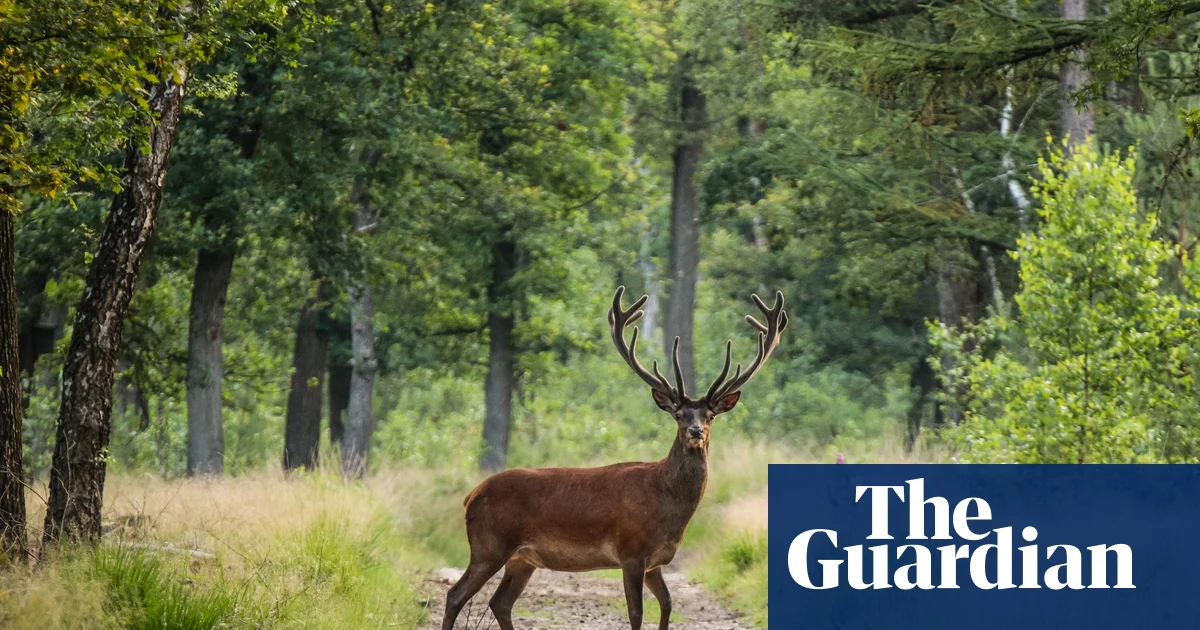
My trip starts at Natuurcentrum De Ginkel, a charming nature and visitor centre near Ede outside Arnhem. Here I meet nature guide Hanna Pol who takes me into the forest. “Veluwe is very biodiverse,” says Pol quietly as we walk past verdant oak, pine and birch. Trees with autumnal tawny-coloured leaves line one side of the path and wildflowers, with pops of bright yellow sunflowers and vivid red poppies, the other. Pol reels off some of the wildlife here: roe deer, five types of woodpecker, beavers, wild boar and wolves. As we crunch through a carpet of fallen leaves, we spy a small brown frog on a log, a woodpecker dancing around a tree, and the outline of two rust-red deers in the distance.
We make our way to the wildlife observation area, an enclosed building with curved windows and a theatre-style set of wooden chairs. “The deer pass this way every night to eat,” says Pol. “Once we saw a really big fight break out.” She’s seen wolves too – they returned to the country in 2015 after about 150 years and it’s a controversial topic, with farmers worried about their livestock. We don’t see the elusive creatures, just a solitary bright white buzzard perching on a tree. On the shelves behind us, an assortment of skeletal remains includes antlers, skulls, the teeth of a wild boar and the foot of a deer.
That night I stay in a stylish and sleek cabin with floor-to-ceiling views of the forest at Buitenplaats Petersburg on the edge of the park. It’s a peaceful haven of lodges with fairy lights strung around the woods and an enchanting Italian restaurant, Il Lupo, with an outdoor terrace.
Besides its unspoilt natural wonders, Veluwe has plenty of other attractions. I visit Paleis Het Loo, a 17th-century royal palace in Apeldoorn, once the summer residence and hunting lodge of William of Orange III and his wife Princess Mary II Stuart. It’s an impressive building with ornate rooms, a staircase with the second biggest mural in the Netherlands, formal symmetrical gardens and an underground museum which tells the story of the Dutch royal family.
Hotel de Echoput, a family-run modern hotel nearby, surrounded by the forest, is my home for the night. Its Grand Bistro Echo is a treat, with a menu that focuses on local ingredients – I enjoy fried mushrooms with a creamy Dordogne sauce and a vegan cheesecake with basil and white chocolate.
The next morning, after a brisk walk in the woods with barely a soul around, I visit the historic Hanseactic city of Harderwijk, on the shores of Wolderwijd lake. I wander the narrow cobblestone streets, medieval city walls and Old Town Hall with guide Marianne van Limbeek. “Harderwijk means hiding place for shepherds,” she tells me. We bump into Hendrik Kaper, a local street organist wearing a flat cap who treats us to a rendition of Bohemian Rhapsody on his portable wooden organ.
But it’s in Hoge Veluwe national park that I find the greatest sense of serenity – though one day a small adder with a dark zigzag stripe stops me in my tracks. Come outside peak times, as I have, and you might have some of the trails to yourself.
Within the park lies Kröller-Müller Museum, a revered national art museum and sculpture garden founded by art collector Helene Kröller-Müller, who along with her husband, shipping magnate Anton Kröller, bought vast amounts of land in Veluwe (their private estate was later donated to the state). My timing is great as all 88 of its Vincent van Gogh paintings are on show together for the first time since 1984 (until 3 January).
The sculpture park is one of the largest in Europe, and I stroll around the surrounding open grass and into the forest and stumble across various artworks (there are about 200 pieces dotted around). A short cycle away is Jachthuis Sint Hubertus, the former country residence of the Kröller-Müller family with a watchtower more than 30m tall (apparently Helene loved afternoon tea at such lofty heights) surrounded by a lake with a very athletic bunch of jumping carp.
I stop at Restaurant De Hoge Veluwe at Park Paviljoen for an early pasta dinner on the terrace before the sky turns a moody grey and rain looks imminent. Fortunately it’s only a 15-minute cycle to Otterlo, a pretty village with clusters of fairy lights and bunting decorating red brick houses and Vakantieoord Het Lorkenbos, a charming holiday park surrounded by trees. My bungalow is cute and, feeling as if I’m in a twinkling winter wonderland, I light a candle and look up the Dutch word for cosy. It’s gezellig – a perfect description of how I feel after my nourishing break in this wild and restorative part of the Netherlands.
The trip was arranged by Visit Veluwe. Entrance to Hoge Veluwe national park €13.85 per adult. Cabins at Buitenplaats Petersburg from €110. Camping at Het Lorkenbos from €23 a night, bungalows from €320 for two nights. Double rooms at De Echoput from €169. Omio provided train travel: Eurostar runs from London to Amsterdam