heart

Paul Whitehouse hopes heart stents ‘aren’t going to be the cause of my demise’

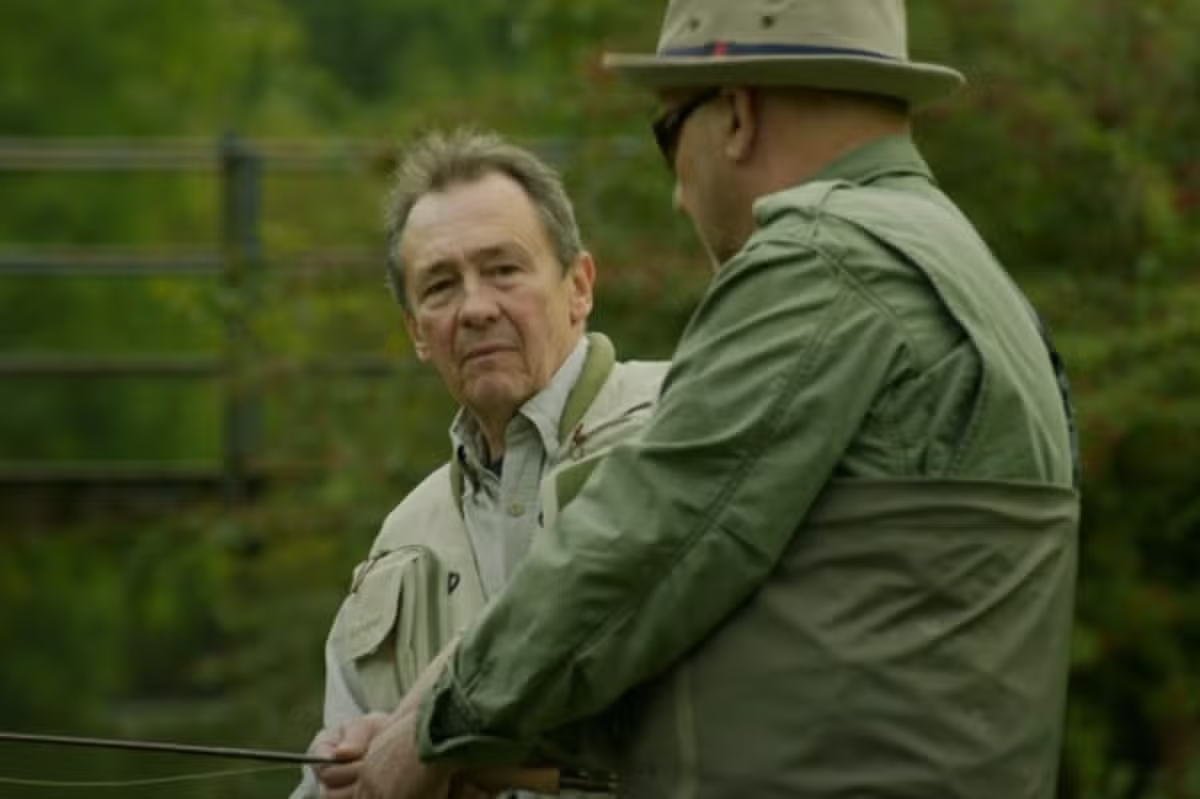
Paul Whitehouse joked his three heart stents would outlast him as he discussed his health with Bob Mortimer on Mortimer & Whitehouse: Gone Fishing.

Comedian Paul Whitehouse opened up about the “very difficult” changes he has had to make to his health.

Welsh actor Paul Whitehouse shared his hope that his heart stents would not be the cause of his death during a candid conversation with Bob Mortimer on Mortimer & Whitehouse: Gone Fishing. The comedian, who had three stents fitted in 2015, said: “I think they are going to outlast me.

“Like I bought a sofa recently that’s probably going to outlast me, Bob. And I like to think my stents aren’t going to be the cause of my demise, you know?” His remarks came after Bob suggested that, although the stents needed no upkeep, they might eventually need replacing.

Paul’s heart disease was discovered following life-saving bowel surgery and the conversation surrounding his health featured in the third episode of the BBC programme’s first series, which saw Paul introduce Bob to fly-fishing for wild rainbow trout in Derbyshire. The pair spoke about their diets, before attention turned to Paul’s stents.

Asked how the stents worked, Paul offered a characteristically humorous explanation: “Some sort of very high-tech, futuristic kind of steel sleeve. They put it in, blow it up, leave it. Get on with it. Let this man carry on delighting millions.” Bob was also keen to know what adjustments Paul had been asked to make after his treatment.

“What had to change, obviously, is diet,” Paul admitted. “But it’s very difficult to resist a mini chocolate doughnut, for example, isn’t it?” Both comedians have experienced serious heart problems, and their shared health struggles inspired the fishing series, which is currently being repeated on BBC Two.

Bob had an emergency triple heart bypass in October 2015 after learning that 95% of his arteries were blocked. The pair’s daily health routines also featured in the episode. At the start, Bob played solemn music on his laptop while Paul listed all of his medication as he took it.

Away from the series, Whitehouse has been open about his stents and how he feels “lucky to be alive” after the operation. He told Saga Magazine: “In many ways I was lucky. When I had the heart stents, the guy who did it said, ‘Well I didn’t put them in for you to go and sit by the fire, so get up and go out’.

“I took him at his word, so I do a lot of exercise to keep myself ticking over.” In a Radio Times interview back in 2015, the star was asked whether he reflected on his own mortality, to which he replied: “Well, I should probably die. Although, there is a school of thought that thinks I will live forever.

“I mean obviously there are things in the world that make me very anxious but I don’t worry about illness. I don’t particularly worry about that. I worry much more about mental illness than physical illness. Again I wouldn’t say I lie awake at night worrying about what mental illness I might be afflicted with in future.”

Also previously speaking to GQ Magazine, the comedian said he was keen to be an advocate for heart health awareness, sharing: “It is because it is a heart attack decade. If you don’t get a scare in your fifties, you’re lucky. Because you either have a heart attack and die or you have problems that flag up serious issues.

“As your doctor, Chris Young put it: angina is the heart consultant’s friend because it is a warning sign at least. If you don’t get that, you could get a heart attack, which could be fatal, or you might be one of these people like Glenn Hoddle who think of themselves as fit, but actually get to 60 and discover they have a heart problem.”

The episode of Mortimer & Whitehouse: Gone Fishing airs tonight on BBC Two at 10pm

Source link

‘Heart of the Beast’ review: A good boy plus someone named Pitt?

Something’s in the air this fall — and it’s not just the autumnal chill. For some reason, survival thrillers are all the rage; there are even two featuring a man and his dog. First, we had Ridley Scott’s “The Dog Stars” with Jacob Elordi and a Belgian Malinois traversing a postapocalyptic landscape.

The latest is “Heart of the Beast,” an Alaskan-set story about two combat veterans — one human, one canine — who set out for a post-retirement camping trip and find themselves in a perilous situation after the human, retired Special Forces officer James (Brad Pitt), suffers a heart attack while piloting his seaplane. James and his combat dog Odin survive the crash, just barely, but they’re stranded deep in the wilderness, miles from civilization.

The film is directed by David Ayer, a purveyor of wild action flicks and ballads of masculinity; the screenplay is the debut effort of Cameron Alexander. Their intent is to deliver something muscle-bound and emotional — if a man can’t cry about an Army dog, what can he cry about? But until the last two minutes of the film, “Heart of the Beast” is essentially “Homeward Bound” for adults. You know, the 1993 kids adventure film featuring a golden retriever, a bulldog and a cat named Sassy who have to make their way home through the wild. Marry the structure of that film with a Jack London-inspired milieu, add some blood, gore and rather cheesy Iraq war flashbacks, and you have “Heart of the Beast.”

We watch James as he’s rained on, chewed on, pulls trunks out of an icy lake, falls off a log, breaks his arm, faces down a bear, fights off wolves, sustains many head injuries and inexplicably keeps going, in hopes of saving if not himself his dog, the most important creature in his life.

And oh, is Odin worth it. Played by four different dogs named Uber, Seeka, Ryker and Hondo, the performance that these dogs collectively deliver is worthy company to an Oscar winner — the dogs may even eclipse Pitt for sheer screen presence. With every whimper, sigh, howl, bark and head tilt, these dogs create an empathetic portrayal of a highly intelligent creature that has been through battle and has the scars (and nightmares) to prove it. Odin is a bionic dog, with titanium teeth and a prosthetic foot from injuries sustained during wartime, but nothing slows him down, not even a plane crash. However, the film does have its limitations when it comes to the other wildlife, all digitally created and the CGI isn’t convincing in the slightest.

“Heart of the Beast” is an onslaught of danger and misery, alleviated only by the pleasure of watching James’ survival skills and ingenuity. This man makes a lot of mistakes on this journey (he’s constantly calling himself “stupid” and “dumb”), but he’s also kind of a MacGyver. He starts a fire with cotton balls and Neosporin. He carries an alarming number of knives. He splints his own arm. If anything, it’s an excellent lesson on carrying the right gear and always taking medical supplies on a camping trip — if you ever go camping again after this.

Pitt typically excels when there’s a little (or a lot) of levity for him to exercise his loose-limbed charms and there’s precisely none of that in “Heart of the Beast.” Ayer pushes the emotional and physical extremes and it feels like a dirge: a forced march through the muddy Alaskan wilderness with plenty of body horror on top. The one moment of camaraderie comes in the beginning, when James shares a beer with a mysterious stranger (J.K. Simmons) who happens upon his camp and might even be an apparition of an old miner. James does share moments of affection and victory with Odin but there’s nothing to relieve the constant danger, even though structurally, the film has already sapped its potential suspense.

“Heart of the Beast” has its highs and lows but cinematically, it’s a mixed bag — entirely predictable and just not great. Nevertheless, there’s no denying that the star of the movie is indeed Odin and he’s a very, very good boy.

Walsh is a Tribune News Service film critic.

‘Heart of the Beast’

Rated: PG-13, for violence, peril, bloody/injury images and some language

Running time: 1 hour, 41 minutes

Playing: Opens Friday. Sept. 25, in wide release

Source link

The heart transplant footballer who won a World Cup for England

Daley Cross, manager of the England team, said of Lucy’s role: “She was just trying to do her best for him and trying to find a way to motivate him.

“His wife did drop in the conversation that he used to play at Manchester United as a schoolboy. So that got our ears twitched instantly.

“You could tell from him being on the pitch, even though he was so fresh into his journey, that he knew the football game and he would be such an incredible asset to us.

“You can be in a dark place, at the time of diagnosis, through your treatment or even post-transplant. So to have us exist to help and inspire people means that we are getting some incredible footballers.

“And that really is the power of it: to that transplant community or to the world, showing people that when you’ve had organ failure, your life isn’t over. There is a chance for you, and you can go and resume and live your life.”

As the recipient of a donor heart, Jackson has to manage his exercise workload more carefully than his team-mates, many of whom have had kidney transplants, the most common transplant in the UK.

His role in the side tends to involve 10-minute bursts, rather than playing for the duration of matches.

Source link

Silent Witness expert at the heart of brand new true crime doc you do not want to miss

The series is hosted by BBC Silent Witness expert Jo Millington

True crime fans do not want to miss a brand new chilling documentary series, plunging viewers into the heart of a crime, and it’s coming sooner than you think.

UK Forensic Breakthroughs is a brand new release, dropping today (September 22) on the True Crime channel. Spanning across 10 episodes, each instalment will focus on its own murder case where scientific breakthroughs and microscopic evidence secured justice for grieving families.

From the murder of a Witney local, whose investigation was the first time in the UK fibre mapping technique was used, and the conviction of a serial arsonist in Cornwall, forensic scientist Jo Millington will give exclusive access to the experts behind the investigations.

Jo Millington has been a forensic scientist for over 30 years, even working behind the scenes on BBC’s Silent Witness. An official synopsis teases: “A rare in-depth dive into the unseen world of forensic science – from ballistics and fibre analysis to forensic ecology and fire investigation. Firsthand testimony from detectives and leading forensic experts directly involved in the cases.

“Ten real UK murder cases where scientific breakthroughs and microscopic evidence secured justice for grieving family, friends and all those impacted by the crime.”

Premiering at 10pm tonight on the True Crime channel, the series will show how forensic science continues to shape major criminal investigations across the UK.

Speaking exclusively to Reach ahead of the show’s new launch, Jo Millington said UK Forensic Breakthroughs stands out from other crime shows, adding: “The first difference is that it puts forensic science at the heart of the show, which normally sits on the periphery in the shadow.

“Over a 10 part series, we’re using the programme to kind of assure a spotlight on forensic science. And more importantly, the scientists that do forensic science, every single day.”

Giving unprecedented access into the world of a forensic scientist, dubbed the “unsung heroes of investigations”, tonight’s episode will explore the story of Edwin Hiles who was found murdered in his own home, but a pioneering fibre mapping technique was used to link one suspect to the crime.

With episodes released weekly, one particular instalment viewers do not want to miss is episode 8 where teams take a deep dive into the world of forensic archaeology and forensic anthropology.

Jo added: “The teamwork that was involved in recovering Natalia Doherty’s body from a clandestine burial site is one of the most painstaking tasks that I have encountered in forensic science.

“Every layer of soil, every root system, and every fragment of evidence had the potential to reveal how her grave had been created, when it was dug and whether it had been disturbed over time.

“Caroline Sims’ archaeology team worked centimetre by centimetre – to record the grave’s construction, the position of the remains and to methodically recover every item from within it.

“Their meticulous approach ensured that the burial itself became evidence, allowing detectives to understand not only where Natalia had been hidden, but how her body had been concealed for so many years.”

TRUE CRIME is available on Sky, Virgin Media, Freeview, Freesat and Freely as well as for streaming via TRUE CRIME UK (FAST), accessible on platforms including Prime Video, Rakuten TV, Pluto TV, Plex, LG Channels, Samsung TV Plus, ITVX and 5.

UK Forensic Breakthroughs premiers tonight at 9pm on True Crime

Source link

Maduro’s wife seeks home detention as heart condition worsens in US custody | Nicolas Maduro News

Venezuela’s former first lady, Cilia Flores de Maduro, has asked a judge to release her from federal detention in the United States, citing a worsening heart condition.

In an application for pre-trial release on Wednesday, her legal team asked for the court to allow Flores to await trial under home confinement in Manhattan.

Recommended Stories

list of 3 itemsend of list

It described her declining health since US military operation on January 3 that resulted in her abduction from Caracas and imprisonment in New York, as well as that of her husband, former Venezuelan President Nicolas Maduro.

“Prior to the United States’ military invasion of Venezuela, Ms. Flores de Maduro was physically healthy and took no ongoing medication, other than a monthly injection to help control her mitral valve prolapse,” the legal filing said.

“Now she is prescribed four medications, maintains nitroglycerin by her side in the event of a potential heart attack, and grapples with the continued medical advice suggesting coronary exploration and surgery.”

Flores was a prominent figure in her husband’s government, serving as first lady since his inauguration in 2013.

Prior to Maduro’s first inauguration, she was also a leading member of the United Socialist Party of Venezuela (PSUV), the country’s dominant political movement, leading the National Assembly for more than four years.

But Maduro had long clashed with the administration of US President Donald Trump, who accused Venezuela of sending drug-traffickers into the US. Both Maduro and Flores have also faced allegations of participating in human rights abuses, including the violent suppression of political dissent.

After launching a one-day military operation to abduct Maduro and Flores, the Trump administration charged them both with drug- and weapons-related charges. They are currently awaiting trial in New York City.

But Flores’s health has been in doubt since her forced removal from Venezuela, according to her legal team.

After consulting outside medical experts, Flores’s lawyers said they believe she may have suffered a minor heart attack on July 29 while in US custody.

They also questioned whether she was receiving the appropriate medical care for her mitral valve prolapse, a condition affecting one of the heart’s valves.

Since her imprisonment, her lawyers said Flores has not received the monthly injection she needs to manage the condition.

Instead, she has reportedly been prescribed baby aspirin, a statin, diltiazem and nitroglycerin to use when she experiences chest pain.

Doctors have recommended that she undergo a cardiac procedure, which could result in additional heart operations. If she undergoes such treatment, Flores “will need adequate time to recover from any procedures in a setting conducive to restoring her health”, her lawyers said.

Thursday’s filing acknowledges that Flores does not “dispute that she has received excellent care” from medical professionals. But it argues that “a detention centre lacks the conditions needed for such a recovery”.

Her lawyers proposed moving Flores from the Metropolitan Detention Center in Brooklyn to a residence within the Manhattan federal court district, where she and Maduro are due to go on trial next June.

Under home detention, Flores would be subject to round-the-clock armed monitoring, with visits restricted to people approved by the court and federal prosecutors. Her home would also be monitored by video and her phone calls recorded, according to the filing.

Judge Alvin K Hellerstein has yet to rule on the application.

Flores, 69, and Maduro, 63, have been held in US custody since the January raid on their home in Caracas. Both have pleaded not guilty to the charges of participating in a conspiracy to traffic cocaine into the US.

Source link

Napoli’s Scott McTominay undergoes successful heart surgery | Football

The midfielder, who will return to training in two weeks, will miss Wednesday’s Champions League game against Arsenal.

Scotland midfielder Scott McTominay has had successful surgery on a minor heart issue on Tuesday and will return to training in two weeks’ time, his club Napoli said.

The former Manchester United player recently experienced a heart rhythm disorder, something which is not considered serious but did require surgery.

“On Tuesday morning, Scott McTominay underwent an ablation procedure at Spire Manchester Hospital. The operation was a complete success,” the Serie A club said in a statement.

“McTominay will rest for two weeks and then resume training.”

McTominay, 29, has been a key player for Napoli since joining from Manchester United in 2024, scoring 27 goals in 82 matches.

But he was off-form in their opening two Serie A games.

Napoli previously said McTominay would miss Scotland’s upcoming Nations League fixtures against Slovenia (twice), Switzerland and North Macedonia.

Napoli, who have just three points from their opening three Serie A games this season, host Arsenal in the Champions League on Wednesday and then play Bologna and Fiorentina before the international break.

Source link

Scott McTominay heart procedure ‘a complete success’

Napoli have said Scott McTominay’s heart surgery “was a complete success” and expect the Scotland midfielder to resume training this month.

The 29-year-old’s ablation procedure – a minimally invasive operation to correct irregular heart rhythms – took place at Spire Manchester Hospital on Tuesday morning.

McTominay was substituted after 56 minutes of Napoli’s 2-1 Serie A defeat by Como on 30 August.

A mild benign arrhythmia was discovered, prompting the corrective treatment.

Napoli, who said in statement, external that “McTominay will rest for two weeks and then resume training”, had expected the former Manchester United player to return to action after the international break in early October.

When his heart issue was announced, McTominay posted on Instagram: “See you soon Napoli. I won’t take long.”

Sebastien Pocognoli’s first four games as Scotland head coach – home and away against Slovenia as well as matches with North Macedonia and Switzerland in the Nations League – are scheduled for the end of September and early October.

According to the NHS,, external an arrhythmia is when the heart beats too quickly or too slowly, or the heartbeat is not steady.

The British Heart Foundation explains, external a cardiac arrhythmia ablation involves using heat or cold energy to create tiny scars in the heart to block faulty signals and restore a typical heartbeat.

Source link