For my 50th birthday, I bought a Toyota Corolla. Wait. Is my midlife crisis car really a Corolla, the best selling and most boring model of all time?
Well, yes. And no.
I have “modded” it, or in layman’s terms, modified the stock components and tuned the engine. This is not your aunt’s Corolla. When I hit the gas, the car pulls hard and the engine buzzes as if it’s powered by a hive of killer bees.
I get thumbs-ups from Mustang drivers and cool head nods from Challenger owners. My favorite is when kids at red lights ask me to rev the engine like I’m F1 driver Lewis Hamilton.
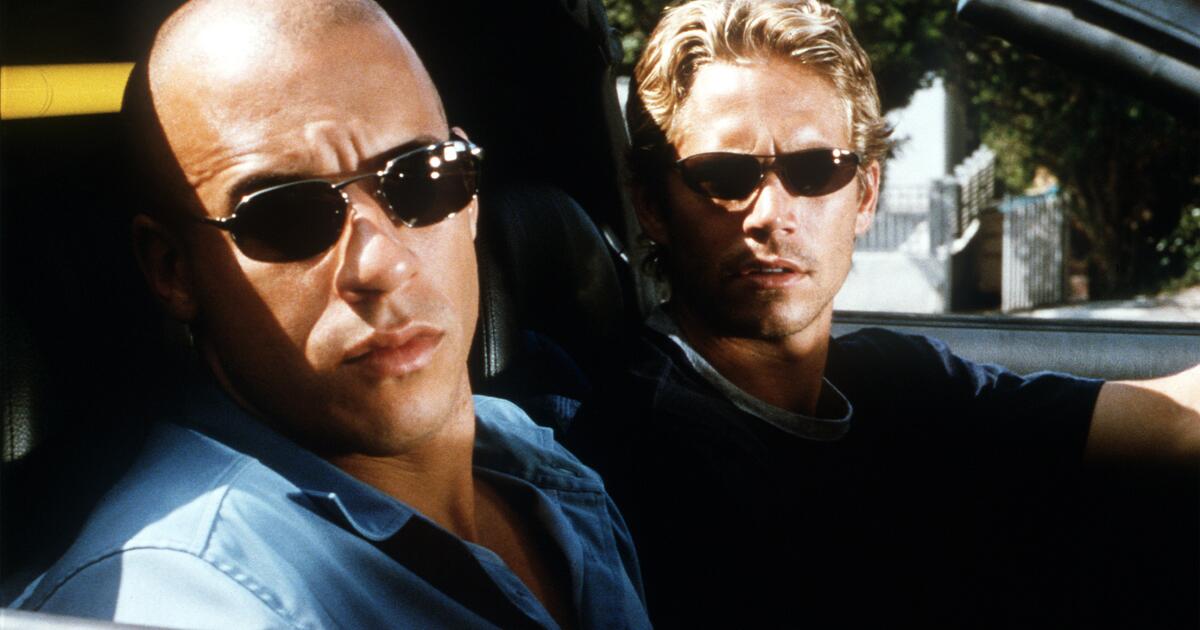
Probably a lot of my drive-by admirers are fans of the movie “The Fast and the Furious,” which was released 25 years ago this month. Fans of modified Japanese import cars, like me, have a love-hate relationship with the $7 billion “Fast and Furious” franchise. On one hand, the movies helped popularize modified Japanese cars. People all over the world fell in love with them and the import car culture they publicized.
On the other hand, the movies left out so, so much of the story.
In Southern California in the mid-1990s and early 2000s, people lived, for the most part, phone-free. The internet was nascent — a repository for flyers and ’zines — and most websites looked like Tetris.
The fashion was baggy everything for guys and short shorts, midriffs and little backpacks for girls. The hair was outrageous. And the cars, especially Japanese import cars, had reached the pinnacle of automotive engineering.
During this era, I was in college at UCLA. I saved up and bought a red 1989 Honda CRX Si. It also had a slick five-speed manual transmission, peppy engine and nimble steering. That car got me to work and through college, and from the mountains of California to the border of Oregon. It probably helped me get girlfriends. It consoled me through breakups. It helped me move to the San Francisco Bay Area for my first grown-up job.
And then, stupidly, I sold it, and all the precious memories it carried.
Now when I hit a loopy freeway interchange at night and my GR Corolla carves through the turns, it’s 1996 and I’m cruising in my CRX, getting pho in San Gabriel or rushing to a flyer party at Naga in Long Beach. That’s the magic of certain cars. A regular car takes you from place to place. A special car takes you back in time.
To be completely honest, I bought the CRX to fit in.
The ’90s import car scene was as diverse as Southern California. But there’s no doubt it started with Asian Americans (specifically Japanese Americans in the South Bay city of Gardena) who were influenced by modified car culture in Japan. Soon, Asian American kids all over the region were taking their inexpensive, underpowered four-cylinder, front-wheel-drive Honda Civics (our parents preferred Japanese reliability over American muscle) and turning them into street rockets.
Not only were they building race cars from scratch, they were also building one of my first experiences with a collective Asian American identity: one that wasn’t overtly about politics and activism, or immigration and assimilation. It was about Asian American joy. It was Chinese, Japanese, Korean, Filipino and Vietnamese Americans building cool-looking, fast cars. It was kids stereotyped as nerds going to parties where the awful stereotype of Long Duk Dong from “Sixteen Candles” was shredded into rubber and obliterated by exhaust blasts.
At the time, the Asian Americans we saw in the mainstream media were negligible or offensive, especially for Vietnamese Americans like me. But in import car culture, I saw, for maybe the first time, Asian guys and Asian girls in a centered and even glamorous light.
We made our own cars and our own car shows. We raced each other and then got fast (with turbos, superchargers and nitrous oxide) and raced others. And we won. We published our own magazines, built our own automotive businesses and, for good and bad, promoted our own outlaw street racer image and our own beauty standard. In those 1990s clubs and car shows, you could see and feel that Asian Americans weren’t assimilating culture. We were creating it.
“The Fast and the Furious” picked up on that. Based on a 1998 Vibe magazine article about street racing import cars in New York, the film was transplanted to Southern California. But it got so many details glaringly wrong. Its street races looked like street raves on major, four-wide roads packed with pedestrians. The races of our scene were clandestine, underground events in industrial, under-policed areas, where cars faced off two at a time.
But the most egregious and inexcusable Hollywood crime to me is that “The Fast and the Furious” whitewashed Asian Americans, the creators of this world, out of starring roles. The Korean American actor Rick Yune appears in the movie, sure — but he plays the villain, Johnny Tran, a guy who hates Vin Diesel’s Dominic Toretto for a crime deal gone bad (understandable) and for sleeping with his sister (ditto). Of course, in a tradition that goes back to “Madame Butterfly” and “Miss Saigon,” Tran dies at the end, shot dead by the blond-haired, blue-eyed hero, Paul Walker’s Brian O’Conner.
A few months ago, seeking a mechanic to mod my Corolla, I was referred to an auto shop in Garden Grove aka Little Saigon. The guy who sent me asked me, “Do you even know who’s working on your car?”
“No,” I replied.
He told me the name, and I Googled it.
Apparently, back in the ’90s, this Vietnamese American mechanic from Orange County had one of the fastest Honda Civics in the world. A true OG of the import car scene modified my car with his own hands. What an honor, and what a connection to the past.
This import car story ends in a full poetic justice circle. As a pioneer and legend of the real-life import car scene, my mechanic wasn’t the villain. He was the hero. He was the fastest, and his car was the most furious.
That’s the heart of my GR Corolla journey. Asian Americans created import car culture. We all deserve to be the hero of our own story.
Ky-Phong Tran is a Vietnamese American writer from Long Beach. He is a professional artist fellow with the Arts Council for Long Beach. This article was produced in partnership with Zócalo Public Square.