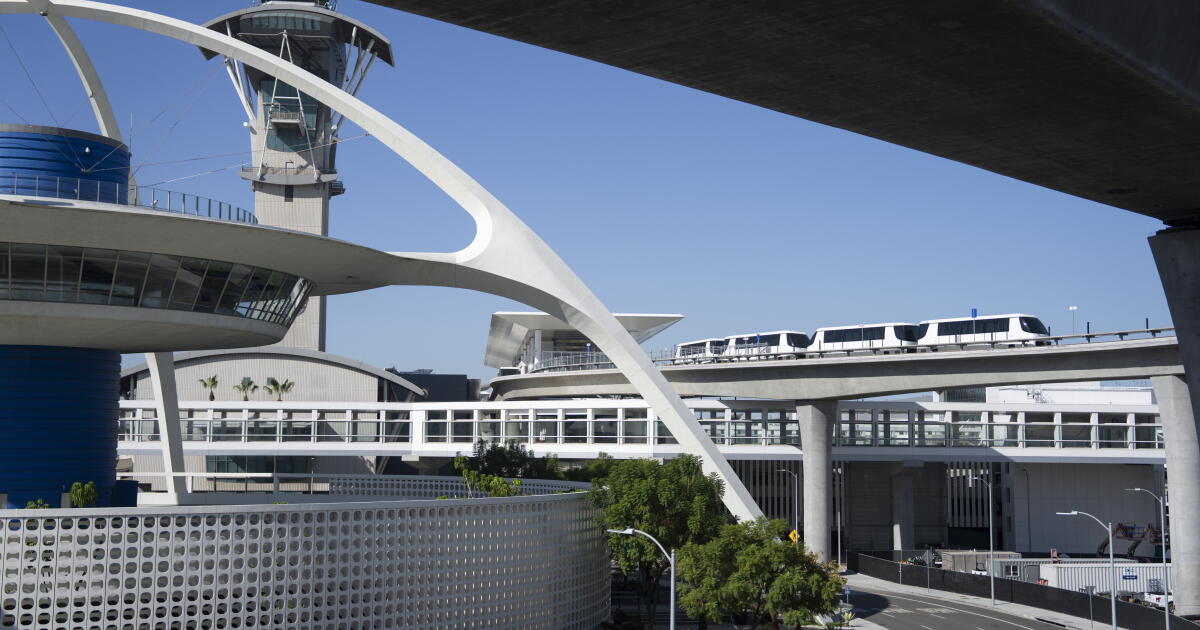
LAX’s long-delayed people mover: The little engine that can’t
In the summer of 1957, Walt Disney spotted a monorail in Europe and decided he’d like to have one of his own. Design and construction began in 1958, and the following year, Disneyland had a monorail.
The LAX SkyLink people mover was approved by the L.A. City Council in 2018 and construction began in 2019, with a targeted completion date of 2023. In the latest news of yet another delay, the hoped-for startup has been pushed into next year.
Almost eight years, and the train has not left the station.
It’s the little engine that can’t.
The people mover that doesn’t.
There’s been finger-pointing, litigation and a grand jury probe into how a $1.9-billion choo-choo has become a $3.3-billion boondoggle.
Maybe they should have hired Disney.
“Tell me about it,” said Los Angeles City Councilmember Monica Rodriguez, who noted that Disney imagineer Bob Gurr, who helped design the monorail and other iconic Disneyland attractions, lives in her district.
I’m waiting to hear back from Gurr, who’s in his mid-90s, to see if he’s available to work a little magic and help get the people mover moving.
“I’m down with that,” Rodriguez said. “And we get an E Ticket ride.”
To fully appreciate the madness, a bit of historical context is helpful.
Given the region’s legendary traffic, a well-designed transit system has always made sense in Southern California, and billions of dollars have been invested, with quite a bit to show for voter-approved sales tax increases with Measures R and M and boatloads of federal dollars.
But the ride has been bumpy.
In the 1990s, the Green Line, as it was then known, was supposed to go to the airport.
It stopped two miles short.
The rail line known as the purple, or the D, was sometimes referred to as the Subway to the Sea.
But even if its next phase is ever completed, it would stop about 3.5 miles short of the beach. (You can, however, take the E Line to downtown Santa Monica.)
Meanwhile, as The Times’ Colleen Shalby just reported, construction is beginning this week on the Van Nuys-Pacoima light rail line.
Only five years behind schedule.
And the cost has gone from $1.3 billion originally to almost $4 billion.
Are you catching on to a pattern here?
And these are not rocket launches we’re talking about. A light rail line. A people mover.
We’re in California, which has a Silicon Valley and Silicon Beach and a few remnants of the aerospace industry, but we can’t get Joe Blow from the Hertz rental lot to an airport terminal in less than eight years?
Meanwhile, the Vision Zero plan introduced 11 years ago by then-Mayor Eric Garcetti, with a goal of eliminating traffic deaths with roadway design and safety improvements, has fallen far short. As Damian Kevitt of Streets Are for Everyone told Shalby, for three years running, L.A. has had more traffic fatalities than homicides.
“The rest of the world has seen a decrease in traffic deaths,” Kevitt told me. “There are ways to do this, and we run into roadblocks. … It’s lack of leadership … at every level. … To me, the people mover is almost an indicator of systemic issues across the city.”
L.A. Mayor Karen Bass is the chair of Metro and appoints airport commissioners. So unsurprisingly, Councilmember Nithya Raman, her challenger in the mayoral campaign, is going after her on the people mover debacle and other transportation shortcomings.
Bass says the LAX project began before she took office, and regarding disputes that led to delays, “we pushed for a settlement so there would be a firm finish line.”
That’s weak.
There’s never been a firm finish line.
It’s like every other major public project in L.A. and beyond. They come with no firm starting time and no firm completion date, and the only two guarantees are that the tab will keep growing, and when the job finally is complete, public officials will take bows at the ribbon cutting.
So what happened in the case of the people mover?
The grand jury report goes into great detail about an arrangement in which L.A. World Airports awarded designing, building and operating authority to a private contracting consortium called LINXS, for LAX Integrated Express Solution.
Are you comfortable with that? Can you understand why anyone would be, other than the contractors?
The grand jury found no criminal activity on anyone’s part, but you’ll be shocked to know there was a considerable amount of eyebrow-raising behavior. The contractor has sued the city, blaming it for delays, but the grand jury suggested it was the contractor who caused the delays, essentially holding out for payment of $550 million in settlement claims.
It’s as if city officials, who missed out on having the project done in time for the World Cup matches, were easy marks, desperate to make sure the trains are running at least by the 2028 Olympics.
We could have flying taxis by then, but no airport locomotive. This would not be a good look.
Rodriguez, who initially voted no on the upcoming convention center expansion project, said she was explicit about one concern she had regarding that public-private partnership.
“Whatever contract language was in the people mover contract, make sure it’s not in the convention center project,” she said.
“This is an embarrassment, by all means,” said James Moore, emeritus engineering professor at USC.
Although the people mover — which would finally make it possible for rail passengers to connect to LAX — is only 2.25 miles long, it’s a sophisticated feat of engineering. But, as Moore noted, countless airports around the world have figured out how to get the job done.
“Should it have taken this long? No,” Moore said. But “when anything goes right in Los Angeles, that’s when I’m surprised.”
Paging Bob Gurr, Disney designer extraordinaire.
We need your help, Bob, and you can name your price.
Money appears to be no object.