WASHINGTON — The Supreme Court agreed Monday to consider outlawing school diversity policies that limit Asian American students at magnet programs and selective high schools.
Three years ago, the court ruled that Harvard and other universities may not discriminate on whom they admit based on the race of their applicants. Evidence in that case showed that Asian applicants with very high test scores were often turned down.
But the justices have been divided over admissions rules for highly selective high schools in Boston, New York and Fairfax County, Va., as well as magnet programs for gifted middle school students.
In most instances, judges have said school officials may use “race-neutral” policies to achieve racial diversity. For example, giving an automatic admission to the top 5% of the students in all of a big city’s high schools or its middle schools could achieve greater racial and ethnic diversity.
But the court’s conservatives, led by Justices Clarence Thomas and Samuel A. Alito, have condemned such policies as thinly disguised racial discrimination.
Magnet programs exist across the country, including in California and Los Angeles, and were conceived as a form of voluntary integration — a way to get white students to attend the same schools as nonwhite students, without having to resort to forced busing.
The idea was that a special school program would be attractive enough to serve as a “magnet” for white students to enroll at a school they might not otherwise attend. A mix of white and nonwhite students was seen as a benefit to the nonwhite students, because white students would be sharing the fate of the nonwhite students.
Asian students were frequently part of that original equation on the nonwhite side of the ledger and counted with other students classified as nonwhite, such as Black or Latino students. But in terms of student achievement, Asian students have performed more like white students, frequently surpassing white students academically.
One subset of magnet schools requires a selective admissions process, and these are at the center of the current dispute.
The court agreed to hear an appeal from parents in Montgomery County, Md., who were upset by a sharp drop in Asian students at its four magnet schools for gifted students.
For a decade, the school board had been troubled that fewer than 15% of the students at its magnet schools were Black or Latino, even though they made up about half of the student population.
In contrast, Asian students were less than 15% of the county’s student population but made up about half of the enrolees at the magnet programs.
After several years of debate, school officials dropped the use of a countywide competitive test and chose top performing students at all of its middle schools using a lottery.
That prompted a lawsuit that reached the U.S. 4th Circuit Court of Appeals.
Fairfax County in northern Virginia had adopted a somewhat similar policy for the Thomas Jefferson High School for Science & Technology. A federal judge ruled for Asian parents and said their students had been deprived of a “level playing field” in competing for admission.
But the 4th Circuit, by a 2-1 vote, disagreed and said Asian American students were still winning more seats than their percentage of the school population.
The Assn. for Education Fairness, the parents group in Montgomery County, lost for the same reason in the 4th Circuit. The number of admitted Asian students had declined, but their percentage remained well above their share of school population.
“School districts across the country have overhauled admissions criteria for competitive public schools after concluding that existing systems produced undesirable racial enrollment patterns,” they said.
They said the court should end this type of racial discrimination against Asian students.
However, a longtime champion of admissions policies that rely on social and economic fairness said he hoped the court would side with Montgomery County.
“The Supreme Court has long disfavored racial preferences and pointed to race-neutral programs that look at factors like socioeconomic disadvantage as the right way to do affirmative action,” said Richard D. Kahlenberg, director of the American Identity Project at the Progressive Policy Institute.
He said the Maryland school board followed that rule.
“It essentially provided an admissions break to students based not on race, but on the economic disadvantage of the elementary school they attended. The question now opened is whether the court will stand by precedent or move the goal posts. Is the court opposed to racial preferences, or to racial diversity itself?”
Los Angeles Unified, the nation’s second-largest school system, has an extensive magnet system, with 66 whole-school magnets and 268 magnet centers within a larger campus.
At this point, many of the magnets provide no discernible integration benefit and are viewed instead as inducements for any student to enroll. Many magnets are nearly all students of color because few white students apply.
A few schools, however, have more applicants than spaces, and the district relies on “the Magnet Priority Point System and the need to maintain a racially balanced enrollment, and by available space.”
Parents must mark one federally recognized race or ethnicity on the application, or it won’t be processed. A family gets points, for example, if a student applied unsuccessfully for a magnet in the past.
In L.A. Unified, 53 schools are designated for students rated as “gifted,” and there are four campuses with programs for highly gifted students, typically identified by a professional evaluator.
Available recent data for the highly gifted program at North Hollywood High indicated that the largest percentage of students, about 38%, were Asian. Overall, the district’s enrollment is about 3.5% Asian.
The justices will hear arguments in the case early next year.
Savage reported from Washington and Blume from Los Angeles.
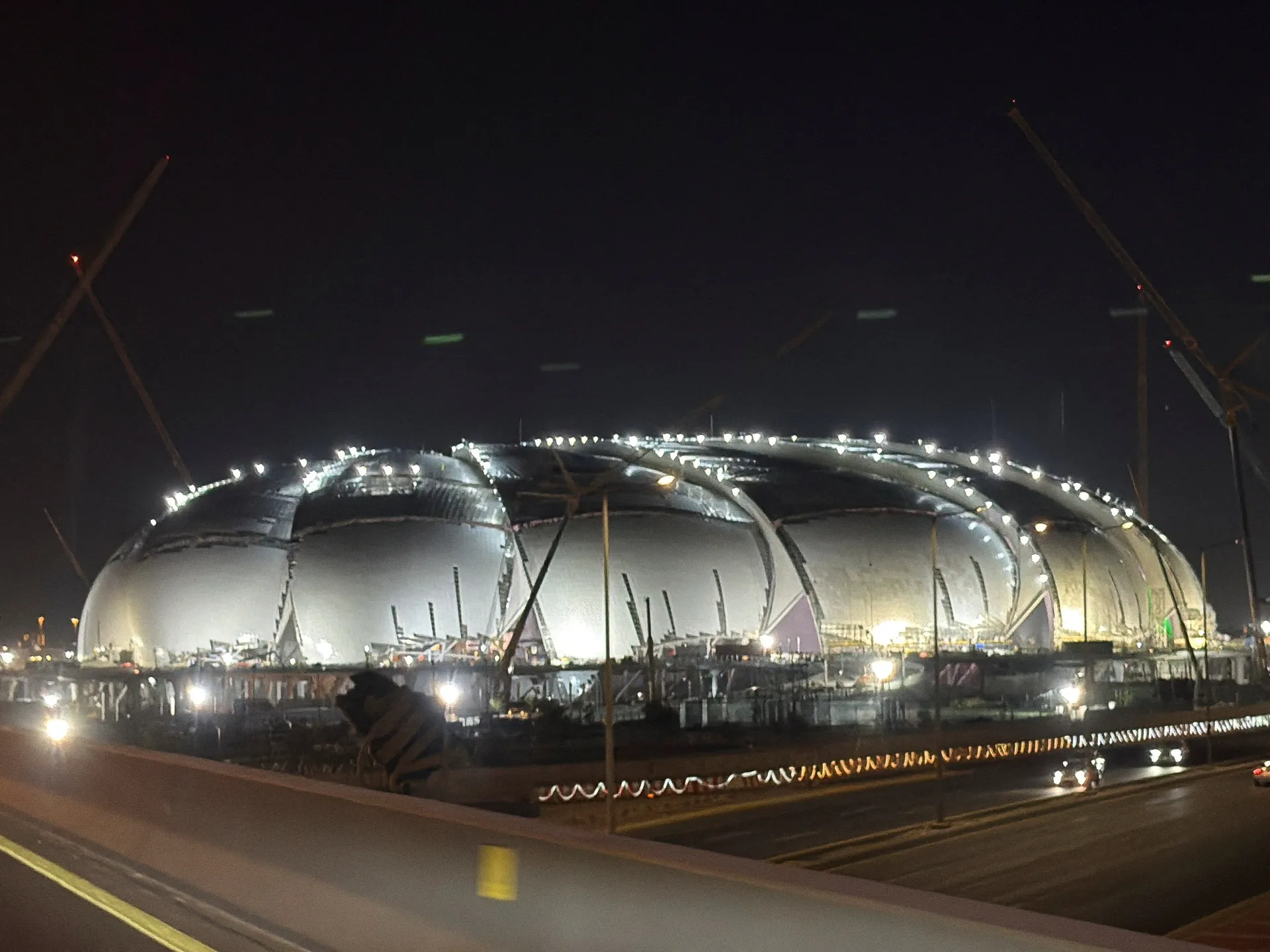
Asian Cup preparations continue for January, but Asian Tour delays golf’s Saudi Invitational after Houthi attacks.
Published On 16 Oct 202616 Oct 2026
The Asian Cup football tournament is on track to take place in Saudi Arabia early next year, local organisers say, but golf’s Asian Tour has postponed the Saudi International indefinitely in the aftermath of a series of attacks on Riyadh.
Yemen’s Houthi group claimed responsibility for the deadliest attack, which took place on Saturday on Riyadh’s international airport. It killed 14 people and wounded more than 300.
Recommended Stories
list of 4 itemsend of list
Australia also withdrew its team from the urban cycling World Championships on Friday, citing safety concerns over travelling to Riyadh, where the event is scheduled to take place in early November.
The Six Kings Slam exhibition tennis tournament in Riyadh has already been moved from October to December while FIFA on Thursday postponed the FIFAe Finals 2026 video game competition in Jeddah until an unspecified future date.
In that environment, serious questions were being asked about whether the 24-team Asian Cup could still go ahead in Saudi Arabia from January 7 to February 5.
Three Saudi Pro League matches, including one featuring Cristiano Ronaldo’s Al-Nassr, were postponed this week while Al-Nassr’s Asian Football Confederation (AFC) Champions League game on Monday was delayed by an hour after Saudi Arabia’s Civil Defence said it had intercepted a missile fired towards Riyadh.
AFC chief Salman bin Ibrahim Al Khalifa said earlier this week that a postponement of the continental championships until 2028 was possible if necessary, but the local organising committee (LOC) said on Friday that it was sticking to the original schedule.
“Preparations across all organisational and operational areas are progressing according to the approved schedule, including work on venues, facilities and supporting services,” it said in a statement.
The LOC “will continue to monitor developments relevant to the tournament and ensure the appropriate conditions are in place for its successful delivery”.
Attacks in Saudi Arabia disrupt sport calendar
The $5m Saudi International, which is sponsored by Saudi Arabia’s Public Investment Fund (PIF), is the flagship event on the Asian Tour and had been scheduled to take place at Riyadh Golf Club on November 18-21.
“The decision to postpone was taken following an assessment of the organisational and logistical challenges associated with hosting the tournament and ensuring the event is delivered to a standard befitting its international stature,” an Asian Tour statement said.
AusCycling said its decision to withdraw the Australian team from the urban World Championships was made “with the safety and wellbeing of our athletes and staff our highest priority”.
The Australian government is advising travellers to “reconsider” trips to Saudi Arabia in general and Riyadh’s King Khalid International Airport in particular “due to recent security incidents”.
The Saudi government has invested heavily in sport through the PIF in recent years, and the Asian Cup was pitched as an early rehearsal for hosting football’s FIFA World Cup in 2034.
South Korea signals cuts to military exemptions for gold medallists after backlash over athletes’ Asian Games comments.
Published On 7 Oct 20267 Oct 2026
South Korea’s sports minister says the government will review the military service exemption for gold-medal-winning athletes after public backlash to some controversial comments from winners at the Asian Games.
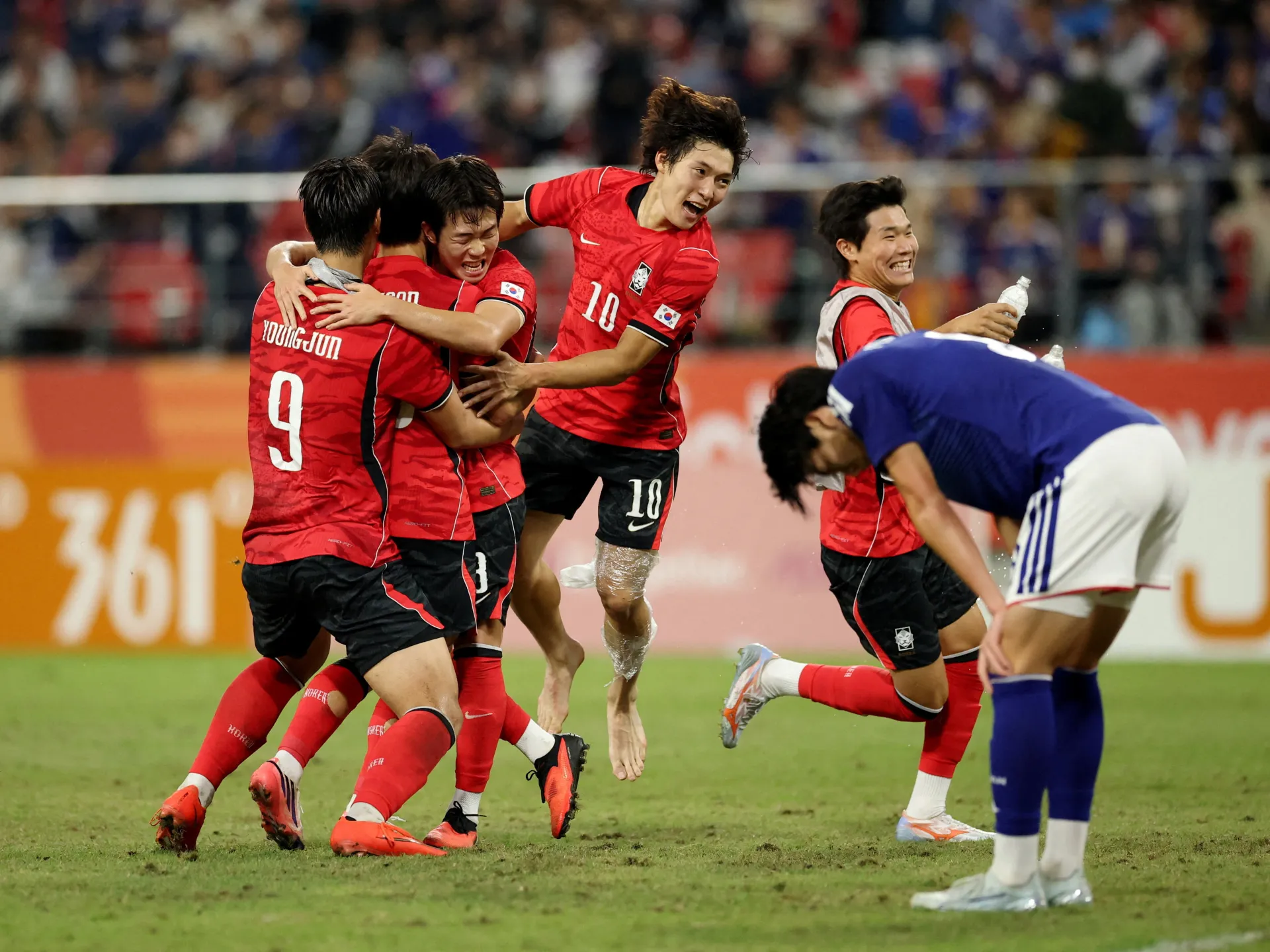
Three players from the men’s football team came under fire for comments following South Korea’s 1-0 win over Japan in the Asian Games final last weekend in Japan.
Recommended Stories
list of 4 itemsend of list
All three apologised, but a broader debate had already reignited over whether athletes should receive special treatment for sporting achievements, particularly as common citizens, as even members of BTS – the globally famous K-pop group – had to complete their mandatory service.
Al Jazeera Sport takes a closer look at the furore surrounding the comments at the Asian Games.
Culture, Sports and Tourism Minister Choi Hwi-young on Wednesday said the alternative military service exemption system for artists and athletes “will inevitably have to be scaled back”.
“It is true that the system has contributed to helping outstanding artists and athletes maintain and develop their abilities,” Choi told the National Assembly’s Culture, Sports and Tourism Committee.
“However, the values attached to fairness and public perceptions of military service have changed. I agree that the system should be comprehensively reviewed once again.”
What does military service look like in South Korea?
Most South Korean men must complete 18 to 21 months of military service by the age of 28.
Since 1973, however, Olympic medallists and Asian Games gold medallists have been able to replace the full term with a supplementary service, which consists of three weeks of basic training.
Three of the footballers, including Yang Min-hyuk, who assisted the winning goal against Japan, made comments that were viewed as insensitive.
“The medal and winning the championship weren’t important. I played the game with only one thing in mind – the reward of a military service exemption,” Yang, who joined Tottenham Hotspur in 2025 and is currently on loan at Belgian club Westerlo, said.
Newcastle United midfielder Park Seung-soo posted a photo on social media showing him wearing a cap associated with soldiers who have completed their service. In a post-match interview, captain Lee Gi-hyuk held up his gold medal and said, “I’m not going to the military.”
What has been said elsewhere in South Korea about the controversy?
A number of politicians, including Ahn Cheol-soo of the People Power Party, said it was time to change the system.
“Some players’ remarks after the match were outrageous,” Ahn posted on social media. “Even the captain bragged about not having to serve in the military. Are all the young people who enlist every year fools?”
Former lawmaker Yoo Seong-min said the flippant comments had provoked resentment and asked: “Is it really fair that BTS has to serve in the military while Asian Games gold medallists are exempt?”
In a Korea Herald editorial on Tuesday, the newspaper declared that the practice was outdated.
“South Korea now stands shoulder to shoulder with the world’s leading nations,” the newspaper said. “The days when finishing first in Asia could meaningfully enhance the country’s national prestige are long gone. It is time to reconsider.”
That was the message from Defence Ministry spokesperson Chung Binna during a press briefing in Seoul.
“Ultimately, we have plans to cut back or scrap the supplementary service, including one designed for artists and athletes,” Chung said.
What other athletes gained military-service exemptions?
The footballers were among many winners from the Asian Games who qualified for the military exemption.
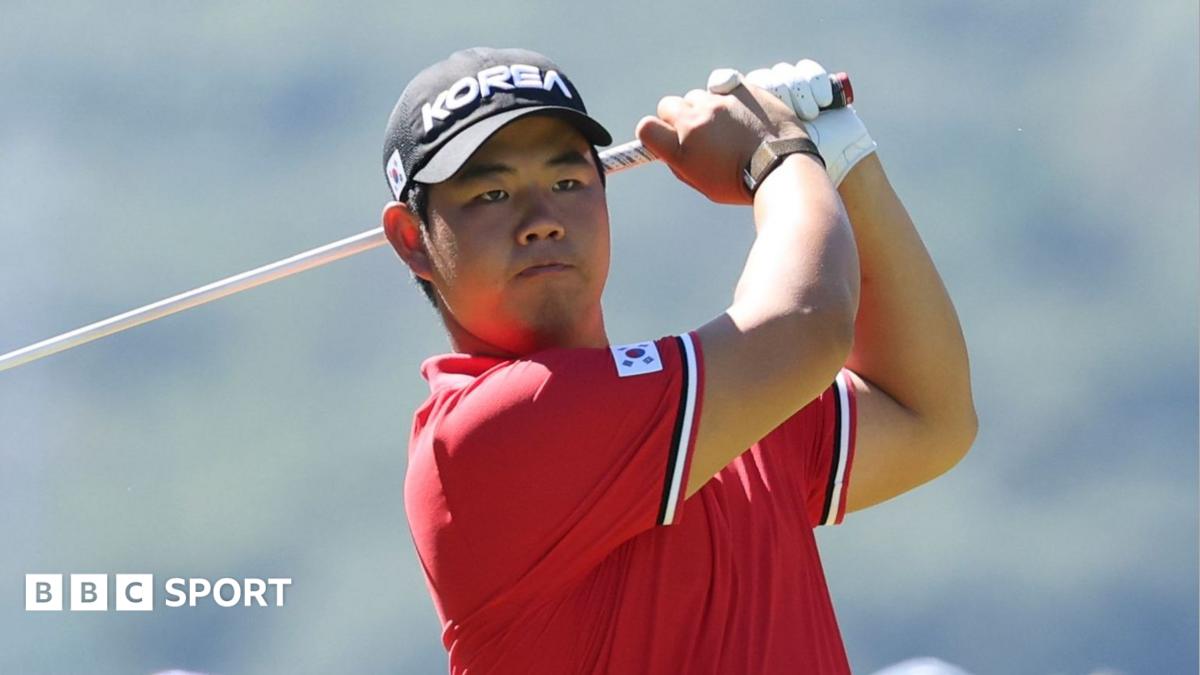
Golfer Tom Kim won the men’s singles on Saturday after flying across the Pacific when the Presidents Cup competition ended so he could compete in Japan. Asked about the military exemption, he took the gold-medal approach.
“I’m more proud that I’m able to bring a medal for my country,” he said.
Sixteen South Korean baseball players are also exempt after defeating Japan 3-1 in the Asian Games final. So are three South Koreans who won gold in esports, an event at the Asian Games.
Teenage athletes have headlined some of the biggest Asian Games triumphs, leading their countries to historic gold medals, breaking records and cementing their legacy as formidable forces in the field.
Far from being intimidated by competitors double or triple their age, these schoolchildren remained cool and unfazed as they cruised to gold at their Asian Games debut.
Recommended Stories
list of 4 itemsend of list
Many are already familiar with the pressure and expectations of the world stage and have dominated their sport all season.
Al Jazeera Sport looks at some of the stars who left their mark in Japan:
Yu Zidi, 13
China: Swimming
At just 13, Yu was named female Most Valuable Player (MVP), as she bagged three gold medals and broke as many Asian Games records in a fairytale debut.
The schoolgirl stormed to victory in the women’s 200m butterfly, 200m and 400m individual medley (IM) and had a comfortable lead over her competitors.
Her time of two minutes and 6.10 seconds (2:06.10) in the 200m IM stands as a world junior record and second-fastest time ever.
“I don’t think I am what people describe as a prodigy,” she said after being crowned MVP. “I will continue to train hard, push myself and work alongside young athletes across Asia to inspire more young people to love and take part in sports, especially swimming.”
Yu Zidi celebrates after winning the 400m Individual Medley [Atsushi Tomura/Getty Images]
Zhang Zhanshuo, 19
China: Swimming
Zhang held up seven fingers after his 400m freestyle win to count out his gold medals at the Games – the most at this edition, and more than what 27 of the 45 participating nations had in their medal tally at the conclusion of the event.
He set Games records in the 400m and 800m freestyle, an Asian record in the 200m, and helped power China to gold and Asian records in the men’s 4x100m and 4x200m freestyle relays.
But the 19-year-old has bigger victories in sight.
“The Asian Games is not the goal. I’m still aiming for the Olympics and competing with the best,” he said.
The teenager’s haul helped China sign off from swimming with 30 golds out of 41 medal events in the pool, with chief rival Japan a distant second with seven titles.
Zhang at the end of the men’s 400m freestyle [Andy Chua/Reuters]
Shin Ohashi, 17
Japan: Swimming
Ohashi broke the world record in the men’s 200m breaststroke (2:04.83) in front of a home crowd to become the first swimmer under the 2:05 mark.
The gold added to his title in the 100m breaststroke shared with China’s Dong Zhihao, bronze in the 50m breaststroke, and silver in the mixed and men’s 4x100m medley relays.
The teenager said he was surprised and honoured that Olympic champion Leon Marchand knew who he was, after the Frenchman described the 17-year-old as a “scary” prospect ahead of the 2028 Los Angeles Olympics.
“I respect him because I know just how strong he is. But if I want to win, he’s someone I know I’ll have to beat.”
Ohashi’s world record performance came just a week after the teenager recovered from COVID-19.
Shin Ohashi broke the world record in men’s 200m breaststroke [Atsushi Tomura/Getty Images]
Yan Ziyi, 18
China: Athletics
Yan was already javelin world number one and Asian record holder when she stepped onto the field for her Games debut – her first and only throw of 70.46 metres was enough for gold and a Games record.
It was the sixth-best of all time and well ahead of Olympic champion and home hero Haruka Kitaguchi’s 62.70m.
Yan is closing in on the world record of 72.28m set by Barbora Spotakova in 2008. In May, she hurled a world-leading, record-breaking 71.74m to open an unprecedented season.
Yan during the women’s javelin throw final [Mohd Rasfan/AFP]
Chen Yujie, 17
China: Athletics
Chen stormed to a new Games record in the women’s 100m en route to her first gold as she announced herself as the new sprint queen in Asia.
“I have no limits,” was her response when asked how much faster she hopes to run.
She followed up her podium finish with a silver in the 200m and gold in the women’s and mixed 4x100m relays.
Chen celebrates after winning the women’s 100m final [Mohd Rasfan/AFP]
Taiju Goto, 17
Japan: Athletics
Goto narrowly missed gold in the men’s 400m hurdles, but his 47.93s was enough for a world under-18 best time, Asian under-20 best time, and a new personal best.
The teen star has run sub-50 seconds eight times this season alone, an impressive feat for a 17-year-old. His Asian Games silver added to the World Under-20 one he bagged in August.
Bassem Hemeida of Qatar crosses the finish line to win the gold medal ahead of Japan’s Taiju Goto in the men’s 400m hurdles final [Yong Teck Lim/Getty Images]
Kumkum Mohod, 17
India: Archery
Mohod scripted history for India when she became the first Indian to win an individual recurve archery gold at the Games. The 17-year-old helped India to gold in the women’s team recurve, and partnered with Dhiraj Bommadevara for mixed team silver.
Mohod’s gold was no stroke of luck; she defeated South Korea’s reigning world champion and Olympic medallist Kang Chaeyoung in the quarterfinals before dominating China’s Zhu Jingyi in the semifinals.
“Ever since I’ve made it to the national team, I’ve been visualising this moment. I had visualised shooting an X, and that is exactly what happened,” she told reporters after the match, according to Indian media.
Kumkum Anil Mohod [Anushree Fadnavis/Reuters]
Anahat Singh, 18
India: Squash
World junior champion Anahat Singh has been India’s finest in the sport for several years now. Despite only being 18, Aichi-Nagoya was Singh’s second Asian Games outing after competing at Hangzhou 2023, where she won two bronze medals in the mixed doubles and women’s team events.
This time round, she won a silver in the women’s singles against world number five Sivasangari Subramaniam of Malaysia. However, her semifinal match against Japan’s Satomi Watanabe was what she called the “best win” of her career after producing a stellar comeback to defeat the world number six.
India’s Anahat Singh in action during the women’s singles gold medal match [Chalinee Thirasupa/Reuters]
Yuki Kurihara, 11
Japan: e-sports
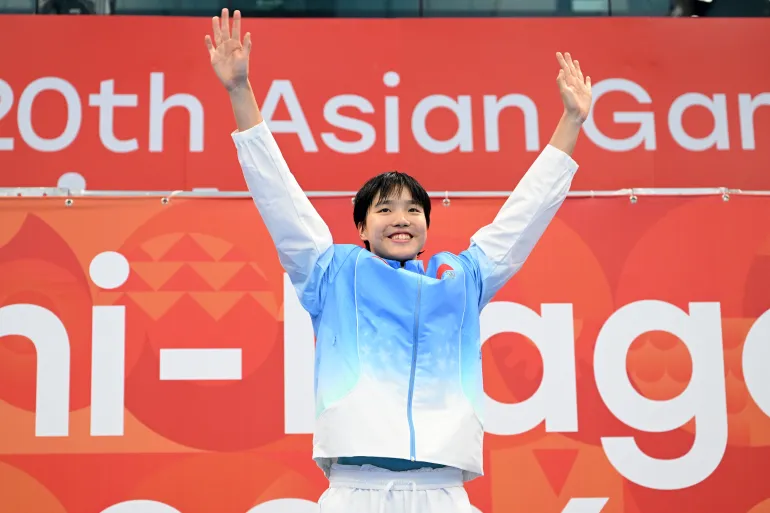
At just 11 years of age, e-sports prodigy Kurihara became the youngest gold medallist in Asian Games history when he won Puyo Puyo Champions.
“I’m really happy. The gold medal is really beautiful, shiny and heavy,” Kurihara said after his final, where he barely broke a sweat.
Kurihara started playing Puyo Puyo in his first year of primary school – where he still studies – and soon started competing and winning in tournaments. He obtained his pro licence in April this year and regularly beats adults, often triple his age.
Yuki Kurihara of Japan poses on the podium [Toru Hanai/Getty Images]
Ku Yong-yan, 12
Taipei: Skateboarding
Ku took silver in the men’s skateboarding park with 87.33 points, and was just one of several teenagers – in his case, a pre-teen – who medalled in skateboarding at the Games.
Japan’s Izuru Nagahara, 15, took gold in the event. China’s Zhu Yuanling, also 15, won gold in the women’s street skateboarding competition.
China’s Cao Shiqi finished fourth in women’s skateboarding park and was the youngest athlete in China’s delegation at the Games.
Ku Yong-yan in action during the men’s park final [Andrew Couldridge/Reuters]
Tom Kim topped the men’s leaderboard after the third round at the Asian Games as he seeks a gold medal that will significantly reduce the time he is required to spend in South Korea’s military.
Having started two shots off the lead, Kim hit a brilliant five-under 65 that included five birdies and an eagle, taking him a stroke clear at 12 under par with one round to play.
Able-bodied South Korean males are usually required to undertake between 18 and 21 months of military service before the age of 28.
However the government rewards Asian Games gold medals and Olympic medals of any colour with a service exemption bar basic training, which lasts less than a month.
Athletes who have previously secured the exemption include former Tottenham footballer Son Heung-min, who served for only three weeks in 2020 having won the Asian Games two years earlier.
Kim hurried from the Presidents Cup in the United States to tee off at the Kasugai Country Club in Japan, having to manage on just six hours of sleep and a 14-hour time difference.
The 24-year-old previously came close to securing an exemption at the Paris Olympics in 2024, finishing day one tied for third before ultimately finishing eighth.
Having looked visibly emotional after that result, Kim is now chasing another chance to stop military service stalling his promising career, which has already featured an Asian Tour order of merit crown and four PGA Tour titles.
The world number 32’s lead would have been larger had he not missed birdie putts on the 14th and 18th holes, but he stands clear of Taiwan’s Wang Wei-hsuan, who had led overnight, and Japan’s Kazuki Higa going into day four.
The men’s team event title offers another route for military exemption, with South Korea also topping the men’s leaderboard by one stroke.
Gold in that event will exempt Tom Kim and SH Kim, 28, regardless of the individual result, but it would come too late for the third team member, Mun Do-yeob, who has already served.
“I think about it. It’s so tough,” SH Kim said of the possibility of military service.
“I am 100% nervous, for sure. It’s a lot of pressure. I could stay on the PGA Tour (with a gold). That’s my goal.”
Hong Kong listing reforms and surging deposits show regional markets funding Asia’s future.
This article appears in the October issue of Global Finance Magazine.
When the International Monetary Fund and World Bank convene their annual meetings in Bangkok this October, it will be the first time the joint gathering has returned to the city in 35 years. IMF officials have taken to calling Asia the “driving force” of the global economy — shorthand for a region that accounts for one-third of global gross domestic product, 29% of global public equity market capitalization, 56% of listed companies and 52% of global venture capital activity, according to the Organization for Economic Cooperation and Development’s Asia Capital Markets Report
The question for chief financial officers isn’t whether Asia is growing — it’s whether the region can finance that growth on its own terms, or whether it still depends on capital, listings, and liquidity from the West. The answer, based on bank data, exchange records, and conversations with practitioners and economists on the ground, turns out to be both.
Alex Ibrahim, until recently corporate CFO of Yanolja, the Seoul-headquartered travel technology company, said Asia is a picture of change. Its financial sector has matured in the decades since the 1960s to 1990s, when headlines proclaimed the rise of the Asian Tigers and countries became synonymous with rapid, export-driven industrialization funded largely from abroad.
“Back then, the economies were growing very fast, and a lot of the money was coming from the U.S. to invest,” said Ibrahim, who before joining Yanolja spent nearly a decade running international capital markets at the New York Stock Exchange. “If you look now, capital has developed locally and the financial infrastructure in Asia is much more robust.”
Marc Iyeki, a board advisor who formerly led the NYSE’s Asia-Pacific listing sector and shepherded about 100 companies to market, said the shift reflects a change in decision-making. “Decades ago, the money was in New York. Decisions were made in New York,” he said. Since then, regional private equity and venture firms have placed people on the ground in Asia who understand the home market and make the calls themselves, often after training at global firms and bringing that experience back. The region has also produced homegrown standouts such as PAG, Hillhouse Investment, MBK Partners, and Peak XV Partners.
That evolution is seen in how Asia’s own exchanges are performing. Over the past ten years, Hong Kong’s equity market has moved through cycles in liquidity and new issuance, but 2025 marked a rebound from the post-pandemic slowdown. Average daily turnover on the Hong Kong stock exchange rose from HK$66 billion in 2016 to HK$248 billion in 2025, nearly 3.7 times the level a decade earlier. Initial public offering proceeds were more volatile: HK$194 billion was raised in 2016, followed by several weak years before rebounding to HK$285 billion in 2025.
Japan’s exchange has risen more steadily. On the Tokyo Stock Exchange’s Prime Market, average daily trading value for domestic common stocks rose from 3.2 trillion yen in fiscal year 2022 to 4.3 trillion yen in fiscal year 2023, and 6.7 trillion yen in fiscal year 2025.
Iyeki recalled that when Alibaba first wanted to list in Hong Kong in 2013, the exchange turned it away over governance requirements — and New York landed the IPO. Losing a flagship company forced a reckoning. Some in Hong Kong worried that loosening listing rules would weaken protections for retail investors; others warned the market would be “hollowed out,” as local companies sought listings in New York and London. Hong Kong changed its rules, and years later Alibaba came back for a dual listing. The infrastructure now absorbing record IPO volumes and Alibaba-scale capital was built, in part, out of that earlier loss.
One of the people behind that financial infrastructure is Larry Li, a Hong Kong-based fintech founder who worked on Stock Connect, a market access program that links the stock markets of mainland China and Hong Kong. It has become a major cross-border equity trading tie between China and international investors. Its northbound turnover more than doubled to 345 billion yuan in the first half of 2026; southbound turnover hit a new high of $123 billion yuan. “It’s a closed loop, so capital cannot fly out of the system,” Li said.
Li, a director of Digital Asset Clearing Center, which aims to develop a financial settlement and clearing infrastructure that can integrate digital and tokenized assets into mainstream capital markets, argued that areas like Hong Kong, Singapore, and Shanghai have pockets of innovation in financial AI. Li said the region’s token economy “drives market infrastructure upgrades, attracts capital globally, and enjoys support from governments as a strategic force of growth.”
Fintech, Banking, and Innovation
Li pointed out that the region’s tokenized economy fosters “co-opetition” between the banking industry and fintech enterprises. Consumers across the region have largely turned to fintech-developed super apps like Alipay and WeChat Pay, while banks have doubled down on the regulated back end: cross-border settlement, know your customer, and other compliance rules.
Some of the same banks figuring out Asia’s patchwork of KYC and settlement rules are also among the world’s fastest-growing lenders. Banking data makes the same point in numbers. S&P Global Market Intelligence’s 2026 ranking of Asia-Pacific’s 50 largest lenders by assets found China’s big four — Industrial and Commercial Bank of China, Agricultural Bank of China, China Construction Bank, and Bank of China — grew assets about 16% year over year in US-dollar terms as of December 31, 2025. S&P also singled out Singapore’s three largest banks — DBS, Oversea-Chinese Banking Corp., and United Overseas Bank — for strong double-digit asset growth, driven by regional deposit inflows rather than capital raised abroad.
China’s financial system is bank-led and primarily state-directed, according to Standard & Poor’s. The country’s household savings, pensions, and corporate liquidity flow into banks rather than capital markets, giving lenders a large, stable funding base that the government then channels toward priority sectors. Beijing has supported that base with a 520 billion yuan capital injection into four state-owned banks in 2025, followed by plans announced in March 2026 to issue another 300 billion yuan in special bonds to recapitalize ICBC and Agricultural Bank of China.
“As the primary liquidity conduit for fiscal stimulus, state-owned banks increased their financial investments by 19% in 2025,” Iris Tan, a senior equity analyst at Morningstar, said in the S&P report. These financial investments were “fueled by a record 28% surge in government bond issuance,” according to Tan.
Vietnam as a Case Study
None of this means that Asia’s approximately 48 countries are growing equally. Sam Van, managing partner of SRO Partners and an advisor on Vietnamese capital markets, said the region is still layered by tier. Blue-chip regional companies can borrow cheaply from local banks at rates set by well-capitalized central banks — sometimes so cheaply, he said, that “it’s better to borrow money from the bank than actually issue a bond.” Midsize companies, those earning under $50 million in revenue, are a harder sell to credit officers weighing thin margins against career risk, which pushes some smaller businesses toward informal lenders. Van sees this gap as a reality in a still-maturing system rather than evidence that the system isn’t working.
Van, who recently co-authored a book that chronicles Vietnam’s economic rise, said the country illustrates how quickly a market can mature once the incentives align. Vietnam’s IMF-linked compliance upgrades — the product of what Van calls the government “consistently wanting to meet that standard” since joining the IMF in the 1990s — helped it earn an upgrade to FTSE Russell’s emerging-market status in September.
Critical Economic Views
Two economists watching from outside the deal room caution against overstating the region’s financial self-sufficiency. Bala Ramasamy, professor of economics at the China Europe International Business School in Shanghai, argued that “the driver in Asia, for Asia and by Asia is definitely China” — its outbound foreign direct investment to the Association of Southeast Asian Nations alone can match what comes from the EU or the US, and the reconfiguration of trade around geopolitical frictions is relocating supply chains in ways that are boosting growth across Southeast and South Asia. Japanese and Taiwanese capital, he noted, is increasingly heading toward the US to secure market access and stay aligned with Trump-era industrial policy, even as flows from Europe and the US slow elsewhere. “I don’t think Asia can do without it,” he said.
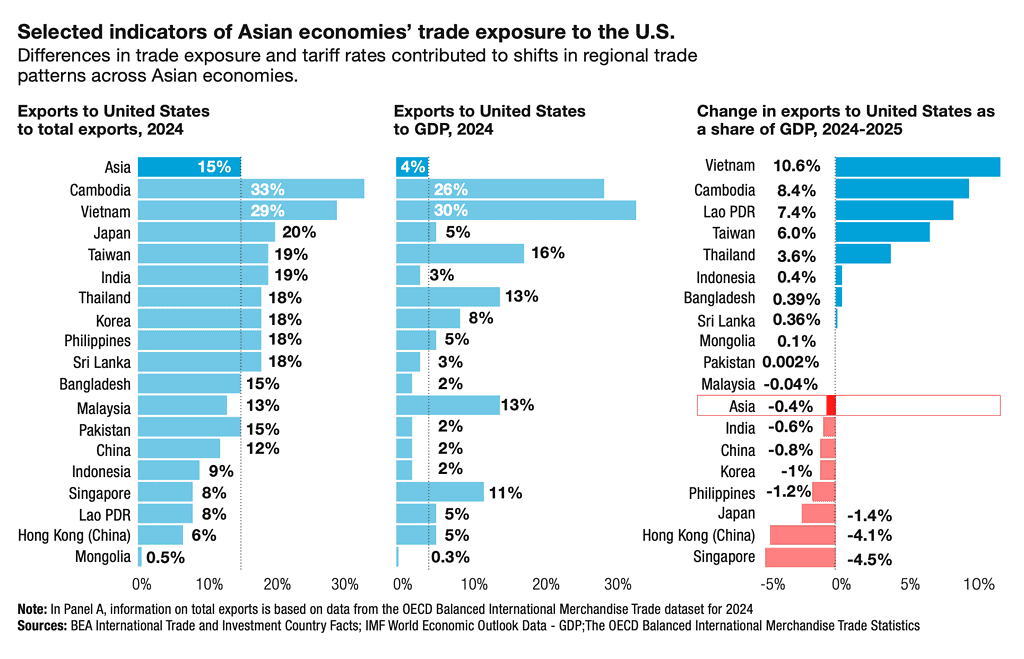
Prema-chandra Athukorala, emeritus professor of economics at the Australian National University, said Asia’s growth is substantial, but its export-driven economy still relies heavily on the rest of the world. Domestic savings rates across the region dwarf the emerging-market average of roughly 25% — Singapore’s is near 58%, China’s near 49.5%, India’s around 30% — and in most Asian economies, investment rates run below those savings rates, meaning the region is, on balance, a net exporter of capital rather than an importer of it. Intraregional FDI from China, Korea, Taiwan, and Singapore has grown substantially over the past two decades. However, Athukorala said that extra-regional FDI still accounts for the larger share of investment in Vietnam, Malaysia, Thailand, and Cambodia, where Western multinationals remain central to “China+1” supply-chain strategies, and even domestically financed activity depends heavily on global demand. “Over two-thirds of the regional exports are still destined to extra-regional markets,” he said.
Taken together, the practitioners and the professors describe a region that finances far more of its own growth than it used to, yet remains clearly reliant on the rest of the world.
Weld Royal is a contributing writer based in the U.S.
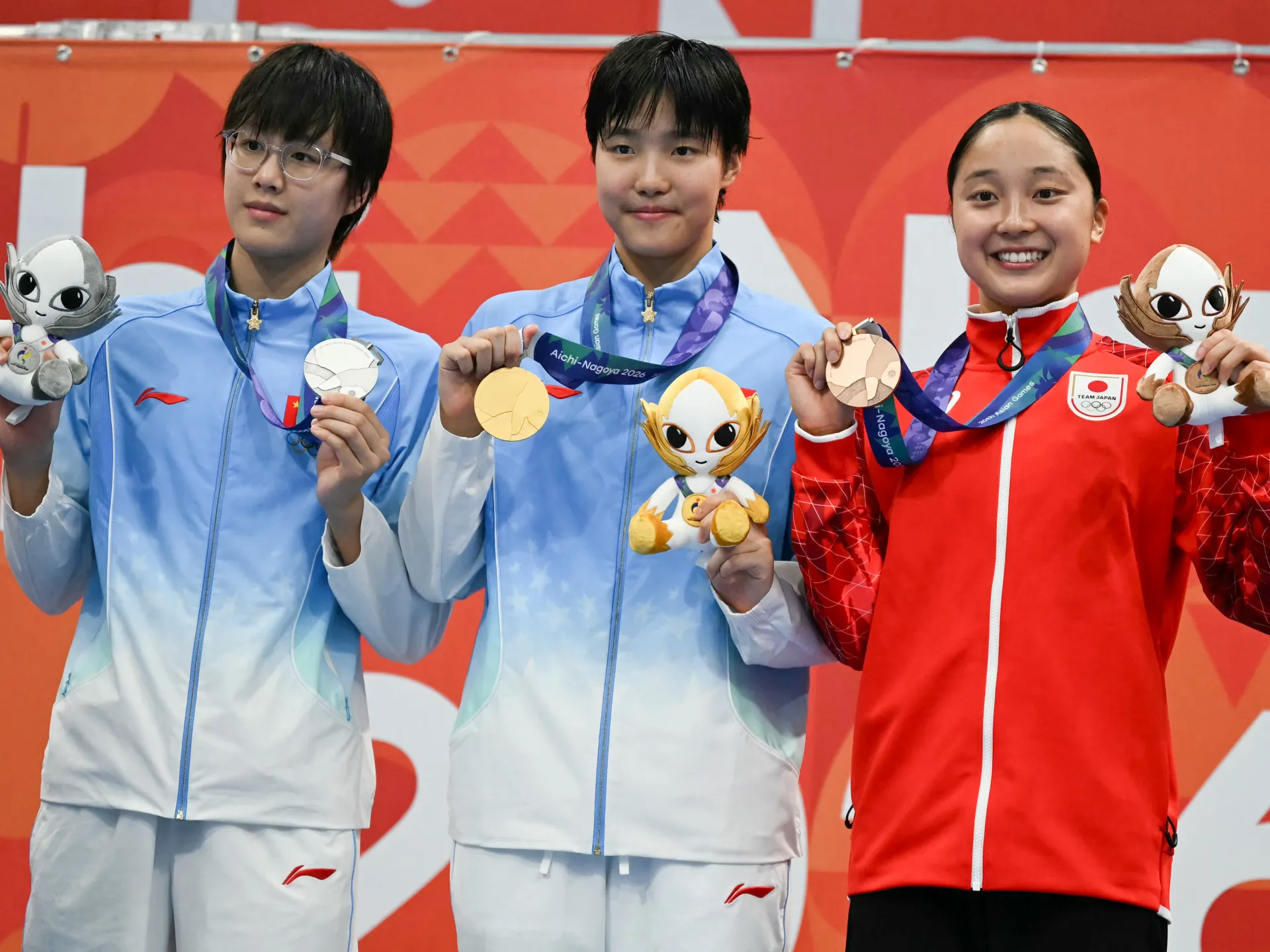
Lin bags her second Asian Games gold medal, three years on from her success in Hangzhou in the 57kg class.
Published On 2 Oct 20262 Oct 2026
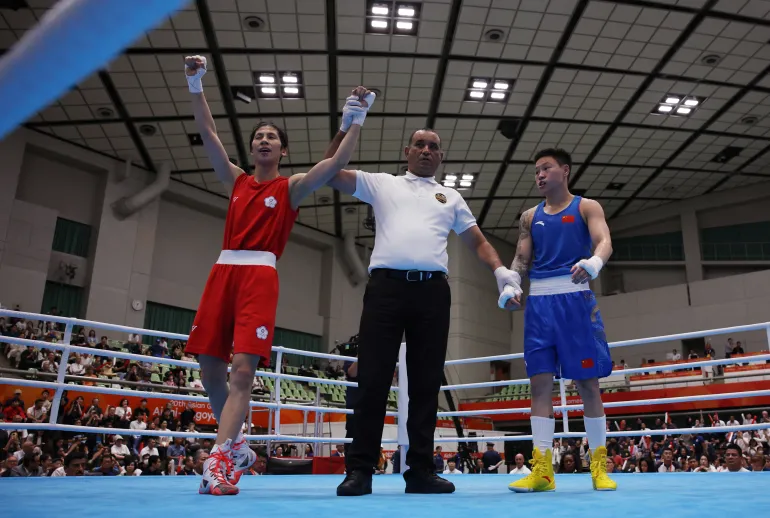
Taiwan boxer Lin Yu-ting, the Olympic champion who found herself embroiled in a major gender row at Paris 2024, has won gold at the Asian Games.
Lin beat China’s Yang Chengyu 5-0 on Friday in the women’s 60kg (132lb) final in Nishio, Japan, giving her a second Asian Games gold after winning in the 57kg (126lb) class in Hangzhou, China, three years ago.
Recommended Stories
list of 4 itemsend of list
The 30-year-old was backed by a small pocket of vocal Taiwan supporters in the Nishio Gymnasium in Nishio, southeast of Nagoya.
Towering over her opponent, Lin used her superior reach to take control of the bout and had a clear advantage heading into the third and final round.
She held off a late assault from Yang to take gold, celebrating with the minimum of fuss.
Taiwan’s Lin Yu-ting is declared the winner of the gold medal over China’s Yang Chengyu in Nishio, Japan [Andrew Boyers/Reuters]
Lin told the AFP news agency before the Games that she had considered retiring after the Paris Olympics but wanted to carry on fighting in part to defy those who questioned her eligibility.
Lin and Imane Khelif of Algeria were disqualified from the 2023 world championships by the International Boxing Association (IBA) after the organisation said they failed unspecified gender eligibility tests.
However, the International Olympic Committee allowed them to compete in Paris, saying they were victims of “a sudden and arbitrary decision” by the widely discredited IBA. Both went on to win gold.
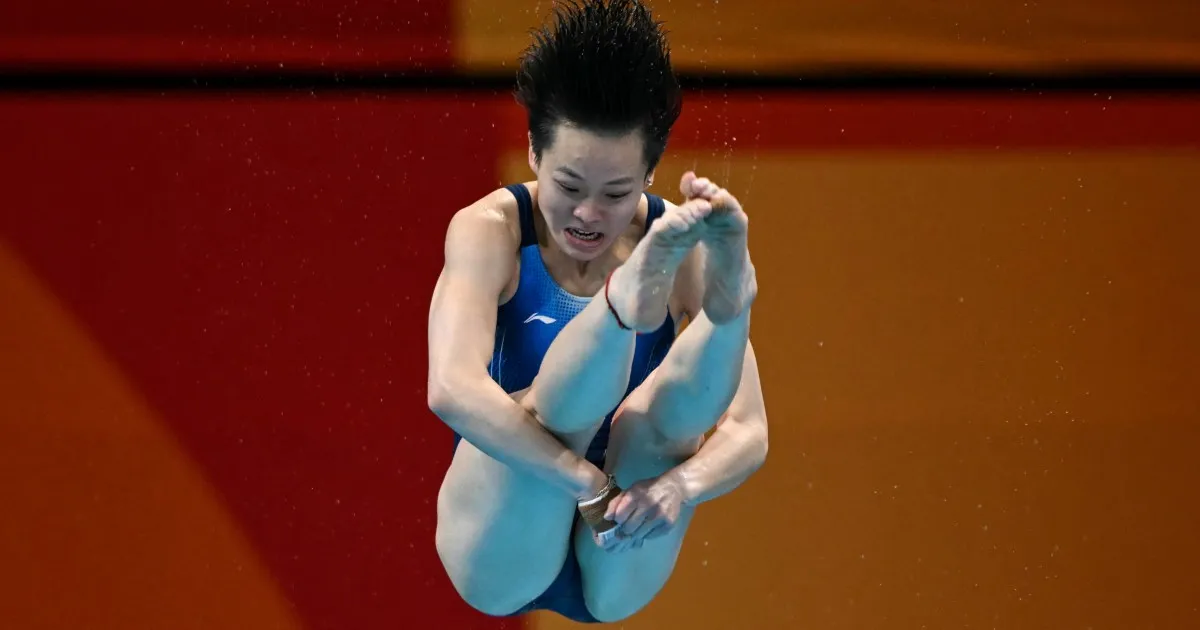
Chinese divers were unstoppable as the country’s sizeable overall tally of gold medals swelled to 150.
Published On 30 Sep 202630 Sep 2026
China’s divers extended their remarkable Asian Games unbeaten record stretching back to 1974 as a top Japanese official apologised for “inconveniences” that have dogged the continent’s premier sporting event.
Chinese divers were unstoppable once more on Wednesday as the country’s sizeable overall tally of gold medals swelled to 150 with four days left.
Hosts Japan are a distant second with 50 golds, ahead of South Korea with 24.
Chen Yiwen and Lian Junjie each won gold in the final two diving events to give China a 14th consecutive clean sweep in the sport.
China has won every diving gold medal since their first Asian Games appearance 52 years ago.
“Girls are every bit as capable as boys. We are pushing ourselves to perform more difficult dives, too,” said Chen, a double Paris Olympics champion.
“We do not train any less than the boys,” she added.
In tennis, the Philippines’ Alexandra Eala stormed into the semifinals, cheered on by fans who had come from far and wide to see their hero in action.
The world number 18 and favourite for women’s singles gold had to work hard early on to beat Taiwan’s England-born Joanna Garland 7-5, 6-0 in her second outing in Nagoya.
The winner of the tournament qualifies for the 2028 Los Angeles Olympics.
“Representing my country and playing these types of games, SEA Games, Asian Games and hopefully the Olympics, they’re very close to my heart and a big part of my dreams,” said Eala.
She plays China’s Wang Xiyu, ranked 85, next.
Taiwan boxer Lin Yu-ting, the Olympic champion who found herself embroiled in a major gender row at Paris 2024, is guaranteed at least a silver medal.
Lin outclassed Sitora Turdibekova of Uzbekistan 5-0 in the women’s 60kg class to surge into the final, putting her one win from a second Asian Games gold.
The 30-year-old thanked the medical team afterwards for treating the cut to her nose she suffered in the quarterfinals.
In football, South Korea scored an 82nd-minute winner in a 2-1 victory over China in the men’s semifinals.
They will face Japan for gold after the hosts pulled through against Uzbekistan 9-8 on penalties, the game having ended 1-1 after 120 minutes.
‘We must apologise’
Meanwhile, on Wednesday Nagoya’s mayor apologised to athletes for “inconveniences” at the games following a string of complaints.
The event has been marred by problems including a shortage of beds and issues with transport.
There are more than 17,000 athletes and officials, more than the Olympics, and countries have accused local organisers of mismanagement.
“We must offer our apologies to the athletes and others affected by these inconveniences,” said Mayor Ichiro Hirosawa, who is also acting chairman of the local organising committee.
“We must sincerely reflect on the mishandling that occurred,” he added.
Unlike past games, there is no athletes’ village, with participants instead sleeping in temporary wooden units, on a cruise ship and in hotels to save money.
Hate speech against Indians, Bangladeshis and Pakistanis in the United States has risen sharply online, according to a report that traces the surge to US President Donald Trump’s immigration crackdown and rhetoric, economic anxiety, and the South Asian community’s growing visibility in US life.
The report, titled “The Rising Tide of Anti-South Asian Hate in the United States”, by the Center for the Study of Organized Hate (CSOH), published on Sunday, found that the monthly volume of hate towards South Asians in the US on the social media platform X rose 240 percent between January 2024 and June 2026, from 12,904 posts to 43,843.
Recommended Stories
list of 4 itemsend of list
Researchers identified more than 542,000 hateful posts on the platform between January 2025 and June 2026 alone towards people from South Asia living in the US, with five of the six highest-volume months falling at the end of that period.
The researchers used the United Nations definition of hate speech. They tracked recurring anti-South Asian slurs and narratives online, reviewing posts to exclude criticism that did not meet the UN threshold.
They found that nearly half of the hate posts on X accused South Asians of invading the US, stealing jobs or threatening the country demographically, while the derogatory slur “pajeet” and its variants showed up in 30 percent of hateful posts on X and 45 percent on fringe platforms.
Posts depicting South Asians as dirty or unhygienic grew by 171 percent on X, “the fastest of all narratives”.
The hate frequently collapsed South Asian ethnic and religious groups into one, with Indians, Pakistanis and Bangladeshis conflated with one another, and Hindus, Muslims, Sikhs and Christians also treated as a monolith.
So why now?
Racism against Indians, Bangladeshis and Pakistanis has a long history in the US, but researchers argue the current surge reflects a confluence of longstanding prejudices and new political and economic pressures.
The report points to the H-1B visa programme, which allows US employers to hire skilled foreign workers, as a major flashpoint. Indians account for more than 70 percent of H-1B visa holders, and researchers linked several spikes in anti-South Asian hate to political fights over the programme, such as when Trump imposed a $100,000 payment requirement on certain new H-1B petitions in September 2025.
“Such actions serve a powerful symbolic function, in the bargain reinforcing the hostility of Trump’s base toward South Asians,” said the report.
The report makes the same argument about the administration’s rhetoric, highlighting Trump’s speech at an AI summit in July 2025, in which he criticised US technology companies for outsourcing jobs to India, after which researchers saw a sharp spike in anti-South Asian rhetoric online.
As more recent examples, the report points to a since-deleted September 2026 Department of Homeland Security post titled “Transformers: Age of Deportations”, featuring a Sikh man identified as “Mr Singh” and telling him to “get off our roads”.
Days later, the Department of Education posted “Make College Football Great Again”, after Texas Republican Bo French had complained about the presence of South Asians at a University of Texas football game.
The report argues that such rhetoric reinforces the idea of South Asians as outsiders who “can never truly belong in the country”.
From ‘model minority’ to job thieves
Economic resentment is another factor, researchers wrote, with the success of some South Asians increasingly being weaponised against them.
Indian Americans once stereotyped as a “model minority” are now portrayed as “opportunists and cheats”, and South Asians are used more broadly as a scapegoat for anger over jobs and the economy.
This comes as South Asians have become increasingly visible in US politics, from former Vice President Kamala Harris and New York Mayor Zohran Mamdani to Vice President JD Vance’s wife, Usha Vance, and politician Vivek Ramaswamy. The report documents racist attacks against figures across party lines and highlights how, for example, Mamdani’s primary and mayoral victories triggered spikes in anti-South Asian and Islamophobic abuse.
Researchers say both trends are now also tied up with “anxieties on the part of the majority about loss of status”, and feed the “Great Replacement Theory”, a conspiracy about the white population in Western countries being replaced by an orchestrated takeover.
Social media has also turned those narratives into targeted harassment.
Researchers found X accounts doxxing South Asians accused of taking jobs or committing visa fraud, while influencers have confronted people at their homes and workplaces and posted the encounters online. Doxxing refers to exposing a person’s private details, such as their home address, online.
In one example, right-wing influencer Sara Gonzalez posted a video to more than half a million followers in which the report says she harassed a South Asian person she accused of exploiting the H-1B programme.
Meanwhile, generative AI has made that content even easier to produce, researchers say, depicting South Asians as “filthy and unclean, sexually predatory, culturally backward, or a demographic threat”.
While the report tracks hate largely through what is happening online, researchers write that online hate “does not exist in isolation from offline forms of hostility”. It cites a July incident in which an Indian Muslim mall employee in Utah was repeatedly stabbed in an attack that federal prosecutors charged as a hate crime. In September, a Sikh truck driver was stabbed 17 times at a Wyoming truck stop.
“Online and offline hate can reinforce one another”, the researchers wrote, “as narratives, stereotypes, and forms of demonization move between digital platforms, political discourse, media, and everyday life”.
Repeated incidents of organisational failure at the Asian Games have left athletes frustrated, exhausted and disappointed as rain-delayed matches became the latest headache for host nation Japan.
A glitzy opening ceremony did little to overshadow the growing accommodation crisis, logistical gaffes and scheduling issues that have headlined the Games, which opened on September 19 in Aichi-Nagoya.
Recommended Stories
list of 4 itemsend of list
India’s multiple-Olympic medallist PV Sindhu lamented a badminton schedule that saw her play three matches within 18 hours.
“Three matches in 18 hours. Back at 3am, out again at 8:30am. It took a toll,” Sindhu wrote on social media after her quarterfinal exit on Sunday.
Pakistan’s volleyball team was mistakenly taken to the wrong gymnasium an hour before the start of its preliminary round match, forcing its members to change into their kits on the bus and leaving them without enough time for a warm-up.
“Japan has destroyed the dignity and discipline of the Asian Games,” men’s captain Murad Jehan wrote in a now-deleted video on his Instagram account as the team travelled to their match against Uzbekistan, which they won 3-0. “Really disappointing situation.”
He said athletes would often return from training to find their hotel restaurant closed, leaving them unable to eat. “This situation at Asian Games is not acceptable.”
The South Korean men’s basketball team faced a similar incident when they missed a light practice session hours before their final after their shuttle bus did not show up on time. Team officials said they received no explanation.
It was a repeat of what the men’s football team faced when the bus did not arrive at the team’s hotel. A day earlier, the bus took the athletes to a baseball ground instead of the Mizuho Rugby Stadium, causing a 30-minute delay.
‘Rain has ruined everything’
On Monday, persistent rain became the organisers’ latest headache when it disrupted several competitions, including tennis, surfing and cricket.
Both the men’s cricket quarterfinals between Pakistan-Hong Kong and India-Afghanistan were washed out after the playing field was drenched at Korogi Athletic Park on the outskirts of Nagoya.
With no contingency built into the schedule for rained-off matches, Pakistan and India advanced to the semifinals of the T20 tournament by virtue of their higher rankings.
It was a bitter pill for Afghanistan, who saw the gold medal go to India due to the rankings rule three years ago when their Hangzhou Games final was abandoned due to rain.
“The rain started yesterday, so hard luck for us,” Afghanistan opener Mohammed Akram said.
“We would have been happy to play here with India. Our players are in form.
“But unfortunately the rain has ruined everything.”
Typhoon Surigae lashed southern Japan’s Okinawa prefecture on Monday and was projected to track northeast towards central Japan and the Tokyo region by midweek, raising the prospect of strong winds and heavy rain further disrupting the Games.
Typhoon Dujuan hit the Games early in week one, causing equestrian events in Tokyo to be suspended although most competitions were unaffected.
The continental sporting showpiece is mainly based in the city of Nagoya and Aichi prefecture, but Tokyo is also hosting diving events while Osaka is hosting football matches.
The rain saw several tennis matches scrapped on Sunday and caused match delays on Monday.
Fans hoping to catch Filipino headliner Alex Eala’s opening match against Thai opponent Patcharin Cheapchandej were repeatedly frustrated at the Higashiyama Park Tennis Centre.
Eala, the women’s top seed, had her match shifted off centre court amid the scheduling logjam and wrapped it up in 55 minutes with a 6-1, 6-0 win over Patcharin.
Poor wave conditions saw the surfing called off early at the Long Beach venue southeast of Nagoya with medal finals having already been pushed to Tuesday.
India’s Kishore Kumar Anbarasu was able to complete his heat before it was abandoned, beating China’s Ma Wensong to make it into the quarterfinals on the sport’s Asian Games debut.
“It was not the easiest conditions. It was very hard to find the good waves,” Anbarasu said.
China’s Jinyi Liu puts his targets into plastic bags due to the rain during his compound men’s individual 1/16 elimination match against the United Arab Emirates’s Sultan Almenhali [Anushree Fadnavis/Reuters]
Organisers apologise for logistical chaos at ‘sad’ games
Organisers on Saturday apologised for logistical glitches at the Games that left thousands of athletes with cramped housing conditions and undersized beds that forced several countries to house their athletes elsewhere.
Satoshi Murate, secretary-general of the local organising committee, said a late influx of about 2,000 additional athletes and officials had stretched resources.
“There have been mistakes in accommodation and transport for various reasons,” Murate said.
“Whatever the cause, AINAGOC [the Aichi-Nagoya Asian Games and Asian Para Games Organising Committee] is responsible for providing the service, and I frankly apologise for the mistakes.
“Our staff work every day to identify the causes of each mistake and make sure they don’t happen again. I think you can see that accommodation and transport have improved greatly compared with the early days.”
Organisers chose not to build a traditional athletes village in a bid to save money. Competitors instead are staying in hotels, temporary wooden units and on a cruise ship.
India’s multiple badminton medallist HS Prannoy said that made for a disappointing experience.
“It was sad,” the 34-year-old, who won team bronze, said in a YouTube video published by the Badminton Association of India.
“It never felt like we were playing in an Asian Games, to be honest.”
The top seeds defend their Asian Games squash titles, becoming the first players to qualify for the Los Angeles Games.
Published On 27 Sep 202627 Sep 2026
Malaysia’s Eain Yow Ng and Sivasangari Subramaniam have made history by becoming the first squash players to qualify for the Summer Olympics after winning gold medals at the Asian Games in Aichi-Nagoya, Japan.
The defending champions won the men’s and women’s finals on Sunday and earned a ticket to the 2028 Los Angeles Games, where squash will make its Olympic debut.
Recommended Stories
list of 4 itemsend of list
Squash is among a handful of sports at Aichi-Nagoya where a gold medal serves as automatic qualification for the next Olympics.
Both Eain and Sivasangari successfully defended their titles without dropping a single game in their campaigns. Their victories gave Malaysia its fifth and sixth gold medals.
World number 18 Eain thrashed India’s Abhay Singh 11-9, 11-5, 11-5 in 33 minutes at the Nagoya Kinjo Futo Arena and became the first Malaysian to qualify for the Olympics.
Subramaniam in action during the women’s singles gold medal match [Chalinee Thirasupa/Reuters]
World number five Sivasangari joined her compatriot soon after when she made quick work of the women’s final against India’s Anahat Singh.
She demolished Singh, ranked 17th in the world, 11-4, 11-4, 11-7 in just 23 minutes to clinch gold.
Earlier, Singh, the world junior champion, produced a stellar comeback in the semifinals from two sets down to overpower Japan’s Satomi Watanabe (9-11, 11-13, 12-10, 11-6, 11-3) on Saturday.
“I think it is the best win of my career,” Singh, 18, said after the match. “She’s number six in the world, and that’s the highest win I’ve ever had in my squash career.”
She made history even before Sunday’s match began when her semifinal victory made her the first Indian woman to reach the singles final at the Asian Games.
Earlier in the day, Pakistan picked up two more bronze medals at the games as third seed Noor Zaman toppled compatriot Ashab Irfan 3-0 in the bronze medal match. Watanabe took a 3-1 win over Hong Kong’s Sin Yuk Chan.
Pakistan’s Noor Zaman celebrates after winning his bronze medal match against compatriot Ashab Irfan [Chalinee Thirasupa/Reuters]
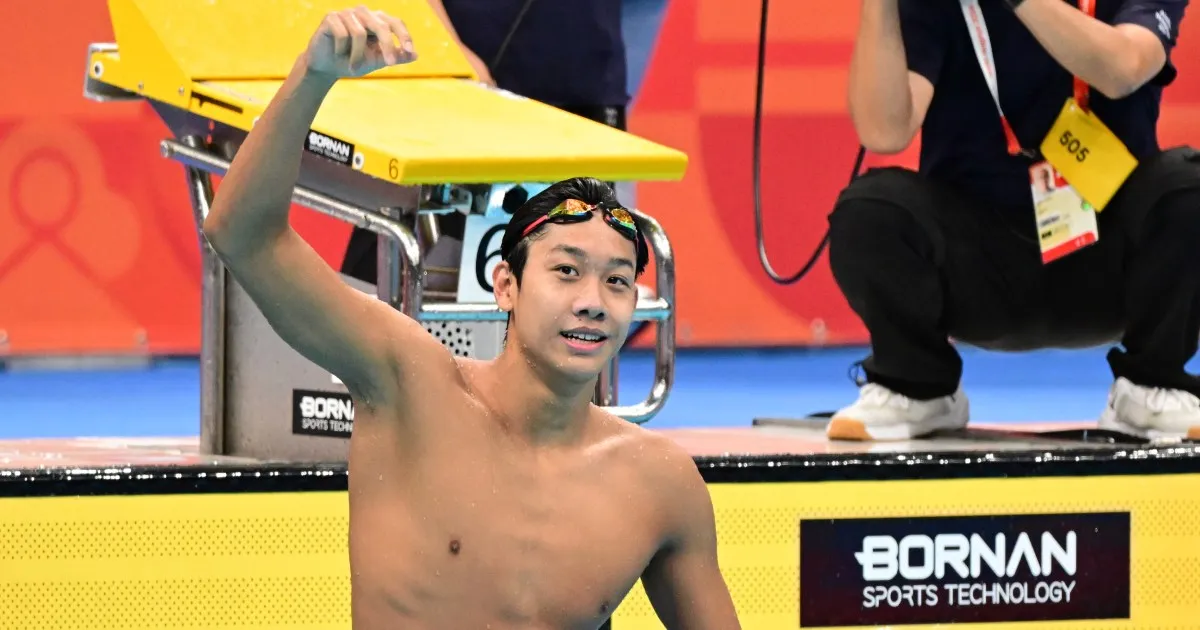
Towering teenager Zhang Zhanshuo became the first swimmer in history to win seven golds at a single Asian Games, while on the track, Thai sprinter Puripol Boonson powered to victory in the 100m.
China’s Zhang, 19, scorched to the men’s 400m freestyle title in the pool in Tokyo on Friday in a Games-record three minutes and 41.28 seconds.
He sat on the lane divider after the race and slowly counted off on his fingers all seven medals he had won.
Zhang also won individual golds in the 200m, 800m and 1,500m freestyle events, as well as three relays.
He said, after wrapping up a scintillating campaign, that it had been the “perfect week”.
“I think the most important thing is to stay grounded and focused, because the Asian Games are not my ultimate goal,” said Zhang, who stands 198cm (six feet, six inches).
With the Los Angeles Olympics less than two years away, China won 30 of the 42 golds in the pool this week.
Their 13-year-old phenomenon Yu Zidi was the undoubted superstar, taking home three individual golds and all in Games-record times.
Not to be outdone, Japan’s 17-year-old Shin Ohashi shattered the men’s 200m breaststroke world record on Thursday.
Swimming, equestrian and diving are taking place in Tokyo, but the city of Nagoya and the wider Aichi prefecture are the main Games host.
The men’s and women’s 100m sprints, the blue riband events in track and field, took place in front of rows of empty seats in Nagoya.
China’s Chen Yujie streaked to a comfortable victory in the women’s final in a Games-record 11.06 seconds.
The men’s was won by 20-year-old Puripol, who burst out of the pack in the final quarter of the race to win in 9.90 seconds, breaking his Games record from earlier in the evening.
It was Thailand’s first men’s 100m gold medal since Suchart Jairsuraparp on home soil at the 1978 Bangkok Games.
‘Today was a miracle for me’
On the last evening of gymnastics, Carlos Yulo won the men’s vault for his second gold of the Games.
The double Olympic champion won floor gold on Thursday to complete his collection of major titles.
“I can’t believe it,” the Filipino said.
“In this whole Asian Games, I felt really stressed, but at the same time, I enjoyed what I did today. I really did my part.
“Today was really a miracle for me.”
There’s little time to celebrate, however, with the world championships next month.
South Korea edged China 85-80 in the semifinals of the women’s basketball, and will face hosts Japan for gold.
China had their giant centre Zhang Ziyu, 19, but it was not enough.
Zhang Ziyu stands 223cm (seven feet, four inches) and scored 22 points.
“She was tough to guard,” said South Korea’s Kang Lee-seul.
“We couldn’t defend her, but we focused on fast breaks and shooting more three-pointers.”
North Korea’s women were again in record-setting form on the weightlifting dais.
Oh Kwang Ok set three world records on her way to women’s 57kg bodyweight class gold.
Oh lifted 104kg in the snatch and 134kg in the clean and jerk for a 238kg total – all world records to add to the two golds North Korea’s women won in the 49kg and 53kg classes this week.
North Korea has won four gold medals and two silvers in the six weightlifting events contested so far.
Kovalam and Mumbai, India – When Sugar Shanti Banarse and Kamali Moorthy entered their first surfing event in 2022, the girls could scarcely have imagined they would end up representing India at the Asian Games within a few years.
Though the competition at the Covelong Classic in Kovalam, about an hour’s drive from Chennai in Tamil Nadu, southern India, featured just seven women among about 50 competitors, the possibility of winning was an afterthought. Their intention was to simply get a taste of competition.
At 12, Moorthy was the youngest of the lot, thrilled to surf alongside some of the senior girls. She failed to catch a single wave, but the experience stayed with her. She vowed to train harder and return stronger.
Finishing second was a decisive moment for Banarse, then aged 16. A recreational surfer until then, she loved the competitive aspect of the sport. In that moment, she knew she wanted to be a professional.
The duo has come a long way since then. Alongside their male counterparts Kishore Kumar and Sivaraj Babu, they will take on the best continental talent at September’s Asian Games in Japan, where surfing makes its debut and runs from Friday until Tuesday.
“We’ve been putting in the work over the last couple of years and made good progress. It’s our time to shine now,” Banarse told Al Jazeera.
Sugar Shanti Banarse catches a wave [Photo courtesy of the Surfing Federation of India]
Even though India has thousands of miles of coastline and breaks of different kinds, it’s taken a while for surfing to catch on.
India’s team coach Samai Reboul comes from the first generation of Indian surfers, who had few resources at their disposal. He would watch holidaymakers surf near his home in Auroville, Tamil Nadu in the late 1990s and had a go when they lent him a board. He was soon hooked.
“I grew up at a time when there were no coaches, no access to training material and no surfboards. [It was] really frustrating,” he told Al Jazeera.
Surf schools started cropping up along the coast over the next few years. This is how Banarse, now 20, got her first opportunity back home in Mandrem in Goa, when she decided to accompany a friend. Moorthy, now 16, was luckier – her uncle is a surf instructor who gave her the first lesson off the coast of Mahabalipuram in Tamil Nadu.
Kumar, 18, and Babu, 22, hail from families who fish for a living in Kovalam and Mahabalipuram, respectively. They started out by jumping into the sea on hot summer days, then body surfing, before finally hopping onto a board.
“A local school in Mahabalipuram would let us use surfboards in exchange for chores. There were a few boards and many boys, so a lot of fights once the patience ran thin,” Babu told Al Jazeera.
Though their lives revolved around the sea, it was difficult to get their families to understand what they were chasing.
A beating awaited Kumar when his family discovered he was sneaking away to surf – they considered it a waste of his time.
Babu was expected to help his father with his fishing, as his elder brother had done.
Moorthy’s mother, who runs a beach shack, knew what the harsh sun could do to her daughter’s complexion and asked her to stay out of the water.
“She was worried I would get [too dark], but at the back of her mind, she knew I was enjoying surfing and that it would reach a point of no return. And here I am today,” Moorthy says, laughing.
More importantly, the sport lacked structure. Though the Surfing Federation of India (SFI) was launched in 2011, there were no regular competitions, and participants had to fend for themselves when it came to travel and accommodation. Babu doubled up as an instructor and banked on community support to make money to compete. He once had to camp in a forest during an event in Mangaluru.
“My family didn’t quite understand the scope of what I was doing. But I had some imagination of what I wanted to achieve and persisted against their wishes,” Babu says.
Sivaraj Babu in action [Photo courtesy of the Surfing Federation of India]
Turning point
Circumstances improved after Arun Vasu took over as the president of the SFI in 2020. As chairman and managing director of the prominent Indian conglomerate TT Group, he secured money from the company’s Corporate Social Responsibility funds to support a handful of athletes. The older surfers were encouraged to pursue their coaching and judging licences to improve the level of domestic competitions.
Meanwhile, Vasu worked towards getting the SFI recognised by the Ministry of Youth Affairs and Sports. That moment arrived in March 2025, and changed the trajectory of the sport. Besides the injection of funds through the government-run Sports Authority of India, it brought stability for the SFI. Its members could now focus all their energy on growing the sport.
“The first generation of Indian surfers worked really hard without much support. They’ve brought us to this point where we are enjoying the benefits,” Moorthy says.
The goal was to prepare the athletes for the Asian Games. Reboul started monitoring the team and refining their technique during camps. A sports psychologist worked on the mental aspect of competition, while other staff focused on improving physical conditioning.
“Besides quality equipment, what really changed was access to cameras and software for video analysis. Even outside of camp, they could send across videos through which I could offer feedback,” Reboul said.
Over the last few years, the SFI has hosted prestigious competitions such as the World Surf League series and the Asian Surfing Championships, which have allowed Indians to rub shoulders with top international surfers. Trips across Asia have given them a feel for different conditions as well as elite competitions.
“It’s very different from a few years ago when we had limited opportunities to train systematically,” Banarse says.
The Olympic dream
Their performances have shown promise. Ramesh Budihal took bronze at the Asian Surfing Championships in August 2025, and a few months later, Kumar won silver at the Asian ProAm Surf Series.
“At the Asian Championships last year, [Kumar] beat Ikko Watanabe of Japan, a country that is up there [with the best]. So we know it’s possible [to compete],” Reboul says.
The focus is also on developing the next generation of surfers. SFI has joined the Asian Surf Ecosystem’s Grom Patrol – youth surf training camps and competitions – and runs three age group contests (under-12s, under-14s and under-16s), with the winners qualifying for the final in Bali.
Besides the talent that usually comes from fishing communities along the coast, it has attracted young surfers from cities such as Chennai, Bengaluru and Mumbai. And more importantly, girls who are ready to test the waters.
“We’ve struggled to find women surfers, so it was really encouraging to see 15-odd girls in every competition,” Vasu says. “Parents see a future, and these kids are hungry to learn. It makes us realise we are doing something right.”
Indian surfers still face a number of challenges. The monsoon season means surfers need to constantly shuttle between the two coasts or travel abroad to train year-round, which requires resources. There is also a need to create a deeper pool of skilled coaches to work with young athletes.
“More of the older surfers are getting into training. This year, we brought down an experienced coach, Ivan Villalba, to conduct a programme for them,” Reboul said.
“Good training and a competitive surf culture is what is required to put India on the map, rather than get a particular athlete to win.”
In the world of Asian surfing, India is still a young nation compared to the likes of Indonesia and Japan. Competing at the Asian Games will be valuable exposure for the current crop, especially ahead of the Los Angeles Olympics in 2028.
“A lot has happened for Indian surfing in the recent past. Some of the guys I’ll be competing against are my idols and I know I can put up a good fight for the podium,” Kumar says.
“The dream is to represent India at the Olympics.”
The 13-year-old beat the previous 400m Asian Games record, set by China’s Ye Shiwen in 2014, by about 4.5 seconds.
Published On 23 Sep 202623 Sep 2026
China’s 13-year-old swimming sensation Yu Zidi has completed a hat-trick of Asian Games golds with a dominant victory in the 400m individual medley, two years before the Los Angeles Olympics.
The schoolgirl powered home in an Asian Games-record 4 minutes 28.56 seconds (04:28.56) on Wednesday to make it a clean sweep of her three individual events in Tokyo, following victories in the 200m butterfly and 200m individual medley, also in games-record times.
Recommended Stories
list of 4 itemsend of list
She beat the previous 400m games record set by China’s Ye Shiwen in 2014 by approximately 4.5 seconds.
It was the fourth-fastest time in the world this year, with world record-holder Summer McIntosh owning the top three.
With the next Olympics two years away, Yu is shaping up to be a major medal contender at the 2028 Los Angeles Games.
Last year, she became the youngest medallist at the World Aquatics Championships, where she won bronze for China’s relay team at the age of 12, and has since been earmarked for success in the swimming world.
At the same championship, Yu finished fourth by a small margin in three individual events.
In March, the teen sensation built on her growing reputation with a 200m butterfly victory over seven-time American Olympic medallist Regan Smith at the China Swimming Open.
At the Asian Games, Yu has dominated the pool and showed another glimpse of her immense talent in the 400m individual medley, where she took the lead from the start and finished 3.95 seconds clear of silver medallist Ke Wenxi of China, with Japan’s Mio Narita finishing third.
In addition to grabbing international headlines, Yu has become a sensation at home following her Asian Games exploits.
The story of her introduction to competitive swimming after being spotted by a coach at a water park, and her struggle with interviews, has gone viral on local social media platforms.
At the games, Yu was asked by the media whether answering questions was the hardest part of competing. She replied, with a giggle: “Every time I just want to float off somewhere else.”
Ri Song-gum wins North Korea’s first gold at the games while Chanu finally clinches elusive Asian Games medal in Japan.
Published On 23 Sep 202623 Sep 2026
North Korean weightlifter Ri Song Gum has broken three world records en route to winning gold in the women’s 49kg (108lbs) competition, which saw India’s Mirabai Chanu win an elusive Asian Games medal by finishing second.
Ri gave North Korea its first gold of the games in Nagoya, Japan, on Wednesday, joining an elite club of four weightlifters who have won three Asian Games gold medals.
Recommended Stories
list of 4 itemsend of list
The 28-year-old hauled 94kg above her head in the opening snatch discipline – the first official segment of the competition where athletes lift a barbell from the floor to an overhead position in a single motion. The lift was 1kg heavier than the previous world record of 93kg.
Ri followed it up by breaking the world record twice in the 115kg clean and jerk – a two-part movement where a barbell is lifted from the floor to the shoulders and then pushed overhead. The 4ft-7in (139.7cm) weightlifter hoisted 116kg and 121kg above her head.
Ri’s total lift of 215kg obliterated the old world record total by 7kg.
She is the fourth lifter, and first woman, to win three Asian Games weightlifting golds and joined Iran’s Mohammad Nassiri (1966-74), South Korea’s Kim Tae-hyun (1990-98) and Iran’s Behdad Salimi (2010-18), who all won three gold medals. No athlete has won four weightlifting gold medals.
Ri joined an elite club of just four weightlifters who have won three Asian Games gold medals [Dita Alangkara/AP]
In the same category, India’s Chanu finally won an Asian Games medal at the third time of asking. She won a silver medal at the Tokyo Olympics in 2021.
The 32-year-old is India’s most decorated weightlifter, with three Commonwealth gold medals and a silver to her name, along with multiple global titles.
She lifted a total of 198kg after a snatch of 87kg and a clean and jerk of 111kg, while Indonesia’s Diana Tri Wijayana took bronze with a total of 191kg, comprising 88kg and 103kg.
Chanu’s silver also ended India’s 28-year wait for a weightlifting medal at the games since Karnam Malleswari won silver in 1998.
Mirabai Chanu during the women’s 49kg weightlifting final [Dita Alangkara/AP]
Sri Lanka were bowled out for 69 runs, 10 less than Mandhana’s belligerent match-winning innings as India retained gold.
Published On 22 Sep 202622 Sep 2026
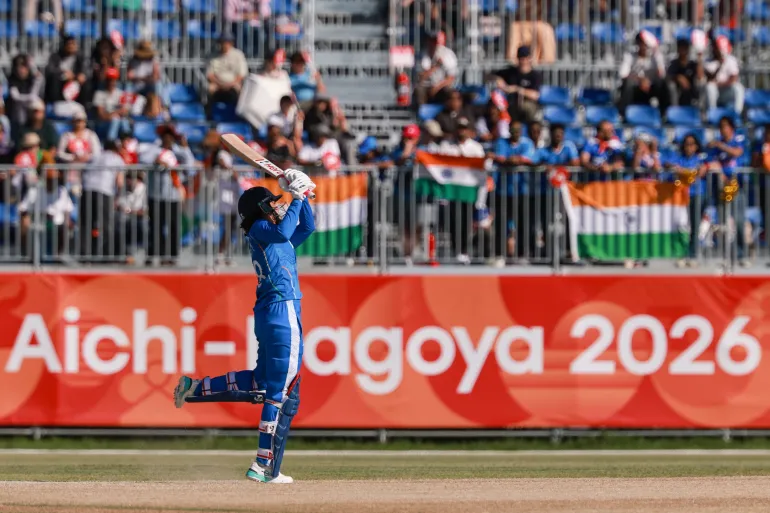
Smriti Mandhana’s whirlwind innings of 79 runs helped India crush Sri Lanka by 147 runs and win a second consecutive women’s cricket gold at the Asian Games.
India smashed 216-3 off their 20 overs, the highest women’s total in Asian Games history, with 18 fours and 13 sixes in the final on Tuesday.
Richa Ghosh and Bharti Fulmali plundered 25 off the final over from the hapless Mithali Ayodhya, who did not help her cause by conceding eight wides.
Sri Lanka were never in the hunt, and captain Chamari Athapaththu’s 29 was their only innings of note as they were skittled for 69 in 15.4 overs and had to settle for silver.
Opening batter Mandhana hit seven sixes and five fours in a 45-ball knock that sent the ball to all parts of the Korogi Athletic Park ground in Nagoya.
Smriti Mandhana hits a six [David Gray/AFP]
After India captain Harmanpreet Kaur won the toss and opted to bat, Shafali Verma, who made an unbeaten century in the semifinal, and Mandhana put on a blistering opening partnership.
The pair had raced to 99 in the 10th over when Verma had a rush of blood, playing a needless reverse sweep which she top-edged to Kawya Kavindi at point to fall for 48 off 29 balls.
Mandhana, the greatest run-scorer in women’s T20 cricket history, had reached her fifty earlier in the over and sailed on in style, clubbing anything loose to the boundary.
Harmanpreet joined her, and the pair took the score to 141 before the captain holed out to long-off for 19.
Mandhana, looking to accelerate further in the latter overs, skied an attempted six and was out in the 17th over with the score on 163.
Ghosh clattered 49 off 22 balls with three sixes and six fours to take India past 200 in the final over.
Mandhana scored 79 off 45 balls [Mark Baker/AP]
Earlier, some late-order hitting by Pakistan captain Fatima Sana set up a 31-run win over Bangladesh in the bronze medal match.
Sana came in with her side rocking at 67-5 in the 12th over but plundered 45 off 30 balls, including three fours and three sixes, and was out off the last ball of the 20 overs after seeing Pakistan to 145-8.
Her 67-run partnership with Aliya Riaz (25) for the sixth wicket proved the turning point, and Bangladesh could only muster 114-7 in reply.
Indian players celebrate after winning [Mark Baker/AP]







![TOKONAME, JAPAN - SEPTEMBER 26: Gold medalist Yuki Kurihara of Japan poses on the podium at the medal ceremony for the Esports Puzzle [Puyo Puyo Champions] on day seven of the 20th Asian Games Aichi-Nagoya at Aichi Sky Expo on September 26, 2026 in Tokoname, Aichi, Japan. Kurihara becomes the youngest gold medalist at the Asian Games at the age of 11. (Photo by Toru Hanai/Getty Images)](https://i0.wp.com/www.aljazeera.com/wp-content/uploads/2026/10/getty_6ac2424a21-1791115850.jpg?w=640&ssl=1)











![Sugar Shanti Banarse catches a wave [Photo courtesy of the Surfing Federation of India]](https://i0.wp.com/occasionaldigest.com/wp-content/uploads/2026/09/Sugar-Shanti-1790080522.jpg?w=640&ssl=1)
![Sivaraj Babu in action [Photo courtesy of the Surfing Federation of India]](https://i0.wp.com/occasionaldigest.com/wp-content/uploads/2026/09/Sivaraj-1790081318.jpg?w=640&ssl=1)