Jessica “Decca” Mitford was one of the 20th century’s indomitable mavericks. Born and bred into British aristocracy, Mitford rejected her bloodline and spirited herself to America in 1939 to pursue a life dedicated to social justice. By that time, her antisemitic parents had declared their public support for Hitler, as had two of her five sisters, while Mitford gravitated toward the Communist party. Working as a dedicated New Dealer and party advocate in Oakland, Mitford fought tirelessly for civil rights and against institutional corruption. Approaching middle age, she swerved into writing; her best-selling book “The American Way of Death” was a savage takedown of the funeral industry.
Carla Kaplan explores all of this and much more in a gripping new biography, “Troublemaker: The Fierce, Unruly Life of Jessica Mitford,” which places Mitford’s achievements within the context of America’s roiling political climate in the mid-20th century.
I chatted with Kaplan, who is the Davis Distinguished Professor of American Literature at Northeastern University, about Mitford and her legacy.
✍️ Author Chat
Mitford essentially runs away from her very wealthy family as a teenager.
Leaving that family at 19 was a very difficult and brave thing to do because she’s grown up so isolated from others. The family was such a self-enclosed world — tribal, the neighbors called them — so she didn’t have much exposure to anything beyond her family when she left them. At the same time, she left with Esmond Romilly, who almost immediately became her lover and husband. He was dazzling and brave and charming and took charge, so he mitigated some of that difficulty.
Mitford was seemingly unbreakable. Despite losing Esmond during the war, she trudges on with her work.
Her husband Esmond was killed in World War II. By then, she had an infant daughter, she was under 25 years old and truly alone with no education or resources or family connections — there weren’t Mitfords in America. Her family had disowned her. … She had to make her own way. She succeeded at making a new life. She remarried a wonderful man and learned to be a really effective worker, but it was all very tough and it could have worked out very differently for her.
She threw herself into political causes, first working in the Office Of Price Administration, which fought against profiteers during the war, and later in the Civil Rights Congress, working on housing and labor reform in Oakland.
The Civil Rights Congress was truly Decca’s training ground. She called herself a “foot soldier” in the CRC and she certainly worked hard. But she also learned to be a really effective political investigator and organizer. And she did a lot of organizing work in Black Oakland on housing, labor and difficult police brutality issues.

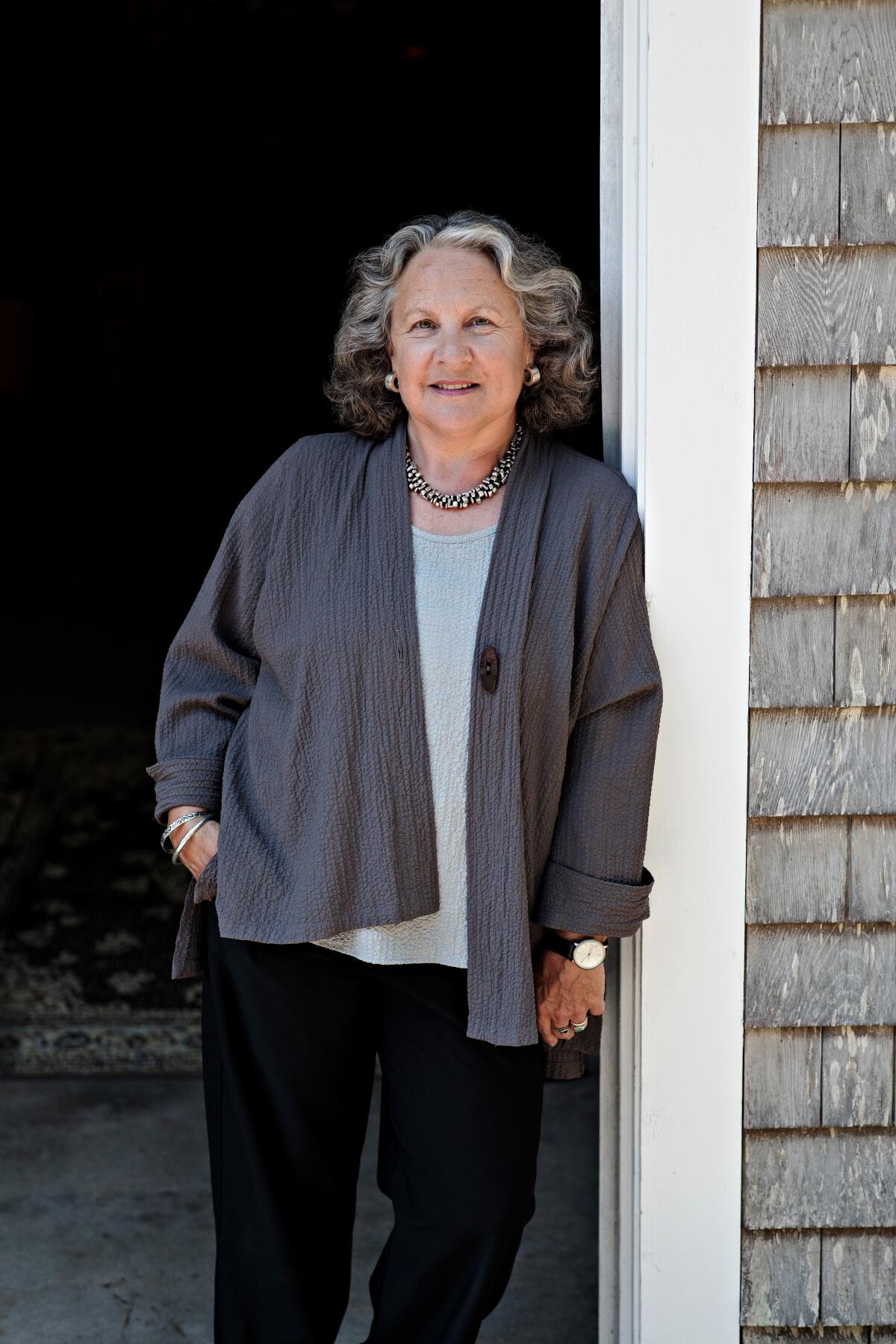
Carla Kaplan is author of “Troublemaker,” a new biography about the British aristocrat-turned-American Communist Jessica Mitford.
(Robin Hultgren)
What’s interesting is that she renounces her family, yet never tries to conceal her roots.
She found that she could be a very effective organizer — an effective ally, as my students would say — by playing into her differences from those she was advocating for. She didn’t pretend to be someone she wasn’t. Her British upper-crust accent only got stronger every year. She knew how to use being different and kind of fascinating to her own advantage.
In 1963, Mitford’s book “The American Way of Death” was published and it rips open the predatory and extortionate practices of the funeral services industry. But according to your book, Mitford’s husband co-wrote the book without credit, as her editor Bob Gottlieb thought it would hurt sales.
Decca’s second husband, Bob Treuhaft, was smart, very funny, shared her politics, had a great sense of fairness and also a sense of play. Most importantly, he wanted Decca to shine. He never needed to diminish Decca to feel good about himself. On the contrary, he was delighted when she was at the microphone, got a byline, was celebrated. He wrote half of “The American Way of Death,” but was happy for the book to come out only with her name on it. And I think part of the real appeal of that book, its electrical charge in a sense, is the energy of their 50/50 collaboration that went into it. None of her other books were co-written in the same way and I think they don’t have quite that electric energy that went into the book they wrote together.
She was very close with Maya Angelou.
Her true running buddy as a writer. They pushed each other to think of themselves professionally, to demand respect, to never accept second best. Angelou encouraged Decca to demand good contracts and advances, and to expect to be treated with respect. And Angelou, like Decca, was very funny and playful, and also an incredibly hard worker. They loved describing one another as sisters — they could hardly have looked more different — and refused to qualify or explain that. And Maya did that as a fellow writer.
How would you sum up Mitford’s legacy?
Decca completely transformed herself, and she built her own life and found deep fulfillment as an activist and progressive writer. Decca fought fascism and authoritarianism all her life and saw how things like the Red Scare devastated progressives she knew and loved, some of whom killed themselves. But she never let the bastards steal her joy either. She insisted on a joyful life of dinner parties and vacations. She made that part of the fight and she kept up the fight by keeping up her spirits — and the spirits of those around her.
(This Q&A was edited for length and clarity.)
📰 The Week(s) in Books

(Los Angeles Times photo illustration; Photo by Aaron Schwartz / Bloomberg via Getty Images)
To commemorate what would have been Joan Didion’s 91st birthday this week, six writers weigh in on her legacy. Lili Anolik’s favorite piece of Joan Didion writing is “Some Dreamers of the Golden Dream.” “It’s trashy noir yet elevated and totally dead-eyed — as if Flannery O’Connor took a crack at writing a James M. Cain story.”
Olivia Nuzzi, the disgraced journalist, has written a memoir, “American Canto,” and Leigh Haber says it’s OK to hate-read it. Nuzzi’s “version of the events that laid her low remain stubbornly unprocessed — as blurry and borderless as the book itself,” she writes.
Actor Tim Blake Nelson has written a Hollywood satire called “Superhero” and Carolyn Kellogg chatted with him about it. “It was certainly my intention, to use a world I know really, really well, to examine bigger issues in American culture,” says Nelson.
And what are the best books to read in December? Bethanne Patrick gives us the scoop.
📖 Bookstore Faves

Jeff Mantor, pictured here in 2011, was an employee at Larry Edmunds Bookshop for 16 years before purchasing the shop in 2007.
(Mariah Tauger / Los Angeles Times)
Now approaching its 88th birthday, Larry Edmunds Bookshop on Hollywood Boulevard is L.A.’s oldest independent bookstore, and the only store devoted to books about the performing arts. I chatted with store manager Jeff Mantor about what titles are rolling out the door right now.
Larry Edmunds is an L.A. institution that has somehow kept its doors open. Who is your primary audience now?
Our audience is across the spectrum, but we get a large percentage of students and young cinephiles that are really starting to learn about cinema. Our other main audience is classic Hollywood-based, people who probably would consider Turner Classic Movies their channel of choice.

A sea of books cover the walls inside Larry Edmunds Bookshop in 2011.
(Mariah Tauger / Los Angeles Times)
What’s selling right now?
“Reflections: On Cinematography” by Roger Deakins, “Pre-Code Essentials” by Danny Reid and Kim Luperi, “Joan Crawford: A Woman’s Face” by Scott Eyman and “The Uncool” by Cameron Crowe.
The entertainment business has changed so profoundly. Is there still an appetite for books about movies?
Absolutely! Stories about the making of classic films and the people who made them, books about technique and filmmaking, photography books and a never-ending public fascination with Kubrick, Lynch, Burton, Tarantino and others. Also, I can frequently be found at the Egyptian Theatre, the Aero Theatre, Old Town Music Hall, the Hollywood Heritage Museum and many other venues where we are putting classic screenings and conversations together with books about the films or with the people who made the movies.
Larry Edmunds Bookshop is located in Hollywood at 6644 Hollywood Blvd.
(Please note: The Times may earn a commission through links to Bookshop.org, whose fees support independent bookstores.)