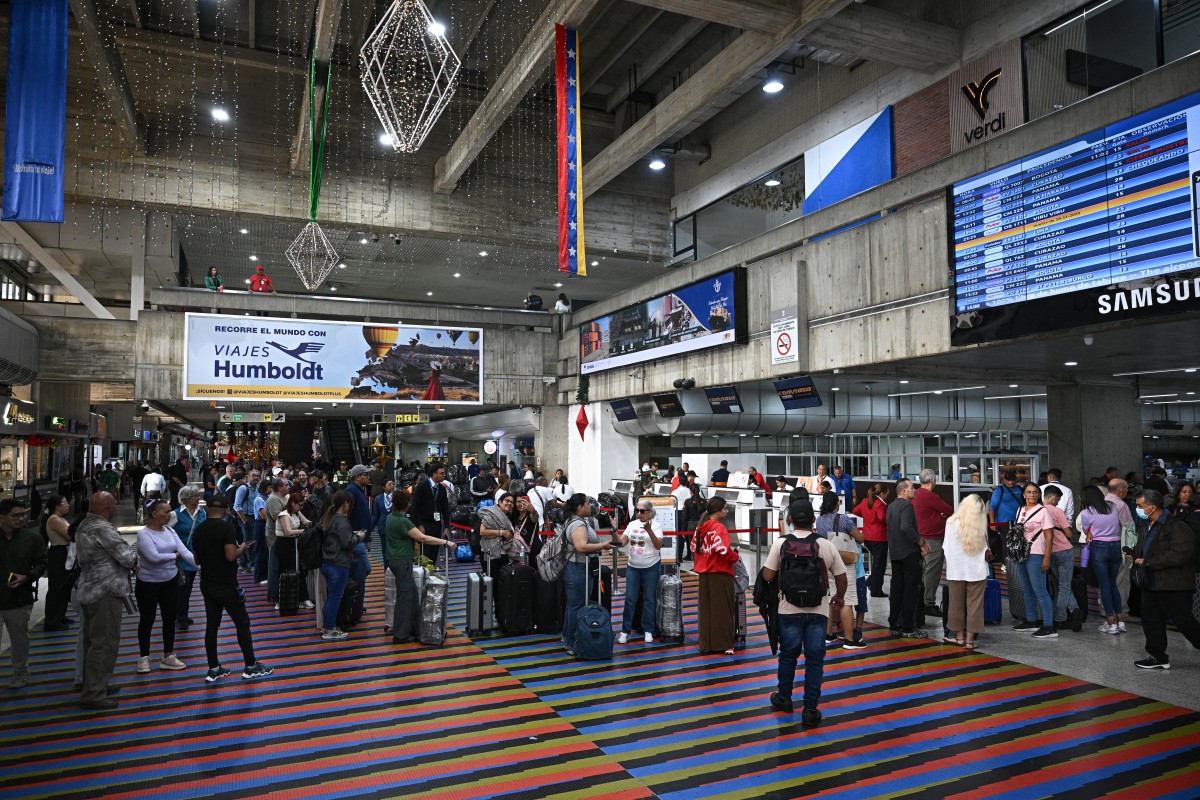
Passengers at Simon Bolivar International Airport in Maiquetia, La Guaira State, Venezuela. (AFP)
Caracas, January 30, 2026 (venezuelanalysis.com) – Venezuelan Acting President, Delcy Rodríguez, welcomed the “lifting of restrictions on the country’s commercial airspace”, which had been in place since last November, following talks with the US government.
Speaking at a rally on Thursday, Rodríguez said she received a phone call from US President Donald Trump and Secretary of State Marco Rubio to address the issue as part of a “working agenda” between the two countries that includes the resumption of diplomatic relations.
“Let all the airlines that need to come, come. Let all the investors that need to come, come”, Rodríguez said. She assumed office following the kidnapping of President Nicolás Maduro and his wife, Cilia Flores, amid the January 3 US attacks.
Earlier in the day, Trump ordered the reopening of “all Venezuelan airspace” to commercial flights, stating that US citizens would be able to travel safely and that Venezuelans wishing to return—either permanently or temporarily—would also be able to do so.
Trump ordered Secretary of Transportation Sean Duffy and other officials, including military commanders, to ensure the reopening was “immediate.”
Trump went on to describe the exchange with his Venezuelan counterpart as “highly positive,” emphasizing that “relations have been very solid and very good.” He further sought to reassure international travelers by stressing that they would be safe while in Venezuelan territory.
Following the announcements, the US Federal Aviation Administration confirmed that it had removed four Notices to Airmen (NOTAM) in the Caribbean region, including one related to Venezuela. “They were issued as a precautionary measure and are no longer necessary”, the agency argued.
Likewise on Thursday, American Airlines announced its intention to resume daily direct flights between the United States and Venezuela, becoming the first US airline to take such a step.
The company, which began operations in Venezuela in 1987, stated that the resumption of the route would be subject to approval by both US and Venezuelan authorities, as well as the corresponding security assessments.
American Airlines Chief Commercial Officer Nat Pieper said the company was eager to offer its customers the opportunity to reunite with family members and to generate new business and trade opportunities with the United States.
Direct flights between the two countries were suspended in 2019, the same year diplomatic relations between Washington and Caracas were severed after the US recognized Juan Guaidó as Venezuela’s interim president.
Last November, Trump declared that Venezuela’s airspace should be considered “completely closed.” A flurry of NOTAM warnings led international airlines to suspend their connections to the Caribbean country. Caracas withdrew licenses from several companies, including TAP, Iberia and Turkish Airlines.
On January 13, Panama’s Copa Airlines announced the resumption of flights to and from Caracas.
Embassy reopening in the works
Secretary of State Marco Rubio said on Wednesday during a Senate hearing that he expects the United States to reestablish a diplomatic presence in Venezuela in the near future. “We have a team there evaluating it, and I think we’ll be able to open a diplomatic presence soon,” he said.
Rubio argued that such a presence would allow Washington to “have real-time information and interact not only with government officials but also with members of civil society and the opposition.”
Laura Dogu has so far been appointed to lead the diplomatic mission from the Venezuela Affairs Unit in Bogotá, Colombia. According to CNN, the CIA is looking to establish a “foothold” in the South American country that may preced the formal arrival of US diplomats.
For her part, Rodríguez has defended her administration’s diplomatic engagement with the United States, while also urging Venezuelan political sectors to resolve their differences and internal conflicts without “orders from Washington.”
Edited by Ricardo Vaz in Caracas.