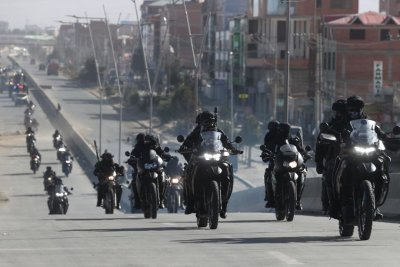

Members of the Bolivian police and Army work to clear roadblocks in El Alto on Saturday after the declaration of a state of emergency. Photo by Luis Gandarillas/EPA
June 22 (UPI) — Bolivia began the week with 11 active roadblocks remaining across the national highway network — a sharp decline from the dozens that had disrupted transportation and commerce for more than 50 days, according to a road accessibility report from the Bolivian Highway Administration.
Local media outlets, including El Deber and La Razón, reported that reopening the country’s main transportation routes occurred shortly after President Rodrigo Paz declared a state of emergency Saturday in response to internal unrest.
Vehicle traffic and essential goods distribution have gradually returned to normal after a joint deployment of the Bolivian National Police and the Armed Forces, officials said. The operation dismantled much of the network of more than 50 critical roadblocks that had pushed the country toward a logistical and economic crisis.
The presidential decree, which the Legislative Assembly backed, temporarily authorized the Armed Forces to support police efforts to maintain order and guarantee freedom of movement.
In key areas such as El Alto and access roads to La Paz, security forces used excavators and other heavy equipment to clear tons of debris, dirt and rocks left on highways.
Negotiations also aided the reduction in roadblocks. Alongside the emergency measures, the government finalized a pacification agreement with the Bolivian Workers’ Center, the country’s largest labor federation.
Authorities also reported the peaceful removal of a 38-day blockade in the strategic municipality of San Julián in the eastern Santa Cruz department. Despite the large-scale demobilization, protests continue in several strongholds.
The remaining roadblocks are concentrated primarily in the Tropic of Cochabamba region and parts of Oruro and La Paz, Diario Libre reported.
Those areas are led by coca growers’ unions and Indigenous and peasant groups aligned with former President Evo Morales. The groups oppose the emergency decree, describing it as repressive, and continue to press political demands against the government.
Authorities reported isolated incidents during security operations, including chemical agents used in high-tension areas such as the Río Seco district of El Alto and roadways leading to Laja.
In those locations, protesters attempted to rebuild barricades and engaged in verbal confrontations with joint police and military patrols.
After the military deployment, Bolivia’s Ombudsman’s Office launched a nationwide monitoring plan. In a report released Sunday, the institution said most roads were reopened without the use of violent force.
With the country’s main transportation corridor restored, hundreds of fuel tankers and cargo trucks carrying food and medical supplies began to enter major cities as part of an emergency logistics effort to mitigate the economic damage caused by the prolonged conflict.