A new species of living cat has been identified for the first time in more than a century. Found in Bolivia’s Yungas forest, it is smaller than a regular house cat, weighing just around 3 pounds and measuring 18 inches long. Known locally as Tilcayo, it belongs to the group of tiger cats.
Leopardus tilcayo is the first new living cat species named and described in more than a century.
Published On 18 Sep 202618 Sep 2026
A tiny wild cat that lives in Bolivia’s lush cloud forests has been identified as a previously unknown species, marking the first time in more than a century that a new living feline species has been formally named and described.
Called “tilcayo” by local communities, the cat is part of a group called tiger cats, which are found across much of South America.
Recommended Stories
list of 2 itemsend of list
It was discovered in the Yungas forest, a mountainous region where forests are often covered by clouds and surrounded by high humidity, according to the researchers.
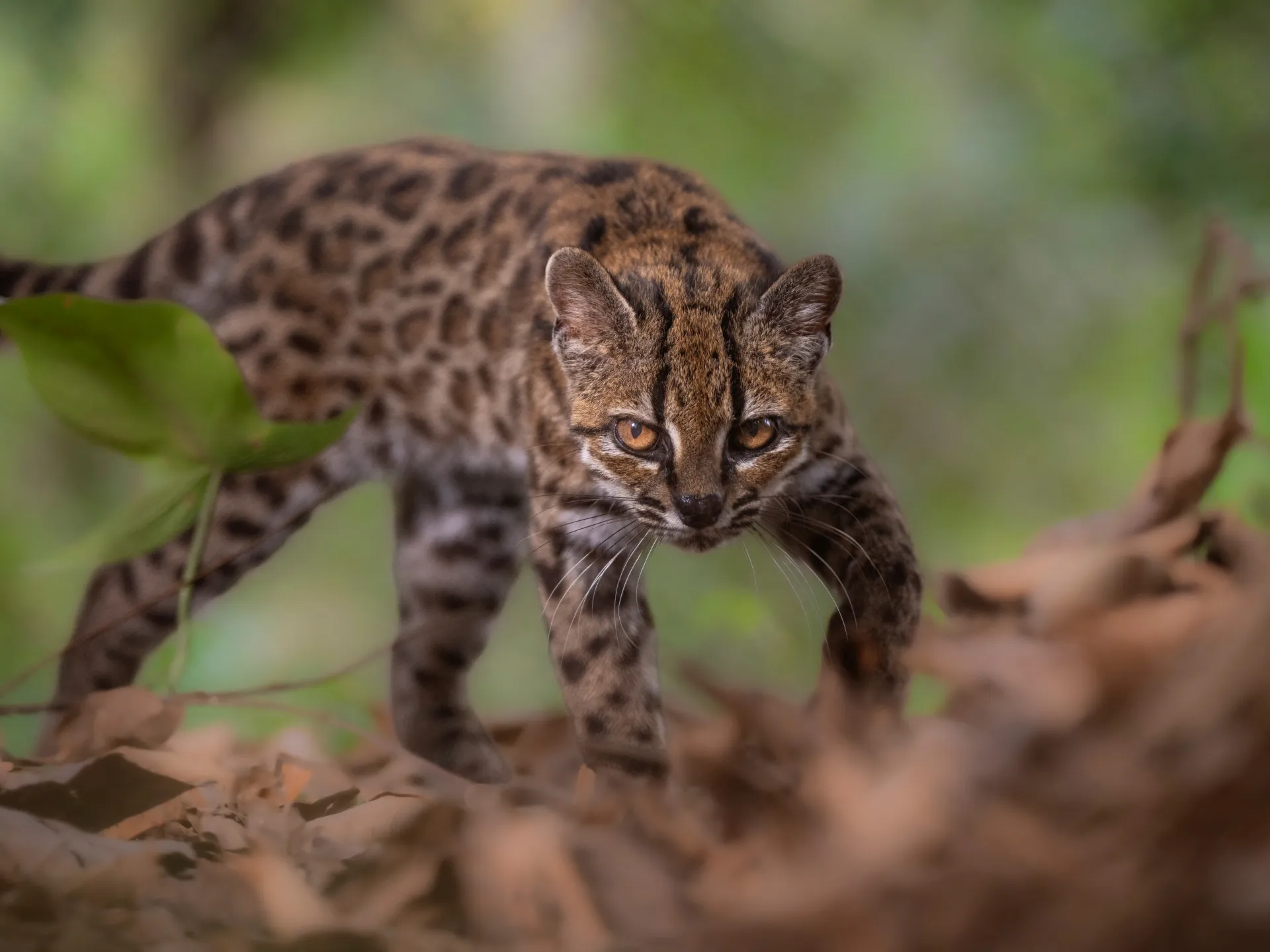
Given the scientific name Leopardus tilcayo, the cat measures 46cm (18 inches) long and weighs about 1.4kg (3 pounds), making it smaller than an average domestic cat.
“Its fur is light brown … with irregularly shaped rosettes across its body,” according to Paola Nogales-Ascarrunz, a National Geographic Explorer and one of the authors of the study describing the newly identified species published on Thursday in the journal Current Biology.
Little is known about the cat’s biology and lifestyle. Remains of small rodents in scat samples suggest they may form part of its diet, while camera-trap evidence indicates it could be more active at night, Nogales-Ascarrunz said.
Tiger cats are so-called cryptic species, meaning they cannot easily be distinguished merely by appearance, evolutionary biologist and study co-lead author Jonas Lescroart of the University of Antwerp in Belgium said.
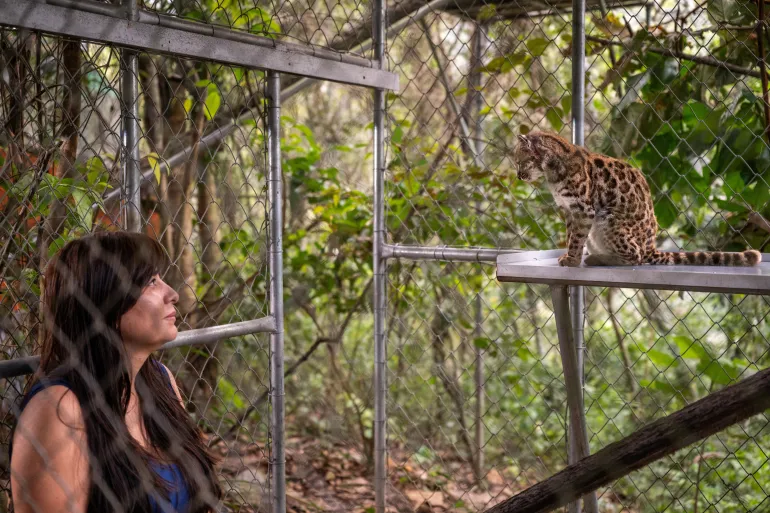
National Geographic Explorer Paola Nogales Ascarrunz, who led the research that identified Leopardus tilcayo as a new species, observes the cat at the Senda Verde animal refuge in the Yungas region, in Bolivia, September 1, 2026 [Handout/Fernando Faciole/Reuters]
Observing the Bolivian cat drew interest because “its characteristics did not match the descriptions, most of them based on Brazilian cats”, Nogales-Ascarrunz said. “This made us wonder, what tiger cat do we actually have in Bolivia?”
The team analysed DNA from 38 cats sampled across several South American countries, including eight museum specimens. The study found that tiger cats are in fact five genetically distinct species.
“We never expected this Bolivian tiger cat to be a separate species, and no one had ever proposed it as a different animal, subspecies or otherwise,” Jonas Lescroart said.
Genetic analysis suggested that the tilcayo lineage separated from other tiger cats about 1.4 million years ago.
The research team also described a new tiger cat subspecies in Peru’s Yungas, naming it Leopardus tigrinus antisuyo, after Antisuyu, the region of the old Inca Empire that included the area it inhabits.
Cochabamba is a city in central Bolivia located in a valley in the Andes mountain range. It is the fourth largest city in the country and capital of the Cochabamba Department.
The city was part of the Incan empire when the Spanish arrived in the 16th century.
A new Spanish settlement, called Villa de Oropesa, was founded in August 1571 by order of Viceroy Francisco de Toledo, Count of Oropesa. The viceroy died in 1573 and for reasons that remain unclear to this day, a second foundation took place on September 14th 1574 by the conquistador Sebastián Barba de Padilla.
In 1786, Villa de Oropesa was elevated to city status in 1786 and adopted its name from Incan times, Cochabamba, meaning “a plain full of small lakes.”
This second foundation is celebrated as the day of the city and department. It also gives the name to the square in the city where the events of 1574 took place – La Plaza 14 de Septiembre.
The official foundation of the Cochabamba Department took place on January 23rd 1826.
MEXICO CITY — He’s been called the “MAGA man” of Latin America, a brash political provocateur whose social media assaults boosted right-wing campaigns from his native Argentina to Central America.
His career as political consultant and co-founder of an ultra-right online outlet made him a rich man and helped elect Trump-aligned politicians across the region. The Economist gave him the “MAGA Man” label, while political commentators gave him another nickname — the “Steve Bannon of Latin America” — a nod to the longtime Trump ally and advisor.
Now, however, Fernando Cerimedo, 45, sits in a maximum-security prison in Bolivia, accused of masterminding a murder-for-hire plot: The attempted femicide of his pregnant mistress, Nadia Beller, 33, a Bolivian lawyer and activist.
It’s a stunning collapse for a onetime ad man with a dodgy reputation who rose to become the go-to digital campaign guru for Latin America’s ascendant right wing. Cerimedo’s signature boasts, exaggerations and peddling of false election-fraud narratives reflected those of his political model, President Trump.
Cerimedo also is another example of how right-wing political operatives outside the United States — as recently in Colombia and Germany — have adopted Trumpian tactics and messaging.
The fall of the “King Midas of the Latin American right,” said Daniel Matamala, a prominent Chilean journalist, stunned “the ecosystem of fake news, bots, trolls and disinformation that has taken this region by storm in recent years.” Speaking on his podcast, Matamala added, “The name of Cerimedo looms like a ghost over the summit of the radical right.”
The Aug. 17 attack on Beller was a seemingly well-planned ambush that was captured by security cameras, the grainy images widely disseminated on social media.
One of two would-be assassins dressed as fast-food deliverymen pulled out a pistol and shot Beller point blank outside a hotel in the eastern Bolivian city of Santa Cruz. She fell to the ground and, according to her account, feigned death. The next day, at dawn, Cerimedo was arrested as he was about to board a plane to Buenos Aires.
Cerimedo set up the hit, prosecutors charge, in a nefarious attempt at damage control. Beller had threatened to expose his alleged criminal behavior and physically abusive behavior toward her while revealing Cerimedo, a married man with two children, as the father of her unborn child.
Cerimedo is also under investigation for alleged illegal enrichment and potential links to cocaine trafficking.
He has denied any wrongdoing.
Even before Cerimedo’s arrest, Latin American journalists had begun unmasking Cerimedo as a prodigious purveyor of fake news — about himself. New reports revealed that his frequent boasts about U.S. connections — that he attended Harvard, trained with U.S. Navy SEALs, worked in the Obama White House — were fanciful.
“He certainly exaggerated things,” said Damian Merlo, a Miami-based consultant who worked with Cerimedo on the 2023 campaign of Argentine President Javier Milei, a Trump favorite. “I never really got the impression that Cerimedo was ‘MAGA’s man in Latin America.’ The guy could hardly speak English! But that’s how he sold himself.”
Many times, the sales pitch worked. It was Cerimedo who helped broker then-candidate Milei’s celebrated 2023 interview with Tucker Carlson, at the time a Trump confidant, an appearance that thrust Milei into the international spotlight.
Like Milei, Cerimedo seemed to relish any proximity to Trump-land.
In February, at the inaugural “Hispanic Prosperity Gala” — a right-wing pep rally held at Trump’s Mar-a-Lago estate — Cerimedo was honored as “Hispanic Political Consultant of the Year.’” From the podium, he spoke of Latin America’s “culture war” and the need to ensure that “the left never again returns” to governments that have elected conservative leaders.
Switching to heavily accented English, Cerimedo gave a shout-out to Brad Parscale, Trump’s former campaign manager, whom Cerimedo thanked for “believing [in] me all the time and giving me your technology.”
Parscale declined to comment.
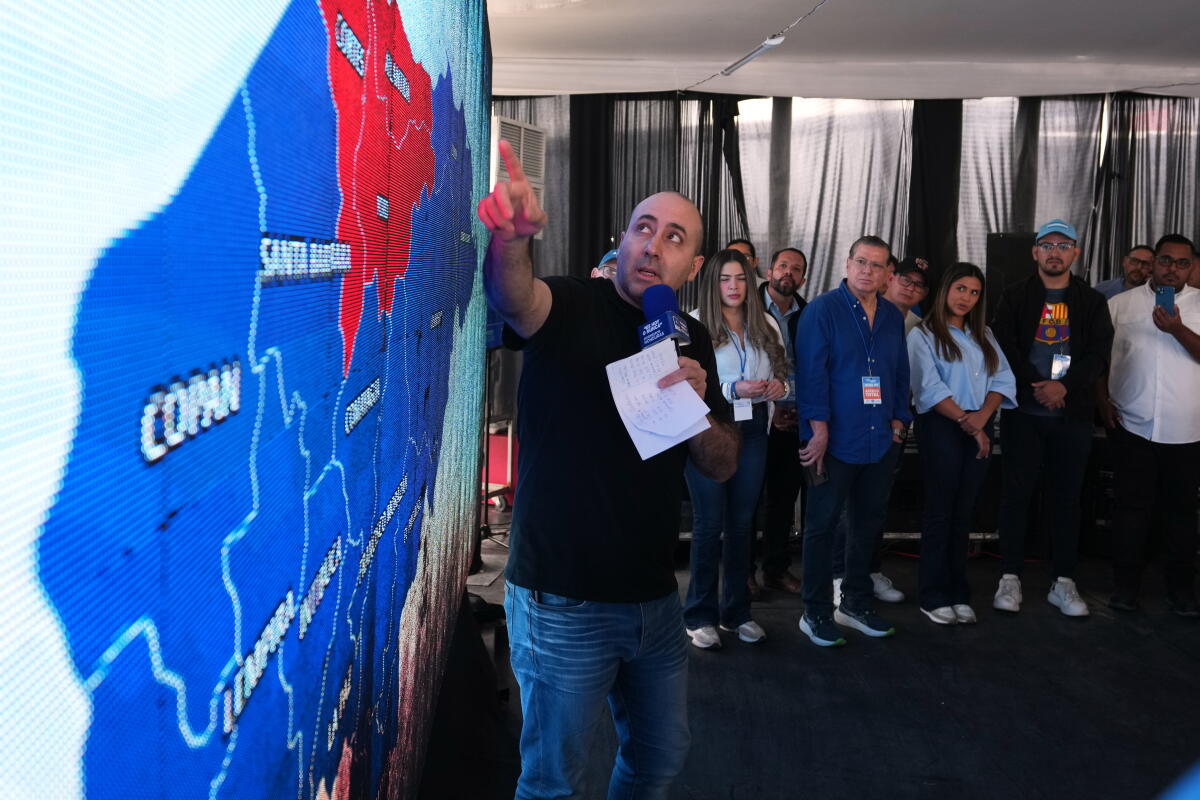
Fernando Cerimedo, an advisor to the National Party, points at a map of Honduras on Dec. 1, 2025, one day after voters went to the polls to elect Nasry Asfura president.
(Moises Castillo / Associated Press)
Both Cerimedo and Parscale were involved in last year’s campaign that resulted in the election of Honduran President Nasry Asfura, whom Trump backed publicly.
Last year, Cerimedo was a key player in the election of Bolivian President Rodrigo Paz, the center-right, U.S.-educated son of a former president who transitioned from Marxist firebrand to moderate. The ascension of Paz broke almost two decades of leftist rule by the Movement for Socialism party of ex-President Evo Morales.
Cerimedo had no official capacity in Paz’s government, but he enjoyed insider status. He accompanied Paz in March to Trump’s anti-narco “Shield of the Americas” summit, a confab of mostly conservative leaders at Trump’s Doral resort in south Florida.
Among the items found in searches of Cerimedo-linked properties, authorities say, was a business card listing him as Paz’s “chief adviser” — a nonexistent post.
“Mr. Cerimedo never had the authorization to represent … the presidency, the government or my family,” a deeply discomfited Paz said in Facebook message last month.
How exactly Cerimedo got into politics — and how he became a right-wing rabble-rouser — remains somewhat opaque. According to media accounts, he worked a series of uninspiring jobs — including stints as a taxi driver, a schoolteacher and an employee of insurance and computer firms — before veering into advertising. In 2019, he assisted the campaigns of several leftist Peronist candidates in provincial races in Argentina, and later founded his own consultancy, Numen.
Cerimedo first gained prominence in neighboring Brazil. That’s where he championed false election-fraud narratives following the narrow reelection defeat in 2022 of President Jair Bolsonaro — a MAGA stalwart — in his reelection bid against Luiz Inácio Lula da Silva, a leftist. Cerimedo’s “Brazil Was Stolen” livestream exacerbated the sense of outrage among Bolsonaro loyalists, who took to the streets in mass protests.
The Brazil exposure helped catapult Cerimedo into successful presidential campaigns in Argentina (Milei), Honduras (Asfura) and Bolivia (Paz). His arrest prompted Chilean lawmakers to create a commission to investigate Cerimedo’s possible role in that nation’s recent electoral shift to the right.
With Cerimedo’s name now toxic, Paz, Milei and other former allies have distanced themselves.
Also ditching Cerimedo was his close partner, Javier Negre, a right-wing Spanish media entrepreneur who, in 2024, purchased 50% ownership of Cerimedo’s La Derecha Diario (The Daily Right), an online, Spanish-language MAGA megaphone. The site strongly backed Colombian President Abelardo de la Espriella — who had Trump’s support — during his tight campaign this summer.
Following Cerimedo’s arrest, Negre announced that he had bought out his former partner in La Derecha Diario.
In Bolivia, the Cerimedo scandal has taken on the character of a Latin American telenovela.
A recovering Beller, shot three times in her upper body, granted interviews from her hospital bed, dishing on her lover’s alleged brutality and criminality.
According to Beller’s testimony to authorities, Cerimedo tricked her into the near-fatal rendezvous outside the hotel. He told her that a source was waiting to share details about the purported rape of a 13-year-old, she said. The supposed rapist? Bolivian ex-President Morales — a despised figure on the Latin American right.
The case has seen the once high-flying Cerimedo reduced to a slumping presence in a hoodie as authorities have shuffled the baldish, heavyset figure to hearings and lockups. Last week, he was transferred while awaiting trial to Bolivia’s maximum-security Chonchocoro prison, infamous for its high-altitude, ill-heated confines.
“I want to see my children!” a sobbing Cerimedo declared at one point in earshot of the media.
His legal team has pushed back. A defense lawyer, Margarita Arce, questioned whether Cerimedo had impregnated Beller and asserted to reporters that Beller staged a “self-inflicted attack” to smear Cerimedo and undermine the Bolivian government.
But prosecutors have sided with Beller, who told the Argentine daily Clarín: “Fernando Cerimedo wanted to kill me because I can tell everything that I know.”
Times staff writer Ana Ceballos in Washington and special correspondents Andrés D’Alessandro in Buenos Aires and Cecilia Sánchez Vidal in Mexico City contributed to this report.
Reports are emerging from the powerful explosion at a military barracks in Bolivia that killed at least nine people. President Rodrigo Paz declared a period of national mourning, with the initial investigation suggesting the blast was an accident.
An explosion at a military barracks in Viacha, Bolivia, has killed at least 10 people and injured dozens following a blast at a facility storing fireworks and other pyrotechnics.
Authorities say seven people are still missing after deadly explosions at a facility storing pyrotechnic material.
Published On 5 Sep 20265 Sep 2026
Two explosions at a military facility in the Bolivian city of Viacha have killed at least 10 people and injured dozens of others, authorities said.
The blasts occurred on Friday in an area used to store pyrotechnic material, about 30km (18 miles) from the administrative capital, La Paz, Bolivia’s Ministry of Defence said.
Recommended Stories
list of 4 itemsend of list
Viacha health director Rita Nebraska told a local television station that between 10 and 15 people were believed to have been killed and 62 others were injured.
She said 14 of the wounded were transferred to hospitals in La Paz, including a girl with third-degree burns.
Fireworks were stored at the military facility, but the cause of the explosions remains under investigation, police spokesman Roger Roca said. He added that seven people were still missing.
Firefighters warned that a heat source remained at the site, Nebraska said, urging residents to stay at least 150 metres away because of the risk of another explosion.
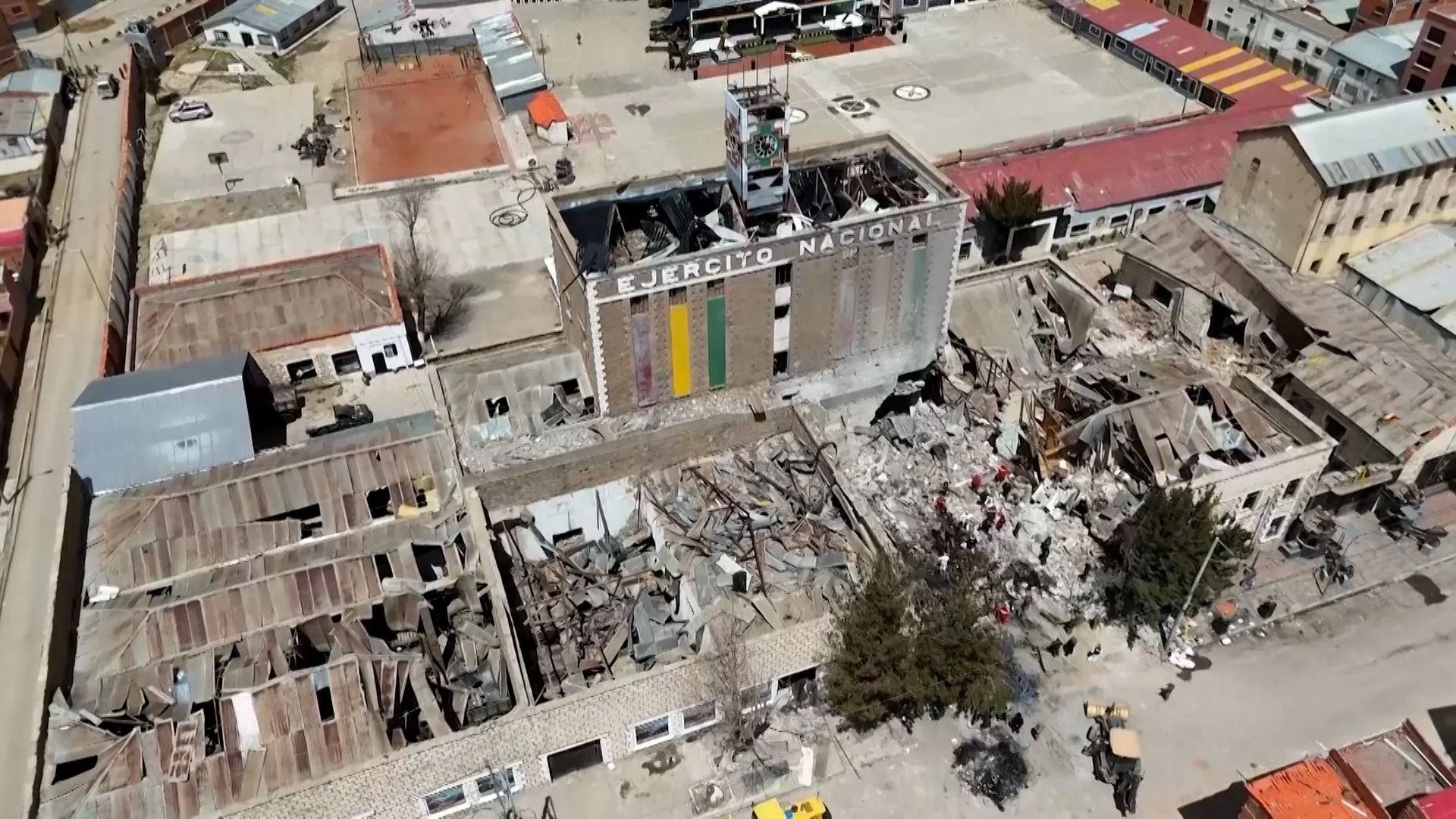
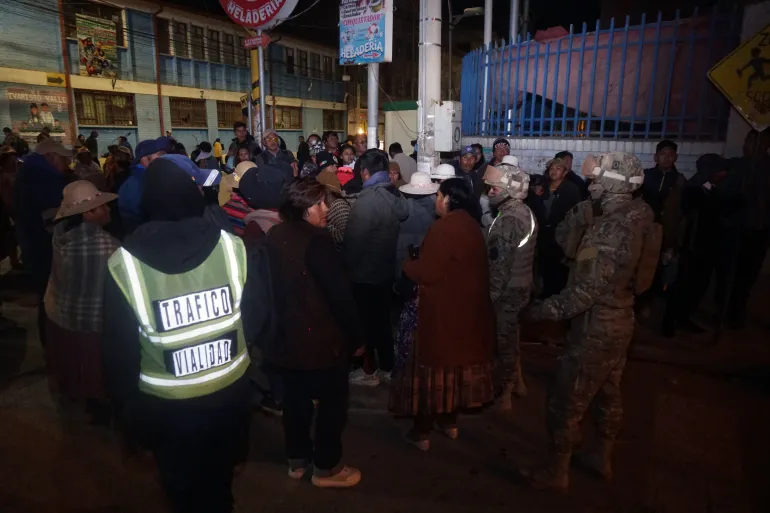
Military personnel evacuating civilians near the site of an explosion at an army barracks in Viacha [AFP]
Police said dozens of nearby homes were damaged and that many civilians were injured by shattered glass.
About 50 civilians and six military personnel injured in the explosions “have been treated … by the different medical centres of Viacha”, Deputy Minister of Defence Ernesto Justiniano Urenda said in a statement.
An investigation is under way to determine the cause of the explosions, how the pyrotechnic material was stored and whether anyone was responsible, he added.
Footage posted on social media showed one of the explosions shattering windows in nearby buildings and sending debris into the air as thick black smoke rose from the facility.
![National Geographic Explorer Paola Nogales Ascarrunz, who led the research that identified Leopardus tilcayo as a new species, observes the cat at the Senda Verde animal refuge in the Yungas region, in Bolivia, September 1, 2026 [Fernando Faciole/Handout via Reuters]](https://i0.wp.com/occasionaldigest.com/wp-content/uploads/2026/09/2026-09-17T154150Z_381273466_RC2N9NAU7NUJ_RTRMADP_3_SCIENCE-CAT-1789702964.jpg?w=640&ssl=1)



![Military personnel evacuating civilians near the site of an explosion at an army barracks in Viacha. [AFP]](https://i0.wp.com/www.aljazeera.com/wp-content/uploads/2026/09/afp_6a9b8149021c-1788576073.jpg?w=640&ssl=1)