Roadblocks

Bolivia launches early-morning crackdown on roadblocks outside La Paz | Protests News

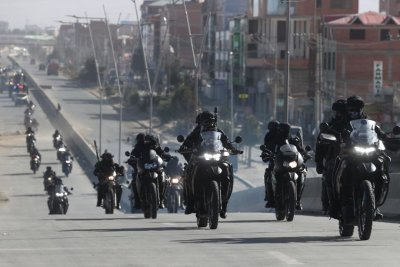
Military and law enforcement clashed with demonstrators outside La Paz, Bolivia, in an attempt to clear roadways that had been blocked as part of nationwide antigovernment protests.

As many as 3,500 soldiers and police were deployed as part of the operation that began in the early hours of Saturday. Around 57 people were arrested, according to the citizens’ rights ombudsman’s office.

Miners, schoolteachers, Indigenous groups and unions have helped to organise the protests, which aimed to convey outrage against the government of centre-right President Rodrigo Paz.

Bolivia is in the grips of an historic economic crisis, considered the worst the country has seen in decades.

The government’s foreign currency reserves have cratered, as exports from Bolivia have slowed down.

Key among those was natural gas. Vast reserves of the fuel were discovered in the late 20th century, and for nearly three decades, those natural gas deposits powered Bolivia’s economy, transforming the South American country into a major energy exporter.

But in 2022, the dynamic switched, amid mismanagement and dwindling supplies. Since then, Bolivia has had to import fuel from abroad, exacerbating its economic crisis.

Currently, many parts of the country have experienced long lines for fuel and shortages of basic supplies like food.

Paz, who was elected in October, had campaigned on alleviating the economic stress. But since taking office, he has spurred outrage by ending a two-decade-old fuel subsidy and pushing to privatise state-owned companies.

Earlier this month, the protests forced the repeal of a land reform measure, Law 1720, that critics claimed could be used to dispossess small, rural landowners, in favour of bigger holdings.

The Bolivian government has estimated that 22 roadblocks have been erected across the country in recent weeks.

Some of the protesters have demanded Paz’s resignation: His election in October marked the end of nearly two decades of rule by the Movement for Socialism (MAS).

But Paz’s office has blamed the demonstrations for cutting off key supplies to cities like La Paz, which holds the seat of government.

Food prices have increased since the blockades began, and the government claims three people have died after being unable to reach hospitals.

According to presidential spokesperson Jose Luis Galvez, Saturday’s crackdown on the protesters was designed to create a “humanitarian corridor” to ensure the free flow of supplies to hospitals in La Paz.

Earlier this week, Paz also thanked his Argentinian counterpart, Javier Milei, for delivering humanitarian assistance to Bolivia.

“This gesture of solidarity not only strengthens the historic bonds of brotherhood between our nations, but also represents vital relief for our communities in times of great need,” Paz wrote on social media on Friday.

Milei responded by denouncing the protesters as anti-democratic.

“Argentina stands with the Bolivian people and supports their democratically elected authorities against those who seek to destabilise the country and obstruct the path toward freedom and progress,” the Argentinian president said.

Source link

Roadblocks to Autonomy: Tesla’s Self Driving Ambitions Face European Doubt

Tesla is encountering growing resistance in Europe as it seeks approval for its advanced driver assistance system known as Full Self Driving. While chief executive Elon Musk has expressed strong confidence that the technology will soon gain approval across the bloc, internal communications among regulators reveal a far more cautious and skeptical stance.

The system, currently marketed as Full Self Driving Supervised, allows vehicles to operate autonomously under certain conditions but still requires full driver attention. Approval in Europe is critical for Tesla as it attempts to recover market share lost over the past two years and expand its subscription based revenue model.

Early Approval and Wider Ambitions

The Dutch vehicle authority RDW granted initial approval for the system earlier this year. This decision has now been forwarded to the European Union for broader consideration, with discussions underway among member state representatives.

Tesla is aiming not only for approval of its current system but also for future deployment of fully autonomous robotaxis in Europe. Such ambitions depend heavily on regulatory trust in the safety and reliability of its technology.

Regulatory Concerns Across Europe

Despite the Dutch endorsement, regulators from several European countries including Sweden, Finland, Denmark, and Norway have raised serious concerns. These include the system’s tendency to exceed speed limits, its performance in icy and hazardous conditions, and the possibility that drivers may bypass safeguards designed to ensure attentiveness.

Officials have also questioned whether the branding of Full Self Driving could mislead consumers into overestimating the system’s capabilities. This concern reflects a broader issue in the automated driving industry, where terminology can blur the line between assistance and autonomy.

Safety, Environment, and Real World Challenges

European regulators are particularly focused on how the system performs under conditions that differ significantly from those in the United States. Winter driving, for instance, presents unique challenges such as icy roads, reduced visibility, and unpredictable obstacles.

Questions have also been raised about how the system would respond to unexpected hazards, including wildlife on roads. These concerns highlight the difficulty of deploying standardized automated driving technology across diverse geographic and environmental contexts.

Pressure, Perception, and Public Influence

Adding to regulatory unease is Tesla’s approach to public engagement. Officials have expressed frustration with the company’s encouragement of Tesla owners to lobby regulators for approval. In several cases, authorities reported being inundated with emails from supporters advocating for the technology.

While some regulators acknowledged that the system performed well in complex urban environments, others warned that public pressure could complicate an already rigorous evaluation process.

High Stakes Approval Process

For the system to gain EU wide approval, it must secure support from a qualified majority of member states representing a significant portion of the bloc’s population. No immediate vote is scheduled, but further discussions are expected in the coming months.

Approval is seen as a key factor in Tesla’s strategy to boost sales and profitability in Europe, especially as competition intensifies from other global and regional automakers.

Analysis

Tesla’s push for automated driving approval in Europe reveals a fundamental tension between technological ambition and regulatory caution. While the company frames its system as a breakthrough in safety and convenience, European authorities are prioritizing risk mitigation and consumer protection.

The skepticism is not merely bureaucratic hesitation but reflects deeper structural differences in regulatory philosophy. European institutions tend to adopt a precautionary approach, particularly in areas involving public safety and emerging technologies.

For Tesla, the challenge lies in bridging this gap. Securing approval will require not only technical validation but also greater transparency and alignment with regional expectations. For regulators, the task is to balance innovation with responsibility in a rapidly evolving sector.

Ultimately, the outcome of this process will shape not only Tesla’s future in Europe but also the broader trajectory of autonomous driving adoption across the continent.

With information from Reuters.

Source link