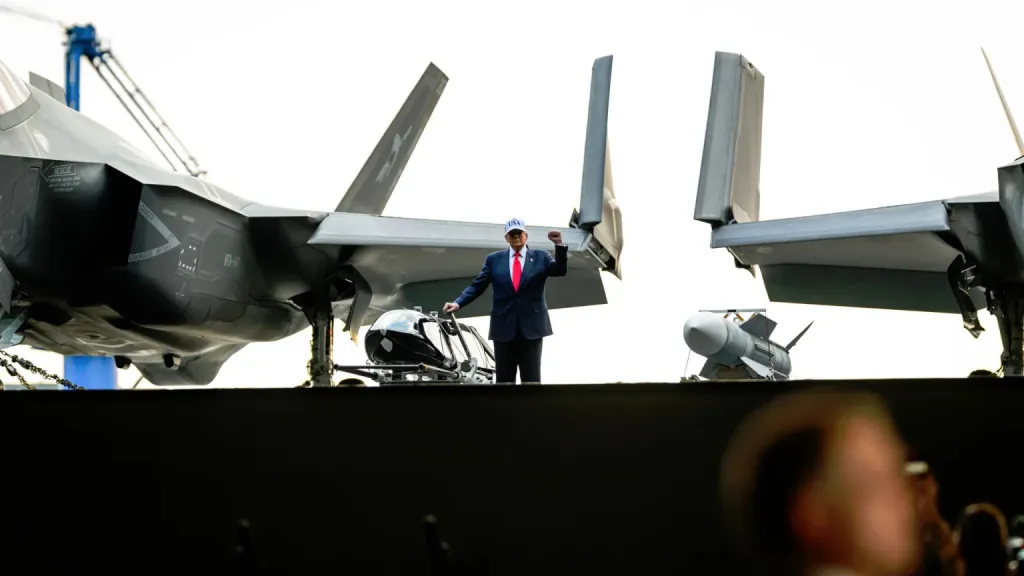
Senator Roger Wicker, the current chairman of the Senate Armed Services Committee, has said unequivocally that the idea of bringing back steam-powered catapults on U.S. Navy aircraft carriers is a “non-starter.” Earlier this year, President Donald Trump ordered the Navy to draw up plans for abandoning electromagnetic catapults and weapons elevators on the future Ford class aircraft carrier USS Doris Miller.
For years now, President Trump has railed against the Electromagnetic Aircraft Launch System (EMALS) and Advanced Weapons Elevators (AWE) that are core to the Ford class design. These systems have struggled with reliability and maintenance issues, but replacing them would require an immensely costly and time-consuming redesign effort. This, in turn, would risk adding to the already substantial delays in the delivery of new carriers.

The USS Gerald R. Ford is currently the only carrier in this class in operational service. In September, the Navy announced the “preliminary acceptance” of the future USS John F. Kennedy, but it has yet to be formally commissioned. The future USS Enterprise (CVN-80) is now under construction, and a contract has been awarded for the future USS Doris Miller. Work on all three of these ships is running behind schedule. There are plans to eventually acquire at least 10 members of the Ford class, including future examples to be named the USS William J. Clinton and USS George W. Bush.
“Returning to steam is a non-starter, and everybody needs to understand that,” Wicker, a member of Trump’s Republican party from Mississippi, said while presiding over a hearing today.
He and other members of the Senate Armed Services Committee had gathered to consider the nomination of Hung Cao to become Secretary of the Navy. Cao has already been serving in this role in an acting capacity since April.
Wicker’s comments followed an exchange between Cao and Senator Tim Kaine, a Virginia Democrat, regarding Trump’s directive earlier in the year on the matter of aircraft carrier catapults and weapons elevators. The President’s instructions had been contained within a larger memo outlining various naval and shipbuilding industry priorities.
“On August 13th, the President released a memorandum that included language directing the Secretary of Defense [Pete Hegseth; also referred to currently as the Secretary of War] and the Secretary of the Navy to provide a plan for replacing the current electromagnetic launch system for aircraft carriers with steam and hydraulic systems,” Kaine said in introducing his question. “I recently visited the Ford, and I went on the flight deck, and I talked to the sailors on that flight deck, many of whom had worked on carriers that both had steam and hydraulic launch systems and the EMAL system, and they were very complimentary of the EMAL system.”

Electromagnetic Aircraft Launch System (EMALS)
The Navy’s public position historically, including during Trump’s first and second terms, has been that EMALS, as well as the Advanced Arresting Gear (AAG), on Ford class carriers are worth investing in despite ongoing challenges. The service regularly touts the benefits they offer for sustained flight operations, particularly when it comes to increased sortie generation rates, compared to steam-powered systems on older Nimitz class carriers. Just in February, the service put out a press release saying a preliminary review of data collected during a new round of testing aboard the USS Gerald R. Ford further supported these viewpoints.
“Should the U.S. return to steam systems to launch aircraft off aircraft carriers?” Kaine asked Cao today.
“The whole question is how can I get, [how] I can maintain 11 carriers at this point because of the delays with EMALS and the electromagnetic elevators,” Cao said in response. “It’s delaying our carriers by seven years. We’re going to have five years where we’re going to be down to nine carriers. I’m trying to accelerate that.”

“Does that mean that you’re considering return to steam launches?” Kaine asked.
“No, no, because just the electromagnetic elevators alone, I don’t know if you know that they require certain spacing, and so you weld – what they do is they weld the elevator in place,” Cao began to say before Kaine interrupted.
“I’m not asking about the elevators. I’m asking about the launches [sic; catapults]. Based again on what the folks on the flight deck told me, the EMAL system works very, very well. And to retrofit existing carriers or change the design – you talked about in an earlier instance changing designs causes problems, and to go back to an old way of doing it is going to have an increased cost with diminished capacity,” Kaine said. “So, just because the President directed it, I do hope you’ll consider the experience of those who’ve been operating these launches [sic; catapults] on the Ford and before you decide to go down a path that will be more expensive and also less capable.”
It should be noted here that it has already been a matter of public record that ongoing troubles with the AWEs are continuing to contribute to delays in the delivery of new Ford class. The Navy has said previously it is working to mitigate those issues and incorporate lessons learned.

Watch the Advanced Weapons Elevators on the aircraft carrier Gerald R. Ford
It is not entirely clear if Cao meant to voice his own opposition to returning to steam-powered catapults. He did not have a further opportunity to respond to Kaine’s questioning, and the topic did not come up again during the hearing, save for Senator Wicker’s brief additional interjection.
The comments today from Kaine and Wicker reflect already growing bipartisan pushback to Trump’s call for a return to steam and hydraulics on American carriers. The Senate Appropriations Committee drew separate attention to this matter just yesterday in an explanatory statement released along with a new draft defense spending bill for the 2027 Fiscal Year.
“The Committee notes the Department’s directed planning to replace the Electromagnetic Aircraft Launch System (EMALS) and Advanced Weapons Elevators (AWE) integrated into the Ford Class Aircraft Carrier with prior-generation steam and hydraulic systems. The Committee understands that recent combat experience of Ford Class Aircraft Carriers appears to demonstrate greater sortie rates, readiness rates, and combat lethality than previous generation carriers,” the statement declared. “Further, the Committee is concerned that such a major redesign would result in many billions of dollars in additional costs and many years in program schedule delays. The Committee, therefore, warns against such significant programmatic shifts without substantive analysis, justification, and Congressional approval.”
The video below shows flight deck operations aboard the USS Gerald R. Ford during operations against Iran in March 2026.

USS Gerald R Ford Continues Epic Fury On Iran • (MAR 2026)
“The Committee directs the Secretary of the Navy to submit to the congressional defense committees [which would include the Senate Armed Forces Committee], not later than 90 days after the enactment of this act: a report that shows comparisons of sortie generation rates between steam and electromagnetic catapults, a comparison of the manned and unmanned systems that can be launched by each type of catapult; costs of redesign for each type of air platform that was not designed to be launched under higher intensity shock and impact stresses associated with legacy catapults, comparisons of the speed and efficiency of the AWE compared to legacy weapons elevators, an estimate of the impact of such redesign on the cost and timeline for Ford Class Aircraft carrier construction and retrofitting, an analysis of the impact of such redesign on the survivability and combat effectiveness of the Ford Class Aircraft Carrier,” the statement continues. “The report shall also include separate analysis on the operational requirement changes including readiness challenges, increases in manpower needed to operate steam catapults and manpower needed for maintenance and sustainment during afloat deployments and scheduled maintenance periods.”
The explicit mention here of “unmanned systems” is worth noting. Another often cited benefit of the EMALS catapults, as well as the AAG, is that they can be more finely tuned when it comes to the forces they exert on aircraft during launch and recovery. This expands the types of platforms the systems can readily accommodate, including smaller and lighter drones, and provides additional margins of safety. For years now, the Navy has made clear that it sees the MQ-25 Stingray tanker drone and other uncrewed aircraft as central to its vision for future carrier air wings.

As TWZ previously wrote in light of Trump’s August memo:
“As mentioned, any plans now to eliminate the EMALS catapults and AWEs from the Ford class design, even just on future carriers like Doris Miller, would be a major undertaking. The core physical structure of the ship, as well as its power generation requirements and other key elements of the design, are heavily rooted in these features. All-new steam piping and the large piston systems, among other elements, would have to be installed in spaces not currently designed to accommodate them. The ship’s flight deck would have been reconfigured, as well.”
“As a result of the base design decisions, the nuclear reactor plant on the Ford class is also notably set up to generate less steam overall compared to the one on the Nimitz class, according to a past report from the Project on Government Oversight (POGO), an independent non-profit. All of this, in turn, raises additional questions about how much time and effort it would take to retrofit future Ford class carriers to use steam catapults, in particular.”
…
“In a time of peace, without all the threats and operational demands the United States is currently facing, or if there was any kind of surplus carrier capacity, making fundamental changes to the Ford class carrier program might very well have been a logical decision. However, all of this also comes at a time when the Navy’s operational carriers are experiencing exceptional pressure.”
Though it did not come up during Hung Cao’s confirmation hearing today, there were also reports in August that the Navy was under pressure from Trump to physically reposition the island superstructure on the Ford class on aesthetic grounds. The service has also touted the location of the island as having operational benefits as part of the overall configuration of the flight deck, which was the product of intense design studies decades ago. The President has been very vocal over the years about what he thinks warships should and should not look like. However, as with the catapults and weapons elevators, changing the position of the island now, even if limited only to future carriers in the class, would be another costly and time-consuming effort.

All of this comes amid larger continued concerns about strains on America’s naval shipbuilding capacity, which has contracted substantially since the end of the Cold War. Within this, America’s ability to produce nuclear-powered surface ships like Ford class aircraft carriers, as well as submarines, is even more limited.
This all ties into an increasingly uncertain future for another one of the Trump administration’s high-profile naval initiatives, the nuclear-powered Trump class battleship program. Earlier this month, TWZ explored the prospects for these ships going forward in light of the Democratic Party’s historic blowout of its Republican opponents.

As we noted then, bipartisan opposition has also already been growing to the battleship plan. This was reflected in the draft defense spending bill the still-Republican-controlled Senate Appropriations Committee released yesterday, which gutted funding for these warships. Not one Senator from either party used their time during Hung Cao’s confirmation hearing today to voice their support for this program, or mention it at all. Cao did make a brief, unprompted call to continue pursuing the new battleships, while also advocating for help in boosting overall domestic naval shipbuilding capacity.

As we have reported previously, Congress is on track to clash with the Trump administration on a host of high-profile defense and other programs once Democrats take control next year. The Golden Dome missile defense initiative, the full scale and scope, as well as cost, of which remains murky, could be another major political flashpoint.
At least when it comes to Trump’s years-long push to go back to steam-powered catapults, as well as hydraulic weapons elevators, on Navy carriers, Senator Wicker’s comments make clear that there is already major opposition even from Republicans.
Contact the author: joe@twz.com