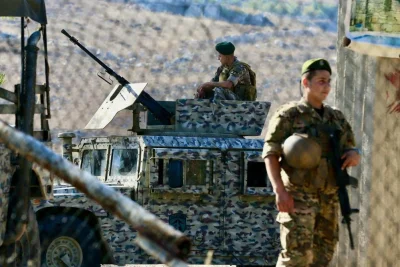

Lebanese soldiers stand guard as the Army deploys to Zawtar al-Gharbiya in southern Lebanon on July 23. Lebanon sent troops to take control of so-called pilot zones in southern Lebanon from which Israeli troops are to withdraw. Photo by EPA
BEIRUT, Lebanon, July 30 (UPI) — The widespread destruction left behind by Israeli forces in Zawtar al-Gharbieh — the first U.S.-backed “pilot zone” in southern Lebanon — was beyond anything its returning displaced residents could have imagined, providing a glimpse of the devastation across the southern region and the extensive reconstruction needs ahead.
Situated in the central sector of southern Lebanon near the strategic Litani River, Zawtar al-Gharbieh represents the testing ground for the success of the pilot zones — the cornerstone of the U.S.-brokered framework agreement reached between Lebanon and Israel on June 26.
It was the first village designated by Israel to begin withdrawing its troops, allowing for the deployment of the Lebanese Army and return of displaced residents. Yet, it reveals the significant and complex challenges facing the process.
The residents rushed back to the village when the Lebanese Army moved in July 21, returning each morning and waiting at the entrance for five days before they were finally allowed to enter and inspect their homes and properties.
The army was carrying out security inspections of all homes and removing missiles and unexploded ordnance remaining from the Israeli military presence.
“We were shocked by the scale of the destruction. It was much, much more than we had expected,” Mayor Abed Ezzedine told UPI.
Ezzedine said Israeli forces “spared nothing,” destroying or damaging everything in their path — from homes and schools to places of worship, shops and the municipality building.
He said the water infrastructure was torn up, the electricity networks blown up and burned, and the village’s only water well destroyed.
“In this life, everything has limits. Even war should have limits,” he added. “They changed the face of the village beyond recognition.”
Some 250 housing units — representing up to 80% of the village’s homes — have been destroyed, while the remaining houses have suffered severe damage and are no longer habitable.
Several of Zawtar al-Gharbieh’s 4,500 to 5,000 residents were killed, including entire families, while others were injured as they fled Israeli attacks and advancing troops three months ago, according to Ezzedine, who said “they showed no mercy to anyone.”
Although Israel stopped targeting the village after the Lebanese Army deployment, he said its drones never left the sky, hoovering at very low altitude “over our heads.”
“What kind of cease-fire or arrangement this is?” Ezzedine asked rhetoically.
Very few residents were able to stay — those who were fortunate enough to still have one room in their homes standing and safe. However, they lacked the basic necessities to continue living, including water, electricity and even Internet access.
The vast majority, meanwhile, spent their days in the village and returned at night to their shelters.
Ezzedine struggled to locate his home among the rubble — one of 25 houses in his neighborhood that had been reduced to ruins.
The rapid reconstruction of Zawtar al-Gharbieh will be a key factor in determining the success of the pilot zones, easing residents’ suffering, restoring confidence in the Lebanese state and reducing the likelihood of them turning again to Hezbollah.
“We want to see action on the ground. This is a test of good faith,” Ezzedine said.
According to a Lebanese official source, the main obstacle is the lack of necessary funding.
The source emphasized that rebuilding the village is an important step in supporting Lebanon’s diplomatic approach and consolidating the success of the pilot zones.
He told UPI that the government faces two options: organizing a reconstruction conference for southern Lebanon, which would require considerable time, or quickly rallying support from friendly states such as Saudi Arabia and Qatar to rebuild the first pilot village.
However, success also largely depends on Israel, which has insisted that it will not withdraw from parts of southern Lebanon it is occupying — specifically its self-declared “yellow zone” — or from Gaza and Syria.
Lebanese and Israeli negotiating teams are scheduled to meet Aug. 4 to 5 to evaluate progress on the pilot zones, the U.S.-led verification mechanism and the withdrawal of Israeli forces from additional occupied Lebanese territories.
The official source told UPI that the United States, which does not want to have boots on the ground in southern Lebanon, would have to “find an acceptable formula for all parties” for the verification process, potentially involving countries such as Italy, France or Spain — proposals reportedly rejected by Israel — or others to carry out the mission.
The source confirmed Lebanon’s commitment to the framework deal, saying, “We will not back out of it,” despite knowing that Israeli Prime Minister Benjamin Netanyahu is not prepared to withdraw from southern Lebanon at this stage, ahead of the October 17 Israeli elections.
Netanyahu remained firm that the disarmament of Hezbollah is a precondition for Israel’s complete withdrawal from southern Lebanon.
A well-informed source expects “tough negotiations” at next week’s Rome talks over the establishment of additional pilot zones, as Israel continues “its aggressions, infiltrations and systematic house demolitions” in violation of the framework agreement.
The Lebanese Army warned this week that Israeli aggressions are hindering completion of its deployment, delaying the return of displaced residents to their villages and undermining efforts to consolidate stability in southern Lebanon.
The source told UPI that the U.S. is exerting pressure on Israel, but “not enough,” adding that Israel “is trying to find an excuse” to withdraw from the framework agreement, which aims to end the nearly three-year war between Israel and Hezbollah and pave the way for peaceful relations between Lebanon and Israel.