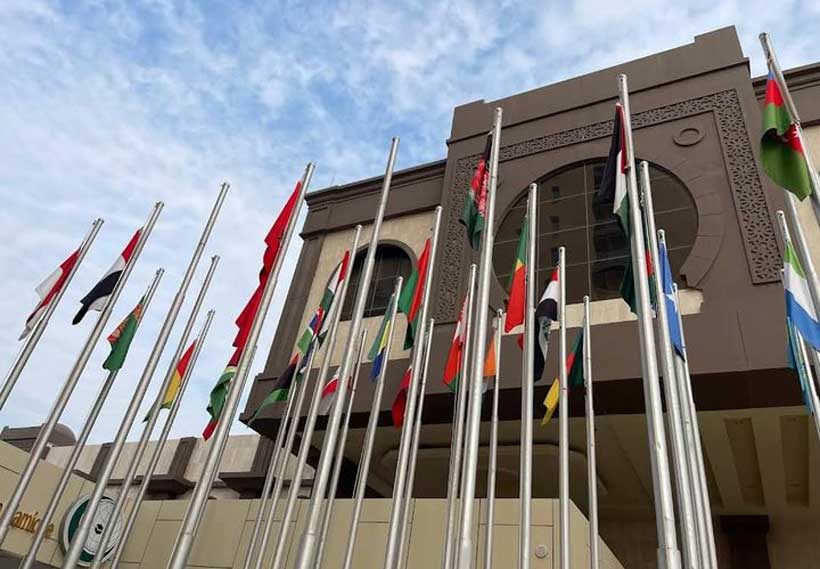
In the United Arab Emirates, women hold half of all parliamentary seats, a threshold reached by only six national legislatures on Earth. In Afghanistan, a fellow member of the same fifty seven nation bloc, girls are barred by law from any education beyond primary school, the only country where that is true. On July 12 and 13, 2026, delegates from all fifty seven states gathered in Islamabad to adopt a single shared declaration on women’s empowerment. The distance between those two realities is the actual subject the declaration had to confront, whether its authors framed it that way or not.
The Organisation of Islamic Cooperation represents fifty seven states and close to 1.9 billion people, a demographic scale matched by few multilateral bodies. What it conspicuously lacks is a shared starting point on gender equality, and the scale of that lack is easy to understate until the two ends of the distribution are placed side by side. The World Economic Forum’s Global Gender Gap Report 2025 ranks the United Arab Emirates 69th of 146 economies overall, with full parliamentary parity and women occupying nearly two thirds of federal leadership roles. It ranks Bangladesh 24th of 148, the strongest performer in South Asia for a second consecutive year, having closed 73 percent of its overall gender gap after decades of expanding a legislative quota from 7 percent of seats to 30. At the opposite pole, three of the only five economies anywhere in the world governed by an entirely male cabinet, Azerbaijan, Pakistan, and Saudi Arabia, are OIC members, and Oman remains the sole national parliament on the planet with no women seated in it at all. Afghanistan sits outside even that range. It is the only country on Earth barring girls from secondary and higher education by law, a policy that currently excludes close to 2.2 million girls from formal schooling altogether.
This is the span the Islamabad Declaration was written into, and it is worth pausing on what that span actually implies. A framework broad enough to be endorsed by both Abu Dhabi and Kabul’s immediate neighbors within the same bloc can, almost by construction, say very little about what any single government is actually required to do. Language capacious enough to cover a country with full parliamentary parity and a country that bars girls from secondary school is language calibrated for consensus, not for consequence. The more useful question, then, is not whether the declaration reads as ambitious, most instruments of this kind do, but whether the bloc has built, or shows any sign of building, a mechanism capable of moving its weakest performers rather than simply narrating the achievements of its strongest.
Where the record earns genuine credit
Stay ahead of the geopolitical week.
MD Briefing delivers expert analysis across five global fronts — the Indo-Pacific, energy, geoeconomics, European security, and the Middle East — every Monday morning. Free.
Some of what the OIC claims for itself withstands scrutiny, and is worth crediting on its own terms rather than dissolved into a general skepticism about summit diplomacy. Female enrollment in tertiary education has expanded meaningfully across member states, and the bloc’s own reporting places women at just over 39 percent of researchers across OIC countries, ahead of the roughly 34 percent global average. Maternal and child health outcomes have improved alongside it. But the most persuasive evidence for what actually moves the needle sits not in the declaration’s language but in the legislative record beneath it. Global data from the Inter Parliamentary Union shows that countries employing electoral quotas elected women at a rate of 31.2 percent in 2024, against 16.8 percent in countries without them, a gap of nearly two to one that survives across regions and income levels. Bangladesh’s own trajectory, from a 7 percent quota to 30, tracks that pattern almost precisely, and the United Arab Emirates reached full parliamentary parity through a comparable top down legal commitment rather than the slow accretion of social change. Where OIC member states have adopted binding, specific instruments, quotas above all others, the results are visible and replicable in the data. That is a genuine and transferable finding, and it rests on firmer ground than most of the rhetoric surrounding it.
The economic weakness the whole bloc shares, to varying degrees
Set the political headlines aside and the bloc’s collective vulnerability comes into sharper focus around economic participation. The OIC’s own assessment puts female labor force participation across member states at roughly 41 percent against 76 percent for men, and estimates some 106 million young people across the bloc as neither employed, in education, nor in training, with young women disproportionately represented among them. Southern Asia, the region anchoring several of the OIC’s most populous members, registers the weakest economic participation score of any region tracked in the Global Gender Gap Report, a full thirty five points separating its best and worst performing economies from one another. Even the UAE and Bangladesh, the bloc’s clearest political success stories, have not resolved this dimension with anything like the completeness they have brought to representation, which suggests economic inclusion answers to different levers than legislative quotas do, and that the declaration’s language on finance, entrepreneurship, and employment access is, whether by design or accident, aimed at the harder of the bloc’s two structural problems.
The test the declaration cannot argue its way around
Afghanistan is where the claim that voluntary declarations carry real weight meets its sharpest and least forgiving test. At the same Islamabad conference, delegates stated plainly that the Taliban’s restrictions on women harm the image of Islam and are inconsistent with Islamic teaching, echoing an OIC position from previous years that described the restrictions as contrary to the faith the bloc exists to represent. The Muslim World League, the largest Islamic non governmental organization in the world, has separately and repeatedly urged the Taliban to reverse the bans. The response from Kabul has been unambiguous. Spokesperson Zabihullah Mujahid has told international audiences that women’s rights are fully protected under the group’s interpretation of Sharia, and Taliban officials have characterized the education ban as an internal matter closed to outside comment, a position firm enough to have stalled unrelated talks over frozen central bank assets as recently as May 2026.
The stakes of this reach well beyond Afghanistan’s borders. If the bloc’s most unified and most theologically grounded criticism, the accusation that a member state’s policy is contrary to Islam itself, produces no observable change in that state’s conduct, it becomes a reasonable proxy for how much practical force softer, less unified language on labor force participation or quota adoption is likely to carry anywhere else in the bloc. The Islamabad Declaration has no enforcement mechanism for Afghanistan, and, tellingly, does not appear to need one in order to be adopted, since adoption requires only consensus on wording, not compliance with it.
Taking the structural counterargument seriously
There is a coherent case that expecting more than this from the OIC misreads what kind of institution it actually is. A consensus body spanning constitutional monarchies, parliamentary republics, and a Taliban administered emirate cannot plausibly issue binding standards on domestic labor law or family structure without member states either declining to sign or signing without any intention of compliance, an outcome arguably worse than the present voluntary model. Under this reading, the declaration’s proper function is to establish a shared reference point and let reputational pressure and peer example, the UAE and Bangladesh held up as internal proof of concept, do the work that binding law structurally cannot. The newly launched Islamabad Initiative on Women’s Digital Inclusion, a voluntary platform for digital literacy, entrepreneurship, and technology access, is built entirely on that theory of change: participation by choice rather than compliance by mandate. Judged against that more modest theory rather than against an enforcement standard it was never designed to meet, the declaration may be performing precisely as intended, and the fair critique is not that it fails at its stated purpose, but that its stated purpose may simply be too modest for the scale of the problem it describes.
Three paths from here
The most probable trajectory, roughly half of plausible outcomes by our estimate, is that the demonstration effect model continues largely undisturbed: the UAE and Bangladesh keep improving and are cited internally as proof the model works, the bloc’s lowest tier, Afghanistan most starkly, remains unmoved by rhetorical pressure however strongly it is worded, and the aggregate figures stay roughly flat because gains concentrated at the top fail to transmit downward through the distribution.
A second and less likely path, perhaps three in ten, sees middle tier member states, those possessing neither the UAE’s resources nor Afghanistan’s total exclusion, adopting elements of the proposed Gender Equality Dashboard or the digital inclusion platform in a genuine if partial way, narrowing the bloc’s middle even while its extremes remain fixed in place.
A third and least likely path, perhaps one in five, involves the range widening further still, driven by continuing instability among the bloc’s weakest performers, Afghanistan foremost among them but potentially compounded by conflict or governance stress elsewhere, at a pace that outstrips whatever gains the top and middle of the distribution manage to produce.
The indicator worth watching
The clearest available test is not whether the OIC issues further statements on Afghanistan, since it plainly will, but whether the Gender Equality Dashboard or the Digital Inclusion Initiative produces any actual, published, comparative country level data within the current reporting cycle. A voluntary framework that generates public comparison functions differently, in practice, from one that generates only communiques, since comparison is the mechanism from which reputational pressure, the model’s only real lever, actually derives. A second and narrower indicator is whether Afghanistan’s formal relationship with OIC gender programming registers any change whatsoever, even nominal engagement, as distinct from continued flat rejection, since that alone would be the first sign that unified religious framing carries weight the bloc’s other instruments do not.
What this means for institutional readers
For Western multilateral institutions and United Nations agencies, the OIC’s internal variance means that a single engagement strategy toward the bloc on gender issues is analytically weak on its face. The UAE and Bangladesh are credible technical partners on quota design and implementation, while engagement on Afghanistan specifically should continue to run primarily through humanitarian and human rights channels, given that the OIC’s own most unified criticism has already been tested there and found to carry no observable weight.
For investors and development finance institutions assessing exposure across OIC economies, a female labor force participation range running from roughly 22 percent to over 70 percent within a single fifty seven member bloc constitutes one of the more differentiated and independently checkable indicators available for human capital and productivity due diligence on any individual member state, and merits assessment country by country rather than reliance on the bloc’s aggregate language.
For rights focused organizations and donors, the quota evidence, 31.2 percent representation where legal quotas exist against 16.8 percent where they do not, is the single most defensible, causally grounded policy argument available to press within OIC forums, considerably more persuasive than the broader declaratory commitments on empowerment that lack a comparably rigorous evidentiary foundation.