Lander says dozens remain in Israeli custody after being detained while helping Palestinian farmers harvest olives.
Published On 21 Oct 202621 Oct 2026
United States Democratic congressional candidate Brad Lander says he has been released from Israeli military custody with a warning after being detained alongside dozens of volunteers helping Palestinian farmers harvest olives in the occupied West Bank on Wednesday.
But several dozen others, including rabbis and international volunteers, remain in detention, according to Lander, who called them to be released immediately.
“I’ve been released from IDF custody with a ‘warning,’ apparently because of my public profile,” Lander wrote on X. “I told them I wasn’t even a congressmember yet, just a nominee.”
Lander, a former New York City comptroller and mayoral candidate, was among approximately 80 volunteers detained by Israeli soldiers and police near the village of Nahalin, outside Bethlehem, according to the Israeli organisation Rabbis for Human Rights.
The group, which included American, Israeli, Palestinian, British and Canadian volunteers, had been accompanying Palestinian farmers for about two hours when Israeli forces arrived and informed them that they were in a closed military zone.
The volunteers were then taken to a police station, according to Rabbis for Human Rights.
The Israeli government has not responded to a request for comment.
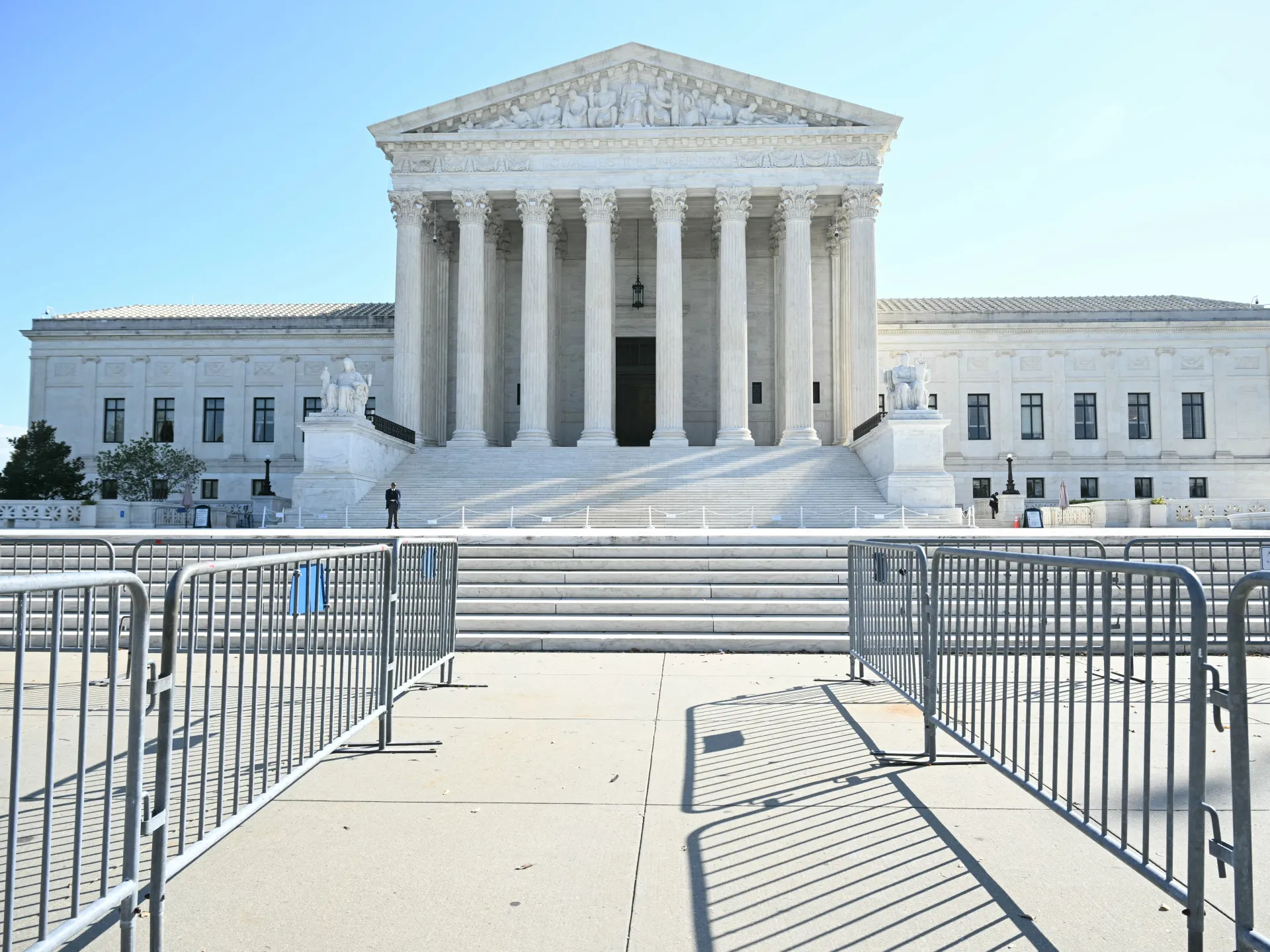
This autumn, the Supreme Court will consider a question with potentially far-reaching consequences for civil rights in the United States: Who gets to enforce them? On November 30, the justices will hear a case over whether employees of federally funded universities can sue under Title IX over alleged workplace sex discrimination. The Trump administration has urged the court to rule that they cannot, arguing that Congress never gave university employees a private right to bring such claims.
The dispute is the latest front in a broader legal push to restrict the ability of individuals and advocacy groups to take rights violations to court themselves. In June, the Supreme Court declined to hear a challenge to a federal appeals court ruling that barred Arkansas United, an immigrant advocacy organisation, from suing to enforce protections for voters who need assistance at the polls. Across a growing number of cases, Republican-led states and the Trump administration are advancing the same basic principle: Unless Congress has clearly authorised private citizens to sue, enforcement should largely be left to the government.
That may sound like an arcane legal argument, but its implications are anything but. If individuals and civil rights groups cannot go to court when laws protecting them are violated, the power to decide which rights are actually enforced increasingly rests with the very government that may be violating, ignoring or choosing not to enforce them.
A private right of action allows individuals, or groups acting on their behalf, to file lawsuits to enforce rights protected by law. These lawsuits can seek compliance with the law or compensation for past violations. Private rights of action are not automatic under US federal and state law. Congress and state legislatures sometimes explicitly authorise private lawsuits. Where they have not, courts have had to determine whether a law implicitly allows individuals or groups to sue, or whether enforcement rests solely with government authorities.
In practice, private litigation has been an essential part of enforcing rights throughout much of US history. As University of Virginia School of Law Professor George Rutherglen writes in a 2015 law review article (PDF):
“The long history of civil rights, dating back to Reconstruction, makes them quintessentially private rights, whose exercise and enforcement should depend primarily on the initiative of the individuals who bear those rights. Public enforcement no doubt remains necessary, and it has an equally long and distinguished pedigree in civil rights law, but it cannot entirely displace individual control over individual rights.”
Proponents of private rights of action, such as AARP, consider them an effective tool for vulnerable individuals and groups to protect their rights when government agencies are unwilling or unable to act. Critics, such as the US Chamber of Commerce Institute for Legal Reform, however, argue that private lawsuits can encourage frivolous litigation.
These critics, often from the political right, have attempted to restrict private litigation through legal arguments against private causes of action. An example is the 2001 Alexander v Sandoval decision, in which a Supreme Court majority led by Justice Antonin Scalia ruled that Title VI did not provide a private right of action to enforce regulations prohibiting policies or practices with a disparate impact on protected groups – discrimination that can occur without clear evidence of intent.
The legal push against private rights of action has intensified in recent years. Republican-led states have increasingly challenged the doctrine of implied private rights of action, arguing that courts should reject private suits to enforce various types of rights. The Trump administration has also adopted this stance. When the court decided a 2021 voting rights case, Justice Neil Gorsuch submitted a one-paragraph concurrence, joined by Justice Clarence Thomas, questioning whether “the Voting Rights Act of 1965 furnishes an implied cause of action,” despite that issue not being raised in the case itself.
The conservative push to restrict private rights of action has extended to a variety of areas. In June, the Supreme Court ruled against Falun Gong practitioners who accused Cisco Systems of helping the Chinese government develop surveillance technology used to facilitate their persecution, concluding that they could not pursue those aiding-and-abetting claims under the federal laws they had invoked.
One of the most consequential implications of restricting private rights of action is the threat to voting rights. In the Arkansas United case, the Eighth Circuit ruled that the immigrant advocacy organisation did not have the right to sue on behalf of non-native English speakers over the right to have language assistance in the voting booth. The ruling concerned Section 208 of the Voting Rights Act of 1965. But it extended a much broader argument already adopted by the Eighth Circuit: that private individuals and advocacy organisations cannot sue to enforce key provisions of the Voting Rights Act. The Supreme Court’s refusal in June to hear Arkansas United left that ruling in place.
This argument has also been pushed by Republican-led governments in two redistricting and vote-dilution cases: Board of Election Commissioners v NAACP in Mississippi and Turtle Mountain Band of Chippewa Indians v Howe in North Dakota. In May, the Supreme Court vacated judgments in both cases and sent them back for reconsideration in light of its ruling in Louisiana v Callais, without resolving the private-enforcement question. That decision sharply raised the bar for some racial vote-dilution claims, endangering the voting power of Black, Hispanic and Native American communities across the US. At the same time, conservative-controlled governments are attempting to deny members and advocates for these communities the right to even bring some of these cases before the courts, arguing that only the Department of Justice can initiate action over such voting rights violations.
The broader danger is that, as private rights of action are curtailed, enforcement of federal law increasingly depends on decisions made by the executive branch.
The Trump administration is now pursuing a different means of restricting private enforcement. The Clean Air Act explicitly gives private citizens the right to bring certain lawsuits, yet the Justice Department has sought to intervene and dismiss a case brought against xAI over allegations that gas turbines at its power facility in Southaven, Mississippi, are violating federal environmental law and polluting surrounding communities. The facility powers xAI’s Colossus 2 data centre in nearby Memphis. In September, the Justice Department appealed to the Fifth Circuit and sought to halt the case. The department has argued that allowing the suit to proceed would threaten national security and the US pursuit of global leadership in AI. Here, the issue is not whether Congress created a private right to sue – it did – but whether the executive branch can nevertheless step in to stop such a case when it conflicts with its priorities.
Relying solely on the Justice Department to pursue such cases at the federal level is a particularly dubious proposition under the current administration. The department has also been weaponised to target political foes of President Trump. Its Civil Rights Division has been steered away from defending the rights of racial and ethnic minorities and refocused on cases brought by white plaintiffs alleging so-called “reverse discrimination”.
The Justice Department’s current politicisation may be reversed under a future administration. But even then, the erosion of private rights of action would leave the enforcement of civil and political rights increasingly dependent on a federal agency with limited resources and subject to political direction. For example, as Democracy Docket noted in 2024, of the 216 active voting rights and redistricting cases it was tracking at the time, only five were cases brought by the Justice Department. As Professor Rutherglen noted in his article, to rely primarily on government actors to enforce rights “is to transform the nature of those rights: from private to public, from individuals to groups, from legal control by plaintiffs to political control by administrators.”
Private rights of action are now being eroded, case by case. Politicians, civil liberties advocates and organisations must challenge this trend before more avenues for enforcement are closed off. Otherwise, protections won over decades may become increasingly dependent on the willingness of government authorities to uphold them, leaving those whose rights are violated with fewer ways to seek redress.
The views expressed in this article are the author’s own and do not necessarily reflect Al Jazeera’s editorial stance.
A group of parents claims local admission policy boosts Black and Latino students while constraining Asian applicants.
Published On 20 Oct 202620 Oct 2026
The United States Supreme Court has agreed to hear a case about the role of race in admissions to selective Maryland middle schools after a group of parents claimed policies discriminated against Asian students in favour of Black and Latino students.
The Supreme Court agreed on Monday to hear the parents’ plea on four academically rigorous “magnet” schools in Montgomery County, a suburb on the outskirts of Washington, DC, in the neighbouring state of Maryland.
Recommended Stories
list of 3 itemsend of list
The high court said it would weigh whether the parent group has enough evidence of discrimination for the case to move forward.
Lower courts previously dismissed the case because Asian-American students were not underrepresented at the specialised-curriculum schools compared with the pool of students that applied.
If the Supreme Court rules for the parent group, the Association for Education Fairness, it could revive the lawsuit.
The court is expected to hear arguments in the coming months and rule by June.
‘The Pandemic Plan’
The Montgomery County school district’s selection process was introduced in the 2021-2022 school year during the COVID-19 pandemic.
It screens all students for academic potential, and then implements a lottery to randomly assign students from that pool to receive enriched instruction at either a magnet school or a local school.
The suit alleged that the screening process makes it harder for Asian-American students, who the challengers said are clustered in “high-performing, low-poverty elementary schools”, to enter the lottery pool.
Part of the process ranks a student’s performance by comparing the student’s test scores against those of other students whose family incomes are at a similar level.
“Under the applicant pool benchmark, the government can set specific racial targets, hit them, and avoid even an inquiry into discriminatory intent,” so long as it has not explicitly called out race in its process, they wrote in their appeal to the Supreme Court.
Previously thrown out
The case was thrown out in 2022 by US District Judge Paula Xinis. She noted that the percentage of admitted Asian-American students exceeded the percentage of Asian Americans among all applicants to the magnet schools.
Xinis also found no evidence that the lottery policy was implemented with discriminatory intent.
The school system has consistently argued the new admissions policy, called the “Pandemic Plan” due to the timing of its release, is race-neutral.
“The Pandemic Plan is a colorblind lottery,” lawyers wrote in a brief asking the Supreme Court not to take up the case. “Nothing about the Pandemic Plan, its history, or its purpose is offensive to the Constitution.”
Supreme Court justices will now consider whether a group claiming to be targeted by a race-neutral policy must show it was disproportionately harmed to prove intentional discrimination.
President Laura Fernandez says mega-prison is part of ‘tough-on-crime model’ embraced by her government.
Published On 15 Oct 202615 Oct 2026
Costa Rica has announced the opening of a new mega-prison amid near-record homicide levels and growing organised crime, as countries across the region embrace police crackdowns that have proven popular but often weaken key civil liberties.
President Laura Fernandez opened the High-Containment Centre Against Organised Crime, or CACCO, on Wednesday. The prison will have capacity for 5,100 people, equivalent to about 20 percent of the country’s current prison population.
Recommended Stories
list of 3 itemsend of list
“The CACCO will force criminals to face a new model – a tough-on-crime model. Costa Rica will become a global benchmark for prison security,” Fernandez said during an inauguration ceremony.
Candidates across Latin America have embraced mega-prisons, seeking to replicate the policies of Nayib Bukele, the president of El Salvador, who has won widespread popularity through a campaign of mass arrests and the suspension of basic rights in the name of combating crime.
Costa Rica, long spared from high levels of violent crime compared with its neighbours, saw a record-setting 905 homicides in 2023, followed by 876 in 2024 and 873 in 2025.
Analysts say that is partly due to increased fighting between criminal groups over lucrative drug routes.
The first transfers to Costa Rica’s new mega-prison will take place at the end of October, with Justice Minister Gabriel Aguilar saying the facility will help the government reassert control over the prison system and diminish infiltration by organised crime.
Right-wing leaders in other Latin American countries have also sought to replicate the mega-prison model.
Peruvian President Keiko Fujimori, inaugurated in July, has announced plans to tour El Salvador’s Terrorism Confinement Centre (CECOT), in anticipation of creating a similar facility in her country. CECOT can hold about 40,000 people.
In Colombia, meanwhile, newly elected leader Abelardo de la Espriella campaigned for the presidency, in part, on a pledge to build 10 mega-prisons. He took office in August.
Brazil, the largest country in Latin America, is currently in the midst of its own presidential election, and right-wing Senator Flavio Bolsonaro has advanced to the final round of the vote. His platform also includes building five mega-prisons, citing the Salvadoran model.
El Salvador first imposed a “state of exception” under Bukele in 2022, expanding police and military powers.
That emergency declaration has been credited with a sharp drop in that country’s homicides, but rights groups say it has led to severe rights abuses and has been weaponised against critics of the government.
The “state of exception” has also resulted in mass arrests and mass trials, with rulings delivered against hundreds of defendants at a time. Some defendants have been detained without charge.
While the Bukele administration frequently touts its success in dismantling the gangs, the government has continuously extended the state of exception since it was first imposed.
Critics have warned that conditions inside mega-prisons are often poor, with imprisoned people facing overcrowding, due process violations and alleged torture in facilities like CECOT.
The immigration agency has rejected a report from a government watchdog, making suggestions for improved body camera policy.
Published On 14 Oct 202614 Oct 2026
Immigration and Customs Enforcement (ICE), a United States agency that has taken a central role in President Donald Trump’s mass deportation campaign, has rejected a government report calling for its agents to wear body cameras that automatically activate.
On Wednesday, the Government Accountability Office, a nonpartisan agency that provides research to Congress, released a report recommending an update to ICE guidelines for camera usage.
Recommended Stories
list of 3 itemsend of list
It suggested that “automated camera activation” would be helpful in situations where “unexpected and unplanned incidents, unrelated to sensitive operations, result in use of force by or against personnel”.
“Given the important role of body-worn cameras in law enforcement activities, we maintain that additional controls are needed to help ensure that ICE personnel capture footage in accordance with policy,” the report said.
Automatic activation, it added, would address difficulties ICE agents face in manually turning on their cameras during enforcement operations.
But ICE has rejected the recommendation for automatic activation, which could be triggered by an agent pulling a gun or turning on a car siren. The agency cited privacy concerns.
But the Trump administration faces public pressure to improve transparency during its immigration raids.
Agents from ICE and other agencies such as Customs and Border Protection (CBP) have faced accusations of excessive force and civil liberties violations.
In January, two US citizens – Renee Good and Alex Pretti – were shot to death in separate shootings in Minneapolis, Minnesota, during immigration operations.
The New York Times estimated in July that immigration agents had opened fire on at least 25 people since the start of Trump’s second term. A CBS News review updated this week counts at least 30 shootings, with nine people killed and 13 others wounded.
ICE has often blamed such incidents on aggression against its agents, and it has argued that its officers have opened fire to defend themselves from danger.
But in several cases, that rationale has come under scrutiny.
Critics argued that video footage in Good’s fatal shooting disproved government statements alleging that she had weaponised her vehicle against agents. Her car, according to observers, appeared to be turning away from agents, not towards them.
In another case, ICE agent Christian Castro was accused of making false statements about a shooting that resulted in injury to Julio Cesar Sosa-Celis, a Venezuelan man living in Minneapolis.
Castro faces federal charges for allegedly lying about being attacked with a snow shovel and broom before the shooting, after video footage contradicted his account. Castro pleaded not guilty last month.
More recently, on October 8, immigration agents shot a man named Oscar Belgal in New York City while his five-year-old son was in the backseat of his car. ICE stated that Belgal appeared to be “going towards officers” in his car when they opened fire.
On Tuesday, a judge rejected the government’s effort to have Belgal deported.
Activists say better recording procedures for body camera footage could help clarify what happened in such incidents.
But the Trump administration has largely refused to implement reforms to ICE protocol.
Earlier this year, Democrats in Congress delayed funding for the Department of Homeland Security, which oversees ICE, on the basis that significant changes needed to be made to reduce incidents of excessive force.
The department said on Wednesday that automatically recording cameras could result in “the unauthorised recording of sensitive interactions with informants or victims”.
The agency added that all ICE offices had received body cameras as of August 5, but that training in their use was still ongoing and would be finished “soon”.
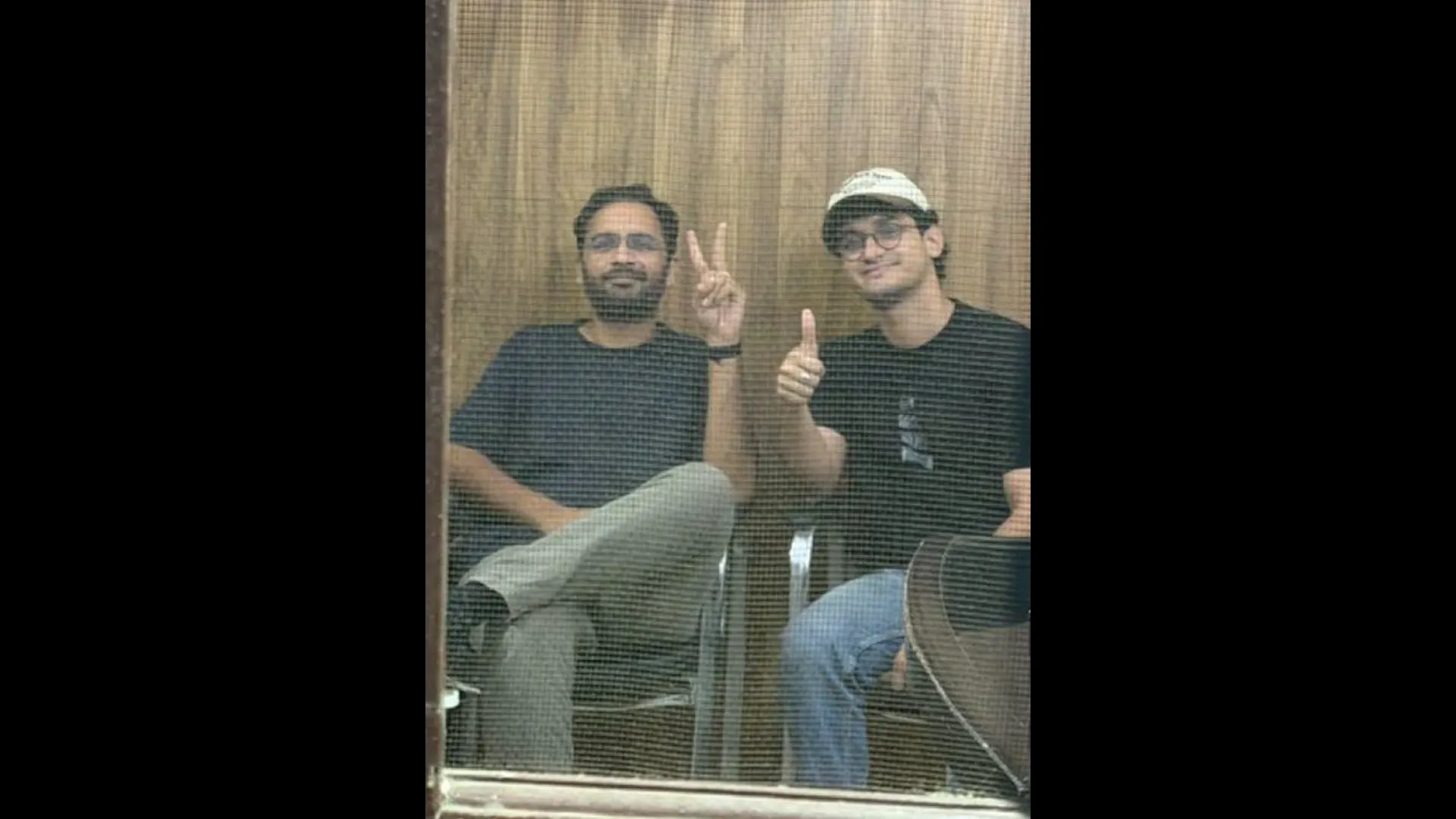
Two leaders of India’s Cockroach Janta Party have been jailed for five days after entering Delhi’s ‘Jantar Mantar’ protest site to demand the election chief’s resignation. The previously designated protest area recently lost its status as an authorised protest venue.
The Cockroach Janta Party wants Chief Election Commissioner Gyanesh Kumar to quit over changes to voter lists.
Published On 10 Oct 202610 Oct 2026
India has deployed thousands of police and paramilitary personnel in central Delhi and restricted transport in and around the capital ahead of a youth-led protest demanding the resignation of Gyanesh Kumar, the country’s chief election commissioner.
Saturday’s rally, called by the Cockroach Janta Party (CJP), a youth-based political movement, is expected to be the biggest yet in a wave of near-daily protests over a revision of voter lists that critics say favours Prime Minister Narendra Modi’s ruling Bharatiya Janata Party (BJP).
Recommended Stories
list of 3 itemsend of list
Organisers have billed it as a protest to “Save Democracy”.
Shutdown of central Delhi
Police have not authorised a rally at Jantar Mantar in central Delhi, which authorities usually designate for protests, because they said the request was not made on time and that the CJP had violated undertakings given during earlier protests.
Police have also warned that protesters will face a forceful law enforcement response if they violate the ban.
Roads to the site are blocked with multiple layers of metal barricades, as authorities shut 57 metro stations from Friday night, cancelled several long-distance trains and suspended mobile internet within 4km (2.5 miles) of the protest area until Saturday night, the Indian news agency ANI reported.
India’s Supreme Court said on Friday that some trains must still run and that blanket closure of metro stations is unlikely.
“The dictator would rather shut down the entire national capital and inconvenience millions of citizens than allow a peaceful protest at a designated protest site,” CJP chief Abhijeet Dipke said on X.
The CJP says at least 10,000 people, including protesters travelling to Delhi by train, have been detained across the country.
“You can detain the people, you cannot detain the movement,” said Neha Bora, national president of the All India Students’ Association, who has emerged as a leading face of the protests.
What kicked off the protests
Protesters want Chief Election Commissioner Gyanesh Kumar to quit over a voter list revision that has removed more than 130 million names.
The Election Commission says the exercise removes duplicate and ineligible voters and aims to prevent “foreign illegal immigrants” from voting.
Critics say it has disproportionately affected marginalised and minority communities.
The protests escalated after the Indian Express reported that Kumar’s two deputies had formally raised concerns at least 14 times in the past 10 months over the revisions.
The Election Commission and the BJP have denied the allegations. The BJP says the opposition is misleading the country because it cannot win elections.
The CJP began online as political satire in May after Chief Justice Surya Kant called unemployed youth “cockroaches”, sparking nationwide outrage. Since then, the CJP has garnered a large following among India’s youth.
The July protests led Modi’s education minister to resign over exam paper leaks. The latest demonstrations come months before a series of state elections in early 2027, including in Uttar Pradesh, India’s most populous state, which the BJP governs.
Award-winning filmmaker, who was detained last month, released on bond with next hearing set for October 27, campaign says.
Published On 9 Oct 20269 Oct 2026
The Immigration and Customs Enforcement (ICE) agency in the United States has released Kashmiri filmmaker Arfat Sheikh from custody after he was detained on September 24.
The award-winning filmmaker was released on Thursday, two days after he was granted bond, according to a statement by a campaign of his friends and relatives to free him.
Recommended Stories
list of 3 itemsend of list
However, ICE’s deportation case against Sheikh continues with the next hearing set for October 27, the campaign said.
Sheikh, whose work has explored conflict in his native India-administered Kashmir, was detained by the Department of Homeland Security (DHS) as he disembarked from a plane at Dulles International Airport outside Washington, DC, after arriving from California.
The 42-year-old, who lives in Alexandria, Virginia, entered the US on a student visa in 2019 to pursue graduate studies in film at Georgia State University and filed for asylum in 2020.
The campaign said he had a pending asylum application and was authorised to work and live in the US.
The DHS confirmed on Wednesday that Sheikh had been arrested on September 24 and said he “legally entered the US on a temporary basis and illegally overstayed his lawful admittance”.
A pending application does not confer legal status in the US, the DHS said, adding he will receive due process.
Sheikh’s first feature film, Saffron Kingdom, garnered multiple honours, notably best feature film at the Chicago Filmmakers Awards, Los Angeles Film and Documentary Awards, Melbourne Independent Film Festival, Wake Forest Film Festival and Anatolian International Film Awards.
In 2025, Sheikh was also recognised with the emerging filmmaker activist award at the Teaneck International Film Festival.
His detention came amid a surge in the number of ICE arrests across the US, which hit record levels over the summer. About 50,000 arrests were recorded in July and August.
President Donald Trump’s administration said in August that it was working “to identify and revoke the non-immigrant visas of foreigners who have come to the US claiming to be short-term visitors, but then file for asylum to stay here permanently”.
The United States Department of Justice has filed 40 new cases seeking to strip naturalised Americans of their citizenship over alleged crimes they have committed.
In a statement on Monday, federal prosecutors said they were targeting individuals accused of “serious offenses”, including money laundering, child sexual abuse, visa fraud and tax evasion.
Recommended Stories
list of 3 itemsend of list
The statement touted the 40 cases as the largest volume of denaturalisation petitions submitted in such a short period under President Donald Trump. The petitions were filed from late August through early October.
“Today’s announcement marks the largest denaturalization effort in modern history,” said Attorney General Todd Blanche.
“Under President Trump’s leadership, the Department of Justice will continue to employ the denaturalization process to maintain our national security and protect the American people.”
The 40 citizens targeted in Monday’s announcement include people from a range of countries, including Mexico, Pakistan, China and Sierra Leone.
They are accused of concealing criminal acts and other facts about themselves as they sought to obtain citizenship. Their criminal convictions largely came after they took their oaths of citizenship.
Two people on the list are also accused of engaging in espionage on behalf of China. Committing these crimes before they became citizens, the Department of Justice alleges, meant these individuals lacked “good moral character” and should have been denied citizenship.
Expanded use of denaturalisation law
The laws to denaturalise US citizens have been used for decades, but historically, they have been reserved for serious crimes.
After World War II, for instance, the US government moved to denaturalise dozens of citizens accused of concealing involvement in the Holocaust or engaging in war crimes.
Notable cases include that of Emma Goldman, a Lithuanian-born anarchist and women’s rights activist who was jailed in 1917 for her antiwar activities, before being denaturalised and deported to the Soviet Union.
But the practice has become much less frequent since the end of the Cold War.
Top officials in the Trump administration, however, have sought to expand denaturalisation as part of a push to conduct the largest deportation operation in US history.
Under US law, prosecutors can ask courts to strip citizenship from those born outside the country if they wilfully concealed a “material fact” during their citizenship application that would have otherwise disqualified them.
But Trump’s efforts to widen denaturalisation proceedings have received pushback from human rights groups, which argue they could leave people stateless.
Critics have also warned that Trump has sought to leverage denaturalisation against specific groups he perceives to be political rivals or enemies.
Last year, for instance, the Trump administration indicated it would seek to denaturalise large numbers of Somali Americans after allegations emerged in Minnesota of daycare fraud involving the Somali diaspora.
“Send them back from where they came, Somalia, perhaps the worst, and most corrupt, country on earth,” Trump wrote at the time.
Members of Trump’s Republican Party, notably Representative Andy Ogles, have also floated the possibility of yanking citizenship from New York City Mayor Zohran Mamdani, who was born in Uganda. Trump himself has falsely suggested Mamdani may be in the country illegally.
At one point, Trump even floated the idea of withdrawing citizenship from tech entrepreneur Elon Musk, a close ally and adviser to his second administration, after the two men had a falling-out in 2025.
Trump has also pushed to do away with birthright citizenship, which is granted to virtually all children born in the US. The few exceptions include the babies of diplomats and foreign military forces.
Birthright citizenship is protected under the US Constitution and cannot be taken away the way naturalised citizenship can.
In June, the US Supreme Court struck down Trump’s efforts to dismantle birthright citizenship, but legal battles continue after the president issued a second executive order also seeking to restrict how birthright citizenship is applied.
The United Kingdom’s Green Party has voted to define Zionism as a form of racism, drawing condemnation from the Israeli government.
In a binding vote held at the party’s conference over the weekend, members voted to usher in the new definition as well as a series of other strongly pro-Palestine policies.
Recommended Stories
list of 4 itemsend of list
However, just as the resolution has drawn international criticism, it has also proved internally controversial with four of the party’s five members in parliament opposing it.
Israel on Monday banned party leader Zack Polanski from the country just a day before the politician faces a by-election as he runs in the London constituency that former Prime Minister Keir Starmer represented.
Zionism emerged as a political ideology in the late 19th century. It called for the creation of a Jewish homeland at a time of rising anti-Semitism and persecution of Jews in Europe. Theodore Herzl, an Austro-Hungarian journalist considered the father of political Zionism, originally proposed an independent and colonial Jewish state in either Palestine or Argentina.
Here’s what we know about what the Greens have said:
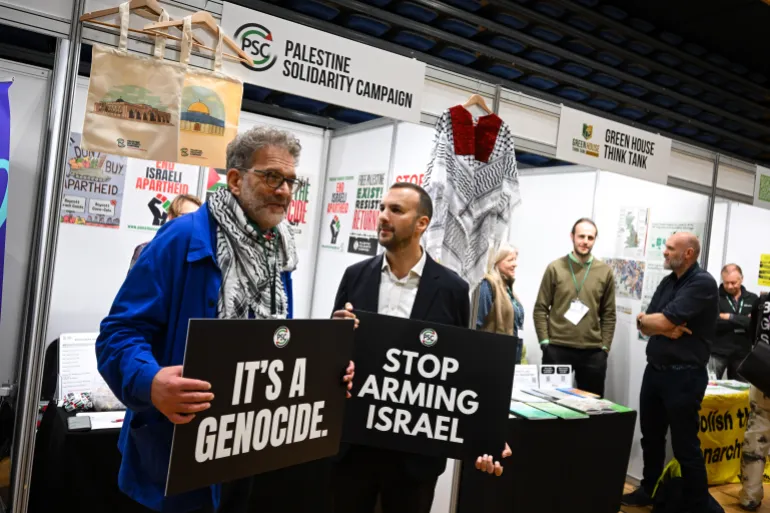
Green Party leader Zack Polanski, right, chats with Ben Jamal, director of the Palestine Solidarity Campaign, at the 2025 Green Party conference in Bournemouth, England [File: Getty Images]
What is the resolution?
The Greens endorsed the motion to equate Zionism with racism by a vote of 1,022 to 813.
In addition, the party restated its “commitment to Palestinian liberation” and called for the “establishment of a single democratic state throughout historic Palestine”.
The party also recommitted to its support of Palestinians’ right of return as well as to the Boycott, Divestment, Sanctions movement against Israel.
“The real, material, manifestation of Zionism has been the historic and ongoing dehumanisation, displacement, dispossession, disenfranchisement and destruction of Palestinians,” a Green Party statement said.
A significant number of party members, including four of its five MPs, were against parts of the resolution, exposing divisions within the party.
Codeputy leader Rachel Millward said in a post on X that while the party is committed to “stop the genocide”, the term Zionism means “different things to different people, … so I personally do not think the policy helps us do the work we all want to”.
Meanwhile, Polanski, who is Jewish and was away campaigning during the vote, told journalists afterwards that if Zionism equates to the displacement of Palestinians, “that is clearly racist.”
Polanski said he, however, did not support the reference to a single Palestinian state and external entities should not decide what a future state would look like.
How has Israel responded?
Israel has accused the party of legitimising “terrorism”, and senior officials equated it to anti-Semitism.
“The Greens have adopted not only the green of Hamas, but also its ideology: the elimination of the State of Israel through armed struggle,” the Israeli Ministry of Foreign Affairs wrote on social media.
Israeli President Isaac Herzog said it would “deliberately endanger Jews and Israelis everywhere”. Opposition leader Yair Lapid said the party was “racist”.
The Green Party has rejected equating criticism of Israel with anti-Semitism and reiterated its stance against “any form of discrimination or harassment”.
“We know there is no conflict between supporting the rights of Palestinians and the rights of Jewish people,” Polanski and other senior party members said in a statement on Sunday.
Has Zionism been equated to racism before?
Yes. In 1975, the UN General Assembly passed a resolution that “determines that Zionism is a form of racism and racial discrimination”.
The vote was sponsored by the Soviet bloc and the Arab League. It passed after 72 countries, largely from the Middle East and Africa, voted for it. Israel and 34 other countries – chiefly from the West – were against it. Thirty-two other countries abstained.
Just a year before, at the 1974 General Assembly, Palestinian leader Yasser Arafat had given his “olive branch” speech at the General Assembly.
About the same time, African countries opposing the apartheid regime in South Africa, which was increasingly allying with Israel, had resolved separately that the Israeli government was “racist” and both had an “imperialist origin.”
Also, in 1975, at the first international women’s conference, held in Mexico City, attendees decided there would be no international peace outside the “elimination of foreign occupation, Zionism, apartheid” and all other forms of “racial discrimination”.
However, the General Assembly vote proved controversial. Chaim Herzog, then-Israeli ambassador to the UN and later president, told the assembly in a speech that it was “based on hatred, falsehood and arrogance” and proceeded to rip up copies of the resolution in front of the audience.
The US too accused the UN of making “anti-Semitism international law”.
In December 1991, the US, under President George HW Bush, stepped up a campaign to revoke the resolution with Bush declaring at the UN that equating Zionism with racism “is to reject Israel itself” and to “challenge its right to exist”.
Israel also insisted it would not participate in the Madrid Peace Process to continue negotiations between Israel and Palestinian leaders if the resolution was not cancelled.
After much pressure from the US, an overwhelming majority of countries voted for its revocation – 111 to 25, including European and African countries.
Who else equates Zionism with racism?
Jewish Voice for Peace, the American anti-Zionist and pro-Palestinian advocacy group, has also named Zionism as a movement that creates a “racist hierarchy with European Jews at the top”.
In a February statement, the group reiterated its stance against what it called the “colonial ideology” of Zionism’s founders.
Similarly, in the United Kingdom, an employment tribunal in 2024 backed anti-Zionist activist and professor David Miller, who was earlier sacked from his post at the University of Bristol in 2021 for his views that the movement was “inherently racist”.
India’s Cockroach Janta Party has launched a new protest demanding change after millions of voters were allegedly improperly removed from electoral rolls. Other protest movements joined the rallies, which led to scuffles and arrests in the capital.
Israel’s top court has overturned an election panel’s ban on Arab parties contesting parliamentary elections this month, saying the decision had not met the legal requirements for excluding them, according to Israeli media.
The Supreme Court justices ruled unanimously on Friday to undo the Central Elections Committee’s disqualification of the country’s two main Arab-majority political lists – Ra’am, also called the United Arab List, and the Joint List, which is an alliance of Hadash, Ta’al and Balad.
Recommended Stories
list of 3 itemsend of list
The decision keeps Palestinian citizens of Israel, who make up about 20 percent of the population, in the race after critics accused the committee of double standards ahead of the October 27 Knesset vote.
The court also voted 7-2 to reinstate Ofer Cassif, a sitting Jewish member of the Knesset from the Arab-Jewish Hadash party and an outspoken critic of Israel’s treatment of Palestinians, media reports said.
The two dissenting justices said Cassif backs “armed struggle against the state of Israel”, which is grounds for his disqualification.
In September, the elections committee voted to disqualify the Joint List and Ra’am as parties, as well as Cassif and Sami Abu Shehadeh, head of the Balad party, as individuals.
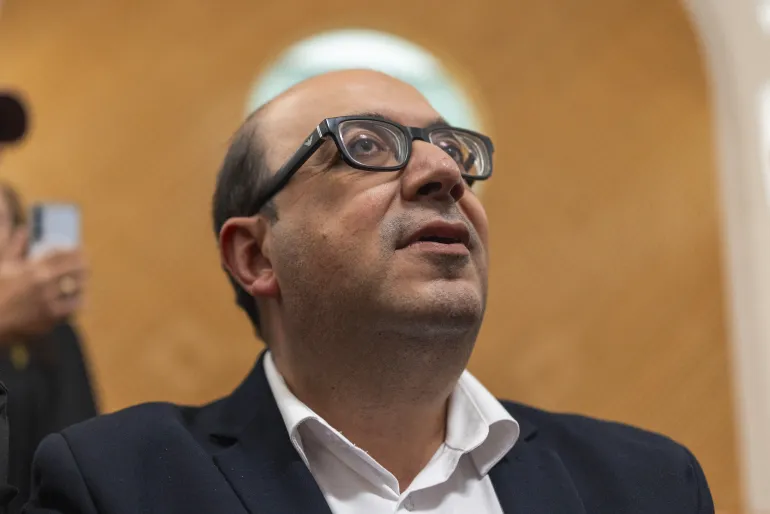
Sami Abu Shehadeh, leader of the Balad party, attends a hearing at the Supreme Court in Jerusalem on October 1, 2026 [AFP]
Balad leader withdraws
The Supreme Court has nearly always overruled the committee when it votes to ban candidates.
However, at a hearing on Thursday, Supreme Court President Yitzhak Amit told Abu Shehadeh that a majority of the nine justices favoured disqualifying him from the election.
They gave him until Friday to withdraw, saying that if he did not, he would be disqualified, according to the Israeli Public Broadcasting Corporation.
National Security Minister Itamar Ben-Gvir, a far-right ally of Prime Minister Benjamin Netanyahu, led the push to bar him over an article written after the Hamas attacks on October 7, 2023. Abu Shehadeh described the attack as “an important historical event” in the piece, but denies supporting it.
Balad said in a statement that a court-ordered removal, rather than a voluntary one, would have had “grave consequences for the country’s political and parliamentary life” as it would set a precedent around the removal of Arab candidates.
Double standards
The Ra’am party made history after the 2021 election, becoming the first Arab party to join an Israeli government when it took part in a disparate coalition that briefly removed Prime Minister Benjamin Netanyahu from power. Most Palestinian citizens of Israel had stayed out of coalition politics until then.
In this election, Ra’am is also fielding a Jewish Zionist candidate for the first time, Yoav Segalovitz, who won popularity in Arab communities for his work to curb crime as deputy minister for internal security.
The election committee’s September vote drew accusations of a double standard, as Palestinian-led parties faced exclusion while parties led by far-right ministers, some of whom have been sanctioned internationally, stayed on the ballot.
Speaking to Al Jazeera on Friday, Abu Shehadeh said he withdrew because he “didn’t have any other choices”.
Although the Supreme Court has restored the Arab parties to the ballot, Abu Shehadeh said the reversal did not make the original disqualifications acceptable.
“In the end, what happened yesterday was a historical catastrophe for democracy, or the very narrow margins of democracy in the State of Israel,” he said. “I was disqualified because I think differently, because I have a different narrative on how to read history, the present, and the future in the place that we live today.”
India is facing growing discontent among its youth and they are taking to the streets. One Indian artist tells Al Jazeera the Modi government changed his voting status and had his Instagram post taken down. Now he’ll join thousands expected at a Cockroach Janta Party-led protest demanding change.
Video shows the moment the minaret of India’s 600-year-old Ujjain mosque collapsed during demolition work for a road-widening project for a Hindu pilgrimage, triggering despair among Muslims onlookers. Officials described it as an accident caused by faulty machinery.
Seven Minnesota judges face ethics complaint after speaking publicly about the US president’s immigration crackdown.
Published On 30 Sep 202630 Sep 2026
The United States Justice Department has filed a misconduct complaint against seven federal judges in Minnesota who spoke publicly about the pressure their courts came under during President Donald Trump’s immigration crackdown.
The judges spoke to The New York Times this month about dealing with a flood of cases during Operation Metro Surge, an immigration crackdown that led to thousands of arrests in the Minneapolis-St Paul area from December to February.
Recommended Stories
list of 4 itemsend of list
The Justice Department says it crossed an ethical line by talking publicly about the cases.
Attorney General Todd Blanche accused the judges of showing “obvious bias” against the Trump administration and called on them to step aside from any cases involving the Department of Homeland Security (DHS).
“When we have a situation like we have now, where you have a judge, a couple of judges, just not only violating the canons in our view but also showing bias in what they’re saying, we have no choice but to act,” Blanche told reporters.
The judges say they did nothing wrong. A spokesperson for Minnesota’s federal court system said legal experts had found that the judges were “well within the ethical rules” when they spoke to the newspaper.
The complaint is the latest in a series of clashes between the Trump administration and the judiciary, which has blocked some of the president’s policies and, in several cases, accused government lawyers of failing to follow court orders.
One of the judges named in the complaint, Patrick Schiltz, alleged that the government did not comply with nearly 100 court orders related to immigration enforcement in January alone.
In one ruling, he wrote that US Immigration and Customs Enforcement (ICE) “is not a law unto itself”.
Schiltz was nominated by Republican President George W Bush and previously clerked for conservative Supreme Court Justice Antonin Scalia.
He later told The New York Times that what happened in Minnesota’s federal courts during the crackdown “created a grave threat to the rule of law”.
Schiltz also pointed to guidance issued by a federal judicial ethics panel in February, saying that judges can speak publicly about issues such as the rule of law and judicial independence.
A United States immigration judge has ruled the leader of Wisconsin’s largest mosque can be deported under a controversial law that United States President Donald Trump’s administration has used against non-citizens advocating for Palestinian rights.
Judge Jayme Salinardi ruled on Wednesday that Palestinian-born Salah Sarsour, president of the Islamic Society of Milwaukee, can be removed from the US based in part on a memo by Secretary of State Marco Rubio that “his actions undermine US foreign policy to combat antisemitism around the world”, according to his lawyers.
Recommended Stories
list of 4 itemsend of list
Sarsour, who has lived in the US for more than three decades, called the ruling “deeply disappointing”.
“I will continue fighting to defend the right to free speech and to stay in the country I have called home for more than three decades,” he told The Associated Press news agency.
His lawyer, Patrick Taurel, strongly rejected the decision.
“I wish the world could see the evidence that we presented and hear the testimony that the court heard because the case we presented compels only one conclusion, which is that Salah is not deportable,” Taurel told reporters on Wednesday.
“He’s done nothing wrong. He should be given back his green card, frankly, with an apology for what’s being done to him.”
The ruling does not mean Sarsour will be immediately deported.
His lawyers have 60 days to argue that sending Sarsour back would put him at risk of torture, which could protect him from deportation under the Convention Against Torture. If they lose, they plan to appeal. Taurel said he can’t be deported while that appeal is pending and will remain in the US for the “foreseeable future”.
‘Extreme deference’
Sarsour was detained by Immigration and Customs Enforcement (ICE) officers in Milwaukee in March, nine months after Rubio issued a memo declaring him deportable on foreign policy grounds.
The June 2025 memo invoked a rarely-used US law that allows the Secretary of State to seek the deportation of non-citizens whose presence could have “potentially serious adverse foreign policy consequences.” The administration has used the same provision against pro-Palestinian activists Mahmoud Khalil and Mohsen Mahdawi.
Sarsour’s lawyers criticised the “extreme deference” Salinardi gave to Rubio’s memo. But Taurel said the judge believed his hands were tied by an earlier ruling in Khalil’s case, which found that a letter from the Secretary of State could be enough to make someone deportable on foreign policy grounds.
That meant Salinardi could not look behind Rubio’s decision to examine the evidence supporting it, Taurel said.
“If the Secretary of State says the person is deportable, it is game over,” he told reporters Wednesday.
The government did not win on all of its arguments.
Salinardi rejected its allegation that Sarsour had lied on his green card application. Taurel said the judge also rejected an allegation that Sarsour had falsely claimed to be a US citizen in order to vote.
Al Jazeera reached out to the State Department and the Department of Homeland Security but did not receive responses by the time of publication.
Decades-old convictions
Sarsour is separately fighting the Trump administration in federal court over his detention while his deportation case is ongoing.
A federal judge ordered his release from ICE custody in June after 81 days, questioning why decades-old convictions that US authorities had long known about suddenly justified detaining him. The judge found there was a “substantial” case that the government was retaliating against him for speaking out about Palestinian rights.
The Trump administration has appealed his release, arguing that Sarsour’s convictions in Israel make him a security threat. He was imprisoned in 1988 after confessing to throwing stones and a Molotov cocktail at Israeli military personnel, and was convicted again in 1995 over an attempt to hold weapons.
Sarsour denies the offences, and his lawyers say the confessions were forced through torture. His former lawyer, Jawad Boulos, testified in August that Sarsour was coerced into signing confessions and was not convicted of an offence tying him to a “terrorist” organisation.
Taurel criticised Salinardi for giving what he called “extreme deference” to Israeli government records submitted by ICE, which Sarsour’s lawyers argue were incomplete and relied on confessions obtained through torture.
“A great deal of evidence we presented was ignored,” Taurel said.
The evidence challenged Israel’s military court system, where he said secret evidence can be used and Palestinians can be denied access to lawyers for extended periods.
Luna Droubi, an attorney representing Sarsour, said the case raises broader questions about whether immigrants can speak freely on political issues without fear of being targeted by the government.
“Why raise these arrests now?” she said. “Do I have the right to speak out about issues that matter to me? What if I draw a political cartoon? Am I going to be arrested and detained because of that?”
‘The end of my life’
Sarsour said being deported to the occupied West Bank “means the end of my life”.
His lawyers argue his prior treatment in Israeli custody shows he could face torture if sent back. Taurel said Sarsour’s former lawyer testified that his case stood out because Sarsour told him that Shin Bet, Israel’s internal security agency, had taken him to hospital while in custody.
The judge also named Jordan as a possible destination. Sarsour travelled to the US on a Jordanian-issued document, but his lawyers say he is not a Jordanian citizen and has no right to live there. They believe he could ultimately be returned to the West Bank and Israeli custody if sent to Jordan.
Demonstrators protest against UK government’s proscription of Palestine Action as a terrorist organisation.
Published On 28 Sep 202628 Sep 2026
Police in the United Kingdom have arrested more than 50 people protesting in support of the banned Palestine Action group outside a Labour Party conference in the northwestern English city of Liverpool.
The local Merseyside Police confirmed the arrests in a statement published on Sunday.
Recommended Stories
list of 3 itemsend of list
The police said those taken into custody at the protest, organised by Defend Our Juries, had displayed material in support of Palestine Action, proscribed as a “terrorist” group by the Labour government in July 2025 under the Terrorism Act.
According to the statement, police respected the rights of people to protest lawfully while aiming to keep the peace and ensure the public are safe.
A police officer speaks to a supporter of the group Palestine Action as demonstrators gather to protest outside the conference venue on the first day of the annual Labour Party conference in Liverpool, northwest England, on September 27, 2026 [Oli Scarff/AFP]
More than 250 protesters sat outside the conference centre holding banners with words supporting the group on Sunday, before dozens of police began making arrests.
English band Massive Attack singer Robert Del Naja was among those arrested.
After asking demonstrators if they were going to continue holding up the signs, officers led people away, telling them they had been arrested under the Terrorism Act.
Reporting from Liverpool, Al Jazeera correspondent Milena Veselinovic said the protesters wanted to put proscription “front and centre of the UK Prime Minister Andy Burnham’s agenda” on the first day of his party’s annual conference.
“Being arrested is nothing in comparison to what the people in Gaza are going through, and it’s also worth it, because this is about our right to free speech,” one protester told Al Jazeera.
Another said that “there are priests, there are healthcare workers, there are people who deeply care, and deeply care about right and wrong.”
Kerry Moscogiuri, chief executive of Amnesty International UK, said protesting “is one of the most effective tools” to make government leaders listen and described the arrests as “a truly shameful attack on freedom of speech”.
“The new prime minister can reform our laws so that communities are protected in coming together and demonstrating on the issues they care about. Will he do so?” she said.
Activists also confronted Foreign Secretary Ed Miliband inside a restaurant in Liverpool, demanding that he lift the ban on the group and declare Israel’s genocide in Gaza.
The activists left after Miliband reportedly refused to comment.
A civil disobedience campaign has emerged since Palestine Action was outlawed in July 2025, with more than 3,600 people arrested for showing their support for the group, often while holding signs reading, “I oppose genocide. I support Palestine Action.”
The UK Supreme Court is now set to hear the case after London’s Court of Appeal upheld the government ban in June.
Head of the Roman Catholic Church holds ’emotional’ two-hour meeting with seven abuse victims in French town of Lourdes.
Published On 27 Sep 202627 Sep 2026
Pope Leo XIV has thanked a group of survivors of clerical abuse “for their painful testimony” and “reaffirmed his commitment” to end harm by Catholic priests at a meeting in southwestern France, the Vatican said.
On Sunday, the pontiff visited the pilgrimage town of Lourdes, where he privately met seven survivors of child abuse, now adults, and promised to further efforts to reform the Church in the wake of the global sexual abuse scandal.
The group said in a later news conference that the meeting was emotional and touching.
“When he saw the state I was in, he took me into his arms,” survivor Jean-Marie Delbos said, adding, “It was an extraordinary moment.”
The 80-year-old was abused as a pupil at the nearby boarding school of Notre-Dame de Betharram, where staff have been accused of physical and sexual abuse over several decades.
The survivors said they felt heard and that they were impressed by Leo’s compassion and knowledge of their individual cases.
But they hoped the words would be accompanied by action.
Jerome Guillement, who has written about a priest abusing him as a teenager, said at the news conference that the pope understood the “systemic” nature of sexual abuse in the Church.
“From his point of view, the perpetrators are individuals, but what allows it to continue is the systemic dimension within the institution,” he said.
“He certainly believes that the Church has done a great deal in France, but he also believes that the Church in France still has a tremendous amount left to do.”
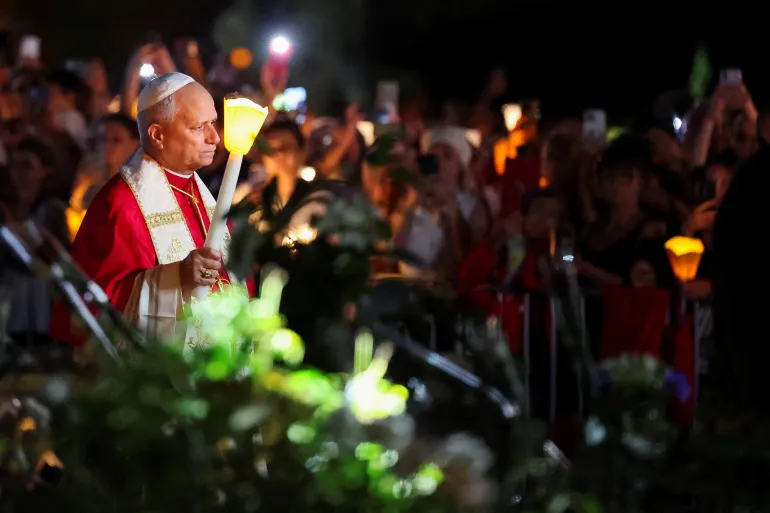
Pope Leo participates in a candlelight procession at the Sanctuary of Our Lady of Lourdes in Lourdes, France, September 27, 2026, as part of his four-day apostolic journey to France [Stephane Mahe/Reuters]
Local leaders hoped Leo’s visit would help repair the Church’s standing after a 2021 independent inquiry found that some 330,000 French children had been abused by Catholic clergy and lay leaders over seven decades.
The pope told an estimated 150,000 people gathered for a Mass in a field near the famed Catholic shrine in Lourdes earlier on Sunday that the Church must have the courage to face its past.
Veronique Garnier, another survivor who met with the pontiff, said she had found the Mass, in which Leo referred to abuse without directly apologising for it, troubling and wondered why she had attended.
But she said she was encouraged by her meeting with Leo.
“I do indeed believe there is hope – hope that there can be change and truly listening to us at a deep level, rather than just superficially with beautiful words that are never followed by any real action,” she said.
Leo also spoke about the abuse scandals in a closed-door meeting with French bishops on Sunday, according to a Vatican-provided text.
He was expected to visit the northeastern city of Metz on Monday before returning to Rome the same day.


![Sami Abu Shehadeh, leader of the Balad party, attends a hearing at the Supreme Court in Jerusalem on October 1, 2026 [AFP]](https://i0.wp.com/www.aljazeera.com/wp-content/uploads/2026/10/afp_6abfdbdd04ed-1790958557.jpg?w=640&ssl=1)

![A policeman speaks to a supporter of the proscribed group Palestine Action as they gather to protest outside the conference venue on the first day of the annual Labour Party conference in Liverpool, north-west England on September 27, 2026 [Oli Scarff/AFP]](https://i0.wp.com/occasionaldigest.com/wp-content/uploads/2026/09/AFP__20260927__C9GU2MN__v1__HighRes__BritainPoliticsLabourConferencePalestineConflic-1790556936.jpg?w=640&ssl=1)
![Pope Leo participates in a candlelight procession at the Sanctuary of Our Lady of Lourdes as part of his four-day apostolic journey to France, in Lourdes, France, September 27, 2026 [Stephane Mahe/Reuters]](https://i0.wp.com/occasionaldigest.com/wp-content/uploads/2026/09/2026-09-27T202553Z_140704132_RC2VRNAYDPZJ_RTRMADP_3_POPE-FRANCE-1790546103.jpg?w=640&ssl=1)