Parity

Megan Stalter and Paul W. Downs on ‘Hacks’ duo, pay parity and more

In 2021, when HBO Max’s “Hacks” first introduced us to fading Vegas comic Deborah Vance (Jean Smart), we briefly met Vance’s hyper-devoted young talent manager Jimmy LuSaque Jr. (Paul W. Downs) and Kayla Schaeffer (Megan Stalter), the braying, inept assistant foisted upon him. Over the years this turbulent pairing found its groove, opening their own agency while Kayla discovered boundaries (sort of). By “Hacks’” fifth and final season, which concluded this spring, a growing Jimmy-Kayla fan base was clamoring for a spinoff. “We’re not doing it, but I wish,” says Stalter as she sits beside Downs during a video call from Hudson Yards in Midtown Manhattan. “I think it would work.”

These days, Stalter, who is nominated for supporting actress in a comedy, is making her Broadway debut as the campily reimagined Mary Todd Lincoln in Cole Escola’s “Oh, Mary!” Meanwhile, Downs, who is also co-creator, co-showrunner, writer and director on “Hacks,” is nominated for supporting actor, writing and comedy series (as executive producer). Is there a dream of a future project in which he wears just one hat? “I love doing all the jobs,” says Downs, who started out as a writer-performer. “But I’d love to do a superhero so that I could just work on my nutrition, my fitness and my lines.”

Paul, one early Megan sighting was her stand-up act at Echo Park’s Little Joy. What about her made you think you’d found your Kayla?

Downs: She’s so singular and funny. It’s like stream of consciousness and yet also material. We’d written the part before we’d seen Meg, but [after seeing] her in person, I came back to my co-creator, Jen Statsky, and I said, “It’s hers to lose.” There’s something about her that’s fearless, uninhibited.

  • Share via

Meg, correct me if I’m wrong, but your first “Hacks” audition involved a dark, blurry self-tape.

Stalter: It wasn’t that well shot. My brother was filming, and he does a good job, but his apartment in New York was really slanted and there’s lots of dogs running around. I was in a weird outfit. And that’s where I did my self-tape.

Was submitting a bad self-tape part of a strategy to land the role?

Stalter: I didn’t know [the tape] was bad until years later when I watched it. [Laughs] I was a really experienced performer — I’d done stand-up and improv for nine, eight years. But I wasn’t experienced with auditioning. This part was the first thing I ever read where I was like, “I can see myself in this.” I really, really wanted it. I really tried hard to prepare for the audition.

When did it become clear that a Kayla/Jimmy scene has its own oscillating frequency?

Downs: Even before we started, there was just inherent chemistry. I think we just really tickled each other. But, not, I mean, physically.

Stalter and Downs with Earl Brown, right, in "Hacks."

Stalter and Downs with Earl Brown, right, in “Hacks.”

When Jimmy is passionately advocating for something and Kayla is in the same frame, she’s often gesticulating, scrunching up her face or emitting noises like “pffffft.” But it never comes off as scene-stealing. How? Why?

Stalter: I can’t help but do it. Kayla’s so expressive. Even if I’m not talking, my face is doing a lot. Kayla can’t hide her feelings.

Downs: To know when not to derail something is a very hard thing to do. But Meg is a true comedian in that she understands not only how to improvise within the lane of the scene, but also the give and take.

Stalter: You’re going to make me cry.

Downs: She gets the comedy, the music of it. It’s like Mozart.

Stalter: [sob-choked voice] Stop. I’m not Mozart. You’re Mozart. And if I’m Mozart, then you’re Beethoven. And I don’t know why I’m crying.

Megan Stalter.
Megan Stalter of "Hacks" in New York City, NY on Monday, August 3, 2026.

Megan Stalter. (David Urbanke / For The Times)

In comedies, personal reps are always outrageous hustlers. Why take on the challenge of finding laughs in a manager who instead is sensitive, kindhearted?

Downs: We wanted to subvert what you’ve seen on TV before in terms of a manager. There’s also so many big personalities on the show. You need a counterbalance to that. One of the reasons we started to lean more and more into Jimmy working hard, being earnest, doing the right thing, is because he was in some moments the voice of the audience, the person that was grounded [amid] the chaos around him.

Was there a specific moment when it dawned on the “Hacks” team that Jimmy and Kayla deserved more airtime?

Downs: It was certainly something we felt. There was so much feedback. At a certain point, we were seeing people online saying, “Where are Jimmy and Kayla in this episode?” “Hacks” is about duos, but it was this particular duo that people really responded to. And then executives started to come and visit on days we were shooting. There were those kinds of little signals that happened.

True or false? When Meg graduated to series regular in Season 3, Paul insisted she be paid the same amount of money as him.

Stalter: [Surprised] Who told you that? Who told you that? [leans over and puts her head on Downs’ shoulder] That’s so nice. Thank you!

Downs: I’ve never said this before, but it was important to me that Meg and I had parity. So I said, “I don’t want to be paid more than her.” You can’t have Jimmy without Kayla. Or you can. But it won’t be as funny.

Stalter: Well, the first season I was paying to be on the show. [Laughs]

Downs: Yeah, we charged. So I felt bad.

New York City, NY - August 3, 2026: Paul W. Downs of "Hacks" in New York City, NY on Monday, August 3, 2026. Both are nominated for Emmys. (David Urbanke / For The Times)
Paul W. Downs of "Hacks" in New York City, NY

Paul W. Downs. (David Urbanke / For The Times)

Who came up with the idea of using your red carpet appearances to send up celebrity culture? The costumes alone!

Downs: I’ll speak for myself, but [near the end of our final season] I started to get scared about not performing with Meg. And it was thrilling and exciting. It’s like doing improv and sketch when you first started. It’s so fun.

A highlight: Striking poses in orange leather ensembles identical to the matching attire worn by Timothée Chalamet and Kylie Jenner at the “Marty Supreme” premiere.

Stalter: It’s my favorite idea, but it wasn’t mine.

Downs: [“Hacks” producer] Genevieve Aniello said, “You guys should do something ‘Marty Supreme.’ Look at these outfits.’” And Meg was bold enough to be like, “We should do it at the Critics Choice Awards.” And I was like, “That’s in six days. That’s insane.” And Meg was like, “We’re going to get it done.”

Was there any blowback?

Stalter: We were at the SAG Awards and we walked past Timothée and I said, [singsongy voice] “Hey, it’s us…” And he goes, “Oh, should we get a picture?” He was so nice. But I then realized that he thought we came up for a picture.

Downs: But we weren’t, we were just walking to our seats. [Laughs] That night his publicist came over and showed us her phone. She’d sent him a photograph of us and he’d written back “incredible.”

Stalter: It was in lowercase.

Downs: It wasn’t screaming “INCREDIBLE,” just “incredible.” I said, “Oh good, he’s not upset.” And she was like, “No, he loves it.”

Stalter: I think he probably never does all caps.

Downs: That’s real star power.

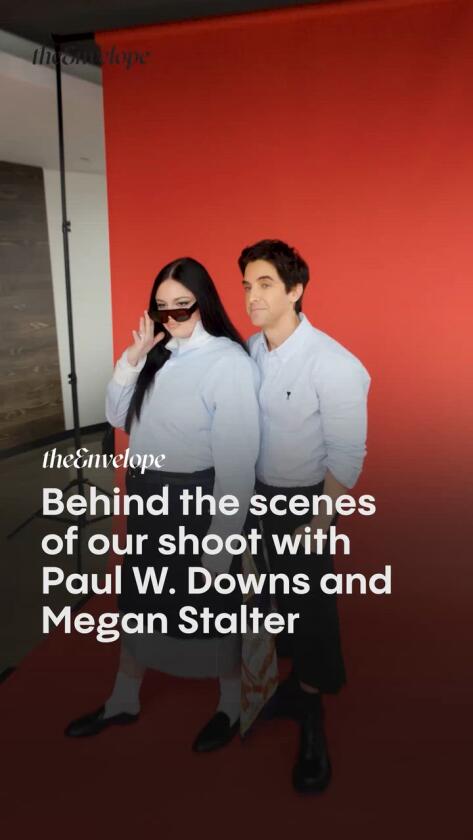
The Envelope digital cover featuring Megan Stalter and Paul W. Downs

(David Urbanke / For The Times)

Source link

Can the OIC Bridge the Gap Between Gender Parity and Total Exclusion?

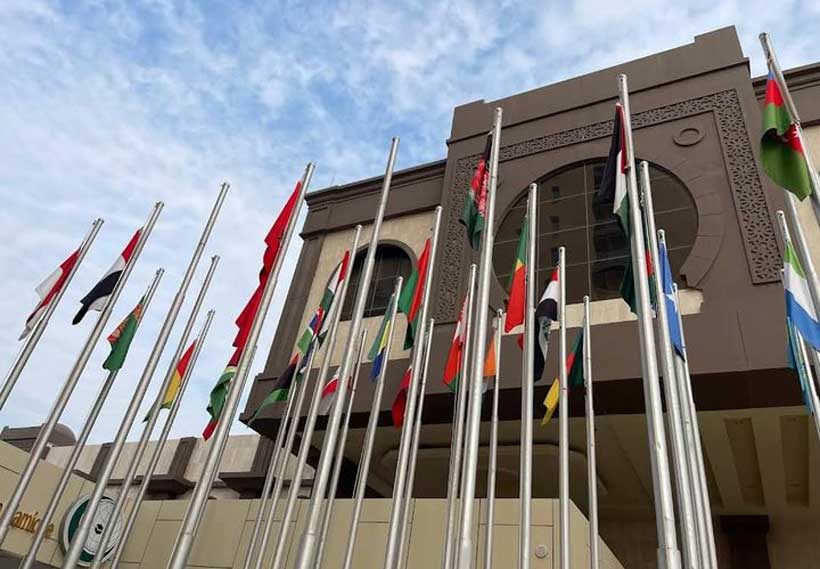
In the United Arab Emirates, women hold half of all parliamentary seats, a threshold reached by only six national legislatures on Earth. In Afghanistan, a fellow member of the same fifty seven nation bloc, girls are barred by law from any education beyond primary school, the only country where that is true. On July 12 and 13, 2026, delegates from all fifty seven states gathered in Islamabad to adopt a single shared declaration on women’s empowerment. The distance between those two realities is the actual subject the declaration had to confront, whether its authors framed it that way or not.

The Organisation of Islamic Cooperation represents fifty seven states and close to 1.9 billion people, a demographic scale matched by few multilateral bodies. What it conspicuously lacks is a shared starting point on gender equality, and the scale of that lack is easy to understate until the two ends of the distribution are placed side by side. The World Economic Forum’s Global Gender Gap Report 2025 ranks the United Arab Emirates 69th of 146 economies overall, with full parliamentary parity and women occupying nearly two thirds of federal leadership roles. It ranks Bangladesh 24th of 148, the strongest performer in South Asia for a second consecutive year, having closed 73 percent of its overall gender gap after decades of expanding a legislative quota from 7 percent of seats to 30. At the opposite pole, three of the only five economies anywhere in the world governed by an entirely male cabinet, Azerbaijan, Pakistan, and Saudi Arabia, are OIC members, and Oman remains the sole national parliament on the planet with no women seated in it at all. Afghanistan sits outside even that range. It is the only country on Earth barring girls from secondary and higher education by law, a policy that currently excludes close to 2.2 million girls from formal schooling altogether.

This is the span the Islamabad Declaration was written into, and it is worth pausing on what that span actually implies. A framework broad enough to be endorsed by both Abu Dhabi and Kabul’s immediate neighbors within the same bloc can, almost by construction, say very little about what any single government is actually required to do. Language capacious enough to cover a country with full parliamentary parity and a country that bars girls from secondary school is language calibrated for consensus, not for consequence. The more useful question, then, is not whether the declaration reads as ambitious, most instruments of this kind do, but whether the bloc has built, or shows any sign of building, a mechanism capable of moving its weakest performers rather than simply narrating the achievements of its strongest.

Where the record earns genuine credit

Stay ahead of the geopolitical week.

MD Briefing delivers expert analysis across five global fronts — the Indo-Pacific, energy, geoeconomics, European security, and the Middle East — every Monday morning. Free.

Some of what the OIC claims for itself withstands scrutiny, and is worth crediting on its own terms rather than dissolved into a general skepticism about summit diplomacy. Female enrollment in tertiary education has expanded meaningfully across member states, and the bloc’s own reporting places women at just over 39 percent of researchers across OIC countries, ahead of the roughly 34 percent global average. Maternal and child health outcomes have improved alongside it. But the most persuasive evidence for what actually moves the needle sits not in the declaration’s language but in the legislative record beneath it. Global data from the Inter Parliamentary Union shows that countries employing electoral quotas elected women at a rate of 31.2 percent in 2024, against 16.8 percent in countries without them, a gap of nearly two to one that survives across regions and income levels. Bangladesh’s own trajectory, from a 7 percent quota to 30, tracks that pattern almost precisely, and the United Arab Emirates reached full parliamentary parity through a comparable top down legal commitment rather than the slow accretion of social change. Where OIC member states have adopted binding, specific instruments, quotas above all others, the results are visible and replicable in the data. That is a genuine and transferable finding, and it rests on firmer ground than most of the rhetoric surrounding it.

The economic weakness the whole bloc shares, to varying degrees

Set the political headlines aside and the bloc’s collective vulnerability comes into sharper focus around economic participation. The OIC’s own assessment puts female labor force participation across member states at roughly 41 percent against 76 percent for men, and estimates some 106 million young people across the bloc as neither employed, in education, nor in training, with young women disproportionately represented among them. Southern Asia, the region anchoring several of the OIC’s most populous members, registers the weakest economic participation score of any region tracked in the Global Gender Gap Report, a full thirty five points separating its best and worst performing economies from one another. Even the UAE and Bangladesh, the bloc’s clearest political success stories, have not resolved this dimension with anything like the completeness they have brought to representation, which suggests economic inclusion answers to different levers than legislative quotas do, and that the declaration’s language on finance, entrepreneurship, and employment access is, whether by design or accident, aimed at the harder of the bloc’s two structural problems.

The test the declaration cannot argue its way around

Afghanistan is where the claim that voluntary declarations carry real weight meets its sharpest and least forgiving test. At the same Islamabad conference, delegates stated plainly that the Taliban’s restrictions on women harm the image of Islam and are inconsistent with Islamic teaching, echoing an OIC position from previous years that described the restrictions as contrary to the faith the bloc exists to represent. The Muslim World League, the largest Islamic non governmental organization in the world, has separately and repeatedly urged the Taliban to reverse the bans. The response from Kabul has been unambiguous. Spokesperson Zabihullah Mujahid has told international audiences that women’s rights are fully protected under the group’s interpretation of Sharia, and Taliban officials have characterized the education ban as an internal matter closed to outside comment, a position firm enough to have stalled unrelated talks over frozen central bank assets as recently as May 2026.

The stakes of this reach well beyond Afghanistan’s borders. If the bloc’s most unified and most theologically grounded criticism, the accusation that a member state’s policy is contrary to Islam itself, produces no observable change in that state’s conduct, it becomes a reasonable proxy for how much practical force softer, less unified language on labor force participation or quota adoption is likely to carry anywhere else in the bloc. The Islamabad Declaration has no enforcement mechanism for Afghanistan, and, tellingly, does not appear to need one in order to be adopted, since adoption requires only consensus on wording, not compliance with it.

Taking the structural counterargument seriously

There is a coherent case that expecting more than this from the OIC misreads what kind of institution it actually is. A consensus body spanning constitutional monarchies, parliamentary republics, and a Taliban administered emirate cannot plausibly issue binding standards on domestic labor law or family structure without member states either declining to sign or signing without any intention of compliance, an outcome arguably worse than the present voluntary model. Under this reading, the declaration’s proper function is to establish a shared reference point and let reputational pressure and peer example, the UAE and Bangladesh held up as internal proof of concept, do the work that binding law structurally cannot. The newly launched Islamabad Initiative on Women’s Digital Inclusion, a voluntary platform for digital literacy, entrepreneurship, and technology access, is built entirely on that theory of change: participation by choice rather than compliance by mandate. Judged against that more modest theory rather than against an enforcement standard it was never designed to meet, the declaration may be performing precisely as intended, and the fair critique is not that it fails at its stated purpose, but that its stated purpose may simply be too modest for the scale of the problem it describes.

Three paths from here

The most probable trajectory, roughly half of plausible outcomes by our estimate, is that the demonstration effect model continues largely undisturbed: the UAE and Bangladesh keep improving and are cited internally as proof the model works, the bloc’s lowest tier, Afghanistan most starkly, remains unmoved by rhetorical pressure however strongly it is worded, and the aggregate figures stay roughly flat because gains concentrated at the top fail to transmit downward through the distribution.

A second and less likely path, perhaps three in ten, sees middle tier member states, those possessing neither the UAE’s resources nor Afghanistan’s total exclusion, adopting elements of the proposed Gender Equality Dashboard or the digital inclusion platform in a genuine if partial way, narrowing the bloc’s middle even while its extremes remain fixed in place.

A third and least likely path, perhaps one in five, involves the range widening further still, driven by continuing instability among the bloc’s weakest performers, Afghanistan foremost among them but potentially compounded by conflict or governance stress elsewhere, at a pace that outstrips whatever gains the top and middle of the distribution manage to produce.

The indicator worth watching

The clearest available test is not whether the OIC issues further statements on Afghanistan, since it plainly will, but whether the Gender Equality Dashboard or the Digital Inclusion Initiative produces any actual, published, comparative country level data within the current reporting cycle. A voluntary framework that generates public comparison functions differently, in practice, from one that generates only communiques, since comparison is the mechanism from which reputational pressure, the model’s only real lever, actually derives. A second and narrower indicator is whether Afghanistan’s formal relationship with OIC gender programming registers any change whatsoever, even nominal engagement, as distinct from continued flat rejection, since that alone would be the first sign that unified religious framing carries weight the bloc’s other instruments do not.

What this means for institutional readers

For Western multilateral institutions and United Nations agencies, the OIC’s internal variance means that a single engagement strategy toward the bloc on gender issues is analytically weak on its face. The UAE and Bangladesh are credible technical partners on quota design and implementation, while engagement on Afghanistan specifically should continue to run primarily through humanitarian and human rights channels, given that the OIC’s own most unified criticism has already been tested there and found to carry no observable weight.

For investors and development finance institutions assessing exposure across OIC economies, a female labor force participation range running from roughly 22 percent to over 70 percent within a single fifty seven member bloc constitutes one of the more differentiated and independently checkable indicators available for human capital and productivity due diligence on any individual member state, and merits assessment country by country rather than reliance on the bloc’s aggregate language.

For rights focused organizations and donors, the quota evidence, 31.2 percent representation where legal quotas exist against 16.8 percent where they do not, is the single most defensible, causally grounded policy argument available to press within OIC forums, considerably more persuasive than the broader declaratory commitments on empowerment that lack a comparably rigorous evidentiary foundation.

Source link