Iran said on Thursday it had targeted U.S. military infrastructure across the Gulf in retaliation for fresh American strikes on Iranian territory, marking the latest escalation in a conflict that is increasingly testing a fragile ceasefire brokered just weeks ago.
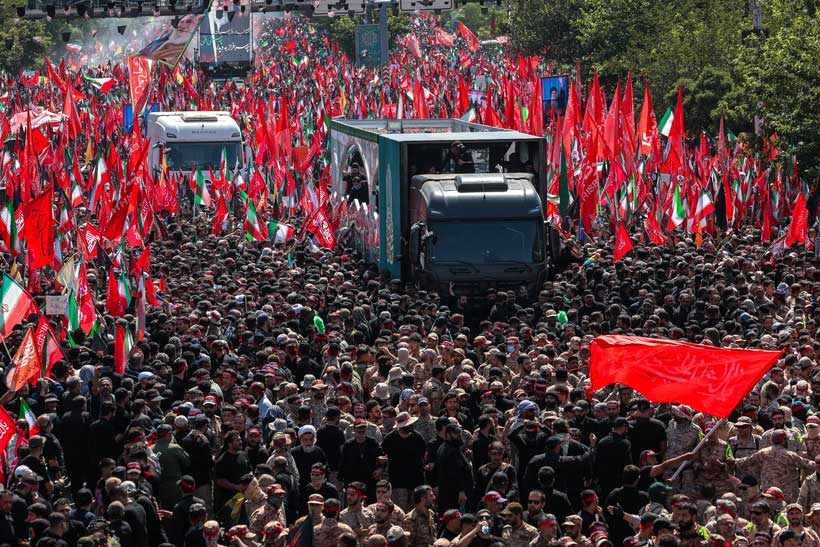
The renewed exchange of attacks came as Iran prepared to bury its late Supreme Leader Ayatollah Ali Khamenei at the holy city of Mashhad following a week of nationwide funeral processions.
Although oil prices eased after surging on fears of wider disruption, investors and governments remained focused on whether the latest violence represented a temporary escalation or the beginning of a broader collapse of efforts to end the conflict.
Iran retaliates after U.S. strikes
Iranian armed forces said they targeted U.S. military facilities in neighbouring Gulf states after American forces struck military infrastructure across Iran’s southern coast and eastern provinces.
Stay ahead of the geopolitical week.
MD Briefing delivers expert analysis across five global fronts — the Indo-Pacific, energy, geoeconomics, European security, and the Middle East — every Monday morning. Free.
According to Iranian officials quoted by state media, the latest U.S. attacks killed 14 people and wounded 78 others across five provinces on July 8 and 9.
The semi-official Fars news agency reported that one strike hit a railway bridge used for trade links with Russia and China.
Explosions were also reported on Thursday morning in Bushehr province, home to Iran’s only operational nuclear power plant, though authorities did not immediately provide details on the cause.
Gulf military installations targeted
Iran’s military said it launched drone and missile attacks against several U.S.-linked military facilities across the Gulf region.
According to Iranian state media, the targets included:
- U.S. Patriot missile systems in Kuwait
- An early-warning installation in Qatar
- A U.S. military fuel storage facility in Bahrain
Kuwaiti authorities said their air defences intercepted a cruise missile, three ballistic missiles and ten drones. Officials reported one person was injured by falling debris.
Qatar, which hosts the largest U.S. military base in the Middle East, called for restraint and urged all sides to return to diplomatic negotiations.
During a phone call with Iranian Foreign Minister Abbas Araqchi, Qatari Prime Minister Sheikh Mohammed bin Abdulrahman al-Thani also condemned attacks on commercial shipping in the Strait of Hormuz.
Strait of Hormuz remains at the centre of tensions
The latest military confrontation follows attacks on commercial tankers in the Strait of Hormuz, one of the world’s most important energy shipping routes.
The U.S. military said Wednesday’s strikes were designed to protect international navigation after blaming Iran for attacks on three commercial vessels.
Although Tehran has not officially claimed responsibility for those attacks, analysts say Iran has increasingly used pressure around the Strait of Hormuz as leverage in negotiations with Washington.
Before the war began in late February, roughly one-fifth of global oil supplies passed through the narrow waterway.
Iran has since exercised significant control over maritime traffic in the strait, giving it considerable strategic influence over global energy markets.
The U.S. Central Command (CENTCOM) said American forces struck around 90 Iranian military targets.
According to CENTCOM, the operation targeted:
- Air defence systems
- Coastal surveillance infrastructure
- Missile and drone storage facilities
- Naval assets
- Military logistics centres along Iran’s coastline
“The United States is holding Iran accountable for recent unjustified aggression against commercial shipping and civilian crews freely navigating a vital international waterway,” CENTCOM said.
President Donald Trump defended the operation on Wednesday, writing on Truth Social: “This is in retribution for yesterday’s bombing of ships by Iran. If it happens again, it will get much worse.”
Trump says ceasefire agreement is effectively over
While attending the NATO summit in Ankara, Trump said he believed the memorandum of understanding signed with Iran to halt the fighting had effectively collapsed.
Asked whether the agreement remained in force, Trump replied:”It’s a very interesting question. To me, I think it’s over. I don’t want to deal with them.”
He later added that even if another agreement were reached, he doubted Tehran would honour it.
Despite the renewed military exchanges, Trump said he did not expect the confrontation to develop into another prolonged war.
“Anything that happens is going to be over very quickly… and will only make it safer, including for oil,” he told reporters.
Iran vows continued retaliation
Iranian officials condemned the latest U.S. military operation as another breach of understandings reached after the ceasefire.
Parliament Speaker Mohammad Baqer Qalibaf warned Washington that future attacks would receive a military response.
“The U.S. has yet to learn that bullying and breaking its commitments no longer come without a cost,” he wrote on social media.
“The Strait of Hormuz will be reopened only under Iranian arrangements, not through U.S. threats.”
Oil markets remain on edge
Oil prices retreated on Thursday after jumping sharply a day earlier, as traders assessed whether the latest fighting would significantly disrupt Gulf energy exports.
Shipping also remains under close watch.
One of the vessels struck this week the Qatari LNG tanker Al Rekayyat remains stranded off Oman after suffering an engine-room fire following a projectile strike.
Industry sources said its liquefied natural gas cargo appears secure and that the immediate risk of explosion remains low.
Future outlook
The latest exchange of strikes has significantly weakened confidence in the U.S.-Iran ceasefire, even if neither side appears ready for a return to full-scale war.
Attention is now focused on whether further attacks occur around the Strait of Hormuz, where any prolonged disruption could quickly tighten global energy supplies and drive oil prices higher.
Diplomatic efforts led by Gulf states are likely to intensify, but Trump’s declaration that the interim agreement is “over” and Iran’s vow to continue retaliating have raised doubts over whether negotiations can still produce a lasting settlement.
With information from Reuters.