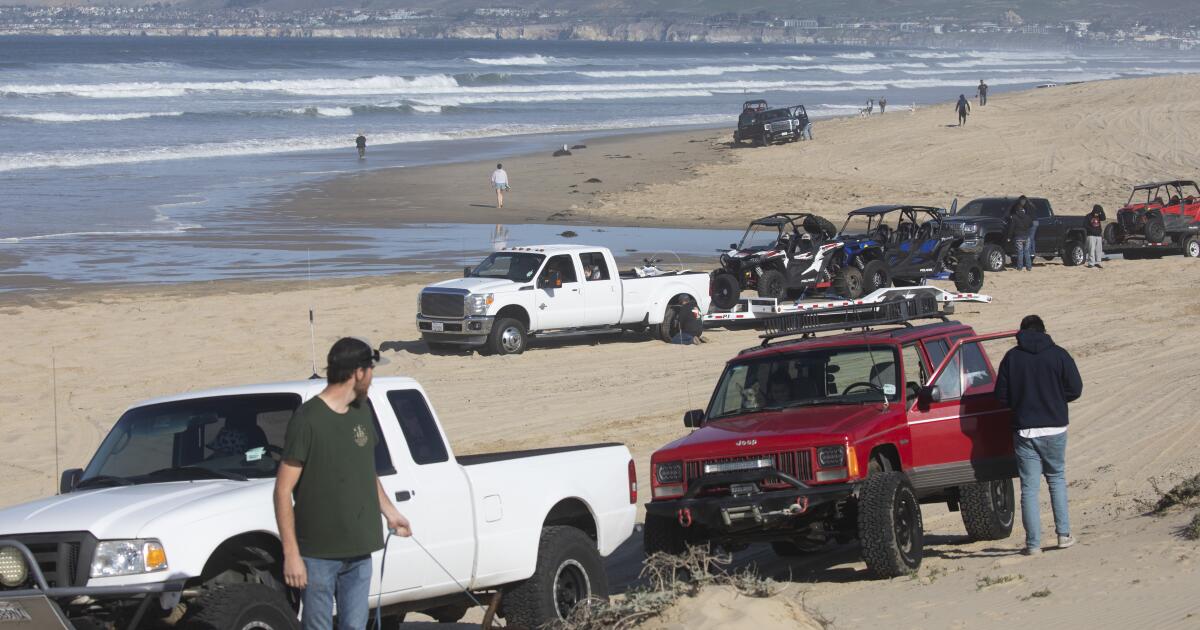
President Trump recently took action that could pave the way for opening many more federal lands to recreational off-road enthusiasts. When I heard about it, I immediately thought of the battle over off-highway vehicle access in California’s Mojave Desert.
Earlier this year, a judge ordered the Bureau of Land Management to close roughly 2,000 miles of off highway vehicle trails in the western Mojave to reduce ongoing harm to the endangered desert tortoise, a keystone species of the local ecosystem whose numbers are in steep decline.
That court decision capped off a decadeslong legal fight led by environmental groups including the Center for Biological Diversity and the Desert Tortoise Council.
Under the ruling, which the BLM has appealed, the agency has roughly three years to redraw the network of Mojave off-road trails.
In the latest action, Trump has rescinded a pair of 1970s executive orders that directed federal land managers to minimize damage to wildlife and natural resources, as well as conflicts between off-roading and other types of recreational land use, when choosing where to locate OHV trails.
He described them as “excessive regulation” that used “ill-defined criteria” to minimize vehicle impacts. “These vague, subjective criteria often result in barriers to energy and timber production and utility maintenance, permit delays, and de facto bans on hiking and other forms of recreation that require accessing remote areas, all while doing little to benefit multiple use of Federal lands,” he wrote.
I called up Lisa Belenky, who’s representing the Center for Biological Diversity in the Mojave proceedings, to ask whether Trump’s order changed anything about the case, or the rules the BLM must follow as it revises the trail network.
The short answer, she said, is no.
Each federal land management agency has its own regulations with criteria for managing off-road vehicle use — for instance, the BLM uses travel management plans to determine where vehicles are allowed on specific pieces of land. Trump’s order rolled back the executive directives that guided those regulations, but the regulations themselves remain in place.
Still, Trump’s order directs federal agencies to reexamine their regulations.
In some cases, such a reexamination appears to be already underway, said Paul Sanford, director of policy analysis at The Wilderness Society. The administration last year signaled its intent to repeal the rule that governs motorized access to Forest Service lands, he noted, the Travel Management Rule.
“The rescission of the executive orders makes that easier,” he said.
The Forest Service said in a statement that the rule is expected to be addressed later this year.
“It’s absolutely irresponsible and stupid,” said Jim Baca of Trump’s order. The former BLM director said it was already hard enough to regulate OHV use when he led the agency from 1993 to 1994. “It was difficult to do anything, especially if oil and gas people, mining people and others wanted to get into an area,” he said. To Ryan “Cal” Callaghan, president and CEO of Backcountry Hunters and Anglers, the order reflects “the prioritization of one set of user groups over all others.”
Increasing vehicle access in remote areas can cause erosion, stress animals and transport weeds into the backcountry, where they can outcompete native plants, and there’s a strong correlation between roads and human-caused fires, he said. Plus, there’s no indication that any increase would mean funding for more personnel to handle enforcement and lessen negative consequences, he said.
To the contrary, between the end of 2024 and the end of last year, the BLM lost nearly 20% of its staff, and the Forest Service and National Park Service each lost roughly 16%, according to an analysis of Office of Personnel Management data by Hawk Eye Strategies and Prospect Partners. Together, those three agencies responsible for managing more than half a billion acres of public land — about 23% of the United States — count fewer employees than the Hartsfield-Jackson Atlanta International Airport, per the figures provided by the consulting firms.
The staffing cuts and regulatory rollbacks — which also include the recent rescission of the public lands rule that put conservation on equal footing with other uses of BLM land — are part of a strategy to “suffocate” federal land management agencies, said Jora Fogg, public lands policy associate director at the Conservation Lands Foundation.
“There’s an effort to undo regulations and protections on public lands because there is a push for this energy dominance and extractive uses,” she said.
I’ve met plenty of OHV enthusiasts who care deeply for public lands. I’ve also encountered degradation and damage.
Earlier this year, tortoise biologist Ed LaRue told me he could show me a corner of the desert that had been scarred by off-roaders departing from designated routes. In the tawny hills of the Ord Rodman Natural Area, a smattering of legal trails had widened into a thick braid so intertwined that it was difficult to tell which were authorized. And while the area was once among the most densely populated tortoise spots in the western Mojave, on that warm February afternoon, LaRue could find no evidence of them.
Reached by phone last week, he said he found some comfort in the fact that certain restrictions on off-roading still remain in place, and that the public will be given the opportunity to weigh in should agencies seek changes.
Still, he said, it’s not clear whether anyone will listen.
More recent land news
Republicans have introduced an amendment to a federal wildfire bill that would repeal the 2001 Roadless Rule protecting certain national forest lands from logging and roadbuilding, reports Brooke Larsen of the Salt Lake Tribune. That comes nearly a year into the Trump administration’s effort to rescind the rule via the rulemaking process, which has faced public opposition.
The Forest Service has cited cost savings as the impetus for a reorganization that will shutter dozens of research facilities. But much of the agency’s research is already inexpensive, and closing these local facilities could make it less so while encouraging workers to leave, according to Chiara Eisner of NPR.
Why is Agriculture Secretary Brooke Rollins dead set on saving a failing Northern California dam? Grist’s Jake Bittle and Ayurella Horn-Muller report this tale, which also includes a ranch-animal veterinarian and his daughter, a Riverside County water district and an X post from county Sheriff Chad Bianco.
New proposed grazing rules appear to prohibit Indigenously managed bison from grazing on federal public lands. That has tribes urgently seeking government-to-government talks with Interior Department officials in a bid to win an exemption, according to Blaine Harden of Inside Climate News.
A few last things in climate news
As a historic El Niño supercharges the Pacific Ocean, a crumbling Pacifica pier has become a climate battleground over what to save — and who pays, my colleague Susan Rust reports.
The Times’ Grace Toohey visited Santa Rosa Island to learn how a recent wildfire has affected a piece of North America’s so-called Galapagos. Here’s what she saw.
Clean water advocacy groups say recent changes to California’s “cap-and-invest” climate program could mean less help for hundreds of thousands of people who live with contaminated water, our water reporter Ian James writes.
This is the latest edition of Boiling Point, a newsletter about climate change and the environment in the American West. Sign up here to get it in your inbox. And listen to our Boiling Point podcast here.
For more land news, follow @phila_lex on X and alex-wigglesworth.bsky.social on Bluesky.