climate crisis

‘I have to protect them’: The man guarding Mauritania’s rare Islamic books | Arts and Culture

Chinguetti, Mauritania – Bookkeeper Muhammad Gholam el-Habot gently pulled a pair of white gloves onto his slender hands and set about his routine in his high-ceilinged, cool library lined with steel bookshelves.

He opened a thick manuscript printed in Arabic. After leafing through its brown and frail pages, looking for damage, el-Habot closed the book with a satisfied thud, rubbed his fingers over the wrinkled leather cover, and carefully placed it in a white cardboard box.

Recommended Stories

list of 3 itemsend of list

“These books are very important to my family and me,” the librarian said, as the midday sunlight spilled in through open wooden doors. He spoke in Hassaniya Arabic, the dialect spoken in Mauritania, his voice low, his sentences halting and poetic. Fat flies buzzed around his long oval face as he worked.

“My relationship with them is like that of a father and his son,” he continued. “We must protect them until God takes the land and all the people who are on the land.”

The el-Habot family library is only one of a handful of its kind still operating in Chinguetti, a medieval fortress town or ksar in Mauritania’s northern Adrar region. Once a centre of commerce and Islamic learning between the 13th and 17th centuries, it is now largely abandoned as, over the decades, locals have sought opportunities in bigger cities.

Chinguetti old town
A view of the old town of Chinguetti, which follows typical Moorish structures with a mosque at the centre [Shola Lawal/Al Jazeera]

Chinguetti is also at the mercy of a changing climate.

Mauritania, in northwest Africa, is 90 percent Sahara desert and has faced desertification for centuries. Now, human-induced climate change is an accelerant. Sand and flash storms occur more frequently, while extreme hot or cold seasons last longer than usual.

Those pressures are a “big deal” for precious books, said Andrew Bishop, a researcher at the University of Wyoming studying climate impacts on Saharan cultures.

“Extreme heat and less predictable rainfall patterns means that texts are increasingly damaged by water or heat, making many manuscripts beyond repair. More than that, the mud libraries themselves are not built for sudden rain and longer summer of over 40 degrees (Celsius, or 104 degrees Fahrenheit),” he told Al Jazeera.

Many of Chinguetti’s 4,500 residents now live in cement buildings outside the original confines of the abandoned ksar, built out of dry stone and red mudbrick. There are fears that the entire area, which is about 500 square kilometres (200 square miles) – about the size of Prague – is at risk of being buried by surrounding sand dunes in the long run, although there is not a clear timeline yet.

Rare manuscripts
Rare manuscripts shown in one of Chinguetti’s last libraries [Logan Stayton/University of Wyoming]

Islam’s ‘seventh holiest city’

El-Habot did not always want to be a bookkeeper.

But when his father grew sick in 2002, he took over the approximately 1,400 manuscripts out of obligation. It was an honour in his culture to be selected, he said.

It would be out of the question now, the 50-year-old librarian said. He imagines that his two sons would reject the duty, as many of their peers have left to explore economic opportunities in the capital city, Nouakchott, or elsewhere.

“This is something that we have to do; it is a family obligation,” el-Habot said, with a bewildered expression. “This is not even a question to be asked.”

The family manuscripts are sacred because they are rare. The bookkeeper’s ancestor, Sidi Mohamed Ould Habot, was one of about two dozen Chinguetti scholars who travelled around the Muslim world between the 18th and 19th centuries, from Egypt to Andalusia, in search of knowledge.

Between them, the scholars amassed a vast fortune of about 6,000 scripts. They covered almost every topic: Islamic jurisprudence, the hadith or teachings of the Prophet Muhammad, mathematics, medicine, and poetry. Some of the works came from the scholars themselves, including the older el-Habot, who wrote about the science of poems.

The books were stored in about 30 libraries in Chinguetti, open to people from all over the world.

At the time, the town was famous because of its location at the crossroads of trans-Saharan trade routes linking the Sahel and the Maghreb. Camel caravans guided by nomadic Berber traders transporting goods – mostly salt and gold – between northern Africa and the southern empires used the city as a way station, transforming it into a commercial hub.

Muslim pilgrims on their way to Mecca on foot or camel would gather in Chinguetti and prepare themselves spiritually and mentally for their long, difficult journey before heading on to Cairo. Islamic and scientific texts were exchanged, bought and sold in the town.

In West African lore, Chinguetti was referred to as Islam’s seventh holiest city. Others nicknamed it the “Sorbonne of the Sahara”, according to UNESCO.

Rare manuscripts
Some of the old texts stored in the el-Habot family library. The family has a total of about 1,400 books in its care [Logan Stayton/University of Wyoming]

Generation after generation managed the libraries. Over time, as the caravan trade declined due to new European sea routes, the old town emptied and several libraries closed.

“Chinguetti was the mother of all people,” el-Habot said, referring to the town’s old status as the main capital of the region. Indeed, the area now known as Mauritania was called “Bilad Shinqit” or Land of Chinguetti. In the local Soninke language, it translates to “spring of horses”.

“People had to go because they wanted to feed themselves, get education for their kids, and get better opportunities for themselves too,” el-Habot said, adding that there were no universities close by, and only a handful of primary and middle schools.

Some within his family have moved on, as well, the bookkeeper said. Those, like him, who stayed back, wanted to respect their ancestor’s three wishes.

“His wishes were that the library stay in Chinguetti, that it should be open to all seekers of knowledge, and that a male descendant of his who is religious and morally upright be the bookkeeper,” el-Habot explained. Not following those instructions, he said, could invite God’s anger.

Chinguetti’s decline is largely due to the lack of support for its traditional lifestyle, Bishop said. Annual rainfall in Mauritania has decreased by 35 percent since 1970, making it harder for herders to graze or for date palms to produce fruit.

In 1996, UNESCO granted Chinguetti and three other Mauritanian ksour World Heritage Status, cementing their rich legacy. The few people still living in the old town are allowed to renovate but only minimally, to keep its original stone architecture and the typical Moorish structuring where houses are lined up along narrow alleys that lead to a mosque with a square minaret.

Just outside Chinguetti are the excavated ruins of Abweir, a town of 25,000 believed to have been founded in 777 AD, and believed to be the “original” Chinguetti. Its residents moved from the settlement, locals believe, in 1264 – likely after a conflict. Over time, the area was completely swallowed by sand.

El Habot stands inside the library
Bookkeeper el-Habot stands inside the family library on a recent weekday [Shola Lawal]

Saving the manuscripts

El-Habot’s job, while enjoyable much of the time, is also taxing, he admitted.

Preserving old books by reprinting or digitising the most worn-out manuscripts before they become unreadable is a costly process. He often needs chemicals to keep away book-eating insects and has to fund more suitable storage.

Then, there is the weather, which is out of his control. Mauritania swelters in the dry season between April and December, and is bitingly cold in the winter months that follow. Old pages are sensitive to both extremes and can become brittle, el-Habot said. Sometimes, when it is really hot, he places buckets of water around the library hall to spur humidity.

Flash floods, meanwhile, threaten water damage.

Escavated mosque of Abweir
An excavated mosque of Abweir, just outside Chinguetti, stands next to a sand dune. The settlement was believed to be the ‘original’ Chinguetti before residents moved for unclear reasons [Shola Lawal/Al Jazeera]

Visitors to the library usually pay a small fee, but tourist numbers dropped drastically across Mauritania in the mid-2000s, when armed groups attacked foreigners. The COVID-19 pandemic also reduced the flow of travellers.

Mauritania has since clamped down on violence. Tourists are slowly coming back, el-Habot said, and some of the locals who left have also returned.

In 2024, a $100,000 UNESCO restoration project provided air-conditioning units, computers and printers, as well as shelving units and storage boxes to 13 family libraries to stimulate the sector. But most libraries remain closed, their texts scattered among members. The lack of capacity of young people who are not as interested in preserving Chinguetti’s culture will continue to pose a challenge, Bishop said.

Chinguetti
A section of old Chinguetti shows the stone masonry used at the time [Shola Lawal/Al Jazeera]

Back in the library, el-Habot continued working, his thin frame bent over his manuscripts. He opened one book and pointed excitedly at its pages: They depicted the moon in its luteal phases, and an eclipse. A third page showed the holy cities of Mecca and Madina.

“I have to protect this heritage,” el-Habot said in his low voice. “As mine, and also for all of humanity.”

Source link

The Wallis Annenberg Wildlife Crossing to open this December

Right-wing pundits and politicos recently attacked the gargantuan wildlife crossing being constructed over the 101 Freeway in Agoura Hills over ballooning costs and delays.

A March 18 post in an outlet published by a conservative think tank set the outrage in motion, calling the now $114-million project a “bridge to nowhere” and “jobs program for environmentalists.” The Murdoch-owned California Post republished it and social media lit up. In an X post, U.S. Transportation Secretary Sean Duffy compared it with the state’s long-delayed, budget-busting high-speed train.

In short, they painted it as a boondoggle. One that might never get done.

But now the Wallis Annenberg Wildlife Crossing has a completion date: Dec. 2, announced at an Earth Day news conference held on the structure rising over a 10-lane stretch of the freeway. Cars whizzed by below.

You’re reading Boiling Point

The L.A. Times climate team gets you up to speed on climate change, energy and the environment. Sign up to get it in your inbox every week.

That’s when the ribbon will be cut and mountain lions suffering from a lack of genetic diversity are expected to get their ticket out of the freeway-locked Santa Monica Mountains to seek mates elsewhere. Lions there have already shown alarming signs of inbreeding, including kinked tails and deformed testicles. The population could go extinct without intervention, and state wildlife officials listed the pumas as threatened earlier this year.

“This is a visionary project that was the impossible dream,” said Beth Pratt, California regional executive director with the National Wildlife Federation and the public face of the crossing. “This is something that’s captured the imagination of Angelenos, captured the imagination of the world.”

Driving under the crossing feels unremarkable; just another concrete behemoth. But it’s another world on top. Under a blue sky and puffy clouds, a gentle wind blew through a sea of about 6,000 native plants — Santa Barbara milk vetch, golden yarrow and purple sage.

It melts into the surroundings — and that’s the point. Soil that was hauled in was inoculated with the same microbes and mycorrhizal fungi that thrive in the nearby hills. The plants were grown just for the crossing, with another 40,000 on the way.

Miguel Ordeñana, senior manager of community science at L.A. County’s Natural History Museum, who discovered the late, great mountain lion P-22 in Griffith Park, saw the whole thing unfold.

Standing atop the suspended habitat, he envisioned bobcats hiding behind the bushes and ambushing ground squirrels: “I can see it now as this thing is coming to life.”

The event drew representatives from Caltrans, National Park Service, Santa Monica Mountains Conservancy, Agoura Hills City Council and other partners.

A photo of P-22 taken in the very early morning on Dec.19, 2016 in Griffith Park.

The plight of P-22, a celebrity mountain lion that once inhabited Griffith Park, helped inspire the wildlife crossing being built over the 101 Freeway in Agoura Hills

(Miguel Ordeñana)

There’s still significant work to be done before bobcats can come aboard.

Crews are currently building a second overpass over Agoura Road.

Once that’s completed over the summer, they’ll haul in 3 million cubic feet of soil — enough to fill half of SoFi Stadium — to bridge the gap between the two structures. Berms will be constructed to block out noise and light.

Like many dreams in California, the project didn’t come cheap. When it broke ground in 2022, it was expected to cost nearly $93 million. That held until last spring, when bids for the second stage of the project went out and “came back through-the-roof high,” Pratt told The Times earlier this year. The current estimate is $114 million but could potentially top out several million higher.

The surge came amid inflation and tariff-driven price increases. The National Highway Construction Cost Index, a figure calculated by the Federal Highway Administration, has increased by 67% since 2021. Torrential rains in 2022 and 2023 delayed the completion by a year.

There’s also the scale: It’s the largest wildlife crossing in the world, with two structures that together span roughly 320 by 175 feet.

The effort appears to be paying off. Driving down to L.A. earlier this month, Pratt was distressed because she was hitting painted lady butterflies in the midst of their long-distance migration. When she ascended the crossing the following day, she saw the dainty orange, black and white insects fluttering about. It moved her to tears.

They weren’t the only lepidoptera. American lady butterflies were laying eggs and white-lined sphinx moth caterpillars were inching along plants.

Then there’s Bob, a western fence lizard that’s taken up residence at the top of stairs that lead to the crossing. A rattlesnake has claimed the bottom. Birds like yellow-rumped warblers and California scrub jays round out the initial cast.

“I can say with some certainty that this is going to be the most popular reality show that L.A. produces,” Pratt said. Cameras will capture the action, though it won’t be broadcast live because “this is L.A. and someone will go try to pet the mountain lions.”

L.A. deserves a good show. The region is reeling from devastating wildfires, immigration raids and the upending of the state governor’s race. County residents reported record-low quality of life in a UCLA survey this year, with the high cost of living looming large.

Much is uncertain, uneasy. The soon-to-open crossing offers one non-abstract finish line.

More recent wildlife news

California lawmakers are considering a bill to create a statewide program to promote coexistence between people and wildlife, an issue reinvigorated by the euthanization of a beloved black bear with two cubs in Monrovia, writes Times reporter Katie King. The state’s wildlife agency operated a similar program until two years ago, when funding ran dry.

A bear wanders across a porch.

Blondie the bear wanders across a porch in Monrovia. The mama bear was euthanized by the California Department of Fish and Wildlife following two incidents where she swiped at residents.

(Brian Gordon)

The Golden State expanded the area in which boats are asked to slow down in an effort to avoid hitting and killing whales, reports the San Francisco Chronicle’s Brooke Park. Ship strikes are a leading cause of death for several whale species off California, where some of the world’s largest cargo ships pass through key feeding and migration routes.

Nutria, a hefty rodent with the tail of a rat, reappeared in California in 2017 — close to 40 years after it was deemed eradicated. As my colleague Samantha Lee explains, California wildlife officials recently published a study indicating the animal — considered a pest — was deliberately brought back to the state.

A few last things in climate news

California is in the midst of a powerful late-season storm, bringing significant rain to northern regions of the state. However, as fellow Times writer Ian James broke down, the state experienced the hottest March on record — a phenomenon that prematurely melted snow in the Sierra Nevada. The heat and early melt is expected to dry out forests earlier than normal, increasing the risk of wildfires.

After years of debate between fire officials arguing for the removal of anything that can burn within the first five feet of homes and ecologists backing selective landscaping, California proposed a compromise, reports my colleague Noah Haggerty. New regulations create a strict one-foot “Safety Zone” around homes where nothing burnable is allowed, while permitting some spaced-out plants beyond it.

Some who lost their homes in the Eaton and Palisades fires are rebuilding all-electric due to health and climate concerns. Per Times staffer Blanca Begert, burning gas and propane for cooking, as well as water and space heating, in California homes and businesses creates 10% of the state’s greenhouse gas emissions.

One last thing

A black-furred wolf that visited L.A. County before making her way to the Eastern Sierra.

BEY03F, the wolf pictured, briefly visited L.A. County before making her way to the Eastern Sierra.

(California Department of Fish and Wildlife)

Remember the wolf that stunned everyone by visiting Los Angeles County? She made history again by venturing into Inyo County earlier this month and remains in the Eastern Sierra. Experts believe she’s probably still looking for a mate.

This is the latest edition of Boiling Point, a newsletter about climate change and the environment in the American West. Sign up here to get it in your inbox. And listen to our Boiling Point podcast here.

For more wildlife and outdoors news, follow Lila Seidman at @lila_seidman on X and @lilaseidman.bsky.social on Bluesky.

Source link

More than 6 million Somalis face hunger amid climate shocks and conflict | Climate Crisis News

On the outskirts of Somalia’s southern port city, the land has become an open graveyard for cattle. Some are left where they fell, while others are buried in shallow graves after consecutive failed rainy seasons.

For many families here, pastoralists who rely on livestock for milk, meat, and income, animals were everything, but what was once a lifeline of food and income has now become a stark symbol of loss.

The impact is not just felt in Kismayo, but across the country, with 6.5 million people forced to skip meals and go hungry every day. Drought and rising costs only pushing the country deeper into crisis.

The humanitarian director at Save the Children, Francesca Sangiorgi, says the crisis is being driven by repeated climate shocks that are compounding over time. “We’re seeing multiple rainy seasons that have failed across the country,” she tells Al Jazeera, adding that even when rain arrives, it is often too uneven and too late to restore livelihoods that have already collapsed.

What’s the scale of the crisis?

The scale of Somalia’s hunger crisis is severe and rapidly worsening.

With a third of the population facing severe food insecurity (classified as IPC Phase 3 and above), many households are struggling to get enough food to meet their basic daily requirements (PDF) — and in some cases going without food altogether, leaving them more vulnerable to malnutrition and illnesses such as diarrhoea, measles, and other infections.

Of these, more than 2 million people are in the most critical conditions short of famine (IPC Phase 4 or emergency levels), where families are facing extreme shortages and are increasingly forced into displacement in search of basic needs, moving towards already overcrowded aid camps where resources are rapidly dwindling.

Children are among the most affected. According to the UN, an estimated 1.8 million children under five in Somalia are at risk of acute malnutrition, putting their survival in immediate danger.

Sangiorgi notes that the deterioration has been unfolding rapidly, its effects already evident.

“The situation of children across the country is extremely concerning,” she explains. “We’re seeing the spread of child illnesses across the country. Dropout rates are extremely high right now, and they continue to rise because of the drought. We want to make sure that children have a chance at life—access to the health and nutrition services they need, as well as education.”

According to Doctors Without Borders, known by its French initials MSF, more than 3.3 million people have been displaced, severely straining the already limited resources and basic services in these communities.

What does the crisis look like on the ground?

Near Kismayo, one of Somalia’s largest camps for displaced people has formed, sheltering families who have nothing to eat and have travelled from across Jubbaland.

One woman describes how her herd has fallen from 200 cattle to just four, ending her very livelihood.

Barwaqo Aden, a displaced Jamame resident in Lower Juba, arrived at the camp only recently, but her eight-month-old daughter is already in the local hospital with severe malnutrition due to the lack of resources.

Others arrive after exhausting journeys, fleeing areas controlled by the armed group al-Shabab. A displaced resident, Hodhan Mohamed, walked for days and crossed the River Juba by boat before reaching a crowded settlement, unsure what she would find. Like many new arrivals, she now waits for assistance that is limited and uncertain.

Sangiorgi explains that secondary displacement – when people who have already been forced from their homes are displaced again – is becoming increasingly frequent. “As services and commodities continue to shrink across the country, the prices of essential goods keep rising as well.”

More than 3.8 million Somalis are currently displaced, making up 22 percent of the population. Many have been uprooted multiple times, moving from one settlement to another as aid resources dwindle and access to support becomes more limited.

What’s driving the crisis?

At its core, the crisis is primarily driven by climate shocks.

Somalia has had three consecutive failed rainy seasons in recent years, drying out rivers, wells, and pasturelands.

For livestock-dependent communities, the impact has been immediate: animals are dying, and with them, livelihoods are disappearing.

As local production collapses, families are forced to buy from markets even as food, fuel, and water prices continue to rise. In rural areas, especially, incomes no longer stretch far enough to meet needs.

Insecurity caused by armed conflict adds further strain, displacing communities and limiting access for aid workers in some regions.

Beyond Somalia, the global economic crisis linked to the US–Israeli war on Iran has also played a role in constricting supply chains. A UN aid chief told the Reuters news agency in March that these disruptions are compounding costs and weakening the ability to deliver assistance, as humanitarian systems come under growing strain.

MSF reported last month that transport costs have risen by up to 50 percent in parts of Somalia, making it harder for people to reach health facilities and increasing the cost of delivering care as fuel prices climb.

The organisation also said more than 200 health and nutrition facilities have closed since early 2025 due to sharp funding cuts, leaving critical gaps in already overstretched health services.

What does the aid collapse look like?

As the need for aid rises, humanitarian funding and response capacities are only shrinking.

The UN response plan for Somalia is currently funded at just 20 percent of what is required — with $1.42bn needed but only $288m received. That discrepancy has forced major cuts, reducing the number of people targeted for assistance from 6 million to just 1.3 million.

For Somalia, which relies heavily on imported food and external assistance, the consequences are immediate. Fewer supplies are reaching ports, while the cost of delivering essentials continues to rise, testing an already fragile system.

As UN humanitarian chief Tom Fletcher told Reuters in March, “These [constraints] will damage our humanitarian supply chains, reduce ‌the ⁠humanitarian supplies we can get to people who need them, but they’ll also drive up energy costs and food costs across the region, this really is a perfect storm of factors right now, and I’m seriously worried,” he stated.

The humanitarian response has been cut by 75 percent, meaning millions of Somalis are no longer receiving assistance, even as the crisis deepens on the ground.

Source link

Six women win 2026 Goldman prize, world’s top environmental award | Environment News

First all-women cohort of winners hails from Colombia, Nigeria, Papua New Guinea, South Korea, the UK and the US.

This year’s prestigious Goldman Environmental Prize has been awarded to six grassroots environmental activists from around the world for their efforts to fight climate change and save biodiversity.

For the first time since the prize was created in 1989 by philanthropists Richard and Rhoda Goldman, all recipients of the award are women: Iroro Tanshi, from Nigeria; Borim Kim, from South Korea; Sarah Finch, from the United Kingdom; Theonila Roka Matbob, from Papua New Guinea; Alannah Acaq Hurley, from the United States; and Yuvelis Morales Blanco, from Colombia.

Recommended Stories

list of 4 itemsend of list

Sometimes described as the “Green Nobel”, the Goldman Prize recipients are chosen from each of the world’s six primary regions. They each receive $200,000 in prize money.

“While we continue to fight uphill to protect the environment and implement lifesaving climate policies – in the US and globally – it is clear that true leaders can be found all around us,” said John Goldman, vice president of the Goldman Environmental Foundation.

“The 2026 Prize winners are proof positive that courage, hard work, and hope go a long way toward creating meaningful progress.”

A young woman wearing a broad hat holds a fish next to a river, smiling
Yuvelis Morales Blanco, winner of the 2026 Goldman Environmental Prize, shows a fish caught on a tour with fishermen along the Magdalena River in Colombia [Handout: Christian EscobarMora/Goldman Environmental Prize]

Morales Blanco, the winner for the region of South and Central America, fought some of the world’s biggest oil companies to successfully stop the introduction of commercial fracking into Colombia.

The 24-year-old grew up in a family of fishermen along the banks of the Magdalena River in the Afro-Colombian community of Puerto Wilches. “We had nothing but the river – she was like a mother who took care of me,” she said.

She began organising protests after a major oil spill in 2018, which forced the relocation of dozens of local families and killed thousands of animals. Her activism, which made her a target for intimidation and forced her to temporarily relocate, helped halt projects and elevate fracking as an issue in Colombia’s 2022 election.

Two of the other five recipients of this year’s prize have also focused their efforts on fighting fossil fuels, which are causing both global climate change and more localised pollution around the world.

Borim, the winner for Asia who started the Youth 4 Climate Action organisation, won a ruling from South Korea’s Constitutional Court that the government’s climate policy violated the constitutional rights of future generations, the first successful youth-led climate litigation in the continent.

Finch, Europe’s winner, told The Times newspaper she will use her prize money to keep fighting fossil fuels.

Together with the Weald Action Group, she fought oil drilling in southeastern England for more than a decade, securing the “Finch ruling” from the Supreme Court in June 2024, stating that authorities must consider fossil fuels’ impacts on the global climate before granting permission to extract them.

Two other recipients have fought against the destructive environmental impact of mining projects.

Papua New Guinea’s Roka Matbob, winner for Islands and Island Nations, led a successful campaign that saw the world’s second-largest mining company, Rio Tinto, agree to address environmental and social devastation caused by its Panguna copper mine, 35 years after it was closed following an uprising.

And the award recipient for North America, Acaq Hurley, from the Yup’ik nation in the US, successfully fought alongside 15 tribal nations to stop a mega- copper and gold mining project that threatened ecosystems in Alaska’s Bristol Bay region, including the largest wild salmon runs in the world.

Meanwhile, Nigeria’s Tanshi, Africa’s winner, rediscovered the endangered short-tailed roundleaf bat and has been working to save its refuge, the Afi Mountain Wildlife Sanctuary, from human-induced wildfires.

Source link

Powerful states are trying to sabotage decarbonisation of shipping | Climate Crisis

The global fallout of the closure of the Strait of Hormuz may create the impression that the world cannot function without fossil fuels. Nothing could be further from the truth. Every single industry can and must decarbonise.

For global shipping, this process would be relatively easy because technological solutions exist and a single United Nations agency can set legally binding rules for all ships. The first steps have already been made.

In 2025, member states of the International Maritime Organization (IMO) agreed on a policy mechanism to cut shipping emissions: the Net-Zero Framework (NZF). But they opted to postpone a decision on formal adoption of this landmark agreement.

This delay is emblematic of obstructive tactics used by countries opposing climate action.

The IMO Framework – the world’s first global carbon price on any international polluter – took years of compromises and watering-down. As it stands, it is the lowest possible bar Pacific Island states like the one I represent can accept. We cannot give in another inch.

While I join the First Conference on Transitioning Away from Fossil Fuels in Santa Marta, Colombia, next week, delegates will gather again at the IMO in London to decide whether to uphold their unanimous commitment to phase out fossil fuels in a just and equitable way.

The delegates of Vanuatu who travel to London have a mandate to push for the adoption of the NZF this year.

Should anyone reopen the framework to water it down, our position is clear: We will revert to our original Pacific demand for a universal levy on emissions of $150 per tonne of carbon dioxide.

Last year my country abstained from the vote on the NZF agreement. We reached that decision because the mechanism is not nearly ambitious enough. Even so, it is a starting point we can work with.

But since then, the tide has shifted dramatically.

After the delay in adoption, a small group of countries is now suggesting further weakening the ambition in the framework to meet the demands of particularly influential states whose current policy positions are not aligned with climate ambition. This strategy is problematic as reducing our collective actions to align with those that want no climate action at all is incompatible with our people’s continued survival.

The world’s poorest countries, and the planet, simply cannot afford anything less than what is already on the table.

The framework, as it is, gives the world and the industry some chance of meeting the climate obligations that IMO countries committed to in 2023, namely reaching net-zero emissions by 2050 in a just and equitable way.

The NZF introduces penalty fees – eg emission pricing for noncompliance with the regulation. This provides the regulation with a “stick” to ensure ships comply or else they must pay.

The penalties also represent revenues, up to $10bn to $12bn a year, to both incentivise industry transition and enable a fair transition for all. This fund is a lifeline for developing – and especially least developed – states to be able to afford clean maritime energy upgrades and compensate for the rising trade costs because of this transition.

Some claim that revenues raised by the NZF will blow out transport costs. This is preposterous.

The penalties charged through this framework come down to less than $1.50 per year for every living human being – although the biggest polluters should pay this cost. If the richest 10 percent of the world’s population foots this bill, it adds up to less than $15 per person. That’s a few coffees a year, which the world’s richest can easily spare.

Losing both financial penalties for noncompliance and financial support for countries like mine in the name of a political compromise with rich oil-producing states is a bad deal. Not just for all climate-vulnerable states but also for the industry that demands and deserves clarity.

If anything, we need more action and more ambition in the framework.

For years, Pacific states have pushed for the IMO regulation to be in the form of a universal levy on emissions, by pricing all emissions. We managed to get the majority of IMO member states on board, including the European Union, South Korea and Japan, as well as important Global South states, such as Panama and Liberia. However, the US has been very effective in exerting its influence in this area, which is resulting in shifts to some positions to the detriment of us all.

Our position was always backed by the best available scientific evidence.

A levy on all shipping emissions is the best way to send an unambiguous signal to the industry: Invest in the future now! The revenues, up to 10 times more than those from the NZF, serve as both a bigger stick for polluters and a bigger carrot for first movers and cash-poor countries.

This is not a handout: Hitting net zero by 2050 is not possible if our countries cannot invest in clean ships.

The bridge we have built in the form of the NZF through years of compromise and evidence is still standing. Let us cross it together by adopting it as agreed without any further dilution.

Pacific states stand ready to fight for what science and justice demand, and we call on our partners to stand with us.

The views expressed in this article are the author’s own and do not necessarily reflect Al Jazeera’s editorial stance.

Source link

Dust storms have overtaken Coachella. Researchers say it’s a sign of what’s to come

A powerful dust storm disrupted the first weekend of the Coachella music festival as blustery winds swept over the sprawling grounds and enveloped concertgoers in a whirlwind of desert sand.

Several social media videos from last Friday night showed attendees navigating the festival grounds amid wind-tossed tents and wearing face masks to guard against the airborne dust.

The weather conditions prompted the South Coast Air District to issue dust advisories for parts of the Coachella Valley, warning that strong winds could expose people to unhealthy dust levels. The dust storm caused festival organizers to cancel a highly anticipated performance by Italian EDM artist Anyma, who had been scheduled to perform Friday at midnight on the main stage.

“I don’t have many words other than to say I’m truly devastated and deeply sorry to everyone who showed up to the main stage, and to those watching the livestream at home,” he posted on X. “The dangerous winds not only prevented us and Coachella from building our stage, but also made it impossible for my entire live setup and performance to operate safely.”

You’re reading Boiling Point

The L.A. Times climate team gets you up to speed on climate change, energy and the environment. Sign up to get it in your inbox every week.

It was the latest instance in which dusty conditions hampered one of the nation’s largest and most profitable music festival, which has been called “Dustchella.” But it is just one fragment of the economy disrupted by this natural phenomenon.

Wind-driven dust is an overlooked environmental hazard — and one that carries a hefty price tag. A recent study estimated that dust storms cost more than $154 billion in the U.S. in 2017, alone. The evaluation puts dust events on par with natural disasters in terms of economic costs, eclipsing, for example, the 2017 wildfire season but shy of that year’s hurricane season, according to Irene Feng, the lead author of the 2024 study, who researched dust at the University of Texas at El Paso.

“Dust is kind of a big deal,” said Feng, now a post-graduate student at George Mason University. “The fact that it was even comparable to hurricanes … was a huge surprise to me.”

Since researchers last attempted to calculate the costs associated with dust pollution in the 1990s, the numbers overall numbers essentially quadrupled.

Some of the greatest costs calculated in the new study include:

  • $100 billion related to dust-related deaths and lost productivity from health issues, as inhaling dust particles can lead to serious respiratory illness and trigger heart attacks.
  • $40 billion from additional household costs from cleaning, painting and property damage.
  • $9.6 billion for damages to agriculture from lost water and weaker crop yields.
  • $4 billion in lost value of weakened renewable energy generation, because dust obscures solar panels and gum up wind turbines.
  • $280 million for traffic crashes caused by reduced visibility due to dust storms.

Among one of the most grave conditions Feng analyzed was a potentially life-threatening respiratory infection known as “valley fever.” Throughout much of Southwest, desert soil can be laced with Coccidioides fungus spores. When inhaled, this fungus can propagate in the lungs, potentially causing scarring and collapse of lungs.

In many cases, valley fever symptoms can mirror the flu or COVID, leading doctors to misdiagnose patients, and to not provide proper treatment.

Coachella, which is hosted at an irrigated polo field surrounded by desert, is particularly susceptible.

“When I heard that there was a dust event at Coachella, I was actually really concerned about the valley fever cases that might come out of that,” Feng said. “Because there’s so many people traveling from outside the state, and they don’t necessarily know what valley fever is.”

But devastating dust-related effects, like valley fever, can be mitigated, at least to some degree, according to environmental experts.

In California, state and local government agencies have launched dust-mitigation efforts by installing windbreaks, such as cultivating native plants or reshaping the topography with more ridges. About 200 miles north of Los Angeles, at the eastern base of the Sierra Nevada mountains, Owens Lake, a critical and controversial source of water for Angelenos, city officials say they have drastically reduced dust near the dry, exposed lake bed in recent years after implementing some of these measures.

Scientists say global warming is causing warmer temperatures and more intense droughts, paving the way for more dust emissions. Feng said that could require more innovative solution, more action and more money.

“From what I’ve seen, it’s projected to be dustier in the future,” Feng said. “So, all these effects, all these costs, they’re just only going to get worse.”

More recent air news

The NAACP sued Elon Musk’s artificial intelligence company this week, claiming xAI (the creator of Grok) violated federal clean air laws. The lawsuit, reported by CNBC’s climate tech reporter Lora Kolodny, accuses the company of installing and operating 27 natural gas-fired turbines to power its data center in Memphis without the necessary air permits.

Recent far-flung wildfire smoke has led to air quality risks in unlikely places. Now, Michigan, my beloved home state, is overhauling its air quality alerts system after having endured heavy smoke from Canadian wildfires in 2023 and 2025, per Planet Detroit’s senior reporter Brian Allnutt.

New research suggests methane emissions have been drastically underestimated in the country’s largest cities. An satellite analysis of 12 urban areas, including New York City and Los Angeles, found up to 80% more methane emissions than previously thought, according to ABC reporter Julia Jacobo.

Because methane warms the atmosphere far more than carbon dioxide, the findings underscore the need to investigate large emitters, such as landfills, gas pipelines and wastewater treatment facilities. One other, underreported source is California’s man-made lakes that we tap for drinking water, L.A. Times water reporter Ian James writes. Environmental groups are urging environmental regulators to investigate why.

A few last things in climate news

Sales of new electric vehicles have slumped as Trump has eliminated federal incentives for car buyers. But, as oil prices have spiked due to the war in Iran, used EV sales have jumped 20%, signaling a renewed willingness by Americans to ween themselves off fossil fuels, according to Bloomberg senior correspondent Kyle Stock.

Stingrays injuries in Southern California have been on the rise. LAist climate reporter Erin Stone, who was recently wounded by stingray’s barb herself, writes that warming waters attract more rays and make these painful encounters more likely.

Under an ambitious proposal, the Bay Area could host the world’s largest floating wind farm, taking California closer to its 100% renewable energy goal, L.A. Times climate reporter Hayley Smith writes. The plan would involve building hundreds of Eiffel Tower-sized wind turbines and towing them into the deep, breezy waters of the Humboldt Bay, where they could generate up to 15% of the state’s electricity.

This is the latest edition of Boiling Point, a newsletter about climate change and the environment in the American West. Sign up here to get it in your inbox. And listen to our Boiling Point podcast here.

For more air quality news, follow me at @_TonyBriscoe on X and on LinkedIn.

Source link

Super Typhoon Sinlaku bears down on Northern Mariana Islands, Guam | Weather News

Slow-moving Sinlaku is weakening as it heads towards Guam, but it will still dangerous conditions to the region.

Super Typhoon Sinlaku is closing in on the remote Mariana Islands in the northern Pacific Ocean, where the massive storm system is due to bring destructive winds and heavy rains.

Sinlaku, which formed on April 9, is the strongest storm of 2026, so far, and saw sustained winds of 278 km/hour (173 mph) on Monday, according to The Associated Press (AP) news agency.

Recommended Stories

list of 4 itemsend of list

The super storm was approximately 68 nautical miles (126km) southeast of the island of Saipan in the Northern Mariana Islands at about midday on Tuesday local time (02:00 GMT), and is moving at a slow pace of about 14 km/hour (9 mph), according to the US Joint Typhoon Warning System.

While Sinlaku appears to be weakening and could pass by the Northern Mariana Islands with the strength of a Category 4 or Category 5 storm, it still remains extremely dangerous, according to Guam’s Office of Civil Defence, with warnings of widespread rain and flooding along with destructive winds that could cause power outages.

It appears Guam will avoid a direct hit from Sinlaku, the Civil Defence Office said, although the island will still encounter high winds of up to 64 to 80 km/hour (40 to 50 mph) and gusts of up to 105 km/hour (65 mph)

“Guam remains under both a tropical storm warning and a typhoon watch. While the threat of typhoon-force winds has significantly diminished for Guam, this remains a serious weather event,” the office said, warning that storm conditions will continue into Wednesday.

This satellite image provided by the National Oceanographic and Atmospheric Administration (NOAA) shows super typhoon Sinlakua in the Pacific Ocean, Monday, April 13, 2026. (NOAA via AP)
This satellite image provided by the National Oceanographic and Atmospheric Administration (NOAA) shows super typhoon Sinlakua in the Pacific Ocean, Monday [NOAA via AP]

The office also warned the island’s 170,000 residents to stay out of the water, as dangerous sea conditions are expected to last until Thursday.

Before turning towards Guam and the Northern Marianas, the storm left significant damage to the outer islands and atolls of Chuuk in the Federated States of Micronesia, said Landon Aydlett, a meteorologist with the weather service in Guam, told the AP.

As the Mariana Islands prepare for the impact of Sinlaku, Australia this week pledged $1.75 million in assistance to Papua New Guinea and the Solomon Islands in the wake of the recent Tropical Cyclone Maila.

The storm ripped through the region over the weekend with the strength of a Category 5 storm, triggering floods and landslides that killed at least 11 people, according to the Australian Broadcasting Corporation.

Papua New Guinea’s Prime Minister James Marape said in a statement that authorities are still assessing the damage.

“Reports are still coming in and are scattered, but we will make sure we reach every place, every island, and every community that has been affected,” he said.

A super typhoon is a name given to the strongest tropical cyclones that develop in the northwestern Pacific Ocean, where Earth’s most intense storms usually form.

Source link

Musician performs inside melting glacier to highlight climate crisis | Climate

NewsFeed

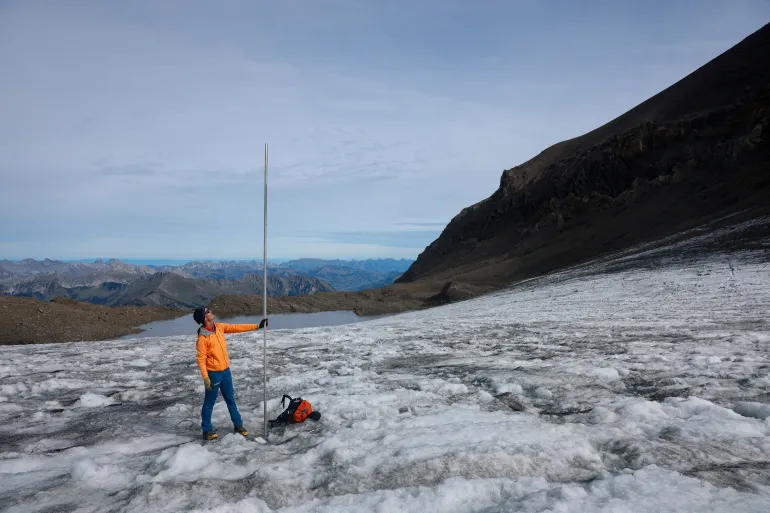
Swiss musician To Athena has performed inside a cave in a melting glacier to highlight accelerating ice loss in the Alps. Scientists say the Morteratsch glacier is shrinking by around 50 metres a year, with the cave itself unlikely to survive another summer as temperatures rise.

Source link

How much water lies underground? Scientists finally have an answer

For scientists, measuring the water in a river or a lake is relatively straightforward. It’s much more complicated to figure out how much water lies underground.

After years of research, a team of scientists has finally mapped what remains of these hidden waters across the United States, and they’ve produced the most extensive estimate of the country’s groundwater to date.

Researchers at Princeton University and the University of Arizona took data from about 800,000 wells and applied a machine-learning model to estimate the depth of the water table nationwide.

“Groundwater is out of sight and out of mind for most people,” said Reed Maxwell, a hydrologist at Princeton and co-author of the recent study in the journal Nature. “Knowing how much we have will be helpful in knowing how to use it wisely.”

They incorporated data on the geology of aquifers and estimated down to nearly 1,300 feet, far deeper than most wells.

You’re reading Boiling Point

The L.A. Times climate team gets you up to speed on climate change, energy and the environment. Sign up to get it in your inbox every week.

The scientists say their detailed map and data could help local decision-makers address overpumping from stressed aquifers, and help researchers estimate how much water has been depleted.

California has seriously depleted groundwater in the San Joaquin, Salinas and Cuyama valleys, Ventura County and other places, with some of the fastest rates of water decline in the world.

In parts of the Central Valley, where large farms draw heavily from wells, aquifer levels have plummeted. The U.S. Geological Survey estimates it has lost 128 million acre-feet, comparable to the volume of Lake Tahoe, since pumps started pulling it out in the early 20th century.

That was as of 2019, and water levels have continued to decline.

A map shows the depth of groundwater across the US. The West generally shows lower levels of groundwater.

(Yueling Ma et al. / Princeton University)

In the desert Southwest, the groundwater is largely considered “fossil water” because it took millennia to accumulate. So once it is pumped out, it’s in effect gone for good.

Even depleting small amounts of water can be a problem, said co-author Laura Condon, a University of Arizona hydrologist. “We see this in Arizona and in Southern California too, where long before you run out of water, you start disappearing wetlands, disappearing small tributaries.”

The total quantity of water underground is still immense. The scientists found nationwide there is roughly 250 billion acre-feet, or 13 times the volume of the Great Lakes.

Data compiled by lead author Yueling Ma show the Colorado River watershed has about as much groundwater as the volume of the Great Lakes, while California has about 70% of that.

Those are vast quantities, but the researchers said that definitely doesn’t mean there is plenty of water to recklessly use up. Declines in groundwater levels have in recent years caused household wells to sputter and run dry, streams and wetlands to dry up, and land to sink, damaging canals and levees. California’s database of dry wells shows about 6,000 have run dry since 2013, but in the last year, only 13 dry wells were reported. So that problem has slowed down for now. It could soon worsen again.

The new map shows groundwater varies widely across the country. In some places, you have to drill down 300 feet to reach it. In others, it’s just a few feet below the soil.

The map can help scientists studying where slow-flowing aquifers are feeding nature, nourishing streams and wetlands.

Jay Famiglietti, a hydrologist and professor at Arizona State University who wasn’t involved in the research, called the researchers’ map and estimates a “remarkable achievement for modeling and understanding groundwater” in the United States.

The scientists “convincingly show that it is now possible to simulate groundwater depths and availability at very high resolutions,” he said, and they have made their results “accessible and useful for water managers across the country.”

He said the research adds to satellite measurements that scientists now use to track shifts in water over time. What the country still needs, he said, is a “national-scale network of deep groundwater wells” to track the quantity and quality of water all the way down to bedrock.

More water news

Two years ago, Gov. Gavin Newsom announced a strategy to save declining salmon. Now, as Rachel Becker reports for CalMatters, members of the Winnemem Wintu Tribe say the state is ending its support for an effort to reintroduce endangered winter-run Chinook to waters upstream of Shasta Lake reservoir, and they feel betrayed.

The Trump administration recently announced it will spend $40 million to begin a plan to raise the height of Shasta Dam, which would expand California’s largest reservoir. As Camille von Kaenel reported for E&E News by Politico, dozens of environmental, fishing and tribal groups sent a letter to Newsom urging him to oppose the Trump administration’s renewed effort to raise the dam.

I followed up to ask Newsom’s office about the idea of raising Shasta Dam. “We aren’t getting distracted by conceptual projects, years from viability,” Newsom spokesperson Tara Gallegos said. Instead, she said the governor is focusing on getting the planned Sites Reservoir built northwest of Sacramento, which “will benefit regions throughout California and is much farther along towards construction.” Gallegos added that the state already is “a significant investor in the project, and the federal government should join us in ensuring this project comes to fruition.”

In the San Joaquin Valley, the Delta-Mendota subbasin has become the fourth farming area to avoid being placed on groundwater probation by state regulators. The State Water Resources Control Board voted this week not to impose enforcement measures on the area, Monserrat Solis reported for SJV Water.

More climate and environment news

The Trump administration has a budget proposal that calls for increasing military spending while slashing funding for clean energy and federal science programs. My colleague Hayley Smith wrote about the proposed cuts, which are strongly opposed by Democrats and environmental groups.

A wolf that captured national attention when she ventured into L.A. County earlier this year continues to make history. As Lila Seidman reports for The Times, it’s the first time a wolf has ventured into Inyo County in the Eastern Sierra in more than a century.

Imperial County supervisors voted to combine several parcels of land to clear the way for construction of a massive data center, which has faced opposition from residents who worry about the complex’s environmental footprint, Kori Suzuki reports for KPBS.

California’s last remaining nuclear power plant has received federal approval to run through at least 2030. My L.A. Times colleague Blanca Begert reports that the federal Nuclear Regulatory Commission has renewed Diablo Canyon Power Plant’s license to operate.

A couple more things

Los Angeles Climate Week started April 8, with a big lineup of community events running through April 15. Here is the full calendar of events, which include a day of activities along the L.A. River and an interfaith climate gathering.

PBS SoCal’s new season of its locally produced environmental series Earth Focus premieres April 22, Earth Day, at 7:30 p.m., with an episode focusing on how L.A. stadiums are taking steps to be more environmentally friendly.

This is the latest edition of Boiling Point, a newsletter about climate change and the environment in the American West. Sign up here to get it in your inbox. And listen to our Boiling Point podcast here.

For more water and climate news, follow Ian James @ianjames.bsky.social on Bluesky and @ByIanJames on X.

Source link

We solved the fire crisis 100 years ago, by the way

When I cracked open retired firefighter Bruce Hensler’s 15-year-old book, Crucible of Fire, I felt I had found an oracle.

Before 15 out of California’s 20 most destructive fires on record, Hensler described large chunks of cities burning to the ground, insurance companies jacking up premiums after realizing they wildly underestimated the risk and politicians failing to enforce the few fire safety rules on the books.

He even describes the fire chief of a decimated city criticizing city its politicians for failing to properly prepare for such a disaster, resulting in the city ousting the chief. (Sound familiar, Palisadians?)

Yet Hensler wasn’t trying to predict what would unfold in California’s wildland-urban interface in the 21st century. He was simply telling the story of the late 1800s and early 1900s in the Eastern U.S.’ downtowns of dense, wooden buildings.

Spoiler: Firefighters, policymakers, local advocates and, notably, insurance professionals figured out how to stop it from happening. Here’s how they did it.

You’re reading Boiling Point

The L.A. Times climate team gets you up to speed on climate change, energy and the environment. Sign up to get it in your inbox every week.

The Industrial Revolution, supercharged by the Civil War, transformed Northeastern cities into denser and denser wooden tinderboxes filled with tons of humans more than capable of accidentally generating sparks.

Fire departments, inspired by the war, were already reorganizing under a new paramilitary structure to more quickly and aggressively respond to blazes although most were still primarily volunteer-based. And beyond a few ad hoc fire safety laws that were scarcely enforced, cities’ building codes and water infrastructure naively lagged far behind the threat cities were creating.

So, cities started burning.

In 1866, a Fourth of July firecracker burned down much of Portland, Maine.

The destruction — more than $240 million in damage in today’s dollars — seriously spooked insurance companies focused on downtown industrial properties. Within days, they joined together to form the National Board of Fire Underwriters to try to stabilize their industry and promote fire-safety measures.

It wasn’t enough. A barn fire burned down Chicago in 1871 — more than $4 billion in damage in today’s dollars. A warehouse fire burned down Boston the next year — causing more than $1 billion in damage.

After the Boston fire, the board raised rates by 50% in large cities and began hurling ham-fisted threats to pull coverage altogether if cities didn’t get their act together and address their tinderbox problems quickly.

Over the next few decades, the board slowly got its own act together: It began collecting data on what caused cities to burn and funded a lab to run experiments. After Baltimore burned in 1904, the board released its own national fire-safety building codes based on that knowledge and created a grading scale to identify the risk of different cities based on their fire departments and water utilities as well as how closely their building practices aligned with the board’s building and electrical codes.

For politicians who dragged their feet because bolstering a water system or fire department is costly and designing a fire-safe building is, quite frankly, more cumbersome, the grading system made maintaining the status quo no longer viable — try explaining to your constituents that insurance rates in town are through the roof simply because the city won’t adopt the board’s new codes.

At some point, cities no longer burned down, only blocks or buildings did. As fire departments and cities continued to adopt new tech (with some pushing from the insurance industry) — motorized fire engines to replace horse-drawn ones, and later, smoke detectors and indoor sprinklers, then air tanks that allowed firefighters to enter buildings — fires didn’t often spread past a single floor or room.

These reforms, targeted mainly at commercial and industrial buildings in dense downtowns, largely missed the looming crisis in suburban residential areas that were slowly building themselves into a different kind of tinderbox that burned from the outside in.

In those areas, we’ve already seen many of the same dynamics play out: first the insurance rate hikes, then the cancellations. Now, some conversations and many heated debates — often driven by the insurance industry — are taking place around what we ought to do to protect our urban-wildland interface areas and how we can make them insurable again.

Organizations such as the Institute for Business & Home Safety play the role of the National Board of Fire Underwriters. Insurance wildfire models are starting to play the role of the grading scale, and policies such as Zone Zero, the national building codes.

As Hensler wrote in 2011, we now “accept building fires as commonplace but no longer expect them to consume adjacent buildings or blocks.”

It reminds me of a text Keegan Gibbs, who leads the Community Brigade program with the Los Angeles County Fire Department, sent me when I asked what he hopes to see in 10 years’ time: “neighborhoods where wildfire can move through the landscape without becoming a community-level disaster.”

More recent wildfire news

State Farm reached a deal with California last month to keep a 17% rate hike that took effect after the 2025 L.A. County fires, my colleague Paige St. John reports. The state initially rejected State Farm’s 22% rate hike request but eventually offered a temporary approval of the 17% hike last year. State Farm — which said it paid $6.2 billion in claims last year, largely from the L.A. County fires — said the increase enables the company to continue serving Californians.

A monthlong heat dome over the American West, fueled by climate change, has melted mountain snowpacks significantly this year, writes fellow Boiling Point host Ian James. With more time for vegetation to dry out, the early melting brings an increased risk of wildfire across the region this year.

In fact, acreage burned this year is nearly triple the 10-year average, reports Tim Casperson of newsletter the Hotshot Wake Up. The uptick has been fueled by a series of fires in Nebraska that has stunned many of the state’s ranchers as it decimated the hay that cattle rely on and stressed pregnant cows, reports Anila Yoganathan at the Flatwater Free Press.

A few last things in climate news

The U.S. Forest Service announced a major reorganization effort Tuesday that will move its headquarters from Washington to Salt Lake City, close research and development facilities in more than 30 states and shift management from broader regional offices to more localized state offices, reports Christine Peterson for High Country News. Former Forest Service employees and tribal leaders expressed concern that the move would uproot thousands of employees, scattering specialized regional knowledge. The chief of the Forest Service said the plan is intended to make the agency more “nimble, efficient, effective and closer to the forests and communities it serves.”

Gas prices in Los Angeles surged to $6 per gallon this week after the U.S. and Israel’s and the U.S.’s attack on Iran prompted the nation to close the Strait of Hormuz. However, California’s petroleum market watchdog is warning that some of the inflated price may be due to price gouging, my colleague Blanca Begert reports. In January, refineries were making 49 cents on the gallon, the watchdog group said; now, it’s closer to $1.25.

Honda is scrapping plans to build and sell three new electric-vehicle models in the U.S. after the Trump administration abandoned Biden-era policy goals to increase EV manufacturing and adoption, Dan Gearino reports for Inside Climate News. It comes after similar moves by Ford and Ram.

Finally, Heatmap News, in collaboration with MIT, has launched a new tool tracking electricity prices across the country on a month-to-month basis all the way down to the Zip Code level. You can check it out here.

This is the latest edition of Boiling Point, a newsletter about climate change and the environment in the American West. Sign up here to get it in your inbox. And listen to our Boiling Point podcast here.

For more wildfire news, follow @nohaggerty on X and @nohaggerty.bsky.social on Bluesky.

Source link

The Interior Department is making it hard to report on national parks

If I had a nickel for every time an editor has sent me an SFGate story and asked me to match it, I’d be at least a couple dollars richer. The San Francisco-based news website provides solid coverage of California public lands, especially our national parks.

So when my colleague Jaclyn Cosgrove told me the National Park Service had reportedly blacklisted SFGate, I wasn’t exactly shocked.

Recent SFGate stories have revealed efforts to limit which public lands employees can share information with the public, quoted critics of the Department of the Interior’s decision to end reservation systems at popular parks and detailed a litany of items that were previously offered at the parks but are now being reviewed for possible removal, thanks to an executive order to “restore truth and sanity” to American history, including books about Indigenous culture and educational materials for children.

You’re reading Boiling Point

The L.A. Times climate team gets you up to speed on climate change, energy and the environment. Sign up to get it in your inbox every week.

But over the past month, the National Park Service essentially stopped responding to inquiries sent by SFGate reporters on dozens of subjects, national parks bureau chief Ashley Harrell wrote last week. The outlet spoke with sources, reviewed internal communications and learned that an Interior Department spokesperson had instructed the National Park Service to ignore SFGate reporters, Harrell wrote. The blacklisting was apparently prompted by a Feb. 10 article on the Interior Department’s efforts to centralize control of park service communications.

I emailed the National Park Service to learn more. “Unfortunately, SFGate has distorted the facts and has caused confusion with their reporting with the mainstream media,” a spokesperson replied. “This has caused the Department to spend countless hours correcting their false narrative with other media outlets.”

Although the statement came from a park service email address, the wording is identical to a statement provided to SFGate by an Interior Department spokesperson.

I’ve also noticed changes in how the park service handles media requests over the past year or so. Some L.A. Times inquiries — about a coyote swimming to Alcatraz and a man charged with BASE jumping in Yosemite, for instance — received prompt replies.

But others — like questions about whether the park service is relying more heavily on seasonal employees amid a decline in permanent staff — went unreturned. And some — like an inquiry for a previous edition of a Boiling Point newsletter about an interpretive exhibit under scrutiny at Death Valley National Park — were fielded by a spokesperson for the Interior Department , rather than the park itself.

I’m not alone. When our wildlife and outdoors reporter Lila Seidman wrote about a wildfire that ripped through Joshua Tree National Park during last year’s government shutdown, she received responses from the Interior Department, but emails to the park service went unreturned.

Jack Dolan, an investigative reporter who often covers public lands, said he hasn’t received meaningful responses from the National Park Service since early last year.

And Cosgrove, who writes The Wild newsletter, said that park rangers remain friendly and helpful, but any communication involves a demand for all questions in writing.

Park service sources and advocates describe all this as part of a broader effort to centralize communications from sub-agencies to the Department of the Interior. Since last year, roughly 230 communications employees have been moved from the National Park Service to the Department of the Interior — part of a broader push in which more than 5,700 employees at the 11 agencies the Interior Department oversees were shifted from the agencies to the department, according to figures provided by the National Parks Conservation Assn., a nonprofit that advocates for the park system.

What’s more, the Interior Department must now approve many park service communications that were once left up to the parks themselves, said John Garder, senior director of budget and appropriations for the National Parks Conservation Assn. That includes exhibits, news releases, website updates and even social media posts, said a source within the park service who asked to remain anonymous over fears of retaliation.

The consolidation “creates significant inefficiencies and removes a layer of accountability to the parks themselves,” Garder said. “It makes it difficult for parks to act nimbly using their professional discretion to make decisions about informing the public about developments in the park,” like a closed road, wildlife hazard or natural disaster.

In an email to The Times, the park service accused National Parks Conservation Assn. employees of donating to Democratic political campaigns and pointed out the nonprofit’s X account follows progressive politicians and groups. “Our parks are nonpartisan, but the NPCA isn’t and they are using you to further raise money off of our parks while never giving those funds to our parks,” a spokesperson wrote in an emailed statement.

National Parks Conservation Assn.’s X account follows over 55,000 users of the platform, including both Democratic and Republican lawmakers and organizations. Garder also noted that the association’s longstanding role has been to advocate for national parks, rather than to raise money directly for them.

The park service email confirmed that officials are “modernizing” the Department of the Interior so that it “will share one voice when communicating the priorities of the Department.”

“The unification of the communication functions will allow for a more collaborative, creative and hands-on approach to Department communications,” the statement said, “and will modernize the federal government by providing a product that is not only better for the American taxpayer but also showcases the state-of-the-art communications capabilities of the United States of America.”

I asked whether I should attribute the statement to a spokesperson for the park service or the Interior Department. The spokesperson replied that I could attribute it to either.

A quick announcement

If you’re a Southern California local, you are probably familiar with PBS SoCal. On April 22, the public media organization is premiering the seventh season of the award-winning program “Earth Focus,” which will be followed by the eighth season in May. We’re excited for the eighth season in particular, because we collaborated with the PBS SoCal team on a few stories about the complexities of rebuilding Los Angeles. You can stream the show for free at pbssocal.org/earthfocus.

More recent land news

Karen Budd-Falen, the third highest-ranking official at the Department of the Interior, has been granted an ethics waiver to work on grazing issues despite potential conflicts of interests that prompted her to recuse herself from such matters during the first Trump presidency, according to Chris D’Angelo of Public Domain.

A pair of Republican senators have officially moved to overturn the management plan for Utah’s Grand StaircaseEscalante National Monument, casting uncertainty on its future and raising new questions about the future of public lands management, Caroline Llanes of Rocky Mountain Community Radio reports.

The Trump administration is aggressively expanding the border wall through ecologically sensitive public lands, with a portion planned for Big Bend National Park emerging as a political flash point, Arelis R. Hernández, Jake Spring, John Muyskens and Thomas Simonetti write in this Washington Post deep dive.

The Interior Department has officially pulled back more than 80% of its regulations tied to implementing the National Environmental Policy Act in a bid to streamline the environmental review process for major projects on federal public lands. Conservation groups say the changes will block public input and violate federal law, according to Hannah Northey and Scott Streater of E&E News by Politico.

The Trump administration is taking the final steps to undo the Public Lands Rule, which elevated conservation to an official use of Bureau of Land Management lands, Streater also reports. The rule allowed conservation groups to obtain leases for restoration work, similar to how the Bureau of Land Management awards leases to private contractors for extraction and development, points out Sage Marshall of Field & Stream.

Meanwhile, the U.S. Forest Service is expected to soon release an updated proposal for the rescission of the Roadless Rule, which blocked new road building and commercial logging on some 58 million acres of backcountry. The rollback would strike a big blow to hunting and fishing opportunities, according to a report from Trout Unlimited.

A few last things in climate news

Amid a global energy crisis that’s seen oil prices skyrocket, California has been particularly hard-hit due to a dearth of refineries and higher taxes and fees, all of which have left politicians, consumer groups and business interests arguing over who’s to blame, write Ivan Penn and Kurtis Lee for the New York Times.

In the latest maneuver in its campaign against renewable energy, the Trump administration will pay a French company $1 billion to walk away from two U.S. offshore wind leases, according to Jennifer McDermott of the Associated Press.

Southern California’s most destructive wildfires, wettest holiday season and hottest March heat wave have all taken place in the last 15 months, and there’s one clear through line connecting them all, scientists told my colleague Clara Harter.

Mosquitoes have gone year-round in Los Angeles, but business owners have indicated they’re not willing to pay to expand a promising effort to help control their numbers, my buddy Lila Seidman reports.

This is the latest edition of Boiling Point, a newsletter about climate change and the environment in the American West. Sign up here to get it in your inbox. And listen to our Boiling Point podcast here.

For more land news, follow @phila_lex on X and alex-wigglesworth.bsky.social on Bluesky.

Source link

Long before Trump: How US policy has harmed the environment for decades | Climate Crisis News

Health and environment advocacy groups in the United States are suing the Environmental Protection Agency (EPA) over the Trump administration’s decision to withdraw a key 2009 climate change ruling known as the “endangerment finding”.

That finding had established that greenhouse gases are a risk to public health and environmental safety, given that they are the primary drivers of climate change. It formed the legal basis for many regulatory policies aimed at curbing climate change.

When US President Donald Trump, who has called climate change a “hoax” and a “con job”, rescinded the declaration in February this year, the EPA supported the move, deeming it the “single largest deregulatory action in US history”.

The lawsuit, filed on Wednesday this week, alleges that the Trump administration’s decision will risk the health and welfare of US citizens.

“Repealing the Endangerment Finding endangers all of us. People everywhere will face more pollution, higher costs, and thousands of avoidable deaths,” Peter Zalzal, the associate vice president of clean air strategies at the Environmental Defense Fund, one of the plaintiffs, said in a statement.

Trump’s revocation of the endangerment finding is the latest in a series of steps he has taken to prioritise deregulation, boost fossil fuel production and reverse climate regulations.

But Trump is not the first US president to enact policy damaging to the environment. Here’s how decades of US policy have harmed the environment before he arrived in the White House

What is the ‘endangerment finding’?

The endangerment finding was established under the presidency of Democrat Barack Obama. It states that carbon dioxide and other greenhouse gases pose a threat to public health and welfare.

That ruling allowed the EPA under President Obama to move forward on policy aimed at limit the release of greenhouse gases in the US, Michael Kraft, professor emeritus of political science and public and environmental affairs at the University of Wisconsin-Green Bay, told Al Jazeera.

Under the endangerment finding, power plants were required to meet federal limits on carbon emissions or risk being shut down. This forced oil and gas companies to invest more to detect and fix methane leaks, curb flaring, and improve tailpipe and fuel‑economy standards to enable automobile companies to manufacture more efficient, lower‑emitting vehicles.

What does rescinding it mean?

“By allowing for increased pollution, these recent changes [by the Trump administration] will harm practically every single person on the planet,” Washington, DC-based policy researcher Brett Heinz told Al Jazeera.

“People living near fossil fuel facilities will be some of the most immediately affected, as they will be exposed to the new air and water pollution unleashed by deregulatory policies,” Heinz added.

Without the endangerment finding in place, the EPA has lost a key legal basis on which to limit greenhouse gas emissions, making it easier for coal plants, oil refineries and petrochemical complexes to run older, dirtier equipment for longer, expand without installing modern pollution controls, and emit more soot, smog‑forming gases and toxic chemicals into nearby communities.

Heinz explained that higher greenhouse gas emissions from burning fossil fuels in power plants, cars and industry as well as continued deforestation will also amplify the dangers posed by natural disasters. This is because increased warming exacerbates heatwaves, storms, floods and droughts, and raises sea levels – all of which turn existing natural hazards into more frequent and more destructive disasters.

“The only people who will benefit from these decisions are a small handful of wealthy fossil fuel executives and shareholders, who will see healthy profits while the world grows sick. These fossil fuel elites, many of whom contributed money to Trump’s presidential campaign, have now gotten a return on this investment,” Heinz said.

Experts say that Trump’s decision to entirely do away with environmental policy is unlike any president before him.

“The White House’s tidal wave of new pro-pollution policies is completely unprecedented. While past administrations have modified environmental rules, the second Trump administration is essentially trying to eliminate them entirely. So far, this has been the most radically anti-environmental presidency in American history,” Heinz said.

How have previous US presidents endangered the environment?

Trump is by no means the first US president to enact policy which is damaging to the environment, however.

Under Republican Theodore Roosevelt, who was president from 1901 to 1909, Congress passed the Reclamation (Newlands) Act of 1902, which treated land and rivers primarily as raw material for large infrastructure projects rather than as ecosystems in need of protection.

This was furthered by Democrat Harry Truman, who was president from 1945 to 1953 and pushed for rapid post‑war industrial and suburban expansion by commissioning the construction of interstate highways and promoting car‑centric development.

Under Republican Dwight Eisenhower, who was president from 1953 to 1961, the interstate highway system burgeoned, and the private car became a developmental priority in the US.

While Republican Richard Nixon, who was president from 1969 to 1974, signed key environmental laws, he also backed massive fossil‑fuel expansion. Under Nixon, the highly toxic herbicide, known as Agent Orange, was used by the US military during the Vietnam War.

Republican Ronald Reagan, who was president from 1981 to 1989, appointed people to the EPA and the Department of Interior who pushed for expanded oil, gas, coal and timber extraction on public lands.

To facilitate this, they favoured deregulation and industry interests, and rolled back existing environmental policy, slashing budgets for EPA enforcement of the Clean Air and Clean Water Acts, easing rules on toxic emissions and pesticides, and opening up more federal land – including wilderness and wildlife habitat – to oil, gas, mining and logging activities.

Republican George W Bush, who was president from 2001 to 2009, refused to ratify the 1997 UN-backed emissions reductions Kyoto Protocol and actively undermined global climate negotiations by formally withdrawing US support for Kyoto in 2001, appointing senior officials who questioned climate science, and pushing voluntary, industry-friendly approaches instead of binding emissions cuts.

While Obama, who was president from 2009 to 2017, introduced several landmark climate regulations, he also oversaw the fracking boom, making the US the world’s largest oil and gas producer, and locking in long-term fossil infrastructure.

Fracking, or hydraulic fracturing, involves blasting water, sand and chemicals into shale rock to release oil and gas, a process believed to cause methane leaks, groundwater contamination, heavy water use and increased local air pollution.

Democrat Joe Biden, who was president from 2021 to 2024, approved large fossil projects such as the Willow project in Alaska. This involved oil development on federal land in the National Petroleum Reserve, projected to pump hundreds of millions of barrels of crude over several decades.

Figures released by the the US Bureau of Land Management (BLM) suggested that the project would release 239 million to 280 million tonnes of greenhouse gases over its lifetime. The project, approved in 2023 and ongoing, was projected to continue for 30 years.

Biden also backed LNG export growth by approving new and expanded export terminals and long‑term export licences, allowing companies to lock into multidecade contracts to ship US gas to Europe and Asia.

Is this a partisan issue?

No.

“The failure of US policymakers to aggressively tackle global warming is not so much a Democrat versus Republican matter,” Steinberg said.

“It’s neoliberalism, a form of corporate freedom, that is the heart of the problem. A bipartisan consensus on the need for economic growth has led to a general trend toward weakening environmental regulations,” he added.

The US once led the world in conservation by creating an extensive national park system in the 19th century, Ted Steinberg, a history professor at the US-based Case Western Reserve University, told Al Jazeera.

“That was then. US corporate interests, especially the fossil fuel industry, combined with the one-party political system, in which both Republicans and Democrats indenture themselves to the business class, have caused the United States to drag its feet on global warming,” Steinberg said.

What is the history of Washington’s impact on the environment?

The US has historically been the largest contributor to global warming, experts say.

“As in most countries, US environmental policy has been a response to the problems caused by industrialisation and urbanisation, starting in the mid-19th century and proceeding from there, happening at the local, state and national levels,” Chad Montrie, a history professor at the University of Massachusetts Lowell, told Al Jazeera.

“Much of that policy has been limited and inadequate, especially when corporations were able to exert their influence, but in some cases, it has been ahead of what other nations were doing,” Montrie, who specialises in environmental history, added.

There was a time when environmental policy was bipartisan. The EPA was, in fact, created by Republican President Richard Nixon in 1970.

“It wasn’t until the rise of pro-business politics in the 1980s that Republicans like President Reagan took a hard turn against environmental protections,” Heinz said.

“The Democratic Party continues to believe in environmental protection and climate-friendly policies to some degree, while the Republican Party has become one of the few political parties worldwide that completely denies the scientific facts around climate change.”

How does this affect the rest of the world?

“US policy often sets the standards for policy in other parts of the world, both because of its cultural influence and because of the control that the US has over global bodies like the International Monetary Fund,” Heinz said.

“Right now, the US is actively pushing dirty fossil fuels on the rest of the world and even threatening some of its allies for trying to negotiate new environmental agreements.”

Heinz explained that this pressure, coupled with soaring energy prices, seems to have convinced Europe to retreat from some of their climate goals. Household electricity prices jumped by about 20 percent across the European Union between 2021 and 2022, according to Eurostat data.

Heinz said that if the latest United Nations Climate Change Conference, or COP negotiations are any indication, global climate ambition appears to be on the decline right now.

The latest conference concluded in November 2025 in Brazil with a draft proposal which did not include a roadmap for transitioning away from fossil fuels, nor did it mention the term “fossil fuels” at all. This drew rebuke from several countries attending the conference.

“So long as Donald Trump remains in office, the hope of future generations relies upon the nations of the world coming together and acting responsibly to preserve a healthy environment at a time when the United States has gone truly mad.”

Source link

At the 2026 Oscars, no one brought up climate change or the war in Iran

Almost exactly 10 years ago, Leonardo DiCaprio won a Best Actor Oscar (his first) for his performance in “The Revenant” as an early 19th century fur trapper who is injured in a bear attack, then by turns grudgingly kept alive, abandoned and left for dead by the avaricious hunting party he had been hired to lead.

In his acceptance speech at those 88th Academy Awards, DiCaprio first thanked the film’s cast and crew. He then pivoted quickly and forcefully to the environment. “The Revenant,” he said, was … “about man’s relationship to the natural world that we collectively felt in 2015, as the hottest year in recorded history.”

The rest of what he said is worth a big block quote; to read it today, the week after the 98th Academy, during which politics and policy both receded, is bracing.

“Our production needed to move to the southern tip of this planet just to find snow. Climate change is real, it is happening right now, it is the most urgent threat facing our entire species, and we need to work together and stop procrastinating. We need to support leaders around the world who do not speak for the big polluters, the big corporations, but who speak for all humanity, for the Indigenous people of the world, for the billions and billions of underprivileged people who will be most affected by this, for our children’s children, and for those people whose voices have been drowned out by the politics of greed. I thank you all for this award tonight. Let us not take this planet for granted. I do not take this award for granted.”

That year was something of a heady time for environmentalists. Barack Obama was in the middle of his second term as president of the U.S and though his climate and environmental policies were not especially progressive, in 2015 he did enact the Clean Power Plan, which had the stated goal of reducing carbon emissions locally, and “leading global efforts to address climate change” outside U.S. borders.

You’re reading Boiling Point

The L.A. Times climate team gets you up to speed on climate change, energy and the environment. Sign up to get it in your inbox every week.

Further, just a couple of months after the 88th Academy Awards, the U.S. would become one the 196 parties to sign onto the Paris Agreement, an international treaty to reduce the rise of global temperatures, whose terms had been negotiated the previous fall.

Fast forward 10 years. Donald Trump withdrew from the Paris Agreement in 2020. Joe Biden rejoined in 2021. Trump withdrew again just a few months ago. And in this second go at the White House, the Trump Administration has done everything in its power to tighten the knots tethering the U.S. to fossil fuels. It has literally forced owners of coal plants in Colorado and Washington State that want to shut them down to keep them open. Trump has fought tooth and nail in court to suspend wind energy projects that are fully permitted, under contract and under construction across the eastern seaboard. And his administration has rolled backed numerous efforts to keep climate change in check, like the allowance of state-specific fuel economy standards and the landmark fossil-fuel endangerment finding of 2009.

Meanwhile, that global temperature record that DiCaprio mentioned in his acceptance speech in 2016 seems almost trifling compared to what has happened since. It’s been surpassed six times. According to data from the National Centers for Environmental Information, the three hottest years on record are 2024, 2023 and 2025.

At the 98th Academy Awards, DiCaprio was nominated again for Best Actor — his sixth in that category — this time for “One Battle After Another.” The film, directed by Paul Thomas Anderson, won Best Picture. DiCaprio lost in his category to Michael B. Jordan, the lead of Ryan Coogler’s “Sinners,” so he didn’t have a chance to say anything about climate change.

But not a single one of the Oscar winners this year mentioned it.

Both “One Battle After Another” and “Sinners” were produced by Warner Brothers, which is about to be acquired by Paramount Skydance, which in turn is owned by David Ellison, the son of Larry Ellison, one the world’s wealthiest individuals and noted Trump supporter. Ellison the younger has already made decisions that have significantly defanged the climate coverage at CBS News — Paramount’s flagship news network — and it would not be shocking if CNN — part of the WB — is next.

Indeed, one of the defining characteristics of this show was its dearth of any language at the awards that could be considered political.

Instead of the fire we got from, say, Michael Moore in 2003, what we got was a sort of mea culpa from P.T. Anderson — who might be the definitional American Gen X director — in his acceptance speech for Best Adapted Screenplay:

“I wrote this movie for my kids to say sorry for the housekeeping mess that we left in this world we’re handing off to them. But also, with the encouragement that they will be the generation that hopefully brings us some common sense and decency.”

I harbor the same hopes, but it might require at least acknowledging the problems first.

More culture & enviro news

One thing that does give me some optimism is that the feted films themselves did a pretty good job acknowledging climate change. According to Good Energy, a consultancy group, of the 16 scripted features that were nominated for an Oscar and met the eligibility criteria, five passed the “climate reality check.” That’s pretty good!

Relevant especially for those facing the heat wave right now in L.A. and the rest of the southwest: a study published earlier this week in Lancet attempted to quantify how rising global temperatures will impact physical inactivity in different parts of the world. Chloé Farand summed it up for the Guardian, noting the researchers’ projection of 500,000 additional annual deaths due to inactivity by 2050.

Meanwhile, Libby Rainey at LAist wrote about how the city is preparing for the inevitable heat challenges that will accompany the World Cup games this coming summer.

This isn’t brand new — in fact, it references the reporting of my former colleague Sammy Roth — but Alexandra Tey over at the Nation has a nice roundup of sports fans protesting their teams’ financial ties to fossil fuel companies. It focuses on one of the most visible of these partnerships: Citi Field, where the New York Mets play, is named for Citi group, the world’s biggest lender to oil and gas companies.

A few last things in climate news this week

With gas prices skyrocketing due to the war in Iran, some Californians have been wondering why oil companies in the state can’t just start drilling more. My colleague Blanca Begert explains why it isn’t that simple.

The related big question is will the turmoil in the middle east push countries around the world to double down on renewable energy. In the New Yorker, Bill McKibben makes the case that this could be the moment that small clean tech — think solar panels, heat pumps, induction cooktops, etc — really takes off.

Finally, somehow, some 10 million tons of manure produced at California factory farms is unaccounted for. Seth Millstein, writing for Sentient, explains how lax regulation let farms dispose of 200 Titanics’ worth of animal waste without telling anyone where or how they did it.

This is the latest edition of Boiling Point, a newsletter about climate change and the environment in the American West. Sign up here to get it in your inbox. And listen to our Boiling Point podcast here.

Source link

‘How do I survive?’ Drought plagues Kenya’s Turkana amid surplus elsewhere | Drought News

Turkana, Kenya – In the relentless heat of Kainama in Turkana county, Veronica Akalapatan and her neighbours walk several kilometres each day to a half-dried-up well surrounded by the parched earth of northern Kenya.

The dug-out hole in the ground with a wooden ladder is the only source of water in the area. Hundreds of people from several villages – and their livestock – share the well, most waiting hours to fill up small plastic buckets with meagre amounts of unclean water.

Recommended Stories

list of 3 itemsend of list

“Once we get here, we dig for water in the well and collect fruit. We wait for the water to fill the well,” says Akalapatan. “We take turns to fetch it because there is so little. There are many of us, and sometimes we fight over it.”

In Turkana, the land is rugged, roads disappear into dust, and villages are scattered across vast distances in a county of just more than a million people.

Despite it being the rainy season, weather experts warn that Turkana and other arid regions may receive little relief.

Authorities say drought is once again taking place, with 23 of Kenya’s 47 counties affected. An estimated 3.4 million people do not have enough to eat, at least 800,000 children show signs of malnutrition, and livestock – the backbone of pastoral life – are dying.

In Turkana alone, 350,000 households are on the brink of starvation.

“We are suffering from hunger,” Turkana elder Peter Longiron Aemun tells Al Jazeera.

“We don’t have water. Our livestock have died. We have nothing. We used to burn charcoal, but there are no acacia trees any more.”

Kenya is still recovering from one of its worst droughts in 40 years, which gripped the country between 2020 and 2023. The new weather crisis will likely make things worse.

But at the same time, experts note a stark paradox: Scarcity amid abundance.

Kenya
Veronica Akalapatan at the bottom of a hand-dug well after collecting water in Turkana county [Allan Cheruiyot/Al Jazeera]

Food loss and food waste

While families face acute water shortages and hunger – with boreholes broken down, and wells and streams dried up – Lake Turkana’s water levels have risen in recent years, displacing some shoreline communities.

In other areas, sudden heavy rains trigger flash floods in normally dry riverbeds – known locally as luggas – yet the land remains largely barren. The water comes too fast, runs off too quickly and cannot sustain agriculture.

At the same time, while droughts lessen food supplies and global donor funding cuts have reduced food aid, not too far away, experts say, there is a surplus of food that does not make its way to those who need it.

“In Kenya, a quarter of the population faces severe food insecurity, even as up to 40% of the food produced is lost or wasted each year,” according to a September report by the World Resources Institute (WRI).

Food loss occurs on farms, and during the handling, storage and transportation of supplies, while food waste occurs in households, restaurants and in the retail sphere, WRI researchers noted.

In parts of the North Rift – one of Kenya’s breadbaskets – farmers have recorded good harvests. But high prices and widespread poverty mean pastoralist families in Turkana cannot easily afford food transported from surplus regions.

Security adds another layer of strain. Competition over water and pasture fuels tensions, cattle raids persist, armed bandits operate in remote areas, and security forces struggle to contain violence amid logistical and political challenges.

“The biggest problem in drought areas is security,” says Joseph Kamande, a food trader in Wangige in central Kenya.

Still, he believes the country has the potential to feed itself with better planning.

“The land is vast. Some of it is arable,” he says, adding that “water is the solution.”

Untapped aquifers

In Turkana, though there is severe drought, there are also untapped natural resources.

Hundreds of metres underground are multiple aquifers, layers of rock and soil containing water. The government is hoping to tap into these sources.

In 2013, two major aquifers were discovered, the Napuu aquifer and the Lotikipi aquifer. The largest covers roughly 5,000km (3,100 miles) and holds about 250 trillion litres (66 trillion gallons) of water.

It is said to have the capacity to supply Kenya with water for decades.

However, much of the water is salty and expensive to purify, so the project has stalled.

“The big challenge is salinity,” says Turkana County Water Director Paul Lotum.

“The national government and partners are mapping out pockets where water is safe and reliable. We are working bit by bit to harness it for communities.”

Until then, relief food remains essential for Turkana communities.

The government’s disaster management teams and other agencies are distributing water and food. But supplies are stretched thin. And getting aid to those who need it most is nearly impossible in some areas.

“Most government organisations are either closed or running leaner programmes,” says Jacob Ekaran, Turkana’s coordinator for the National Drought Management Authority.

“The resource basket has shrunk. But the government is trying to do more with what it has.”

Kenya
A resident of Turkana displays wild berries collected for food in Loima, Turkana county. Families say the bitter berries have little nutritional value but are now a primary source of sustenance amid prolonged drought [Allan Cheruiyot/Al Jazeera]

‘I can’t find food’

When supplies run low, many people turn to wild berries and fruits.

In Lopur village, resident Akal Loyeit Etangana harvests berries that she then cooks in a small pot over an outdoor fire.

She says she has not had a proper meal in two weeks, so the fruit mixture keeps hunger away. Still, it carries almost no nutritional value.

“If it doesn’t rain, trees and leaves dry up. There is no water,” she laments, adding that clinics are also very far away and people have to walk long distances to get help.

In another village, Napeillim, resident Christine Kiepa worries that there is no food.

“I try to look for food. Sometimes it’s not there,” she says. “If I can’t find food, how do I survive?” she asks.

Villages in the region are slowly emptying. Male herders, who are usually the providers for their families, have moved to neighbouring counties in search of pasture and water for their dying livestock.

Only the elderly, women, young children and the weakest animals remain in the homesteads.

Still, there have been some gains in the region.

Since Kenya adopted a devolved system of government in 2013, Turkana has seen new schools and health centres built, irrigation schemes launched, boreholes drilled, and some roads tarmacked. Officials say investments in drought response have strengthened resilience.

“In the past, drought always degenerated into disaster. You would see reports of deaths,” says Ekaran from the drought management authority. “We are coming from one of the worst droughts in 40 years, but we did not record deaths. That is because of resilience building.”

Painful cycle

For generations, northern Kenya’s nomadic communities have depended on livestock. But climate change is forcing a reckoning. Calls for diversification – irrigation, drought-resistant crops and trees, large dams – have grown louder.

“We can change our community mindset,” says Rukia Abubakar, Turkana coordinator for the Red Cross.

“We can plant drought-resistant trees. We can do irrigation. Our soil is good for crop farming.”

These proposals are not new. They have surfaced after every drought, repeated in policy papers and political speeches.

Yet for many people in Turkana, the cycle feels painfully familiar and daily survival remains precarious.

Back in Kainama, Akalapatan and her neighbours walk back from the water well through the vast, arid landscape, carrying a collection of filled yellow plastic buckets.

They finally return to their small community of thatched huts.

Akalapatan has managed to collect 20 litres (5 gallons) of water for her family for the day.

Her son eagerly fills a cup and gulps it down.

But she knows that what she has is barely enough for everyone, and she will soon have to make the journey to the well again.

Source link

At least 64 killed, dozens reported missing in Ethiopia landslides, floods | Floods News

Authorities have said most of those who died were found buried in mud.

The death toll from landslides and flooding in the Gamo Zone of southern Ethiopia has risen to at least 64, with dozens more people missing, police have said.

“The number of people missing due to the recent flood in Gamo zone has reached 128, and according to the latest information, 64 bodies have been found,” said the South Ethiopia Regional State Police Commission in a statement on Facebook on Thursday.

Recommended Stories

list of 3 itemsend of list

The Gacho Baba district communication chief, Abebe Agena, said most of those who died were found buried in mud. It is not yet clear how many households were affected.

Gamo Zone director of disaster response Mesfin Manuqa said that one person was pulled out of mud alive during rescue operations.

Tilahun Kebede, president of the South Ethiopia Regional State, expressed his sorrow over the disaster and urged residents to move to higher ground as rains continue.

“Given that it is the rainy season and these types of disasters could happen again, I am calling on communities living in the highlands and flood-prone areas to take the necessary precautions,” he said.

Flooding caused by heavy rains has led to the deaths, with most of East Africa seeing heavy flooding in recent days.

Dozens were killed in neighbouring Kenya after torrential rain hit the capital, Nairobi, and other areas on Friday.

Mudslides and floods caused by heavy rainfall are common in Ethiopia, especially during the rainy season.

In July 2024, a deadly mudslide caused by heavy rain killed more than 250 people in southern Ethiopia.

Multiple studies have tracked the increasing frequency of extreme wet and dry periods in East Africa in the last 20 years.

Scientists have long warned that human-driven climate change is increasing the likelihood, length and severity of severe weather events such as torrential downpours.

Source link

‘Slow TV’, like Jackie and Shadow’s live cam, may be an antidote to turbulent times

Erin Wagner lives in the Chicago suburbs but visits two bald eagles in Southern California’s Big Bear Valley nearly every day.

At work, the 41-year-old often plays a livestream featuring Jackie and Shadow on one of her monitors — a respite when she needs a break.

The avian power couple follows her home, keeping her company as she cooks dinner.

“We live in such a busy world, and things are always being thrown at our face, so sometimes it’s nice to just have a gentle reminder of nature and what else is out there in the world,” Wagner told me last week.

You’re reading Boiling Point

The L.A. Times climate team gets you up to speed on climate change, energy and the environment. Sign up to get it in your inbox every week.

By continuing, you agree to our Terms of Service and our Privacy Policy.

She is just one of many devoted fans; the eagles had the highest view count of any year-round nature livestream active on YouTube between last fall and this spring, said Rebecca Mauldin, an assistant professor at the University of Texas at Arlington who studies social connectedness.

While the eagles’ following is singular, it’s part of a broader trend: surging interest in webcams that broadcast nature, unadulterated, minute by minute, in all its messy glory.

The number of 24/7 livestreams created per year swelled by about 3,000% between 2019 and 2025, Mauldin’s data show.

Jackie and Shadow’s livestream exemplifies “Slow TV,” a genre that began with a 2009 Norwegian broadcast of a seven-hour train trip. It took off, with other marathon programs featuring chopping firewood and knitting.

Nature looms large in the format. Millions tune into Sweden’s live coverage of an annual moose migration, and the same goes for a seasonal broadcast of bears chowing down on salmon in Alaska.

The appeal makes intuitive sense. In a world of quick camera cuts, sound bites and troubling headlines, Mother Nature’s rhythms can be a salve. And with many of us wound up in concrete urbanity, the livestreams offer instant transportation to the wild.

Following Jackie and Shadow takes patience. If they’re not hanging out at the nest, it’s a waiting game until they come back. Even when they’re there, there may not be much going on.

Entertainment “can be very artificial, it can be very packaged, and it can be very short,” said Jenny Voisard, media manager for Friends of Big Bear Valley, the nonprofit that operates the cameras broadcasting the eagles. “This is long and slow and calm.”

Yet nature is unpredictable, another draw for viewers. This nesting season alone has brought plenty of drama, from the lovebirds losing their eggs to ravens to laying more not long after. Last week, I wrote about the couple’s shocking origin — it involves a love triangle! — and their rise to reality stardom.

Last year, Jackie and Shadow raised two chicks that fledged: Sunny and Gizmo

Last year, Jackie and Shadow raised two chicks that went on to fledge: Sunny and Gizmo

(Friends of Big Bear Valley)

Research backs the vibes. Those who watch nature livestreams — from platypi to osprey — report a host of benefits, from uplifted mood to relaxation, said Mauldin, citing a literature review she-coauthored.

Others get jazzed about learning about a particular species, she said.

There may be limitations, though.

In terms of connecting to nature, “I lean toward the effect is stronger if you’re actually outdoors, or, you know, you’ve got a little ant crawling on your finger and watching it,” Mauldin said.

She highlighted another dimension I didn’t think of: Many “talk about how they’re developing strong online relationships, and you can see it in the chats or in the comments.”

Someone might comment that they had a bad day and are glad to be watching their favorite birds again, and another viewer will rally to support them. Then there are people who watch on their own, but gab about it later with a friend.

Friends of Big Bear Valley, with 1.2 million followers on Facebook, offers more than just updates on the eagles. It’s a buzzing community center where fans can share their thoughts and engage with one another.

Animals may also get something out of being watched: protection.

The eagle cam, for example, “sort of stokes the public’s imagination and interest in conservation,” said Thomas Leeman, deputy chief of the U.S. Fish and Wildlife Service’s migratory bird program in the Pacific Southwest. “They start to really care about whichever particular birds that they’re watching.”

Wagner, of Chicago, said her husband and 14-year-old son sometimes give her a hard time about how invested she is in Jackie and Shadow.

But her cat, Oscar, shares her fascination.

She recently posted a photo of the feline on Jackie and Shadow’s Facebook — looking intently at a TV where an eagle hunkered down on the nest.

“My new cat is just as obsessed as all of us,” she wrote.

More recent wildlife news

Big Bear’s celeb eagles continue to keep us on our toes. Jackie recently vanished from the nest for nearly 24 hours, sending fans into a panic — but eventually reunited with her eggs and mate, reports USA Today’s Michelle Del Rey.

While we’re on the subject of avian kind: Last week, I wrote about a pair of condors that appear to be nesting in Northern California, something not seen for a century. The Yurok Tribe is leading the effort to bring the large, endangered vultures back to their historic homeland in Humboldt and Del Norte counties.

As conservationists celebrate that win, the story for birds nationwide is not so rosy. A recent study found that North America is rapidly losing birds, and the loss is accelerating, largely due to intensive agriculture and warming temperatures, writes the Associated Press’ Seth Borenstein.

A few last things in climate news

Trump’s war on Iran has disrupted global oil and gas supplies. The conflict has kept ships that carry millions of barrels of oil a day stranded in the Persian Gulf, and key Middle East facilities have sustained damage, reports the Associated Press.

Oil prices have spiked, and Californians are paying the highest price at the pump in the nation. As my colleague Iris Kwok explains, that’s due to the state’s higher taxes and stricter requirements for cleaner, more expensive gas that pollutes.

Sticker shock at gas stations is expected to spur more Americans to consider hybrid or electric vehicles, according to fellow Times staffers Caroline Petrow-Cohen and Blanca Begert.

Meanwhile, the U.S. Department of Justice has released a legal opinion that sets the stage to approve a controversial oil operation off the Santa Barbara County coast, The Times’ Grace Toohey reports.

This is the latest edition of Boiling Point, a newsletter about climate change and the environment in the American West. Sign up here to get it in your inbox. And listen to our Boiling Point podcast here.

For more wildlife and outdoors news, follow Lila Seidman at @lilaseidman.bsky.social on Bluesky and @lila_seidman on X.

Source link