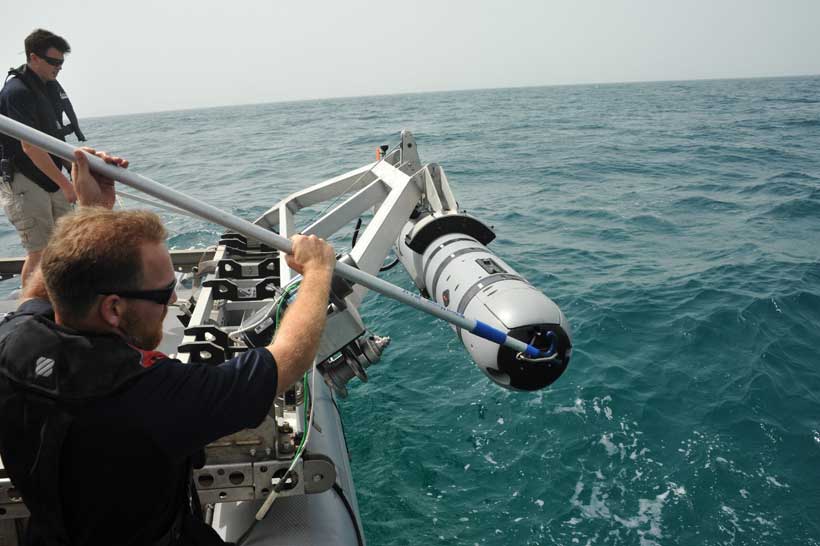
Inside a hangar located near a motorway and a port, sleek fiberglass unmanned attack boats, resembling oversized canoes and painted naval grey, await engine fitting. These boats, initially built by Ukrainian special forces, have been effective in pushing the Russian Black Sea Fleet from nearby waters. If conflicts intensify in the Middle East between Israel and the U. S. and Iran, these British boats may be deployed. Such vessels are increasingly recognized as the future of naval warfare, as well as suitable for various offshore roles like search and rescue.
The manufacturing facility belongs to Kraken, a fast-expanding British defense company that has secured a contract to supply 20 small attack boats to Britain’s Royal Navy and has other agreements with U. S. Special Operations Command. Fueled by venture capital, similar companies globally are producing autonomous attack craft essential for potential conflicts, such as a Chinese invasion of Taiwan or NATO actions against Russia in the Baltic. Kraken offers various drones; the 8.5-meter Scout Medium is highly popular, though it hasn’t confirmed whether any of its boats have been used in the Middle East or Black Sea.
The U. S. military has deployed similar boats like the Global Autonomous Reconnaissance Craft in Gulf operations. U. S. Central Command has been testing unmanned vessels for years, while European nations have advanced their skills with NATO’s Task Force X-Baltic. These vessels, whether autonomous or remotely operated, can carry weapons and surveillance tools, showcasing the rapid evolution of naval warfare, as evidenced by Iranian attacks on commercial ships.
Heavy jamming in Ukraine and the Gulf has led to challenges in keeping remote human-piloted systems operational and has shifted focus towards developing autonomous systems that do not require a communication link. Reports indicate that there were several problems in last year’s tests of these autonomous systems, which is not surprising given the contested regions like the Black Sea and Baltic Sea. Currently, the British Royal Fleet Auxiliary vessel Lyme Bay is expected to load drones for potential mine clearance in the Gulf, but only when the conflict ends and it is safer to operate such craft.
If this mission proceeds, it would highlight the reduced number of functional warships in the UK’s financially constrained navy and showcase changes in military technology. However, experts do not believe that vessels built by companies like Kraken will completely replace traditional warships, despite the reminder from Trump’s “armada” of the significant power that traditional ships hold. Notably, U. S. commanders have deployed these vessels away from battle zones to reduce risks.
Kraken claims it can produce as many as 500 remote-controlled vessels within the current year, with plans to double that by 2027 through partnerships with shipyards in Germany and the Pacific region. Kraken’s founder, Mal Crease, aims to establish a leading maritime offshore systems manufacturer by applying his experiences from Formula One racing and high-performance offshore boats. He acknowledges the complexities of producing quality systems amid conflict while also striving to mass-produce boats in peaceful environments.
Kraken’s team utilizes modular construction to rapidly assemble a variety of vessels by hand, similar to how supercars are made, allowing for quick scale-up in production. However, uncertainties about military spending in the UK remain, with ongoing debates regarding the Defence Investment Plan and budget allocations between the prime minister and the Treasury.
A broader trend is evident as new defense firms such as Kraken and others emerge, differing from traditional defense contractors like Lockheed Martin and BAE Systems, which are known for long development times and high costs. Newer companies, some less than two years old, are more agile and focused on producing weapons systems quickly and affordably.
Many former military personnel are now working with these companies and engaging with clients in various countries, including Ukraine, which is both buying and manufacturing these systems. Reports suggest that missile supplies, like the Tomahawk and Patriot missiles, are dwindling, while drone manufacturers expect to produce hundreds of thousands or even millions of systems annually. Ukraine, in particular, has rapidly grasped the importance of these new technologies and has been sharing its expertise with nations in the Middle East. Conversely, Western nations outside the conflict have been slower to adapt, but some firms are already making swift advancements.
With information from Reuters