Eurozone annual inflation accelerated to 3.8% in September, up from 3.2% in August and above market expectations of 3.6%, according to preliminary estimates.
Core inflation, which excludes energy and food, rose to 2.5% from 2.4%, in line with expectations.
Lighter regulation and excess capital are setting up the biggest U.S. banking wave since the 2008 crisis.
The U.S. banking industry is bracing for its most significant wave of consolidation since the 2008 financial crisis, according to a new Bain & Co. analysis.
The firm expects the number of trillion-dollar U.S. banks to grow from the “Big Four” — JPMorgan Chase & Co., Bank of America Corp., Citigroup Inc., and Wells Fargo & Co. — to as many as seven by 2030. Key drivers include lighter regulation, burgeoning tech and 17 global banks holding over $10 billion each in excess capital. That capital cushion, Bain argues, will lead to a spike in M&A activity.
Banco Santander SA’s August acquisition of Webster Financial Corp. serves as an early example of what could be in store for U.S. banking giants. For Joe Lischwe, a partner in Bain’s financial services and customer strategy practice, the deal illustrates how capital-rich banks are leveraging eased regulatory conditions to combine geographic scale with targeted scope. In this scenario, Santander gets Webster’s health savings account franchise.
“We think there’s a window within this current [Trump] administration over the next two to three years where this will continue to be accelerating,” Lischwe told Global Finance on a call. “You will see more consolidation over the next few years.”
A Capital-Rich Setup
Seventeen U.S. banks currently hold more than $10 billion in excess capital — a figure Lischwe said Bain compiled from a mix of public quarterly filings and third-party data sources, including Refinitiv.
Bain also found that total bank M&A deal value rose 19% in 2025 and is up another 7% so far this year.
“There’s been an uptick in the actual deal value that has been occurring,” Lischwe added. “But I think, probably, the biggest tailwind is from a regulatory perspective.”
The Trump administration continues to move on multiple fronts that matter most to M&A-hungry banks, the latest being on Sept. 17 when the Federal Deposit Insurance Corporation’s (FDIC) proposed new guidelines to make bank mergers easier and faster to approve.
Scale vs. Scope
Not all acquisitions are created equal, according to Bain’s framework, which sorts bank deals into two categories. “Scale” deals expand a bank’s existing footprint — deposits, branches and geographic reach — and generate value primarily through cost synergies.
“Scope” deals, meanwhile, bring in capabilities the acquirer doesn’t already have. Bain predicts that these blended scale-and-scope deals will emerge as the standouts. Capital One Financial Corp.’s acquisition of Discover, which gave Capital One a payments network it previously lacked, produced outsized total shareholder returns on a two-year basis, Lischwe said.
Fifth Third Bancorp’s purchase of Comerica, by contrast, was a more traditional scale play — consolidating similar deposit and branch businesses — without adding new capabilities.
“In general, we were seeing that blended deals, on average, performed better,” Lischwe said. “That’s not to say that scale deals don’t do well.”
The Fintech Integration Trap
Bain’s advice to bank executives is to first conduct a rigorous self-assessment across six dimensions — financial scale, geographic density, business mix, product capability, technology and liquidity — before approaching an acquisition target.
“The answer is not to buy more fintechs,” Lischwe said. “The answer is to know your gaps, diligence those gaps, and then consider every asset that helps you close those gaps.”
Nowadays, fintechs tend to outpace incumbent banks in artificial intelligence, data, payments, blockchain and digital assets — areas that could tempt banks to leapfrog years of in-house development. But evaluating those targets is harder than buying a similar-sized bank, Lischwe said. A fintech operating in an unfamiliar capability area is more difficult to underwrite than a competitor running the same core business.
That complexity introduces significant execution risk for buyers looking to acquire growth quickly.
Winners, Losers, and the Case for Consumers
Jeff Barrington, Windsor Drake
Jeff Barrington, Managing Director at tech and payments sell-side advisory firm Windsor Drake, cautions that banks frequently misjudge these acquisitions on several fronts.
“Banks buying fintechs tend to get tripped up in four ways: they pay a growth multiple for revenue that was acquisition cost-fuelled and doesn’t survive inside the bank, they underestimate the cost of bolting a modern stack onto a legacy core, they lose the founders and engineers once the earnout vests, and they misprice the regulatory and partner bank risk that comes attached,” Barrington said. “The recurring error is buying what looks like a growth company and ending up with a bank-owned product that stops growing.”
There’s also the risk of a more concentrated banking landscape: fewer banks means higher fees and diminished access to the kind of relationship-based banking that small towns and entrepreneurs rely on.
Barrington added that while scale can fund improved pricing and technology for users, “consolidation consistently narrows choice, closes branches and thins out relationship lending.
Yes, but …
Banks that fail to acquire or build the AI, data and digital capabilities that are currently reshaping the industry risk falling behind competitively.
“Those [banks] that will be successful are those that will be really ruthless about what are our capability gaps, what can we close inorganically, doing the proper diligence and then properly integrating it,” Lischwe added.
Capital One-Discover, Fifth Third-Comerica and Santander-Webster are recent deals that, so far, have held up. Whether pricier, more speculative targets — he cited digital banking upstart Revolut as an example of an asset banks are watching, despite its rich valuation — get bought will depend on whether acquirers can underwrite a clear strategic fit and value-creation case.
As for whether a change in political control in Washington could derail the trend, Lischwe remains skeptical.
“The regulatory tailwind is going to last,” he said, “through this administration and even into the next one.”
Anthony Noto covers corporate finance and private credit. Contact him at anoto@gfmag.com
France is accelerating work on the Rafale F5 standard, bringing forward development of a major new configuration of its combat aircraft at a time when the country’s planned next-generation fighter with Germany has effectively collapsed in its original form. The contracts cover the equipment judged to have the highest technical risk, ahead of the overall development contract for the F5 standard, expected for the end of this year.
The French defense procurement agency, the Direction générale de l’armement (DGA), ordered the first upstream development work for F5 from Dassault Aviation, Thales, MBDA, and Safran. The contracts cover key areas including navigation, datalinks, radar, electronic warfare, and propulsion, laying the groundwork for the next configuration of the Rafale, which is planned to enter service with the French Air and Space Force and the French Navy starting around 2033.
The most extensive modernization of the Rafale yet, the F5 standard was originally part of a longer transition toward France’s next-generation combat-air capability. But with the Franco-German New Generation Fighter (NGF) effort now effectively dead in its original configuration, the accelerated F5 program is taking on a much larger strategic role.
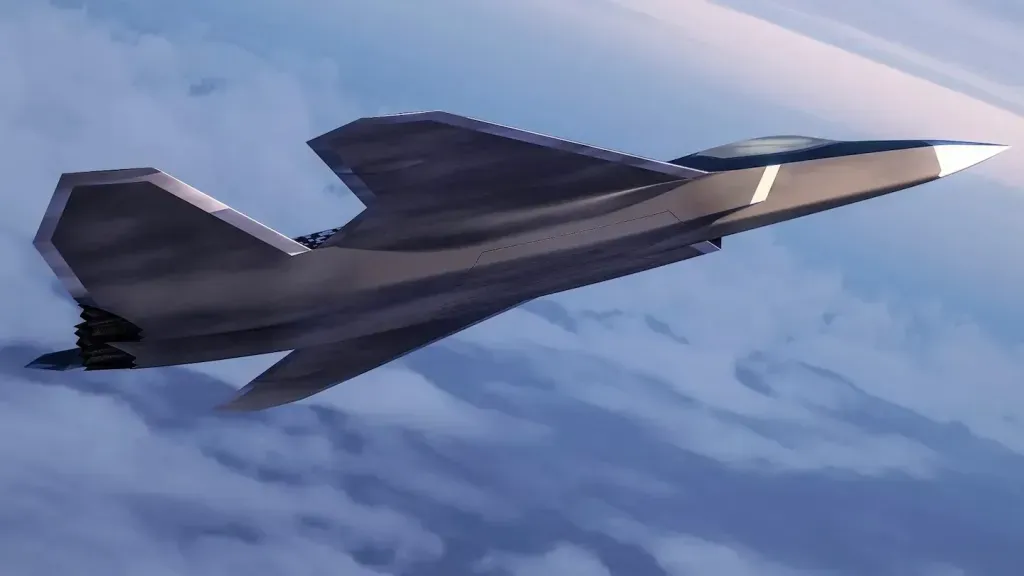
Concept artwork of the NGF future fighter. Dassault Aviation
Rather than simply keeping the Rafale relevant until NGF arrives, France is now developing a version of the aircraft that is set to carry much of the country’s high-end combat-air capability well into the 2030s and potentially beyond.
The increasingly capable F5 could, in turn, reduce the urgency of finding a replacement for the Rafale — while potentially adding to the fighter’s export appeal. After a slow start, Dassault has recorded export sales of 299 new-build Rafales to eight nations.
The DGA’s contracts engage four of France’s principal combat-aircraft industrial players. Dassault Aviation remains responsible for the aircraft and its overall integration; Thales is involved in major sensor, electronic warfare, and communications capabilities; MBDA is responsible for much of the weapons system; and Safran is responsible for propulsion.
The Rafale assembly line at the Dassault Aviation facility in Mérignac, France. Dassault Aviation – V. Almansa ALMANSA
Previous Rafale standards have largely consisted of incremental upgrades, focusing on software and other improvements to the existing aircraft configuration. F5 is notably more extensive, addressing many of the critical systems that determine how the aircraft senses the battlespace, communicates with other platforms, conducts electronic warfare, and generates the power needed to operate increasingly demanding equipment.
The DGA has specifically identified the Thales RBE2-XG radar as one of the major technological advances associated with F5.
The RBE2-XG is expected to feature gallium nitride (GaN) semiconductors. Compared with previous technology, GaN generates less heat and has the capacity to operate at higher voltages, meaning that output power can be increased, while component size can be reduced. Overall, using GaN should help to get more power out of the radar without increasing its size.
According to the DGA, “This new radar will benefit from a substantial increase in power, and consequently in detection range, as well as improvements in the identification of targets with an extremely low radar cross-section (RCS). Its computing capabilities will also be enhanced to facilitate the integration of artificial intelligence.”
The RBE2-XG will also be “designed with collaborative combat in mind, featuring sensors capable of working together without the need for pilot intervention.” It is also planned to have enhanced resilience, including against cyber threats.
France is already working on the concept of a combat drone to accompany the Rafale, with the future F5 standard providing the crewed aircraft around which those systems can operate.
A Rafale during a test mission with a Dassault nEUROn combat drone demonstrator. Dassault Aviation – A. Pecchi
The new radar will be combined with more capable electronic warfare equipment, improved communications and datalinks, expanded processing capacity, and a more capable propulsion system.
To be developed by MBDA and Thales, the forthcoming F5 version of the SPECTRA self-protection suite is intended to significantly improve detection and jamming capabilities, the DGA says, “through a fully digital approach, enabling a complete overhaul of the core electronic warfare system to counter the increasing density and broadening of the threat spectrum, as well as the growing complexity of threat waveforms, expected by 2035.”
Thales à bord du Rafale de Dassault Aviation
Thales will also be responsible for the new Inter-Vehicle Data Link (IVDL) system, described as a “stealthy and resilient datalink.” The DGA says the new datalink will expand connectivity “thanks to a new high-speed, discreet, and jamming-resistant waveform. IVDL will allow the Rafale to penetrate hostile areas where jammers are widespread, while maintaining optimal quality of communication and dialogue between aircraft.”
Safran will begin preliminary design work on the M88 T-Rex engine, which is planned to increase the turbofan’s thrust from around 16,500 pounds to nearly 19,850 pounds, an increase of roughly 20 percent.
M88 T-REX: A 9-ton thrust predator serving the Rafale
In terms of armament, the contract announcement mentions the ASN4G missile, set to be introduced to service by 2035, which will allow the Rafale F5 to continue to serve as the airborne nuclear component. The munition remains in the early stages of development, but it will be capable of hypersonic speeds — defined as speeds greater than Mach 5 — with a range in excess of 1,000 kilometers (621 miles).
Other likely new missiles include a beyond-visual-range air-to-air missile to succeed the current Meteor. As you can read about here, France’s Comet program, apparently led by the French side of MBDA, is already looking into this requirement, with an apparent plan to introduce the weapon around 2030.
An older video from MBDA showing some of the company’s weapons integrated on earlier versions of the Rafale:
PARIS AIR SHOW 2021: MISSILES ON THE RAFALE
For France, the original logic behind the pan-European FCAS program was that Rafale would eventually give way to the NGF as its principal crewed combat aircraft, operating from land bases and aircraft carriers.
With the collapse of the Franco-German effort, France cannot simply wait for a next-generation fighter program whose industrial and political future is uncertain. Instead, the Rafale has to remain capable against rapidly evolving threats throughout the 2030s and beyond.
With the F5 standard, however, France is looking to incorporate some of the concepts envisaged for NGF. These include distributed architectures in which crewed fighters, uncrewed aircraft, remote carriers, missiles, and offboard sensors cooperate across a battlespace.
The nEUROn drone and a Rafale M in flight over the aircraft carrier Charles de Gaulle, during tests to investigate the use of a UCAV in a naval context. Dassault Aviation – A. Pecchi
For now, F5 also sidesteps the central problem in the now-defunct Franco-German effort: whether the two countries could agree on the requirements, industrial structure, and workshare behind a new-generation combat aircraft.
Despite its advances, the F5 airframe remains derived from a design dating back to the 1980s, which first entered French service in the early 2000s. In particular, it falls well short of fifth-generation designs — let alone sixth-generation ones — in terms of low observability. This is one area where collaborative drones could potentially help compensate for the Rafale’s inherent limitations.
France has therefore bought itself some time with the F5 program. But it may eventually decide that it needs a future high-end crewed fighter to provide capabilities that an upgraded fourth-generation airframe cannot fully replicate, particularly in terms of survivability against advanced integrated air-defense systems, signature reduction, internal weapons carriage, and operations deep inside heavily contested airspace.
On an industrial level, F5 is also significant because it brings together the same French industrial heavyweights that would have formed the backbone of its FCAS effort. Dassault Aviation, Thales, Safran, and MBDA are now well-positioned to work together on whatever comes after F5, whether that is a crewed combat aircraft, uncrewed CCA-type platforms, or a combination of both. Based on its experience with the nEUROn program, France would be well placed to develop a UCAV that can work cooperatively as well as independently, taking over the deeper-penetrating fighter mission set, and potentially skipping a sixth-generation fighter altogether.
https://www.youtube.com/watch?v=frNsu7g7r94
Meanwhile, success with F5 — and, in particular, with the wider combat ecosystem planned around it — could put France in an even stronger position when it comes to any future European fighter project.
For the time being, Britain, Italy, and Japan are pursuing the GCAP/Tempest pathway toward a new combat aircraft. Germany and Spain remain tied to the wider FCAS architecture, even as the original Franco-German NGF arrangement has fractured. Sweden’s position is less clear, with indications that it could collaborate with either France or Germany.
France, for its part, is now investing heavily in an increasingly sophisticated Rafale architecture while maintaining its own sovereign industrial base.
In terms of acqusition, France is expected to pursue a mixed approach, buying new-build Rafales while upgrading suitable aircraft already in service to the F5 standard. The oldest jets are unlikely to receive the full F5 treatment, however.
The irony is that the failure of the NGF effort may ultimately make Rafale F5 more important — and potentially more capable — than it was ever expected to be.