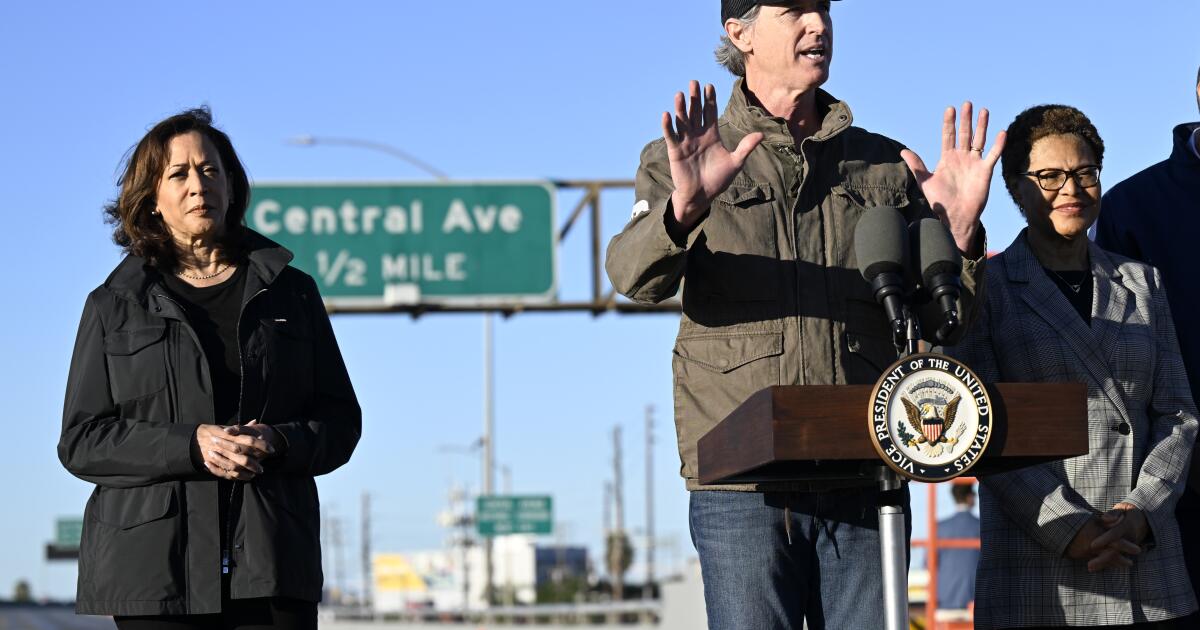
Gavin Newsom and Kamala Harris have long circled one another.
The two moved in the same political slipstream, wooed the same set of Democratic donors and, for a time, even shared the same group of campaign advisors.
Harris rose from San Francisco district attorney to elected positions in Sacramento and Washington before twice running unsuccessfully for president.
Newsom climbed from San Francisco mayor to lieutenant governor to California’s governorship, where he quietly stewed as Harris leapfrogged past him into the vice presidency. While she served in the White House, Newsom tried any number of ways to insinuate himself into the national spotlight.
Now both have at least one eye on the Oval Office, setting up a potential clash of egos and ambition that’s been decades in the making.
Newsom, whose term as governor expires in January, has been auditioning for president from practically the moment the polls closed in 2024 and horrified Democrats realized Harris had lost to Donald Trump.
Harris, who’s mostly focused on writing and promoting her campaign autobiography — while giving a political speech here and there — hasn’t publicly declared she’ll seek the White House a third time. But, notably, she has yet to rule out the possibility.
In a CNN interview aired Sunday, Newsom was asked about the prospect of facing his longtime frenemy in a fight for the Democratic nomination. (California’s gallivanting governor is embarked on his own national book tour, promoting both the “memoir of discovery” that was published Tuesday and his all-but-declared presidential bid.)
“Well, I’m San Francisco now, she’s L.A.,” Newsom joked, referring to Harris’ post-Washington residency in Brentwood. “So there’s a little distance between the two of us.”
He then turned zen-like, saying fate would determine if the two face off in the 2028 primary contest. “You can only control what you can control,” Newsom told CNN host Dana Bash.
A decade ago, Newsom and Harris swerved to keep their careers from colliding.
In 2015, Barbara Boxer said she would step down once she finished her fourth term in the U.S. Senate. The opening presented a rare opportunity for political advancement after years in which a clutch of aging incumbents held California’s top elected offices. Between Lt. Gov. Newsom and state Atty. Gen. Harris, there was no lack of pent-up ambition.
After a weekend of intensive deliberations, Newsom passed on the Senate race and Harris jumped in, establishing herself as the front-runner for Boxer’s seat, which she won in 2016. Newsom waited and was elected governor in 2018, succeeding Jerry Brown.
Once in their preferred roles, the two got along reasonably well. Each campaigned on the other’s behalf. But, privately, there has never been a great deal of mutual regard or affection.
Come 2028, there will doubtless be many Democrats seeking to replace President Trump. The party’s last wide-open contest, in 2020, drew more than two dozen major contestants. So it’s not as though Harris and Newsom would face each other in a one-on-one fight.
But dueling on the national stage, with the country’s top political prize at stake, is something that Hollywood might have scripted for Newsom and Harris as the way to settle, once and for all, their long-standing rivalry.
The two Californians would start out closely matched in good looks and charisma.
Those who know them well, having observed Newsom and Harris up close, cite other strengths and weaknesses.
Harris has thicker skin, they suggested, and is more disciplined. Her forte is set-piece events, like debates and big speeches.
Newsom is more of a policy wonk, a greater risk-taker and is more willing to venture into challenging and even hostile settings.
Newson is more fluent in the ecosphere of social media, podcasts and the like. Harris has the advantage of performing longer on the national stage and bears nothing like the personal scandals that have plagued Newsom.
But Harris’ problem, it was widely agreed, is that she has run twice before and, worse, lost the last time to Trump.
“To a lot of voters, she’s yesterday’s news,” said one campaign strategist.
“She had her shot,” said another, channeling the perceived way Democratic primary voters would react to another Harris run. “You didn’t make it, so why should we give you another shot?”
(Those half-dozen kibbitzers who agreed to candidly assess the prospects of Newsom and Harris asked not to be identified, so they could preserve their relationships with the two.)
Most of the handicappers gave the edge to Newsom in a prospective match-up; one political operative familiar with both would have placed their wager on Harris had she not run before.
“I think her demographic appeal to Black women and coming up the ranks as a Black woman working in criminal justice is a very strong card,” said the campaign strategist. “The white guy from California, the pretty boy, is not as much of a primary draw.”
That said, this strategist, too, suggested that “being tagged as someone who not only lost but lost in this situation that has set the world on fire … is too big a cross to bear.”
The consensus among these cognoscenti is that Harris will not run again and that Newsom — notwithstanding any demurrals — will.
Of course, the only two who know for sure are those principals, and it’s quite possible neither Harris nor Newsom have entirely made up their minds.
Those who enjoy their politics cut with a dash of soap opera will just have to wait.