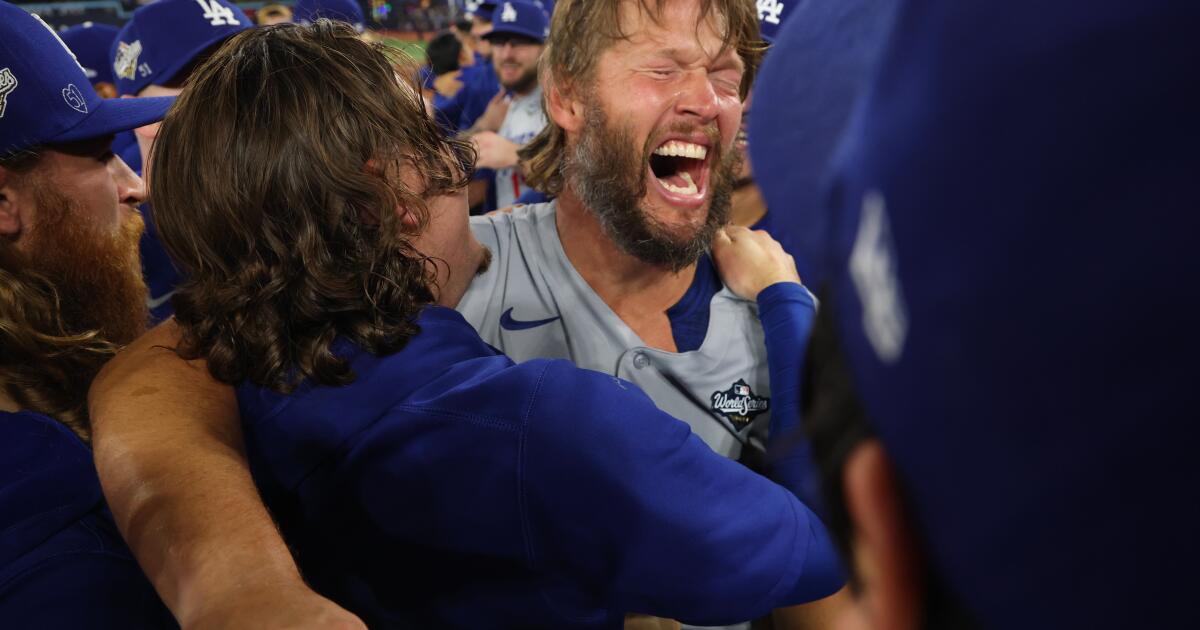
Hi, and welcome to another edition of Dodgers Dugout. My name is Houston Mitchell and it’s time for our annual Dodgers Dugout Dodgers Hall of Fame voting.
I get dozens of emails every season from fans who want to know why their favorite Dodger isn’t in the Hall of Fame. Which got me thinking (always a dangerous proposition), what if we had a Dodgers Dugout Dodgers Hall of Fame, as selected by the readers? We started it in 2022 and so far, readers have voted 16 people into the Hall. It’s time to vote again.
The way it works: Below you will see a list of candidates divided into two groups, players and nonplayers.
In the players’ category, you can vote for up to 10 players. You don’t have to vote for 10, you can vote for any number up to and including 10. Your vote should depend on what the player did on and off the field only as a Dodger. The rest of his career doesn’t count, which is why you won’t see someone such as Frank Robinson listed. And you can consider the entirety of his Dodgers career. For example, Manny Mota was a good player and has spent years as a Dodgers coach and a humanitarian. You can consider all of that when you vote. And remember this is the Dodgers Hall of Fame, so there might be some people considerably worthy of being in a Dodgers Hall of Fame who fall short of the Baseball Hall of Fame in your mind.
In the nonplayers category, you can vote for up to three.
To recap, you can vote for up to 10 people on the players ballot, and three on the non-players ballot, meaning you could vote for 13 people total if you desire. But no more than 10 players and three non-players.
Whoever is named on at least 75% of the ballots will be elected. The eight people receiving the fewest votes will be dropped from future ballots for at least the next two years. Active players or active non-players are not eligible.
How do you vote? For the players ballot, click here. For the nonplayers ballot, click here. Or you can email me at houston.mitchell@latimes.com. You have until Feb. 1 to vote. Results will be announced soon after that.
I tried to compile a ballot that had players representing each era of Dodgers baseball. I’m sure there’s a player or two you think should have been on the ballot. Send that player’s name along and he might be included in next year’s ballot. And it’s possible the player you are thinking of has already been on the ballot, but dropped off due to lack of support.
Before we get to the ballot, let’s review previous results.
2025 inductee
Don Sutton, named on 75.7% of ballots
2024 inductees
Walter O’Malley, 79.4%
Pee Wee Reese, 76.3%
2022 inductees
Tommy Lasorda, 87.7%
Walt Alston, 86.5%
Fernando Valenzuela, 80.6%
Maury Wills, 76.6%
Gil Hodges, 75.3%
Orel Hershiser, 75.1%
Branch Rickey, 72.1%
Note: In 2022 you had to be named on only 65% of the ballots to be inducted. It has been 75% all other years.
2021 inductees
Sandy Koufax, 95.6%
Vin Scully, 92.7%
Don Drysdale, 90%
Jackie Robinson, 88.9%
Roy Campanella, 84.7%
Duke Snider, 78.2%
How the rest of the 2025 ballot fared:
Jaime Jarrín, 65.8%
Peter O’Malley, 65.1%
Steve Garvey, 64.4%
Don Newcombe, 62.1%
Ron Cey, 61.6%
Mike Piazza, 50.3%
Dusty Baker, 47.7%
Davey Lopes, 47.1%
Manny Mota, 46.7%
Red Barber, 45.4%
Carl Erskine, 42.9%
Tommy Davis, 42.5%
Kirk Gibson, 40.6%
Jim Gilliam, 40.5%
Mike Scioscia, 39.7%
Johnny Podres, 36.7%
Ross Porter, 35.3%
Willie Davis, 33.9%
Buzzie Bavasi, 32.1%
Eric Karros, 30.1%
Jerry Doggett, 29.8%
Bill Russell, 29.5%
Zack Wheat, 28.9%
Eric Gagne, 28.2%
Carl Furillo, 27.9%
*Rick Honeycutt, 26.7%
John Roseboro, 26.1%
Pedro Guerrero, 25.3%
Dazzy Vance, 23.3%
Tommy John, 23.3%
Andre Ethier, 23.1%
Bottom 12, eliminated from at least next two ballots
Helen Dell, 22.7%
Adrián Beltré, 21.4%
Steve Yeager, 20.6%
Leo Durocher, 18%
*-Ned Colletti, 12.9%
*-Steve Sax, 10.8%
*-Casey Stengel, 5.2%
*-Red Adams, 4.7%
*-Jim Lefebvre, 3.8%
*-Billy Cox, 3.6%
*-Cookie Lavagetto, 2.6%
*-Monty Basgall, 0.8%
*-first time on ballot.
The Dodgers Dugout Dodgers Hall of Fame
Listed in order of percentage:
Sandy Koufax, 2021 (95.6%)
Vin Scully, 2021 (92.7%)
Don Drysdale, 2021 (90%)
Jackie Robinson, 2021 (88.9%)
Tommy Lasorda, 2022 (87.7%)
Walt Alston, 2022 (86.5%)
Roy Campanella, 2021 (84.7%)
Fernando Valenzuela, 2022 (80.6%)
Walter O’Malley, 2024 (79.4%)
Duke Snider, 2021 (78.2%)
Maury Wills, 2022 (76.6%)
Pee Wee Reese, 2024 (76.3%)
Don Sutton, 2025 (75.7%)
Gil Hodges, 2022 (75.3%)
Orel Hershiser, 2021 (75.1%)
Branch Rickey, 2022 (72.1%)
Note: In 2022, you had to be named on only 65% of the ballots to be inducted. It has been 75% all other years.
The 2026 ballot
Players
Vote for no more than 10 players. Vote here or email me at houston.mitchell@latimes.com. Click on the player’s stats to be taken to his overall career stats. If you don’t wish to read all the comments, scroll to the bottom where you will see just a straight list of candidates without comments. But I worked hard on these, so throw me a bone, will ya?
Dusty Baker (1976 to 1983, .281/.343/.437): Baker is one of the most loved Dodgers since they moved to L.A. He was a very good player and part of the group of four Dodgers who hit at least 30 homers in 1977, becoming the first team to do that. Baker did it on the final day of the season, homering off of Houston ace and Dodger nemesis J.R. Richard in the sixth inning. Baker finished fourth in MVP voting in 1980, when he hit .294 with 29 homers and 97 RBIs. He hit .320 in strike-shortened 1981 and .300 in 1982.
Ron Cey (1971 to 1982, .264/.359/.445): Cey is almost criminally underrated by those who grew up outside of L.A. He was good for 20-30 homers, 70-90 walks and 80-100 RBIs every year and played a solid third base. He was a direct contemporary of Mike Schmidt, so he often got overlooked when it came to discussing the best third basemen during his era. But the Dodgers made four World Series with Cey as the starting third baseman, and he played a huge part in the team getting there each time.
Tommy Davis (1959 to 1966, .304/.338/.441): Davis put together one of the greatest seasons in Dodgers history in 1962, when he hit .346 (leading the league) with 27 doubles, 27 homers, 120 runs scored and a league-leading 153 RBIs. He followed that up in 1963 by leading the league in hitting again with a .326 average. Those were the only two batting titles in L.A. Dodger history until Trea Turner won a title in 2021. Those seasons are even more impressive when you consider that Dodger Stadium was an extreme pitcher’s park in those days.
Willie Davis (1960 to 1973, .279/.312/.413): Davis was an outstanding defensive player who led the NL in triples twice (1962 with 10 and 1970 with 16) and whose offensive numbers don’t look as impressive as they should because he played during one of the biggest pitcher’s eras in baseball history. His best season was probably 1969, when he hit .311 with 23 doubles, eight triples and 11 homers, or it could have been 1962, when he hit .285 with 18 doubles, 10 triples and 21 homers, or 1971, when he hit .309 with 33 doubles, 10 triples and 10 homers. He didn’t walk much and had moderate power, but he caught everything hit to him (except for that one game in the 1966 World Series, but let’s not get into that). He is still the L.A. Dodgers career leader in runs (1,004), hits (2,091) and triples (110).
Carl Erskine (1948 to 1959, 122-78, 4.00 ERA): “Oisk” is what he was called, and “Oisk” was known for his big overhand curve. But what I love about Erskine is he became a staunch supporter of Jackie Robinson from the day Erskine joined the team as a rookie in 1948, one year after Robinson broke the color barrier. At one point during the 1948 season, Erskine left the clubhouse after a game to talk to Rachel Robinson and Jackie Robinson Jr. Fans filed by and stared at this white man talking to these two Black people. Some didn’t care. Some were taken aback. Some shook their head. The next day, Jackie came up to Erskine and thanked him for talking to his family in the open, which was quite a thing for a rookie to do in those days. He said, “You know, you stopped out there in front of all those fans and talked with Rachel and little Jack.” Erskine replied, “Hey Jackie, you can congratulate me on a well-pitched game, but not for that.” In 2005, he wrote a book titled “What I Learned From Jackie Robinson.”
Andre Ethier (2006 to 2017, .285/.359/.436): On Dec. 13, 2005, the Dodgers made one of their best trades ever when they sent Milton Bradley and Antonio Perez to Oakland for Ethier, who became their starting right fielder for the next 10 seasons and put himself on many all-time top 10 lists in L.A. Dodgers history. You knew what you were going to get from Ethier every season: A .280-.290 average with about 20 homers and 80 RBIs. He was the first Dodger to have at least 30 doubles in seven consecutive seasons, made the All-Star team twice and won a Gold Glove.
Carl Furillo (1946 to 1960, .299/.355/.458): “The Reading Rifle” led the NL in batting average at .344 in 1953, the second of his two All-Star seasons with the Dodgers. He finished sixth in MVP voting in 1949 when he hit .322 with 27 doubles, 10 triples, 18 homers and 106 RBIs. He was a good fielder with a great arm, racking up 24 assists in 1951, more than earning his nickname. He was a steady player for the Dodgers for years and played in seven World Series, including the 1955 and 1959 title teams.
Eric Gagné (1999 to 2006, 25-21, 3.27 ERA, 161 saves): Gagne was a failed starter who came out of nowhere to seize the closing job in spring training in 2002. He converted 84 consecutive saves at one point, and few people left Dodgers games early when Gagne was the closer because they wanted to see him pitch. He was dominant and won the Cy Young Award in 2003. Then injuries derailed him and he pitched little in 2005 and 2006. He was with the Brewers when he was named in the Mitchell Report as a player linked to human growth hormone use. His tenure ended with the Dodgers 20 years ago, but it seems like a million years ago for some reason.
Steve Garvey (1969 to 1982, .301/.337/.459): Do I really need to write a lot about Garvey? One of the most popular Dodgers in history. But history hasn’t been kind to him, as many of the newer analytic numbers have downgraded him on offense. But, the importance of knowing every season that your first baseman was going to hit .300 with 100 RBIs can’t be overstated. He was named NL MVP in 1974 and finished in the top six in voting five times. He also made eight All-Star teams and won four Gold Gloves.
Kirk Gibson (1988 to 1990, .264/.353/.433): There are Dodgers with better numbers not on this ballot, but he makes the list because he turned the Dodgers from losers to winners in an incredible 1988 season, when he seemed to get every clutch hit the team needed, especially when he hit that amazing pinch-hit home run in Game 1 of the World Series. It’s up to you to decide if one miraculous season is enough to make him a Dodgers Hall of Famer.
Jim Gilliam (1953 to 1966, .265/.360/.355): It seemed that every season Jim Gilliam would be on the bench, squeezed out of the lineup by a hot rookie or flashy newcomer, then by the end of April, either the new player would be a bust or an injury would open a spot and Gilliam would end the season as the starting second baseman. Or starting third baseman. Or starting left fielder. But let me recount a story Vin Scully told me about Gilliam for my book: “I was introducing the team, and I would introduce, ‘So and so is the shortstop’ and so on, and I introduced Jim as ‘Jim Gilliam, baseball player.’ He was one of the smartest players. I remember Walter Alston saying that Jim never missed a sign. Never. Like anyone else, you are going to drop a ball, you are going to make an error, but Jim never made a mental mistake. And on the base paths, he’d go from first to third all the time. He always did the right thing. He was very quiet and not at all ‘on,’ but he was a consummate baseball player. He was married in St. Louis, and the team bus stopped at the reception while the photographer was taking pictures. Jim said to the photographer, ‘One more.’ The photographer took it and Jim got on the bus and we went to Busch Stadium.” The Dodgers retired Gilliam’s No. 19 shortly after he died after the 1978 season.
Pedro Guerrero (1978 to 1988, .309/.381/.512): You can make an argument that Guerrero is the best hitter in Dodgers history. He is fifth in OPS+ and had at least 1,000 more plate appearances than the four people ahead of him on the list. He hit .320 in 1985, then blew out his knee on an ill-advised slide in spring training of 1986. He came back in 1987 to hit .338. He had power, hitting 30-plus homers three times (back when that really meant something) and had a good eye at the plate. Defensively, however, he was brutal. He was not a good fielder at third, and hated playing there, but you have to give him credit for going out there whenever he was asked.
Tommy John (1972-78, 87-42, 2.97 ERA): After being a mainstay of the rotation in 1972-73, John was on his way to a career year in 1974 (13-3, 2.59 ERA) when he tore a ligament in his elbow. It always meant the end of a pitcher’s career, but John agreed to undergo a first of its kind surgery, taking a ligament from a different part of his body to replace the one in his elbow. He came back in 1976 to win 10 games, then went 20-7 with a 2.78 ERA in 1977, finishing second in Cy Young voting. He was almost as good in 1978 and went 3-1 with a 2.08 ERA in six postseason starts with L.A. Since then, hundreds of pitchers have had the surgery now named after him.
Eric Karros (1991 to 2002, .268/.325/.454): Karros had an interesting career. He is the all-time L.A. Dodgers home run leader, yet rarely gets mentioned when the subject is all-time great Dodgers. He led the league in only two categories in his career (games played in 1997 and double plays grounded into in 1996). He never made an All-Star team. He was often overshadowed by Mike Piazza. But he rarely got hurt and was good for 25-30 homers every season.
*-Joe Kelly (2019-21, 2023-24, 9-5, 3.72 ERA, 3 saves): Kelly is remembered for two things with the Dodgers: His Mariachi jacket, and not being afraid to hit an Astros batter or two after the sign-stealing scandal. After the Astros cheated to win the 2017 World Series, the Dodgers didn’t face them again until 2020. Kelly decided someone had to pay a price. The game was uneventful through five innings, and then Kelly decided to shake things up. After retiring Jose Altuve on a popup, he had a 3-0 count against Alex Bregman when his next pitch, ball four, flew behind Bregman’s head. The next batter, Michael Brantley, wasn’t on the 2017 Astros. Kelly threw him three pitches, none particularly close to him, and got him to ground to first. When Kelly covered first base in an attempt to complete a double play, he got annoyed when Brantley’s foot clipped his leg. Kelly glared at Brantley and suddenly, from the Astros dugout, someone shouted “just get on the mound, little … “ The … represents a word we can’t use in a family newsletter.
The next batter: Yuli Gurriel. With a 2-0 count, a Kelly pitch went well inside, sending Gurriel sprawling. He walked Gurriel on the next pitch. That brought us to the main event: Carlos Correa.
Correa was the most vocal Astro to defend their title after the sign-stealing was discovered. He was particularly pointed in his comments toward the Dodgers. Kelly started with a pitch that made Correa duck. He seemed none too happy. The at-bat continued and Kelly struck Correa out with a breaking ball in the dirt.
And then the fun began. Correa chirped at Kelly. Kelly, according to Astros manager Dusty Baker, said “Nice swing ….” Kelly made a pouty face at Correa, who started walking toward the Dodger dugout. The benches cleared. No punches were thrown. The game resumed and nothing much interesting happened after that, other than the Dodgers winning, 5-2.
But, on social media, Kelly became one of the most loved Dodgers of all time. He still is. So that puts him on the ballot.
Of course, Kelly is also known for hitting Dodger Hanley Ramirez in the ribs with a pitch, which pretty much ended the Dodgers’ postseason. He talks about that here.
*-Clayton Kershaw (2008-25, 223-96, 2.53 ERA): What can I say that I haven’t already written over the last 10 years? We can quibble over his postseason stats all day, but he’s a first-ballot Hall of Famer with the only question being how many people leave him off their ballot.
Davey Lopes (1972 to 1981, .262/.349/.380): There were certainly more prolific base stealers in baseball history, but there may have never been a better base stealer than Lopes. In 1975, he led the NL with 77 steals and was caught only 12 times. In 1976, he led with 63 steals and was caught only 10 times. At the age of 40, he stole 47 bases and was caught only four times. Admittedly, that was with the Cubs, so it doesn’t count for our purposes, but it’s my favorite Lopes stat. My favorite thing Lopes always did with this: He was often batting behind the pitcher, and when the pitcher made an out, particularly if he had to run hard on a ground ball, Lopes was a master of taking his time getting to the batter’s box, allowing the pitcher a little extra time to recuperate. Lopes would reach the batter’s box and see that he “forgot” to knock off the weighted donut off the bat, so he’d return to the on-deck circle to do so. Or he’d go back for a little extra pine tar. It was always a lot of fun to watch.
Manny Mota (1969 to 1980, 1982, .315/.374/.391): To think of Mota as only a pinch-hitter is a mistake. He hit .305 in 124 games with the Dodgers in 1970 and .323 in 118 games with the team in 1972. He made the All-Star team in 1973, when he hit .314. But pinch-hitting is what made him famous. Mota set the record (since surpassed) for most career pinch hits in 1979 when he collected his 145th. He seemed to be able to get a hit whenever he wanted to. Eighteen players have at least 100 pinch-hits in their career. Mota is the only one with a .300 average in such situations. After retiring for good as a player, he became a coach for the Dodgers and remains active in the organization to this day.
Don Newcombe (1949 to 1951, 1954-1958, 123-66, 3.51 ERA): Newcombe could have been a two-way player if the Dodgers would have let him. In 1956, he went 27-7 with a 3.06 ERA in 38 games, 36 starts and 268 innings with 15 complete games. At the plate, he hit .234 with six doubles, two homers and 16 RBIs. He won the Cy Young and MVP awards after the season. He was rookie of the year in 1949 and was the first player to win all three major baseball awards. He went 20-5 during the Dodgers’ World Series championship season in 1955. That year, he hit .259 with nine doubles, seven homers and 23 RBIs. How good a hitter was Newcombe? He pinch-hit 88 times in his career. Newcombe struggled with alcoholism for years but became sober in 1967 and worked for the Dodgers for years, helping athletes and others across the country in their struggles with sobriety. “What I have done after my baseball career and being able to help people with their lives and getting their lives back on track and they become human beings again means more to me than all the things I did in baseball,” Newcombe said in 2008.
Mike Piazza (1992 to 1998, .331/.394/.572): The best-hitting catcher in baseball history was an All-Star every full season with the Dodgers and finished as the MVP runner-up two consecutive seasons. His best season was 1997, when he hit .362 with 32 doubles, 40 homers and 124 RBIs in 152 games. He wasn’t much defensively, but not as bad as people said, and the less said about his trade to Florida in 1998, the better.
Johnny Podres (1953 to 1955, 1957-66, 136-104, 3.66 ERA): Podres pitched for four of the Dodgers’ World Series title teams (1955, 1959, 1963 and 1965, though he didn’t pitch in the ’65 World Series) and was MVP of the 1955 World Series, the first title for the Dodgers, when he went 2-0 with a 1.00 ERA, good for two complete-game victories over the New York Yankees, including a 2-0 shutout in the decisive Game 7. He was often overlooked on the team, overshadowed by Koufax or Newcombe or Drysdale, but he was a key pitcher for the team for 12 years.
John Roseboro (1957 to 1967, .251/.327/.382): Roseboro made five All-Star teams with the Dodgers and won two Gold Gloves. He was the starting catcher on three World Series title teams and when people mention the great Dodgers pitching staffs of the 1960s, they seldom mention who was catcher for all those great pitchers. It was Roseboro.
Bill Russell (1969 to 1986, .263/.310/.338): Russell was a converted outfielder who went on to become one of the longest-tenured Dodgers in history, second all-time in games played for the team with 2,181, trailing Zack Wheat (2,322). If there is one word to describe Russell, it’s “steady.” He never was the best shortstop in the NL, and was never the worst. He never led the league in anything, made the All-Star team three times, seldom struck out, didn’t have a lot of power. But he went out there every day and rarely cost his team a game, and also was known among fans as the best clutch hitter on the team. He replaced Lasorda as manager in 1996 and was fired in 1998 during the infamous Fox era.
Mike Scioscia (1980 to 1992, .259/.344/.356): Scioscia was with the Dodgers for 13 seasons, never won a Gold Glove, never led the league in any offensive category and made only two All-Star teams. But what he did can’t be understated: He gave you above average play almost every season for 13 seasons. You never had to worry about the position when Scioscia was there, and he hit one of the most important home runs in Dodgers history when he connected off Dwight Gooden in Game 4 of the 1988 NLCS.
Dazzy Vance (1922 to 1932, 1935, 3.17 ERA): Vance was the first true ace the Dodgers had and is still one of the greatest pitchers in their history. He led the league in wins twice, in ERA three times and in strikeouts seven consecutive seasons. Vance’s actual first name was Arthur, but he was called “Dazzy” because of his dazzling fastball. You can read more about him here.
Zack Wheat (1909 to 1926, .317/.367/.450): The most unappreciated great player in Dodger history. Wheat was just relentless at the plate, hitting over .300 every year with mid-range power. He hit .375 in 1923 and 1924. He is still the team’s all-time leader in several offensive categories. He was beloved in Brooklyn and served as a mentor for several young Dodgers, including future manager Casey Stengel. “I never knew him to refuse help to another player, were he a Dodger or even a Giant,” Stengel said. “And I never saw him really angry and I never heard him use cuss words.” Read more about Wheat here.
*-Alex Wood (2015-18, 2020, 31-21, 3.54 ERA): Wood went 16-3 with a 2.72 ERA in 2017, but never quite reached those heights again. He was the one guy who thought there was something fishy going on with the Astros in the 2017 World Series and had catcher Austin Barnes changes signals after every batter when someone was on base during Game 4. He gave up only one run and one hit in 5.2 innings for the only Dodgers’ victory in Houston. He was a valuable member of three Dodgers World Series teams, winning one with them in 2020, pitching four innings of shutout relief over two games.
Steve Yeager (1972 to 1985, .229/.299/.358): Yeager was one of the best defensive catchers in history who had the misfortune of being a direct contemporary of the best defensive catcher in history, Johnny Bench. Otherwise, Yeager would have multiple Gold Gloves. His best season offensively was 1977, when he .256 with 21 doubles and 16 homers. Dodger fans remember how he blocked the plate, becoming an almost impenetrable wall whenever a runner tried to score and Yeager had the ball.
Nonplayers
Vote for no more than three. Vote here or email me at houston.mitchell@latimes.com.
Red Barber: Barber was a Dodgers broadcaster from 1939 to 1953 and mentored a young Scully. His folksy style and catchphrases made him one of the most famous announcers in the U.S. Among his phrases: “They’re tearin’ up the pea patch,” “Can of corn,” “Sittin’ in the catbird seat,” “Tighter than a new pair of shoes on a rainy day.”
Buzzie Bavasi (former general manager): In Bavasi’s 18 years as the team’s GM, the Dodgers won eight NL pennants (1952, 1953, 1955, 1956, 1959, 1963, 1965 and 1966) and four World Series titles (1955, 1959, 1963 and 1965).
Jerry Doggett: Called games in Brooklyn and Los Angeles from 1956 to 1987, and was a key part of the memorable Vin Scully-Jerry Doggett-Ross Porter broadcasting trio.
Rick Honeycutt: Honeycutt pitched for the Dodgers from 1983-87 and went 33-45 with a 3.58 ERA. The Dodgers traded Dave Stewart and Ricky Wright to acquire him and got Tim Belcher when they dealt him away. But he’s mainly here for his long tenure a pitching coach, from 2006-19, under four different managers. He and Ron Perranoski hold the record for most years as Dodgers pitching coach.
Jaime Jarrín: The longtime Spanish language broadcaster for the Dodgers, who started with the team in 1959 and retired after the 2022 season. In 1998, Jarrín received the Ford C. Frick Award from the Baseball Hall of Fame. In February 1998, Jarrín was the first recipient of the Southern California Broadcaster Assn.’s President’s Award. He also received a star on the Hollywood Walk of Fame that year.
Peter O’Malley: O’Malley was team president starting in 1970 and became team owner in 1979 until he sold the Dodgers in 1998. Many fans consider the Peter O’Malley era to be the golden age for the L.A. Dodgers.
Ross Porter: Dodgers broadcaster from 1977 to 2004. On Aug. 23, 1989, Porter set a major league record for broadcasting 22 straight innings on radio by himself in a six-hour, 14 minute game against the Expos in Montreal. Also hosted the postgame “Dodger Talk” on the radio for many years and contributed the “Ask Ross Porter” segment to this newsletter for several years. Currently answers reader questions at his Ross Porter Sports Facebook page.
*-new to ballot this year.
Here is the ballot without comments:
Players (vote for no more than 10)
Dusty Baker
Ron Cey
Tommy Davis
Willie Davis
Carl Erskine
Andre Ethier
Carl Furillo
Eric Gagné
Steve Garvey
Kirk Gibson
Jim Gilliam
Pedro Guerrero
Tommy John
Eric Karros
*-Joe Kelly
*-Clayton Kershaw
Davey Lopes
Manny Mota
Don Newcombe
Mike Piazza
Johnny Podres
John Roseboro
Bill Russell
Mike Scioscia
Dazzy Vance
Zack Wheat
*-Alex Wood
Steve Yeager
Non-players (vote for no more than three)
Red Barber
Buzzie Bavasi
Jerry Doggett
Rick Honeycutt
Jaime Jarrín
Peter O’Malley
Ross Porter
*-new to the ballot
My ballot
There are four people should definitely be in: Clayton Kershaw, Dazzy Vance, Zack Wheat and Jaime Jarrín. Vance and Wheat played 100 years ago, yes, but they were outstanding players and should be in. It would be like someone starting a Dodgers Hall of Fame 100 years from now and not including Duke Snider and Don Drysdale. Kershaw is one of the greatest Dodgers of all time. And Jarrín was the Spanish-language broadcaster for the team for more than half a century and helped open them to a new market.
If you don’t vote for those four, no one is going to yell at you, but it’s hard to justify putting 10 (or four) on the ballot ahead of them.
And finally
Clayton Kershaw comes out of a regular-season game for the final time. Watch and listen here.
Until next time…
Have a comment or something you’d like to see in a future Dodgers newsletter? Email me at houston.mitchell@latimes.com. To get this newsletter in your inbox, click here.