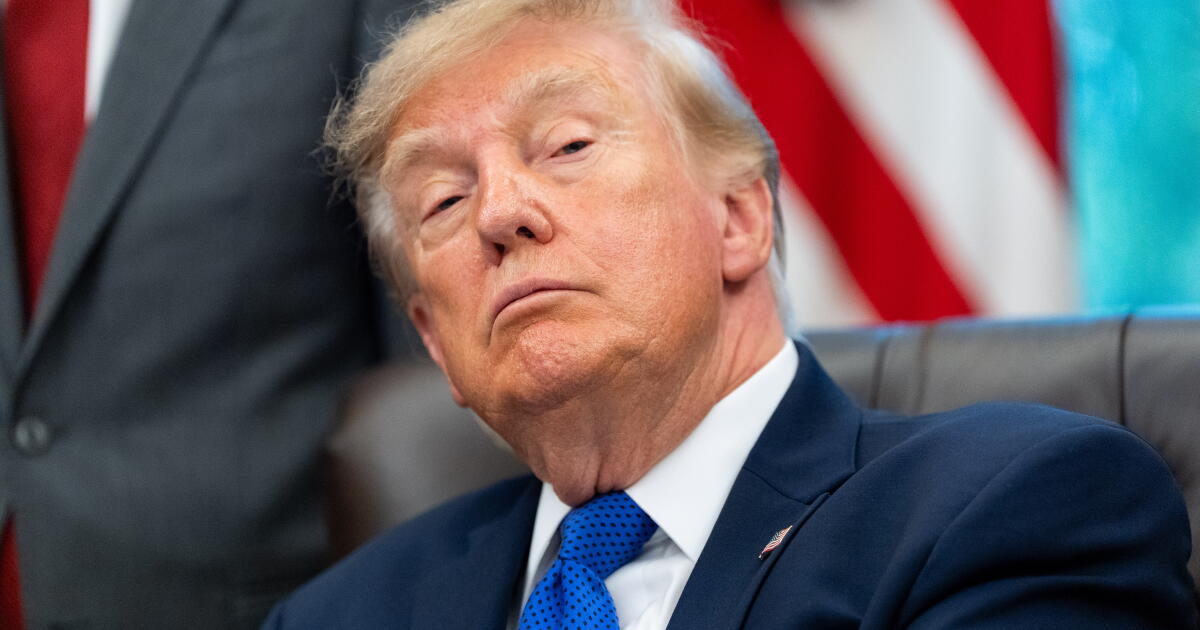
SACRAMENTO — In recent weeks, the Trump administration has been using taxpayer dollars — your money and mine — to pay for a series of cringy, self-glorifying advertisements that feature, you guessed it, President Trump himself.
In one particularly needy spot, the lyrics “love me, love me” are repeated continuously over fast-cut clips of Trump. The White House claims it’s a call to love America, but if someone I knew posted this, I’d be asking if they were OK. Like, teenage-style, “Are you OK?”
But I’d be missing the point if I went down that path of laughing off these regrettable commercials as just more Trump self-adulation.
Taken with two other recent developments — the banning of certain press from the White House and a further purge of military leadership — some experts on authoritarianism told me what we’re really watching is a further collapse of democracy into an authoritarian cult of personality in which Trump is the state and the state is Trump.
“In authoritarian countries, all leaders, they try to completely blur the line between themselves and the state function,” said Konstantin Sonin, an expert in authoritarianism and a professor at the University of Chicago. “So basically, being ‘anti-me’ is being anti-state. In this Trump advertisement, there is this authoritarian scent.”
State propaganda
Jason Stanley, a former Yale professor who moved to the University of Toronto in part over concerns about the far-right political shift in the U.S., put it even more succinctly.
“Trump is trying to tell you, you live in an authoritarian society now, and that he is the state,” Stanley said. “This is pure, pure state propaganda.”
State propaganda matters because it serves not just as a message, but also a warning, said Federico Finchelstein, a history professor at the New School for Social Research and author of “The Wannabe Fascists,” about dudes who try to destroy democracy from the inside. It tells citizens that being against Trump is being against America, he said — a chilling prospect for those who would oppose him.
Finchelstein points out that painting opponents as communists or socialists — an incessant refrain from Trump and the core of the commercials — is a common practice in non-democracies, turning enemies of the dictator into enemies of the state, and perhaps even criminalizing them.
“This should not be seen as just another outburst or just another ridiculed dimension of a kind of ‘original personality,’” he said of the ads. “This is more of a structural pattern of authoritarianism.”
The press ban
Finchelstein points to the recent White House press ban as another part of that pattern, and another way Trump is removing that line between himself and the state.
Recently, CNN, MS NOW and Politico were denied access to the White House on Trump’s orders. The outlets sued, a judge issued a restraining order, and as of now, it mostly has blown over — though it shouldn’t.
For days, Trump made it clear that the ban was because he didn’t like coverage that made him look bad — and if it made him look bad, it was bad for America.
“Virtually every story about me, or anything having to do with me, is negative, wrong and, in many cases, DANGEROUS for our Country! No matter how GREAT my Achievements, they trivialize and demean,” Trump ranted on social media.
Then Atty. Gen. Todd Blanche, who has made loyalty to Trump his brand, took that a step further, arguing that “after years and years and years of one-sided media coverage of the president from certain outlets, the president finally said it’s not fair to the American people,” and constituted a national security risk.
Trump “tries to blur this line about negative stories about [himself] and negative stories about America,” a classic authoritarian tactic, said Sonin, the University of Chicago professor.
Finchelstein said that that kind of crackdown on dissent comes most often in moments of crisis for the person in power — such as when, say, his approval ratings are at an all-time low, gas prices are soaring because of an unpopular war and an election is looming.
The military concern
But what happens if propaganda and intimidation aren’t enough?
Stanley said that faced with plummeting popularity, Trump seems to have stopped trying to win our approval — instead focusing on consolidating power while he still has time.
“Trump is in a race to be a dictator,” Stanley said. “That’s why he doesn’t try to persuade you anymore. He’s not in the business of persuading. He’s in the business of hard propaganda, of just expressing his power. He’s saying public opinion doesn’t matter anymore.”
Finchelstein, Stanley and others warn that the most dangerous moment for democracies can be when a wanna-be dictator loses momentum.
“We’re in a situation where it matters whether the military will violate the Constitution,” Stanley said.
Make of this what you will, but this week, U.S. Defense Secretary Pete Hegseth continued his purge of seasoned military leaders by confirming the department is firing 20% of top officers.
“The ideological clowns are out. The patriotic cowboys are in,” Hegseth said of the unprecedented hollowing of experienced leadership.
Hegseth also announced that billionaire right-wingers Elon Musk and Palmer Luckey are going to help guide the future of the military, which doesn’t sound terrifying at all. I mean, DOGE went so well.
Sonin, the University of Chicago professor, said despite all this, he has hope — because Trump is “old and unpopular” and support of him may have found a “floor.”
Or as Stanley puts it, Trump can conflate himself with the state all he wants, but it works only if we believe him — and even his supporters seem tired of the lies.
What else you should be reading:
The must-read: Legal Immigrants Lose Medicaid Coverage Under Trump’s Bill
The California angle: Sean Combs’ release date is pushed up, as new report details pampered prison lifestyle
The L.A. Times Special: What the ‘Taco Stand Karen’ fiasco says about right-wing Latinos
Stay Golden,
Anita Chabria
—
Was this newsletter forwarded to you? Sign up here to get it in your inbox.