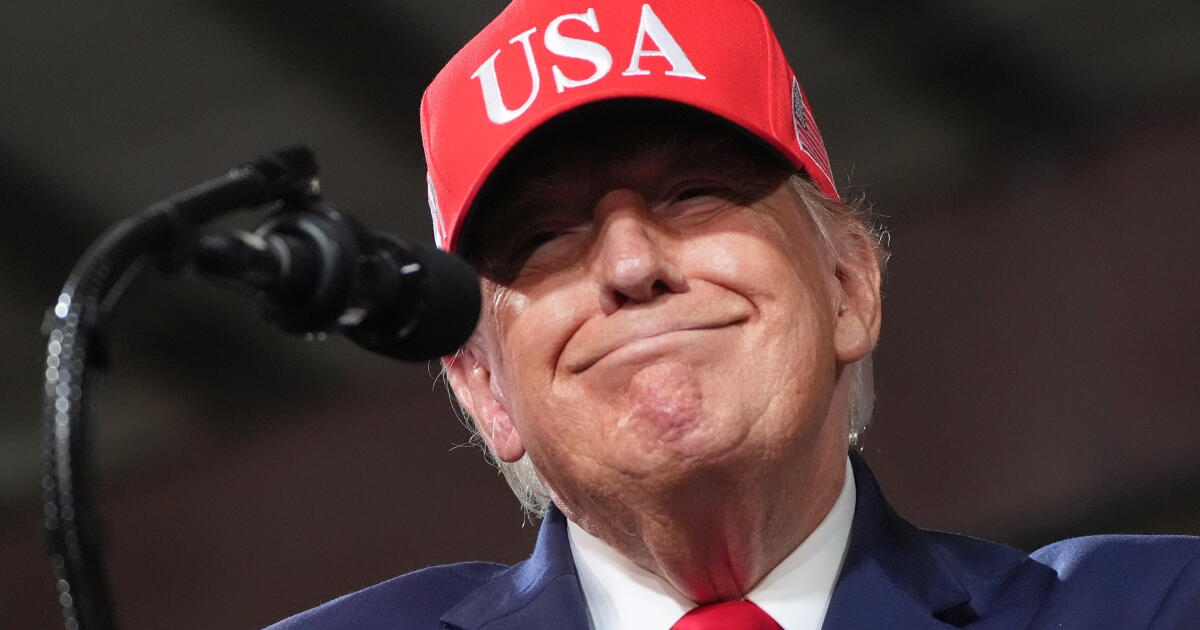
NEW YORK — President Trump says he wants voters to pretend that he’s on the ballot in this year’s midterm elections.
His rivals are doing their best to help his case.
Democratic candidates and their allies have spent more than $163 million since Sept. 1 on television advertising that mentions the Republican president, according to an Associated Press analysis of data from AdImpact, which charts media spending.
That includes airing ads that reference Trump on broadcast, cable and streaming nearly 180,000 times, the data shows. Republicans, meanwhile, have run ads that talk about the president just 16,000 times, at an estimated cost of $11 million, over the same period.
It’s a noticeable silence about the party’s dominant yet unpopular leader.
Many of the Democrats’ ads accuse Republican opponents of siding with the president over voters, particularly on issues like tariffs and the Iran war, which they blame for jacking up costs.
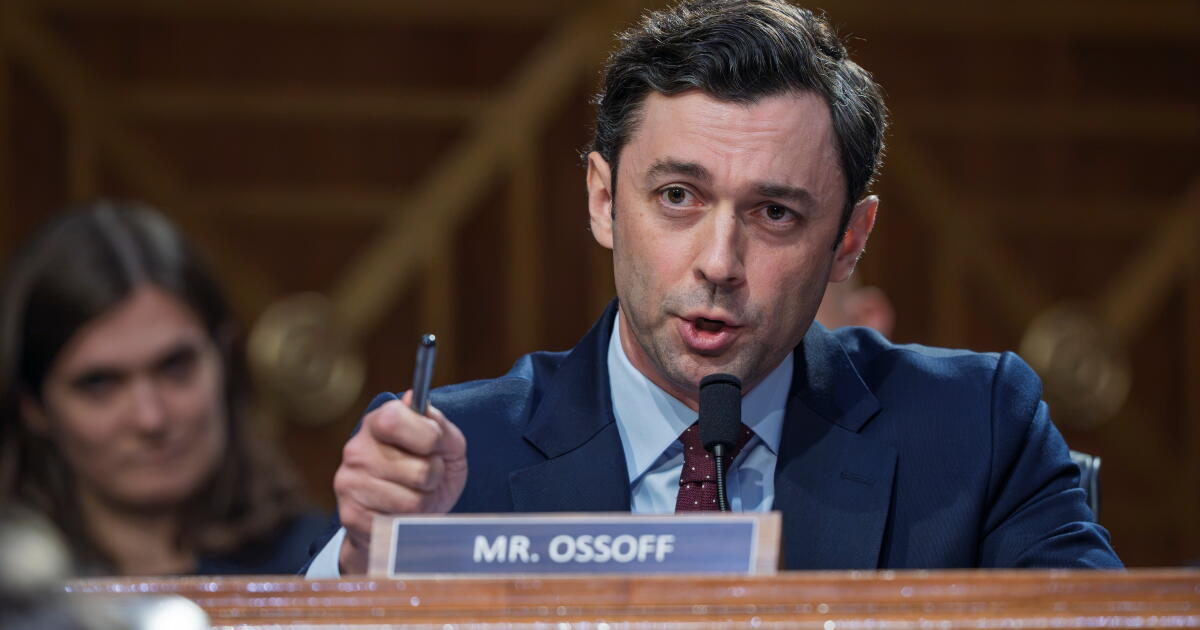
The ads include one from the campaign of Georgia Sen. Jon Ossoff, who is running for reelection and has spent nearly $3 million on a Trump-focused ad attacking his rival, Rep. Mike Collins, for his close relationship with the president.
“Mike Collins voted for Trump’s war in Iran, sending gas prices through the roof. He voted for Trump’s tariffs, sending grocery prices soaring. And Mike Collins voted with Trump to double health insurance premiums for more than a million Georgians,” it says. “Mike Collins sides with Donald Trump and makes you pay more.”
Republican National Committee spokesperson Natalie Baldassarre said Democratic messaging reflected the party’s hollowness instead of its strength.
“Democrats are lighting money on fire talking about President Trump because they have no agenda other than investigation, obstruction and impeachment,” she said. “Trump Derangement Syndrome isn’t a policy platform, it’s a $160 million way of saying you have nothing to offer to the American people.”
Democrats link Trump and his allies to economic woes
Another ad from the House Majority PAC, a super PAC dedicated to electing Democrats to the House, opens with a middle-aged woman standing over her kitchen stove and talking about how her family is “barely getting by” before she expresses her disappointment in Pennsylvania Rep. Brian Fitzpatrick, who is one of Republicans’ vulnerable incumbents.
“He used to be independent. But now it seems like he’s in lockstep with Donald Trump. It really bothers me,” she says, adding, “Congressman Fitzpatrick is not for us anymore.”
Indeed, all the Democratic ads that have aired in Pennsylvania’s tightly contested 1st Congressional District since Sept. 1 have mentioned Trump, even though Fitzpatrick voted against Trump’s tariffs and his power to wage war against Iran without congressional approval.
All four of the ads talking about Trump have aired a combined 2,000 times in that period, the AdImpact data shows. Fitzpatrick is being challenged by Democrat Bob Harvie, a county commissioner who is a former social studies teacher.
Democratic strategists say the messaging reflects the sentiment of voters.
“Every single poll and every single focus group shows affordability to be voters’ number one issue, and they specifically point to corrupt politicians as being responsible for driving up prices,” said House Majority PAC spokesperson Katarina Flicker.
Republican ads back away from the president
Out of dozens of issue categories tracked by AdImpact, the analysis found that Trump was the fourth most common issue mentioned by Democrats in House and Senate races’ final stretch. It was topped only by healthcare, taxes and accusations about opponents being beholden to special interests.
For Republicans in the same races, Trump-themed ads clocked in at number 33, by comparison. The top issues in their ads were taxes and crime.
Idaho Republican Senator Jim Risch tells viewers he “fought alongside President Trump to pass the biggest tax cuts for working families in American history.”
Overall in the race’s final stretch since Sept. 1, Democrats have spent or plan to spend $1.8 billion in ads across all federal, state and local elections. Republicans have spent or reserved $2.2 billion nationwide.
Republican strategist Alex Conant said Democrats are banking on Trump motivating their base to vote, an approach they’ve routinely used over the last decade.
“Democrats want this election to be a referendum on Trump. They want to equate a vote for a Republican candidate to a vote for Trump,” he said.
For Conant’s party, it’s a different calculus.
“We have a ton of money and we’re throwing every kind of message on the wall to see what sticks,” he said. “There’s not a cookie-cutter Republican ad this year. Whereas the Democratic ads are pretty obvious.”
Colvin and Kessler write for the Associated Press.
WASHINGTON — The Supreme Court sided with Republicans Wednesday and gave political parties and their fundraising committees lower rates for broadcast campaign ads.
Over two dissents, the justices granted a fast-track appeal from the Trump administration and the National Republican Congressional Committee and upheld the use of the GOP-friendly rule in the midterm election.
In a brief order, the court said the issue should be left to the Federal Communications Commission.
The outcome has given Republican candidates an advertising edge in the final weeks of the campaign.
Federal law says a “legally qualified candidate” running for election is entitled to a “lower unit charge” for campaign ads in the 60 days prior to an election.
However, on March 30, the FCC, under Republican control, announced that broadcasters must extend the lower rates to political parties and their joint fundraising committees.
The FCC notice did not explain the basis for this change, and it refused to hold a commission hearing to debate the issue.
But the change was seen as benefiting Republicans.
Democratic candidates have raised more money from direct but limited contributions from individuals, while Republicans have raised far more through party committees that are funded by wealthy donors.
The non-partisan Campaign Legal Center said the FCC’s rule change was “contrary to the text and purpose of the federal statute and would effectively grant super PACs an advertising discount.”
Anna Gomez, the lone Democrat on the FCC, issued a statement objecting to the change.
“The American public should not have sweeping election-year rule changes forced on them in the dark, on the eve of the election, without a single opportunity for public input,” she said.
Democratic Senate candidates Sherrod Brown of Ohio, Jon Ossoff of Georgia and Roy Cooper from North Carolina objected to the FCC rule change in April and and asked for a review.
When no action was taken, they filed suit in federal court. They argued the FCC had no authority to change the law that gave only candidates, not fundraising committees, the benefit of the lower ad rates.
Since then, the two sides have gone back and forth in the courts, with both accusing the other of seeking a late change in the rules.
The U.S. 4th Circuit Court of Appeals in Virginia ruled for the Democrats in a pair of 2-1 decisions.
“Suffice to say that any ‘chaos’ is the FCC’s fault, not ours,” Judge Robert B. King, a Clinton appointee, said on Oct. 7. It “has endeavored to create from whole cloth a new rule entirely outside the purview of judicial review.”
But the Supreme Court stepped in twice to overturn the 4th Circuit and rule for the Republicans.
In a Sept. 4 order, the court said in an unsigned order the 4th Circuit intervened too soon. The law “makes clear that an aggrieved party must wait for the Commission to resolve its application for review by order before filing a petition for judicial review.”
Only Justice Ketanji Brown Jackson dissented.
In September, the FCC did nothing other than to ask for public comments on its March rule change.
Frustrated with the delay, the 4th Circuit issued a second order requiring the FCC to act by Oct. 9.
Last week, in response to an appeal from Solicitor Gen. D. John Sauer, Chief Justice John G. Roberts put the 4th Circuit order on hold.
On Wednesday, the full court said the 4th Circuit Court should have left the issue to the FCC.
“Our system of separation of powers does not allow the judiciary to meddle in the workings of a coordinate branch of the government in this manner,” the court said an unsigned opinion.
In dissent, Jackson and Justice Sonia Sotomayor voted to deny the administration’s appeal.
In rural Modoc County, in California’s remote northeast corner, Republican gubernatorial candidate Steve Hilton donned a beige cowboy hat and climbed atop a horse.
Riding through a grassy field, with his dress shoes in the stirrups, Hilton lamented to a camera that California was “completely being ruined by killjoy bureaucrats” who put too many rules on fun stuff like beach fire pits and bars that stay open extra late.
In coastal San Luis Obispo County, Hilton boarded a bright yellow dune buggy at the Oceano Dunes State Vehicular Recreation Area and called the California Coastal Commission “idiots” for trying to end off-road beach driving.
And in the Central Valley, he waved the ceremonial green flag at a stock car race at the Madera Speedway, where he was named grand marshal of the annual Harvest Classic. (The designation caused a minor uproar, prompting the operator of the racetrack to make a fake online concession menu that offered a hot dog and soda for $6 for Republicans and $17.50 for Democrats.)
If it seems like Hilton — the British immigrant and former Fox News talk show host — is just about everywhere, taking just about every media interview that comes his way, well, that’s the point, he says.
He has logged thousands of miles on the proverbial campaign trail, visiting all 58 counties in his quest to lead the nation’s most populous state, where no Republican has been elected to statewide office in 20 years.
Meanwhile, his heavily favored — and far more staid — opponent, Democrat Xavier Becerra, has kept a comparatively low profile, agreeing to just one debate with Hilton and holding few public events, mostly in urban areas.
In a phone interview while driving through Los Angeles, Hilton said: “Whether I’m in Humboldt or Del Norte or Siskiyou County, my joke is, when people say, ‘Where do you live?’ I say I live in the Hampton Inn somewhere in California because we’re basically in a different place every night.”
The odds are against him.
Sure, California produced GOP presidents Richard Nixon and Ronald Reagan. But today, Democrats outnumber Republicans nearly 2 to 1 in the state, and the current White House occupant shares a mutual disdain with the vast majority of Golden State voters.
Hilton was endorsed during the primary by President Trump, who suggested at a campaign rally this month that Iran could “take out” Los Angeles and San Diego, drawing swift outrage from both Democrats and Republicans.
Hilton has tried to walk a fine line, appealing to the 6 million Californians who voted for the president in 2024 while simultaneously downplaying Trump’s support.
This summer, Hilton took out full-page ads in The Times and the San Francisco Chronicle asking: “Can you be anti-Trump and still vote for me?”
“Yes, I’m the Republican,” it said. “The ‘Fox News guy.’ Endorsed by Trump. But this election is not about who you hate in Washington. It’s about what you love here.”
Corrin Rankin, chairwoman of the California Republican Party, said that 16 years after the state’s last Republican governor, Arnold Schwarzenegger, left office, “it’s safe to say Democrats own all the problems in California.”
“You can’t blame Trump for what’s going on here in California,” she said. “We feel really good about Steve Hilton’s campaign. He is working so hard, up and down the state.”
Hilton has blasted California Democrats as entitled, saying they assume Becerra will cruise to victory in the race to replace termed-out Gov. Gavin Newsom simply because he has a “D” beside his name on the Nov. 3 ballot.
Hilton frequently quotes a September podcast interview by Los Angeles’ Democratic mayor, Karen Bass, who mocked his British accent and said: “The governor’s race right now is over. Our governor’s name is Xavier Becerra. You don’t need an election on Nov. 3. A Republican cannot win in this state.”
Hilton told The Times that Democrats “feel they don’t have to earn your vote. … They can deliver results that are bad as ever, and they don’t need to work hard to deliver results for people or earn their support. And I think it’s that attitude that is going to be their downfall.”
Steve Hilton has the support of 33% of likely California voters, according to a recent poll, while rival Xavier Becerra has 58%.
(Jason Armond / Los Angeles Times)
Becerra is a former member of Congress who represented Los Angeles, and he was the California attorney general and U.S. Health and Human Services secretary under President Biden. He has the backing of 58% of likely California voters, compared with 33% who support Hilton, according to a poll released late last month by the UC Berkeley Institute of Governmental Studies and co-sponsored by The Times.
The poll showed that voters’ top concern was reducing the state’s high cost of living — followed by fighting Trump administration policies.
“Hilton is trying to win an election, so he tries to frame himself as someone who can appeal to the broader electorate,” Underland said. “But at the end of the day, he has the albatross around his neck, which is Trump, who is openly hostile to California.”
Hilton cuts a colorful and pugnacious figure on the campaign trail. He eschews ties and jackets, favoring T-shirts with punchy phrases like, “$ave With Steve” and “WAKE UP” superimposed on a California license plate — a reference to his proposal to eliminate the state’s Department of Motor Vehicles and slash vehicle registration fees, which would cut billions in state revenue.
He wears one bracelet with the name of slain right-wing activist Charlie Kirk, whom he called an “incredibly close friend.” Another reads, “Save Girls’ Sports,” calling back to this spring, when he traveled to the state high school track and field championship in Clovis to protest the participation of a transgender athlete.
Republican nominee Steve Hilton protests transgender athletes’ participation in girls’ sports during a May 29 news conference in Clovis, Calif.
(Tomas Ovalle / For The Times)
Hilton, 57, was born in London to parents who fled conflict in their native Hungary during the 1956 uprising against the Soviet-controlled communist government and later anglicized their surname, Hircsák, to Hilton.
He was a senior advisor to British Prime Minister David Cameron, a member of the Conservative Party, though the men’s once-close friendship never recovered from Brexit, Britain’s withdrawal from the European Union. Hilton supported it; Cameron did not.
Hilton earned a reputation as eccentric but savvy, pushing the Conservative Party to embrace same-sex marriage and more climate-friendly policies. Dubbed “the barefoot revolutionary” for his refusal to wear shoes, Hilton was satirized on the BBC political sitcom “The Thick of It” as Stewart Pearson, the Tories’ “eco-friendly, media-savvy, blue-sky-thinking” communications director.
He and his family moved to California in 2012 after his wife, Rachel Whetstone, was promoted to lead global communications at Google. For six years, he hosted “The Next Revolution,” a weekly Fox News show from which Trump regularly tweeted clips.
In 2015, the couple purchased their home in the Silicon Valley city of Atherton, one of the wealthiest ZIP Codes in the U.S., for $12.5 million, property records show.
Whetstone now leads communications for Sierra, an AI startup founded by OpenAI board Chairman Bret Taylor and Clay Bavor, who met while working at Google. Hilton and Whetstone’s 2024 tax returns show they had a combined household income of $7.5 million, which included his reported earnings of $250,000 from Fox News and her $6.7 million from her then-employer, Netflix.
Hilton became a U.S. citizen in 2021 and last year renounced his British citizenship.
He finished second in the June 2 primary behind Becerra. Under California’s top-two primary system, the first- and second-place finishers, regardless of party, advance to the general election.
The pack of Democratic candidates was so large that party leaders initially urged struggling candidates — including Becerra — to drop out to avoid splitting the vote. Becerra shot to the top of the polls when then-Rep. Eric Swalwell, a front-runner at the time, dropped out of the race after he was accused of sexual assault and misconduct.
Republicans coalesced around Hilton after the president endorsed him over his GOP rival, Riverside County Sheriff Chad Bianco, a staunch Trump supporter who later said the endorsement made Hilton unelectable.
Kim Nalder, director of the Project for an Informed Electorate at Sacramento State, said it is exceedingly difficult for Hilton to distance himself from Trump and the Fox News brand.
“If you had a different brand of Republican they might have a shot,” given the discontent in the state over myriad issues, she said. “But Trump is so politically radioactive in California right now that it is an effective technique to tie this particular candidate to him.”
California’s population growth is stagnant after years of pandemic-era losses, with immigration lagging amid the Trump administration’s crackdown and many residents leaving the state for more affordable parts of the country.
Greg Perrone, past president of the conservative Greater Bakersfield Republican Assembly, said he was impressed with Hilton’s policy knowledge and the amount of detail in his economic plans.
Steve Hilton, right, chats with Sir Richard Branson before a White House dinner with then-British Prime Minister Cameron and President Obama in 2012. Hilton was an advisor to Cameron.
(Susan Walsh / Associated Press)
“There’s a real concern that the current state of the economy is worse than people expected,” Perrone said. “A lot of people hung their hat on Donald Trump saying he was going to bring down prices, and that just has not happened. There’s a lot of angst.”
Perrone said he remains a Trump supporter, though he has been frustrated by the frenetic roll-out of tariffs that, he said, hurt many businesses. While he has been annoyed that Becerra, in his view, has focused more on the president than laying out his own detailed economic plans, he acknowledged that the strategy plays well in blue California.
Christopher Cole, former chairman of the Lassen County Republican Party, said that in his rural corner of the state, he has seen Trump banners that have hung since 2016 start to come down because people are angry about the Iran war, the high cost of fuel and the economy.
“When Trump stupidly endorsed Hilton, it was the kiss of death for any down-ticket Republican,” said Cole, whose county voted for Trump on 76% of the ballots in 2024, the highest percentage in the state, and was the only one to support Bianco in this year’s primary.
“Hilton is a carnival barker and a very wealthy man,” said Cole, who supported Bianco. “You can’t run a multimillionaire when people are struggling to put food on the table.”
Hilton has made a slew of campaign promises to lower the cost of living, including having no taxes on income below $150,000, lowering energy bills by slashing climate-friendly regulations imposed by Democrats, and having $3 gasoline (though governors cannot directly set the price at the pump, which is driven largely by global crude oil supply and demand).
He has tried to channel the state’s discontent into persuading voters to “try something different” by voting Republican.
During the gubernatorial race debate on CNN last month, Hilton quoted a former Biden domestic policy advisor who reportedly called Becerra a “bitch-ass,” and his campaign promptly launched a website, bitchassbecerra.com, outlining alleged failures of the politician known for his calm demeanor and decades of government experience.
“I think Hilton got dealt a bad card with Becerra making the runoff,” said Rob Stutzman, a Republican strategist who was Schwarzenegger’s spokesman. “It’s difficult to get anyone outraged about Becerra because he is perfectly boring. He worked for Joe Biden — maybe that upsets some people? — but you can’t associate him with any bizarre, woke policies like you could Kamala Harris or Gavin Newsom.”
Hilton’s campaign this month released a provocative, sexually suggestive ad titled “Just Try It!” in which two young women sit on a bed in a candlelit room. An LGBTQ+ pride flag hangs on the wall, and they’re seemingly talking through one’s first romantic encounter with another female.
In a recent poll, voters rated California’s high cost of living as their top concern, followed by fighting Trump administration policies. Above, people gather in North Hollywood to watch the Sept. 30 gubernatorial debate.
(Jason Armond / Los Angeles Times)
Wearing a T-shirt that says, “RESIST,” the anti-MAGA mantra, the first-timer nervously says: “I’ve just never done anything like this before. Like, what if my dad finds out?”
The other woman holds her hand as she fills out a ballot for Hilton then says, “Now lick it,” referring to the mail ballot envelope.
Some conservatives condemned the ad, saying it promoted lesbianism. Liberals criticized it, too, saying it was insensitive to the LGBTQ+ community.
The day the ad launched, he told The Times: “I think there’s a very strong sense that things aren’t working in California, and my argument is: ‘OK, let’s try something different.’”
Later, he said he never meant to offend anyone with the risqué ad, which did, after all, do its job in racking up millions of views online — coveted and invaluable publicity for a long-shot California Republican.
President Trump must cancel any remaining television commercials paid for with millions of dollars in taxpayer money to promote his political message, a federal judge ordered Sunday night, even as the administration said the ad campaign was coming to an end.
U.S. District Judge Jennifer L. Rochon in New York sided with a coalition, including the nonpartisan watchdog Common Cause, that challenged the ads and called them an illegal misuse of funds. She told the administration to cancel any remaining ads, including any set to air Sunday night, in granting a temporary restraining order.
“Defendants shall not enter into, renew, or expand any agreement authorizing the development, creation, dissemination, placement, or airing of the challenged advertisements” during the two-week duration of her order, the judge said.
The White House did not immediately respond to an email requesting comment Sunday night. In a court filing late Saturday, the Justice Department argued that the temporary restraining order was unnecessary because “the alleged offending conduct will end tomorrow.”
The Department of Homeland Security tapped $20 million in taxpayer money for the ads. Legal experts have suggested that violated a federal statute against congressionally appropriated money being used for “publicity or propaganda” and potentially other laws.
“We are pleased the court acted swiftly to prevent more taxpayer dollars from being used for such blatantly unlawful political propaganda,” the plaintiffs said in a statement issued by Democracy Forward, the nonprofit legal organization that represents them. “There is no legal justification — and no precedent — for the president to use the machinery of the government and funds set aside by Congress for other uses to influence electoral outcomes that further his own agenda.”
In a court declaration Saturday, senior Homeland Security official Holly Mehringer wrote that the money came from funds appropriated by Congress that are “available for, among other things, ‘commemorating efforts and events related to border security.’”
The White House has defended the ads as public service announcements akin to what past administrations have done to promote various policies. But the recent ads differ from many past public service announcements in that they aren’t aimed at helping members of the public benefit from specific government programs.
The ads, which began airing in late September, glorify Trump and echo his political messaging going into the midterms. One features a clip of the president talking about the threat of communism and another is a replay of an ad from his last presidential campaign. The fifth ad in the campaign began airing Tuesday, focusing on his administration’s capture of Venezuelan leader Nicolás Maduro.
The use of public funds to pay for the ads drew heavy criticism — including from some in the GOP.
“It shouldn’t be paid for with taxpayer dollars,” Senate Majority Leader John Thune (R-S.D.) told reporters.
The Democratic National Committee has separately sued the Republican administration over the ads.
Amid the backlash, Trump said he would start paying for the ads with a campaign account. A White House official said there were no immediate plans to reimburse the government for money already spent.
Johnson writes for the Associated Press. Johnson reported from Seattle. AP reporters Collin Binkley in Washington and Ali Swenson contributed to this report.
WASHINGTON — The Democratic National Committee on Wednesday sued President Trump’s administration for recent television advertisements that promoted his political message while costing taxpayers millions of dollars.
The complaint, filed in the U.S. District Court for the District of Columbia, alleges that the ads are illegal government-sponsored propaganda and accuses Trump of personally directing them. It asks the court to declare the ads illegal and stop the use of federal funds to pay for them.
Trump has faced bipartisan backlash for the ads, which glorify him and echo his campaign pitch as voters cast early ballots with the midterm elections less than a month away.
The spots, which began airing in September, already have cost more than $12 million to run, according to the media tracking firm AdImpact, and a total of $20 million in Homeland Security Department funding has been tapped to pay for them.
Responding Monday to the criticism, Trump defended the ads as “positive promotion for our Great U.S.A.” but said he’d pay for them using his MAGA Inc. super PAC going forward.
But on Tuesday, the fifth ad in the campaign began airing with the notice “paid for by the U.S. Government,” promoting Trump’s military actions in Venezuela earlier this year. The same day, Trump made it clear he hasn’t committed to reimbursing any money that has already been spent, telling reporters “we’ll decide.”
DNC Chair Ken Martin said in a statement that Trump is misusing taxpayer dollars in “a last-ditch attempt to save Republicans in November.”
“Americans deserve better than to have their hard-earned tax dollars used for Trump’s illegal schemes,” he added.
Legal experts have suggested the ads run afoul of a federal statute against congressionally appropriated money being used for “publicity or propaganda,” and potentially other federal laws. The Homeland Security money tapped for the ads comes from a $175 million package Congress gave to the department as part of Trump’s immigration enforcement agenda.
The White House has defended the ads as public service announcements akin to what past administrations have done to promote various policies. Legal experts have said the recent ads differ from many past public service announcements because they aren’t aimed at helping members of the public benefit from specific government programs.
The defendants in the lawsuit — Trump, the White House, DHS and the Office of Management and Budget — didn’t immediately respond to requests for comment.
Move comes after ethics experts criticised three nationally broadcast ads and called for independent investigations.
Published On 6 Oct 20266 Oct 2026
United States President Donald Trump has said he will stop using taxpayer funds for television advertisements featuring him after widespread criticism of the campaign-style spots.
In a post on his social media site on Monday, Trump defended the advertisements, which cost at least $1.5m in federal funds and were aired ahead of the US November midterm elections.
Recommended Stories
list of 4 itemsend of list
Trump said he considered the advertisements to be “a positive promotion for our Great U.S.A.”, but that they would no longer be funded by taxpayers but by either him or his MAGA PAC,
MAGA Inc. is Trump’s political war chest and had amassed more than $400m by the end of July.
The announcement came as ethics experts and lawmakers from both parties have criticised the three nationally broadcast advertisements and called for independent investigations.
The advertisements have run during football games as recently as Sunday and during other programming.
One features Trump declaring that “America will never be a communist country”, while a chorus repeats the words “love me”. Another combines images of Mount Rushmore with footage of Trump praising a “golden age of America”.
The advertisements end with a disclaimer saying they were paid for by the US government.
Democratic lawmakers said last month that the White House transferred $20m in Homeland Security Department funds to air the advertisements, including one that closely resembles a 2024 Trump campaign ad, and sought independent probes.
California Attorney General Rob Bonta on Monday called for an independent investigation, calling it a “staggering misuse of public funding and breach of public trust” after the calls for a probe.
Federal Communications Commission Chair Brendan Carr, a Republican named to his position by Trump, last week said the advertisements were appropriate and rejected a request to investigate them.
SACRAMENTO — In recent weeks, the Trump administration has been using taxpayer dollars — your money and mine — to pay for a series of cringy, self-glorifying advertisements that feature, you guessed it, President Trump himself.
In one particularly needy spot, the lyrics “love me, love me” are repeated continuously over fast-cut clips of Trump. The White House claims it’s a call to love America, but if someone I knew posted this, I’d be asking if they were OK. Like, teenage-style, “Are you OK?”
But I’d be missing the point if I went down that path of laughing off these regrettable commercials as just more Trump self-adulation.
Taken with two other recent developments — the banning of certain press from the White House and a further purge of military leadership — some experts on authoritarianism told me what we’re really watching is a further collapse of democracy into an authoritarian cult of personality in which Trump is the state and the state is Trump.
“In authoritarian countries, all leaders, they try to completely blur the line between themselves and the state function,” said Konstantin Sonin, an expert in authoritarianism and a professor at the University of Chicago. “So basically, being ‘anti-me’ is being anti-state. In this Trump advertisement, there is this authoritarian scent.”
State propaganda
Jason Stanley, a former Yale professor who moved to the University of Toronto in part over concerns about the far-right political shift in the U.S., put it even more succinctly.
“Trump is trying to tell you, you live in an authoritarian society now, and that he is the state,” Stanley said. “This is pure, pure state propaganda.”
State propaganda matters because it serves not just as a message, but also a warning, said Federico Finchelstein, a history professor at the New School for Social Research and author of “The Wannabe Fascists,” about dudes who try to destroy democracy from the inside. It tells citizens that being against Trump is being against America, he said — a chilling prospect for those who would oppose him.
Finchelstein points out that painting opponents as communists or socialists — an incessant refrain from Trump and the core of the commercials — is a common practice in non-democracies, turning enemies of the dictator into enemies of the state, and perhaps even criminalizing them.
“This should not be seen as just another outburst or just another ridiculed dimension of a kind of ‘original personality,’” he said of the ads. “This is more of a structural pattern of authoritarianism.”
The press ban
Finchelstein points to the recent White House press ban as another part of that pattern, and another way Trump is removing that line between himself and the state.
Recently, CNN, MS NOW and Politico were denied access to the White House on Trump’s orders. The outlets sued, a judge issued a restraining order, and as of now, it mostly has blown over — though it shouldn’t.
For days, Trump made it clear that the ban was because he didn’t like coverage that made him look bad — and if it made him look bad, it was bad for America.
“Virtually every story about me, or anything having to do with me, is negative, wrong and, in many cases, DANGEROUS for our Country! No matter how GREAT my Achievements, they trivialize and demean,” Trump ranted on social media.
Then Atty. Gen. Todd Blanche, who has made loyalty to Trump his brand, took that a step further, arguing that “after years and years and years of one-sided media coverage of the president from certain outlets, the president finally said it’s not fair to the American people,” and constituted a national security risk.
Trump “tries to blur this line about negative stories about [himself] and negative stories about America,” a classic authoritarian tactic, said Sonin, the University of Chicago professor.
Finchelstein said that that kind of crackdown on dissent comes most often in moments of crisis for the person in power — such as when, say, his approval ratings are at an all-time low, gas prices are soaring because of an unpopular war and an election is looming.
The military concern
But what happens if propaganda and intimidation aren’t enough?
Stanley said that faced with plummeting popularity, Trump seems to have stopped trying to win our approval — instead focusing on consolidating power while he still has time.
“Trump is in a race to be a dictator,” Stanley said. “That’s why he doesn’t try to persuade you anymore. He’s not in the business of persuading. He’s in the business of hard propaganda, of just expressing his power. He’s saying public opinion doesn’t matter anymore.”
Finchelstein, Stanley and others warn that the most dangerous moment for democracies can be when a wanna-be dictator loses momentum.
“We’re in a situation where it matters whether the military will violate the Constitution,” Stanley said.
Make of this what you will, but this week, U.S. Defense Secretary Pete Hegseth continued his purge of seasoned military leaders by confirming the department is firing 20% of top officers.
“The ideological clowns are out. The patriotic cowboys are in,” Hegseth said of the unprecedented hollowing of experienced leadership.
Hegseth also announced that billionaire right-wingers Elon Musk and Palmer Luckey are going to help guide the future of the military, which doesn’t sound terrifying at all. I mean, DOGE went so well.
Sonin, the University of Chicago professor, said despite all this, he has hope — because Trump is “old and unpopular” and support of him may have found a “floor.”
Or as Stanley puts it, Trump can conflate himself with the state all he wants, but it works only if we believe him — and even his supporters seem tired of the lies.
Two Democratic lawmakers are said to have called for independent probes into taxpayer-funded TV ads featuring President Donald Trump running ahead of the November midterm elections.
Representative Jamie Raskin, the top Democrat on the House Judiciary Committee, and Representative George Whitesides, asked the Government
The White House has spent days fiercely defending three taxpayer-funded advertisements that glorify President Trump — approaching at least $1.5 million in public spending — calling them public service announcements.
“Don’t let the Fake News get away with their lies about our epic Public Service Announcements that have been running on tv,” White House communications director Steven Cheung posted on X on Sunday.
But the Republican administration’s ads attracted mounting criticism on Monday, including from members of Trump’s own party.
“It shouldn’t be paid for with taxpayer dollars,” Senate Majority Leader John Thune, R-S.D., told reporters.
“It would not have been something that I would have done. And I know that the White House is not covered by the same guidance that we are, but it’s not something that I would have done,” said Sen. Mike Rounds, another South Dakota Republican.
Multiple legal experts consulted by the Associated Press said the ads appear to run afoul of federal statutes, including a law against congressionally appropriated funds being used for “publicity or propaganda” and a law that limits the partisan political activities of government employees.
They said the new ads, which are airing on network and cable TV and streaming, differ from other administrations’ PSAs because they aren’t designed to help Americans access any specific program.
“You watch all three ads, they’re sheer propaganda,” said Richard Painter, a former White House ethics czar under Republican President George W. Bush. “This is increasingly looking like what authoritarian governments do to promote their leaders.”
The heightened scrutiny comes as the Trump administration has increased spending on the ads and bought time on popular TV shows, including college football and National Football League programming. It remains unclear which part of the government is supplying the funds.
With both chambers of Congress led by Republicans, any oversight would likely have to come from Trump’s allies, decreasing the likelihood of hearings or other accountability efforts before November’s midterm elections.
Three ads have aired in less than a week, totaling well over $1M
The first ad in the campaign, which began airing last Wednesday, features clips of Trump talking about defeating communism interspersed with onscreen text promoting the “largest tax cuts in history,” “reigniting American manufacturing” and a call to “defend law and order and police.”
Later in the week, a second ad began running, showing scenic videos of Mount Rushmore at night with quotes and clips from Trump’s Fourth of July weekend speech there honoring the country’s 250th anniversary.
The latest of the ads, a spot first aired over the weekend, is virtually identical to an ad for Trump’s Republican reelection campaign in 2024. It shows him walking down a hallway as his voice can be heard warning of a “final battle” against “globalists” and “warmongers.”
All three ads end with a message that says: “Paid for by the U.S. Government.” The White House hasn’t responded to inquiries about which part of the government is paying.
According to AdImpact, which tracks media spending, the spots have so far cost more than $1.4 million and run across a wide range of TV networks around the country. The actual amount spent could be significantly more, depending on whether networks classified the ad as a political ad.
The ads are different from past PSAs, experts say
In defending the campaign, the White House published a list of PSAs from recent Democratic and Republican administrations.
Among the examples it cited were Bush’s Republican administration touting a Medicare law, Barack Obama’s Democratic administration promoting Affordable Care Act subsidies and Joe Biden’s Democratic administration running ads promoting COVID-19 vaccinations.
“The announcements are very clearly not campaign ads; President Trump is not on the ballot and there is no call to action,” the White House wrote. “Instead, the announcements are a reminder for Americans to love their country and know why it’s worth defending — at home, at the border, and abroad.”
Kathleen Clark, a legal ethics professor at Washington University in St. Louis, said in her view the new ads differ from the examples the White House provided because they aren’t aimed at helping members of the public benefit from specific government programs.
“These ads are nothing more than government propaganda, aimed at helping Trump,” she said.
Painter, who joined the Bush administration after the Medicare PSAs went out, said that ad campaign toed the line on appropriateness because it included misleading information about Medicare Part D. But he said Trump’s campaign is a far more egregious violation of the statute that blocks congressionally appropriated money from being spent on publicity or propaganda.
“There’s nothing in here about a particular policy that’s at all focused,” Painter said of Trump’s ads. “One of them is just about the evils of the deep state. Another one of them is about communists and Marxists.”
In its support for the ads, the White House also referenced the administrations of President Woodrow Wilson and President Franklin D. Roosevelt, both of whom used posters, radio and film to rally the country during World Wars I and II.
James Kimble, a communication professor at Seton Hall University who studies domestic propaganda, said it’s true that Wilson’s Democratic administration used propaganda to rally Americans. But he said most Americans no longer view its actions in a positive light.
“By almost any objective measure, looking back, we find what they did pretty repulsive,” he said.
Skepticism of the campaign grows on the Hill
Top Democrats on the Senate and House appropriations committees last week wrote to the White House demanding the ads be taken down and requesting more information on how much money was spent to create and air them.
In the days since, more than a dozen Democrats and a handful of Republicans have spoken up to further criticize the ads. Senate Minority Leader Chuck Schumer called the latest ad “an absolute violation of what a democracy is supposed to look like.”
“Americans sat down to watch football, not to be force-fed Trump’s propaganda on their own dime,” he said in a Senate floor speech Monday.
Sen. John Kennedy, a Republican from Louisiana, said on CBS’s “Face the Nation” on Sunday that no public official should spend public money on private ads for themselves.
And Rep. Thomas Massie, a Kentucky Republican who lost his primary to a Trump-backed challenger, had his own harsh words for the administration on Monday.
“Don’t worry, using taxpayer dollars to run ominous campaign ads of the President has been done before and is completely legal… in banana republics,” he wrote in an X post.
The Republican chairs of the Senate and House appropriation committees didn’t respond to requests for comment.
Swenson writes for the Associated Press. AP writers Mary Clare Jalonick and Steven Sloan contributed to this report.