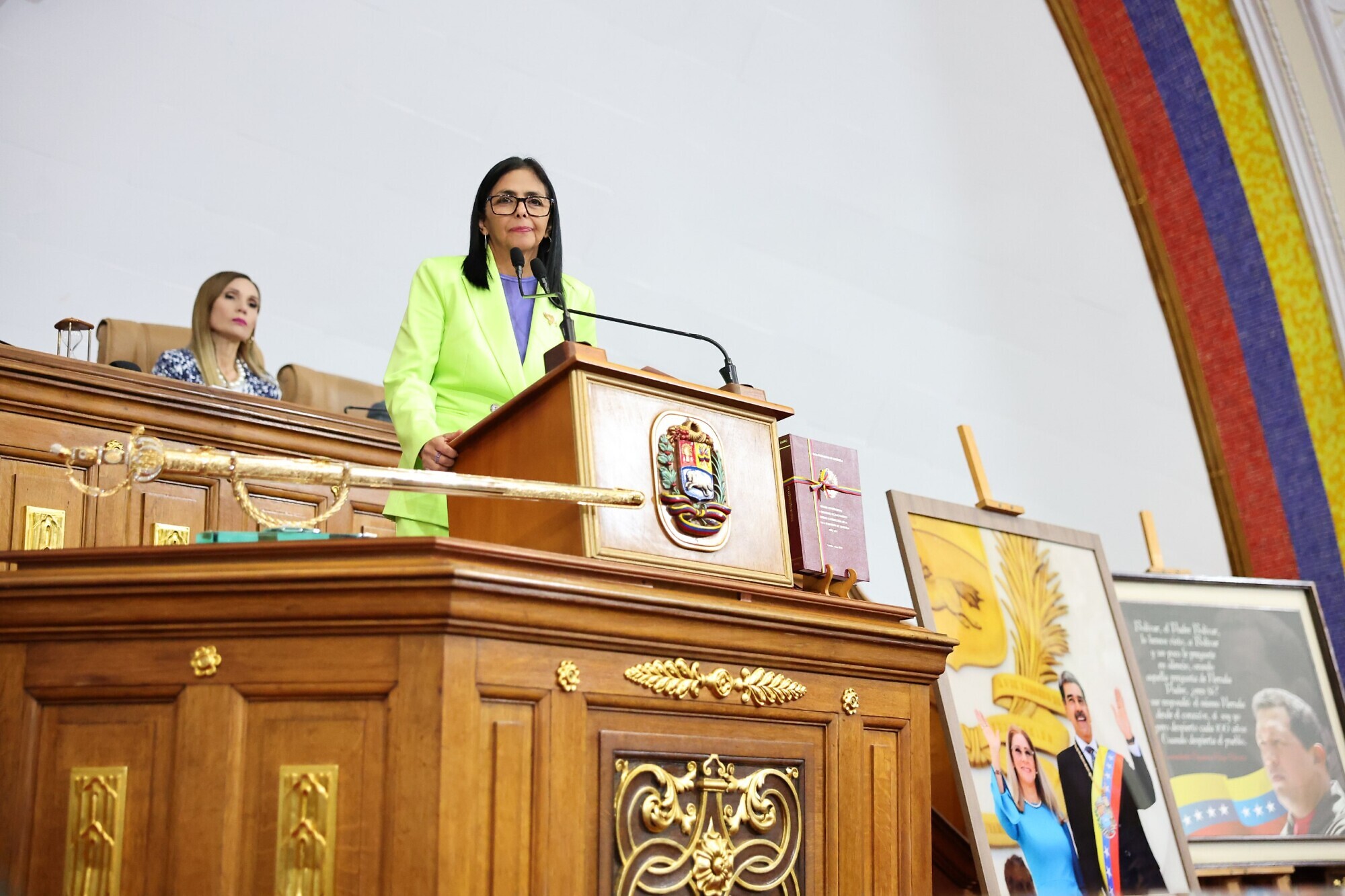
The acting president has defended diplomatic engagement with the Trump administration. (Prensa Presidencial)
Caracas, January 16, 2026 (venezuelanalysis.com) – Venezuelan Acting President Delcy Rodríguez expressed her willingness to “continue shaping energy cooperation” with the United States while “respecting international legality.”
Rodríguez delivered the “Memoria y Cuenta” address to the nation before the National Assembly on Thursday, having taken office following the January 3 US military attacks and kidnapping of President Nicolás Maduro and First Lady Cilia Flores.
In her speech, Rodríguez highlighted some of the country’s recent economic achievements amidst wide-reaching US sanctions, including a reported 19 consecutive quarters of economic growth and an expected 8.5 percent GDP growth in 2025.
The acting president likewise stated that the Caribbean nation had eliminated gasoline imports last year. Rodríguez went on to announce a reform of Venezuela’s Hydrocarbon Law in order to promote foreign investment. The proposal seeks to incorporate mechanisms established under the 2020 Anti-Blockade Law to circumvent unilateral sanctions.
Rodríguez focused her speech on the importance of diplomacy, stressing that Venezuela “has the right” to maintain ties with China, Russia, Cuba, Iran, as well as the US.
With the US government reportedly administering Venezuelan oil sales and the Trump administration vowing to control the industry for an “indefinite” period, Rodríguez reiterated that Caracas remains open to energy relations in which “all parties benefit.”
She also reaffirmed her willingness to strengthen bilateral relations with Washington without subordination, urging legislators not to “fear” diplomatic initiatives.
“The acting president is afraid because she is threatened; Venezuela is threatened—Venezuela as a whole,” she said. “That is why I call for national unity, so that with sovereignty as our guiding principle, we can wage the diplomatic battle.”
Rodríguez went on to affirm that if, as acting president, she were to travel to Washington, she would do so “standing upright, walking—never groveling.”
Diplomatic rapprochement
The acting president’s diplomatic focus came days after the Venezuelan government announced the start of an exploratory process with the US aimed at reopening the respective embassies in Caracas and Washington, DC. Venezuelan officials have defended the diplomatic rapprochement with the need to denounce Maduro and Flores’ kidnapping and offer consular support during their upcoming trial.
Caracas also reported the arrival of a US State Department delegation last week to evaluate conditions for the embassy reopening. The Maduro government broke diplomatic ties with the first Trump administration in 2019 after the latter recognized the self-proclaimed “interim government” headed by Juan Guaidó.
Rodríguez further revealed that on January 14 she held a “long and courteous” phone call with Trump, during which they discussed “a working agenda for the benefit of both peoples.” The US president confirmed the exchange, describing the conversation as “great” and calling Rodríguez “a wonderful person” with whom “it is very easy to work.”
On Thursday, the Venezuelan leader reportedly held a meeting with CIA Director John Ratcliffe at Maiquetía airport. According to the New York Times, the two discussed intelligence cooperation, with Ratcliffe emphasizing that Venezuela should cease to be an alleged “safe haven for America’s adversaries, especially narco-traffickers.” The Rodríguez administration has yet to comment on the meeting.
Additionally, the interim president dispatched Félix Plasencia—former foreign minister and ambassador to the UK—to hold meetings with US officials in Washington.
Plasencia’s visit coincided with a trip by opposition figure María Corina Machado, who held what the BBC described as a “brief and atypical” encounter with Trump at the White House. The far-right leader handed the US president her Nobel Peace Prize medal.
The gesture drew criticism from Norwegian experts and media outlets, who labeled it “incredibly shameful” and “damaging” to the award. The Nobel Committee’s decision to grant Machado the prize had likewise come under fire due to the far-right leader’s history of involvement in violent coup plots and calls for foreign intervention.
Trump, however, thanked Machado for the “gesture of respect,” though the White House later stated that the visit was just a “courtesy” with no influence on administration policy. Following the January 3 attacks, the US president dismissed Machado’s prospects of leading Venezuela, adding that she “did not have respect within the country.”
Meanwhile, agreements between Caracas and Washington continue to move forward, including the resumption of deportation flights from the US on Friday. The first such flight, operated by Eastern Air Express, departed from Phoenix, Arizona, and landed at Simón Bolívar International Airport with 199 Venezuelan migrants onboard.
The previous deportation flight had taken place on December 10. Two days later, the Venezuelan government announced that the Trump administration had unilaterally suspended the migrant repatriation program.
Edited and with additional reporting by Ricardo Vaz in Caracas.