Delcy Rodríguez

Venezuela and the Perils of Ceding Sovereignty

Washington has imposed a semi-colonial tutelage over Caracas. (Archive)

On January 3, the US bombed Venezuela’s capital region and kidnapped President Nicolás Maduro. The unprecedented attack represented the culmination of a quarter-century of imperialist hybrid war, including devastating unilateral sanctions, mercenary incursions, “color revolution”-style insurrections, media disinformation, and NGO infiltration.

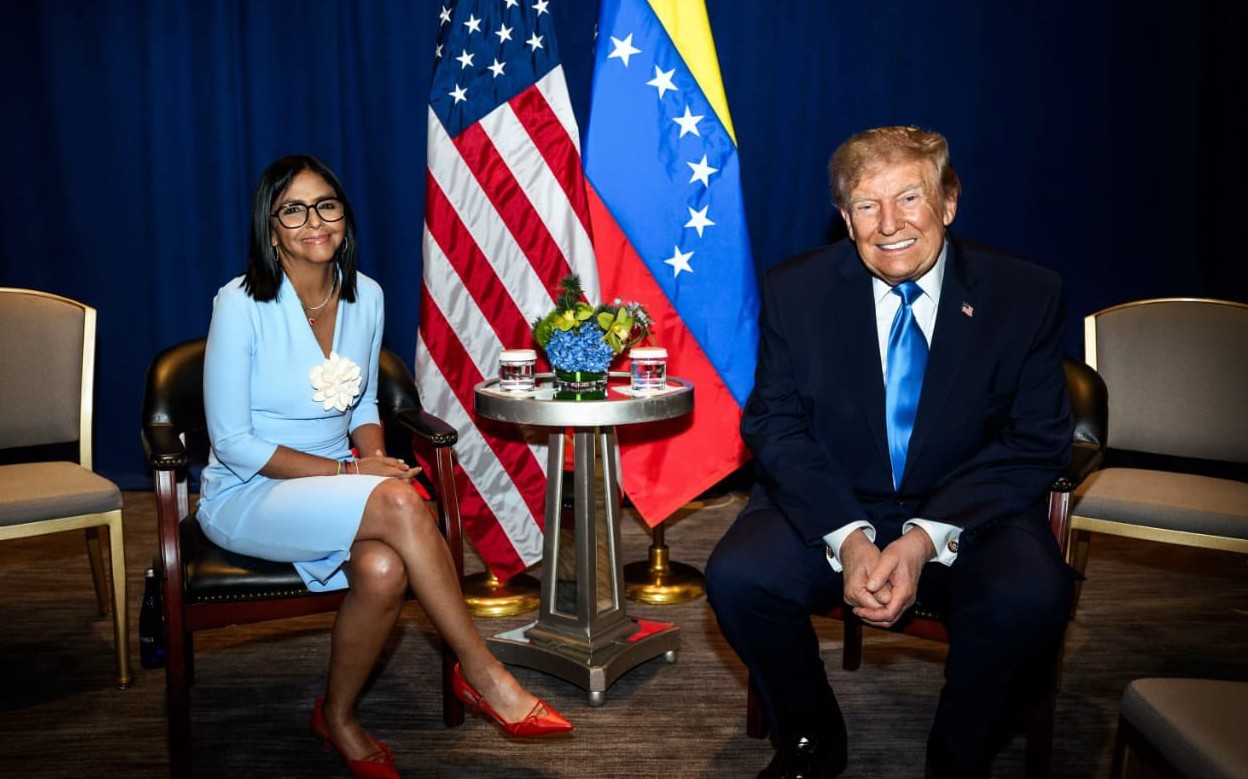
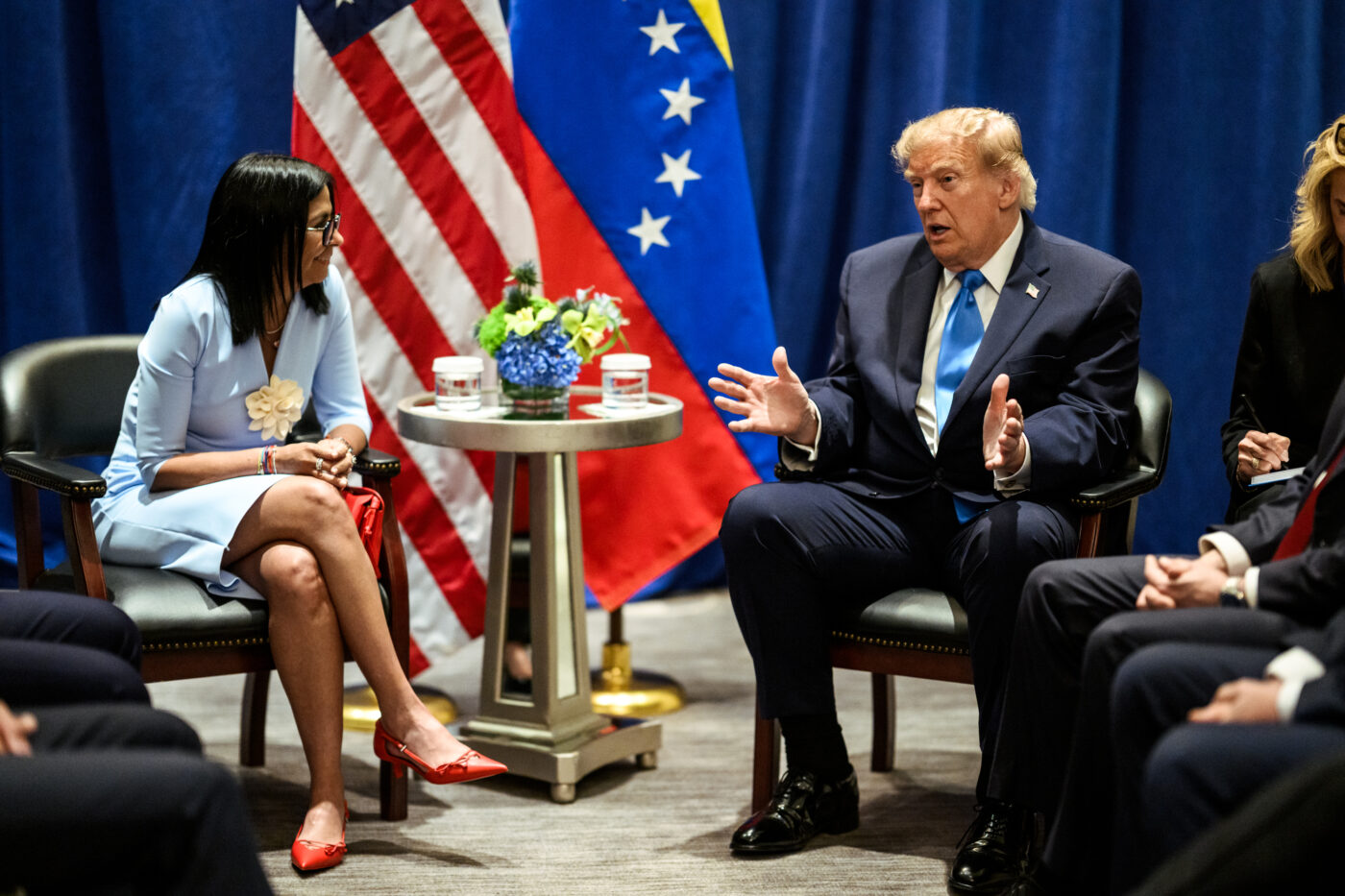
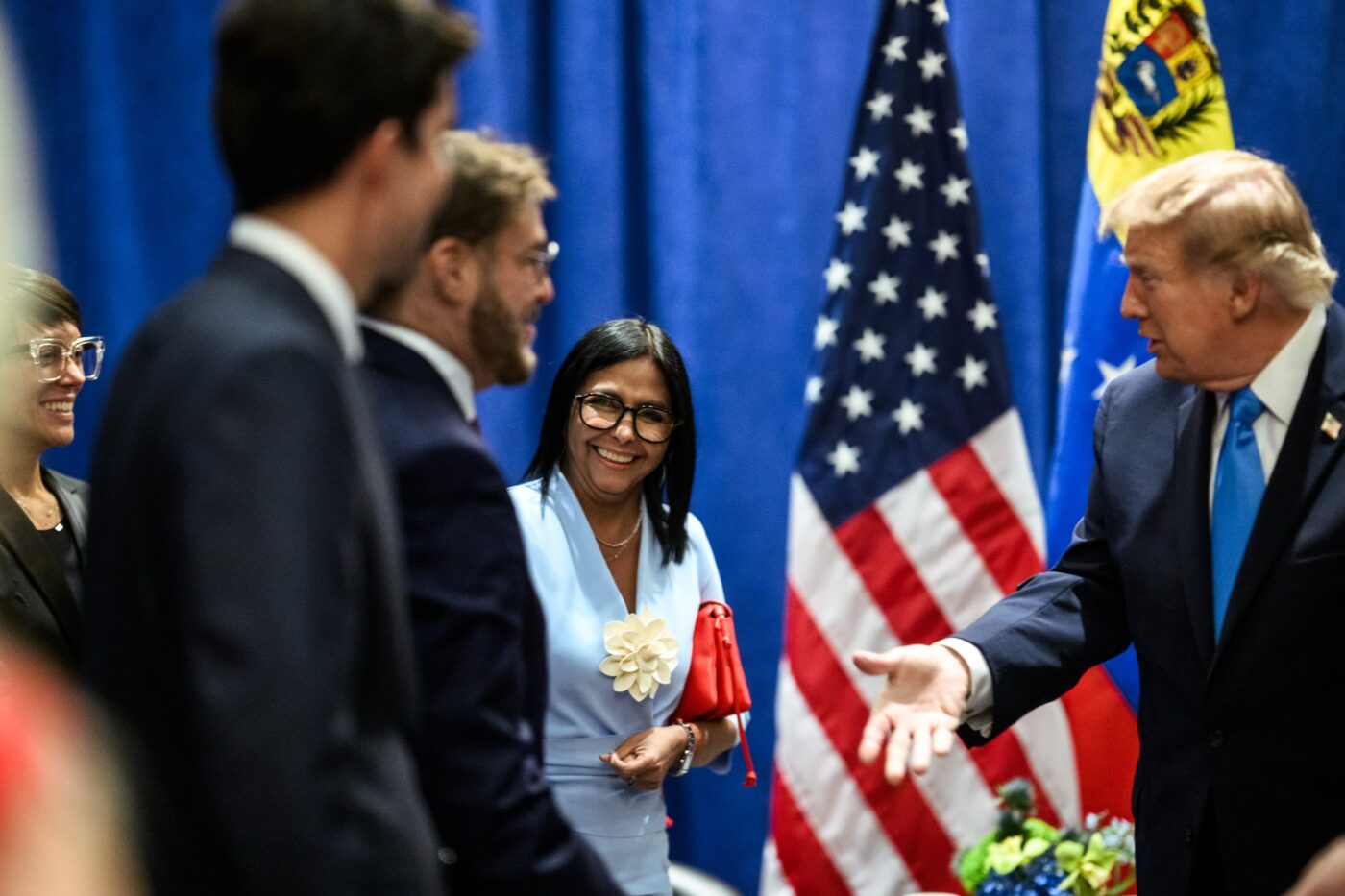
The four months since have brought a flurry of developments, from renewed diplomatic ties with the US to an overhaul of key legislative pillars of the Bolivarian Revolution. Additionally, the Trump administration established semi-colonial control over Venezuelan oil revenues, with the amounts and timings of disbursements back to Caracas left entirely at US officials’ discretion. The arrangement is similar to the one Washington has forced on Iraq since the 2003 invasion.

This compromised sovereignty is a catalyst for other issues. On the one hand, it makes it tougher for the Venezuelan government to improve living standards without challenging business interests. On the other, the burden of Venezuela’s external debt might see Washington attempt to impose an IMF loan that will bury the country in debt and dependency for decades.

Venezuelan Acting President Delcy Rodríguez alongside US Energy Secretary Chris Wright at the presidential palace. (Credit: Presidential Press)

The holy grail of foreign investment

The acting Rodríguez government’s tenure has been marked by accelerated political and economic transformations. On the international front, Caracas has restored diplomatic ties with Washington and recently resumed dealings with the US-controlled International Monetary Fund (IMF) and World Bank.

Domestically, Rodríguez has changed key cabinet and military posts, while pushing through the National Assembly a number of reforms with the explicit goal of making the country more attractive for private sector investment, especially from Western multinationals.

Plans to reform pension, tax, housing, and the landmark 2012 labor law are in motion. Mining and hydrocarbons have already undergone pro-business overhauls, with slashed fiscal responsibilities, decreased oversight, and disputes subjected to international arbitration. In contrast to Chávez’s reassertion of oil sovereignty, which underpinned the massive sociopolitical achievements of the Bolivarian Revolution, the reformed energy law brings back the old concession model that puts operations and sales in the hands of private corporations.

In tandem, the Trump administration has issued licenses to pave the way for Western conglomerates to return to Venezuela, and several have already struck deals under the new highly favorable conditions. The licenses maintain and even double down on US sanctions by barring dealings with China, Cuba, Iran, North Korea, and Russia and mandating that all Venezuelan state revenues from oil and mining be deposited in US Treasury-run accounts.

The subordination to US impositions saw Venezuelan authorities extradite former diplomatic envoy and minister Alex Saab to face charges in the US with little to no explanation. The move was shocking but not out of context. In recent weeks, there has been a succession of ceremonies at Miraflores presidential palace where Trump officials get the red-carpet welcome and escort corporate executives to sign contracts under the new pro-business incentives. Far-right tech moguls, including Palantir founder Peter Thiel, are already taking advantage of Trump’s leverage to establish a lucrative foothold in the country. For his part, the US chargé d’affaires holds regular publicized meetings with Venezuelan cabinet ministers. 

Caracas’ technocratic and pragmatic approach has dovetailed with a corresponding shift in discourse. On foreign policy, the anti-imperialist rhetoric has all but vanished. As Trump unleashes a savage war against Iran and threatens to “take over” Cuba, Venezuelan leaders have refrained from condemning the escalating imperialist aggression while emphasizing their desire to build good relations with Washington. At the same time, references to Maduro have drastically decreased, as documented in a recent investigation. Domestically, the central focus has become macroeconomic stability and attracting foreign investment. Both Acting President Rodríguez and her brother, National Assembly President Jorge Rodríguez, acknowledged receiving “recommendations” and “suggestions” from oil majors amid the recent hydrocarbon overhaul. 

Rodríguez and the Bolivarian leadership, under ongoing US pressure, are betting that the pro-business opening will lead to accelerated economic growth that will trickle down into improved living conditions, thus allowing the government to rebuild social legitimacy and political prospects. However, this plan faces serious roadblocks.

US Chargé d’Affaires John Barrett meeting with Venezuelan Electricity Minister Rolando Alcalá. (Credit: @usembassyve) 

Rising domestic pressure

The first issue is that the acting authorities may not have a lot of time to improve the living conditions of the Venezuelan people. 

Over the previous seven years, with the economy asphyxiated by the US economic blockade, the Maduro government prioritized macroeconomic stability and reduced inflation first and foremost, through a strict monetarist policy package. While the approach, coupled with a modest oil industry recovery, did lead to slowed down inflation and modest economic growth, it came at a price of freezing wages, consumer credit, and public spending. The minimum wage, last raised in 2022, is now worth less than US $1 per month, with further increases replaced by non-wage bonuses that cheapen labor costs for employers.

Though these bonuses have increased periodically (the income floor is now $240/month for public sector workers), they are still far from covering living costs. On May 1, Rodríguez ignored growing calls for a minimum wage hike, the conversion of bonuses to wages, and the restoration of collective bargaining rights, instead doubling down on the bonus policy. With government officials announcing a labor reform soon, it is likely that the return of the minimum wage will come alongside a significant erosion of workers’ rights and employer responsibilities.

However, apart from its commitment to fiscal discipline, the Rodríguez acting government has little room to maneuver because of its lack of direct management over oil revenues. At the mercy of the Trump administration to return export earnings in the amount and timing of its choosing, Venezuelan authorities are unlikely to commit to anything that might unsettle the budget. Rodríguez herself warned that wage increases must be “responsible.”

There is a delicate balance to strike. To implement the current pro-business agenda, not to mention the US rapprochement, the government needs social peace, and only improved material conditions for the working-class majority can ensure that in the short term.

Venezuelan trade unions have mobilized to demand a restored minimum wage and labor rights. (Credit: La Izquierda Diario)

The specter of debt

It is not just the pressure for better living standards that looms large on Venezuela’s economic front. There is a growing expectation that creditors will soon reengage with Venezuelan authorities to collect on a sizable external debt: a combination of defaulted bonds, unpaid loans, and arbitration awards that, with interest accrued over years, may amount to as much as $170 billion. The Venezuelan government recently announced the launch of a debt restructuring process, while Washington issued a license allowing the hiring of financial and consulting services. 

Given the recent overtures to foreign capital, Venezuelan leaders will be hard-pressed to honor whatever commitments necessary to render the country a favorable investment climate. Nevertheless, a major chunk of this debt is illegitimate.

On the one hand, debt ballooned in the mid-2010s as Venezuela’s credit rating was unjustifiably downgraded and borrowing costs went up, as Washington slapped its first rounds of sanctions on the Caribbean country. The Maduro government made a strategic choice to prioritize debt service as the economy reeled following a collapse of global oil prices, hoping that this “discipline” would stave off a scenario where the country was shut out of financial markets. It turned out differently.

Venezuela was gradually locked out of global finance after the Trump administration’s 2017 financial sanctions. Bonds defaulted one after another and have been accruing interest ever since. And the notoriously corrupt US-backed “interim government” also played its part in running up Venezuela’s liabilities and pilfering state assets abroad.

The diverse group of bondholders and corporations owed arbitration awards is sure to receive the backing of the White House, which holds the purse of Venezuela’s export proceeds. This mechanism could be utilized to directly transfer Venezuelan state income to creditors in what would effectively amount to international wage garnishing. Given how Venezuelan bonds have risen in recent months, investors are eagerly eyeing a significant windfall.

Venezuela’s unsustainable debt burden opens the door for further US imperial predations. Even if there is an agreement to pay 50 cents on the dollar for Venezuela’s $170 billion debt for a period of 15 years, that comes to $5.6 billion a year, roughly a quarter of the present budget. It is simply unpayable.

While Caracas may be able to settle with some creditors by privatizing Venezuelan state assets, it will not amount to much. Venezuelan leaders will stress that, with the recent reforms and US opening, the economy will grow tremendously, and they will be able to honor all commitments. But creditors are not willing to wait when they can cash in now, especially given Venezuela’s weak bargaining position. The government cannot maintain a functioning country in the short term with a huge debt burden. As a result, the US might take advantage of the crisis to impose a major loan from the IMF or some lending coalition.

Trump has pushed for the return of Western corporations to Venezuela at the expense of Russian, Chinese and other counterparts. (Credit: VCG)

Sovereignty under threat

An IMF or similar loan program is more than just an agreement to lend some amount under certain repayment conditions. It is an opportunity to impose neocolonial arrangements on Global South countries. In Venezuela’s case it is even more symbolic: it would mean exacting the proverbial pound of flesh for Chávez’s revolutionary audacity to challenge US hegemony in the Western hemisphere.

An eventual long-term credit program would surely come alongside a structural adjustment package of mass privatizations, gutted social expenditure, and all-around liberalization of the economy. Given the current leverage over Venezuela, US officials may attempt to further entrench the rollback of the Caribbean nation’s sovereignty.

Between the growing domestic demands for improved living conditions and the specter of debt renegotiation, the acting Rodríguez government will find it increasingly difficult to walk the tightrope of maintaining social peace while continuing to make one concession after another to monopoly capital and the Trump White House. 

With the limits of US imperialism nakedly exposed in Iran, Trump needs a victory in Venezuela. But that victory does not entail a buoyant economic recovery with social justice, let alone the survival of a sovereign and revolutionary project. Victory for the US is a dependent country, mired in debt and underdevelopment, where Western corporations plunder natural resources and geopolitical rivals are kept at bay.

Ultimately, any long-term plan for sovereign development needs to start from the fact that US imperialism, to echo Che Guevara,  is “not to be trusted even a little bit,” much less considered a “partner” in a “cooperation agenda.” It will undoubtedly be a major hill to climb. But thankfully, even if it means starting over, the Bolivarian Revolution is not starting from scratch.

Source: Sovereign Media

Source link

Attacking the Death Star Isn’t Enough to Build the New Republic

It’s more evident by the minute that Darth Delcy’s plan is to avert the creation of the New Republic by giving the Empire a technocratic, trade-friendly outlook. The path between defeating Darth Maduro and dismantling the Empire has turned out to be treacherous. Master Machado has tried to reassert her leadership by visiting foreign galaxies, but can’t find a breakthrough with the Viceroy.

Delcykrats are trying to conduct a swift takeover of the layered system Darth Maduro inherited from the Emperor. Madurokis are being neutralized or quietly assigned to minor planets, as is the case of Grand Moff Padrino in Agraria. Grand Admiral González López and Envoy Plasencia, old friends of Darth Delcy, are making strides, one within the Imperial High Command, the other across intergalactic diplomacy. Grand Vizier Jorge, Darth Delcy’s cunning brother, is running the senate and recasting the new imperial order through the language of old Scarlet propaganda.

The new imperial order

Viceroy Trump looks unwilling to press the ruling Delcykrats as long as he gets unrestricted access to on-demand resources such as kyber crystals and beskar steel. As Darth Delcy’s power and appeal before the Trade Federation has grown, she has terminated initial gestures of reconciliation that were initially needed for appeasement. A new Death Star is in the works, and to build a superior weapon for durable rule, Darth Delcy knows time is her most valuable asset.

Chief Envoy Rubio has reassured Master Machado that the galaxy first needs to stabilize and revive its economy before any transition can take place. Lately, however, the envoys that visit Carascant have said nothing about Republican reform, and a great deal about kyber crystals and the resumption of intergalactic travel.

The Empire does not need either Darth Maduro or Darth Delcy to prevail. It only needs the New Republic project to fail.

Aligning the interests of the victors of the November referendum with those of the New Republic will be a challenge for rebel aides Mon Meda and Pedro Organa. They won’t just need to keep a level of coordination with allies of growing importance, but to safeguard Master Machado’s position before Viceroy Trump while keeping the new hope alive.

The struggle for Republican foundations

At the same time, a genuinely independent Imperial High Court could become the first meaningful check on Imperial power. The courts are also expected to oversee the Council of Electoral Battles, still controlled by Madurokis whom Darth Delcy has left untouched to avoid triggering her pending matchup with Master Machado. These two institutions will be critical to the third phase that Chief Envoy Rubio is purportedly pursuing, and might determine the success of Viceroy Trump’s plan after capturing Darth Maduro. Control over courts and the Battles Council will determine whether the final electoral contest—backed by the Trade Federation—can take place on credible terms.

The Rebel struggle will gradually shift toward navigating a far more intricate web of factions within a fragmented Trade Federation.

The near future provides an opportunity for the new order to strengthen. The Trade Federation’s influence over Darth Delcy depends on Viceroy Trump’s grip on power, which will face its biggest challenge in the November referendum. The unchecked power the Viceroy currently has allows him to circumvent any criticism over Carascant. But change in the Trade Federation’s balance of power could make bipartisan support essential for the future of the New Republic.

The Trade Federation’s reckoning

These alliances will likely be essential to maintain pressure and decisively advance the New Republic’s agenda. Nonetheless, Viceroy Trump’s polarizing grip on the narrative has created deep seated resistance amongst potential allies. The struggle will gradually shift away from merely managing and appeasing Viceroy Trump and his Envoys, and toward navigating a far more intricate web of factions within a fragmented Trade Federation.

When Darth Maduro was defeated but no New Republic was allowed to emerge, the Empire did not dissolve, it adapted. Its new faces and colors are not signs of weakness but mechanisms of survival, designed to delay or prevent the formation of a New Republic. “Permanent victory” is an illusion. The Empire does not need either Darth Maduro or Darth Delcy to prevail. It only needs the New Republic project to fail.

What follows for Master Machado and the Rebellion is therefore not a triumphant return, but a sequence of calculated risks. The next chapter will depend on whether Master Machado returns as the leader of a Rebellion or as the effective architect of a New Republic. The Empire is determined to prevent her return or neutralize her immediately. If she returns solely as a symbol of resistance, Imperial forces will seek to frame her as a destabilizing threat to Viceroy Trump’s plan, increasing the risk of escalation against her.

If, however, her return becomes the centerpiece of a multilateral New Republic project backed by the Trade Federation, it would directly undermine Darth Delcy’s strategy. In that scenario, any move against Master Machado would signal to Viceroy Trump that Delcy cannot control the coalition she leads. At the same time, Master Machado’s movement can position itself as a more credible alternative for institutional reconstruction.

This shift, from diplomatic cover during resistance to an instrument of internal legitimacy, opens a narrow but meaningful window for the New Republic’s success.

The past 12o days show that Venewoks have not yet earned their Endor moment. As in the Star Wars movies, dismantling an Empire and building a New Republic will take a long and arduous journey. Normally the credits would unroll now, but the crisis continues and Darth Delcy’s intentions are crystal clear.

Source link

Delcy’s Approval is Already Slipping

Venezuela has spent three months measuring the exact moment when a collective expectation begins to turn into disappointment. The monthly surveys conducted by AtlasIntel and Bloomberg for LatAm Pulse Venezuela, fielded in February, March, and April 2026, document a political process with a name, a direction, and a speed. What they show is unequivocal: Delcy Rodríguez is not consolidating a transitional government. She is managing one that is eroding by disguising that transition rather than carrying it out.

This is not a collapse in her popularity, but a clear downward trend is already visible.

The numbers are precise. In February, 37% of Venezuelans approved of Rodríguez’s performance. By April, that figure had fallen to 31.4%. Disapproval rose from 44.3% to 47.1%. In absolute terms, the gap between those who approve and those who disapprove widened from 7 to nearly 16 points in 90 days.

The most revealing data point is not approval but performance evaluation. Those rating her government as “excellent or good” dropped from 23.4% to 16.2%. That share did not migrate into outright rejection. It moved into the “average” category, which grew from 34.7% to 45.3% and is now dominant. That shift suggests disappointment more than anger, and the former is far harder to reverse than open rejection.

The segment that once supported Rodríguez is the one moving the most. A first conclusion is that the management of expectations created on January 3 is not working. Almost 120 days into her time in power, people are not really buying the narrative.

To understand why these segments are shifting, the economic data must be read in parallel. In February, 78% of Venezuelans believed the country would improve over the next six months. That was the optimism of the historical moment, the expectation unleashed on January 3. Three months later, that optimism has dropped 23 points. Today, 55% still expect improvement.

According to these figures, public perceptions of the opposition remain intact.

Meanwhile, reality has not moved: 77% still rate the country’s economic situation as bad. The labor market is perceived as equally deteriorated. The Consumer Confidence Index fell from +14.7 in February to -1.9 in April. The expectations index dropped from +58.3 to +34.6.

The gap between what was expected and what is being experienced is the engine behind everything else. And that gap does not weigh equally on everyone. That vulnerable Venezuelan who, even in crisis, continued to rely on Chavismo out of necessity, obligation, or support (the lower-income, less-educated, a beneficiary of the Patria system who gave Rodríguez the benefit of the doubt) also expected that the post–January 3 shift would be felt in their pocket, their job, their daily life. Three months later, they do not feel it.

Chavismo and the opposition

The leadership approval ranking measured by AtlasIntel completes the picture. María Corina Machado holds a positive image among 56% of participants without losing a point in three months, with a +30 net rating. Edmundo González stands at 49% with +24 points. According to these figures, public perceptions of the opposition remain intact.

The contrast with the Chavista bloc is stark. No government figure has a positive net rating. Diosdado Cabello stands at -52 points, Jorge Rodríguez at -51, and Nicolás Maduro at -46. Rodríguez is the “least negative” within the bloc at -30, but still deeply in negative territory. The Chavista leadership, without exception, occupies extremely high rejection levels, a clear reflection of how the public views anything associated with Maduro.

Ruling is easy when you control the entire State. Legitimizing power requires improving people’s lives. That is the debt the public is now charging to Rodríguez.

Venezuela is moving from the expectations born on January 3 toward reality. And the reality is that Rodríguez’s government is not being perceived as the solution—it is increasingly being identified as the continuation of the problem left behind by Maduro. AtlasIntel identifies corruption as the country’s number one issue for 53% of respondents. The weakening of democracy ranks third at 32.8%. The public does not confuse management with change.

Rodríguez has not lost her critics, a majority that was never with her. What she is losing is politically more costly: her believers. Those who, without being part of the opposition, expected something to change. Those who gave her the benefit of the doubt at the peak of collective expectation Venezuela had not seen in years. That movement, which is quiet and without headlines, is what AtlasIntel’s data captures month after month with a clarity that official discourse cannot conceal.

AtlasIntel sampling

The data for this analysis comes from a random digital recruitment survey (Atlas RDR) conducted among 4,629 Venezuelans between April 24 and 28, 2026. Like all digital polling in Venezuela, the method carries a known structural bias: it overrepresents populations with active internet access, implying a relative underrepresentation of rural areas, older adults, and lower-income sectors without stable connectivity. Absolute figures should be interpreted with caution.

However, the instrument’s real value lies not in a snapshot but in its month-to-month tracking. If the bias is constant (as it is in this case, given that the digital profile captured remains structurally the same each month) then movements between measurements reflect real changes in opinion. A miscalibrated thermometer still detects a fever. And what this three-month series detects is unequivocal: erosion is real, sustained, and advancing among the segments Rodríguez could least afford to lose.

Managing power is relatively simple when the instruments of the State are in hand. Legitimizing it requires improving people’s lives. That is the debt these three months of surveys are charging to Rodríguez’s government.

If this continues, her own base could withdraw its support in the worst possible way: through the disappointment of those making a final bet on trust after years of having lost it. That kind of disappointment does not reverse, and may represent a more dangerous political rupture than outright rejection.

Chavismo wants to remain in control. But time is charging the opportunity for change that people saw on January 3. If that change does not arrive, it will be demanded. Without elections, it will be very difficult for them to claim to represent the country’s leadership before a population that no longer believes in them. Elections are necessary and urgent. Can chavismo avoid them?

Source link

Trump’s “Transition” in Venezuela is Starting to Reek

One day Delcy Rodríguez calls for a reform to the justice system after announcing the sudden revocation of the amnesty law her brother sponsored. The other, rumors suggest she’ll reshuffle the country’s higher court without providing any indication of who the new magistrates are going to be. The central bank president she recently named prepares to disclose figures to the IMF for the first time in decades.

The public does little else than follow the news, as if things were normal. Futile debate has emerged on social media over whether the new US chief of mission in Caracas is more hawkish than his predecessor. Or if the opposition has racist tendencies because a singer (once popular in the 2000s) called Delcy an ape in the opposition’s largest rally in years.

The picture of the country in recent weeks is one of Delcy Rodríguez calling the shots with near-total freedom. She has been enjoying a clear head start over a potential presidential election, as she crisscrosses Venezuela on what amounts to an unofficial campaign tour. In Caracas, she keeps changing everything so that nothing really changes. She is intent on controlling government offices in the next four years through newly promoted loyalists and a clean inflow of petrodollars. The chavista elite has looked more confident in the meantime, touring with Delcy in sky-blue outfits, leading cartoonish chants for peace and national union as if the internal contradictions that surfaced two months ago were now less important, because the possibility of survival looks clearer.

Back in February, optimists would discuss the scope of Washington’s coercion capacity over the “caretaker” regime, the boundaries that (if crossed) would trigger a “second wave” of attacks, the disappearance of Alex Saab as a prelude of a broader purge against other “untouchables” that overtly normalized the commission of terror. Now, lunatics like Diosdado Cabello’s nephew, Alejandro Rondón, claim on social media that “the recess is about to end” the same day Delcy says the amnesty scheme ran its course and Cabello recounts an unlikely justice system crackdown.

What followed January 3rdwas a paradigm change with positive practical consequences for society that chavismo quickly learned to manage if not reverse.

Alejandro doesn’t look like the brightest dude. He’s another chavista nepo-kid working for the other Cabello uncle that controls Venezuela’s taxing authority, Jose David, though Alejandro made a name for himself with rage-baiting tweets that celebrated Maduro’s “victory” in 2024 and claimed the opposition were terrorists who falsified the official voting records (i.e. Diosdado’s talking points during the tun-tun operation).]

But an emboldened member of the Cabello Rondón clan is a troubling sign for those who fled the country after being placed on “treason” blacklists. It also undercuts the very notions of pluralism and national reconciliation that Marco Rubio invoked three months ago when outlining his vision for Venezuela’s democratic transition before US senators. Shortly thereafter, Rondón drove the point home by publicly wishing Donald Trump well after the shooting at the White House Correspondents’ Dinner. The message seems clear: the arrangement with Team Trump is comfortable enough that, however fraught the geopolitical backdrop, they can afford to be flippant—even in public. They remain, unmistakably, the bullies in town. 

The long wait for elections (or just a calendar?)

What followed January 3rd was a paradigm change with positive practical consequences for society that chavismo quickly learned to manage if not reverse. Allies of Maria Corina  Machado who spent the past two years jailed or hiding are back in the street, even providing testimonies about their imprisonment. The student movement has undergone a revival, liaising with human rights groups to set up carefully-controlled protests. Censorship isn’t what it used to be, so journalists have tried to take advantage of that opening. Pensioners and public workers have perhaps become the loudest actor in confronting Rodríguez, despite having to face colectivos and National Guards whenever they hit the streets.

Repression has become less intense, but the lack of a clear electoral calendar keeps the opposition on the sidelines, waiting for the arrival of Machado, which is no less paralyzing. The amnesty law passed on February 19 effectively funneled the release of political prisoners, shattering expectations of a “landmark outcome” that would speed up the process. 

Indeed, the statute’s contents make more than 180 supposed military rebels ineligible, although the release of a handful of FANB officers in recent days reinforces the idea that a law wasn’t necessary to get people out of jail. Nearly 300 civilians are still imprisoned, and we haven’t seen significant breakthroughs in the past few weeks.

According to figures from NGO Foro Penal (based on documented cases), the political prisoner population fell by 40% in the two months following the US military intervention—dropping from 863 detainees in late December to 526 by March 2. The pace has clearly slowed since then. Chavismo released 36 people between March and April, and 17 over the past 18 days (about 6% of the pre–January 3 total). The regime still resorts to sporadic arbitrary arrests and intimidation. Alexis Paparoni, an opposition figure in Mérida (and brother of Carlos Paparoni), was briefly detained while traveling and later released under precautionary measures. A similar incident occurred last weekend with a government employee in Guárico, who was detained for having a note on his desk bearing the now-infamous slur directed at Delcy.

“These prisoners are currently incarcerated because POTUShas chosen to appease and praise the perpetrators instead of supporting their victims,” Burelli recently told Senator Scott.

The White House appears satisfied with results so far. Venezuela is now subject to sweeping sanctions relief across oil, gas, minerals, and fertilizers, while OFAC has issued waivers allowing operations with public banks. Most notably, Delcy Rodríguez has been removed from the Specially Designated Nationals list—effectively unfreezing her US-based assets and clearing the way for financial dealings under American jurisdiction. 

The opposition leadership has largely stuck to its 2025 strategy of projecting trust and patience toward Donald Trump. María Corina Machado continues to argue that Trump is the head of state who has done the most to advance Venezuela’s liberation and maintains that the Rodríguez government is dismantling the Maduro-era “structures of corruption and repression.” However, she acknowledged last week that a bout of political instability cannot be ruled out. 

“The risk is that if people feel the path [toward freedom and democracy] is beginning to close, they may start to push back in a disorganized and potentially anarchic way,” she told esRadio hosts in Madrid. “That’s why a clearly defined electoral calendar is a guarantee of peace and stability. That would help people accept that this process will last a bit longer, as institutions must be strengthened and we need to take time to prepare for a truly impeccable election.”

Running out of patience

Criticism of the Trump administration’s handling in Venezuela continues to grow among groups of scholars and foreign policy observers, while opposition parties remain largely quiet and prefer to let Machado formulate their stance.

But in general, there’s a tense awareness that the waters are getting muddy. Some in journalism, and other opposition allies are starting to lose their patience.

Venezuelan journalist Sebastiana Barraez, an outspoken critic of chavismo and popular source on repression, told her audience that Venezuelan people have no guarantees about their future. Two days ago, she admitted the overthrow of Nicolás Maduro had raised hopes of a new democracy and true institutional recovery.

“It turns out none of that is happening,” Barráez said. “In Venezuela, Trump is promoting the interests of the United States. The problem is that those interests are not compatible with what we Venezuelans are looking for.”

Pedro Mario Burelli, an independent advisor for the opposition, is among the few figures to be pressing Washington over its ties with Delcy Rodríguez, calling Trump’s decision to elevate her an “incoherent strategy.” He has warned that doing business with Minerven makes the US an effective enabler of environmental crimes in Venezuela’s south. In March, he told The Atlantic that the remaining political prisoners now belong to Trump and Rubio.

“These prisoners are currently incarcerated because POTUS has chosen to appease and praise the perpetrators instead of supporting their victims. Constantly praising Delcy is disgraceful and an insult to the vast majority of Venezuelans”, Burelli told GOP Senator Rick Scott on Sunday.“Faulting her, as you and some of your colleagues do, is disingenuous. Venezuelans rightfully expect, and deserve, much more from democratically elected US officials.”

Source link

Venezuela Installs Commission to Evaluate State Assets, Mulls Possible Sell-Offs

Rodríguez announced four categories for state assets, with “non strategic” ones destined for privatization or liquidation. (Presidential Press)

Caracas, April 23, 2026 (venezuelanalysis.com) – Venezuelan Acting President Delcy Rodríguez has established a commission to assess the “strategic” value of state-owned assets and their possible transfer to the private sector.

The Commission for the Evaluation of Public Assets held its first meeting on Wednesday. In a short televised message, Rodríguez said the commission had the purpose of bringing “agility and modernity” to the Venezuelan state.

The acting president announced that Venezuelan state assets would be divided into four categories: strategic ones to remain under state control, “strategic alliances” where the state retains ownership but management is turned over to the private sector in concession-type deals, “non-strategic” assets to be fully privatized; and assets to be liquidated or reincorporated elsewhere.

“The purpose of this commission is to elevate Venezuela’s productivity levels, so that the Venezuelan state can be robust and attend to the strategic aspects of the nation,” she said.

The commission includes Economic Sector Vice President Calixto Ortega, Finance Minister Anabel Pereira, Industry Minister Luis Villegas, State Solicitor Arianny Seijo, Communes Minister Ángel Prado, as well as Luis Pisella, former president of industry guild CONINDUSTRIA, representing the private sector.

Former Venezuelan President Hugo Chávez spearheaded a nationalization campaign in the 2000s to impose state control of key economic areas such as oil, electricity, telecoms, banking, and the heavy industries.

In recent years, with the economy heavily targeted by US sanctions, the Nicolás Maduro government expanded “strategic alliances” with the private sector, particularly in the Venezuelan countryside. However, campesino organizations have denounced that the private takeover of companies that formerly supplied seeds, inputs, and tractors has significantly raised costs for small-scale producers. Strategic alliances in sugar mills have also drawn complaints of companies defrauding sugar cane growers.

The Cisneros Group, one of Venezuela’s largest private sector conglomerates, has recently announced plans to raise over $1 billion in funds ahead of potential sell-offs of state assets.

Elias Ferrer Breda, financial analyst and director of Orinoco Research, told Venezuelanalysis that he foresees privatizations in basic industries such as steel and cement.

“In my view, we will see virtually all the industries that are running at low capacity and without turning profits privatized,” he predicted. “We are talking about industries like steel and cement, but also other sectors like hotels or agricultural land.”

Ferrer affirmed that state companies currently under strategic alliances, such as sugar mills or Ferrominera Orinoco, an iron-ore complex presently managed by India’s Jindal Steel, could continue under similar deals as opposed to being sold outright.

“Where investors have mostly expressed an interest is in extractive industries: oil and mining,” he added. Ferrer additionally claimed that US “strategic and business interests” are likely to pursue control over Venezuelan critical mineral reserves, which are not presently certified.

Rodríguez had unveiled the commission to evaluate state assets in an April 9 presidential address. The acting leader also set in motion efforts to reform Venezuela’s labor, tax, and pension legislation. The Venezuelan National Assembly has recently approved pro-business overhauls of the country’s hydrocarbon and mining laws.

Caracas reestablished dealings with the International Monetary Fund (IMF) and the World Bank on April 16. On Wednesday, Rodríguez disclosed a conversation with IMF Managing Director Kristalina Georgieva and stated Caracas’ priority in unblocking around US $5 billion worth of Special Drawing Rights to improve public services such as electricity and water supply.

For her part, Georgieva acknowledged a “very valuable and productive call” and that the next steps include IMF “policy advice and capacity development.”

Venezuelan leaders have vowed that there are no plans to incur IMF debt. However, the Caribbean nation could soon face pressure from creditors looking to collect on a massive external debt, with unpaid loans, defaulted bonds, and international arbitration awards totaling as much as $170 billion with accrued interest.

On April 16, the so-called Venezuelan Creditor Committee held talks with US officials amid efforts to secure a license to engage in debt negotiations with Caracas. The committee includes Fidelity Management & Research Company LLC, Morgan Stanley Investment Management, Greylock Capital Management, and others.

Since the January 3 US military strikes and kidnapping of Venezuelan President Nicolás Maduro, the Trump administration has seized control of Venezuelan oil revenues while issuing licenses to grant Western corporations favorable access to the Caribbean nation’s energy and mining sectors.

Edited by Lucas Koerner in Fusagasugá, Colombia.

Source link

Delcy, the Leopard | Caracas Chronicles

Tarek William Saab, one of the key figures in the repressive apparatus that oppresses Venezuelan society, is dismissed as prosecutor general, but a family friend who has spent years denying Maduro’s atrocities on the international stage is appointed in his place. Vladimir Padrino, under investigation for systematic human rights violations, is replaced by Gustavo González López, also under investigation for systematic human rights violations. They pass an amnesty law, but primarily to grant amnesty to themselves. Over 700 political prisoners are released, but another 473 remain in prison, and those who are released do not always enjoy full freedom.

The institutional reforms of Delcy and Jorge Rodríguez generate headlines abroad that portray them, to those who don’t pay attention to the details, as the moderates The New York Times described them as shortly before the military incursion of January 3rd. The economic reforms, on the other hand, provide arguments, or rather content, for the Trump administration to claim on its social media accounts that it is succeeding in reshaping Venezuela, when on the ground the population observes their living conditions—the blackouts, the inflation, the widespread vulnerability—and concludes that they remain the same as when Maduro was dancing calmly over our dead.

Yes, there are some reasons for optimism, especially regarding the economic transition, but the transition to democracy doesn’t seem to be happening yet. The dictator was removed in a helicopter, but the dictatorship remains.

So far, all of this fits into a metaphor that has been cited countless times in decades of opinion pieces in Venezuela: the Rodríguezes are changing everything so that nothing changes. I grew up reading that cliché in the press, before chavismo burst onto the scene, guns blazing, in our history. “They’re like the Leopard, they change everything so that nothing changes.” In a country that has seen so many supposed reinventions, so many revolutions promising a clean slate to simply replace one set of power with another without solving any of the nation’s structural problems, that cliché has been uttered in relation to many governments and many leaders. But where does it come from, and what does it originally mean?

The cunning of the opportunist

Giuseppe Tomasi, Prince of Lampedusa, was a Sicilian aristocrat who seemed like a character from a novel: he failed as a soldier, he couldn’t prevent his family’s ruin, he saw his palace destroyed by Allies bombs during World War II, and in reality, he was only good for reading and learning languages. He published very little during his lifetime, and spent more than twenty years writing a novel that was published a year after his death in 1957. The book, which was a great success from the start, was titled Il Gattopardo (The Leopard in the English translations), after the cheetah that appears on the coat of arms of its protagonist: Don Fabrizio, the Prince of Salina.

The world is full of Tancredis like Jorge, Venezuela has never lacked them. Juan Vicente Gómez also promised change when he overthrew his crony Cipriano Castro, remaining in power for 27 years.

The character, like his creator, was the last of a line. He was a landowner whose noble titles and privileges depended on the existence of the Kingdom of the Two Sicilies, as the Spanish dominion of southern Italy was called in 1860. When, that year, Garibaldi’s troops invaded Sicily, in the process that would eventually produce the Italy we know today, Don Fabrizio found that everything he stood for was in danger. Sicily would cease to be Spanish and merge into the new Kingdom of Italy, and he would lose his place at the pinnacle of that feudal society, dominated by a few through the mere will of a foreign sovereign. Don Fabrizio, who had dedicated his life to preserving what he had inherited, saw no way to stop the transformations that were approaching like a tsunami at the gates of his palace, crowned by wrought-iron leopards. But his favorite nephew, Tancredi, an ambitious climber who married the daughter of an uneducated nouveau riche and joined Garibaldi’s Redshirt revolution without hesitation, showed him what had to be done: “If we want everything to stay the same, we have to change everything.”

The fate of the cynics

Il Gattopardo is an exquisite work, a great historical novel that brings together all the virtues of the genre: the ability to transport you to an era and dissect it; the pleasure of escaping to a beautiful palace in the golden hills of Sicily, beside a turquoise sea; details like the pasta timbale and granitas served at a fully set table. All of that is in Luchino Visconti’s magnificent 1963 film version, starring Burt Lancaster and Alain Delon, and in the superb miniseries—in which all the actors are Italian—on Netflix.

But what immortalized it was that line from Tancredi. Because of its power to synthesize what many people, in many different historical contexts, have done time and again: move from the old order to the new, disguised as reformers, to avoid losing their privileges by securing a place in the emerging elite. Changing everything so that nothing changes is the strategy of those who must pretend to be the future and not the past, because they would pay a heavy price if they didn’t. It’s the roadmap of those who, like Delcy and Jorge Rodríguez, have prepared themselves to take advantage of an external factor that destabilizes the order of their world—Garibaldi’s landing, the arrival of the Marines—and reorganize that world to their advantage.

Perhaps Jorge Rodríguez read Lampedusa back when he frequented bookstores and wrote fiction like the story that won the El Nacional literary contest. Perhaps he saw Visconti’s film. Perhaps he doesn’t even know this story: the world is full of Tancredis like him, and Venezuela has never lacked them. Juan Vicente Gómez also promised change when he overthrew his crony Cipriano Castro, remaining in power for 27 years at the head of a dictatorship that had a very good relationship with foreign oil companies.

In the novel, however, Tancredi meets a bad end: he loses an eye, fails in his ambition to seize power, pays for the mistake of underestimating the Mafia father-in-law with whom he became involved, and for overestimating his own talents. The prince, as expected, disappears along with the world he represented. Italy in the 1860s changed in many ways, and left other things as they were. When you truly read that immortal book left to us by that sad, solitary Sicilian prince, you understand how cynics work to appropriate historical changes, but you also realize that no one, not even those who seem most powerful, can control these.

Source link

Delcy’s Make-or-Break Central Bank Appointment

American sanctions on the Venezuelan Central Bank (BCV) have been relieved, generating a flurry of speculations over what is next for the financial sector and the broader economy. After the big news, Delcy Rodríguez announced the resignation of BCV President Laura Guerra on Thursday night. Guerra is the sister of Nicolás Maduro’s first wife, and the aunt of Nicolasito Maduro Guerra.

At least for now, the central bank will be led by Guerra’s former deputy, Luis Pérez-González, a name that is as underwhelming as any of his predecessors. Pérez has been a member of the BCV board since April 2025. Before that, his experience in monetary policy was nil. He was in charge of Carbones del Zulia and of “Monitoring and Control of Eco-mining Development” in Maduro’s Ministry of Mining. You can find him playing Frank Sinatra songs in his spare time.

It doesn’t look like this will be Delcy’s permanent pick.

Before diving into the immediate and medium term effect that recent developments could have, it is worth highlighting what the BCV’s actual purpose is and the spectacular failure that has driven the institution to near irrelevance. 

Ironically, Venezuelan law mandates the BCV to ensure price stability and preserve the value of the currency. We don’t have to go far back to remember the multiple zeros stripped from the bolívar after one of the longest hyperinflationary episodes in modern history, directly contradicting its constitutional mandate. After all, this is a central bank that went years without publishing any data, and when it resumed, it released incomplete figures, forcing economists to reconstruct years of missing information. It is the same BCV that despite its constitutional mandate did not make any counterbalance to the completely irresponsible fiscal policy of the Chávez and Maduro era, shattering any sort of credibility it may have had. 

Nevertheless, reviving the BCV is crucial to the reintegration of the financial sector into the wider Venezuelan economy. In the near term, the effects of sanctions relief will likely be most visible in exchange rate auctions. Greater transparency and reliability in these operations will help reduce the gap between the official and the black market rates. This would directly affect daily life, reducing price distortions and helping stabilize inflation expectations for ordinary Venezuelans. It would also reopen the door to multilateral institutions and international markets, particularly renewed engagement with the International Monetary Fund, which is a necessary step toward debt restructuring and access to credit.

However, there is no on and off switch in terms of trustworthiness, and the BCV is supposed to be in the credibility business.The effectiveness of any central bank relies on its independence from political pressures and ability to communicate a coherent monetary policy, not just on the technical capacity of who runs it. Undermining that independence is what ultimately kills the effectiveness of any policy it may attempt to implement. 

Delcy needs to set up an independent central bank to satisfy the economic discourse, attract investment, and control inflationary pressures. Doing so will require establishing the first institution capable of challenging the administration from within.

This is true everywhere, as hard fought-battles are being waged around the economic world on this matter. From Trump’s challenges to Federal Reserve Chair Jerome Powell, which unsettled financial markets, to standout regional cases like Peru, where the central bank has been single-handedly supporting the economy despite near-permanente political turmoil. These examples highlight just how crucial central bank independence is to real economic stability.

Restoring trust in the BCV goes beyond who runs it, but the naming of the new president is one of the most crucial decisions that the interim administration of Delcy Rodríguez will have to make. Whoever is chosen will be scrutinized by both ordinary Venezuelans and international investors to gauge the commitment of Rodríguez to carry out the necessary economic reforms. Someone that falls short of being able to implement true independence and restore confidence in the system will just undermine all the political speech of the economy first that is currently being put on display. 

The paradox is that Delcy needs to set up an independent central bank to satisfy the economic discourse, attract investment, and control inflationary pressures. But doing so will require establishing the first institution capable of challenging the administration from within. This is where the political and economic reality clash.

The decision comes with a level of urgency, as patience is starting to run out in an internal political climate that is heating up. Trade unions and pensioners have recently taken to the streets to demand higher wages and benefits. Appointing someone close to the previous administration will increase frustration and complicate the weak equilibrium that Rodríguez has built around the promise to rebuild the economy.  

The interim government is attempting to make itself useful to the American overlords by convincing them that they have the ability and willingness to commit to economic reform. Failure to follow through with an independent BCV board could strain the relationship further and make it even harder to justify. Now that sanctions have been lifted and oil money is flowing through US-backed accounts, it is time for the interim authority to live up to their side of the bargain, as Delcy risks losing the little goodwill her administration has left.  

Attention is now focused on who will be appointed to lead the BCV, and whether that choice signals a genuine shift toward institutional autonomy or a continuation of past policy constraints.

Source link