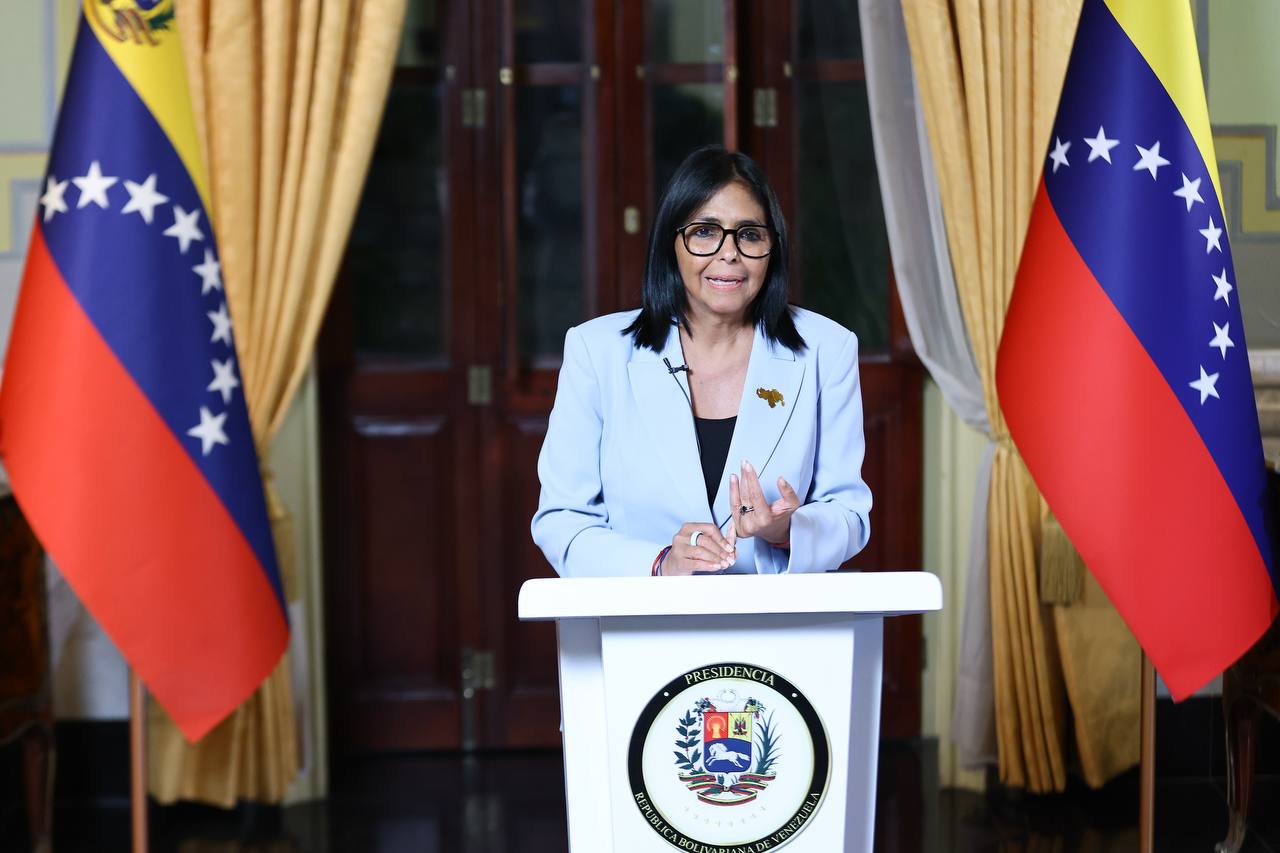
Rodríguez thanked Trump and Rubio for the long-term energy deal. (Presidential Press)
Caracas, August 30, 2026 (venezuelanalysis.com) – Venezuelan Acting President Delcy Rodríguez has defended an oil agreement that US President Donald Trump called “the biggest in history.”
“The historic agreement with the United States will have a great impact on Venezuelans’ lives in the long term,” she said in a televised broadcast on Saturday evening. “It is useless to have oil reserves underground. They should be turned into welfare and prosperity for our country.”
The acting president pledged that the deal would lead to “education and healthcare” improvements and contribute to “energy security” in the Western Hemisphere. She reiterated gratitude to Trump and US Secretary of State Marco Rubio for the agreement.
According to Rodríguez, the joint initiative will see undisclosed private operators take over 17 oilfields for 25 years. The fields in question contain 65 billion barrels of crude, a little over 20 percent of the country’s reserves.
She added that the project had a 1.5 million barrel per day (bpd) target. With prices estimated at $65, Venezuela would collect US $19 per barrel, totaling $209 billion over the course of the agreement.
However, the price estimates stand markedly below present and projected market values, while the state’s take is likewise significantly reduced. Under previous legislation, enacted by former President Hugo Chávez, the Venezuelan state collected over $0.75 for every dollar of oil extracted in the form of royalties, taxes, and dividends from state oil company PDVSA.
Furthermore, an average of $8.4 billion in yearly revenue for 1.5 million bpd produced also amounts to a much reduced share for the Caribbean nation. In 2025, with lower market prices and Venezuela forced to sell at a discount to circumvent US sanctions, the country collected a reported $18.4 billion from an average of 941,000 bpd produced.
Unofficial sources have published the 17 oilfields in question, with nine being extra-heavy crude projects, eight of them in the Orinoco Oil Belt. The remaining eight are reportedly mature light and medium crude fields in Western Venezuela.
For his part, Trump presented the agreement as a major foreign policy victory that would boost US energy security for decades. In a social media message on Sunday, Trump claimed he would use Venezuelan oil to “fill up the Strategic National Reserves,” calling the supply “a gift from Venezuela.”
Details on the US role in the agreement have yet to be disclosed, with Trump Energy Secretary Chris Wright expected in Caracas in the coming days.
According to AP, the US government will have an ownership stake in a company receiving 100-year rights to drill in the assigned oilfields. Washington would reportedly secure 55 percent of the output and be able to purchase oil at cost.
The Wall Street Journal reported that the Trump administration plans to secure a 35 percent stake in North American Blue Energy Partners (NABEP), a firm owned by Venezuelan oil mogul Alejandro Betancourt that currently operates multiple oil projects. The operation would be conducted by the Pentagon’s Office of Strategic Capital through penny warrants that minimize capital investment.
Venezuelan and US officials have stated that the deal will attract $100 billion in private sector investment. Nevertheless, there has been no information released about the private actors involved.
Since the January 3 US military strikes and kidnapping of President Nicolás Maduro and First Lady Cilia Flores, the Trump administration has seized control over Venezuela’s energy sector. Washington has maintained wide-reaching sanctions in place while issuing licenses for select Western corporations. The US Treasury likewise manages Venezuela’s crude sale revenues, with the amounts and timings of the disbursements to Caracas left at the White House’s discretion.
The acting Rodríguez government has pushed a pro-business overhaul of its hydrocarbon law and regulations in coordination with US officials and corporate executives. In recent months, companies such as Chevron, BP, and Shell have struck new long-term oil and natural gas deals or renegotiated existing ones.
Popular movements call for ‘anti-imperialist resistance’
The announced agreement with the Trump administration has drawn significant criticism over its lack of transparency and implications for Venezuelan sovereignty.
Economist Francisco Rodríguez questioned whether the deal would require parliamentary approval as established by the Venezuelan Constitution. He likewise called for an explanation on whether the announced revenue figures are at current prices or adjusted for inflation. “19 dollars per barrel in 2051, when the project ends, correspond to a real value of 9 dollars today,” he wrote.
Venezuelan social movements also took to the streets of Caracas on Saturday to protest against “neocolonialism and imperialist attacks.” The mobilization was organized by the Popular Anti-Imperialist Front, a coalition of grassroots collectives that has staged regular demonstrations in recent weeks.
“The Popular Anti-Imperialist Front aims to bring together revolutionary movements to resist the imperialist aggression our country is facing,” activist Fernando Berroterán told Venezuelanalysis. “We are staging protests in different communities to raise popular consciousness.”
Berroterán stated that he was “completely opposed” to the announced deal, adding that the Popular Anti-Imperialist Front would meet and establish a joint position in the coming days.
Fellow organizer Orlando Vega argued that the Venezuelan government has “stumbled” in its response following the January 3 US attacks. He urged a firmer stance, demanding the release of Maduro and Flores and a review of legislation approved “under US coercion.”
“Our call is for the people to organize pockets of resistance against imperialism and Zionism,” Vega concluded.
Edited by Lucas Koerner in Philadelphia, USA.