It’s right there in the medical books, along with Belsey fundoplication, Heineke-Mikulicz pyloroplasty and Keller’s excision arthroplasty: Tommy John surgery.
Purists might refer to it as ulnar collateral ligament reconstruction, but the rest of the world knows it as the career-saving surgery named for a sore-armed left-handed Dodgers pitcher.
Tommy John was facing the bleak reality that his career was likely over when he ruptured a ligament in his left elbow on a summer night in 1974, an injury that had sent so many pitchers into an early retirement. But a then-radical surgery not only saved but revived his career, as well as the careers of hundreds of baseball players ranging from Tom Candiotti to John Smoltz to Shohei Ohtani in the 50 years since.
Always more famous for the surgical procedure than his career stats, John died Saturday, the Dodgers announced. He was 83.
“We are saddened to hear the news of Tommy John’s passing,” Dodgers president and CEO Stan Kasten said in a statement. “… Tommy was an exceptional pitcher throughout his career in Major League Baseball and his courageous role in becoming the first to have surgery that would go on to bear his name can’t be overstated. His impact both on and off the field has been felt by ballplayers of all ages and will be for generations to come.”
A good pitcher before the surgery with 124 wins in 12 seasons with three teams, he won 164 more afterward — only one fewer than Sandy Koufax during his entire career, he liked to point out — in 14 more seasons with four teams, finally retiring at 46 with a 288-231 record and a 3.34 earned-run average.
“Dr. Jobe made it so I could throw a baseball again,” John told The Times’ Sam Farmer in 2023 from his home in Sarasota, Fla. “After surgery, I never missed a start, and I even pitched out of the bullpen every once in a while.”
He pitched for the Dodgers and the Angels and had two successful stints with the New York Yankees but it was with the Dodgers that he had his greatest success, an 87-42 record and a 2.97 ERA, helping them to consecutive World Series appearances.
It was also as a Dodger that he had his history-making operation.
He came to the Dodgers in a trade from the Chicago White Sox in December 1971 with an 84-91 record, a good curveball and a less than intimidating fastball. Pitching coach Red Adams convinced him that precision location and ball movement were more effective than raw speed and John went 11-5 the following season. He also became well acquainted with orthopedist Frank Jobe, the team physician.
Late in the season, he jammed his left elbow sliding into home plate, jarring loose some bone chips. Jobe cleaned things up for John during the offseason.

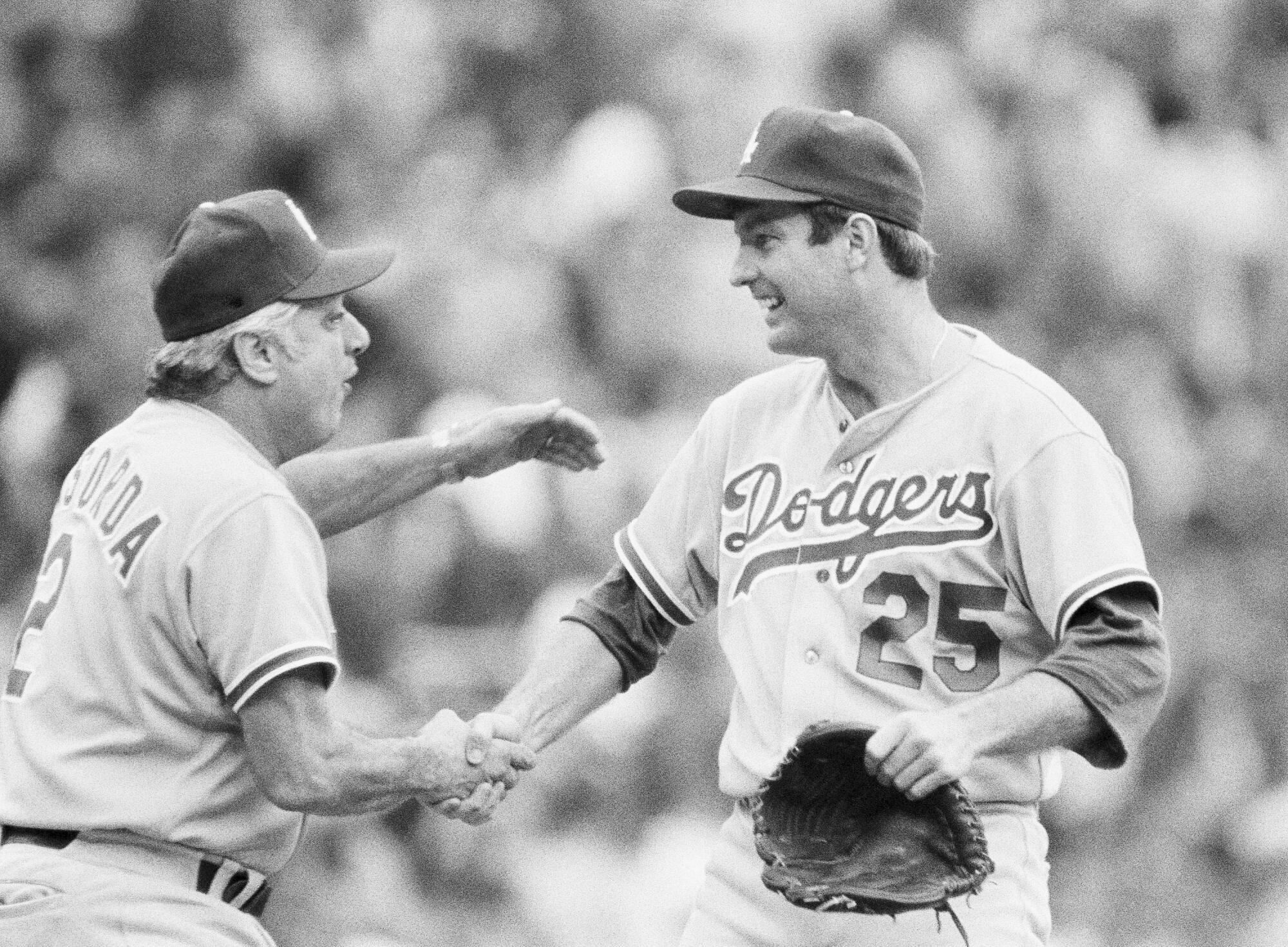
Dodgers manager Tommy Lasorda congratulates Tommy John after John shut out the Phillies during 1978 National League Championship Series.
(Associated Press)
Then in July 1974, by which time John had become a mainstay in the pitching rotation, he threw a pitch to Hal Breeden of the Montreal Expos that changed his life, and ultimately the lives of many others.
“Right at the point where I put force on the pitch, the point where my arm is back and bent, something happened,” he told Sports Illustrated. “It felt as if I had left my arm somewhere else. It was as if my body continued to go forward and my left arm had just flown out to right field, independent of the rest of me.
“I heard this thudding sound in my elbow, then I felt a sharp pain.”
John had ruptured the medial ulnar collateral ligament in his left elbow, although he didn’t know that then. The pitch, of course, was nowhere near the strike zone and, despite the pain and in an effort to see if that was a fluke, he tried to throw another. It bounced off the plate, ending his outing and, for all anyone knew, his pitching career.
Jobe recommended total rest but after a month, with no sign of healing, he came up with an outside-the-box suggestion. Earlier, Jobe had grafted a tendon to a recovered polio patient’s ankle to provide stabilization. He thought maybe a tendon could be grafted to a pitcher’s elbow as well.
He gave John a grim choice: Do nothing and never pitch again, or try the surgery at 100-1 odds against success.
“I told Dr. [Frank] Jobe if you do your job I will do more than mine,” John told The Times last year. I just happened to be in the right place at the right time with the right doctor and team.”
So, on Sept. 25, 1974, Jobe took a tendon from John’s right arm, threaded it through holes he had drilled in John’s left elbow and hoped it all would work.
Nerve damage necessitated a second surgery several months later and the prospects were not promising. John’s left arm had atrophied, his hand now basically a claw, and two of his fingers were numb.
Even so, he began rehab, knowing he would miss the entire 1975 season. He taped the unfeeling fingers to the functioning ones so that he could grip a baseball, then, resembling “a little boy throwing against the steps of his back porch,” threw against a wall. He squeezed Silly Putty and strictly adhered to a physical therapy regimen.
By June 1975 he had regained the use of his entire hand and in late September pitched three innings in an exhibition game. He continued his routine through the offseason and into spring training, once joking, “When they operated on my arm, I asked them to put in a Koufax fastball. They did but it turned out to be Mrs. Koufax.”
Surprising many, who considered it at least a minor miracle, he was back in the rotation at the start of the 1976 season and went five innings in his first start, giving up five hits and three runs in a loss to the Braves in Atlanta. He finished the season at 10-10 with a 3.09 ERA, and if anyone was still wondering about his comeback, he put doubts to rest in 1977.
In one of his best seasons, he won 20 games, had a 2.78 ERA and finished second in National League Cy Young award voting for the pennant-winning Dodgers. In a 4-1 win over the Philadelphia Phillies in the clinching Game 4 of the NL Championship Series — then a best-of-five format — John pitched a complete game, striking out eight in a 130-pitch effort.

Dodgers pitcher Tommy John celebrates after the final out in a 4-1 victory over the Phillies in Game 4 of the 1977 NLCS that clinched the pennant for the Dodgers.
(Associated Press)
He came back with a 17-victory season in ’78 and the Dodgers won the pennant again but again lost to the Yankees in the World Series, with John winning a game in both the NLCS and World Series. After the season, he signed with New York as a free agent.
He was an immediate hit with the Yankees, winning 21 games in 1979 and finishing second in the American League Cy Young voting, then won 22 in ’80. In 1981, the Yankees reached the World Series, once again facing the Dodgers — and John was at the center of the most controversial decision in the series that ultimately sealed New York’s fate.
John was the starter in Game 6 at Yankee Stadium with the Dodgers leading the series, 3-2. The left-hander had won Game 2, giving up three hits over seven innings in a 3-0 victory, and had completed four innings of one-run ball when Yankees manager Bob Lemon elected to pinch-hit for John with two runners on in a 1-1 game. ABC, which broadcast the World Series that year, showed John looking visibly upset and surprised as he paced the dugout.
Bobby Murcer flied out to right to end the inning, and the Dodgers would score eight runs over the next four innings against an ineffective Yankees bullpen to secure a 9-2 victory and win the franchise’s first World Series since 1965.
“At the time my reaction was, ‘why is he doing this?’ I was pitching fine and you don’t pull someone out in the fourth inning just because you need a hit at the time,” John said last year. “I was not happy, but that was so long ago in retrospect could we have won? I think so. Does it matter now? No.”
In John’s two stints with the Yankees — he had four seasons with the Angels in between — he was 91-60 with a 3.59 ERA.
And it was with the Yankees that he made the record book, in a way no player would ever want. He committed three errors in an inning, all on the same play during a game July 27, 1988.
With the Yankees leading the Milwaukee Brewers 4-0 and Jim Gantner on first for the Brewers, John charged a slow roller by Jeffrey Leonard to the first-base side of the mound. First, he bobbled the ball. Then, he sailed it past first baseman Don Mattingly, bouncing it off the right-field ballboy. Dave Winfield made a nice play on the ball and fired a strong throw home. It was on line and probably would have nailed the hustling Gantner but John cut it off, then threw wildly past catcher Don Slaught and into the Brewers’ dugout as Gantner scored.
John’s summation, according to Newsday? “I must have had a metal cup on. It glitched the ions in the air.”
After his playing days, John did some broadcasting, some minor league managing and became a strong advocate for suicide prevention after one of his sons took his own life. And after seeing many young pitchers, some still in their teens, undergo the surgery named for him, he spoke out against arm overuse, recommending less than year-round pitching by young arms.
But regardless of the context, John is forever linked to the operation that continues to be performed by orthopedic surgeons such as Dr. Neal ElAttrache, who began learning how to perform the procedure when he was a fellow at the Kerlan-Jobe Orthopedic Clinic in 1990 from Jobe himself. The two would operate together twice a week throughout the 1990s and were close friends until Jobe’s death in 2014.
“It should have been called the Frank Jobe operation,” ElAttrache told The Times in 2023. “But with Frank being the man he was, it was all about the person he was treating. It wasn’t about him.”
By ElAttrache’s estimation, he has performed the operation between 50 and 75 times per year over his career — including the two he has done on Ohtani, one in 2018 and one in 2023. And although ElAttrache has put his own signatures on the surgery — including a second graft to further fortify Ohtani’s elbow — the operation has remained largely the same since Jobe first performed it in 1974.
John is survived by his wife, Cheryl, and his children, Tommy, Travis and Tamara. A private celebration of his life will be held in Florida.