John

The Rainmaker’s John Slattery has very famous co-star wife as he leads ITV drama

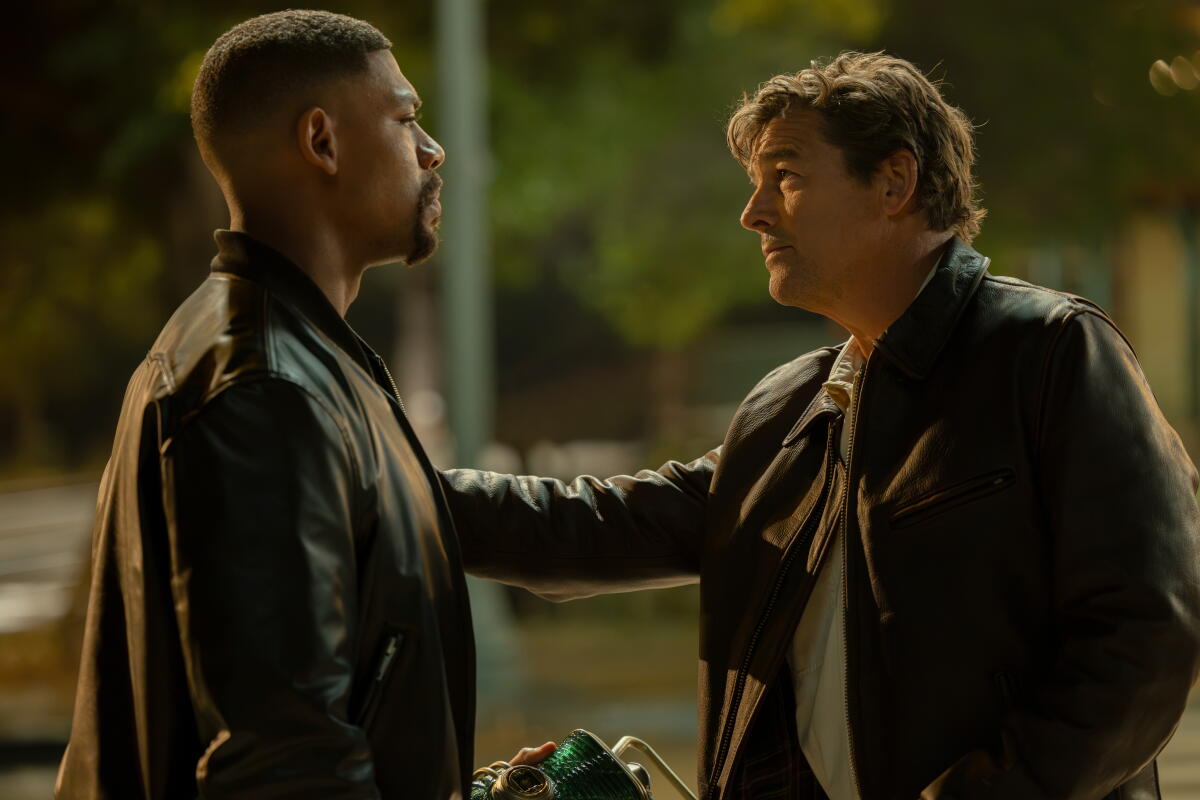
John Slattery is leading the cast in US legal thriller, The Rainmaker, which starts on ITV tonight

The Rainmaker starts on ITV tonight.

The ‘one of the best’ legal thriller, which first aired in the US back in 2025, will be airing on Friday, 28 August, at 9pm on the broadcaster. The star-studded show will also be broadcast weekly and also be accessible to stream on ITVX.

A synopsis reveals about the legal thriller: “Based on the best-selling novel by John Grisham, Rudy Baylor, who is fresh out of law school, goes head-to-head with courtroom lion Leo Drummond as well as his law school girlfriend, Sarah.

“Rudy, along with his boss, Bruiser, and her disheveled paralegal, Deck, uncover two connected conspiracies surrounding the mysterious death of their client’s son”.

Mad Men legend John Slattery will be playing Leo Drummond in the drama. John, 64, is also known for Sex and the City, Desperate Housewives, Spotlight, Avengers: Endgame, Captain America: Civil War and Ant-Man – to name just a few.

Away from his impressive acting career, John is married to actress Talia Balsam with the two tying the knot in 1998. They have a son together, Harry, 27.

Much like John, Talia is famous in the acting world too. The actress, 67, who was previously married to George Clooney from 1989 to 1993, has an impressive career with shows such as Happy Days, Dallas, Taxi, Hill Street Blues, Family Ties, The Larry Sanders Show, and Magnum, P.I.

Other roles include Without a Trace, Homeland and Divorce. In a funny life imitating art twist, John and Talia played husband and wife Roger and Mona Sterling in hit series Mad Men.

Elsewhere, John and Talia, as well as their son Harry, all appeared in the drama The Subject Was Roses.

John previously gushed about his wife in a sweet interview in 2019, telling Closer Weekly: “I just found the right person, you know, I lucked out.

“I guess marry someone you like. We get along well, we always have, and I guess being in show business, some people say it’s difficult.”

He added: “I don’t know. We understand the rhythms of this life, which aren’t easy sometimes and there’s insecurity. You’re not sure where you’re going to be. So I don’t know. I got lucky.”

The Rainmaker is available to watch on ITV and ITVX from Friday 28 August

Source link

Dolly Parton tributes: Elton John, Oprah Winfrey, Taylor Swift, Sabrina Carpenter and Paul McCartney

McCartney reflected on his history with Parton, which began when he met her in Nashville at the Grande Ole Opry right before starting her solo musical career.

“She was so bubbly and full of life, it is difficult to take in the news that she has passed,” he said. “Her songwriting, her singing and her philanthropy were unrivaled in the world of country music and it is hard to imagine living in a world without Dolly.”

John said he was “shocked and devastated” over the news. “A giant of an artist – unique and irreplaceable, with the kindest heart”.

Swift, who began her professional career in country music as a teen after moving to Nashville, has paid tribute to Parton’s “true grace and true grit, all in one dazzling person”.

“A world without Dolly doesn’t feel possible, real, or right,” the singer said in a statement shared with the BBC. “But because of the eternally generous way she spent her time on this earth and the countless lives she changed for the better, her legacy will be an everlasting one.”

As well as “melodies and lyrics she wrote that thawed even the coldest of hearts,” Swift acknowledged “the millions of books she provided children all over the world so that they might fall in love with stories the way she did”.

She thanked Parton “for the tightropes she walked so that young girls like me could grow up dreaming of joining the circus too”.

Beyoncé said Parton was the “barometer” and the “north star”.

“Bold and brilliant. Talented and tenacious. You taught so many lessons on how to be uniquely oneself. I am grateful for your art, your heart, your generosity, your humor, your entrepreneurship,” Beyoncé wrote.

Cowboy Carter, Beyoncé’s 2024 country album, famously featured a rendition of Parton’s song Jolene.

Former talk-show host Winfrey wrote that one of her fondest memories with Parton was “having a hoot and a holler while wearing Bob Mackie gowns on her show Dolly”.

“This girl from the Smoky Mountains of Tennessee dreamed a life and then lived a life bigger than she could have ever imagined, giving so generously to others in ways we saw and ways we didn’t.”

Source link

Man accused of forging Supreme Court Justice John Roberts’ signature

Aug. 25 (UPI) — A man is facing federal charges for forging the signature of Supreme Court Chief Justice John Roberts and impersonating a federal agent.

Joshua M. Culver was indicted Friday in the Northern District of Indiana on four counts of falsely impersonating an officer of the United States and one count of forging the signature of a judge and court seal.

He was arrested in Colorado and has been assigned a public defender there.

The indictment alleges that Culver identified himself as a National Security Agency agent on at least two occasions in September 2025. He allegedly did so at the Tippecanoe County Sheriff’s Office trying to get information about the location of a family member. The indictment also alleges that he made phone calls to someone at their employer threatening them and accusing them of breaking the law.

In January 2026, Culver allegedly claimed to be a “Special Master enforcing orders of the United States Supreme Court” to get a Lake County, Ind., judge to dismiss criminal cases and judgments against him.

He’s accused of forging Roberts’ signature and using a counterfeit seal on an order in September that told a Grant County, Ind., court to drop theft charges against him.

President Donald Trump looks on as Secretary of Education Linda McMahon speaks during a back-to school event in the Rose Garden of the White House on Monday. The event focused on education and the Trump administration’s education policies. Photo by Will Oliver/UPI | License Photo

Source link

San Francisco 49ers owner arrested in Ohio, pleads no contest to two misdemeanors

John “Jed” York, the owner and CEO of the San Fransciso 49ers, was arrested this weekend in his home state of Ohio and pleaded guilty to a pair of misdemeanor charges, according to local court records.

York, 45, pleaded no contest to charges of disorderly conduct and possessing criminal tools, Columbiana County Municipal Court records show.

He was arrested Sunday and released on $5,000 bail, court records show. He returned to court Monday morning to be arraigned on charges that were initially listed as engaging in prostitution and possessing criminal tools, but the former was changed to disorderly conduct in his plea.

York was sentenced to two days in county jail, with credit for the day he has already served, and ordered to pay a $1,150 fine, the court file shows. The order also noted that $160 that had been confiscated in the arrest would be forfeited to MVHTTF, which appears to stand for the Mahoning Valley Human Trafficking Task Force. The records also said that officials were to return a phone to York, and that York had “completed online course,” but additional details were not immediately available.

A mugshot from York’s arrest was published by local news site WKBN-27, who said he was arrested Sunday by the East Palestine Police Department. That agency told the news outlet that any additional information from the case would come from the Mahoning Valley Human Trafficking Task Force, a regional task force that includes the East Palestine Police Department and the Columbiana County Sheriff’s Office.

York grew up in Youngstown, Ohio, which is just north of East Palestine.

York had already filed a request to have the charges expunged Monday.

The Times attempted to contact the attorney listed in York’s sentencing records, but he did not immediately respond. The 49ers have not yet addressed the arrest.


Source link

St. John Bosco’s rally falls short in loss to Bishop Gorman

Call it St. John Bosco’s Nightmare on South Hualapai Way on Friday night.

Why St. John Bosco traveled on three buses to the desert to play in 104 degree temperature against Bishop Gorman was on everyone’s mind, because the Braves were either unprepared or uninterested at the outset for a high school football team ranked No. 1 in the nation by several national publications. A sold-out crowd of 5,000 was surprised when the Braves were down by 21 points at halftime and the offense looked deader than Elvis.

“It was almost like the moment was too big,” Braves coach Jason Negro said.

Then the real St. John Bosco team came out of the locker room after halftime and almost pulled off a Hollywood ending, rallying to tie the score before losing 38-28.

“We showed a lot of resolve, a lot of fight,” Negro said.

The Braves didn’t get a first down until 7:35 left in the second quarter. Their first offensive play from scrimmage was a botched snap landing quarterback Koa Malau’ulu on the three-yard line. The third play resulted in Malau’ulu getting sacked and losing the ball on a fumble in the end zone for a Bishop Gorman touchdown.

The Gaels (2-0) cruised to a 21-0 halftime lead. They’re ranked No. 2 nationally and repeatedly hurt the Braves with the mobility and decision-making of quarterback Ace Amina, who finished with 212 yards passing and four touchdowns. He guided the offense on an 80-yard drive to start the game. St. John Bosco struggled to adjust covering Bishop Gorman running backs going out for passes.

In the third quarter, everything changed. A 10-yard touchdown catch by fiery sophomore Kuika Moaalii on fourth down was the moment St. John Bosco got its mojo back. Then DJ Tubbs followed with a touchdown catch to make it 21-14. Bishop Gorman went back up 28-14 on a 53-yard touchdown reception by Zyren Menor. But the quarter ended with the Braves’ Maliq Allen scoring on a 29-yard run. The noise in the stadium was rising on both sides.

The Braves finally tied it 28-28 on Tubbs’ punt return for a touchdown with 9:52 left after Dillon Davis’ third-down sack.

As if the fourth quarter weren’t wild enough, the Gaels regained the lead with 6:49 left on a 54-yard touchdown reception by Corey Hinton. And what a game-changer it turned out to be. Hinton played for St. John Bosco the last two seasons until returning to Las Vegas, the city he grew up in.

Asked if he wanted to leave, Hinton said, “I didn’t but it looks like God did this.”

On the winning touchdown, Hinton said, “It was surreal. It was something I prayed for and it meant everything.”

Afterward, he was hugging former teammates. “No hate. Those are my boys,” he said.

Bishop Gorman’s Maximiliano Fuentes clinched the win with a 49-yard field goal late in the fourth quarter.

Negro said all the mistakes made by his team are fixable, so he believes the Braves can get back on the winning track. “We just have to execute better,” he said.

Malau’ulu was under duress much of the night. He had two passes intercepted, was sacked three times and did not look comfortable throwing on the run. He did rally the Braves and ended up with 210 yards passing.

There was an “extreme heat warning” on Friday, with the daytime temperature reaching 109 degrees. St. John Bosco began its preparation to be hydrated and avoid cramps on Monday with constant reminders on taking fluids all week by athletic trainer Daisy Martinez.

“It’s 108 out there. It’s good for us,” a Bishop Gorman coach told players 3 1/2 hours before kickoff during their pregame meal in a room on the second floor of their gymnasium complex. Players began to eat in total silence focused on their task at hand.

The Braves hadn’t faced Bishop Gorman in Las Vegas since their 34-31 loss in 2014 to the Gaels amid thunder, lightning, wind and a downpour of rain. They were ranked No. 1 and No. 2 in the nation just like Friday’s matchup.

Bishop Gorman (2-0) looks talented and executed well, but the Braves, like their final game of 2025 when they were upset as the No. 1 seed in the first round of Division 1 playoffs by Orange Lutheran, have plenty to work on.

St. John Bosco is starting the season without its two prized transfer students, offensive tackle Elisha Mueller and defensive back Kingston Fatu, who will will be eligible on Sept. 28. It still hasn’t been determined if Mueller will be a sit-out period player.


Source link

New USS John F. Kennedy Brings Back Key Feature From The Nimitz Class

The U.S. Navy’s Ford class aircraft carriers have been very much in the news in the past week, with huge changes to the core design now potentially on the horizon. Whether or not radical changes to the catapults, weapons elevators, and island superstructure on future ships in the class actually materialize remains to be seen. However, the design has already been changing in various other ways. This includes adding back in a feature that had been found on all Nimitz class carriers and other Cold War-era flattops before it – dedicated radar illuminators to guide surface-to-air missiles.

The illuminators are used to guide the RIM-162 Evolved Sea Sparrow Missiles (ESSMs). The need to add this feature is intertwined with a decision to integrate a replacement for the complex and troublesome Dual Band Radar (DBR) on all forthcoming carriers in the class after the USS Gerald R. Ford. The future USS John F. Kennedy is the first of those ships.

The Mk 95 radar illuminators on John F. Kennedy were particularly visible in pictures released last week of the ship leaving port in Newport News, Virginia, to begin acceptance sea trials. The carrier, also known by its hull number CVN 79, made its maiden voyage in January, and the Navy hopes to take formal delivery of the ship before the end of the year.

The future USS John F. Kennedy is seen leaving port to begin acceptance sea trials on August 12, 2026. A Mk 95 radar illuminator is seen on a sponson on the port side of the ship’s stern. HII
A close-up look at the Mk 95 radar illuminator. HII

The Mk 95 traces back to the 1970s and was originally designed to support the employment of surface-launched RIM-7 variants of the Sparrow missile. All versions of the RIM-7 use semi-active radar guidance, which requires the launch platform to ‘illuminate’ the target.

As an example of the mode of operation for the RIM-7, if a ship were to detect an incoming cruise missile or some other kind of aerial threat, it would cue the missile in the right direction, fire it, and then use illuminators like the Mk 95 to ‘paint’ the target in radar energy. The missile’s seeker would then passively home in on the reflected radar energy through the terminal phase of flight.

When it was first introduced, the Mk 95 was part of a larger fire control suite that also brought an important new level of automation compared to previously available capabilities. Some earlier illuminators on Navy ships even had to be manually operated by sailors on deck.

Today, Mk 95s are found on a variety of U.S. and foreign naval vessels, including the Navy’s Nimitz class carriers. Some versions of the illuminators have camera systems to further help spot and track incoming threats, which have also been upgraded over the years. Improvements in associated combat systems also mean they have become better able to manage available illuminators to allow for as many engagements simultaneously as possible.

A Mk 95 radar illuminator, among other things, seen at the stern end of the Nimitz class aircraft carrier USS George Washington. USN
Close-up looks at improved Stalker Long-Range Electro-Optical Infrared Laser Sensor System (SLREOSS) cameras mounted on Mk 95 illuminators. Ball Aerospace

The RIM-7 family has since been supplanted in U.S. Navy service with the improved RIM-162 ESSM. Block 1 variants of the ESSM also use semi-active radar guidance and have the same general mode of operation as their predecessors. New Block 2 versions, which began entering service in the early 2020s, have semi-active and active modes, the latter of which does not require any illumination in the terminal phase. In addition, the new missiles feature a data link, allowing them to receive targeting updates after launch, helping cue them to the target area, which further reduces the need for an illuminator in the initial phases of flight. It is also very valuable for longer-range engagements beyond the horizon, especially against low-flying cruise missiles.

A Block 1 ESSM seen just after launch. USN
A RIM-162 Evolved Sea Sparrow Block 2 missile. Canadian Department of National Defense

At present, the defensive armament suite on Ford class aircraft carriers includes two 21-round launchers for RIM-116 Rolling Airframe Missiles (RAM), three Mk 15 Phalanx Close-In Weapon Systems (CIWS) armed with 20mm Vulcan cannons, four 25mm cannons on Mk 38 mounts, and various small arms. There are also two eight-cell Mk 29 launchers, a design that also dates back to the 1970s and was originally designed to fire RIM-7 Sparrows. The Mk 29 has since been adapted to fire Block 1 ESSMs, but there were issues in integrating Block 2 versions owing to the increased weight of those missiles, at least in the past.

“CVN 79 and follow-on Ford class ships will be upgraded to a mix of new RAM variants Block 2A and 2B, plus a mix of ESSM Block 1 and Block 2,” according to an annual report from the Pentagon’s Office of the Director of Test and Evaluation (DOT&E) covering work on the program during the 2025 Fiscal Year.

The Navy’s most recent annual budget proposal for Fiscal Year 2026 does note work to modify the Mk 29 launchers to support Block 2 ESSM capability, but the current state of those efforts is unclear. The service is also pursuing an entirely new launcher to replace the aging and increasingly unsupportable Mk 29, as well as a follow-on to the Block 2 ESSM.

Mk-29 Sea Sparrow Missile Launcher - RIM-162 ESSM & RIM-7P During Sea Trials thumbnail

Mk-29 Sea Sparrow Missile Launcher – RIM-162 ESSM & RIM-7P During Sea Trials


Even with integration of the Block 2 ESSM, Ford class carriers will still have to provide ‘illumination’ in order to employ Block 1 versions of the missile, which remain in active Navy inventory. As noted, Block 2 variants can be employed in a semi-active radar homing mode, as well.

This all brings us to the matter of the DBR, which was intended to be the main radar on all members of the Ford class. The DBR consists of two distinct radar systems, the AN/SPY-3, an X-band active electronically scanned array (AESA) type, and the AN/SPY-4, an S-band phased array. On paper, this was set to be a powerful combination. In a defensive scenario, the SPY-3 would be used for horizon search, generating high-fidelity target tracks, and otherwise helping direct interceptors like the ESSM to their targets. The volume search SPY-4 would provide additional long-range search and tracking functionality. Being able to fuse all that data for the dual arrays together, while also leveraging the specific capabilities of the quick-scanning AESA SPY-3, would only offer even greater benefits.

A look at the front of the island superstructure on Ford showing two fixed-face arrays that are part of the DBR. USN

As part of the original Ford design, DBR also serves as host of other functions, including helping to provide air traffic control in support of flight operations. This also allowed the Navy to pare down the total number of distinct radars on the ship compared to the Nimitz class. This, in turn, directly factored into the design of a smaller and more angular flight deck island on the Ford class. Just this week, TWZ published a separate detailed piece on the island, and the reasons for its location so far back on the flight deck. This followed reports this past weekend that President Donald Trump is pushing the Navy to reposition the structure on future ships in this class on aesthetic grounds.

Despite the promised benefits, and its deep integration into the Ford class design, the DBR has proved to be extremely complicated and unreliable.

“Here’s the one thing that I think I screwed up. I think I’m responsible for at least a billion-dollar cost of overrun because I wanted to reduce the number of radars,” retired Navy Capt. Tal Manvel, who served for a time as Program Manager for Future Carriers, said during a presentation at the U.S. Naval Academy Museum in 2015. “I did not appreciate that the complexity of that is not just increasing scale like with a mechanical system, like in the propulsion plant, but the complexity of the software-hardware interface.

A detailed comparative look at the radar configurations and island designs on the Nimitz class carriers USS Ronald Reagan (CVN-76) and USS George H.W. Bush (CVN-77), as well as the USS Gerald R. Ford (CVN-78), from Tal Manvel’s 2015 presentation. U.S. Naval Academy Museum capture

“That’s my fault. I screwed up on that because I thought that this would be significant,” Manvel continued. “It turns out to be a big cost driver up front, and that’s one of the reasons why the Ford has this challenge of cost.”

You can watch Tal Manvel’s full 2015 presentation below.

Shifley Lecture: USS Ford-class carrier design thumbnail

Shifley Lecture: USS Ford-class carrier design


The Navy has since made the decision to replace the DBR on Ford class carriers primarily with the AN/SPY-6(V)3, also known as the fixed-face version of Raytheon’s Enterprise Air Surveillance Radar (EASR). The AN/SPY-6(V)3 has three antenna arrays compared to the DBR’s six. John F. Kennedy and future ships in the class will also feature an AN/SPQ-9B horizon search radar and the Mk 9 Tracker Illuminator System – which includes the Mk 95 illuminators – to provide additional functionality that was originally supposed to come from the DBR.

A side-by-side comparison for the islands on the future USS John F. Kennedy, at left, and the USS Gerald R. Ford, at right. HII/USN

As an aside, the DBR was originally a core component of the Zumwalt class stealthy destroyer design, and was to be deeply integrated with the ship’s unique combat system, but suffered from similar technical and reliability issues in that setting, as well. The Navy subsequently decided to eliminate the S-band arrays on those ships as a cost-cutting measure. As it stands now, the USS Gerald R. Ford is the only ship the service expects to operate with the full DBR. The Navy has plans to eventually replace the DBR on that carrier with the EASR and other radars, too. Several variants of the AN/SPY-6 are also increasingly being integrated onto a host of different Navy ships, as seen in the graphic below.

RTX

The need for the Mk 95 illuminators on the Ford class could evolve further over time, including as the Block 2 ESSM enters more widespread service and with the development of the planned follow-on missile. TWZ has previously noted that the total number of Mk 95s has been reduced on at least some Nimitz class carriers for reasons that are still not entirely clear.

John F. Kennedy is also expected to bring along other important, but less visible improvements, which are set to be carried over to future ships in the class. This includes upgrades to the ship’s combat management system and a Block II version of the Navy’s Cooperative Engagement Capability (CEC) networked sensor architecture.

The Ford class program, overall, continues to face major delays and cost growth due to a host of technical issues and other factors that go well beyond problems with the DBR. The Navy had originally hoped to receive John F. Kennedy in 2022. Work on the next two ships in the class, the future USS Enterprise and USS Doris Miller, is also running behind schedule.

Another look at the future USS John F. Kennedy as it headed out for acceptance sea trials last week. HII

The Navy has said it is working to mitigate these ongoing issues and incorporate lessons learned in the construction of future ships in the class. The USS Gerald R. Ford has also now supported real combat operations, mostly recently as part of the conflict with Iran.

As highlighted in John F. Kennedy‘s recent sea trials, the Ford class design is already evolving in notable ways, particularly when it comes to the radar suite.

Special thanks to user @lfx160219 on X for bringing the Mk 95 radar illuminators on the future John F. Kennedy to our attention.

Contact the author: joe@twz.com

Joseph is TWZ’s Deputy Editor, helping to oversee the site’s highly experienced and dedicated team, while also writing informative and impactful defense and national security content. He lives right in the thick of it in the Washington, D.C. area.


Source link

Boeing whistleblower John Barnett’s mysterious death and furious final words

WARNING – DISTRESSING CONTENT: New Netflix documentary Freefall: A Reckoning for Boeing, investigates the story of Boeing whistleblower John Barnett, who was found dead in his truck in 2024

John Barnett worked for Boeing for 32 years before turning whistleblower and dying in mysterious circumstances.

New Netflix documentary, Freefall: A Reckoning for Boeing, explores the story of Barnett, who publicly condemned Boeing’s safety processes before he was found dead in his truck. He was in the process of testifying against the company.

From 2010, Barnett was employed as a quality manager at the North Charleston plant, which built the longhaul 787 Dreamliner, before retiring in 2017 on health grounds.

After Boeing merged with a former rival McDonnell Douglas, several former Boeing employees alleged the company started focussing more on increasing profits rather than safety and quality.

Barnett told the Today Show before his death: “From day one, it’s just all been about schedule, and hurry up, and just get it done. Push a plane out. We’re behind schedule. We don’t have time to worry about issues that y’all bring up.”

He alleged there were severe production and safety flaws such as defective oxygen systems and metal shavings near critical wiring on the 787 Dreamliner program.

Just before he left Boeing in 2017, Barnett filed a complaint against the company, accusing bosses of retaliating against him for raising safety concerns. He was outspoken on the issue with journalists – and in 2022 appeared in acclaimed director Rory Kennedy’s investigative film Downfall: The Case Against Boeing.

But then, on March 9, 2024, Barnett was found dead in his truck with a gunshot wound to his head.

Deeply affected by Barnett’s death and ongoing concerns about Boeing’s safety culture, Kennedy reunited with her team to produce the documentary sequel, Freefall: A Reckoning for Boeing, which is being released on August 19, 2026.

Speaking to the Guardian about Barnett’s death, Oscar-nominated filmmaker Kennedy said: “I was horrified and heartbroken. I spoke to his mom pretty immediately after we had heard that news. She said to me, ‘We need to make sure John’s story gets out there,’ and that was a big part of why we decided to revisit this.

“I’ve never done a documentary follow-up in this kind of way, but we all felt that Boeing is such a big company, and we all fly these airplanes all over the world. I don’t want one of these planes falling out of the sky, and I feel like I have a lot of inside knowledge and also connections to understanding what’s going on inside of Boeing, and I just felt like we’ve got to stay at this.”

Details of the circumstances surrounding Barnett’s death came to light when his mother sued Boeing in a wrongful death suit in March 2025. The complaint alleged that Barnett was subjected to a campaign of harassment, abuse and humiliation after he raised concerns about safety issues. It further claimed that the conduct of the company was “the clear, foreseeable cause” of his death. In September that year, Boeing settled the lawsuit, agreeing to pay at least $50,000 to Barnett’s mother, who, in return, agreed to drop her claims that the company contributed to her son’s death by suicide.

The complaint contained a copy of Barnett’s suicide note, and the annexes presented the full police report concluding that he died by his own hand.

In conversations with Fortune in March 2025, the family’s longstanding counsel Rob Turkewitz added further details on his client’s last hours.

He said that on the evening of March 8, 2024, Barnett left the law offices of Boeing’s outside counsel in Charleston after testifying for two days in his OSHA case against the company. OSHA rules make it unlawful to retaliate against a whistleblower.

Barnett was giving his account of how Boeing allegedly violated its own policies and procedures, and FAA rules, during his seven years as a quality inspector at the North Charleston plant.

He’d delayed a trip back to his home in Louisiana to finish his deposition the next day, which was a Saturday. Videos cited in the police report show Barnett leaving the hotel around 8:30pm, and getting in his orange Dodge truck.

When Barnett failed to show up the next morning for his final round of testimony, Turkewitz called the Holiday Inn to conduct a welfare check. It was then that a hotel employee saw Barnett slumped in the front seat of his vehicle.

Charleston police arrived to discover Barnett barefoot and clutching a Smith and Wesson pistol in his right hand. His right temple showed a bullet entry wound, and an exit wound appeared in the back of his head.

On the seat next to Barnett’s body lay a message written on a single page of a red-covered notebook, with sentences written in all directions.

It contained phrases including: “America come together or die!!! Pray that the motherfk…ers who destroyed my life pay!!! I pray that Boeing pays!!! Bury me face down so that Boeing and their lying ass leaders can kiss my ass.”

Elsewhere: “I can’t do this any longer!!! F-k Boeing!!! Family and friends, I love you’ll [sic].”

“To my family and friends, I found my purpose! I am at peace! I love you more John/Mitch Barnett aka Swampy Fununcle Mitch.”

The complaint also included a heartbreaking email that Barnett sent Turkewitz in 2021, which read: “I can understand the direct costs that we can establish, ie lost pay, bonuses, etc. What I’m struggling with is how do you restore a person’s overall outlook on life? I used to be a very happy-go-lucky guy who loved his job and the products he built. I had a very positive outlook on life. Boeing absolutely destroyed my outlook on life. What is a person’s ‘outlook on life’ worth? How to put a price on that?'”

Freefall: A Reckoning for Boeing is scheduled to debut on Netflix on August 19, 2026 .

For mental health support, contact the Samaritans on 116 123, email them at jo@samaritans.org or visit samaritans.org to find your nearest branch

Source link

Maj. Gen. John Bruce; Head of Unmanned Space Unit

Former Maj. Gen. John Bruce Medaris, the military director of the nation’s unmanned space program who after a seemingly miraculous recovery from cancer devoted his remaining years to the Episcopal priesthood, has died of the disease, it was learned Sunday.

Medaris was 88 when he died Wednesday at his summer home in Highlands, N.C., after a long struggle against bone and lung cancer. The announcement was made by friends in Florida and reported by United Press International.

He had commanded the Army’s early space program, the Army Ballistic Missile Agency, when it orbited America’s first satellite on Jan. 31, 1958. The program was soon turned over to the civilian control of the new National Aeronautics and Space Administration.

Col. Pat Patterson of Maitland, Fla., a friend of Medaris’ for 47 years, said the former general had picked the nation’s first team of space scientists, both military and civilian, “and I have never seen a team surpass that one.”

The historic team that built those first missiles was headed by German scientist Wernher Von Braun, father of the Saturn V rocket that was to send Americans to the moon and a pioneer in the development of Germany’s wartime V-2 rocket. Kurt H. Debus, the Kennedy Space Center’s first director, was another team member.

The expatriated German scientists that included Von Braun had been sent after the war to Ft. Bliss, Tex., and later transferred to the small north Alabama cotton town of Huntsville where Medaris became their commander.

There was little sense of urgency about the nation’s embryonic space program until the Korean War broke out in 1950. Then seven years later, on Oct. 4, 1957, the Soviet Union launched the 184-pound Sputnik I, the world’s first orbiting satellite.

On Dec. 6, Medaris’ team tried to respond by sending a three-pound satellite into orbit, but the Vanguard rocket which was to have propelled it rose two feet off its Cape Canaveral launch pad and exploded into a giant fireball.

America finally got into space Jan. 31 when a Jupiter C booster hurled the 31-pound Explorer I into orbit. The satellite discovered the Van Allen Radiation Belt.

Medaris was born in Milford, Ohio, and at 16 lied about his age to get into the Marines. After a couple of years, he resigned and tried his hand at business, where he made but then lost a fortune.

Medaris entered the Army as a second lieutenant and came through 300 days of World War II combat unscathed.

An ordnance expert, he served as chief of the first Army contingent to Argentina from 1949 to 1952, and in 1955 was named commander of the Ballistic Missile Agency.

He became known as an aggressive, often arrogant commander who would roll over anyone in his way. He even carried a swagger stick for emphasis.

But in 1964, four years after retiring from the service, he was stricken with bone cancer and told he had only 18 months to live. Eighteen months later he was not only still alive, but the cancer somehow had gone into remission.

“The thought had sometimes crossed my mind that perhaps a power, or whatever it was, was keeping me intact because there was some important job that I was destined to do,” he said in a 1970 interview.

He told the Los Angeles Times in a 1982 interview from Cape Canaveral, where he had gone as an honored guest to watch the launch of the space shuttle Columbia, that he decided to repay the debt by service to his church.

He said he originally intended to become only an Episcopal deacon but “soon I found myself irresistibly forced into (other) situations.” He thus became the Very Rev. John B. Medaris, rector of Anglican churches in Maitland and Orlando, Fla.

In recent years, the International Aerospace Hall of Fame made Medaris a fellow, its highest award. The Army awarded him the first Medaris Award to Army Space Pioneers.

In the meantime, the cancer resurfaced in 1970 but again went into remission, returning only recently.

Although he had become a man of God, he did not lose the aggressiveness that had marked his military days and remained particularly critical of the decisions made many years earlier that separated military and civilian space objectives.

“It’s one of the greatest mistakes we ever made.”

Source link

Tommy John dead: Dodgers pitcher and medical pioneer dies

It’s right there in the medical books, along with Belsey fundoplication, Heineke-Mikulicz pyloroplasty and Keller’s excision arthroplasty: Tommy John surgery.

Purists might refer to it as ulnar collateral ligament reconstruction, but the rest of the world knows it as the career-saving surgery named for a sore-armed left-handed Dodgers pitcher.

Tommy John was facing the bleak reality that his career was likely over when he ruptured a ligament in his left elbow on a summer night in 1974, an injury that had sent so many pitchers into an early retirement. But a then-radical surgery not only saved but revived his career, as well as the careers of hundreds of baseball players ranging from Tom Candiotti to John Smoltz to Shohei Ohtani in the 50 years since.

Always more famous for the surgical procedure than his career stats, John died Saturday, the Dodgers announced. He was 83.

“We are saddened to hear the news of Tommy John’s passing,” Dodgers president and CEO Stan Kasten said in a statement. “… Tommy was an exceptional pitcher throughout his career in Major League Baseball and his courageous role in becoming the first to have surgery that would go on to bear his name can’t be overstated. His impact both on and off the field has been felt by ballplayers of all ages and will be for generations to come.”

A good pitcher before the surgery with 124 wins in 12 seasons with three teams, he won 164 more afterward — only one fewer than Sandy Koufax during his entire career, he liked to point out — in 14 more seasons with four teams, finally retiring at 46 with a 288-231 record and a 3.34 earned-run average.

“Dr. Jobe made it so I could throw a baseball again,” John told The Times’ Sam Farmer in 2023 from his home in Sarasota, Fla. “After surgery, I never missed a start, and I even pitched out of the bullpen every once in a while.”

He pitched for the Dodgers and the Angels and had two successful stints with the New York Yankees but it was with the Dodgers that he had his greatest success, an 87-42 record and a 2.97 ERA, helping them to consecutive World Series appearances.

It was also as a Dodger that he had his history-making operation.

He came to the Dodgers in a trade from the Chicago White Sox in December 1971 with an 84-91 record, a good curveball and a less than intimidating fastball. Pitching coach Red Adams convinced him that precision location and ball movement were more effective than raw speed and John went 11-5 the following season. He also became well acquainted with orthopedist Frank Jobe, the team physician.

Late in the season, he jammed his left elbow sliding into home plate, jarring loose some bone chips. Jobe cleaned things up for John during the offseason.

Dodgers manager Tommy Lasorda congratulates Tommy John after John shut out the Phillies during 1978 NLCS.

Dodgers manager Tommy Lasorda congratulates Tommy John after John shut out the Phillies during 1978 National League Championship Series.

(Associated Press)

Then in July 1974, by which time John had become a mainstay in the pitching rotation, he threw a pitch to Hal Breeden of the Montreal Expos that changed his life, and ultimately the lives of many others.

“Right at the point where I put force on the pitch, the point where my arm is back and bent, something happened,” he told Sports Illustrated. “It felt as if I had left my arm somewhere else. It was as if my body continued to go forward and my left arm had just flown out to right field, independent of the rest of me.

“I heard this thudding sound in my elbow, then I felt a sharp pain.”

John had ruptured the medial ulnar collateral ligament in his left elbow, although he didn’t know that then. The pitch, of course, was nowhere near the strike zone and, despite the pain and in an effort to see if that was a fluke, he tried to throw another. It bounced off the plate, ending his outing and, for all anyone knew, his pitching career.

Jobe recommended total rest but after a month, with no sign of healing, he came up with an outside-the-box suggestion. Earlier, Jobe had grafted a tendon to a recovered polio patient’s ankle to provide stabilization. He thought maybe a tendon could be grafted to a pitcher’s elbow as well.

He gave John a grim choice: Do nothing and never pitch again, or try the surgery at 100-1 odds against success.

“I told Dr. [Frank] Jobe if you do your job I will do more than mine,” John told The Times last year. I just happened to be in the right place at the right time with the right doctor and team.”

So, on Sept. 25, 1974, Jobe took a tendon from John’s right arm, threaded it through holes he had drilled in John’s left elbow and hoped it all would work.

Nerve damage necessitated a second surgery several months later and the prospects were not promising. John’s left arm had atrophied, his hand now basically a claw, and two of his fingers were numb.

Even so, he began rehab, knowing he would miss the entire 1975 season. He taped the unfeeling fingers to the functioning ones so that he could grip a baseball, then, resembling “a little boy throwing against the steps of his back porch,” threw against a wall. He squeezed Silly Putty and strictly adhered to a physical therapy regimen.

By June 1975 he had regained the use of his entire hand and in late September pitched three innings in an exhibition game. He continued his routine through the offseason and into spring training, once joking, “When they operated on my arm, I asked them to put in a Koufax fastball. They did but it turned out to be Mrs. Koufax.”

Surprising many, who considered it at least a minor miracle, he was back in the rotation at the start of the 1976 season and went five innings in his first start, giving up five hits and three runs in a loss to the Braves in Atlanta. He finished the season at 10-10 with a 3.09 ERA, and if anyone was still wondering about his comeback, he put doubts to rest in 1977.

In one of his best seasons, he won 20 games, had a 2.78 ERA and finished second in National League Cy Young award voting for the pennant-winning Dodgers. In a 4-1 win over the Philadelphia Phillies in the clinching Game 4 of the NL Championship Series — then a best-of-five format — John pitched a complete game, striking out eight in a 130-pitch effort.

Dodgers pitcher Tommy John celebrates after the final out in a 4-1 victory over the Phillies in Game 4 of the 1977 NLCS.

Dodgers pitcher Tommy John celebrates after the final out in a 4-1 victory over the Phillies in Game 4 of the 1977 NLCS that clinched the pennant for the Dodgers.

(Associated Press)

He came back with a 17-victory season in ’78 and the Dodgers won the pennant again but again lost to the Yankees in the World Series, with John winning a game in both the NLCS and World Series. After the season, he signed with New York as a free agent.

He was an immediate hit with the Yankees, winning 21 games in 1979 and finishing second in the American League Cy Young voting, then won 22 in ’80. In 1981, the Yankees reached the World Series, once again facing the Dodgers — and John was at the center of the most controversial decision in the series that ultimately sealed New York’s fate.

John was the starter in Game 6 at Yankee Stadium with the Dodgers leading the series, 3-2. The left-hander had won Game 2, giving up three hits over seven innings in a 3-0 victory, and had completed four innings of one-run ball when Yankees manager Bob Lemon elected to pinch-hit for John with two runners on in a 1-1 game. ABC, which broadcast the World Series that year, showed John looking visibly upset and surprised as he paced the dugout.

Bobby Murcer flied out to right to end the inning, and the Dodgers would score eight runs over the next four innings against an ineffective Yankees bullpen to secure a 9-2 victory and win the franchise’s first World Series since 1965.

“At the time my reaction was, ‘why is he doing this?’ I was pitching fine and you don’t pull someone out in the fourth inning just because you need a hit at the time,” John said last year. “I was not happy, but that was so long ago in retrospect could we have won? I think so. Does it matter now? No.”

In John’s two stints with the Yankees — he had four seasons with the Angels in between — he was 91-60 with a 3.59 ERA.

And it was with the Yankees that he made the record book, in a way no player would ever want. He committed three errors in an inning, all on the same play during a game July 27, 1988.

With the Yankees leading the Milwaukee Brewers 4-0 and Jim Gantner on first for the Brewers, John charged a slow roller by Jeffrey Leonard to the first-base side of the mound. First, he bobbled the ball. Then, he sailed it past first baseman Don Mattingly, bouncing it off the right-field ballboy. Dave Winfield made a nice play on the ball and fired a strong throw home. It was on line and probably would have nailed the hustling Gantner but John cut it off, then threw wildly past catcher Don Slaught and into the Brewers’ dugout as Gantner scored.

John’s summation, according to Newsday? “I must have had a metal cup on. It glitched the ions in the air.”

After his playing days, John did some broadcasting, some minor league managing and became a strong advocate for suicide prevention after one of his sons took his own life. And after seeing many young pitchers, some still in their teens, undergo the surgery named for him, he spoke out against arm overuse, recommending less than year-round pitching by young arms.

But regardless of the context, John is forever linked to the operation that continues to be performed by orthopedic surgeons such as Dr. Neal ElAttrache, who began learning how to perform the procedure when he was a fellow at the Kerlan-Jobe Orthopedic Clinic in 1990 from Jobe himself. The two would operate together twice a week throughout the 1990s and were close friends until Jobe’s death in 2014.

“It should have been called the Frank Jobe operation,” ElAttrache told The Times in 2023. “But with Frank being the man he was, it was all about the person he was treating. It wasn’t about him.”

By ElAttrache’s estimation, he has performed the operation between 50 and 75 times per year over his career — including the two he has done on Ohtani, one in 2018 and one in 2023. And although ElAttrache has put his own signatures on the surgery — including a second graft to further fortify Ohtani’s elbow — the operation has remained largely the same since Jobe first performed it in 1974.

John is survived by his wife, Cheryl, and his children, Tommy, Travis and Tamara. A private celebration of his life will be held in Florida.

Source link

John Chiang is the no-drama candidate for governor in the Trump era, and you’re probably saying his name wrong

It took decades for John Chiang to hustle into the top ranks of California politics, and he relished all the schmoozing along the way.

On Lunar New Year, Chiang turned up at a firecracker party in Westminster. Weeks later, he woke early for a cattlemen’s breakfast in Sacramento. When the Fresno Rotary Club sought a luncheon speaker, Chiang made time.

His nonstop networking has paid dividends. He won five elections in a rout, most recently in 2014 for state treasurer.

Yet to many Californians, Chiang is just a vaguely familiar name, often mispronounced. (It’s Chung, not Chang.) It shows up on ballots, somewhere near the middle.

But now that he’s running for governor, Chiang is competing on a much bigger stage. Voters pay close attention to the top of the ticket, appraising character and personality.

For the first time in his career, the way that Chiang’s reserved, low-key demeanor comes off on television will matter — all the more so in a race against fellow Democrats Antonio Villaraigosa and Gavin Newsom, two of the state’s most charismatic politicians.

A strait-laced finance man, Chiang, 55, dismissed the former mayors of Los Angeles and San Francisco as “stylish” — more showhorse than workhorse.

Chiang, who lives in a condo around the corner from a South Bay mall, wears baggy suits from Nordstrom Rack. He called himself “Torrance stylish,” then burst out laughing.

“I’m quite OK with being a season behind,” he said.

At a time of constant drama in the Trump White House, Chiang hopes that Californians will turn to a more ordinary style of leadership, as they did when they elected Gray Davis governor a generation ago.

His manner can come off as unpolished. Chiang, unlike his nimble opponents, can get mired in explaining the likes of “surplus money investment pools” — not surprising for a onetime high school mathlete who majored in finance and won election to California’s Board of Equalization on his way up to state controller and treasurer.

“He’s sort of an accidental politician,” said Michael Genest, who was state finance director under Republican Gov. Arnold Schwarzenegger.

Chiang has already banked nearly $9 million for the governor’s race, ensuring he’ll have plenty to spend on ads before the June 2018 primary.

For now, he is playing up his defiant streak. In 2008, when he was controller, he refused to obey Schwarzenegger’s order to cut the pay of state workers to minimum wage until lawmakers passed a budget.

State Treasurer John Chiang, holding the microphone, flaunts his off-key singing at a karaoke stop in Santa Ana with a group of young Democrats on June 23. (Video by Michael Finnegan / Los Angeles Times)

“I was the last person standing, and I said, ‘Gov. Schwarzenegger, you don’t do that to 200,000 good people,’ ” Chiang told union leaders at a labor gathering last month in Orange County.

In 2011, Chiang enraged legislators by docking their pay during another budget impasse, saying they’d breached a law that punishes them for late spending plans. He boasts that friends in the Legislature stopped talking to him.

“It made me the most unpopular person in Sacramento,” Chiang told a crowd in Anaheim.

Critics see a pattern of crass opportunism. “It’s all about what’s best for himself and what will generate headlines — not what’s best for the state,” said Matt David, a Republican strategist who was deputy chief of staff to Schwarzenegger.

The son of immigrants from Taiwan, Chiang grew up with three younger siblings in Palos Heights, Ill. His father was a plastics engineer, his mother a full-time parent.

They were the first Asian family to move into the mainly white upscale Chicago suburb in the 1960s, when Chiang was just starting grade school. He recalls rampant bigotry — taunts, fights, vandalism and “ugly racial epithets.” It left him feeling isolated but taught him empathy.

“The hurt goes deep,” he said. “It makes me who I am.”

At home, Chiang’s parents spoke mostly English, but also Taiwanese Hokkien, Mandarin and Japanese. Every few years, the family would visit relatives in Taiwan, which was under Japanese occupation when Chiang’s parents were children.

Chiang remembers his mother cooking delicious Chinese food for his school lunches. But to fit in, he begged her to switch to American sandwiches, preferably on Wonder bread.

“I was petrified bringing lunch to school,” Chiang said. “Everybody had peanut butter and jelly sandwiches.”

At 12 years old, he was captivated by the Watergate hearings. “All I knew is the president lied, and he had secret tapes, and it was like, ‘Oooooh, the president has secret tapes.’ ”

He was stunned by the prominence of a Japanese American, Hawaii Sen. Daniel Inouye, in the congressional investigation of President Nixon. It was a jarring counterpoint to the racism in his own neighborhood.

“You’re just trying to get dignity and respect, and you’re thinking, ‘Oh, how did that guy get to be a United States senator?’ ”

State Treasurer and Democratic gubernatorial candidate John Chiang attends the Los Angeles Current Affairs Forum on June 1.

State Treasurer and Democratic gubernatorial candidate John Chiang attends the Los Angeles Current Affairs Forum on June 1.

(Marcus Yam / Los Angeles Times)

Chiang graduated in 1984 from the University of South Florida in Tampa, then interned on Capitol Hill while earning a law degree at Georgetown University in Washington. He worked for one Democratic congressman from Illinois (Lane Evans) and two from California (Norman Mineta and Robert Matsui).

“I was always interested in public policy,” Chiang said. “I fell in love with it in Washington, D.C.”

In 1988, he moved to Los Angeles to work downtown at the Internal Revenue Service. He settled in Chatsworth. But the job — screening corporate pension plans — left him “emotionally barren,” Chiang said.

He quickly left the IRS to work on the campaign for Proposition 100, a measure to reward good drivers with lower car-insurance rates. Voters rejected it, but Chiang was hooked on campaign work.

For a decade, he bounced from one to the next: Gray Davis for controller, Kathleen Brown for treasurer, Mel Levine for U.S. Senate, Barbara Boxer for U.S. Senate, Don Perata for controller, Brown again — this time for governor.

Chiang was an all-purpose operative, raising money, writing speeches and rounding up political support. He also took staff jobs for Davis at the controller’s office and for Boxer at her Senate office in L.A.

“He’s incredibly competent, he’s very smart and he’s very likable — kind of rare in the business,” said Marc Litchman, who in the ’80s and ’90s raised money with Chiang for Westside and San Fernando Valley candidates.

“A lot of people fold under the pressure of all that rejection or people dodging you, and John, he took it in stride,” he said.

Chiang’s genuine fondness for political events — nights, weekends, no matter — was striking to Bob Blumenfield, a longtime friend now on the L.A. City Council.

“It’s almost frightening how much of his life he’s given to being everywhere,” Blumenfield said.

Following Chiang’s path was his more outgoing younger sister, Joyce. She, too, got a law degree at Georgetown University. After a stint at the congressional office of Democrat Howard Berman of the San Fernando Valley, she went to work as a lawyer at what was then the Immigration and Naturalization Service. Chiang saw a future for his sister in elected office.

But one evening in January 1999, she vanished on her way home to the apartment that she shared with their brother Roger in Washington’s Dupont Circle. She was 28 years old. A few months later, her body washed up on the Potomac River. Police ultimately concluded the cause was homicide, but no killer was caught.

“She was the person I was closest to in the world, so her loss is devastating,” Chiang said, his voice cracking.

Trouble struck the family again in 2005, when Roger Chiang admitted to embezzling more than $360,000 from the Democratic Senatorial Campaign Committee, where he worked as outreach director. He served a year in prison.

State Treasurer John Chiang has described himself on the campaign trail as a "tough, strong fiscal watchdog."

State Treasurer John Chiang has described himself on the campaign trail as a “tough, strong fiscal watchdog.”

(Justin Sullivan / Getty Images)

John Chiang, who has no children, is separated from his wife of 10 years. In his scant spare time, he likes to visit his six godchildren, play poker or watch sports or “Game of Thrones” with friends.

When he campaigns, Chiang describes himself as a “tough, strong fiscal watchdog.” He takes credit for uncovering $9.5 billion in waste, fraud and abuse in state and local government spending.

“It’s not just about the numbers, it’s about values — where you put the money,” Chiang told a dozen young Democrats eating taquitos and sipping margaritas at a karaoke stop in Santa Ana. “That’s why I’m tough with the buck — because it helps you reduce student debt.”

When the karaoke started, he stepped on stage and gamely launched into a rendition of the Eagles’ “Hotel California,” exposing his off-key singing. He tried to mute it by passing the microphone to others on stage.

Trump presidency eases Gavin Newsom’s path in his second run for California governor »

Chiang likes to engage crowds by asking each person to share a dream before posing a question, a request that befuddles many.

“My dream is to eliminate German cockroaches,” one woman declared to a roar of laughter at a Disneyland pest-control conference where Chiang was the featured speaker.

Eventually, Chiang will market himself in 30-second television commercials to give Californians a better sense of who he is. For now, he’s mostly dashing from one event to another — an Israeli Consulate reception, an Encino Chamber of Commerce lunch, a gala for FilipinoAmerican lawyers. That approach got him this far, and he’s sticking to it.

About this story: This is one in a series of articles about the candidates vying to succeed Jerry Brown as governor of California in the 2018 election. Learn more about them at latimes.com/CA2018.

michael.finnegan@latimes.com

@finneganLAT

ALSO

Can California’s fractured GOP get it together to nominate a candidate for governor?

What’s Delaine Eastin thinking? The long-shot candidate for governor explains

Sign up for the free politics newsletter

Updates on California politics


Source link

This director made a John Hughes-inspired movie about a Mexican American teen

Growing up, filmmaker Fernando Eimbcke didn’t get to watch the scene in “The Breakfast Club” where the teenage characters smoke marijuana. That moment was removed from the VHS copy of the 1980s classic he’d rented because of strict censorship in Mexico at the time.

Drug use or not, that John Hughes movie, as well “Ferris Bueller’s Day Off,” impacted him profoundly. “Those were movies that spoke to young people, and in Mexico there wasn’t much cinema aimed at teens,” Eimbcke tells me in Spanish on a video call from Mexico City.

From his indie trench, Eimbcke, 55, has tried to fill that void in Mexican cinema — starting with his 2004 acclaimed debut “Temporada de patos” (Duck Season), about two teen boys spending a day without adult supervision. Since then, in films like “Lake Tahoe” (2008) or “Club Sandwich” (2013), the woes of adolescence have dominated his purview.

With “Olmo,” in theaters Friday, Eimbcke has adapted his career-long interest on the youth’s preoccupations to a story on this side of the Mexico-U.S. border for the first time.

Set and filmed on location in Las Cruces, N.M., his bilingual coming-of-age dramedy follows the titular Olmo (played by Aivan Uttapa), a charismatic Mexican American 14-year-old boy in the 1970s, whose bedridden immigrant father requires around-the-clock care.

The tightly written and humorously bittersweet narrative (co-penned by Eimbcke and Vanesa Garnica) unfolds over the course of a fateful Saturday. Nina Sandoval (Melanie Frometa), Olmo’s crush, invites him and his boot-wearing best friend Miguel (Diego Olmedo) to a party, with the condition that they bring a stereo. But Olmo has also been tasked with looking after dad Nestor (Gustavo Sánchez Parra), while his mother works.

Olmo must decide between fulfilling his duty or pursuing his age-appropriate impulse for fun.

Fernando Eimbcke's new coming-of-age dramedy "Olmo" follows a charismatic Chicano teen in 1970s New Mexico.

Fernando Eimbcke’s new coming-of-age dramedy “Olmo” follows a charismatic Chicano teen in 1970s New Mexico.

(Andrew Bohn / Olma 2023 LLC)

It was during the six years that Eimbcke lived in Germany that Plan B, the American production company behind titles like “Moonlight,” reached out with an idea for him to write a screenplay about a Mexican American character. That project didn’t come to fruition, but Eimbcke took advantage of their initial interest to create his own story.

Eimbcke had long been interested in stories of migration, and in the dynamics that occur within “bicultural” families. His experience living abroad heightened this curiosity.

“I’m surprised to see the fear that governments and society have regarding migration today. It’s one of the best things that can happen to a culture,” Eimbcke says. “Everyone is talking about Christopher Nolan’s ‘The Odyssey,’ and the story of Odysseus is a story of migration.”

Among the key inspirations that shaped how Eimbcke and Garnica (who have been friends since they were 14 years old) conceived “Olmo” were Dominican American author Junot Díaz’s work, as well as Kevin Bubriski’s photography book “The New Mexicans: 1981-83.”

“He photographed Mexican Americans in the 1980s in New Mexico, and that gave us many ideas,” he says. “He has some incredible, truly beautiful photos of Mexican Americans.”

While scouting locations in New Mexico, the production interacted with local Latino families. In those households, Eimbcke witnessed immigrant parents speaking Spanish to their children who replied to them in English. Similar exchanges happen in “Olmo.”

“If communication is already difficult within a family when everyone speaks the same language, the idea of a family speaking two languages struck me as absolutely fascinating. Rather than an obstacle, I saw it as an opportunity to explore their relationship,” he explains. “Language isn’t always that important. When Olmo and Néstor argue over the stereo, you never really know if they actually understand each other through words or not.”

The complex intricacies of language manifested on Eimbcke’s first bilingual set.

During a scene where Olmo and Miguel finally fix the stereo and begin dancing, Eimbcke wanted a more rambunctious reaction. He started yelling, “More caos. More caos.” The assistant director looked puzzled, thinking the director was asking for “cows.” Eimbcke meant “chaos,” but pronounced it Spanish, which sounds like the farm animal in English.

“It was very difficult for me, because my English is far from perfect, it’s actually quite imperfect,” Eimbcke says sincerely.

For Uttapa, 17, these interactions seemed authentic; he is a second-generation Mexican American whose grandmother came to the U.S. from Mexico, while his mother was born here.

“My grandma speaks fluent Spanish, and she talks to me, my brothers, and my sister in Spanish, and we answer in English,” says Uttapa on Zoom. “That dynamic and that detail in the movie really did make it real to me.”

Fernando Eimbcke's new coming-of-age dramedy "Olmo" follows a charismatic Chicano teen in 1970s New Mexico.

Fernando Eimbcke’s new coming-of-age dramedy “Olmo” follows a charismatic Chicano teen in 1970s New Mexico.

(Andrew Bohn / Olma 2023 LLC )

Based in Las Vegas, the fresh-faced Uttapa started acting at 12. He shared his interest in performing with his parents, who enrolled him with acting coach Frank Parillo. “I remember telling my mom, ‘I just want to entertain. I just want to be relatable and make an impact on people.’ If you can impact one person, then it pretty much is worth it,” he says.

Eimbcke cast him solely based on his self-tape after a long search for the right actor to become Olmo, primarily in Los Angeles and New York.

Since shooting “Olmo” when he was 14, Uttapa has appeared in the latest season of the hit medical drama “The Pitt,” playing Grady Barnhill, who has an asthma attack, in two episodes. Still, playing Olmo remains the highlight of his short but burgeoning career.

“I’ve gotten some auditions here and there about Mexican American or Latino characters, but if I’m being honest, none of them really clicked to me as much as it did with Olmo. I really felt a connection with the character,” Uttapa notes.

That Eimbcke set “Olmo” in the ’70s — based on his memories of watching “Saturday Night Fever” as a child and being enamored by disco music — helped Uttapa connect with the character. At several points in their adventure, Olmo and Miguel break out their best dance moves.

His mother, Uttapa says, thinks of him as an “old soul,” given his eclectic taste in music, from Elvis Presley and Del Shannon to AC/DC and Led Zeppelin.

“I was already familiar with cumbia, because my mom would always teach me,” Uttapa says. “The disco dancing wasn’t really that hard for me because I grew up loving ’70s music, so I’d always dance in my room to it. And being able to show it on screen was really special.”

Eimbcke says he has no secret technique to obtain wonderful performances from his teen stars; the only strategy that works is to lean into fun. “Teenagers are very willing to play. They are willing to take risks,” the director adds. “And I always love combining two schools of acting: the professional and the nonprofessional.” The actors who play Olmo’s parents, Gustavo Sánchez Parra and Andrea Suárez Paz, are seasoned Mexican thespians.

And while Eimbcke may very well be the Mexican John Hughes, there are certainly uniquely Mexican, and perhaps unexpected, references that were foundational for him as an artist.

“I also grew up watching a lot of telenovelas. They were really formative for me, specifically, the telenovelas on the local Channel 2,” Eimbcke confesses. “I remember there was one I followed religiously called ‘Quinceañera,’ starring Thalia. I loved it.”

Source link

LA Jazz Festival, with John Legend and Janelle Monáe, is cancelled

This month’s LA Jazz Festival was slated to be one of the largest concerts in Los Angeles history.

With dozens of performances spread throughout every City Council district, organizers hoped the shows would draw 250,000 attendees and inaugurate the city as a home for jazz events on par with New Orleans and Montreal.

Those hopes will have to wait, as organizers announced the cancellation and postponement of the festival on Friday, including its main show Aug. 22-23 on Dockweiler Beach.

“Due to significant, unanticipated last-minute public safety and municipal costs associated with the final permitting of the On The Beach Festival, we have reached the decision to unfortunately postpone this year’s inaugural LA Jazz Festival,” organizer Martin Ludlow said in a statement to the Times. “Although this decision was an extremely difficult one to reach, our commitment to the audiences and artists participating in the festival is to have a first-class experience worthy of the great legacy of Jazz and our great city. We were encouraged by the enthusiastic support of the artists on the bill, the fans and our sponsors for this inaugural event, and we look forward to presenting all of the components of this incredible cultural opportunity for Los Angeles and the world in 2027 and beyond.”

John Legend, Janelle Monáe, Charlie Wilson, Parliament Funkadelic and Raphael Saadiq were booked to headline the main show.

“We are so grateful to all the artists–from our headliners to our musicians in the parks, many of whom went above and beyond to make this affordable to the community,” Ludlow added. “All current ticket holders for LA Jazz Festival events will be refunded in full within 30 days. We apologize deeply for this situation and vow to make this right over time.”

LA Jazz Festival was a major project for Ludlow, a former Los Angeles City Council member turned music promoter and community activist after pleading guilty to misappropriating funds in 2006.

Ludlow announced the show in a splashy speech on the steps of City Hall in February, flanked by Mayor Karen Bass and other civic leaders. “During this journey, you can only imagine there’s a lot of highs and a lot of lows,” Ludlow said then. “When you have those lows, you want a friend that really can lift you up.”

Back in February, Ludlow described the mission of LA Jazz Festival with a civil rights-inspired fervor, saying that “This festival is intended to lift up our ancestors that came to this country in bondage, terrorized, brutalized. It’s also about celebrating the end to those last bastions of Jim Crow racism, the days we were denied access to public drinking fountains, public swimming pools and public beaches. From the beginning of this journey, we’ve been very intentional about telling the narrative of that human rights struggle called Jazz.”

Source link

Brooklyn Beckham and Nicola Peltz hang out with Elton John at £15m villa after missing awkward reunion with parents

BROOKLYN Beckham and wife Nicola Peltz enjoyed a luxury stay at his godfather Elton John’s £15m Nice villa after narrowly avoiding an awkward run-in with estranged parents David and Victoria.

Sir Elton, 79, and husband David Furnish, 63, invited the couple over to stay and the vibe looked relaxed from pictures shared to the couple’s Instagram pages.

Brooklyn Beckham and Nicola Peltz reunited with Elton John at his £15m mansion Credit: instagram.com/brooklynpeltzbeckham
They looked smitten as they spent the weekend with close friends including the famous singer Credit: instagram.com/nicolapeltzbeckham

In one Brooklyn, 27, looks carefree as he lays on the grass while in another he smiles beside Nicola, 31, who beamed with her arm wrapped around Elton.

Furnish commented: “So lovely having you both to stay with us……”

He also wrote on Nicola’s collection of snaps: “Such a lovely time we all spent together.”

The American actress could be seen admiring a lily pond and outdoor tennis courts.

READ MORE ON BROOKLYN BECKHAM

tat’s it!

Brooklyn Beckham’s wife Nicola reveals new tattoo tribute on her leg


COLD SHOULDER

Brooklyn Beckham didn’t speak to his parents for 3 months BEFORE 2022 wedding

Brooklyn looked carefree as he lays on the grass while in another he smiles beside Nicola Credit: instagram.com/brooklynpeltzbeckham
The couple lived it up on Elton’s super yacht off the shore of St Tropez Credit: instagram.com/nicolapeltzbeckham
Victoria and David Beckham spent time relaxing on their own vessel on the French Riviera Credit: Getty
Brooklyn is still refusing to speak to his parents Credit: instagram.com/brooklynpeltzbeckham

Before the villa stay, the couple lived it up on Elton’s super yacht off the shore of St Tropez.

David, 51, and Victoria, 52, had the same idea and spent time relaxing on their own vessel at the lavish location on the French Riviera.

The two warring factions were photographed minutes apart when they ventured onto dry land for a spot of shopping and a bite to eat.

Despite numerous olive branches, Brooklyn is still refusing to speak to his parents, who he accused of “hijacking” his wedding to Nicola in 2022 and caring more about Brand Beckham than family members themselves.

He also alleged the fashion designer Victoria pulled out of making Nicola’s dress at the eleventh hour. 

Brooklyn has since served his parents with a legal notice telling them they should only contact him through his lawyers

Meanwhile, it has been claimed by the Daily Mail that things between them were tense before he and Nicola tied the knot. 

A source told the publication: “Indeed, relations had become so fraught between Brooklyn and his parents – because of tensions with his fiancee Nicola – that I can reveal that they weren’t actually on speaking terms for some three months before the young couple married in Palm Beach, in April 2022.”


Source link

Marlon James and Douglas Stuart are among Booker semifinalists

Booker Prize winners Marlon James and Douglas Stuart are in the running again for the prestigious fiction award, alongside Dublin gangs, dystopian science fiction and the New England characters of Pulitzer Prize laureate Elizabeth Strout.

Judges read 163 novels to come up with the 13 semifinalists announced Tuesday for the $66,000 Booker Prize, a list described by historian Mary Beard, head of the judging panel, as literary “dynamite.”

The list includes James’ “The Disappearers,” about a group of gay men in a hostile 1980s Jamaica; Stuart’s “ John of John,” a story of father-son secrets on a remote Scottish island; and Strout’s heartfelt small-town tale “The Things We Never Say.”

Author Marlon James in 2015.

Marlon James is semifinalist for the 2026 Booker Prize for fiction. In 2015, he became the first Jamaican writer to win the prestigious literary award.

(Neil Hall / Associated Press)

James won the Booker in 2015 for “A Brief History of Seven Killings,” and Stuart won in 2020 for “Shuggie Bain.” Strout’s “Oh William!” was a finalist in 2022. She won the Pulitzer Prize for fiction in 2009 for “Olive Kitteridge.”

They sit alongside lesser-known names on a Booker longlist that includes authors with roots in Britain, Ireland, Jamaica, Mexico, Turkey and the United States.

Three of those on the list are debut authors: Turkish American writer Kenan Orhan for the family history saga “The Renovation,” British author Rebecca Perry for the Medieval-to-modern tale “May We Feed the King” and Ireland’s Djamel White for “All Them Dogs,” a thriller set in the Dublin underworld.

White, at 28, is the youngest author in the running. The oldest is 81-year-old M. John Harrison, whose postapocalyptic tale “The End of Everything” is a rare science fiction novel to make the Booker list.

The other contenders are “The Shadow of the Object” by Chloe Aridjis, “Black Bag” by Luke Kennard, “The Vivisectors” by Missouri Williams, “Switzy” by Emma Cline, “Helen of Nowhere” by Makenna Goodman and Gwendoline Riley’s “The Palm House.”

Beard said the five jurors, who include Pulp frontman Jarvis Cocker and American novelist Patricia Lockwood, tried to look beyond the idea of a typical Booker winner — “slightly serious, about to be classic.” Instead, they chose novels that are “trying to expand the boundaries of how we can think about ourselves in completely different ways,”

“Sometimes they’re using humor, sometimes it’s pathos, sometimes there’s shock value,” Beard said. “They’re risk-takers. They are dynamite. They say, ‘Come on, try seeing it a different way.’ ”

Pulitzer Prize winner Elizabeth Strout.

Pulitzer Prize winner Elizabeth Strout is a semifinalist for the Booker Prize for fiction for her novel, “The Things We Never Say.”

(Leonardo Cendamo)

Founded in 1969, the Booker Prize has a reputation for transforming writers’ careers and is open to novels from any country published in the U.K. and Ireland. Last year’s winner was “Flesh” by Hungarian-British writer David Szalay.

The judges will announce six finalists on Sept. 22, and the winner will be revealed Nov. 9 at a ceremony in London.

Lawless writes for the Associated Press.

Source link

Emma Roberts and Cody John are married! Here’s everything we know

Emma Roberts and Cody John have said “I do!”

After four years as an item, Roberts and John tied the knot during an intimate ceremony at John’s family estate in Sun Valley, Idaho, on Saturday.

Page Six published photos of the outdoor nuptials that showed Roberts’ 5-year-old son, Rhodes (whom she shares with ex Garrett Hedlund), walking his mom down the flower-lined aisle, the bridal party dressed in coordinating black ensembles, Roberts throwing her head back in laughter while John appears to be reciting his vows and Roberts’ Oscar-winning aunt, Julia Roberts, taking her seat.

Notably not in attendance was the “American Horror Story” actor’s father, Eric Roberts. He addressed skipping the party, telling Page Six, “I love my daughter, always have, always will.”

“It is perfectly wonderful for her to celebrate however she wants, with whomever she wants.”

Among the famous friends who gathered for Roberts’ big day were “American Horror Story” co-stars Sarah Paulson and Billie Lourd, Demi Moore, Kristen Stewart and wife Dylan Meyer, “Pretty Little Liars” star Ashley Benson and her husband, Brandon Davis.

Roberts and John — an actor who has appeared in television shows including “In the Dark,” “Wu-Tang: An American Saga” and “The Rookie” — have been together since the summer of 2022. John popped the question two years later, in 2024. Roberts announced the news via Instagram with a photo of the two beaming near a river and a caption that read, “putting this here before my mom tells everyone.”

Roberts shared a glimpse into the planning of her wedding look with Vogue, who captured designer Monique Lhuillier discussing the concept of the dress. “Working with Monique has been an absolute dream,” she told Vogue. “I wanted it to feel very vintage-inspired. I’m obsessed with antique books and and treasure hunting, and I love collecting old ephemera.

“So I really wanted that to like shine through in the dress. So for me, it wasn’t so much about the cut; it was like about what the color was going to be. So Monique actually designed a custom color, and it’s this antique kind of tea-stained color that is so beautiful. Because I realized that, on my wedding day, I kind of wanted to look like a ghost, a little like [an] antique ghost doll.”

Lhuillier posted some clips from the Vogue fitting on social media and wrote that designing Roberts’ gown was about capturing a feeling of timeless romance through a modern lens. “Every detail, from the custom Vintage Rose hue to the hand-draped silk chiffon, delicate lacework and sculpted corsetry, was created to reflect her effortless spirit while celebrating the artistry of couture.”

This is the first marriage for the “Holidate” star. Roberts split from “Tron” and “Country Strong” actor Hedlund in 2022 after an on-again, off-again three-year relationship. She was also famously linked to “American Horror Story” actor Evan Peters. The pair had a tumultuous seven-year relationship that spanned 2012 to 2019.


Source link

Emma Roberts is married as actress ties the knot with Cody John in lavish Idaho wedding

ACTRESS Emma Roberts has tied the knot with her fiancee Cody John in a lavish Idaho wedding.

The American Horror Story star, 36, said “I Do” in front of close friends and family including the “Nerve” actress’s A-list aunt, Julia Roberts.

Emma Roberts has tied the knot with her fiancee Cody John in a lavish Idaho wedding Credit: Getty
The couple announced their engagement back in 2024 Credit: Instagram/emmaroberts

A source told Page Six that the ceremony took place in 95-degree weather and lasted about 45 minutes.

Emma looked gorgeous in a white chiffon wedding gown that featured a high slit as she held onto her son Rhodes’ hand as they walked down the aisle.

Cody, 29, looked stylish in a black tuxedo as he stood at the altar reading his vows to his new wife.

The couple got engaged back in July 2024, after nearly two years together.

The American Horror Story star, 36, said “I Do” in front of close friends and family including the “Nerve” actress’s A-list aunt, Julia Roberts Credit: Getty
Emma has starred in American Horror Story since 2013. Credit: Shutterstock Editorial

At the time, Emma shared a photo of herself and Cody with the caption, “putting this here before my mom tells everyone.”

In the selfie, she was shown hugging her new husband while showing off her engagement ring on her finger.

Emma shares a son, Rhodes, with her ex-boyfriend, actor Garrett Hedlund.

The pair have co-parented Rhodes since the news of their breakup came out in January 2022.

Most read in Entertainment

“It’s been easy for Emma to co-parent with Garrett in a healthy way because she is so happy,” a source told Entertainment Tonight in October 2022.

Emma hails from New Jersey and is an American singer and actress.

She is the niece of Hollywood actress, Julia Roberts, and spent time on the sets of her aunt’s films when she was growing up, which inspired her to pursue a career in acting.

Her Hollywood debut was in the 2001 film, Blow, a role that gained her recognition and landed her an opportunity in Nickelodeon’s series, Unfabulous.

Emma has appeared in numerous films since her debut including Aquamarine, Nerve, Nancy Drew, and Hotel For Dogs and has starred in American Horror Story since 2013.

Source link

Bergerac original cast now as BBC reboots John Nettles drama

Bergerac is back for a “modern reimagining” of the iconic 1980s detective show.

This Morning: Bergerac cast discuss reboot

Bergerac has returned more than 30 years on with fans questioning what happened to its original cast.

BBC has given hit detective series Bergerac a fresh new look with troubled DCI Jim Bergerac (played by Damien Molony) back and ready to investigate head-scratching crimes months after the death of his wife.

The first episode sees Bergerac dive back into the world of policing after a woman from one of Jersey’s wealthiest families is murdered.

But as the reboot drama debuted tonight, Friday, July 24, fans could not help but wonder what happened to the original stars who made Bergerac a hit.

Where is the Bergerac original cast now?

Jim Bergerac – John Nettles

Actor John Nettles led the way as heartthrob detective Jim Bergerac for nine seasons in the 1980s series, launching the now 82-year-old’s career.

When the show came to an end, he joined the Royal Shakespeare Company before taking on his next iconic role in 1997 as DCI Thomas Barnaby in ITV’s Midsomer Murders.

He remained in the detective drama until 2011 and later went on to have a recurring role as Ray Penvenen in BBC period drama Poldark.

Nettles has since retired from acting and, according to The i Paper, he turned down a cameo role in this latest Bergerac reboot stating “I’m too old and I’d just get in the way.”

Susan Young – Louise Jameson

Taking on the role of Jim Bergerac’s estate agent girlfriend Susan Young is actress Louise Jameson.

She previously played Doctor Who companion Leela in the late 1970s and regularly appeared in Bergerac between 1985 and 1990.

Jameson starred as Rosa di Marco in EastEnders from 1998 to 2000 but since 2022, she has been best associated with Mary Goskirk in Emmerdale.

Charlotte – Annette Badland

Charlotte was the secretary in the Bureau des Etrangers in the first three seasons of Bergerac.

She is played by actress Annette Badland who has been in shows such as Cutting It, Coronation Street and EastEnders as Babe Smith.

Fans will also recognise her as Mae the landlady in Ted Lasso and Nanny Bingo in Big Boys.

Deborah Bergerac – Deborah Grant

Actress Deborah Grant portrayed Deborah Bergerac, Jim Bergerac’s ex-wife.

She played receptionist Carol Johnson in ITV medical drama Peak Practice, Leonora in BBC sitcom Bread and the mum of Tim and Lucy in the Lee Mack comedy Not Going Out.

Marianne Bellshade – Celia Imrie

Actress Celia Imrie starred in the first two seasons of Bergerac as Jim’s girlfriend Marianne Bellshade.

The 74-year-old actress has starred in an abundance of iconic films throughout her career, including Calendar Girls, Mamma Mia! Here We Go Again and the Bridget Jones franchise.

She is also one of the mains stars of Netflix’s The Thursday Murder Club and appeared in other shows like Dinner Ladies, Kingdom and Cranford. She proved a hit in the first UK edition of BBC gameshow Celebrity Traitors.

Charlie Hungerford – Terence Alexander

Charlie Hungerford, Bergerac’s former father-in-law and dad of Deborah Bergerac, was played by actor Terence Alexander.

He starred as Dr Ian McLaren in Bless This House, Sir Greville Macdonald in The New Statesman and featured in films like The Seven Dials Murder and The Day of the Jackal.

Alexander made his last TV appearance in 1999 in Casualty before retiring due to poor health.

He died 10 years later in 2009 at the age of 86.

Barney Crozier – Sean Arnold

Officer in charge of the Bureau des Etrangers Barney Crozier was portrayed by actor Sean Arnold.

He starred as Mr Llewelyn in children’s show Grange Hill, Harry Fisher in medical drama Doctors and the chief constable in the BBC series Merseybeat.

Arnold passed away at the age of 79 in 2020.

Bergerac is available to watch on BBC Two and BBC iPlayer.

Source link

Bergerac star opens up on replacing John Nettles in detective series

Damien Molony now plays Jim Bergerac, a role held for many years by John Nettles

Bergerac star Damien Molony has opened up about John Nettles‘ reaction after he replaced him in the series.

John starred as detective sergeant as Jim Bergerac in the original run of the British crime drama, which aired from 1981 to 1991. The much-loved series has now been rebooted, with Damien as DCI James ‘Jim’ Bergerac.

Asked if John had given the show his blessing, Damien told Radio Times they they had spoken about it and that he was “thrilled” with what the original Bergerac had to say.

He said: “We met and he said, ‘I’ve watched the first episode and I think it’s fantastic. It’s very different to what we did, it’s much darker – I loved it.’

“He didn’t need to say that, and I was thrilled that he did.”

The Bergerac reboot started in 2025, airing on U&Drama. It follows the police detective as he solves solves crimes in Jersey, while also dealing with issues in his own past.

Viewers have been enthusiastic about the new take on the series, with one posting on IMDB.com: “I have fond memories of the original with the gorgeous John Nettles, so there is always a bit of anxiety regarding a remake.

“However, this Bergerac, with the mesmerising Damien Molony is a different deal altogether. The general feel is much darker and less of a glossy travelogue for Jersey.. Have just binged this and can’t wait for the next season!”

Someone else said: “Like the reboot. Love the cast. Good plots and clever twists. The setting of the show is also an added bonus. I really like the actor playing the lead role, he is very likeable as this character.”

“I loved it,” one viewer posted on review site Rotten Tomatoes, although another added: “An entertaining reboot although not as good as the original.”

One reviewer commented: “Bergerac is not Superman, he is flawed and sometimes makes dumb decisions, and he wields the double-edged sword of obsessiveness, which leads to breakthroughs but can just as backfire.

“But he is very watchable, and Molony is able to persuasively carry Bergerac’s darkness and dynamism.”

Bergerac aired on on U&Drama.

Source link

Countryfile’s John Craven shares heartwarming show update and fans can’t wait

Countryfile viewers were quick to share their excitement on Sunday night over a huge show update

Countryfile favourite John Craven shared a heartwarming show update on Sunday’s episode.

The latest instalment saw presenter Anita Rani continue her east coast road trip, visiting a nature reserve on the Essex coast and also joining a group of fossil hunters on the search for new historical treasures.

However, BBC show veteran John, 85, issued an important show update halfway through the episode as he revealed that the 2026 Countryfile Photographic Competition is now open. This year’s theme is Signs of the Seasons.

Anita, 48, said: “I could take a photograph in any direction and capture a moment in time, a perfect day at a British seaside resort. There’s buckets and spades, there’s ice creams, there’s dogs running around, we’ve got the lot. And if you want to enter our photographic competition in aid of Children In Need, then here’s our John with the details.”

John then appeared in a pre-recorded segment to promote the competition, saying: “From dramatic landscapes to fleeting wildlife moments, there are certain things that really capture the feel of the season and make you want to stop and reach for your camera. And that’s exactly what we want to celebrate in this year’s photographic competition.

“Our theme is Signs of the Seasons. So get out into the summer with your cameras during the next few weeks, but also check through your camera galleries for shots that you might have taken in winter, autumn or spring because we want photographs that really show the beauty of the British countryside right through the year.”

John then explained: “From all the entries received, 12 photographs will be selected to star in the Countryfile calendar for 2027. All in support of BBC Children in Need.

“Once all the entries are in, a panel of judges will choose the winning photos to appear in the Countryfile calendar 2027, sold in aid of BBC Children in Need. And then the overall winning image will be chosen by you, the Countryfile viewers.

“Not only will that picture feature on the cover of the calendar, but the winner will also get a £1,000 gift card to spend on photographic equipment of their choice. And whoever takes the judge’s favourite photo will receive a gift card for £500 to spend on their choice of photographic equipment.”

After explaining the terms and conditions, and how to apply as well as find out more information, John ended his segment with: “So now it’s over to you. The very best of luck, and we can’t wait to see your Signs of the Seasons.”

Taking to social media to respond to the show update, one person said: “Looking forward to entering!” with a hands up emoji to which another account shared heart emojis over the announcement.

Meanwhile, another show watcher quipped: “Blimey! I swear the #Countryfile Calendar competition comes round earlier every year! Better get the sprouts on!” to which a different viewer joked: “Christmas tree up!”

Countryfile airs on Sundays on BBC One and BBC iPlayer

Source link

John Esposito transformed how the West understood Islam | Opinions

John L Esposito, a prominent scholar of religion and international affairs at Georgetown University, passed away on July 15, 2026, due to complications from heart surgery.

He was a towering intellectual who published more than 55 books, mainly with Oxford University Press, which have been translated into dozens of languages. He uniquely shaped the modern study of Islam and Muslim societies during the late 20th and early 21st century, particularly in the area of Islam-West relations during key moments of friction following the 1979 Iranian revolution and 9/11.

John was born into a working-class Italian-American family in Brooklyn, New York, in 1940. His worldview was shaped by his devout Catholic mother and his father’s commitment to social justice. He aspired to become a Catholic priest and, at a young age, joined the strict Capuchin Franciscan Order. John left the seminary before ordination and opted for graduate school instead. He earned a doctorate in religious studies at Temple University under the supervision of Ismail al-Faruqi, the late Palestinian-American scholar of religion.

John’s family and friends questioned his career choice because they feared for his employability. When he entered the job market in 1974, there was only one advertised position in Islamic studies. The study of religion, particularly Islam, was absent in many institutions of higher learning, and international relations programmes at universities ignored the role of religion in global affairs.

Telling stories was one of Professor Esposito’s many passions. Reflecting on his career, he frequently joked that he owed his livelihood to two famous “radical” Muslims, one Shia and the other Sunni: Ayatollah Khomeini and Osama bin Laden.

After the 1979 Islamic revolution in Iran, interest in the relationship between Islam and politics skyrocketed in the West. The same happened after 9/11. John’s expertise was suddenly in high demand. He responded by publishing several groundbreaking books on the relationship between Islam and politics, Islam’s normative ideals, Islam-West relations, and the diverse political and social structures of Muslim societies. He was frequently quoted in the media, and governments now sought his counsel.

This story about John’s career, however, has a steep downside.

The Western interest in Islam and Muslims emerged due to threats to United States national security. This meant the ability to understand this topic in a free, unbiased and independent way was absent for most Westerners. The enveloping context that shaped the policy and public debate on Islam and Muslims was themes of political revolution, mass violence and perceived threats to global order.

John’s educational efforts were always an uphill battle. Establishment academics dominated the intellectual, policy and media debates. Bernard Lewis wrote about the alleged “Roots of Muslim Rage” at modernity that purportedly explained turmoil in the Middle East. Around the same time, Samuel Huntington advanced a popular thesis on the “Clash of Civilizations”. These views had a wide following, in part because they reinforced pre-existing Western biases about Islam and Muslims. They were further enhanced by US and Israeli national security narratives about an alleged Islamic threat in the aftermath of the Cold War.

John was an early and courageous scholar who challenged Orientalist misrepresentations of Islam and Muslims in an era of deep polarisation. His scholarship created room for understanding in lieu of prejudice, and his intellectual insights allowed a younger generation of scholars to build on and expand upon his pioneering research.

Professor Esposito advanced a new understanding of religion by criticising the dominant social science theories about political development. He astutely drew attention to a “secular bias” that informed mainstream intellectual debates in the West on the relationship between religion and politics. These modernisation theories purported to be universally applicable based on the assumption that religion was a relic of the past that no longer mattered in the modern world. In truth, these claims were ideologically biased, based on a set of specifically Western experiences.

By contrast, John interpreted the politics of the Muslim world not from a Western normative framework but rather from the Muslim world’s own experience. In other words, not from the outside in, but rather from the bottom up, from the perspective of the masses, many of whom held onto a religious identity.  In doing so, he advanced a historically grounded and sociologically compelling analysis of religious politics in the Islamic world. Critiques of the legacy of colonialism, authoritarianism and US foreign policy were central to his intellectual work.

Professor Esposito’s work on political Islam was pioneering. He wrote about the social conditions and collective aspirations that rendered political Islam appealing to diverse constituencies across the Middle East and the broader Muslim world. While most mainstream Western scholars and liberal intellectuals focused on the Islamist desire to implement “Sharia”, Esposito focused on the core aspirations that animated political Islam: dignity, justice, self-determination, and opposition to external domination. These same aspirations made political Islam a resilient and enduring force.

In reflecting on John Esposito’s legacy, I’m reminded of an observation by Edmund Burke III. Commenting on the work of the late Marshall GS Hodgson, author of The Venture of Islam: Conscience and History of a World Civilization, Burke noted that Hodgson, like Esposito, refused to view Islam as the “other”. Instead, he understood the Islamic tradition as “a venture alongside others that marked human efforts to bring about a just and moral world”.

We are unlikely to see a scholar in our lifetime again who can match John Esposito’s moral and intellectual caliber. His impact on our collective education and understanding of Islam-West relations is unique and immeasurable. Those who care about universal values rooted in international law, human rights, democracy, and cross-cultural understanding are deeply in his debt.

John Esposito is survived by his wife of 61 years, Jean Esposito, his partner and primary supporter in all his endeavours, and the enduring love of John’s life.

The views expressed in this article are the author’s own and do not necessarily reflect Al Jazeera’s editorial policy.

Source link

Don Iwerks, special effects pioneer, dies at 96

Don Iwerks, an Academy Award-winning special effects pioneer whose innovations transformed film and Disney theme parks, died peacefully Thursday at the age of 96, the Walt Disney Co. announced.

For Disney and his own studio, Iwerks Entertainment, Iwerks helped develop technologies and techniques like Circle-Vision, the 360-degree camera behind “America the Beautiful” and other early Disney attractions, and the 3-D effects used in attractions like Captain EO and the Star Tours ride.

“There was a ‘can-do’ attitude I learned from Walt and my father,” Iwerks said, according to a statement shared by the Disney Co. “Walt gave everyone a feeling that they were creating things that others had never thought of before, of being a part of history.”

Born July 24, 1929, Iwerks received his first camera at age 14 as a gift from his father, animator Ub Iwerks.

The elder Iwerks met fellow artist Walt Disney when both men were teenagers working at a Kansas City, Mo., art studio. They would go on to work together at the Disney Brothers Cartoon Studio, where Iwerks designed and animated “Plane Crazy,” the first Mickey Mouse cartoon.

After a stint at his own animation studio, Ub returned to Disney as a special effects engineer, pioneering techniques like the 360-degree motion-picture camera.

“He was absolutely my inspiration because he was technically minded. He made my childhood and formative years one of the greatest times of my life,” Don Iwerks told The Times in 1998.

The Iwerks family moved to the San Fernando Valley in 1936, where Don graduated from Van Nuys High School in 1947.

He served as a photographer in Germany during the Korean War and joined his father at Disney following his 1952 discharge from the U.S. Army. An allergic reaction to chemicals used to develop film led to his transfer to the company’s Studio Machine Shop, where he spent the next 34 years.

Don spent three months in the Bahamas manning underwater cameras for the 1954 Disney film “20,000 Leagues Under the Sea.” He then worked as the camera technician on “A Tour of the West,” an original Tomorrowland attraction at the soon-to-be opened Disneyland. The immersive 360-degree film was shot on the Circarama camera system his father invented.

Together, Don and Ub developed technologies like the “endless loop” system that enabled a single film print to run for up to 10,000 performances with minimal intervention and refinements to the photography processes used in “Mary Poppins” (his favorite of the Disney films) and other movies.

His own hands were used as the model for those of the Abraham Lincoln Audio-Animatronics figure in “Great Moments with Mr. Lincoln,” which opened at Disneyland in 1965. The “Iwerks Hands” now appear on similar figures at Disney parks around the world, according to his family.

In 1986, he co-founded Iwerks Entertainment, which soon became a major player in the film and theme park industries. The company specialized in large-format films and created the 3-D projection system used in the Terminator rides at Universal Studios parks in Hollywood and Florida.

His innovations were honored with the Academy of Motion Picture Arts and Sciences’ honorary Gordon E. Sawyer Award and an Academy Scientific and Technical Award, among other prizes.

“It’s very obvious that computers are playing a big role in motion pictures today. The digital technology in film is able to put elements of scenes together on a film and have them look lifelike. It’s hard to know where that will go,” Iwerks said in a 1998 interview.

“My view is that technology should support a good story and add to it. Technology for technology’s sake?” he said with a shrug. “You still need good films.”

Iwerks is survived by his wife of 54 years, Betty; his sons, Larry and John; John’s wife, Chris; his daughter Leslie, and great-nephew,Mike, both of whom have also worked for Disney, according to an obituary shared by his family. His daughter Tamara preceded him in death.

“Like his father, he was a humble genius, a consummate problem solver, and delighted in sharing knowledge, encouraging others, and approaching every challenge with confidence and grace,” his family said in the statement from Conejo Mountain Funeral Home in Ventura.

Both Don and Ub Iwerks are commemorated in a storefront window on Main Street U.S.A. in Disney World’s Magic Kingdom. Located above the Main Street Bakery, the window is a lasting tribute to a family who made some of the park’s magic possible.

“Iwerks-Iwerks Stereoscopic Cameras,” the lettering reads. “No Two Exactly Alike.”

Source link

John Rousselot, 75; Congressman for 14 Years, John Birch Society Official

John H. Rousselot, the conservative Republican who represented part of the San Gabriel Valley in Congress for 14 years, was an officer of the John Birch Society and who tried to buy Charles H. Keating Jr.’s failed Lincoln Savings and Loan Assn., died Sunday. He was 75.

Rousselot, of Mission Viejo, died at Irvine Medical Center of congestive heart failure, said his son, Craig. He said his father had suffered a heart attack a year ago.

For the record:

12:00 a.m. May 21, 2003 For The Record
Los Angeles Times Wednesday May 21, 2003 Home Edition Main News Part A Page 2 National Desk 1 inches; 62 words Type of Material: Correction
Rousselot obituary — An obituary of John Rousselot and an accompanying caption in the May 12 California section implied that Rousselot left the John Birch Society after its founder called President Eisenhower a communist agent in 1979. Rousselot left the organization in 1979, but the comment about Eisenhower that he attributed to Birch Society founder John Welch had been made years earlier.

A glad-hander and energetic campaigner, Rousselot was controversial and colorful as he surfed the changing waves of political power as public relations expert, legislator or lobbyist.

He first gained office in 1960 when he ousted incumbent Democratic Rep. George Kasem in the 25th District. But he was so outspoken in defending the right-wing Birch Society, which he had just joined, that he failed to win reelection. In 1970, he was returned to Washington for half a dozen two-year terms in the 26th District, which included his native San Marino.

The congressman’s elective status ended in 1982 after redistricting threw him into a new 30th District, stretching from Bell Gardens to Azusa. Too long out of office and tainted by his association with Keating, Rousselot failed in a 1992 comeback campaign for the 25th District.

In Congress, Rousselot became active on the Banking and Currency Committee, and later the Economic and Budget and Ways and Means committees, where he staunchly opposed spending and tax increases, proposed cuts in the food stamp program, and worked for deregulation of the savings and loan industry. He also advocated U.S. military occupation of Cuba two years before the Cuban missile crisis.

As then-Atty. Gen. Robert F. Kennedy and others criticized the Birch Society in the early 1960s, freshman Congressman Rousselot defended the group: “They are calm, firm, dedicated people who are merely trying to inform themselves about communism.”

If Kennedy read the group’s “blue book,” Rousselot told The Times in 1961, he’d know that “one of the main purposes of each chapter is to keep its members and guests who attend fully informed as to the nature, purpose and intent of the Communist conspiracy in this country.”

First turned out of Congress in 1963, Rousselot was named regional director of the Birch Society — heading the group in California, Oregon, Washington, Arizona, Nevada and Idaho from an office in San Marino. He also served as national Birch Society public relations chairman. In both positions, he continued to insist that the organization’s purpose was to educate rather than advocate or indoctrinate.

But Rousselot resigned from the Birch Society with characteristic drama on April 17, 1979, when he was contemplating running for the U.S. Senate [he didn’t], “to demonstrate to the citizens of California that I am my own man, controlled by no organization or individual.” He also said that he had become disillusioned because Birch Society founder Robert Welch had besmirched President Eisenhower as a Communist agent and Winston Churchill as a traitor.

After Rousselot left Congress, he was in the Reagan White House as special assistant for business matters, then served as Western states coordinator for Reagan’s 1984 reelection campaign.

From 1985 to 1988, Rousselot was president of the National Council of Savings Institutions, a Washington-based lobbying group for banks and savings and loans. In addition to deregulation he worked to enable savings institutions to expand their business beyond mortgage lending.

In 1989, after lobbying for Keating, Rousselot was named the final chairman and chief executive of Lincoln Savings and Loan. With four others, he tried to buy the institution shortly before it was shut down by federal regulators who said that its assets were dissipated. Critics alleged that the attempted purchase was a scheme to delay the federal shutdown in the largest thrift collapse in U.S. history.

“I did nothing illegal, improper or unwarranted,” Rousselot told The Times a few years later.

Nevertheless, in 1993 his former association with the scandal-plagued thrift forced Gov. Pete Wilson to withdraw his appointment to the California Board of Prison Terms when legislators refused to confirm him.

John Harbin Rousselot was born Nov. 1, 1927, in San Marino and majored in political science and business administration at Principia College in Elsah, Ill.

In the 1950s, he established a public relations firm in Los Angeles and became president of the California Young Republicans.

From 1958 to 1960, when he resigned to run for Congress, he was national director of public information for the Federal Housing Administration.

Twice divorced, Rousselot is survived by his son, Craig of Irvine; two daughters, Robin Edwards of Lake Forest and Wendy Sirugo of San Dimas; a brother, Norman of Sonora, Texas; and five granddaughters.

A public memorial service will be planned at a later date.

Source link