This story contains spoilers for “The Super Mario Galaxy Movie.”
Everybody’s favorite fearless and super capable princess is back for another adventure — along with the denizens of her kingdom and a pair of New York plumber brothers — in “The Super Mario Galaxy Movie.”
Now in theaters, the follow-up to the 2023 blockbuster “The Super Mario Bros. Movie” sees Princess Peach, Mario, Luigi and Toad joined by some new yet also very familiar faces as they try to thwart yet another evil plan by a member of the Bowser clan. The result is some intergalactic travel and family-friendly action.
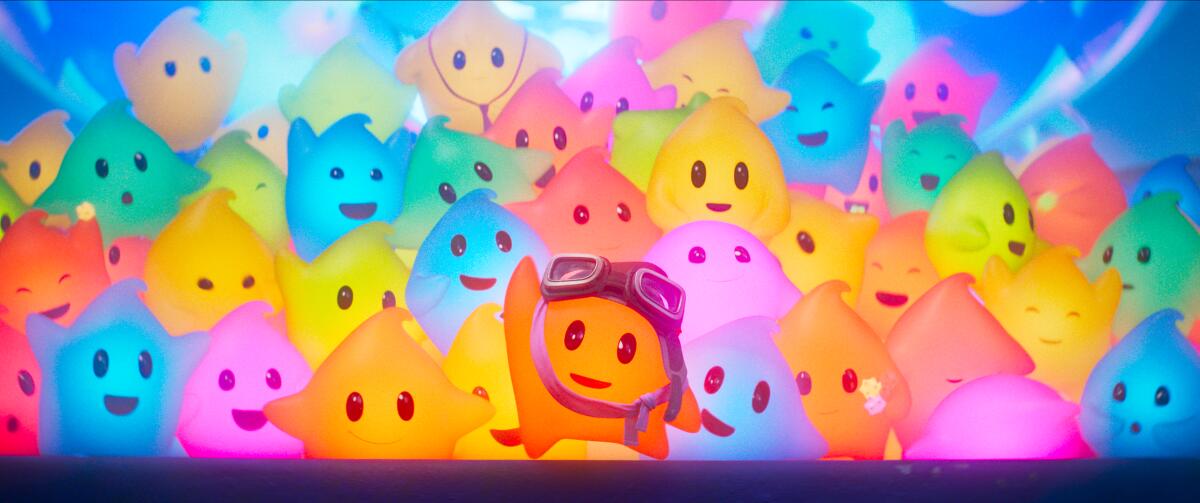
Directed by Aaron Horvath and Michael Jelenic, who also helmed the first film, “The Super Mario Galaxy Movie” formally introduces into Nintendo’s movie universe the cosmically powerful Rosalina and her flock of star-shaped Lumas, Bowser’s ambitious mini-me, Bowser Jr., the insatiable dinosaur-like Yoshi, ace pilot Fox McCloud and more video game fan favorites. (That includes Mr. Game & Watch, one of Nintendo’s earliest playable characters.)
These introductions, of course, don’t stop when the film’s main story ends.
Much like the first installment, “The Super Mario Galaxy Movie” features a couple of bonus scenes that are shown after the credits begin to roll. The first is a mid-credits scene that involves a breakout character from “The Super Mario Bros. Movie,” and the second, shown after the credits end, introduces another Nintendo royal.

Many Lumas appear in “The Super Mario Galaxy Movie.”
(Nintendo and Illumination)
The mid-credits scene is justice for Lumalee
Lumalee quickly won audiences over in “The Super Mario Bros. Movie” with his cheerfully nihilistic one-liners while imprisoned by Bowser. The blue Luma doesn’t appear during the main story of “The Super Mario Galaxy Movie,” but the star-shaped creature steals the mid-credits scene.
The bonus scene takes place sometime after the movie’s main story ends at the prison where Bowser and Bowser Jr. have been locked up. After Fox teases a possible sequel or “Star Fox” spin-off by mentioning he is finally “heading home” as he approaches his ship, audiences get a glimpse of what’s in store for the Bowser duo’s foreseeable future.
Peace may not be an option, because their prison guard is former Bowser captive Lumalee. And the role reversal — complete with uniform — doesn’t appear to have changed Lumalee’s outlook on life in any way.
The blue Luma said it best in the first “Mario” movie: “Life is sad, prison is sad, life in prison is very, very sad.” Just how sad things might get for the Bowsers will be up to Lumalee.

Peach fights off some Ninjis in “The Super Mario Galaxy Movie.”
(Nintendo and Illumination)
The second post-credits scene introduces a new princess
The final bonus scene in “The Super Mario Galaxy Movie” is more of a teaser for what could come in a future “Mario” installment.
This stinger takes place back at the hub known as the Gateway Galaxy. The mischievous thieving monkey Ukiki is once again trying to make off with the belongings of a passerby when he is stopped by another traveler: Princess Daisy.
Daisy is a character that first appeared in the 1989 Game Boy game “Super Mario Land.” Much like Peach in the first “Super Mario Bros.” video game, Daisy was the princess players were trying to rescue. She has since become a Nintendo regular, being featured as a playable character in “Mario”-related titles including in the “Mario Kart,” “Mario Party” and “Super Smash Bros.” series of games as well as the latest main series installment, “Super Mario Wonder.”
Although Daisy does not have any lines in the film, the video game incarnation of her is known to be energetic and feisty.
This brief glimpse of Daisy is another indication that there is more to come in the Mario movie franchise. Audiences will have to wait to see if (or when) a third movie is officially announced.