galaxy

Michael Araujo lives his dream as the voice of Angel Stadium

You’ve probably never seen Michael Araujo, but if you’ve attended an Angels game since 2013, you’ve definitely heard him.

On Sunday, Araujo will work the final game of his 14th season as the Angels’ public address announcer. During that time he has started more home games than Mike Trout and finished hundreds more than any reliever to come out of the bullpen.

Yet for most fans, his voice has been little more than background noise, an acapella Muzak that only gets noticed when Araujo makes a mistake.

And mistakes just don’t happen, said Davin Maske, the Angels’ director of entertainment and production.

“I don’t remember any,” said Maske, Araujo’s boss. “There isn’t that one major mistake since I’ve been here that I could recall.”

Araujo, who is also the stadium voice for the Galaxy, has worked Gold Cup and Copa América soccer matches, eight World Cup games and the 2003 Women’s World Cup final. But the Angels’ gig is his dream job and he passed 1,000 games as the team’s PA announcer last month.

“He loves sports,” said his wife Kathryn Casey. “He really does enjoy being there and being part of it because he’s a huge fan. It’s not just a job.”

It is a job that comes with high expectations, though. Because if the broadcasts of the late Vin Scully were the soundtrack for baseball fans in Southern California, for people of a certain age, the booming baritone of John Ramsey will forever be the template for what a PA announcer should sound like.

Ramsey, who died in 1990, was the original PA voice of the Angels, as well as the Dodgers, Kings, Lakers and L.A. Raiders. He also did the Rams and USC football with a calm, articulate and authoritative delivery that was so powerful, it had its own echo.

Would you all please rise (rise, rise, rise) and honor America in the singing of our national anthem (anthem, anthem, anthem).”

It was like being spoken to by God, an impression aided by the fact that Ramsey, hidden in a small booth near the press box, was heard but never seen.

“That’s not me, Araujo said. “So I try not to emulate that.”

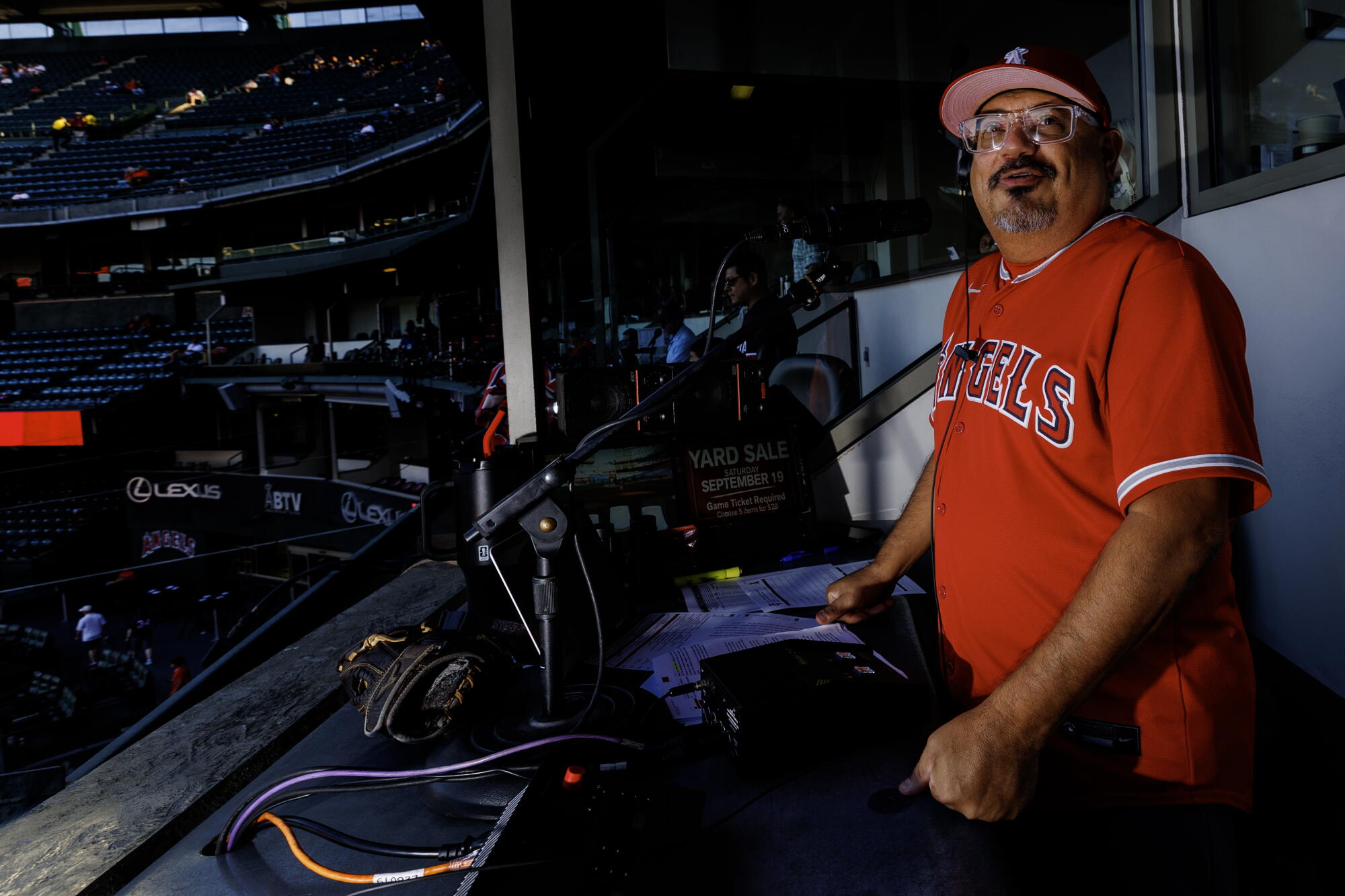
Angels public address announcer Michael Araujo overlooks the field in his booth before a game.

Angels public address announcer Michael Araujo overlooks the field in his booth before a game against the Minnesota Twins on September 17.

(Gina Ferazzi / Los Angeles Times)

Still, like Ramsey, Araujo’s gift is his voice. And though his delivery isn’t nearly as deep and commanding as Ramsey’s, it is unique in that it has a distinct, enthusiastic lilt, one he’s been able to maintain through what will likely be the Angels’ first 100-loss season.

“I try to bring the energy,” he said.

“It’s all about riding your vibes,” Maske added. That’s why Araujo’s perch on the club level behind home plate is exposed to the crowd rather than enclosed, like the booths to his right used by the radio and TV broadcasters. The idea is to feed off the fans, not lock them out.

“Baseball is gnarly. It’s repetitive. It’s a sport that’s inherently, at times, very boring,” Maske said. “So you’ve got to find those little moments to make it entertaining.

“It’s not NFL. It’s not the NBA. It’s baseball. Mike’s good at kind of finding that balance of excitement and traditionalism.”

And the excitement, even at the end of a blowout loss, is genuine, he said.

“The Angels were my team growing up, so the Angels was my dream job,” said Araujo, a former season-ticket holder. “I’ve been very fortunate.”

“I want to get paid to watch sports and that’s it,” he continued. “So whatever I’ve got to do to be invaluable so that I stay there, that’s kind of my mission.”

It’s not a mission that pays much, however, with most PA announcers across the majors earning between $100-$500 a game to announce each hitter as he comes to plate, read commercial copy between innings and, in Araujo’s case at least, to handle the play-by-play for the cartoon races that run on the scoreboard late in the game.

“It’s fun money,” said Casey who, like Araujo, is a teacher as well as the clock operator at Galaxy games, where she works alongside her husband. “We use it for travel.”

The job is one Araujo stumbled into. Despite a rich voice and a lifelong passion for sports, pairing the two was something that just happened, not something that was planned.

A teacher at an alternative-education high school in La Puente, Araujo, 54, has worked for the Galaxy since the MLS team’s second game in 1996, filling a number of roles from glorified errand boy to assistant game-day producer. That last job required him to stand behind the PA announcer and relay silent cues, and since he knew the gig, Araujo was handed a microphone and asked to fill in a few times during absences, sick days and other emergencies.

The biggest emergency came when Victor Villalba, the Galaxy’s regular announcer, left in the middle of a season to join the Dallas Cowboys radio team. Araujo was the natural choice to finish out the year and he’s been there ever since.

“That was 2002,” he said. “So I’m in my 25th season.”

It was similar desperation that led to his job with the Angels. When David Courtney, who had been with the team for nearly two decades, died at 56 two months after the 2012 season, the Angels began asking around for a replacement and Araujo’s name was the one they heard most frequently. So he was invited to spring training the following year to audition and he beat out two others to claim the job.

On game days Araujo gets to the ballpark about 2½ hours before first pitch, pausing in the parking lot to pull on an Angels cap and jersey with his name on the back. If the team wins, he’ll wear the same jersey the next day; if not, he’ll rotate through a closet of red, white, gray and City Connect jerseys.

Araujo’s only other tools are a microphone and a laptop, on which he’s installed an interactive software program he created that tracks the lineups of both teams. He can also call up pronunciation guides for players on all 30 major league teams, though he’s found the radio broadcasters for the visiting clubs are often more helpful.

Angels public address announcer Michael Araujo overlooks the field from his booth.

Angels public address announcer Michael Araujo has worked more than 1,000 games at Angel Stadium and has been the Galaxy’s public address announcer since 2002.

(Gina Ferazzi / Los Angeles Times)

His cramped work space, about 90 feet from the field, has enough room for two green vinyl chairs, though Araujo prefers to stand when he’s working. And unlike many people whose vocal chords are their livelihood, Araujo says he has few ritualistic habits to protect his voice.

“In my bag I have a gazillion cough drops; a couple of different kinds, some with honey,” he said. “I definitely wouldn’t do anything carbonated before a game. Makes you burp and all that kind of stuff.”

Araujo is one of three Latino PA announcers in the majors, alongside Marysol Castro, who works for the New York Mets, and Frank Fernandez of the Miami Marlins. Given that 30% of big-league players are from Latin America, the fact that just 10% of the PA announcers are Latino is something Araujo said he thinks about during Hispanic Heritage Month.

“Did I grow up in Boyle Heights or anything like that? No, I’m no poster child or miracle story or anything like that,” said Araujo, who was raised middle class in La Verne, where his father, a sheriff’s deputy, and mother, a nurse, often spoke to one another in Spanish.

“We are here in 2026 and it’s not a little more prevalent. It can be an aspiration to any kid, even one of my students, that bigger things are possible.”

For a PA announcer, it turns out, there are times when it’s important to be heard and seen.

Source link

Why Disney turned Tower of Terror into Guardians of the Galaxy

Ten years ago, Walt Disney Imagineering announced what was widely perceived by the public as a risky — and ill-advised — project: Disney California Adventure’s Twilight Zone Tower of Terror would be remade into a ride featuring Marvel’s “Guardians of the Galaxy.” And it would open in just a few months, ahead of the 2017 summer tourist season.

Fans, to say the least, were not happy. They saw the makeover as a marketing move, done solely because a new movie in the franchise was being released. They were also skeptical of the tight timeline.

Retired Imagineer Joe Rohde, who led the project, heard the complaints.

Sign up for Mr. Todd’s Wild Ride

An insider guide to the ever-changing world of theme parks, coming to you straight from SoCal — the theme park capital of the world.

“They look at the schedule and go, ‘You can’t do anything in that amount of time. There’s nothing you can do that is worth doing in this short amount of time, so we think this is going to be bad,’ ” says Rohde, whom I chatted with at the recent Disney fan convention D23.

Rohde‘s new book, “Floating Mountains: The Art of Imagining the Impossible,” is out this week and in it, he demystifies the creative process, heavily touching on his four-decade career at Imagineering as a jumping-off point on how to stay inspired and find art in the everyday. In a revealing chapter on what became Guardians of the Galaxy — Mission: Breakout!, Rohde writes about creating art out of a series of limitations.

Famed retired Disney Imagineer Joe Rohde.

Famed retired Disney Imagineer Joe Rohde, whose book “Floating Mountains: The Art of Imagining the Impossible” demystifies the creative process.

(Jay L. Clendenin / Los Angeles Times)

He notes that the new “Guardians of the Galaxy” film was not the reason for changing the drop tower ride — rather, the motivating factor was giving the Disneyland Resort something new to promote for 2017 and to begin to bring Marvel into the parks.

When assigned the project, Rohde initially pitched a Dr. Strange-inspired attraction, believing the hotel facade of Tower of Terror could quickly and easily translate to a mysterious sanctum. Execs, however, rejected the concept, arguing Dr. Strange wasn’t popular enough. They told Rohde and the team to focus on Spider-Man.

Now it was Rohde’s turn to say no. “Spider-Man needs room to swing,” Rohde writes in his book. “We only go up and down. There’s nowhere for Spider-Man to be!”

Bringing Marvel superheroes into a theme park, Rohde tells me, is something of a challenge.

“Marvel is a character brand,” Rohde says. “When we watch these movies or read the comics, our primary investment is in the psychology of the character. Spider-Man is a great example of this. Spider-Man’s life is a constant emotional crisis of one kind or another. It’s almost more of a soap opera format.

A Quinjet rests high atop the Avengers Headquarters building at California Adventure.

Guardians of the Galaxy — Mission: Breakout! is today the dominating structure of Avengers Campus at Disney California Adventure.

(Allen J. Schaben / Los Angeles Times)

“So, you have an art form — the Marvel Cinematic Universe and the Marvel Comic Universe — in which settings are disposable and are disposed of in order to drive character development. That works great in a film, but when it comes to place-making, it is difficult to lock yourself on the experiences of places, which is part of what makes theme parks theme parks. All through your day in a theme park the primary actor you engage with is the architecture and the landscape.”

With Spider-Man out, “Guardians of the Galaxy” was the compromise everyone could agree on. Only now the clock was ticking. Rohde notes that the team had to stop viewing the Tower of Terror as a hotel, and instead look at it as something of a blank page — an empty canvas that just happened to be in the shape of a blocky silhouette that jolts guests 190 feet in the air. Remove the hotel signage, and suddenly the mass resembled many things: “a grain silo, a fortress, a bank, a storage facility, possibly a prison,” Rohde writes.

Arguably, the facade for Mission Breakout! represents a bit of each of those. In “Floating Mountains,” Rohde says he began reimagining the building by taking inspiration from Marvel comic artist Jack Kirby, but he has also spoken of finding influence in architect Renzo Piano, who worked on France’s Centre Pompidou. The end result is a retro sci-fi building with high-tech-like pipes drawing one’s attention.

The chapter documents a frantic race against time. The star of the ride is an audio-animatronic of the Rocket Raccoon character, but it wasn’t always clear the figure could be finished by the deadline. And instead of using just one ride profile like the Tower of Terror, Mission Breakout! aimed for four, but Rohde writes the team had two as a fall-back plan (ultimately, they prevailed with their original intent).

Rohde notes that to get it done, a concession was made: limited reviews but a fixed, unchangeable budget with a strict deadline. And the team had to make a decision and commit. Little tinkering.

Guardians of the Galaxy — Mission: Breakout! is now considered one of the most popular attractions at Disneyland.

Guardians of the Galaxy — Mission: Breakout! is now considered one of the most popular attractions at Disneyland.

(Jason Armond / Los Angeles Times)

“You have to allocate a certain percentage of time and energy to prepare for a review, and that can be two weeks of energy,” Rohde says. “In this case, the most crucial thing about this project was its opening day. If you back out of that opening day just with production time, it becomes clear there’s no time to change. There’s no time to ask someone if they like it or don’t like it. So we have to decide we’re going to do it, and we’re going to do it for this much money, and you can look at it once before we start, and once before we build.”

Guardians of the Galaxy — Mission Breakout! opened on time, and with enough budget left over to create an “after dark” version during the Halloween season, which is currently running. And those fans who initially viewed the project with skepticism? Many were quiet after opening day, as Mission Breakout! is considered one of the Disneyland Resort’s most popular attractions.

Aside from replacing the former tension with chaotic elevator maneuvering, the makeover was a success because it’s not a rehash of a scene from the film. Rather than rely heavily on plot, it focuses on one frantic moment — a prison breakout — to create a zany, screwball comedy feel. In short, it’s a singular work of art, one that stands apart from its cinematic counterparts.

And that’s key to the appeal of “Floating Mountains,” as throughout Rohde makes the case that theme parks — often derided as commercial entities — are indeed vital spaces. He speaks of art as living on a spectrum. On one end, “art for art’s sake,” and on the other, “utterly commercial enterprises with no purpose other than to harvest value out of an intellectual property.”

“Theme parks,” says Rohde, “rocket somewhere in the middle of this.”

“I do believe that their social impact alone should argue for the fact that, no matter what you think of high art, of low art, something is going on here that people find very affecting,” he says of theme parks. “I think it is an art form.”

This week in SoCal theme parks

Inside Kingswell skate shop is a wall documenting the building's history

Inside Kingswell skate shop is a wall documenting the building’s history as the first L.A. outpost of what would become the Walt Disney Co.

(Todd Martens / Los Angeles Times)

  • A Disney history celebration. Walt Disney launched his animation career in Kansas City, Mo., in 1920. But when his Laugh-O-gram Studio failed after only about two years, he decided to move west. Here in Los Angeles, Walt and his brother Roy would in 1923 rent a small studio space on Kingswell Avenue in Los Feliz, near where he was staying with his uncle. They called their operation the Disney Bros. Studio, and it was officially the formation of what would become the Walt Disney Co. In September 2024, a small strip on the corner of Kingswell and Vermont avenues was designated the Disney Bros. Cartoon Studio Square. This Sunday, the space will host a mini-block party from noon to 5 p.m., with photo ops, events and skating demonstrations courtesy of the Kingswell skate shop,
  • Welcome the Lucas Museum. The long-awaited Lucas Museum of Narrative Art has arrived in L.A. and is welcoming members for previews. The space officially opens Sept. 22, and its emphasis on pop culture and “Star Wars” likely means there’s many an overlap with the Disney fan community. The Times has a bevy of coverage, including an architecture review as well as an analysis of its collection and how it deviates from typical art gallery fare.
  • Meow Wolf taps dozens of L.A. artists for new venue. Meow Wolf is getting closer to unveiling its Los Angeles locale. When doors open — the company is targeting late 2026 — expect a walk-around, floor-to-ceiling experience that pays homage to the art of cinema with a sci-fi, psychedelic-like bent. And to bring that vision to life, the Santa Fe, N.M.-based experiential art collective will be working with nearly 40 L.A. artists across multiple mediums. Meow Wolf last week unveiled its roster of artists with ties to the L.A. region.
  • A new Magic Mountain coaster is on the way. Six Flags Magic Mountain, garnering headlines tied to the safety of its X2 coaster, is looking ahead to 2027 and teasing a Thursday announcement for its next big thrill ride. The park last week posted a video to social media hinting at more info to come this week on what is expected to be a glider coaster with bike-like seating.

Ride report

An actor performing as Ozzy Osbourne during a haunted house at Universal Studios Hollywood's Halloween Horror Nights.

An actor performing as Ozzy Osbourne during a haunted house at Universal Studios Hollywood’s Halloween Horror Nights.

(Scott Strazzante / For The Times)

This week’s ride report is actually a haunted house report. Of the eight spooky mazes at Universal Studios Hollywood this year, there were two clear standouts for me: the “Sinners” maze, which I documented last week, and Ozzy Osbourne: Prince of Darkness. This walk-through attraction, which Halloween Horror Nights mastermind John Murdy has described as something of a passion project, is a filled with cartoonishly sinister imagery in an homage to the recently deceased heavy metal legend.

Murdy says he didn’t have any hesitation about crating a haunted house based on Osbourne’s solo career so soon after he died last summer. “It hit everybody really hard,” the lifelong Osbourne fan says of the artist’s death. “It hit his fan community really hard. We needed to do something for the fans to celebrate this guy’s legacy.”

A giant animatronic bat in a haunted house inspired by the music of Ozzy Osbourne.

A giant animatronic bat in a haunted house inspired by the music of Ozzy Osbourne.

(Scott Strazzante / For The Times)

In an unique twist, nearly every scare actor is performing as some embodiment of Osbourne. The attraction is also filled with little nods to Osbourne’s life and legacy, including pictures donated from the family and a toy cow as a nod to an early job of Osbourne’s in a slaughterhouse. Murdy estimates the house features about 20 songs from Osbourne’s solo career, bookended by “Crazy Train” and “See You on the Other Side.” A train, of course, figures heavily into the maze, and an early ride scene appears to take us straight to hell.

It gets demented, but in a silly way that feels all-in-good-fun rather than anything frightening. Case in point: A centerpiece of the attraction is a giant animatronic bat, which is holding the severed head of Osbourne, only here the musician is depicted as a werewolf. Osbourne, says Murdy, was also heavily religious, so the walk-through culminates with the artist on a church-like throne. But it’s no ordinary cathedral, as jetting our from under Osbourne’s chair is a blue dragon, a nod to the tattoo the singer had on his chest.

It’s a love letter to Osbourne, and Murdy’s appreciation of the artist runs deep. He notes that as a seventh- or eight-grader in the early ‘80s, he wrote a term paper defending the artist. “I didn’t like the fact that people were condemning things when they hadn’t even bothered to read the lyrics and know what they are about,” Murdy says. “Take ‘Crazy Train.’ It’s about the Cold War. It’s about a fear that society is going off the rails. At an early age I was already going, ‘Don’t trust things that you hear at face value.’ ”

Tell us your stories. Ask us your questions.

Have a theme park tale to share? Whether it was a good day or less-than-perfect day, I would love to hear about it. Have a question? A tip? A fun photo from the parks to share? Email me at todd.martens@latimes.com. I may feature your note in an upcoming newsletter.

Ride on,

Todd Martens

P.S.

I can admit when I was largely wrong. Last week I expressed concerns about the way Halloween Horror Nights was adding the character of Nikki from “Obsession,” worrying a hyped incognito approach could open up the actor — or regular paying guests — to being uncomfortably approached by attendees. But while Nikki is not easy to find, she’s far from anonymous, all bloodied up and holding a brick. Plus, she’s accompanied by multiple handlers who keep folks from crowding the performer’s space.

There is a game-like aspect to this. Those who speak a password, released via social media, receive a fake business card, which does mean many a guest is standing there shouting a password at the actor. This is slightly awkward, and where I still have some reservations.

An actor as Nikki from "Obsession" interacting with guests during Halloween Horror Nights at Universal Studios Hollywood.

An actor as Nikki from “Obsession” interacting with guests during Halloween Horror Nights at Universal Studios Hollywood.

(Scott Strazzante / For The Times)

But many who find Nikki may discover it’s a highlight of the night. I’m not someone who seeks out characters at theme parks, largely because they’re there more for photos than to completely interact. Nikki is different. Nikki is in full immersive theater mode, responding entirely in character and pushing guests to talk about their devotion — to her, to another, to anything. In my minute with the actor, she aggressively quizzed me on my nonexistent love life, forcefully walking toward me so I had to gently stumble backward, which she lightly mocked.

Despite the unnerving tone of the actor’s questions, I was charmed. More of this type of interacting and play is always welcome. Now, I just wonder why she was so consumed with the health and age of my cat.


Source link

Red card dashes Galaxy’s hopes of win in draw with Montreal

Daniel Ríos scored his first goal in MLS and Prince Owusu also scored a goal for CF Montreal in a 2-2 tie with the Galaxy on Saturday night.

Goalkeeper JT Marcinkowski, shown a red card in the 68th minute, was replaced by Novak Micovic and the Galaxy played a man down the rest of the way. The Galaxy have drawn red cards in three consecutive games.

Owusu scored his career-high tying 13th goal this season to make it 2-2 in the 79th minute. The 29-year-old forward, who also scored 13 goals for Montreal last season, has a goal in four consecutive games and scored seven goals in the past seven.

Montreal (6-10-5) has a season-long four-game unbeaten streak.

Rubén Ramos Jr. and Maya Yoshida each scored a goal for the Galaxy (6-9-7), who beat San José 1-0 on Wednesday to snap a six-game winless streak.

Ríos made his debut for Montreal and opened the scoring in the 16th minute. Matty Longstaff played a low ball into the area from the right side that was parried by Marcinkowski at the front post before Ríos tapped in the rebound from point-blank range.

Ramos scored his first career MLS goal in the 20th. On the counter-attack, Kyōgo Furuhashi played a first-touch shot off a cross from Robert Taylor that was stopped by goalkeeper Thomas Gillier, but Ramos slammed home the putback to make it 1-1.

Yoshida back-heeled a shot from the center of the area into the net to give the Galaxy a 2-1 lead in the 48th minute.

Source link