Average Women’s Super League attendances surged by 192% in the season after the Lionesses’ Euro 2022 triumph, but the speed of the boom has stalled.
Median crowds have risen by just 166 fans, from 3,070 in 2023-24 to 3,236 in 2025-2026, according to a 2026 report from YouGov and architecture firm Populous, external.
Some of the biggest fixtures are now attracting significantly smaller attendances.
Arsenal against Manchester United at Emirates Stadium fell from 46,603 in 2024-25 to 29,853 this season, while Chelsea v Arsenal dropped from 34,302 to 19,349 over the same period.
The Gunners, who averaged 34,000 at the Emirates last season – almost four times the next-highest club, Chelsea, and higher than eight Premier League sides, external – had just 19,546 for their October match against Birmingham City.
There are bright spots, including a sold-out 4,000-ticket Arsenal away allocation at Tottenham for the first time, but the wider trend for some matches is clear.
Manchester United against Manchester City was hosted at Leigh Village in October with a crowd of 5,361. The same fixture was held at Old Trafford in March 2026 with 24,983 fans.
So what is behind the decline? Marketing, scheduling, matchday experience, stadium design, product or something else?
Jay-Z has chosen himself to headline the Super Bowl halftime show.
The 25-time Grammy winner will perform at Inglewood’s SoFi Stadium on Valentine’s Day, Apple Music, the NFL and Roc Nation announced during the Cowboys vs. Eagles “Monday Night Football” matchup.
This caps a banner year for Jay-Z. The rap superstar performed two back-to-back concerts at SoFi Stadium last weekend — part of his “Jay-Z 30” tour celebrating the 30th anniversary of his debut album, “Reasonable Doubt,” and the 25th anniversary of “The Blueprint.” He sold out three nights at New York’s Yankee Stadium in July, followed by stops in London and Paris. He partnered with legendary music producer Rick Rubin on “Jay-Z in 8,” an eight-part documentary about his life and legacy released by HBO last month.
“From Reasonable Doubt to standing on the Super Bowl Halftime stage, this has been a journey,” Jay-Z said in a news release. “Thirty years of music, work and culture on the world’s biggest stage. This run continues to be a dream come true.”
Miley Cyrus, Justin Bieber and Harry Styles were reportedly also in the running, but lost out to the decision-maker himself.
Super Bowl LXI marks the eighth year that Roc Nation, the entertainment behemoth founded by Jay-Z, will produce the halftime show. The Brooklyn rapper has had the ultimate say in who the halftime performer is every year since 2020. In 2019, Roc Nation signed on to consult the NFL on live music entertainment and the social justice initiative Inspire Change, which aims to reduce barriers to opportunity, especially in underserved communities. They extended their deal in 2024 for another five years.
Roc Nation will executive-produce “The Apple Music Super Bowl LXI Halftime Show” and Hamish Hamilton will serve as director.
“For several years, we’ve had the privilege of working closely with Jay-Z and Roc Nation, and I’ve seen the extraordinary impact he has had on the Super Bowl Halftime Show,” NFL Commissioner Roger Goodell said in a news release. “When we first reached an agreement with Roc Nation to produce the show, I had just one request: that Jay-Z take the stage himself one day, whenever the moment felt right to him. I couldn’t be more excited for fans around the world to experience the artistry, creativity and cultural impact he will bring to the Super Bowl stage.”
Jay-Z told Entertainment Tonight in 2024 that it was too soon for him to take on the task.
“I thought it would be selfish to pick myself too early. Maybe one year. Maybe,” he said.
The NFL had approached him years prior about headlining the Super Bowl halftime show, but it came with the stipulation to perform “Run This Town” with Rihanna and Kanye West.
“Of course I would have,” Jay-Z told the New York Times in 2020, “but I said, ‘No, you get me.’ That is not how you go about it, telling someone that they’re going to do the halftime show contingent on who they bring. I said forget it. It was a principle thing.”
Rihanna eventually performed at the 2023 Super Bowl. She may be one of his guest stars come Feb. 14, but he could tap any top artist to perform, considering his label’s deep roster of talent … and the fact that he’s married to Beyoncé. Beyoncé headlined the halftime show in 2013 and made a guest appearance during Coldplay’s Super Bowl 50 set in 2016.
Bad Bunny headlined the show in February, which created an uproar and something of a culture war. “Turning Point USA, the conservative organization founded by the late Charlie Kirk, put together a so-called All-American Halftime Show featuring Kid Rock in an appeal to viewers scandalized by … the Spanish language? Dancing? The idea of fun?” Times music critic Mikael Wood wrote in his review. “For the NFL, the blowback was a calculated risk as the league makes a push to globalize its fan base.”
Before Bad Bunny, performers have included (in reverse chronological order): Kendrick Lamar; Usher; Rihanna; Eminem, Dr. Dre, Snoop Dogg, Kendrick Lamar and Mary J. Blige (all together in 2022); the Weeknd; and Shakira and Jennifer Lopez (also together). Last season’s game drew almost 125 million viewers; this is one of — if not the — biggest stages in music.
No single Argentine capability shaped British planning during the 1982 South Atlantic conflict more than the pairing of the Dassault Super Étendard strike fighter and its deadly AM39 Exocet anti-ship missile. Against that threat, the British launched a series of special forces operations, all with the same objective: kill the Argentine pilots and destroy their aircraft and missiles before they could be used again. Together, the strike fighter and missile pairing had proven to be the biggest threat to the Royal Navy task force that had been sent to recapture the islands.
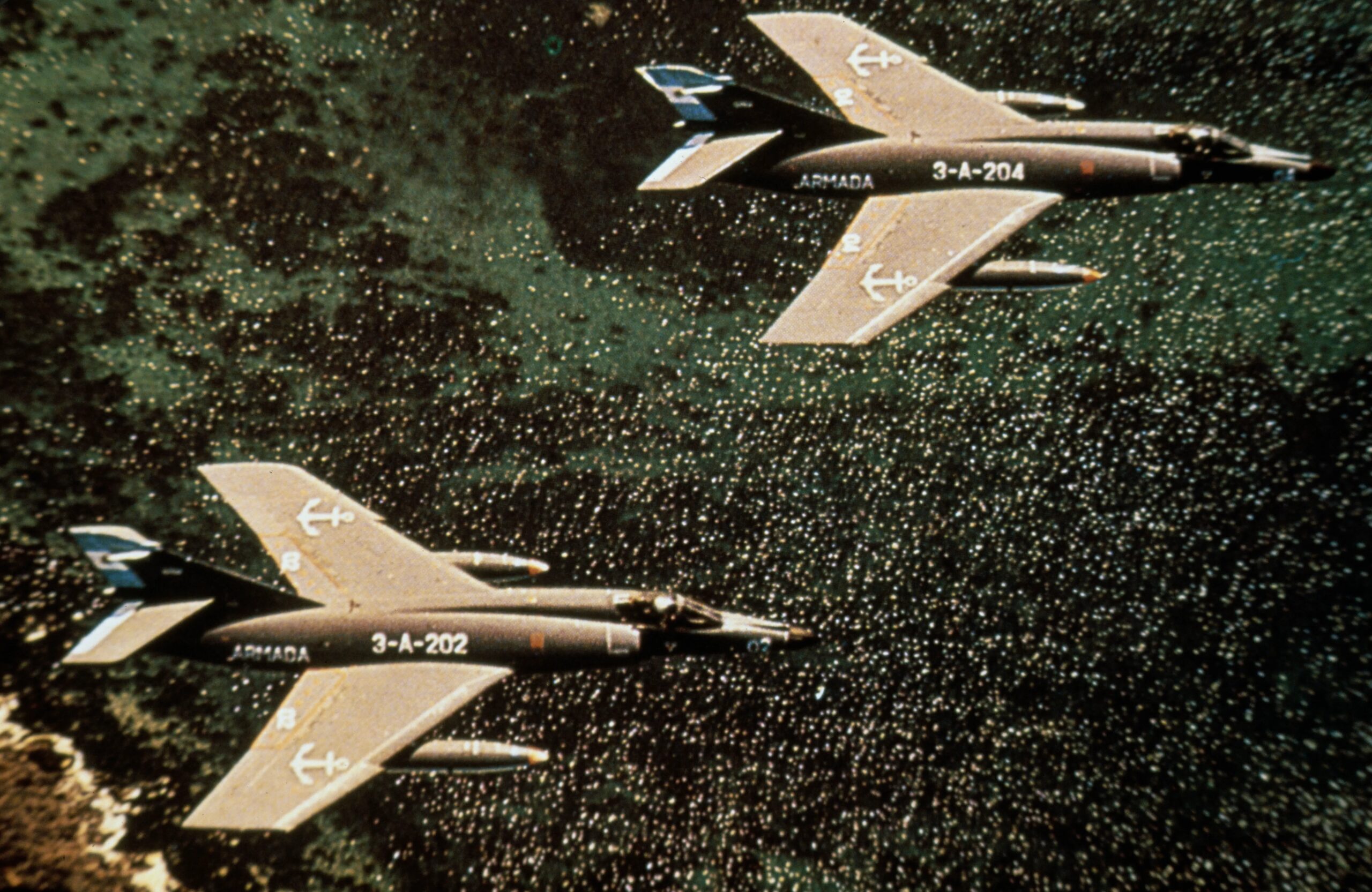
Two Super Étendards of the Argentine Navy in flight around the time of the Falklands War in 1982. Photo by UPI/Bettmann Archive/Getty Images
Five Super Étendard aircraft and five AM39 Exocet missiles had been delivered to Argentina before a French embargo took hold. The jets were flown by the Argentine Navy’s 2nd Naval Fighter and Attack Squadron out of Río Grande, on Tierra del Fuego, a region at South America’s southernmost tip, shared by Chile and Argentina. The Super Étendard/Exocet combination had already cost the British the destroyer HMS Sheffield on May 4 and the container ship Atlantic Conveyor on May 25.
A casualty from HMS Sheffield being rushed to the sick bay on board the aircraft carrier HMS Hermes. Crown Copyright
The special forces operations were broken down into four phases — named PLUM DUFF, MIKADO, KETTLEDRUM, and IMPI — the last of which is the least well-documented, and the focus of this article.
PLUM DUFF was the insertion phase and was a reconnaissance mission. On May 16, an RAF Hercules airdropped eight special forces troops onto RFA Fort Austin to form a recce party. On the night of May 17/18, a Sea King HC4, ZA290, lifted off from the aircraft carrier HMS Invincible for a one-way flight to Tierra del Fuego, where the men were to observe Río Grande and report back. The patrol was set down far from the objective and never completed the reconnaissance; the helicopter crew flew on into Chile, where the aircraft was deliberately burnt to try and hide the evidence, while they tried to evade capture.
Commandos being lifted from the decks of HMS Hermes and HMS Invincible to be transferred by Sea King helicopters to other ships while the two aircraft carriers forge ahead to the Falkland Islands from Ascension Island, leaving the marines ready to move at short notice. Photo by Fox Photos/Getty Images
MIKADO was the planned attack phase, and it depended on that missing intelligence. Two Hercules were to air-land up to 70 men of B Squadron, 22 Special Air Service (SAS), directly on Río Grande — the air operation order of May 19 also named Río Gallegos, further up the Argentine coast, as an alternative. The men would destroy the Super Étendards and their Exocets on the ground, kill the pilots, and then withdraw overland into Chile. Commander Task Force 317, at Northwood, accepted from the outset that the mission could well cost both Hercules.
Lieutenant Juan José “Tierno” Rodríguez Mariani in Super Étendard 3-A-203, preparing to take off from Río Grande on May 23, 1982; note the ground power unit still connected. Armada Argentina
The aircrew did not refuse the task, but they were blunt about what it demanded: formation landing by two heavy transports on a possibly heavily defended, icy military runway, with a probable 20-knot tailwind, at night and on passive night-vision goggles in minimum light levels, with intelligence that was inadequate to support any air-land option at all. The RAF planning team recommended an airdrop as the better way to maintain a covert posture, and the Senior Air Staff Officer at Headquarters 38 Group warned the Air Commander to watch for overambitious schemes coming out of the SAS.
The U.K. Ministry of Defense formally cancelled MIKADO on June 4.
KETTLEDRUM was planned as the third of the set. It was aimed at Puerto Deseado, Santa Cruz Province of Argentina, and would have inserted a Special Boat Service party (SBS, the Royal Marines’ special forces unit) from the submarine HMS Onyx — a boat that will reappear before the end of this story.
None of the three was executed as planned.
The Oberon class submarine HMS Onyx on the surface off Ascension Island. HMS Onyx was the only diesel-electric British submarine to serve in the conflict, and its ability to operate silently close inshore enabled it to play an important role. At Ascension Island, Onyx boarded SAS and SBS special forces personnel and supported them during a series of operations. Imperial War Museums via Getty Images
Less well-known is that the cancellation of MIKADO produced a fourth project: Operation IMPI, named after a Zulu fighting force.
Cancelling MIKADO did not mean the wider operation was over. Also on June 4, the U.K. Ministry of Defense tasked CTF 317 to produce a new plan for special forces to destroy the combat effectiveness of the Super Étendards.
CTF 317’s staff went to work on what became IMPI. The planning document, Ops 1/3, is dated June 14 — the day of the Argentine surrender in the islands. In broad terms, the objective was to be attacked by special forces arriving both by air and by sea.
That much has been known, in fragments.
Teniente de Naviro (Lieutenant Commander) Alfredo Astiz signing the Instrument of Surrender on behalf of his Argentine forces at Leith, on the island of South Georgia, on board HMS Plymouth. Crown Copyright
What has not been published until now is the fact that the operation had already been resourced.
At 2240Z on June 12, Maj. Gen. Jeremy Moore, commanding the land forces as CTG 317.1, signalled Rear Admiral Sandy Woodward’s battle group (CTG 317.8), with Admiral Sir John Fieldhouse at Northwood (CTF 317) and Commodore Michael Clapp’s amphibious group (CTG 317.0) as information addressees. The message called for B Squadron, 22 SAS, to be made available for operations as soon as possible: cover was needed against rapid developments of an unfavorable nature in West Falkland (Gran Malvina), and the theatre’s existing special forces assets were fully absorbed supporting the battle for Stanley — and IMPI. Operation IMPI, Moore noted in passing, was by then self-sufficient.
Maj. Gen. Sir Jeremy Moore Mc, Commander, Land Forces Falkland Islands Conflict. Photo by Avalon/Getty Images
Examining two lines of routine signal traffic settles several things at once. Forty-eight hours before the surrender, IMPI was not a staff study but an operation that had been resourced, and that was enough to consume the theatre’s special forces and justify calling a fresh SAS squadron forward. It is also the only contemporary, operational-level reference to IMPI released so far: everything else comes from a narrative written years afterwards.
As that later narrative describes it, the concept behind IMPI was much leaner than MIKADO. Against two Hercules and 70 men, the air element of IMPI rested on a single RAF Hercules.
Overflying Stanley Airfield in November 1983, with two RAF Hercules aircraft present. Getty Images
The aircraft was to fly from Ascension Island, refuel in flight, and then track east of the Falkland Islands and south of Cape Horn before making a low-level approach below Argentine radar cover for a night landing of special forces at the airfields codenamed San Jose and Arco Iris. Other special forces would have been inserted by sea. That air element, as will be seen, is the most questionable part of the entire file.
The routing is worth attention, because it rules out the intuitive picture of a direct run south from Ascension. Instead, the aircraft would have entered from the least-covered and least-expected direction, coming around the bottom of the continent rather than from the northeast.
A schematic map of the planned Operation IMPI. via author
The precise identities of San Jose and Arco Iris are not established in the declassified record.
The most likely reading is that they stand for Río Grande and Río Gallegos — the airfields at which the planned navigation ended, and the two named in MIKADO’s air operation order a month earlier. For a document circulating through restricted channels, encrypting the names of the two targets was an elementary precaution, although it should be noted that an operational order would more commonly have designated them simply as Target One and Target Two.
None of this rules out Chilean participation in other phases of the operation; if anything, it suggests it’s more likely. The narrative survives inside a folder classified Top Secret and restricted to the Chief of the Air Staff, whose declared subject is cooperation with Chile. That setting contrasts with the earlier stage of the planning, when mounting and recovering a special forces insertion from a Chilean airfield was considered and expressly discounted on political grounds — much as the use of an Antarctic strip was discounted after the New Zealand High Commission advised that the Antarctic winter precluded safe trans-polar flight.
The maritime half of IMPI can be traced in the records of those who were there.
Navigational support for the final phase was to come from the nuclear attack submarine HMS Conqueror. On June 9, 1982, Conqueror was off Bahía Camarones, working as an advanced picket and hunting targets of opportunity that ventured outside the 12-nautical-mile limit of Argentine territorial waters, with authority to sink any civilian vessel judged to be running to the Falklands/Malvinas; that same morning the sub had in fact entered Argentine territorial waters trying to locate the Argentine Navy’s Task Group 79.2.
Nuclear attack submarine HMS Conqueror returning to port. via author
That day, Conqueror received preparatory information on IMPI. The sub’s task was to come to periscope depth and act as a radio beacon, giving the Hercules a radio reference against which to refine a navigation that, low and at night, allowed no error. The resulting picture is an odd one: a nuclear submarine deployed on interdiction off the Patagonian coast, turned into a navigation aid for a transport aircraft.
The insertion itself fell to HMS Onyx, the Oberon class diesel-electric boat that had already taken part in Operation KETTLEDRUM and the only conventional submarine Britain deployed to the South Atlantic. On June 14, at 0815Z, lying in San Carlos Water, Onyx embarked a party of 10 men from B Squadron, 22 SAS and the SBS for the mission. The timing matches Moore’s signal of two days earlier almost exactly.
The plan called for the submarine to surface some two nautical miles offshore at night. The troops would close the beach in Gemini inflatables and destroy the objective — aircraft and missiles, if any were there — using anti-tank weapons and demolition charges.
What happened next illustrates the inertia of military machinery. The Argentine surrender in the islands came on that same June 14, hours after the party had gone aboard Onyx. Even so, preparations did not stop at once: on June 15 the embarked troops carried out practice landings from a Gemini. That does not mean IMPI was ever executed — it was not — but it does show that with the strategic outcome already settled, the machine was still rehearsing.
HMS Onyx operating with special forces. via author
The British record closes the matter with administrative dryness: the surrender of the Argentine forces in the Falkland Islands and the cessation of hostile activity by Argentine aircraft resulted in the operation being cancelled.
The air part of the mission is another matter entirely and is where IMPI becomes more uncertain.
The only link between IMPI and an aircraft is a single paragraph in an RAF historical narrative. The folder that holds it was opened on April 18, 1986 — four years after the war — as an eyes-only briefing file for the Chief of the Air Staff, and the pages appear to be a working draft rather than a finished submission, carrying pencil amendments throughout.
Had a Hercules been earmarked, there is no doubt which unit would have provided it. The Special Forces Flight that runs through the whole chapter — five crews, commanded by a squadron leader, exercising regularly with SAS and SBS Sections — appears with its squadron number blanked out, yet the number surfaces a few paragraphs later, where two of its crews are described training on the probe-fitted Hercules C1P. The unit was No. 47 Squadron, RAF, home-based at Lyneham, and it would keep the special forces air support role for decades afterward.
The men who were at Ascension with that detachment, however, say they had nothing to do with it. Reliable sources with direct knowledge of the flight’s activity state that they never saw the codeword at the time, had never heard of the operation until this file surfaced, and consider it inconceivable that a special forces Hercules and crew could have been earmarked for a mission of this kind without the flight — a community of five crews that has stayed in touch ever since — learning of it at some point in the intervening four decades. By June 14, at most one aerial-refueling-qualified special forces crew was at Wideawake.
That skepticism is reinforced by the way the same narrative handles events those crews lived through. Its account of their own work-up does not survive contact with their logbooks.
For example, a practice infiltration into RAF Laarbruch in Germany that the narrative describes as successful had in fact been detected; the Hercules was notionally shot down about two miles out on the approach. The ramp toes (attachable extension plates located at the very end of the rear cargo ramp) it describes as droppable at 20 to 30 knots were never meant to be lowered with the aircraft moving, which would have been unsafe and risked the airframe. There are other anomalies, too.
West Falklands seen from the ramp of an RAF Hercules. Donald Morrison/Getty Images
A document that misstates the squadron’s own exercises is thin evidence on which to place that squadron over Tierra del Fuego.
What is not in question is what the Special Forces Flight could have done, had it been asked.
By mid-May the flight had two crews qualified in air-to-air refueling — one deployed to Ascension, the other held in the United Kingdom to train the others — flying Hercules C1s fitted with probes and, where the task required it, additional fuel tanks in the fuselage. It had rehearsed stream landings and rapid offloads, parachute insertion below radar cover to a pinpoint coastal feature, as well as flying on ANVIS goggles at 250 feet over sea and land. The goggles themselves were fitted to the crews’ helmets by RAE Farnborough specialists in a single day in mid-April. The reach was demonstrated on May 16, when the sortie that dropped the PLUM DUFF party stayed airborne for 24 hours and five minutes, with Victor tankers refueling some 1,800 miles from Ascension. Almost none of it was routine: nearly everything the force did during the conflict was improvised, at speed, in a matter of weeks.
A picture taken on May 24, 1982, at Wideawake Airfield on Ascension Island, showing an RAF Victor tanker prepared for air-to-air refuelling tasks. Photo by AFP
What never had an answer — not for MIKADO, and not for whatever IMPI intended — was the other end of the problem. Putting men ashore deep inside Argentine territory was the solvable half. Getting an aircraft and its passengers out again after a direct action, from a strip in range of the Argentine Air Force, was not.
All of the above is reconstructed from lateral references: the RAF’s narrative in file AIR 20/13036 at the National Archives, unit records, submarine logs, operational signal traffic, and the accounts of participants.
The specific file — the one holding the complete plan with its annexes, the identification of the airfields and the execution sequence — remains closed. It is DEFE 71/980, titled Operation Corporate (Falklands Conflict): Operation IMPI, retained at the National Archives at Kew with no announced opening date. Until it is released, the air element of IMPI cannot be settled either way.
Forty-four years after the conflict, the last British special operation of the war is still, in essence, a document the British state is not prepared to show. That is not a trivial detail: the files touching on cooperation with Chile have consistently been the most reluctantly opened of all.
The folder holding the outline plan for Operation IMPI. National Archives
What remains is an operation of two halves. One of them is solid: a resourced plan, declared self-sufficient on June 12, with a nuclear submarine briefed to act as a beacon, 10 men of the SAS and the SBS embarked in a conventional submarine in San Carlos on the morning of the surrender, and rehearsals continuing the following day. The other half — a lone Hercules coming round Cape Horn to land on a codenamed strip — rests on one paragraph of a flawed staff narrative and is rejected by the only men who could have flown it.
Either way, the obsession is the same.
Between June 4 and June 14, 1982, while the final battle for Port Stanley/Puerto Argentino was being fought and the Argentine land campaign was collapsing, part of the British planning effort was still revolving around five French-built aircraft, their 10 aircrew, and their missiles. That the plan carries the date of the surrender itself, that it was still being rehearsed the following day, and that it remains classified today says a good deal about how far the British were prepared to go to destroy the Super Étendards and their Exocets.
Contact the editor: thomas@thewarzone.com
Mariano Sciaroni holds a master’s degree in Strategy and Geopolitics as well as a postgraduate diploma in Contemporary Military History, both earned at the Argentine Army’s Military Academy. Sciaroni has published five books and numerous articles on military and naval history. He is also an active member of the Argentine Institute of Military History and serves as a sub-lieutenant in the Argentine Army Reserve (Army Aviation Reserve Squadron). You can find out more about his books here.
Maisie Symonds scores a “goal of the season” contender to help Brighton beat West Ham 3-0, securing just their second league win of the season in the Women’s Super League.
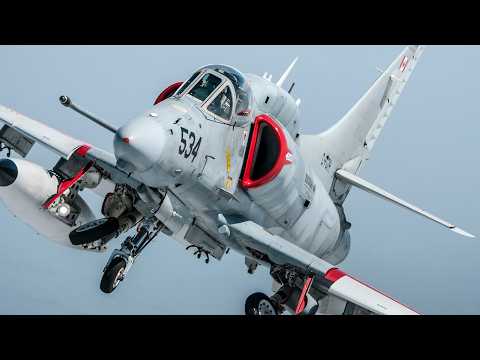
Northern Germany probably isn’t the first place you’d think of to look for a U.S. Navy and Marine Corps classic attack jet. However, contract aggressor company Top Aces flies a squadron of deeply upgraded Douglas A-4N Skyhawks to support European air arms for their “red air” training needs.
Nearly 3,000 A-4s were built between 1956 and 1979, and TWZ’s Jamie Hunter traveled to the Germany Navy base at Nordholz for the latest episode of our “Special Access” to witness some of the last, and by far the most modern, Skyhawks operating up close.
There he learned what it was like operating the iconic but nearly antique jets against some of the world’s most capable fighters. He also discovered that significant developments are on the horizon for Top Aces in Europe, principally the arrival of F-16s that will further enhance the company’s aggressor services for its growing list of European customers.
Enjoy the show!
Skyhawks On Steroids Playing The Bad Guys In European Skies
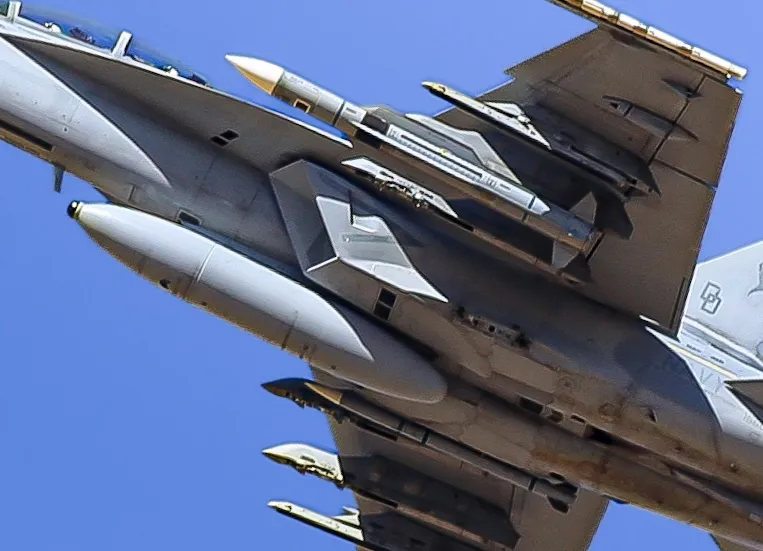
A U.S. Navy F/A-18F Super Hornet assigned to Air Test and Evaluation Squadron 31 (VX-31) has been spotted carrying both the AIM-174B and AIM-260 Joint Advanced Tactical Missile (JATM) during a flight over Ridgecrest, California. This represents the first known publicly documented instance of these two advanced air-to-air weapons appearing on the same aircraft.
The aircraft was photographed on October 14 by aviation photographer @photosxlyss2, who shared the result with TWZ. The same Super Hornet was also carrying an IRST21 infrared search-and-track pod on its centerline station.
A close-up of the AIM-174B, AIM-260 Joint Advanced Tactical Missile, and IRST21 infrared search-and-track pod under an F/A-18F Super Hornet assigned to Air Test and Evaluation Squadron 31 (VX-31) during a flight over Ridgecrest, California. @photosxlyss2_ RY
Two critical elements of the modernization of the U.S. military’s air-to-air missile arsenal, the AIM-174B and AIM-260 provide complementary capabilities, addressing different aspects of the Navy’s evolving air-combat requirements.
Based on the SM-6 missile family, the AIM-174B provides the Navy with an extended-range air-to-air weapon. Its size and reach make it particularly relevant to engagements against high-value airborne assets, including aerial refueling tankers and airborne early warning and control aircraft.
A U.S. Navy F/A-18F Super Hornet test jet with four AIM-174B missiles under its wings. point_mugu_skies
Threatening these support platforms at extended distances complicates an adversary’s ability to sustain fighter operations, maintain airborne surveillance, and coordinate engagements across domains. Such targets are especially important in the Indo-Pacific, where distances are vast and combat aircraft may depend heavily on tanker support to reach and remain on station over contested areas.
The range of this missile is classified but should be far in excess of that of the AIM-120D AMRAAM, probably in the hundreds of miles, as discussed in the video below.
How The Navy’s New Very Long-Range AIM-174 Will Pierce China’s Anti-Access Bubble
The AIM-174B has already appeared in several major exercises, including RIMPAC 2024 and Northern Edge 2025. Following developmental trials at RIMPAC, the weapon entered Live Fire Test and Evaluation in 2025. Some examples of the missile have since reached forward-deployed Navy squadrons in Japan.
The AIM-260, meanwhile, is being developed to provide a next-generation beyond-visual-range air-to-air capability. It is intended to address increasingly sophisticated aerial threats and improve upon the capabilities of the very widely used AIM-120 Advanced Medium Range Air-to-Air Missile (AMRAAM) family.
It was another F/A-18F from VX-31 on which the AIM-260 was first publicly seen when departing Eglin Air Force Base in Florida in May of this year. The same type of weapon has since also appeared on a Royal Australian Air Force F/A-18F, as you can read about here.
An F/A-18F from VX-31 carrying the AIM-260. Jonathan Tweedy/ @flightline_visuals
The AIM-260’s precise specifications remain classified, but it is designed to deliver significantly greater range than the AIM-120 AMRAAM while maintaining a broadly similar form factor. Its compact design is important, as the missile is intended for both external carriage and internal carriage aboard aircraft such as the F-22 Raptor and F-35.
A rendering depicting an F-22 Raptor firing an AIM-260 JATM. U.S. Air Force
The AIM-260 is being developed to counter the growing long-range air-to-air threat posed by China’s PL-15 and other advanced missiles. Although no official range figures have been disclosed, previous reporting has indicated a target range of at least 120 miles, with the potential to reach considerably farther.
Inert PL-15s in the weapons bay of a Chinese J-20 fighter. via Chinese internet
It is unclear when the first operational AIM-260s may begin entering the U.S. inventory. Together, however, the two weapons give the Super Hornet access to a broader range of engagement options, depending not only on the range of the target, but also on the nature of the engagement and overall tactical situation.
The presence of an IRST21 pod is also noteworthy. The infrared search-and-track system passively detects and tracks airborne targets rather than relying exclusively on radar emissions.
Passive sensing is especially valuable in environments where electromagnetic emissions must be managed carefully. Although an IRST system does not automatically provide all the information needed to support a long-range missile engagement, it can contribute to a broader sensor picture and potentially help crews detect targets without immediately revealing their own position through radar emissions.
After a long and troubled development, a full-rate production contract for Block II IRST21 sensors to go into pods for U.S. Navy and U.S. Air National Guard fighters was awarded this time last year, as you can read about here.
An IRST21 built into the centerline tank on a Super Hornet during early tests. U.S. Navy
The appearance of both missiles on a VX-31 Super Hornet is a notable development in the Navy’s ongoing testing of advanced air-combat capabilities. VX-31, based at the sprawling Naval Air Weapons Station China Lake in California, conducts test and evaluation activities involving naval aviation weapons and systems.
On this occasion, the jet is carrying inert missiles (denoted by their blue bands) in a captive-carry configuration. The flight may have been part of ongoing weapons-integration testing, handling and compatibility evaluations, or another test activity.
At the very least, the configuration offers an intriguing glimpse into how a Navy Super Hornet might go into battle in a future high-end air combat scenario. Pairing the extended-range AIM-174B with the next-generation AIM-260 would provide a powerful combination.
Added to those two will be the AIM-424 Malice, an all-new, very long-range air-to-air missile, the existence of which was only disclosed in August of this year. This is reportedly a two-stage design, which should result in extreme range — said to be in excess of 250 nautical miles — and very high speed. It isn’t known where Malice slots in next to the AIM-174B, although the newer missile is purpose-designed for air launch, unlike the Standard-derived weapon.
Four AIM-424 Long Range Air-to-Air Missiles (LRAAM) are loaded on an F/A-18E Super Hornet for a test event. U.S. Navy U.S. Navy
As the service prepares for increasingly demanding scenarios in the Indo-Pacific, the new photo underscores the fact that the ability to threaten a wider range of targets at greater distances is one of the key considerations in the evolution of the Navy’s carrier-based fighter force.
While the U.S. military has a wide array of installations where it can test these systems, it’s still not enough. In addition to the massive increase in weapons development and the need for more realistic training, the changing nature of war is outstripping the capacity of existing facilities as future kill webs will extend thousands of miles, not hundreds. There are only so many places with enough space to try out these systems even to a limited degree without butting up against statutes and regulations while also avoiding interference with civilian air traffic and communications, all in an environment remote enough to avoid prying eyes. The need for more and bigger testing grounds is an issue TWZ has long raised.
In addition to the backdrop of the increase in a wide range of weapons testing, much of it aimed at China, Trump’s super range announcement was delivered as the Pentagon and services are specifically creating commands dedicated to autonomous weapons. On Tuesday, during the annual Association of the U.S. Army (AUSA) conference in Washington, D.C., attended by TWZ, the acting Army Secretary unveiled one such new command, which we will discuss in greater detail later in this story.
“I’m pleased to inform you and announce that right here in Montana, the Department of War is going to establish a new ”super range” for testing advanced weapons and technologies, technologies including potential autonomous weapons, space, and electronic warfare technology, supersonics and hypersonics,” Trump said during a campaign rally in Kalispell. “Montana will help ensure the American military always reigns supreme.”
.@POTUS: “I’m pleased to inform you and announce that right here in Montana, the @DeptofWar is going to establish a new Super Range for testing advanced weapons and technologies, including potential autonomous weapons, space and electronic warfare technology, supersonics, and… pic.twitter.com/W4YqKfq8X4
Trump provided no additional details about where this new “super range” will be located, when it will come online, exactly which systems will be tested or how much it will cost.
Thursday morning, the office of U.S. Sen. Tim Sheehy noted that he has been “a strong advocate for building an advanced training range in Montana, securing $10 million for a feasibility study in the FY27 National Defense Authorization Act that passed the Senate Armed Services Committee earlier this year.”
“The 21st-century battlefield is being redefined by new weapons and evolving technical frontiers that require a novel approach to how America will resource its warfighting capabilities,” the senator said in a statement. “Contested spectrum, electronic warfare, hypersonics, space capabilities and enhanced targeting require a new class of testing and evaluation facilities for our military. The U.S. faces a clear choice: adapt and expand our development infrastructure to the realities of modern warfare, or risk falling behind adversaries who iterate faster.”
The Montana Republican highlighted the value of his state’s huge swaths of undeveloped land for this effort.
“By combining our state’s vast landscapes, innovative spirit, and proud tradition of military service, we are the Last Best Place to ensure America’s fighting men and women have the technological edge they need to dominate the battlefield and win the wars of tomorrow,” he explained.
Montana (Google Earth)
Like Trump, Sheehy offered no specifics about exactly where in Montana the “super range” will be located, when it will come online or how much it will cost. We have reached out to the White House, Sheehy and the Pentagon for more details. The Pentagon deferred us to the White House, which referred us back to the Pentagon. We also contacted the office of U.S. Sen. Steve Daines and Gov. Greg Gianforte.
There are already a number of facilities in Montana conducting the kind of military weapons testing described by Trump. One that closely matches what would be needed from such a location is the Montana Spaceport & Test Range and the affiliated Limestone Hills Innovation & Test Campus. A public-private aerospace and defense initiative, it already conducts testing for next-generation space vehicles, hypersonic, supersonic and ballistic weapons, drones and counter-drone systems and electronic warfare equipment.
Another potential site could be an expansion of the Big Sky Autonomous Systems Range (BSASR). Located near Bozeman, it is “the Lobo Institute’s primary training and testing facility for U.S. and allied military, federal, and partner organizations.” Operated under the Lobo Tactical division, BSASR is “a 6,000-acre, fully fenced complex purpose-built for advanced unmanned aerial systems operations, full-spectrum live fire, mounted and dismounted mobility, and full mission profile exercises grounded in the latest tactics, techniques, and procedures from active conflict zones,” according to the Lobo Institute. “The range pairs realistic terrain with the regulatory, infrastructure, and instructor depth required to train against the operational realities of today’s and tomorrow’s battlefields — and it does so in a remote, controlled environment where units can push hard while keeping risk to acceptable levels.”
Training at the Big Sky Autonomous Systems Range in Montana. (BSASR)
We have reached out to both facilities for more details.
The new super range could also leverage existing range space on the ground and in the air. There is also the large Hays Military Operations Area (MOA) which could be expanded for this new test range effort. MOAs are blocks of airspace designated for military training. Malmstrom Air Force Base and its ICBM fields could also potentially be utilized. Overall, it’s possible a number of existing range areas could be interconnected, both digitally and via airspace corridors, to create a larger complex, as well.
The Pentagon has long realized the need to increase the areas where it can test out these systems, especially to evaluate them under combat-like conditions.
“The current open-air range space should be increased and better integrated to support system-of-systems assessments of air, land, and sea combat systems with capability for emerging long-range fires, hypersonic missiles, EMS warfare, unmanned systems, nuclear effects, and directed energy (DE) weapons,” the Pentagon’s Director of Operational Test & Evaluation (DOT&E) stated in a report last year. “The DoW needs to invest in and coordinate expanding and connecting the airspace available to the open-air ranges enabling testing and training of advanced capabilities.”
DOT&E
The current facilities are inadequate, DOT&E further explained.
“Threat systems and our own capabilities far exceed the current available air space on the open-air ranges,” according to the report. “The ranges need support and assistance to coordinate additional airspace and corridors with the FAA and industry. Expanding and connecting range air space is necessary to facilitate testing and training critical long-range capabilities that our warfighters need and to replicate the threats they will face.”
In addition, the report states that “to test missiles with longer ranges and gather data to support simulation validation, including for hypersonic missiles, the DoW should invest in long-range, overland missile flight test corridors with land-based impact areas and mobile hypersonic-specific range instrumentation to produce the required lethality data against threat-representative targets for terminal area assessments.”
Rendering of an X-51A Waverider hypersonic weapon. Powered by a Pratt & Whitney Rocketdyne SJY61 scramjet engine, it is designed to ride on its own shockwaves and accelerate to about Mach 6. (U.S. Air Force)
The Defense Department had largely been conducting the testing of hypersonic weapons — those that can reach speeds of Mach 5 and above — at sea given the need for the long ranges for evaluation. Still, even that was limited. The Pentagon restricted the number and location of hypersonic tests it carried out each year because of the aging fleet of ships it used as its primary data collection assets to track the capabilities while in flight.
Retired Block 20 and Block 30 RQ-4 Global Hawks belonging to the U.S. Air Force, reconfigured as RangeHawks under the SkyRange hypersonic weapon testing infrastructure program, would help address some of those restrictions. You can read more about that in our story here.
However, if testing moves to an overland phase, the need for expanded air corridors could grow increasingly critical. Last year, the Pentagon’s Test Resource Management Center (TRMC) identified three candidate locations to perform those tests, one over Alaska, another at White Sands Missile Range in New Mexico and a third in Australia, Defense News reported at the time.
An interceptor launches from an Indirect Fire Protection Capability (IFPC) system operated by soldiers assigned to the 1st Battalion, 51st Air Defense Artillery Regiment, 7th Infantry Division (Multi-Domain Command Pacific), during a test at White Sands Missile Range, New Mexico, on July 28, 2026. (U.S. Army photo by Sgt. Michael Majors and White Sands Missile Range Public Affairs) Sgt. Michael Majors
The U.S. Air Force’s scramjet-powered Hypersonic Attack Cruise Missile (HACM) has finally reached the flight test phase, with at least one “release” having been carried out so far over a range in Australia. (Raytheon) Raytheon
The military is also looking to expand where it can test electronic warfare systems to help ease the bottleneck at White Sands and a few other locations. Such testing is limited due to U.S. restrictions on jamming, which can interfere with civilian systems.
Before he resigned after tensions with Defense Secretary Pete Hegseth, former Army Secretary Dan Driscoll in June said the service had plans to set up at least two domestic ranges that mimic realistic conditions on Ukraine’s battlefields, where the electromagnetic spectrum is a highly contested domain. This spectrum would be even more heavily disputed in a fight with China.
“You can have a kind of electronic warfare and all of the contested environment created, and you can have drone manufacturers and counter-drone tool-builders engaging together,” Driscoll told reporters. “Then, we also want soldiers to be able to go there, so that they can strengthen their skills and work hand-in-hand with developers.”
A drone swarm returns from a mission during the XVIII Airborne Corps’ Scarlet Dragon 26-3 at Fort Bragg, N.C., Sept. 15, 2026. (U.S. Army photo by Pfc. Iliana Lopez) Pfc. Iliana Lopez
Driscoll said there are already places in the U.S. where the Army can test safely, and separately, the service is looking at a global range outside the U.S. to do “much more aggressive testing,” including with hypersonics. When asked, Driscoll declined to say where these ranges would be until planning is farther along.
“At least some of the current counter-drone training for soldiers, like one CBS News saw in April, does not include electronic jamming — in part because the U.S. restricts jamming domestically,” CBS reported.
In August, the Army opened premier test ranges for the use of private industry to conduct internal research and development. Additionally, the service co-hosted a Denied, Disrupted, Intermittent and Limited testing environment, at Camp Grayling in September, and there are three more scheduled for Fiscal Year 2027, an Army spokesperson told us.
(U.S. Army)
Trump’s news about the “super range” was delivered as the Pentagon and the services are working to ramp up the development and production of a range of autonomous systems.
Last month, as we noted earlier in this story, the Pentagon announced plans for a new functional combatant command, very broadly akin to U.S. Special Operations Command (SOCOM) or U.S. Space Command (SPACECOM), but for operational activities involving autonomous and robotic capabilities. In addition, Hegseth also announced new initiatives to help further accelerate the fielding of uncrewed systems in the air, at sea, and on land, as well as to explore future warfighting challenges. All of this builds on previous and long-overdue efforts to prioritize the fielding of various tiers of drones, as well as artificial intelligence (AI) and other emerging technologies, across domains, but there are questions about how these new efforts will translate into tangible developments.
.@SECWAR “Today, at my direction—we are announcing the creation of Autonomous Warfare Command, or AutoWarCom:
A new 4-star combatant command—with service-like authorities—built to scale autonomous and robotic capabilities across the Joint Force in the fastest peacetime shift in… pic.twitter.com/kYWBxy6Dij
On Tuesday, acting Army Secretary Adam Telle announced the creation of the service’s Futures and Autonomous Systems Command (FASCOM).
“This is our way to make sure that we take all of the great work that’s been happening with the resources that we have today, and we centralize it,” Telle said. “We’re pushing autonomy down into our units, but when it comes to having and making sure that the left hand in the Army knows what the right hand of the Army is doing, this happens at FASCOM; then FASCOM feeds up into AutoWarCom.”
Telle added that FASCOM “will work with the other services to create scale for purchasing power and share best practices on autonomy.”
“It is too soon to speculate about anything related to FASCOM,” the Army told us. “Specifics on structure, command, mission, etc. will be announced at a future dates [and] will require the kind of additional testing facilities that a new Montana super range could provide.”
The use of highly cooperative autonomous weapons platforms that can swarm and operate collectively over large areas will also tax existing ranges beyond their capacity.
Details about the new range proposed by Trump are scant, and it remains to be seen whether it will live up to the hype or even be built. As we noted earlier in this piece, a feasibility study, which hasn’t even been funded yet, is still needed before major work can begin. However, if and when it does come online, a new Montana test range will be welcomed by a military in need of additional places to test out its latest capabilities.
Put away the holochess board, C-3PO is going to the 2027 Super Bowl!
An animated “Star Wars” version of Super Bowl LXI featuring characters from the galaxy far, far away will air live, simultaneously with the game, on Feb. 14 on Disney Channel and Disney XD, the NFL announced Monday along with partners ESPN, Lucasfilm and Disney. “Star Wars Funday Football” will also be available on Disney+ and the ESPN app.
Anthony Daniels, who has portrayed C-3PO since the original “Star Wars” trilogy, will voice the worry-prone protocol droid in the live alternate telecast. If the brief teaser video is any indication, C-3PO will be joined by his favorite astromech, R2-D2.
“Star Wars Funday Football” will feature live-animated avatars of all of the players on the field as they play the game. Viewers can expect “Star Wars” characters to sub in during special moments, as well as various Easter eggs to appear throughout the game.
The “Star Wars” themed telecast follows previous “Funday Football” installments that were themed to “Toy Story,” “The Simpsons,” and “Monsters, Inc.” This marks the first time that the Super Bowl is getting the “Funday Football” treatment.
The traditional telecast, featuring announcers Joe Buck and Troy Aikman with reporters Lisa Salters and Laura Rutledge, will be available on ESPN, ABC and Disney+.
Super Bowl LXI will be held at SoFi Stadium in Inglewood. Details for the halftime performance have not officially been announced, but Jay-Z is rumored to be the headliner.
Following “Star Wars Funday Football” and Super Bowl LXI, a newly restored version of “A New Hope” will return to theaters on Feb. 19. “Star Wars: Starfighter,” a new standalone film starring Ryan Gosling as Kade Auberon, is slated to hit theaters May 28.
Rams tight end Colby Parkinson scores a touchdown in front of Cardinals safety Andrew Wingard at SoFi Stadium Sunday.
(Eric Thayer/Los Angeles Times)
First-year Cardinals coach Mike LaFleur, the Rams former offensive coordinator, outcoached and outmaneuvered friend and mentor Sean McVay.
With just more than a third of the season complete, the Rams are 2-4.
The Rams failed to bounce back from their overtime defeat by the powerful Buffalo Bills and lost to a Cardinals team that entered the game having given up at least 31 points in each of its last four.
Only six players from the team that won Super Bowl LVI are still on the roster: Quarterback Matthew Stafford, defensive lineman Aaron Donald, tight end Tyler Higbee, center Coleman Shelton, left tackle Alaric Jackson and receiver Tutu Atwell.
During the offseason they added two players with two Super Bowl rings each: cornerbacks Trent McDuffie and Jaylen Watson.
Rams quarterback Matthew Stafford looks to pass the ball against the Cardinals at Sofi Stadium on Sunday.
(Eric Thayer/Los Angeles Times)
But they have not looked anything like a Super Bowl contender.
An offense that went into the game as the league’s most productive from a yardage standpoint managed only a field goal and two touchdowns.
Stafford completed 25 of 33 passes for 222 yards.
With left tackle Alaric Jackson suspended for the game for punching Bill linebacker Bradley Chubb on the field after the Rams loss, veteran David Quessenberry started for the first time since 2023.
The Cardinals predictably brought pressure and blitzed, sacking Stafford three times and hitting him seven times.
Safety Quentin Lake intercepted a pass for a defense that was without All-Pro cornerback Trent McDuffie because of a groin injury. The defense gave up only field goals and gave the offense multiple opportunities.
And special teams continued to be a disaster.
New kicker Blake Grupe, signed this week after the Rams released struggling Harrison Mevis, kicked a 44-yard field goal in the first quarter. But on the ensuing kickoff, Devin Duvernay returned Grupe’s kick 40 yards before the 5-foot-7, 156-pound Grupe hurled his body to stop him. Grupe suffered a knee injury and did not return.
The Rams managed Grupe’s 44-yard field goal and Corum’s touchdown for a 9-9 tie at halftime.
The Cardinals consumed nearly nine minutes of the third quarter before kicking a field goal for a 12-9 lead.
The loss of Grupe then came into play again late in the third quarter. On a fourth-and-one at the Cardinals’ 27-yard, McVay opted to go for it. Davis Allen lined up in the backfield and took a handoff from Stafford, but the Cardinals stopped him for no gain.
The Cardinals added another field goal with 9:28 left for a 15-9 lead.
The Rams then put together a lively drive, but Higbee fumbled with just under eight minutes left.
They got the ball back with just less than seven minutes remaining. They drove into Cardinals’ territory with about three minutes left but a false-start penalty gave them a fourth-and-eight situation, and Stafford’s pass to running back Kyren Williams fell incomplete.
But the Rams got one more chance when they got the ball with 2:48 left.
Stafford escaped pressure and found Nacua, for a mid-range pass that he turned into a 32-yard gain. Stafford connected again with Nacua for 16 yards to the Cardinals’ 13-yard line.
Stafford’s six-yard touchdown pass to Colby Parkinson tied the score, and punter Ethan Evans came on to kick the extra point to give the Rams the lead.
But the Cardinals came back with the help of a personal-foul penalty after a completed pass. And Ryland’s sixth field goal finished the Rams.
There’s a good case for Danny Welbeck, who as the only current player in the top three, with 19 goals, still has time to catch those above him.
Welbeck was a goalscoring sub at Manchester United and Arsenal but perfected the art on the south coast, with 12 of his tally coming during six years with Brighton.
The 35-year-old is now at Chelsea but – with apologies to Danny – there is another former Blue whose stats demand a place on this list.
Daniel Sturridge has two fewer substitute goals then Welbeck but has scored a slightly higher percentage of his overall Premier League tally as a sub – 22%.
The former England man, who played for Manchester City, Chelsea, Bolton, Liverpool and West Brom in the top flight, was good for an assist, too.
In fact, when you take his total goal contributions of 24, he provided at a more prolific rate than every substitute in Premier League history – bar Edin Dzeko and Ole Gunnar Solskjaer.
Richarlison matches Sturridge for minutes per goal contribution, but with eight fewer the Brazilian, perhaps harshly, misses out.
Two men charged Wednesday in connection with the shooting of San Francisco 49ers defensive lineman Keion White at a Super Bowl party in the early hours of February 9 were among four arrested as a result of a sweeping investigation.
Alleged gunman Gregory Walker, 36, of Mountain House was arrested by the Los Angeles Police Department and charged with assault with a firearm. San Francisco District Attorney Brooke Jenkins said Walker is alleged to have personally discharged the weapon that wounded White. Walker is also charged with causing great bodily injury, possession of a firearm by a felon, possession of a concealed firearm by a felon, and possession of a loaded firearm by a felon.
Curtis Green, 35, of Irvine was charged with brandishing a firearm at the party held in the VIP area of the Dahlia Lounge in San Francisco’s Mission District. Green was booked in San Francisco on misdemeanor weapons charges. Charges for the other two suspects, Marquis Davis, 38, and Antoine Washington, 36, have not been announced because they are not in custody in San Francisco, police said.
Davis was arrested in Atlanta and police said they found 979 grams of cocaine, 820 grams of MDMA, 1,026 grams of methamphetamine and 3,842 grams of fentanyl at his home. Washington was arrested in Stockton and police said they found loaded gun and oxycodone pills.
The investigation was dubbed “Operation D-Line” by San Francisco police and involved more than 50 search warrants and the assistance of more than 250 law enforcement personnel nationwide, officials said Wednesday.
“This kind of violence is unacceptable in San Francisco, and we devoted significant resources to holding the perpetrators of this incident accountable,” San Francisco Police Chief Derrick Lew said in a statement.
White was struck in the ankle with a bullet at 4 a.m. According to reports, the shooting occurred after an argument between White, Atlanta rapper Lil Baby, and the rapper’s entourage, who attempted to enter White’s event, according to a police report.
“For those who know me, y’all know this won’t stope [sic] me from spreading peace and joy to the world,” White wrote on Instagram a day after the shooting. “Full steam ahead. I’m in great spirits and ready to make the most of this off-season.”
White, a second-round draft pick of the New England Patriots in 2023, has played in all five games this season for the unbeaten 49ers, registering three sacks and nine tackles. He had a rooting interest in Super Bowl LX because he was traded to the 49ers from the Patriots, who lost the game to the Seattle Seahawks at Levi’s Stadium in Santa Clara.
Lil Baby, a 2022 Grammy winner whose given name is Dominique Jones, performed the night of the game at The Grand nightclub San Francisco before heading to the Dahlia Lounge, where strippers entertained on the main floor. White’s private party was downstairs.
An unidentified witness from White’s group told police that when he went upstairs to ask for help breaking up the conflict, he heard two gunshots. He returned downstairs and found that White had been shot in the left leg. According to the police report, topless women were scooping up money from the floor when police entered the club.
“As I entered, I saw numerous scantily clad females picking up dollar bills that were strewn all over the floor,” the police report said. “Some of the females were topless and appeared to have been adult entertainers.”
White posted a photograph on his Instagram story showing him smiling from his hospital room. He wrote, “I’ve undergone successful surgery. Thank you to everyone who has reached out with their prayers and concerns on my behalf.”
The shooting was the second involving a 49ers player in San Francisco in the last two years. Rookie wide receiver Ricky Pearsall was shot in Union Square when a teenager allegedly attempted to rob him in 2004.
COLUMBUS, Ohio — Campaign mailers urging Ohio voters to support a socialist U.S. Senate candidate over Democratic nominee Sherrod Brown are being underwritten by a newly incorporated PAC with ties to President Trump’s MAGA Inc., public filings show.
The mailers are sponsored by Enough Promises Ohio PAC and began arriving in voters’ mailboxes in recent days. They promote independent candidate Greg Levy over Brown with messages such as “Join the Revolution” and “Send a Worker to the Senate.” Levy describes himself as “Socialist running for the U.S. Senate to represent Ohio in 2026” on his X account.
Levy condemned the fliers for falsely impersonating his campaign and engaging in “dirty tricks” designed to mislead voters. He said he is considering legal action.
“This is a highly undemocratic practice and does a disservice to voters in Ohio and throughout the country,” he wrote on X.
According to Federal Election Commission filings, Enough Promises Ohio was founded on Sept. 29. It has not yet had to disclose its contributors, but additional federal filings lay out a trail of associations linked to Republicans.
Enough Promises paid the firm Seven Farms more than $397,000 on two dates last week for printing, postage and mail services either supporting Levy or opposing Brown. Seven Farms, also a new entity, lists as its address the same South Carolina business suite as the one used by Whistlestop Strategies LLC.
Whistlestop is a direct mail outfit operated by Big Dog Strategies LLC, the strategy firm that advises Trump’s MAGA Inc. super PAC and that managed Republican Sen. Bernie Moreno’s successful campaign against Brown in 2024.
Messages seeking comment were left with Enough Promises Ohio and Big Dog.
MAGA Inc. and affiliated groups began pouring huge sums of cash into midterm races in September, after party officials had been urging Trump to begin spending some of the fortune he had amassed to help embattled Republicans before it was too late.
Smyth writes for the Associated Press. AP writer Jill Colvin in New York contributed to this report.
Wakefield have matched 2025 champions Hull KR’s record grading score of 17.85 from 12 months ago, to continue their rise on and off the field under Matt Ellis’ ownership. In the same rankings last year they were eighth with a mark of 15.47, only just above the threshold for Category A status.
“Wakefield Trinity’s rise to the top of the 2026 club grading rankings is a fascinating story for rugby league, and a strong example of how sustained progress on and off the field can be recognised through the grading framework,” said RFL chief executive Ian Nolan.
“Their achievement sits alongside encouraging movement across the sport, from growing attendances and digital audiences to continued improvements in facilities and community delivery.”
Leeds Rhinos remain second, although their score of 17.03 is slightly lower than they achieved in the 2025 rankings.
Warrington Wolves have jumped from sixth to third on the back of a much stronger season which culminated in reaching the Grand Final at Old Trafford, only to lose to Wakefield.
It is fourth place again for Wigan, who won both the Challenge Cup and the League Leaders’ shield, just above Hull KR and Leigh Leopards. St Helens drop from third to seventh after a season in which they missed out on the play-offs for the first time in the Super League era.
Castleford Tigers complete the Category A clubs as they have risen from 11th in 2025 to eighth and move into the top-tier section despite finishing 13th in Super League.
Catalans Dragons and Hull FC are ninth and 10th, but both have fallen from an A to a B grade. Then come Bradford Bulls and Huddersfield Giants, with Toulouse Olympique and York Knights, occupying 13th and 14th, albeit with higher scores than last year.
However, only six of the 14 Super League clubs have scored higher than they did 12 months ago.
But there was a significant gap to the teams outside. York’s score of 13.24 was comfortably higher than the next best, Barrow with 9.85, while London only achieved 9.77, which was down on their mark of 11.65 from last year.
The Walt Disney Co. announced Wednesday that ESPN’s telecast of the NFL’s marquee event on Feb. 14 at SoFi Stadium in Inglewood, Calif. will be available to Disney+ subscribers. The company also said Disney+ will carry two ESPN “Monday Night Football” games in the current season.
ESPN is producing the Super Bowl for the first time in its history. The game is airing on Disney’s broadcast network ABC which last carried the game in 2006, and on ESPN and the ESPN app.
The addition of Disney+ makes the game available to casual fans who may not have cable or subscribe to a sports TV channel. The Super Bowl is the most-watched TV event of the year, with audiences exceeding 120 million viewers in recent years.
Streaming platforms are bringing in additional advertising revenue for the networks that carry the game.
In 2025, the Fox telecast of Super Bowl LIX averaged 13.6 million viewers on Tubi, the ad-supported streaming service owned by the network’s parent company. Fox was able to sell streaming-only ads on the telecast at around $2 million for a 30-second commercial. The spots aired in the commercial breaks for local Fox TV affiliates.
Disney is offering advertisers the opportunity to buy streaming-only ads across Disney+, the ESPN app, Hulu Live and Fubo. The company has already sold out the commercial time on the ESPN and ABC telecasts with some 30-second spots going for $10 million.
As a lead-up to the game, Disney+ will carry ESPN’s “Monday Night Football” match-up between the Dallas Cowboys at Philadelphia Eagles on Oct. 26 and another contest later in the season.
Disney+ has been adding sports to its lineup, with select ESPN college football games and Formula E races now available on the platform.
This season is the WSL’s biggest ever, literally, with the league expanding from 12 to 14 teams and three coming up from WSL 2.
But does bigger mean stronger?
Crystal Palace look the most comfortable of the promoted sides, boasting six points from five games and they moved to eighth in the WSL table by drawing at Aston Villa on Sunday.
But things are more difficult for the other promoted sides, Birmingham and Charlton, who prop up the table.
Despite some promising patches, WSL 2 champions Birmingham have just two points and one of those came against Crystal Palace.
At least France forward Oceane Hurtre looks suited to this level, sitting as joint top scorer in the WSL with five goals from five games.
Hurtre scored against Everton in defeat on Sunday but defender Neve Herron summed things up by saying Blues were “second to everything” after the game.
Meanwhile, it looks bleak for Charlton, bottom of the table with zero points, 15 goals against and only two goals scored.
After their 5-1 loss to Brighton on Sunday, goalkeeper and captain Sophie Whitehouse said: “It just wasn’t good enough.
“It’s a tough league. The jump up is so big. You can’t make any mistakes.”