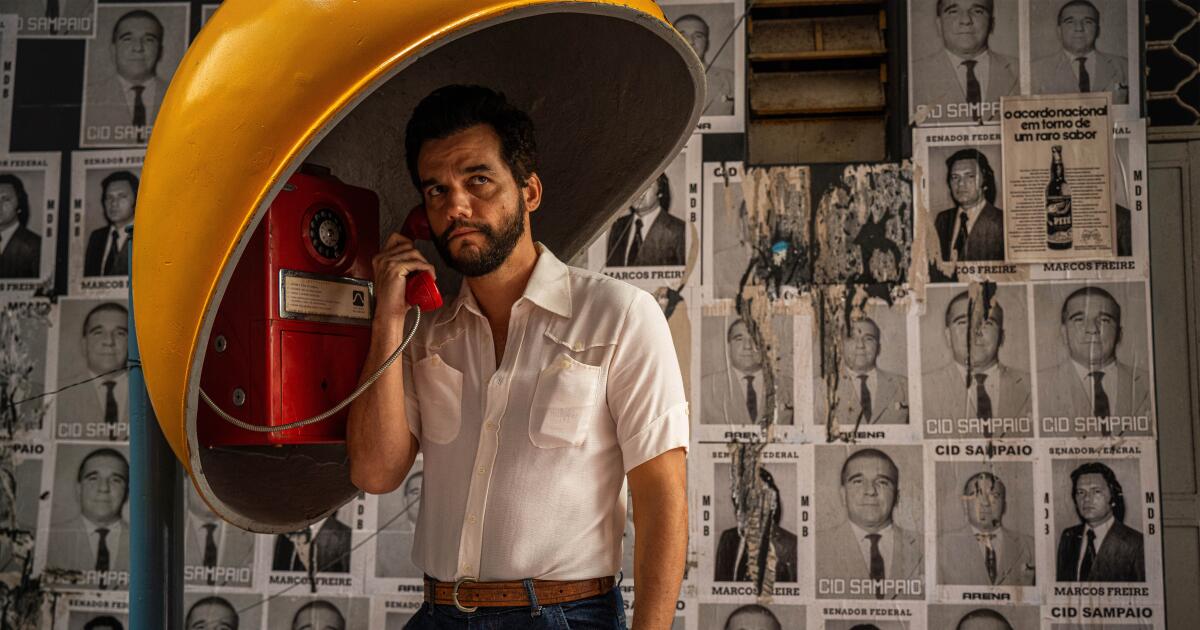
Drenched in sex and death, “The Secret Agent” peers into the past in order to make sense of the present. The latest film from celebrated Brazilian writer-director Kleber Mendonça Filho starts with a dead body and ends with an elegy for a different one. In between, it tells the story of an ordinary man ensnared in Brazil’s political turmoil during the late 1970s. Both deadly serious and seriously playful, this Cannes prizewinner may have the trappings of a thriller, but Mendonça Filho occasionally flips the script by inserting cheeky nods to schlocky B-movies — or the random movie theater blowjob. “The Secret Agent” isn’t tightly coiled so much as it gradually unfolds, its full meaning unclear until the filmmaker eventually hurtles forward nearly 50 years, snapping the final puzzle piece into place.
Wagner Moura plays Armando, who is driving to the city of Recife in early 1977. Stopping at a lonely gas station, he notices a corpse on the ground, the body barely covered by cardboard. That’s been there for a while, an employee offhandedly informs him. Maybe the cops will come eventually to pick it up. Just then, policemen do arrive, except they’re not here for the deceased — they’d much rather shake Armando down for a bribe. Mendonça Filho, who previously co-directed the feverish sorta-Western “Bacurau,” which doubled as a critique of inequality and colonialism, tells us all we need to know about the time period we’re about to enter. Welcome to reality under a brutal dictatorship: Life is cheap and you’re on your own.
Armando doesn’t need to be reminded. He’s actually on the run, using the name Marcelo as an alias to hide from those in power looking for him. Once he was a scientist, but that time in his life, as we will discover through wrenching flashbacks, was destroyed, forcing him to change his identity and ponder fleeing Brazil. But first, Armando must retrieve his young son, Fernando (Enzo Nunes), who’s been staying with the parents (Carlos Francisco, Aline Marta) of his beloved late wife, Fátima. He soon learns that hit men have been hired to kill him by order of a crooked government lackey he defied. Armando used to do technology research; now, he has a price on his head.
“The Secret Agent,” which took directing and acting awards at Cannes, continues Mendonça Filho’s tendency to mix genres. His films refuse to behave properly, making room for whimsical asides along with somber reflections on government oppression. (Impishly, an opening title card warns us that the movie takes place during a “period of great mischief.”) The recently departed cult actor Udo Kier makes an appearance — his second in a Mendonça Filho film — which only emphasizes “The Secret Agent’s” wild-card unpredictability and, retroactively, its sympathy for the ghosts who walk among us. The narrative adventurousness comes to the fore when the action abruptly cuts to the present day as young women listen to cassette recordings of our main characters. That jarring digression will gradually morph into a crucial subplot, allowing Mendonça Filho to build a thematic bridge between then and now.
Running slightly over two and a half hours, the film expands as it unspools, introducing new side characters with their own histories. We meet Armando’s fellow refugees, all of them cooling their heels in an apartment complex overseen by a delightfully crusty matriarch (Tânia Maria). He picks up a lover (Hermila Guedes) while also confronting Fátima’s wary parents, who suspect their son-in-law cheated on her while she was alive. Mendonça Filho even invests some time in the hired goons (Gabriel Leone, Roney Villela) sent to whack Armando.
This panoramic sweep lends “The Secret Agent” a novelistic sprawl, although it sometimes dilutes the proceedings. That said, the approach adds texture to a film set during Carnival, the festival’s vibrancy paling in comparison to the creative exuberance on display. The movie doesn’t just celebrate “Jaws” — a worldwide phenomenon — but also features a clever recurring shark motif. Brazilian pop hits pepper the soundtrack, jockeying for space alongside Chicago’s schmaltz epic “If You Leave Me Now.” Severed legs wreak havoc and cats with three eyes stop by. And again and again, we see snippets of a mysterious modern-day storyline in which Laura Lufési’s diligent researcher studies Armando’s ordeal, his desperate saga rendered as ancient history.
If Mendonça Filho overstuffs his accomplished picture, it’s a fitting rebuke to a violent regime that would have tried to tamp down his voice. He finds a worthy partner in Moura, who embodies the rugged sex appeal and muffled anguish of a principled individual in a world gone mad. Alluring but haunted, Armando may be flawed, but his defiance makes him a reluctant hero. The film mourns all such political crusaders whose names we never knew, although it wears its commentary lightly. Even when this thriller arrives at its jolting, time-shifting epilogue, Mendonça Filho’s attitude is as much wry resignation as it is anger. Our contemporary horrors will inevitably become yesterday’s news. “The Secret Agent” suggests we not let those voices from the past go silent. They still have things to tell us.
‘The Secret Agent’
In Portuguese and German, with subtitles
Rated: R, for strong bloody violence, sexual content, language and some full nudity
Running time: 2 hours, 38 minutes
Playing: In limited release