WASHINGTON — Before being deployed to Los Angeles during anti-ICE protests last summer, U.S. Marines were given 12 rules for engaging with protesters, and Rule 1 was clear: Force “of any kind” was allowed only as a last resort.
If force were used, the rule stated, it “should be the minimum necessary to accomplish the mission.”
That detail is among 178 pages of federal documents released by the Marine Corps to the nonprofit watchdog group American Oversight through the Freedom of Information Act and shared exclusively with The Times.
The documents paint a thorough picture of how Marines prepared to deploy in Southern California, where they stood alongside National Guard members and agents with the Department of Homeland Security.
The documents also illuminate a glaring contrast between the training of Marines and that of immigration agents, who have been accused repeatedly of using unnecessary force against peaceful protesters, bystanders and immigrants during enforcement operations.
“Ironically, I would’ve felt much safer with Marine engagement than with DHS because of the depth of training,” said Ryan Schwank, a former instructor for Immigration and Customs Enforcement recruits at the ICE Academy within the Federal Law Enforcement Training Center in Georgia.
Schwank is a whistleblower who resigned in February after revealing that the Trump administration had slashed immigration officer training. After reviewing the documents obtained by American Oversight, he said the training given to Marines on crowd control was “significantly more in-depth and longer than training given to an ICE officer, even under the best of circumstances.”
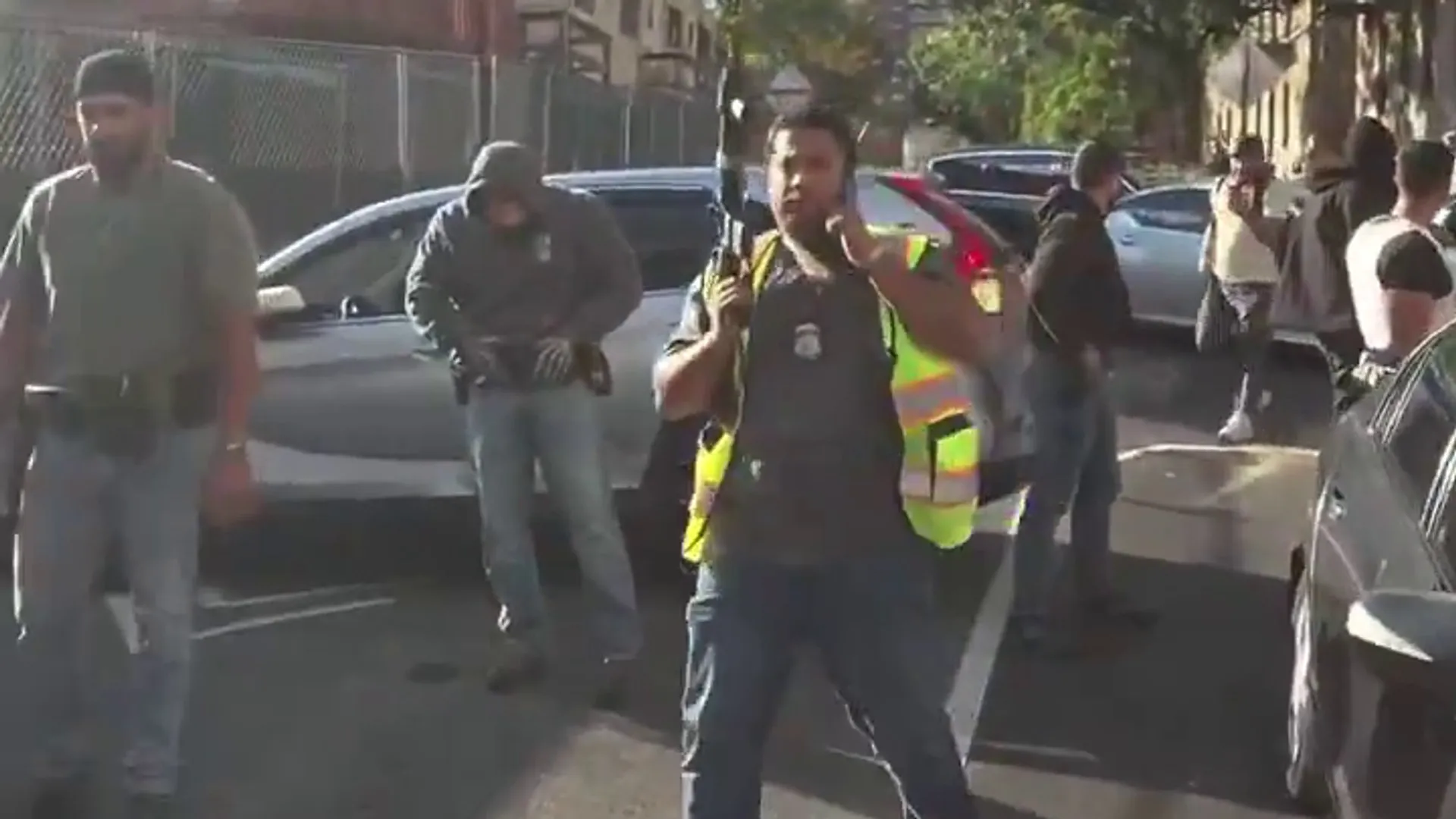
An ICE agent walks through tear gas that was fired to push protesters back during a raid on Atlantic Boulevard in the city of Bell on June 20, 2025.
(Genaro Molina / Los Angeles Times)
The Department of Homeland Security did not respond to questions and instead pointed to a February news release that said training has not been cut back and that new hires receive additional training after leaving the academy.
“ICE law enforcement officers are trained to use the minimum amount of force necessary to resolve dangerous situations to prioritize the safety of the public and our officers,” said Lauren Bis, a department spokesperson. “Officers are highly trained in de-escalation tactics and regularly receive ongoing use of force training.”
Schwank noted that the Marines and ICE officers came to Southern California with different objectives: As protectors of people and property, the Marines had a more limited, reactive mission, while ICE officers were charged with making arrests, a confrontational role.
“We’re giving [ICE officers] less training on it and fewer refreshers than the Marines are getting and yet we’re putting them in a situation where they’re taking the more confrontational actions to where they’re more likely to have to make split-second decisions,” Schwank said.
For most of history, he added, ICE agents detained people who were already in the custody of another law enforcement agency. He said ICE was never meant to act as riot police.
“The real fundamental problem isn’t ICE agents using force,” Schwank said. “It’s ICE agents using force in an environment they are not trained for.”
The training of Marines, and the lead-up to their deployment, is outlined in the documents reviewed by The Times.
On June 6, a commanding general emailed other generals to say that “national-level leadership” had directed Marines to assume an “alert posture” and be ready to support the Los Angeles Police Department, Los Angeles County Sheriff’s Department and ICE officers who were already responding to civil unrest in downtown Los Angeles.
The Marines would safeguard federal facilities and thus “protect lives and property through the restoration of civil order,” the email said.
Marines push back anti-ICE protesters in front of the Federal Building during a “No Kings Day” in downtown Los Angeles last June.
(Carlin Stiehl / Los Angeles Times)
First, though, they needed to be trained.
The five-day course reviewed use-of-force policies, less-lethal weapons and handling of civil disturbances.
Overall, the 12 rules emphasized safety, urging Marines to be reasonable, to de-escalate tensions and to avoid confrontations with individuals who posed no threat.
Marines could use non-deadly force, if necessary, to control a situation or protect themselves or other federal personnel, and deadly force “only when all lesser means have failed.”
“Exercise due regard for the safety of innocent bystanders when using any type of force,” the rules state.
Schwank said there is no equivalent to the Marines course at Homeland Security. When he left the academy in February, he said, “there was no crowd control training, period.”
Crowd control was briefly added to the curriculum in 2021 for experienced law enforcement officers, he said, but it was later removed. ICE recruits may also have gotten lessons on crowd control after leaving the academy and joining their respective field offices, he said.
When Schwank left the agency, a six-hour class called “Public Order Public Safety” was in development for the 2026 curriculum, according to documents he provided to Congress. Homeland Security did not respond when asked if the class had started.
“I wouldn’t assume that any of the ICE officers on scene in L.A. had received any sort of actual crowd control class,” Schwank said. “They might have gotten a one-to-two-hour PowerPoint slideshow, but that would’ve been it.”
Marine Col. Beth R. Smith confirmed that the entire 2nd Battalion 7th Marines received academic and practical training before deploying to Los Angeles.
Managing civil disturbances has been an issue for Homeland Security since at least 2021, according to an audit conducted by the agency’s internal watchdog review of a 2020 deployment to Portland, Ore.
That year, President Trump mobilized federal power against the protests that spilled into Portland streets after the murder of George Floyd by a Minneapolis police officer. Trump sent 755 Homeland Security agents to defend federal property in what would come to be seen as a dry run for much larger operations of his second term.
A protester damages a Waymo vehicle at Los Angeles Street and Arcadia Street in L.A. on June 8, 2025.
(Robert Gauthier / Los Angeles Times)
Nested on rooftops, agents launched chemical weapons against protesters. Ground forces fired less-lethal rounds at point-blank range and forced participants into unmarked vans without explanation.
The audit by the Homeland Security inspector general found that only seven of 63 officers reviewed had received any level of riot and crowd control training. Some officers told investigators that they needed additional training, and many “questioned their involvement in the operation” due to the lack of preparation.
”Without the necessary policies, training, and equipment, DHS will continue to face challenges securing Federal facilities during periods of civil disturbance that could result in injury, death, and liability,” the audit concluded.
As of spring 2025, Homeland Security records show, the department had not corrected the training failures flagged in the audit years earlier.
Schwank agreed that the concerns raised in the inspector general’s report were never addressed.
Liz Hempowicz, deputy executive director of American Oversight, said the Marine Corps’ emphasis on de-escalation and on using force only as a last resort stands in stark contrast to what happened on the ground in Los Angeles with immigration agents.
The practices outlined in the documents “differ from positions taken by senior DHS leadership, whose separate internal communications revealed a mindset that appeared far more encouraging of violence,” she said.
Internal Homeland Security emails also obtained by American Oversight revealed that the agency’s lead attorney said federal agents in Los Angeles should have “just started hitting the rioters and arresting everyone that couldn’t get away.”
“These records underscore that the difference between disciplined restraint and unnecessary harm can come down to the tone set at the top — and when that tone shifts toward hostility, the human cost can be devastating,” Hempowicz said.
Jennifer Kavanagh, director of military analysis at Defense Priorities, a military research group, said that for Homeland Security, the issue is partly a training deficiency and partly a cultural shift against agent accountability.
“Trump talks about ‘the enemy within’ — this is what he’s talking about,” she said. “To some at DHS, the enemy within is all immigrants, it’s cartels — it’s also groups that are protesting the government.”
Conversely, the Marines’ documents emphasized personal liability and responsibility. For example, one page said that “if you either use more force than is necessary, or respond with DEADLY-force to a NON-deadly threat — You will likely lose your right to self-defense, and you will be viewed, under the law, as the ‘Aggressor.’”
Marines were told to immediately report anyone violating the 12 rules of engagement.
The high level of training for Marines shows that command considered the optics of military personnel harming or even killing civilians, Kavanagh said. But just because the deployment worked out last year doesn’t make it a good idea in the long run, she said.
Kavanagh, alongside Gov. Gavin Newsom, Mayor Karen Bass, and LAPD Chief Jim McDonnell, opposed the military deployments to Los Angeles last year, maintaining that Marines are trained for foreign combat, not domestic crowd control.
“I see these deployments as a recipe for disaster,” she said.
Schwank said ICE’s training touches on personal liability but not in as much depth. Last fall, Stephen Miller, Trump’s deputy chief of staff, said ICE officers “have federal immunity in the conduct of your duties, and anybody who lays a hand on you or tries to stop you or tries to obstruct you is committing a felony.”
On the ground in Los Angeles, ICE agents and other local law enforcement fired a range of less-lethal weapons at protesters, such as pepper balls, hard foam rounds or canisters delivering flash-bang grenades and tear gas.
At a June 12 protest, a federal agent shoved freelance journalist Anna Sophia Moltke to the ground, causing sprains on her left arm and leg and deep scrapes to her hip and knee that have since scarred. She was carrying a camera, she said, and wore clear press credentials and a helmet that said “PRESS.”
“I remember distinctly there being no violence at all until police and ICE showed up,” she said. “We saw them firing rubber bullets into the crowd. People started running away. I was halfway turned around when they started rushing the crowd, and a tall, 6-foot-4 masked man used both hands to push me onto the concrete.”
Moltke said she recalled a large group of protesters gathered near the Marines stationed at the northern end of the detention center, just before police and ICE swept through and forced her to the ground. To her knowledge, she said the Marines remained at their post and didn’t participate in street skirmishes.
According to Acting Atty. Gen. Todd Blanche and other top administration officials, the U.S. Secret Service did a fine job protecting President Trump and Cabinet members from the gunman who breached the White House Correspondents’ Assn. dinner Saturday.
“That horrible act was stopped because of the courage and professionalism of law enforcement — the officers who responded without hesitation and did their jobs as they were trained to do,” Blanche said Monday.
However, according to a detailed accounting filed Wednesday by federal prosecutors in the criminal case against suspect Cole Tomas Allen, the performance of the nation’s preeminent protection agency was marred by inattentiveness and misfires and saved by “extraordinary good fortune” and the gunman falling to the ground.
“The defendant, armed with a 12-gauge shotgun, a .38 caliber pistol, two knives, four daggers, and enough ammunition to take dozens of lives, was apprehended by [Secret Service] officers mere feet away from the ballroom where his primary target was located, along with other members of the Cabinet,” prosecutors wrote Wednesday, in a filing arguing for Allen to be held in detention pending trial on one charge of trying to kill the president and two firearms charges.
Contradicting a prior claim by Blanche that officers had “promptly tackled and detained” Allen, prosecutors wrote that the 31-year-old tutor from Torrance simply “fell to the ground” after blowing past a team of agents just two open flights of stairs from the ballroom.
They wrote that one officer fired at Allen five times, but never hit him.
The same officer saw Allen fire his shotgun “in the direction of the stairs leading down to the ballroom,” prosecutors wrote, and officers later discovered “one spent cartridge in the barrel and eight unfired cartridges in the magazine tube.”
Prosecutors said nothing about the Secret Service officer who Blanche said was shot in his ballistic vest during the incident — adding to speculation that the officer may have been shot not by Allen, but by a fellow officer, or not at all.
Agency critiqued before
In all, the court filing brought further into focus a chaotic Secret Service response that appeared flawed from the start, including in a video Trump posted shortly after the incident in which agents appeared to be idling around an unobstructed entrance when Allen ran past them.
It added to concerns that law enforcement, security experts and members of Congress had raised about the performance of an agency that has been repeatedly called on to improve after previous attempts on Trump’s life. At a 2024 campaign rally in Butler, Pa., a gunman fired a bullet that grazed Trump’s ear, and that same year, another assailant prepared to shoot him from the unsecured perimeter of a Florida golf course.
Robert D’Amico, a former FBI deputy chief of operations for hostage rescue teams who is now a security consultant, said the security failures he saw in the Secret Service’s preparation for Saturday’s dinner — including its failure to set up basic barriers to prevent people from sprinting into the secured area — were stunning, especially given the past threats and the fact the nation is at war with Iran.
“It’s for a person like Trump, who’s had two assassination attempts before and is at war with Iran, which has terrorist training and proxies up, and you still don’t have the basics?” D’Amico said. “It’s unfathomable.”
Other concerns have been voiced by members of Congress, including Republicans.
The House Oversight Committee has requested a briefing from the Secret Service, and Sen. Josh Hawley (R-Mo.) has called for a hearing before the Senate Homeland Security and Governmental Affairs Committee, which also investigated the Butler incident.
In a letter urging the hearing, Hawley said the latest incident “raises questions about presidential security arrangements, potential resource needs, and the degree to which reforms previously proposed by Congress have been adopted.”
House Speaker Mike Johnson (R-La.) told Fox News that from “a layman’s perspective,” event security “looked a little lax in terms of getting into the building,” and that it “doesn’t sound like it was sufficient.”
Sean M. Curran, director of the Secret Service, has been on Capitol Hill in recent days briefing lawmakers.
He told CBS News that agents did a “great job,” but also that the incident remains under review. White House Press Secretary Karoline Leavitt has said that White House Chief of Staff Susie Wiles would be leading discussions on potential updates to Secret Service plans for securing the president.
Fear of graver threats
Blanche has argued that proof of the Secret Service’s effectiveness at the press gala was in the result: Allen was stopped, Trump and other officials were unharmed and no one was killed, despite Allen’s alleged intent.
However, the concerns being raised have to do with the vulnerabilities that were exposed as much as those that were exploited.
Because the dinner was not designated a major “national special security event” — such as a political convention — there were no trained counterassault agents on standby to prevent a breach or to take down a person with a weapon, officials have said.
Law enforcement experts said that was clearly a mistake given so many top officials — Trump, Johnson, Vice President JD Vance, Secretary of State Marco Rubio, Treasury Secretary Scott Bessent and Defense Secretary Pete Hegseth, among others — were in the room.
Such a gathering could have been targeted by foreign adversaries or others with far more experience, less regard for human life and much greater firepower than Allen, experts said.
“Most of my military friends are all saying the same thing,” said D’Amico, who is also a former infantry platoon commander in the U.S. Marines. “If you had had a team of three or four [gunmen], they would have gotten to [Trump].’”
In the initial criminal complaint against Allen, prosecutors included the text of an email Allen sent to family just as he was preparing to rush the security perimeter, in which he allegedly wrote that he had chosen to use buckshot in order to “minimize casualties” and prevent bystanders from being wounded by more powerful bullets penetrating walls.
He also allegedly wrote that he was willing to “go through most everyone” at the event to get to top administration officials, but that guests and hotel staff were “not targets at all.”
In Wednesday’s filing, prosecutors describe Allen’s actions as “premeditated, violent, and calculated to cause death,” and say he was “laden with weapons” as he breached security. But none of those weapons included assault-style rifles that can fire multiple bullets rapidly and have been used to kill civilians in mass shootings across the country for years.
The filing described Allen — a Caltech graduate and high school tutor — not as some trained tactical expert, but as an ideologue who spent part of his Amtrak journey from California to Washington waxing poetic about the landscape around him, describing Pennsylvania’s woods as “vast fairy lands filled with tiny trickling creeks in spring.”
Could have been worse
D’Amico said he and other Marines learned early on in Iraq that entrances to secured locations have to be designed in a “serpentine” fashion, forcing anyone approaching to move more slowly through the area and giving security officers more time to assess their intentions. And at an event the size of the correspondents’ dinner, with so many top officials gathered in a public hotel, you would want to make entrances “even more difficult.”
And yet no barriers seemed to be in place at the event, he said — something anyone trained more than Allen could have capitalized on.
“If they just had come through in a team of three or four who were coordinated and trained, there absolutely would have been penetration into the ballroom,” D’Amico said. “It would have been a gunfight.”
Allen himself questioned the security at the event, according to court records, allegedly writing that he had walked into the Washington Hilton with multiple weapons and no one considered “the possibility that I could be a threat.”
He wrote that if he “was an Iranian agent, instead of an American citizen,” he “could have brought a damn Ma Deuce in here and no one would have noticed” — referring to a powerful machine gun.
“It is fortunate he was only armed with what he had,” said Ed Obayashi, a California law enforcement expert on use of force.
MINNEAPOLIS — Federal agents executed multiple searches in Minnesota on Tuesday, seizing records and other evidence in an ongoing fraud investigation by the Trump administration of publicly funded social programs for children, authorities said.
Few details were released, though armed agents were seen at child-care centers in the Minneapolis area. KSTP-TV said one crew even had a battering ram.
Democratic Gov. Tim Walz, who has been on the defensive amid Trump administration claims that he hasn’t done enough to root out fraud, welcomed the raids. The state child welfare agency said it shared key information with law enforcement to “hold bad actors accountable.”
“We catch criminals when state and federal agencies share information. Joint investigations work, and securing justice depends on it,” Walz said.
The searches were being conducted at daycares, businesses and some residences, according to a person familiar with the matter who spoke to The Associated Press on the condition of anonymity because they were not authorized to publicly discuss the investigation.
Tensions between Minnesota officials and the federal government were high during an extraordinary immigration crackdown that led to the deaths of two people before Operation Metro Surge was eased in February.
Before that crackdown, the government had brought fraud charges against dozens of people, many of them Somali Americans, who were accused of fleecing a federal program that was meant to provide food to children. The investigation began during the Biden administration. More than 60 people have been convicted.
Various state and federal agencies, including the Department of Homeland Security, participated in searches Tuesday. Officers from Minnesota’s Bureau of Criminal Apprehension were removing boxes at some sites.
“The American people deserve to know how their taxpayer money was abused. … No stone will be left unturned,” DHS said.
Jason Steck, an attorney who represents childcare centers, said the names of targeted businesses that were shared with him show they’re operated by Somali immigrants. They were not his clients.
“A few childcare centers, a few autism centers, a few healthcare agencies of some type,” Steck said, adding that it appeared to be a “particular sweep for fraud.”
The executive director of Child Care Aware of Minnesota, a nonprofit that serves childhood educators, said the publicity will be unflattering.
“The majority are in business to do good business. You’re going to come across individuals who try to capitalize on systems that are broken and need to be fixed,” Candace Yates said.
Right-wing influencer Nick Shirley posted a video in December that caught the attention of the Trump administration. He alleged that members of Minnesota’s Somali community were running fake child care centers so they could collect federal subsidies, fueling suspicions on top of the food aid scandal. The claims were disproven by inspectors.
President Trump, meanwhile, has used dehumanizing rhetoric, calling Somali immigrants “garbage” and “low IQ.”
In February, Vice President JD Vance said the government would temporarily halt $243 million in Medicaid funding to Minnesota over fraud concerns. Minnesota sued in response, warning it may have to cut healthcare for low-income families, but a judge on April 6 declined to grant a restraining order.
Walz told Congress in March that he wanted to work with the federal government in fraud investigations, but that the immigration surge had made it more difficult.
“The people of Minnesota have been singled out and targeted for political retribution at an unparalleled scale,” he said at the time.
Vancleave and Richer write for the Associated Press. Durkin Richer contributed from Washington. AP reporters Steve Karnowski in Minneapolis and Corey Williams and Ed White in Detroit contributed to this story.
Weekly insights and analysis on the latest developments in military technology, strategy, and foreign policy.
While a multitude of law enforcement agents sprang into action after a shooter tried to storm a ballroom where President Donald Trump and others were attending the annual White House Correspondents’ Dinner, one well-dressed and cool under pressure plainclothes agent went viral after whipping out a Heckler & Koch MP7. The MP7 is a high-end personal defense weapon (PDW) that is already something of a pop culture fascination, being famously used by SEAL Team Six and featured in countless video games. Unlike many of its counterparts, it also remains unavailable in any configuration on the general firearms civilian marketplace. Regardless, the memes have come fast and furious and have made this still unidentified expressionless agent, and his futuristic-looking weapon, internet stars.
What agency this individual belongs to still is not entirely clear, with the U.S. Secret Service, FBI, and U.S. Capitol Police having been raised as possibilities. The latter is very likely to be the agency in question, having adopted the MP7 for its Dignitary Protection Division following another politically-motivated shooting nearly a decade ago.
The MP7-armed agent seen following the shooting at the White House Correspondents’ Dinner on April 25, 2026. Jemal COUNTESS / AFP via Getty Images
Cole Tomas Allen was subdued and arrested at the Washington Hilton hotel in Washington, D.C., on Saturday after authorities say he attempted to shoot his way past security to get to the White House Correspondents’ Dinner. He is said to have been armed with a .38-caliber pistol and a 12-gauge shotgun, as well as knives, at the time. A Secret Service agent was hit by gunfire, but the projectile was reportedly stopped by a combination of their protective vest and cellphone, and they are expected to recover. Allen, a resident of Torrance, California, sent a message to family members stating his intention to target members of the Trump administration right before the attack.
The President and First Lady Melania Trump, Vice President J.D. Vance, and other top members of the administration were at the White House Correspondents’ Dinner. Speaker of the House Mike Johnson, a Louisiana Republican, and other members of Congress were also present. A host of other dignitaries were in attendance, as well. Trump and other administration officials were moved first to secure locations on site, before returning to the White House after authorities asked everyone to leave the venue.
It was during that initial response that the plainclothes agent emerged carrying the MP7. A photographer actually caught the individual pulling the gun from what looks to be a Crye Precision EXP-series pack. The MP7 in this case was also fitted with a non-magnifying T2 red dot optic on a raised Unity mount, both of which are made by Aimpoint. What appears to be a Surefire XVL2-IRC laser aiming and light module was also spotted mounted on top of the gun in front of the optic. It also had a collapsible foregrip.
A close-up look at the MP7. Jemal COUNTESS / AFP via Getty ImagesThe agent in question, at right, is seen drawing the MP7 from their pack. Mandel NGAN / AFP via Getty Images
Since Heckler & Koch first introduced the MP7 in 2001, it has been presented as ideally suited to being discreetly carried by individuals tasked with VIP protection duties. In its standard configuration with its built-in buttstock collapsed, the gun is around 16 and a half inches long. Without a magazine loaded or any accessories fitted, it weighs just under four pounds. The MP7 is a bit heavier than the smallest version of Heckler & Koch’s famed MP5 submachine gun, the MP5K, but also has far more modern ergonomics and controls.
MP7A1 vs MP7A2: H&K’s Modern PDW
In addition, the 4.7x30mm round that the MP7 fires is designed to offer excellent low-recoil, armor-penetrating, and range characteristics in a very compact package, especially compared to traditional pistol rounds. Due to its relatively tiny rifle-style ammunition, Heckler & Koch’s gun is regularly compared to the FN P90, a very different weapon design-wise, but which was built around a broadly similar cartridge, the 5.7x28mm. Both offer submachine gun size, but with armor-piercing capabilities that their pistol caliber cousins cannot offer. The accessibility to increasingly capable body armor by civilians is a main reason why units have moved from submarine guns to guns in the PDW class, including the MP7 and FN P90, as well as compact assault rifles.
The MP7’s focus on lower felt recoil also helps increase accuracy. Altogether, the gun, with its rate of fire of around 950 rounds per minute, is intended to offer a potent amount of firepower that a shooter can get on target easily and keep it there, even when drawing quickly from concealment under pressure.
Despite still having a relatively small user base today, as noted earlier, the MP7 has attained a certain spot in popular culture, including video games and movies, in large part due to the gun’s use by SEAL Team Six. This is the same unit, also known as the Naval Special Warfare Development Group (DEVGRU), responsible for the raid that led to the death of Al Qaeda founder Osama Bin Laden in 2011.
“I ran with a suppressed MP7 submachine gun on a few missions, but lacked the knockdown power of my H&K 416 [5.56x45mm assault rifle]. The submachine gun came in handy during ship boarding, in the jungle, or when weight, size, and the ability to stay extremely quiet were needed,” retired Navy SEAL Matt Bissonnette (writing under the pen name Mark Owen) wrote in his 2012 book No Easy Day. “Several times we shot fighters in one room with a suppressed MP7 and their comrades next door didn’t wake up. The H&K 416s didn’t compare to the MP7 when you were trying to be extremely quiet.”
SEAL Team 6/DEVGRU kit. MP7 and HK416 in matching camo. The real gem is the ‘Pirate Gun,’ the sawed-off M79 40mm break-open grenade launcher made famous by ‘Mark Owen’s’ book No Easy Day. pic.twitter.com/IzwEwun4ZX
At the White House Correspondents’ Dinner, the agent’s stoic action movie mystique and tailored suit also upped the ‘cool factor’ when paired with his intriguing MP7 armament.
All of this has now also contributed to the images of the MP7 agent at the Washington Hilton this weekend going viral on social media. The general visual of the MP7 being drawn from the pack has also prompted comparisons to iconic photos of Secret Service agent Robert Wanko producing a Uzi submachine gun from a custom briefcase during the attempted assassination of President Ronald Reagan in 1981. The MP7-armed agent spotted over the weekend is already developing a similar following online.
US Secret Service agent Robert Wanko, at left, unfolds the stock on his Uzi submachine gun in the immediate aftermath of the attempted assassination of President Ronald Reagan in 1981. A briefcase, in which an Uzi, either the one held by Wanko, or one wielded by another agent somewhere else at the scene, had been concealed, is seen in the street to the right. NARA
As noted, there still remains something of a question as to what agency the MP7-armed individual seen at the Washington Hilton on Saturday belongs to.
The U.S. Capitol Police is a particularly distinct possibility based on its very public adoption of the MP7 for use by its Dignitary Protection Division (DPD). Agents from DPD would have had a clear reason to be among those providing security at the White House Correspondents’ Dinner, given the presence of Speaker Johnson and other legislators. In the United States, the Speaker of the House is an extremely important position, with whoever is serving in that role being second in line to succeed the President if need be.
The USCP’s Dignitary Protection Division (DPD)
The U.S. Capitol Police first began acquiring MP7s as a result of four people, including then-U.S. House Majority Whip Steve Scalise (another Louisiana Republican), being shot at the annual Congressional Baseball Game in 2017. The gunman, James T. Hodgkinson, was also wounded in the ensuing firefight and subsequently died. Authorities concluded that Hodgkinson had deliberately targeted Republican lawmakers at the event.
“It should be noted that we do have the ability to deploy another weapon, the M4, the [5.56x45mm] assault rifle. We have that ability today, and we deploy that when necessary,” then-Chief of the U.S. Capitol Police Matthew Verderosa told members of Congress at a hearing in 2019. “The MP7 is a pilot program that the Board has directed us to engage in, in terms of providing a weapon that meets the needs that sort of bridges the gap between a true assault rifle and a handgun.”
A posed shot of members of the US Capitol Police, including a tactical officer, third from the left, armed with an M4-type carbine. USCP
“We currently have a [sic] MP7 assault weapon that is specifically utilized by our Dignitary Protection Division agents,” Assistant Chief of the U.S. Capitol Police Sean Gallagher also said in 2022. “I believe almost 60 to 70 percent of our entire DPD is trained on that weapon.”
Gallagher’s comments came in an interview with the House of Representatives’ Select Committee investigating the events at the U.S. Capitol on January 6, 2021.
The individual with the MP7 at the White House Correspondents’ Dinner may still belong to another agency, though this seems less likely to be the case. The Secret Service has been brought up as another possibility. However, it is known to have adopted the P90, and it is unclear why it would also have the functionally similar MP7 in inventory. Interestingly, on April 24, the Secret Service also awarded a contract to J.P. Enterprises, Inc., for an unspecified “9mm Pistol Caliber Carbine,” which could be based on that company’s existing JP-5 or GMR-15 designs.
FBI has also been put forward based on the badge the individual has on their belt. It features an eagle on top with wings that are not fully connected with the rest of the badge, as is the case with what the FBI issues to special agents. The FBI is also not known to be a user of the MP7, though this does not rule out the possibility. At the same time, members of the U.S. Capitol Police have been seen wearing badges with eagles with similarly detached wings over the years, as well.
A US Capitol Police special agent badge, which also has an eagle on top with partially detached wings. USCP
TWZ has reached out to the Secret Service, the FBI, and the U.S. Capitol Police for any additional information they can provide. FBI declined to comment.
The White House Correspondents’ Dinner shooting may well trigger further reviews of tactics, techniques, and procedures at the Secret Service and other agencies. Whether it prompts the adoption of new weapons, like the U.S. Capitol Police’s adoption of the MP7 in the wake of the 2017 attack on the Congressional Baseball Game, remains to be seen.
If nothing else, the suit-wearing expressionless agent carrying the MP7 has already been cemented as a core image of the shooting incident at the Washington Hilton this weekend.
HOUSTON — A Houston city ordinance that limited police officers’ cooperation with federal immigration agents was amended on Wednesday after Texas’ governor threatened to take away millions of dollars in public safety grants.
Houston, Austin and Dallas — three of the state’s biggest cities and Democratic strongholds — are being confronted by GOP Gov. Greg Abbott with threats of losing public safety dollars over policies that dictate how law enforcement interacts with federal immigration authorities. The three cities are being threatened with the loss of about $200 million in public safety funding, including tens of millions expected to cover security at World Cup matches this summer in Dallas and Houston.
Two weeks ago, the Houston City Council passed the ordinance, which eliminated a requirement that Houston police officers wait 30 minutes for agents with U.S. Immigration and Customs Enforcement to pick up someone with a nonjudicial administrative warrant. If ICE agents didn’t show up in time, police officers took a detained person’s information and then released them.
But Abbott warned city officials that the new ordinance and its limitation on cooperating with ICE agents violated the terms of $110 million in state grants Houston had received for police and security during the World Cup games the city is hosting in June.
Texas Atty. Gen. Ken Paxton had also filed a lawsuit against Mayor John Whitmire and members of the City Council over the ordinance, accusing them of violating a 2017 state law that prevents cities from adopting policies that limit the enforcement of immigration laws and that also banned “sanctuary city” policies in the state. There is no strict definition for sanctuary policies or sanctuary cities, but the terms generally describe limited cooperation with ICE.
After more than two hours of discussion during its weekly meeting, the Houston City Council voted 13 to 4 to make changes to the ordinance. Whitmire said he had consulted with Abbott’s office about making changes that would prevent Houston from losing its funding.
The amended ordinance deletes language that highlighted that administrative warrants — versus warrants signed by a judge — that ICE agents use to take individuals into custody are not enough for officers to arrest or detain an individual.
Houston Mayor John Whitmire speaks during a City Council meeting on Wednesday.
(Raquel Natalicchio/AP)
“We have no alternative for Houston to survive, prepare for [the World Cup], patrol these neighborhoods,” Whitmire said. “We’ve got to have today the restoration of the $114 million.”
Andrew Mahaleris, a spokesperson for Abbott, said the governor expects any policy Houston police adopt has to comply with the city’s certification that it will fully cooperate with the Department of Homeland Security.
“This vote is a step in the right direction after Houston leaders put public safety at risk with reckless policies that undermined law enforcement,” Mahaleris said in a statement.
Councilmember Abbie Kamin, one of three members who had pushed for the ordinance, voted against amending it, saying that doing so was giving in to bullying tactics from state leaders.
“If we roll over now to a bully, what will he come for next?” Kamin said.
Councilmembers Edward Pollard and Alejandra Salinas, who also pushed for the ordinance, said they remained hopeful the changes approved Wednesday would not violate individuals’ constitutional rights and wouldn’t result in people being held on nonjudicial warrants.
Nikki Luellen, an advocate for criminal justice reform for the ACLU of Texas, called the amended ordinance “a green light for deeper collaboration between ICE and the Houston Police Department.”
Martha Castex-Tatum was one of several council members who had supported the ordinance but voted in favor of amending it in order to protect the city’s finances.
“For some people, this may feel like surrender. It’s not. It’s real stewardship,” Castex-Tatum said.
Dallas officials have said they are committed to ensuring public safety.
Austin Mayor Kirk Watson, a moderate Democrat, said the local policy complies with state law. He said Abbott’s threat to cut nearly $3 million in Austin would cut trauma aid for police officers and sexual assault victims.
“We don’t have the time and will not play into this political theater,” Watson said.
Austin officials have since indicated they could try to negotiate with Abbott.
The debate in Houston and other Texas cities comes during fraught times. Whitmire and other local leaders in many of Texas’ left-leaning urban areas have tried not to draw the federal government’s attention amid the aggressive immigration crackdown by President Trump’s administration.
Lozano writes for the Associated Press. AP writer Jim Vertuno in Austin contributed to this report.
MINNEAPOLIS — An ICE agent is charged with assault for allegedly pointing his gun at people in a car while driving on a Minneapolis highway, prosecutors in Minnesota said Thursday.
An arrest warrant in Hennepin County, which includes Minneapolis, says Gregory Donnell Morgan Jr. is charged with two counts of second-degree aggravated assault. The warrant says Morgan was working as an Immigration and Customs Enforcement officer in the Minneapolis area on Feb. 5 when he pointed a gun at the occupants of a vehicle on Minnesota State Highway 62.
Hennepin County Atty. Mary Moriarty said she believes it is the first criminal case brought against a federal immigration officer involved in the Trump administration’s crackdown on immigration enforcement that surged federal authorities into cities including Los Angeles, Chicago, Portland and New Orleans.
Department of Homeland Security and Justice Department officials didn’t immediately respond to emails seeking comment. The Associated Press called a number associated with Morgan and sent a message to his possible email address but did not receive any immediate response.
Moriarty said during a news conference that Morgan was driving a rented, unmarked SUV on the shoulder of the highway when a car on the road moved into the shoulder to try to slow Morgan down, not knowing he was a federal officer. After the car returned into the legal lane, Morgan pulled up alongside and pointed his service weapon at the people in the car.
Morgan, 35, and his partner, who was not charged, were on their way to the federal building to end their shift when they were caught in traffic. Charging documents note Morgan did not say the incident occurred during an enforcement action.
According to the charging documents, Morgan told a Minnesota State Patrol officer that he pulled up alongside the victim’s vehicle, drew his firearm and yelled “Police Stop.” The warrant says the victims couldn’t hear him because their windows were up.
Morgan is charged with two counts of assault because he threatened both people in the vehicle, and there is a warrant out for his arrest, Moriarty said.
The charges could intensify a clash between the Trump administration and Minnesota officials over the crackdown. Todd Blanche, the acting attorney general, has warned that the Justice Department could investigate and prosecute state or local officials who arrest federal agents for performing their official duties.
Moriarty said she is not concerned about blowback from the Trump administration and that her office’s goal is to “hold people accountable if they violate the laws of the state,” she said.
She said Morgan’s actions were beyond the scope of a federal officers’ authority.
“There is no such thing as absolute immunity for federal agents who violate the law in the state of Minnesota,” she said.
In Minnesota, felony second-degree assault is punishable by up to seven years in prison, or up to 10 years imprisonment if the assault inflicted “substantial bodily harm.”
The Department of Homeland Security deployed about 3,000 federal officers to the Minneapolis-St. Paul area from December through February in what the agency called its “largest immigration enforcement operation ever.” The Minnesota operation led to thousands of arrests, angry mass protests and the fatal shootings of two U.S. citizens.
Backlash over the aggressive tactics mounted, and two of the crackdown’s most high-profile leaders were soon gone. Trump fired Homeland Security Secretary Kristi Noem in March shortly after the Minnesota surge ended. That same month, Gregory Bovino, the Border Patrol sector chief who led immigration operations in several large cities, announced his retirement.
In a letter to California officials last year, then-Deputy Atty. Gen. Blanche wrote that “the Justice Department views any arrests of federal agents and officers in the performance of their official duties as both illegal and futile.”
“Numerous federal laws prohibit interfering with and impeding immigration or other law-enforcement operations,” Blanche wrote. “The Department of Justice will investigate and prosecute any state or local official who violates these federal statutes (or directs or conspires with others to violate them).”
Sullivan and Bynum write for the Associated Press. Bynum reported from Savannah, Ga. AP reporter Alanna Durkin Richer in Washington, contributed to this report.
Senegalese prime minister Ousmane Sonko criticised Donald Trump, accusing him of plunging the world into “chaos” by starting a war on Iran, and questioned whether the world is now less safe under Trump’s leadership.
I’m A Celebrity’s returning campmate Gemma Collins confessed to co-stars she ‘regrets’ her comeback, calling the camp ‘hell’ and ‘rancid’ as she feared she’d need surgery
21:36, 08 Apr 2026Updated 21:36, 08 Apr 2026
I’m A Celebrity’s returning campmate Gemma Collins confessed to co-stars she ‘regrets’ her comeback(Image: ITV)
But Gemma wasn’t seeing the funny side, demanding someone “call her agent” as she slammed the “rancid” camp. She fumed the conditions “were not right”, calling it “hell”.
She hadn’t even been in camp for a day, but life in the basic camp took its toll as she confessed she regretted her return. Gemma left her series after 72 hours in 2014, and now she’s ready to redeem herself.
But just a day in, Gemma was struggling. Seeing the bed situation, the toilet and the shower, Gemma did not hold back. She said to Adam Thomas: “Do you think this is acceptable? This ain’t right. I ain’t showering.
“This is so bad. Someone call my agent if they’re listening because this is not acceptable.” As Adam asked if she regretted coming back, she simply replied: “Yeah.”
Later the complaints continued, as she said: “What have I done in my life to deserve this? It is just rancid. The beds… I’m gonna need back surgery after one night sleep.
“It is just hell, basically. That’s not right.” She then added after her first sleep in camp: “I feel like I’m in a torture camp. I’m in agony, this is so bad but I’ve done it.”
It comes after fans complained about the ending to Tuesday’s episode, calling for the pre-recorded format to be axed entirely. Just as Gemma and Craig Charles battled it out during their first trial in the spin-off series, the episode featured a cliffhanger twist that left fans fuming.
Gemma and Craig had just decided how much they were going to eat in the eating trial, battling it out for points for their team. It all came down to the final showdown, but as hosts Ant McPartlin and Dec Donnelly kicked it off, the show ended.
Featuring a cliffhanger and ending the episode before the trial had finished did not go down well with ITV viewers. As many slammed the decision and bosses, one viewer even called for the format of the spin-off series to be axed entirely.
With it being a pre-recorded series, filmed late last year, viewers have less involvement and it’s all a little different to the main series. Taking to social media to call out ITV for ending the episode too early, one fan said: “What a cruel way to end that.”
Another said: “No no no, it didn’t just end like that. Who do I’m celeb think they are. Love island?” A third post read: “WHAT THE F**K. Axe this pre-recorded format immediately WHAT DO YOU MEAN ending the episode on a cliffhanger in the MIDDLE OF A TRIAL?!”
A further post said: “YOU CANT JUST END IT LIKE THAT WHAT THE HELL.” One fan wrote: “NOOOOOOOO WHY END THERE,” as another said: “A cliffhanger. You’re ending it on a cliffhanger.”
WASHINGTON — Three fired FBI agents sued on Tuesday to try to get their jobs back, saying in a class-action lawsuit that they were illegally punished for their participation in an investigation into President Trump’s efforts to overturn his 2020 election defeat.
The federal lawsuit adds to the mounting list of court challenges to a personnel purge by FBI Director Kash Patel that over the last year has resulted in the ousters of dozens of agents, either because of their involvement in investigations related to Trump or because they were perceived as insufficiently loyal to the Republican president’s agenda.
The lawsuit in federal court in Washington was technically filed on behalf of just three agents but may have much broader implications given that its request for class-action status could open the door for agents fired since the start of the Trump administration to get their jobs back.
The three agents — Michelle Ball, Jamie Garman and Blaire Toleman — were fired last October and November in what they say was a “retribution campaign” targeting them for their work on the investigation into Trump. The agents had between eight and 14 years of “exemplary and unblemished” service in the FBI and expected to spend the remainder of their careers at the bureau but were abruptly fired without cause and without being given a chance to respond, the lawsuit says.
“Serving the American people as FBI agents was the highest honor of our lives,” they said in a statement. “We took an oath to uphold the Constitution, followed the facts wherever they led and never compromised our integrity. Our removal from federal service — without due process and based on a false perception of political bias — is a profound injustice that raises serious concerns about political interference in federal law enforcement.”
Trump’s indictment
The investigation the agents worked on culminated in a 2023 indictment from special counsel Jack Smith that accused Trump of illegally scheming to undo the results of the presidential election he lost to Democrat Joe Biden in 2020. Smith ultimately abandoned that case, along with a separate one accusing Trump of illegally retaining classified records at his Mar-a-Lago estate in Palm Beach, Fla., after Trump won back the White House in 2024, citing Justice Department legal opinions that prohibit the federal indictments of sitting presidents.
The lawsuit notes that the firings followed the release by Sen. Chuck Grassley, the Republican chair of the Senate Judiciary Committee, of documents about the election investigation — known as Arctic Frost — that he said had come from within the FBI. Those records included files showing that Smith’s team had subpoenaed several days of phone records of some Republican lawmakers, an investigative step that angered Trump allies inside Congress.
The complaint names as defendants Patel and Atty. Gen. Pam Bondi, accusing them of having orchestrated the firings despite being “personally embroiled” either as witnesses or attorneys in some of the legal troubles Trump has faced.
Patel, for instance, was subpoenaed to appear before a federal grand jury investigating Trump’s retention of classified documents at Mar-a-Lago and had his phone records subpoenaed, while Bondi was part of the legal team that represented Trump at his first impeachment trial, which resulted in his acquittal.
“And now, by virtue of presidential appointment to the pinnacle of federal law enforcement, Defendants are abusing their positions to claim victories that eluded them on the merits,” the lawsuit states.
Spokespeople for the FBI and the Justice Department declined to comment on the ongoing litigation. Patel and Bondi have said the fired agents and prosecutors who worked on Smith’s team were responsible for weaponizing federal law enforcement, a claim that was also asserted in their termination letters but that the plaintiffs call defamatory and baseless.
Fired agents call for ‘fundamental constitutional protections’
Dan Eisenberg, a lawyer for the agents, said in a statement that his clients were fired without any investigation, notice of charges or chance to be heard.
“This lawsuit seeks to reaffirm fundamental constitutional protections for FBI employees, ensuring they can perform their duties without fear or favor. We all benefit when law enforcement officers’ only loyalty is to facts and the truth,” said Eisenberg, who is with the firm of Emery Celli Brinckerhoff Abady Ward & Maazel.
The lawsuit asks for the agents to be reinstated to their positions and for a court declaration affirming that their rights had been violated. It also seeks to represent a class of at least 50 agents who have been terminated since Jan. 20, 2025, or will be. Those agents also stand to recover their jobs in the event the case is successful and the requested class-action status is granted.
Others have been fired too
Other fired employees who have sued include agents who were photographed kneeling during a racial justice protest in 2020; an agent trainee who displayed an LGBTQ+ flag at his workspace; and a group of senior officials, including the former acting director of the FBI, who were terminated last summer.
The firings have continued, with Patel last month pushing out a group of agents in the Washington field office who had been involved in investigating Trump’s hoarding of classified documents. Trump has insisted he was entitled to keep the documents when he left the White House and has claimed without evidence that he had declassified them.
Rep. Eric Swalwell, a leading Democratic candidate for governor of California, has accused President Trump of trying to sway the election following reports that FBI Director Kash Patel may release documents from a decade-old investigation into the congressman’s ties to a suspected Chinese spy.
According to a report by the Washington Post, Patel has directed agents in the bureau’s San Francisco office to redact the case files for public release. According to the outlet, it’s highly unusual for the FBI to release case files tied to a probe that did not result in criminal charges.
The investigation centered on Swalwell’s ties to a suspected intelligence operative, Christine Fang, or Fang Fang, who worked as a volunteer raising money for his congressional campaign. Swalwell cut off ties to Fang in 2015, after intelligence officials briefed him and other members of Congress about Chinese efforts to infiltrate the legislative body.
Swalwell was not accused of impropriety.
The FBI did not immediately respond to a request for comment.
“Through great reporting, we now know the outrageous ends the White House will go to target political opponents,” Swalwell said in a prepared statement Saturday, calling the decade-old story “nonsense.”
“Donald Trump is targeting me. He’s trying to influence the election,” Swalwell said in a post on X. “There is only one reason why: he’s scared.”
Swalwell accused Trump of “desperately trying” to stop him, because he’s now the favored candidate for California governor.
“What Trump wants the most is to have a Western White House. An enabler on the opposite coast,” he said. “A lot of people have bent the knee to this administration. But I will not. And neither will the people of California.”
It’s not the first time Swalwell has accused the administration of targeting Trump’s political opponents.
Last year, Swalwell sued Federal Housing Finance Agency Director Bill Pulte, accusing him of criminally misusing government databases to target Trump’s political opponents. Pulte had accused Swalwell of mortgage fraud and referred him to the Justice Department for a potential federal criminal probe. Swalwell dropped that suit this month.
Swalwell, a former prosecutor who ran for president in 2020, announced his bid for California governor in November. Swalwell said his decision was driven by the serious problems facing California and the threats posed to the state and nation with Trump in the White House.
U.S. Sen. Adam Schiff (D-Calif.), who has endorsed Swalwell for governor, shared the Post story on X Saturday, saying, “This abuse of the FBI is as dangerous as it is unlawful.” Schiff served with Swalwell on the House Intelligence Committee, where they riled Republicans by investigating President Trump during his first term.
Schiff served as the lead manager of Trump’s first impeachment and Swalwell as a manager of Trump’s second impeachment.
“Time and again, the President and his appointees have weaponized the Department of Justice against those who dare stand up to Trump,” Schiff wrote. He added that there was no doubt that Trump and Patel “will stop at nothing to try to tell Californians who their next governor should be.”
The Post story unleashed a flood of critiques from California politicians, including Rep. Jimmy Gomez (D-Los Angeles), who sits on the House Intelligence Committee. On X, Gomez accused Patel of “wasting resources” on a “closed, decade-old case where Swalwell cooperated with the FBI and was found innocent of any wrongdoing.”
“Reopening it now, right as he leads in the polls and ballots are about to drop, is a political hit-job!” Gomez said. “Trump and Kash Patel are weaponizing the FBI against people they deem political enemies.”
Rep. Jamie Raskin of Maryland, the top Democrat on the House Judiciary Committee, released a statement accusing Patel of working at “the behest of the White House” and “wasting the resources of the FBI and perhaps violating the Hatch Act by ordering agents to spend hours preparing a political smear file for a personnel vendetta.”
According to the Associated Press, Fang came into contact with Swalwell’s campaign as he was first running for Congress in 2012. She also participated in fundraising for his 2014 campaign and helped place an intern in his office, the report said. Federal investigators alerted Swalwell to their concerns — and briefed Congress — about Fang in 2015, at which point the California Democrat says he cut off contact with her, the AP reported in 2021.
In 2023, the House Ethics Committee closed a two-year investigation into the allegations of his ties to Fang.
In closing the probe, the ethics committee wrote in a letter to Swalwell that it had “previously reviewed allegations of improper influence by foreign agents and in doing so, cautioned that Members should be conscious of the possibility that foreign governments may attempt to secure improper influence through gifts and other interactions.”
Times staff writer Kevin Rector contributed to this report.
Former first lady Jill Biden delivers remarks in the East Room of the White House in Washington, D.C., on December 2, 2024. A Secret Service agent on her detail mistakenly shot himself in the leg at an airport Friday. File Photo by Annabelle Gordon/UPI.. | License Photo
March 27 (UPI) — A U.S. Secret Service agent on former first lady Jill Biden‘s detail shot himself in the leg by mistake Friday in Philadelphia, the agency announced.
Around 8:30 a.m., the agent sustained “a non-life-threatening injury following a negligent discharge while handling a service weapon at the Philadelphia International Airport during a protective assignment,” a Secret Service statement issued to ABC News said.
“There were no reported injuries to any other individuals and the special agent is being evaluated at an area hospital in stable condition.”
Doctors at Penn Presbyterian Medical Center were evaluating the agent, who was listed in stable condition.
The Secret Service’s Office of Professional Responsibility expects to investigate the incident, CNN reported.
Secret Service spokesman Anthony Guglielmi said Biden was at the airport when the shooting happened, but wasn’t in the agent’s presence.
President Dwight D. Eisenhower and first lady Mamie Eisenhower (R) pose for photographers with Queen Elizabeth (C) after welcoming her to the White House on November 4, 1954. She was first lady from 1953 to 1961 and focused on supporting military families, veterans and women’s volunteer efforts. UPI File Photo | License Photo
WASHINGTON — A lead attorney for the Department of Homeland Security suggested that federal agents should have “just started hitting the rioters and arresting everyone that couldn’t get away” during an anti-ICE protest in Los Angeles last June, internal emails show.
The note was in an email chain obtained by the nonprofit watchdog group American Oversight through the Freedom of Information Act and shared exclusively with The Times.
In it, attorneys for Homeland Security appear to be discussing the June 9 lawsuit filed by California Gov. Gavin Newsom over President Trump’s deployment of thousands of California National Guard troops to Los Angeles.
Under the subject line “California DOD Lawsuit,” officials coordinated legal filings defending the Trump administration and included a draft declaration by the Los Angeles field office director of Immigration and Customs Enforcement supporting the deployment of military forces.
The final email in the thread was from Joseph Mazzara, then-acting DHS general counsel, and he appears to be referring to an incident in which protesters tried to breach a protective line at a federal building.
On June 11, he wrote: “Every time I read about the battering ram incident I’m just floored at how wild that is.”
Referring to law enforcement as “they,” he continued: “They should have, when they brought the line in, just started hitting the rioters and arresting everyone that couldn’t get away from them. No one likes being hit by a stick, and people tend to run when that starts happening in earnest.”
The Department of Homeland Security didn’t respond to requests for comment.
Mazzara was later appointed deputy commissioner of U.S. Customs and Border Protection.
Politico reported that Mazzara is among 10 staffers who followed former Homeland Security Secretary Kristi Noem to the State Department after she was fired this month from DHS and given a new role as special envoy for the Shield of the Americas.
The battering ram incident Mazzara referred to is detailed in court documents for the lawsuit.
A June 19 order from a panel judges from the 9th Circuit Court of Appeals states that Trump administration attorneys presented evidence of protesters interfering with federal officers. The protesters threw objects at ICE vehicles, “pinned down” several Federal Protective Service officers and threw “concrete chunks, bottles of liquid, and other objects,” the order said.
Protesters also “used ‘large rolling commercial dumpsters as a battering ram’ in an attempt to breach the parking garage of a federal building,” the order states.
Mazzara’s comment in the email thread with other Homeland Security attorneys was given to American Oversight with a watermark showing the agency had intended to withhold it. American Oversight also received a version of the documents with that statement redacted.
Chioma Chukwu, executive director of American Oversight, said it’s no wonder the administration wanted to keep Mazzara’s comments hidden.
“They reveal a level of hostility toward protesters that is deeply at odds with the government’s obligation to protect civil liberties — and there’s no FOIA exemption that justifies hiding them,” she said.
Kerry Doyle, the former top ICE attorney during the Biden administration, said Mazzara’s comments show a shocking carelessness about the potential for harm against both the general public and the officers he was employed to protect.
The email, she said, “seems to encourage, or, at the very least, support constitutional violations by the operators that are supposed to be getting legal counsel from him to avoid violating the law.” Plus, commenting on operational strategy is outside the scope of his responsibilities, she said.
“He’s doing a disservice to the people that are on the front line, that rely on him and his colleagues to give them the parameters of what they can and can’t do,” Doyle added. “If you give them bad legal advice, you are setting them up for liability.”
Noem’s removal came amid backlash against an escalation of violence during Trump’s crackdown on immigration, including the shooting deaths of U.S. citizen protesters by immigration agents.
Doyle said part of the secretary’s job is to set the tone for the agency so the rank and file know what is expected of them. Mazzara’s comments, she said, show how that tone has permeated all facets of the agency.
After the U.S. Supreme Court cast doubt on the Trump administration’s legal theory for using troops in domestic law enforcement operations, the president in December began removing the National Guard from Los Angeles and other Democratic-led cities.
The protests last summer caused significant property damage in a small section of downtown Los Angeles. But grand juries refused to indict many demonstrators accused by federal prosecutors of attacking agents, and a Times review of alleged assaults found that most incidents resulted in no injuries.
The latest episode of Season 2 of ‘The Pitt’ shows ICE agents at the ER, dramatizing what has happened at hospitals across the country, including in California.