“For the third quarter, we delivered revenue of $411 million, which was at the low end of our guidance range” (CEO, President & Chairman Stuart Essig). “We delivered adjusted earnings per share of $0.59 and generated $96 million of operating
Seeking Alpha’s Disclaimer:This article was automatically generated by an AI tool based on content available on the Seeking Alpha website, and has not been curated or reviewed by humans. Due to inherent limitations in using AI-based tools, the accuracy, completeness, or timeliness of such articles cannot be guaranteed. This article is intended for informational purposes only. Seeking Alpha does not take account of your objectives or your financial situation and does not offer any personalized investment advice. Seeking Alpha is not a licensed securities dealer, broker or US investment adviser or investment bank.
As Uber slashes corporate headcount, the cuts hint at how companies could finance an automated future.
When a highly profitable, fast-growing company decides to cut a tenth of its workforce, you must look beyond its formal statements. Uber Technologies’ recent move to run through three rounds of layoffs—cutting 10% of its global corporate team, or about 3,300 people—isn’t standard, defensive cost-cutting.
Instead, it offers a fascinating look at where big corporate money is moving. At the same time these office desks are being cleared, Uber is gearing up to pour up to $10 billion over the next few years in self-driving cars and autonomous vehicle networks. CEO Dara Khosrowshahi said the goal is to make the company “simpler and faster,” but that points to a much bigger trend in boardrooms everywhere: corporate layoffs are starting to look like a funding mechanism for an automated future.
Pinning down a direct link between artificial intelligence and job cuts requires reading between the lines of carefully crafted corporate PR. In its official announcements, Uber has been quiet on this front, explicitly linking only an early 10% cut in its customer service department to the embrace of AI. Later rounds in HR, recruiting, and middle management were described as strategic flattening and the removal of organizational layers. Yet broader data shows a trend moving much faster than company memos suggest. According to data from outplacement firm Challenger, Gray & Christmas, AI was cited as a reason for over 100,000 announced layoffs in the US during just the first half of the year—a massive jump compared to previous years.
This tension between streamlining operations and pivoting to new technology highlights a deep shift in how companies are built. Danielle LaFleur, an enterprise automation strategist and partner at TextBernie.me, believes we should view Uber’s layoffs as a sign of things to come for operations-heavy industries, rather than a one-off event. “Uber’s 10% reduction is a leading indicator, not an anomaly,” LaFleur said. “A profitable company does not cut a tenth of its workforce during a growth period to save money. It does so to reallocate resources: shifting investment from a labor model built on human drivers to one built on autonomous infrastructure.”
Reallocating for Autonomy
Moving capital away from old, labor-intensive setups marks a fundamental shift in how technology interacts with business. “Most corporate AI adoption to date has been additive,” LaFleur said. “Firms kept their organizational structures intact and layered AI tools on top. Uber represents the next phase, in which AI alters the firm’s structure itself. Operations-heavy industries should expect similar restructurings as autonomous systems mature.”
But the human side of this shift shows that the impact goes far beyond a smaller headcount. As independent coach Nataliia Rastehaieva pointed out: “AI may not simply remove jobs. It may change roles, responsibilities and expectations much faster than before. That creates uncertainty for the people who leave, but also for those who stay. They need to understand what is changing and what their place in the company will be. I would not treat Uber as proof of what AI will do to every company. But it may be an early example of how technology and management decisions together are reshaping work.”
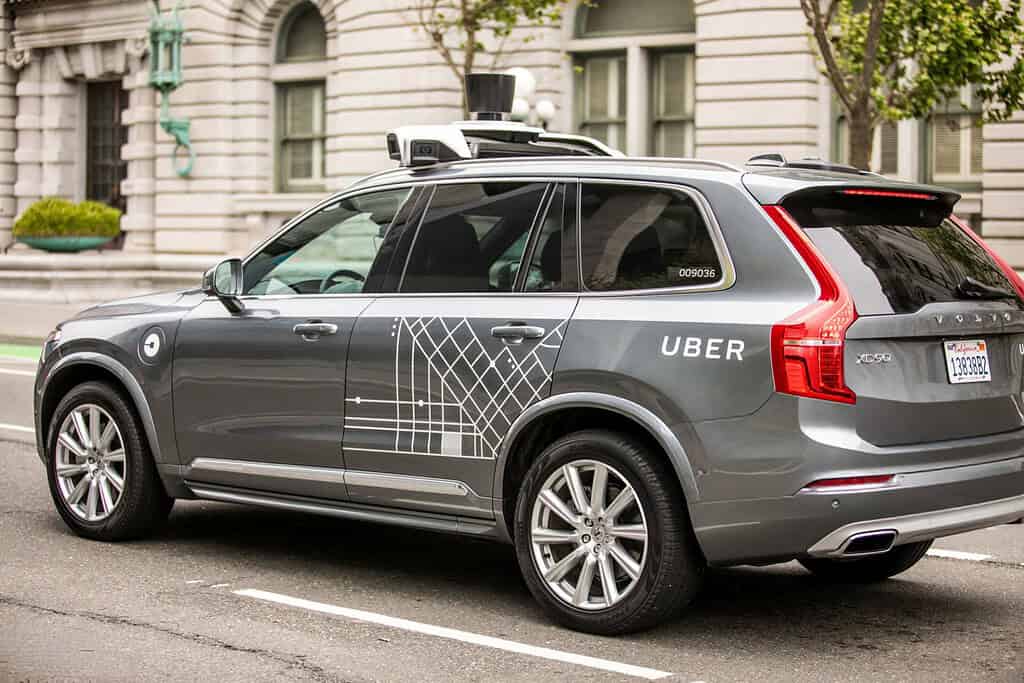
An Uber self-driving car in San Francisco.
Serhii Nikolaichuk, a former Uber driver and founder of The Capital Index, offers a closer look at the corporate layers being targeted. “Uber’s cut of about 3,300 jobs, roughly 10% of its workforce, isn’t aimed at drivers,” Nikolaichuk said. “It’s aimed at management: about a fifth of its managers, teams of one or two, and reporting chains more than seven levels deep. Technically, that makes sense. Most coordination work is routing: collect status, compress it into a report, and pass decisions down. That’s exactly what language models and workflow agents now do in seconds.
“The memo (of the company) doesn’t blame AI, but the money tells the story: more than $10 billion committed to autonomous vehicles. Uber already runs robotaxi rides in four U.S. cities, including Austin, [Texas] and has about 20 autonomous-vehicle partners. It even pays some drivers, between rides, to complete data tasks for its AI unit, whose clients include self-driving companies. The workforce is helping train the machines that will compete with it.”
A Leaner Future of Work
This leaves a big question for the rest of corporate America: what does this playbook mean for everyone else? Kyle Elliott, founder of Tech Career Coach and CaffeinatedKyle.com, sees it clearly: “Fewer managers and fewer layers between frontline employees and senior leaders. Companies will look for leaders who can manage larger teams without relying on several levels of management beneath them. AI does often play a supporting role in layoffs. Tools that speed up performance reviews, internal communications, and reporting let one manager oversee more people, which, in theory, makes some management layers easier to cut.”
At the end of the day, Uber’s latest moves carry significant weight for companies of all sizes and across sectors. As AI shifts from tech experiments to everyday infrastructure, the classic corporate setups designed to manage massive human networks will continue to shrink. The layoffs and reshuffling we’re seeing now aren’t just temporary speed bumps—they are early signs that tech and leadership decisions are completely changing the way we work.
Andrea Fiano is editor-at-large at Global Finance Magazine. Contact him at afiano@gfmag.com.
French yields have been rising for weeks as lawmakers wrangle over a 2027 budget that calls for billions of euros in spending cuts to reduce a debt pile that now stands at around 120% of France’s GDP – one of the highest levels in the eurozone and well above the EU limit of 60%.
ADVERTISEMENT
ADVERTISEMENT
The French Treasury’s OAT bond is also used to set interest rates across a wide swath of the economy, meaning borrowing costs could begin rising for businesses and households.
The last time it was that high was during the dot-com financial crisis.
The spread between the 10-year yield and the German 10-year bond, considered the European benchmark of creditworthiness, also surged to nearly 160 basis points.
The bond selloff puts further pressure on the government ahead of a decision Friday by the ratings agency Moody’s on France’s sovereign credit rating, with most economists expecting a downgrade that would automatically raise the government’s borrowing costs.
Prime Minister Sebastien Lecornu is trying to get a 2027 budget approved in parliament despite not having a political majority for the €43 billion ($48bn) in spending cuts he seeks.
Even if approved, the budget would bring France’s deficit down to only 5% of GDP next year, well above the 3% limit for EU members.
Meanwhile, protests over the weekend calling in part for more spending on schools and other public services, degenerated into the worst street violence seen in years.
As Uber slashes corporate headcount, the cuts hint at how companies could finance an automated future.
When a highly profitable, fast-growing company decides to cut a tenth of its workforce, you must look beyond its formal statements. Uber Technologies’ recent move to run through three rounds of layoffs—cutting 10% of its global corporate team, or about 3,300 people—isn’t standard, defensive cost-cutting.
Instead, it offers a fascinating look at where big corporate money is moving. At the same time these office desks are being cleared, Uber is gearing up to pour up to $10 billion over the next few years in self-driving cars and autonomous vehicle networks. CEO Dara Khosrowshahi said the goal is to make the company “simpler and faster,” but that points to a much bigger trend in boardrooms everywhere: corporate layoffs are starting to look like a funding mechanism for an automated future.
Pinning down a direct link between artificial intelligence and job cuts requires reading between the lines of carefully crafted corporate PR. In its official announcements, Uber has been quiet on this front, explicitly linking only an early 10 percent cut in its customer service department to the embrace of AI. Later rounds in HR, recruiting, and middle management were described as strategic flattening and the removal of organizational layers. Yet broader data shows a trend moving much faster than company memos suggest. According to data from outplacement firm Challenger, Gray & Christmas, AI was cited as a reason for over 100,000 announced layoffs in the US during just the first half of the year—a massive jump compared to previous years.
This tension between streamlining operations and pivoting to new technology highlights a deep shift in how companies are built. Danielle LaFleur, an enterprise automation strategist and partner at TextBernie.me, believes we should view Uber’s layoffs as a sign of things to come for operations-heavy industries, rather than a one-off event. “Uber’s 10% reduction is a leading indicator, not an anomaly,” LaFleur said. “A profitable company does not cut a tenth of its workforce during a growth period to save money. It does so to reallocate resources: shifting investment from a labor model built on human drivers to one built on autonomous infrastructure.”
Reallocating for Autonomy
Moving capital away from old, labor-intensive setups marks a fundamental shift in how technology interacts with business. “Most corporate AI adoption to date has been additive,” LaFleur said. “Firms kept their organizational structures intact and layered AI tools on top. Uber represents the next phase, in which AI alters the firm’s structure itself. Operations-heavy industries should expect similar restructurings as autonomous systems mature.”
But the human side of this shift shows that the impact goes far beyond a smaller headcount. As independent coach Nataliia Rastehaieva pointed out: “AI may not simply remove jobs. It may change roles, responsibilities and expectations much faster than before. That creates uncertainty for the people who leave, but also for those who stay. They need to understand what is changing and what their place in the company will be. I would not treat Uber as proof of what AI will do to every company. But it may be an early example of how technology and management decisions together are reshaping work.”
An Uber self-driving car in San Francisco.
Serhii Nikolaichuk, a former Uber driver and founder of The Capital Index, offers a closer look at the corporate layers being targeted. “Uber’s cut of about 3,300 jobs, roughly 10% of its workforce, isn’t aimed at drivers,” Nikolaichuk said. “It’s aimed at management: about a fifth of its managers, teams of one or two, and reporting chains more than seven levels deep. Technically, that makes sense. Most coordination work is routing: collect status, compress it into a report, and pass decisions down. That’s exactly what language models and workflow agents now do in seconds.
“The memo (of the company) doesn’t blame AI, but the money tells the story: more than $10 billion committed to autonomous vehicles. Uber already runs robotaxi rides in four U.S. cities, including Austin, [Texas] and has about 20 autonomous-vehicle partners. It even pays some drivers, between rides, to complete data tasks for its AI unit, whose clients include self-driving companies. The workforce is helping train the machines that will compete with it.”
A Leaner Future of Work
This leaves a big question for the rest of corporate America: what does this playbook mean for everyone else? Kyle Elliott, founder of Tech Career Coach and CaffeinatedKyle.com, sees it clearly: “Fewer managers and fewer layers between frontline employees and senior leaders. Companies will look for leaders who can manage larger teams without relying on several levels of management beneath them. AI does often play a supporting role in layoffs. Tools that speed up performance reviews, internal communications, and reporting let one manager oversee more people, which, in theory, makes some management layers easier to cut.”
At the end of the day, Uber’s latest moves carry significant weight for companies of all sizes and across sectors. As AI shifts from tech experiments to everyday infrastructure, the classic corporate setups designed to manage massive human networks will continue to shrink. The layoffs and reshuffling we’re seeing now aren’t just temporary speed bumps—they are early signs that tech and leadership decisions are completely changing the way we work.
Andrea Fiano is editor-at-large at Global Finance Magazine. Contact him at afiano@gfmag.com.
Earnings Call Insights: Neptune Insurance Holdings Inc. (NP) Q3 2026
Management View
“The third quarter was another record for Neptune. Revenue grew 34% year-over-year to $59.6 million. Adjusted EBITDA grew 38% to $36.8 million at a 62% margin, an improvement of 147 basis points from a year ago.” (President & Chief
Seeking Alpha’s Disclaimer:This article was automatically generated by an AI tool based on content available on the Seeking Alpha website, and has not been curated or reviewed by humans. Due to inherent limitations in using AI-based tools, the accuracy, completeness, or timeliness of such articles cannot be guaranteed. This article is intended for informational purposes only. Seeking Alpha does not take account of your objectives or your financial situation and does not offer any personalized investment advice. Seeking Alpha is not a licensed securities dealer, broker or US investment adviser or investment bank.
Telix Pharmaceuticals press release (TLX): Q3 revenue of US$245 million increased 19% over the prior corresponding quarter (Q3 2025) driven by continued strong demand for the commercial portfolio, in line with expectations. September sales drove a higher quarterly exit rate indicating continued strength
CEO David Rosa said Q3 was “a strong quarter for Intuitive with broad-based adoption across our multiport, single-port and Ion platforms,” adding that “total procedures increased 15%, driven by 14% growth in da Vinci procedures and
Seeking Alpha’s Disclaimer:This article was automatically generated by an AI tool based on content available on the Seeking Alpha website, and has not been curated or reviewed by humans. Due to inherent limitations in using AI-based tools, the accuracy, completeness, or timeliness of such articles cannot be guaranteed. This article is intended for informational purposes only. Seeking Alpha does not take account of your objectives or your financial situation and does not offer any personalized investment advice. Seeking Alpha is not a licensed securities dealer, broker or US investment adviser or investment bank.
The American Petroleum Institute reportedly shows a draw of 4.93M barrels of oil in U.S. commercial stockpiles for the week ending October 16, after inventories fell by more than 11M barrels in the previous week.
Experts warn Bank of America’s hefty AML fine signals a reckoning for aging banking compliance.
When Bank of America released third-quarter financials on Oct. 14, shareholders took note of a $1.2 billion non-tax-deductible blow to earnings. The anti-money laundering, or AML, and sanctions penalty shaved 17 cents off its per-share net income.
But the fine itself may be the least of the bank’s worries.
Financial crime and AML experts told Global Finance that this penalty was not an outlier but a warning to the rest of the industry.
“If you looked at every bank in detail, you’d find problems,” ThetaRay CEO Brad Levy said in an interview. “It’s kind of like every house — when the inspector comes, there’s something wrong.”
What Happened
The Treasury Department’s Financial Crimes Enforcement Network (FinCEN) addressed the penalty. The segment cited Bank of America’s “failure to mitigate and report priority national security risks, including Chinese Money Laundering Networks and illicit finance along the southwest border.”
The fine is the third-largest in the department’s history, behind a roughly $4 billion settlement with Binance in 2023 and an approximately $3 billion settlement with TD Bank in 2024.
This particular cost includes $750 million that goes to the Office of the Comptroller of the Currency — the largest fine that regulator has ever imposed— plus $11.6 million to the Treasury’s Office of Foreign Assets Control over apparent violations of sanctions programs covering Iran, Russia, narcotics and global terrorism.
A Bank of America spokesperson issued the following statement to Global Finance: “Financial crime compliance is serious, and we are responsible for getting it right. We worked with regulators to reach these penalty resolutions stemming from violations cited in the previously reported 2024 OCC Consent Order and FinCEN’s investigation. We have invested billions of dollars in technology and dedicated thousands of employees to combat financial crime, and our team is far along with and committed to completing the work required to address the issues raised by our regulators.”
Fallout Extends Beyond Government Agencies
For Nikhil Raghuveera, CEO of Predicate, a startup that uses blockchain technology for AML enforcement, the real government-inflicted damage is not to Bank of America’s coffers but to its goodwill.
“The bank faces business and reputational damage with counterparties,” Raghuveera said. Partner institutions, clearing banks, and corporate clients typically tighten their own risk thresholds to protect themselves from secondary liability and run their own risk assessments. And a Bank Secrecy Act violation feeds directly into them, he explained.
“A large bank doesn’t lose its ability to operate, but it does face greater scrutiny and the potential loss of business opportunities,” Raghuveera added. “The regulator now sees the bank as unable to fix things itself. As a result, every new product or expansion gets reviewed through that lens.”
Regulatory Trust Broken
The hefty fine grabbed headlines, but according to Will Lawrence, CEO of San Francisco-based AML software maker Bretton AI Inc., the money matters less than what the bank has lost in regulatory trust.
Will Lawrence, Bretton AI
“For a large bank, even a significant financial penalty may be manageable,” Lawrence said in an email. “What’s much harder is operating once regulators lose confidence in the institution’s ability to manage risk.”
That can mean independent monitoring, more board scrutiny and limits on growth.
“Even without formal restrictions on growth or acquisitions, unresolved compliance issues can complicate a bank’s expansion plans,” he said. “The financial penalty may be immediate, but remediation can take years.”
Big-name banks are also vulnerable if their methods for flagging suspicious activity remain outdated.
For example, when a typical analyst pulls data from different systems, reconstructs transactions, and documents the findings, that approach often falls short against sophisticated laundering networks, Lawrence explained.
“These are not necessarily risks you can understand by looking at one transaction or one customer in isolation,” he said. “You need to connect activity across accounts, counterparties and payment channels to identify broader patterns.”
Large penalties are rarely a one-time blip, Raghuveera said. “They tend to reflect patterns: transaction monitoring that’s poorly calibrated, SARs filed late or not at all, watchlists that aren’t kept current, and compliance teams lacking the staff, tools or authority to escalate.”
24/7 Reality Check
For Lawrence, true accountability raises certain questions: Who knew about the risks? Who had the authority to address them? Was appropriate action taken?
“A bank can have sophisticated monitoring systems, but if serious issues aren’t escalated or leadership doesn’t respond, the program isn’t working,” he added.
Also, Lawrence said, a bank can’t spend its way out of the problem. Regulators want evidence that changes are working, not just new policies or software.
“A bank can hire more analysts, purchase new technology, and rewrite its policies without fundamentally improving its ability to identify financial crime,” Lawrence said. Banks have also long tracked activity counts, such as the number of alerts reviewed or cases closed. “Those numbers tell you something about workload, but not necessarily whether you’re managing risk effectively.”
Levy, who spent nearly 20 years at Goldman Sachs before joining ThetaRay, expressed a similar sentiment. To put it plainly, legacy technology hasn’t kept pace.
“Most of these systems and processes are 10 to 30 years old,” he said, stressing the need for serious internal audits to accommodate the 24/7 banking world.
“Ten years ago, you could get away with it,” he said. “In the next five, you actually can’t… the speed-up in technology is going to be breathtaking.”
Anthony Noto covers corporate finance and private credit. Contact him at anoto@gfmag.com
Nvidia (NVDA) has already secured more than $35B in orders from the Chinese tech giants ByteDance (BDNCE), Alibaba (BABA) and Tencent (TCEHY) for its latest export-compliant chip, according to Reuters.
The three companies have ordered more than 3M of Nvidia’s