case

Disneyland’s Soarin’ Across America has the greatest Soarin’ scene

America’s semiquincentennial came and went, and the Disneyland Resort marked the occasion with a transformation of its now-classic Soarin’ ride. Gone, for now, is Soarin’ Over California and Soarin’ Around the World. In their place is Soarin’ Across America, a lightly patriotic-themed journey from coast to coast.

There are flyovers of nationalistic symbols such as the Statue of Liberty, Mount Rushmore National Monument and the Washington Monument, but the majority of its dozen locations are national parks, making Soarin’ Across America a love letter to America’s natural and diverse beauty. And it felt like a four-and-a-half-minute celebration.

You’re reading Mr. Todd’s Wild Ride newsletter

Todd Martens’ newsletter delivers news and commentary on the past, present and future of theme parks, right from the theme park capital of the world — Southern California.

Soarin’ Across America has the strongest scene of any of the three attraction films, which envelop riders as they ascend in the sky on a hang glider simulator. That’s its opening, a shot of a rocket launch at Florida’s Kennedy Space Center. We start level with the spacecraft, and then follow its journey into the clouds. Being this close to a liftoff, and feeling the sensation of rising with it, creates an inspiring, rousing moment. As in any Soarin’ film, we are promised the great outdoors, but here we get magnificent ingenuity.

Is it the best Soarin’? I’d still rank Soarin’ Over California as No. 1, as it has a sort of goofball charm, such as tumbling skiers or a golf ball flying toward the audience. But Soarin’ Across America is a worthy successor. It takes a more patient approach, as the ride now seems to linger longer over certain locales, allowing us to take in the majesty of the Grand Canyon West or vibrancy of the Louisiana bayou without distraction. I appreciated the tonal shift, which makes it stand on its own and doesn’t try to force itself to capture the original’s whimsy.

A coastal scene from Soarin' Across America.

A coastal scene from Soarin’ Across America.

(Disney Parks)

I also enjoyed the new smells. When hovering near the Hawaii coast, for instance, the tropical fragrances that wafted over guests seemed to reflect the gummy fruitiness of a mai tai. (No, that wasn’t just me longing for an afternoon break at Trader Sam’s.)

I went in with a bit of skepticism, and I’m relieved to say my fears weren’t realized. Well, fully realized. This is a divisive time in American history, and cultural works are increasingly viewed through a political lens. When announcing the attraction, Disney did so with symbolism of the American flag, a bald eagle and the Statue of Liberty, art that was admittedly bright and welcoming, but also could be read as giving it an uncomfortable, chauvinistic sheen.

  • Share via

Not everyone in 2026 may be excited with a flight simulator that serves as a cheerleader for America. And I still question the inclusion of Mount Rushmore, which has a long, controversial history, and has been a fascination of President Trump’s. But aside from that scene, and some odd red, white and blue sparkler-like fireworks visible in the New York Harbor, which curiously distract from a view of the Statue of Liberty, Soarin’ Across America doesn’t lay on the jingoism. At least until the final moments, when we see an American flag in the sky above Disneyland’s Sleeping Beauty Castle.

I’ll take it. The vibe throughout is one of restraint. When we glide near a Maine lighthouse, the film seems to pause, allowing the rocky coast and long-standing structure to be the stars. A dip across the American plains takes us above a herd of bison, but by and large movement is kept to a minimum (here the scent is of grassy freshness, which I’m betting is not what a bison smells like). A train in the Ozarks, for instance, comes to us rather than the film rushing to trace its path.

Filmed primarily with helicopters and drone shots, Soarin’ Across America utilizes CGI, courtesy of Industrial Light & Magic, less than Soarin’ Around the World, and primarily on scene transitions when we appear to fly next to a bird. This is an attraction that leans more National Geographic, that is it is unobtrusive and unstaged, than past iterations of Soarin’. While some may miss more active visuals, I appreciate that each Soarin’ film takes a different approach. Long term, it will allow Soarin’ Across America to serve as a snapshot in time, of an America at a certain point in history.

A Maine lighthouse as scene from the air.

Soarin’ Across America shows aerial vistas across the United States, and it’s arriving at a divisive moment in our nation’s political history.

(Disney Parks)

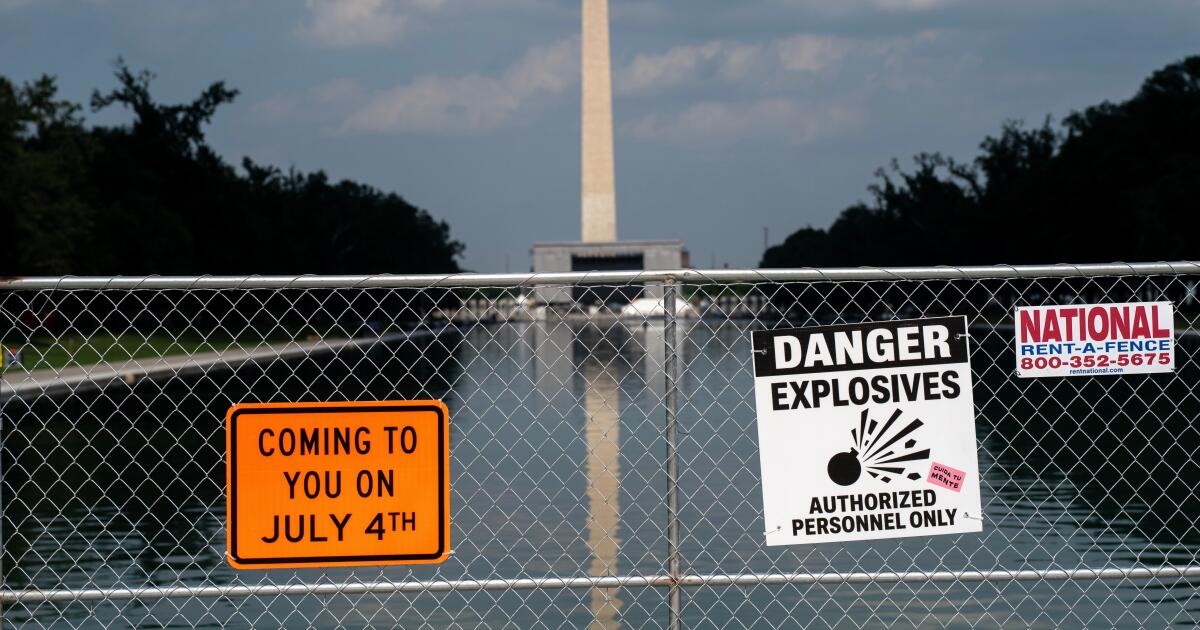
And that’s already true. For when the film takes us down in front of the Washington Monument, we can off in the distance ever-so-slightly glance at the Lincoln Memorial Reflecting Pool, caught before its current Trump adminstration remodeling. Depending on your point of view, it can be unintentionally uncomfortable or amusing to see a locale before it became a political lightning rod. But that’s sort of the appeal of the Soarin’ films. They’re glimpses of not just a moment in time, but of a constantly changing world.

In that sense, there’s something relatively quaint about Soarin’, especially for our fast-paced, thrill-focused world. Soarin’ was groundbreaking when it debuted in 2001, but today we have venues like Las Vegas’ Sphere and Inglewood’s Cosm, whose spherical screens are higher definition and can even create the illusion of movement. Soarin’ Across America charms — all four of my rides last week ended in audience applause — by simply being a calming, relaxed journey that stokes our sense of adventure.

This week in SoCal theme parks

Disneyland Park has now welcomed more than 1 billion guests.

Disneyland Park has now welcomed more than 1 billion guests.

(Christian Thompson / Disneyland Resort)

  • Disneyland: More than 1 billion served. The Disneyland Resort over the weekend welcomed its 1 billionth guest. The distinction went to 8-year-old Andres Robles, who with his family was treated to a VIP tour of the park. Disneyland has updated its population sign atop the Disneyland Railroad’s Main Street Station. To help put into context how unfathomably large 1 billion is, it’s worth noting that it took Disneyland, which in recent years has been drawing around 17 million attendees, nearly 71 years to reach that number.
  • The Cenobites are coming to Universal Studios Hollywood. The latest addition to this year’s Halloween Horror Nights has been revealed, and it’s a haunted house based on the “Hellraiser” franchise. Pinhead actor Doug Bradley will reprise his role for the walkthrough attraction by voicing the character’s representation in the house. Halloween Horror Nights is set to launch Sept. 3.
  • Don’t miss this look into Disney history. PBS SoCal will on Friday, July 17, show the documentary, “Bob Gurr: Living by Design.” It’s a revealing look into the life of a key early Disneyland designer, as Gurr created the look and feel of the Haunted Mansion “Doombuggies,” the original Autopia cars, the bobsleds of the Matterhorn and, of course, the first Disneyland Monorail. Before you watch, get to know the colorful, outspoken Disney legend.
  • A Disneyland deal for Anaheim residents. Good news for those who live near the Disneyland Resort. For a limited time from July 20 through Aug. 8, Anaheim residents will have access to a locals-only deal. Adult one-day tickets will start at $71, while child tickets will be $50. Park-hoppers for adults will sell for $104 while child tickets will remain $50. It’s a significant savings and a great way to see the start of the park’s Halloween season. The tickets go on sale July 16.

The best thing I ate at the parks

The al pastor pork chop at Lamplight Lounge.

The al pastor pork chop at Lamplight Lounge.

(Todd Martens / Los Angeles Times)

One of Disneyland’s best dishes is currently available at Disney California Adventure’s Lamplight Lounge, its Pixar-decorated pub-like outpost. It’s a sliced al pastor pork chop served with cheese polenta, pineapple relish and a spicy red chili butter sauce ($32). The pork is soft, the polenta creamy and it carries just enough heat to give it a bit of an edge. While filling, it’s surprisingly not too heavy, and Lamplight is always a lively spot to take a break from the parks. I only wish the place had a non-hazy IPA.

Your questions answered

Disneyland's Sleeping Beauty Castle on a crowded 2019 day.

Disneyland’s Sleeping Beauty Castle on a crowded 2019 day.

(Jay L. Clendenin / Los Angeles Times)

Hi Todd, we went to the park [Sunday] and it was empty: walk on to Cars, walk on to Indy. Thirty minutes for Guardians. Everything else was down to about 5 [minutes] besides Tiki Room because it’s a 15 min show. Are they struggling this summer? I haven’t seen a day like that at Disney since I was a kid.
— Jake from Riverside

Disneyland has been unseasonably comfortable this summer (read: less people). And the Fourth of July holiday week was kind of a breeze, with low wait times at most attractions at both parks.

But I wouldn’t says struggling, as I have seen busy days in recent weeks and Sunday was particularly unique. Mexico and England were playing a much-buzzed-about World Cup match, which no doubt kept crowds at bay. But it’s true that Disneyland this summer has, on a whole, been more pleasant, crowd-wise, than in year’s past.

Ultimately, I attribute the potentially lighter attendance to a combination of factors. One, the park has likely hit the peak price it can currently offer guests (fingers crossed this is true, as I don’t think most Disneyland fans can absorb another yearly price hike right now). Two, the aforementioned World Cup is drawing away potential attendees. And three, everything is more expensive today, forcing families to choose between, say, an afternoon at Dodger Stadium or a day at Disneyland. It’s increasingly untenable to do both.

And people are hungry for different, approachable ticket options. Last week, for instance, Disneyland unveiled a new evening ticket deal for all guests. The $59 offer allows attendees to enter either Disney California Adventure at 5 p.m. or Disneyland at 7 p.m. Available Sundays to Wednesdays through Aug. 5, all dates sold out in six days, unless Disneyland allots more tickets for the deal.

Tell us your stories. Ask us your questions.

Have a theme park tale to share? Whether it was a good day or less-than-perfect day, I would love to hear about it. Have a question? A tip? A fun photo from the parks to share? Email me at todd.martens@latimes.com. I may feature your note in an upcoming newsletter.

Ride on,

Todd Martens

P.S.

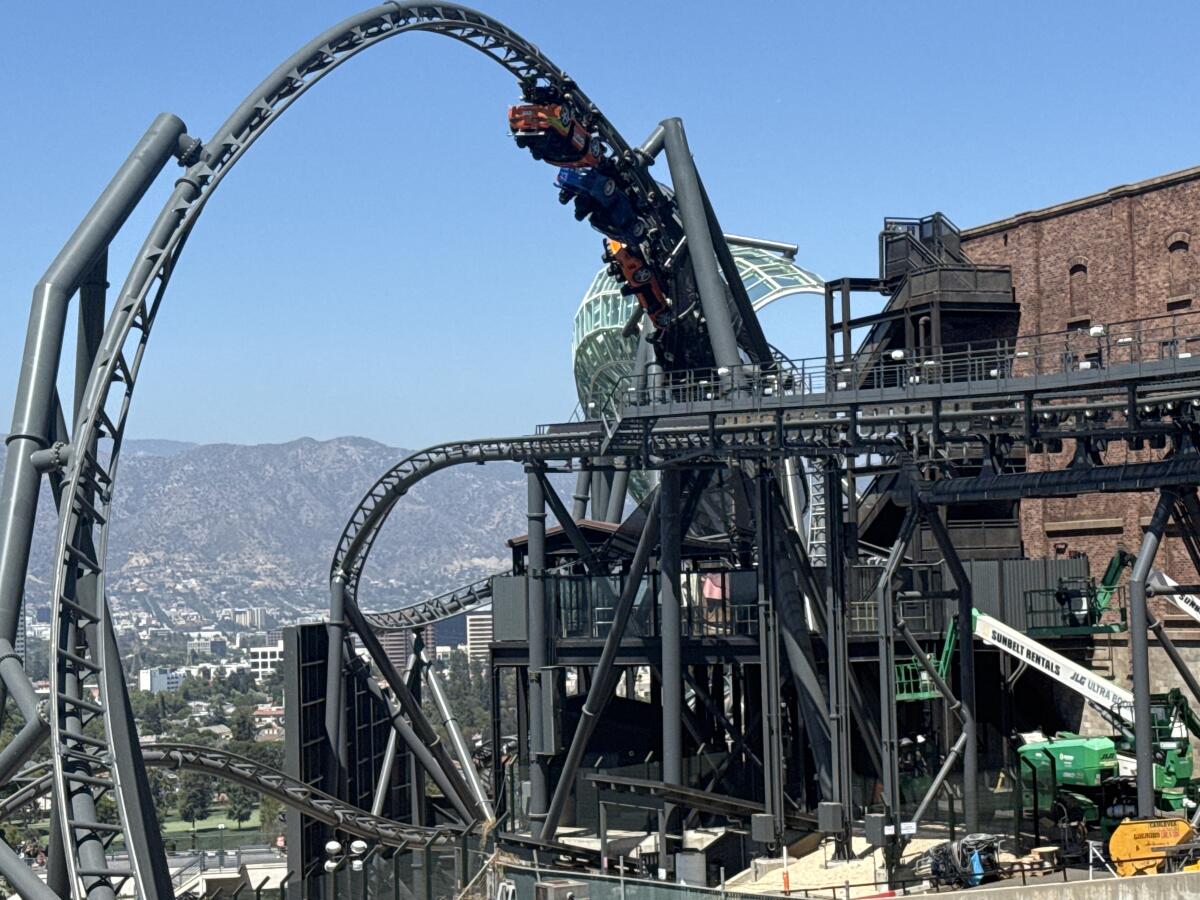
Coaster cars coming down from a loop.

Universal Studios Hollywood first began exploring a high-speed coaster more than a decade ago.

(Todd Martens / Los Angeles Times)

Universal Studios Hollywood’s new Fast & Furious: Hollywood Drift is set to open soon, and while many are excited, I’m curious to hear from those who live near the theme park. Universal has emphasized how it has instituted a number of noise-mitigating factors, from placing pea gravel in the tracks to building sound walls and creating shields designed to capture rider screams.

Theme park rides, however, can still be loud. If you’re in one of the neighborhoods surrounding the park, drop a line at todd.martens@latimes.com and let me know if Universal’s efforts have been enough, or if the coaster is a disruptive presence.

Source link

Humans, machines or nothing: Future of court transcripts hangs on case

The California Supreme Court is poised to rule in a lawsuit that has pitted the state’s court reporters — the workers who create transcripts of court proceedings — against victims of domestic violence and other vulnerable litigants.

The case will determine whether to end a long-standing prohibition on the electronic recording of most civil court proceedings, enabling the use of modern technology to create a “verbatim record,” which is crucial to appeals and other legal challenges.

Advocates say a decision in favor of electronic recording could end a years-long judicial crisis virtually overnight, producing legal records and preserving the right to appeal in tens of thousands of cases in civil, family and probate hearings where court reporters are rarely provided. Participants in the civil proceedings can hire private stenographers to maintain a record of what’s said, but their services can run thousands of dollars a day.

“In many, many courtrooms throughout the state today, there is nobody there, and there’s not going to be anybody there,” attorney Sonya Winner told the high court during oral arguments in Los Angeles last month. “The court reporters the court has on staff are off doing felony trials,” making electronic recording the only alternative for most civil litigants.

Everyone agrees the lack of court reporters is a crisis. Lawyers on both sides have urged the high court to establish a clear right to a verbatim record in civil hearings.

The divergence is over whether the worker shortage is improving slowly or still getting worse, and what the Supreme Court should do about it.

California’s largest public sector union and the court reporters it represents warn the decision could allow the state’s court systems to stop hiring stenographers.

Court reporters say their duty to maintain an accurate record is a profound public trust that can only be performed by a human being, who can intervene to ensure everyone is heard and who bears responsibility if a transcript is missing or incomplete.

Despite California’s sluggish job market, hiring for court reporters remains brisk, bolstered by tens of millions in funding from Sacramento, a recent change in state law and aggressive recruitment by some of the country’s largest court systems, including Los Angeles, Orange and San Diego counties.

Lila Scott, a TV writer, is among those seeking to join the profession. Like a lot of Hollywood talent, she had been struggling to find steady work in recent years.

The “Unicorn Academy” writer was trolling government job sites when she stumbled across a listing for court reporters in Los Angeles — and then another, and another.

“I thought, ‘What the heck is this?’” Scott recalled as she set up for a class at Downey Adult School.

Scott is now in training to become a “voice writer,” a form of note-taking that relies on a device called a stenomask — something like a cross between a podcast mic and a nebulizer — to produce a transcript. Voice writers repeat every word spoken in court along with a sequence of formatting commands to voice recognition software.

“You use your mom voice when you’re dictating,” said another Downey student, 40-year-old Wanda Port. “That stern mom voice, that’s the one you use.”

Traditionally, court reporters have used 22-key steno machines to rapidly take down every word said by lawyers, judges and anyone else who speaks on the record during an official proceeding. The licensing process for these stenographers is significantly longer and more difficult than what voice writers undergo.

A change in state law in 2024 allowed voice writers to become licensed as “certified shorthand reporters,” opening a new pipeline for court staff.

About half of the court reporters hired in California since 2024 have been voice writers, data show.

“Of the 300-plus students we have, it’s about 50/50,” said Jennifer Shenbaum, who directs the Downey program.

The current hiring blitz follows more than a decade of decline, after California’s court systems shed about a third of their reporters amid a protracted budget crisis in 2012. Labor leaders say new licenses have jumped ninefold in recent years, and court reporting classrooms across the state are full.

Diana Van Dyke, a Los Angeles County Superior Court reporter and a shop steward in Service Employees International Union Local 721, credits much of that growth to the expansion of paid internships, signing bonuses and other aggressive recruitment tactics funded by the Legislature and promoted by the union.

Students sit in a classroom setting.

Students training to become court reporters practice on stenotypes and stenomasks during a speed-building class at Downey Adult School.

(Kayla Bartkowski / Los Angeles Times)

At Orange County’s Cypress College, which offers court reporter training, job fliers boasting six-figure salaries paper the walls. A pamphlet from the Central District of California that touted “front-page Federal cases” hung in the window of a court reporting classroom, where students practiced typing 200 words per minute.

“By the end of the third test I can’t feel my fingers — but it’s worth it!” said Asia Mendez, a trainee-stenographer.

While advocates for court reporters say humans can still do the job better than machines, the fact that many hearings occur without any official transcript at all has drawn concern from top state officials.

Atty. Gen. Rob Bonta has called the situation “untenable.”

“This is the rare case in which the current application of a statute violates procedural due process,” Bonta’s office said in a brief urging the state’s high court to allow recordings.

Such a ruling would be especially important for survivors of domestic violence, who often find the family court system weaponized against them, said Jennafer Dorfman Wagner, director of programs at the Family Violence Appellate Project, which brought the suit that is now before the California Supreme Court.

“People who want to exert power and control over an ex-partner will find whatever foothold they can and use it,” Wagner said.

Without a record of their proceedings, litigants can’t prove what happened in the courtroom, or appeal if a judge denies a restraining order or approves a custody arrangement that leaves them vulnerable to further violence.

California’s court systems have also thrown their weight behind the plaintiffs in the case.

“California has long led in areas of access to justice and technology, but in this area, it lags far behind the rest of the country, and behind the federal courts that are in this state,” said Mark Yohalem, an attorney representing the state’s superior courts.

The justices, too, seemed eager to embrace electronic recording in cases where no court reporter is available and litigants cannot afford to pay for one on their own, repeatedly pressing lawyers on exactly how such a ruling might be written.

Although the decision would not affect criminal proceedings, the high court judges have expressed concern that court systems may use their ruling to roll back the broader recruitment push as a cost-cutting measure — a worry labor leaders share.

“Electronic recording is cheaper,” said Justice Joshua P. Groban. “It allows any court to just say, for example, that no more court reporters are needed.”

When advocates for the Family Violence Appellate Project told Groban and the other justices hearing the case that such a move by the courts would amount to “bad faith” and should not weigh on their decision, the judge appeared skeptical.

“Either bad faith or fiscal responsibility, depending on the budget that year,” Groban said.

Source link

Former Olympian indicted on felony charge over alleged Reflecting Pool vandalism

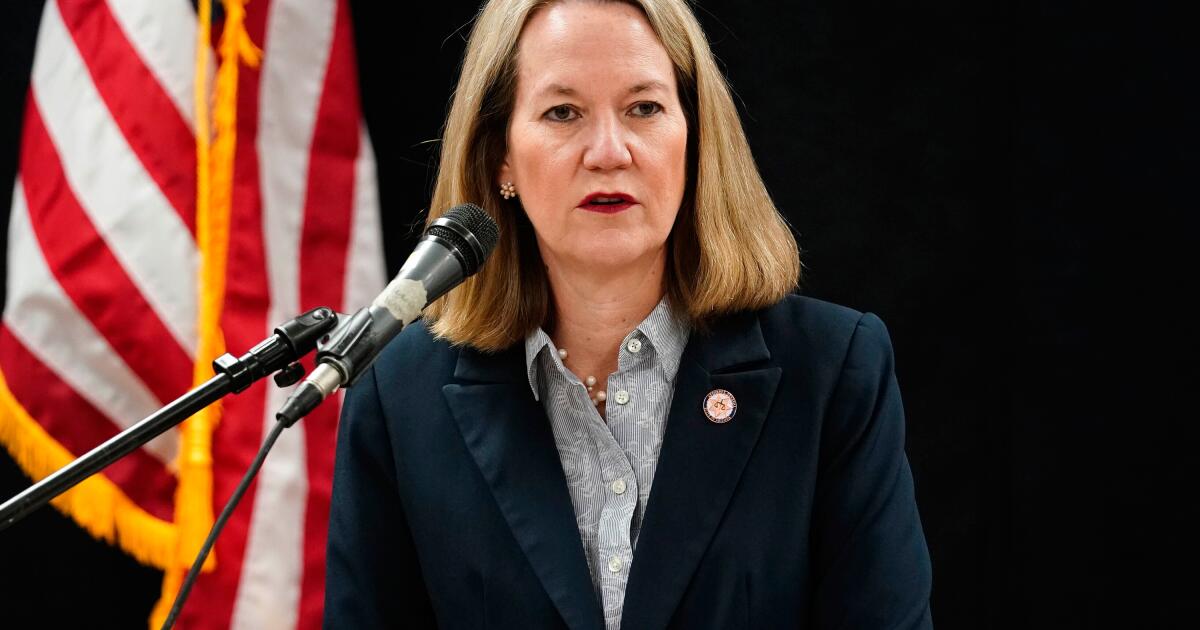
A former Olympian was indicted Thursday on a felony charge in what President Trump has called vandalism of the Lincoln Memorial Reflecting Pool, where a renovation project he launched has been riddled with problems.

David Hearn, a former Olympic canoe racer, was indicted on a single count of property destruction in a Washington, D.C. court.

District of Columbia U.S. Atty. Jeanine Pirro said Hearn ripped up recently installed sealant on the pool in “a deliberate act” that caused more than $1,000 in damage. She accused him of “forcefully and violently” pulling up the bottom liner “with both hands” and acting belligerently toward an employee who told him to stop.

“This is a case with tremendous evidence,” she said, adding that authorities have made about six other misdemeanor arrests.

In a statement, Democracy Defenders Fund co-founder Norm Eisen and Mary Dohrmann, senior counsel at Washington Litigation Group, said that they represented Hearn and that the charges were “outrageous and should be alarming to every American.” Eisen and Dohrmann construed the case as representative of “the misuse of government power against an ordinary citizen based on a concocted narrative.”

Hearn didn’t immediately return a phone call seeking comment. He previously told the Associated Press that he reached into the pool on June 19 to examine the newly peeled coating. He said he briefly touched a chunk that was still attached to the side of the pool, then let go shortly after a park worker told him to.

“I’m a curious citizen,” Hearn said in a telephone interview last month. “I reached down to see what it felt like. It was very rubbery.”

Hearn, 67, of Bethesda, Md., owned a company that made composite materials used to build watercraft.

Saying that he stopped by the pool during a 64-mile bike ride, Hearn said he was detained by National Guard troops and U.S. Park Police for five hours before being released.

Trump said last month that federal authorities made “multiple arrests” of people he accused of vandalizing the Reflecting Pool as he struggled to explain why the $16-million rehabilitation project he launched for the nation’s 250th anniversary seemingly backfired. Without providing any substantiation, he also said vandals dumped fertilizer into the pool and slashed the coating with a box cutter.

In subsequent days, National Guard members and the park police patrolled the deck around the Reflecting Pool as Trump’s administration faced a self-imposed deadline to fix a botched renovation before the nation’s 250th anniversary celebration. Contractors and federal workers used chemicals and ozone nanobubbles to combat an algae bloom, and Trump has said that the problems probably require draining the pool again for liner repairs.

Whitehurst and Kinnard write for the Associated Press. Kinnard reported from Columbia, S.C.

Source link

Birthright citizenship ruling was a win for democracy — and a warning

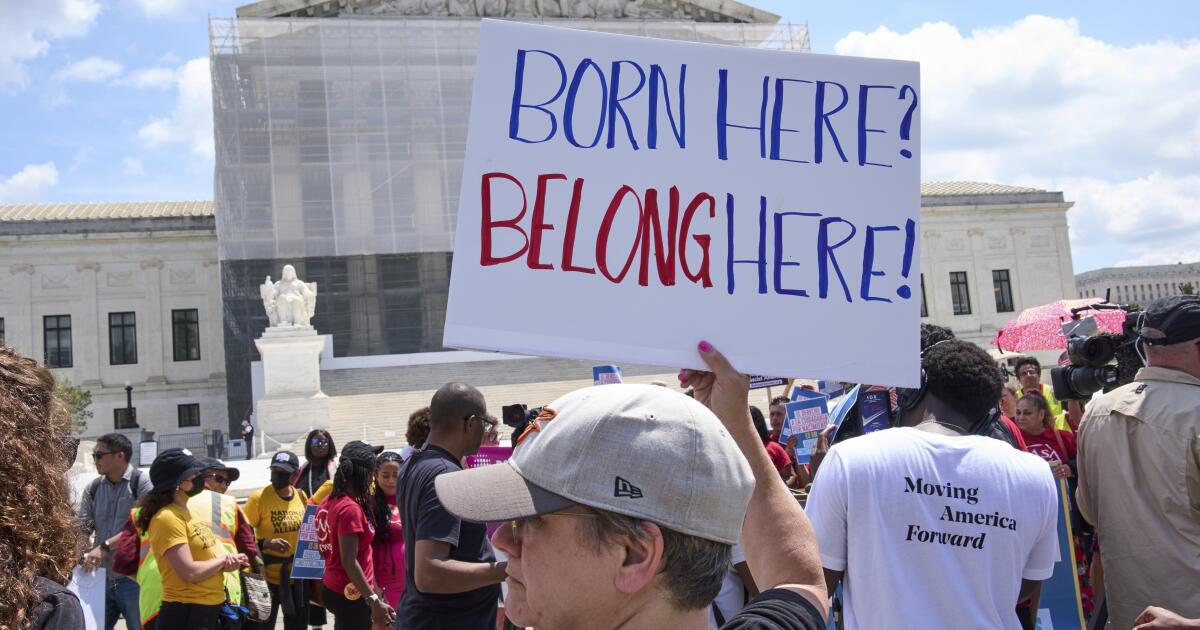
This week’s narrow Supreme Court decision protecting birthright citizenship is rightly being hailed as a triumph for the American experiment.

By some, anyway.

Check out MAGA world and you’ll quickly find Trump surrogates and even elected leaders spouting a kind of extremist anti-immigrant sentiment that once, not so long ago, was considered intolerable in the public sphere.

This has included suggestions that go as far as banning pregnant women from traveling to the United States for fear they might give birth here, and — no joke — one notable commentator writing that demanding female immigrants be sterilized might be a solution.

Trump’s Homeland Security advisor Stephen Miller said after the ruling that children of immigrants might not be “qualified to carry on or capable of executing the inheritance of this country.”

“We have people from all over the world, from Third World nations, nations that on their own would have never invented the wheel, let alone modern technology, let alone medicine, let alone air travel, and they can just come into the country, have a baby at a hospital, paid for it by you and me, and then that baby is automatically a citizen,” Miller said.

Before you tell me that the Supreme Court has spoken and this is a done deal, no matter if there’s more gross Miller mush, let me tell you about Supreme Court Justice Ketanji Brown Jackson’s written opinion and why it matters. It is, if read in the right light, a warning for what comes next — a fight to rewrite history to serve political aims.

“The odds were long and the stakes were high,” Jackson wrote about the creation of the 14th Amendment in 1866, which has long been understood as granting citizenship to any child born on U.S. soil and which was the focus of this case.

Still, she wrote, despite the unlikeliness of post-Civil War America rising to the challenge of inclusiveness, the amendment was always meant to do just that — because free Black people, recently emancipated but denied citizenship, “fought for the shared humanity of all people.”

An alternative interpretation by MAGA world of this amendment and this history was the center of this case.

To greatly simplify, the 14th Amendment was originally a response to a Supreme Court decision, the Dred Scott case, that said freed Black slaves could not be U.S. citizens. MAGA world was arguing that the authors of the 14th Amendment never intended much more than that — citizenship for ex-slaves and their descendants.

While concurring with the majority of the court, Jackson also wrote her own summary that makes a vital point: Without history that includes the Black experience — as most of the arguments in this case did — we are left bereft of the suffering that has shaped our values and which gives us the empathy required to be a pluralistic society.

Black history — any non-white history, really — is the history of resistance and the road map to recovery from this dark era of hate.

It’s hard to call someone your fellow citizen if you take away their humanity — which is exactly what this case was attempting to do by splitting into factions those who would fight for equality and rewriting history with only the voices that match the current administration’s goals.

It was disappointing that the court, whose individual justices bounced around arguments from a myriad of sources outside of their erstwhile adherence to the ideas of originalism, did not call out that erasure more forcefully, and that it was left to Jackson to do so.

Jackson took that narrow idea that Black people — and the white legislators sympathetic to their cause — had only themselves in mind when crafting the 14th Amendment and attacked it head-on, arguing that if we just look at what Black people were saying at the time, the larger intent of the amendment becomes clear.

“This alternative account pitches Black Americans against immigrants when the advocates who promoted the Fourteenth Amendment did no such thing,” Jackson pointed out of the MAGA version of events. “Freed Blacks fought for the shared humanity of all people.”

That “universalist vision of belonging and citizenship,” she wrote, “eventually won the day.”

The 14th Amendment was largely written by Sen. Lyman Trumbull of Illinois, who took much of the basis of it from the legal arguments of Black intellectuals, including Frederick Douglass, the most influential Black statesman of the era.

Trumbull then argued in Congress that the amendment was meant to be inclusive — even of so-called “gypsies” and Chinese immigrants, who faced extreme racism, especially in California.

One congressman opposed to the measure warned that if it passed, Chinese immigrants would “overrun” California and “will double or treble the population.” At the same time, the Romani would likely continue to “wander in gangs” and “have no homes, pretend to own no land, live nowhere, settle as trespassers where ever they go, and whose sole merit is a universal swindle,” he warned.

Asked if the amendment would grant citizenship to those two controversial groups of immigrants, Jackson points out that Trumbull gave an unapologetic “undoubtedly,” again drawing on the universalist ideas of Douglass and others.

The “child of an Asiatic is just as much a citizen as the child of a European,” Trumbull said (and Jackson quoted, drawing from an amicus brief by Evan Bernick of Northern Illinois University and Jed Sugerman of Boston University).

“There is a serious breakdown in on the court that reflects the breakdown and echo chambers in America,” Sugerman, the professor, told me Wednesday. “When it comes to history and originalism, you have to read more broadly than just the founding fathers that you liked.”

So the history of the 14th Amendment is right there — equality not just for Black Americans but for immigrant Americans — but it required Jackson to write her own opinion to put it on the court record.

Legal scholars aligned with Trump did Olympic-level gymnastics in this case to parse what the authors of the 14th Amendment meant with the phrase “subject to the jurisdiction” — words that MAGA claimed were meant to secretly exclude undocumented immigrants.

Brown instead reminded us that outside of those white-only discussions when the amendment was written, it was the activism of Black people — their demand for colorblind equality — that actually shaped the final words that granted citizenship to all babies born within our borders.

Solidarity — the unbreakable strength of American democracy.

After the ruling, Trump wrote on social media that Congress could write legislation undoing birthright citizenship. Some pundits say that wouldn’t work, but I’m here to say Trump has managed a bunch of stuff that the pundits said wouldn’t work.

More chilling, and direct, were more comments from Miller.

“It’s an abomination,” he said of the ruling.

But “because of President Trump’s courage and leadership, we are now on the precipice. Yes, we were dealt a setback, but because of his courage alone, we’re on the precipice as a nation of being in a position to end this travesty once and for all, and that’s what we have to fight for.”

Miller and his ilk are seeking to rewrite history to justify their vision of the future of America.

Jackson alone in the court offered us both a warning and a path — a reminder that our history holds indisputable facts despite politics, and we erase them at our own peril.

Source link

Disneyland’s Pirates of the Caribbean goes high tech. And it’s losing its mystique

Since its opening in 1967, Pirates of the Caribbean has stood as an anchor at Disneyland, a statement piece that has defined the direction of the park.

And that remained true last week when Walt Disney Imagineering unveiled a new audio-animatronic pirate. It’s wow-inducing. It’s also narrative-wrecking. And it fundamentally shifts the vibe of the attraction’s early scenes.

The high-tech pirate, we can bet, is just a small preview of the park’s next-gen toys. Because when changes come to Disneyland, they often hit Pirates of the Caribbean first. Over a half-century ago, the robotic figures of Pirates were a symbol of Disneyland’s technological ambitions, dazzling audiences with characterized but lifelike movements. With the ride, Disneyland made it clear that as the world advances, so, too, would the park.

You’re reading Mr. Todd’s Wild Ride newsletter

Todd Martens’ newsletter delivers news and commentary on the past, present and future of theme parks, right from the theme park capital of the world — Southern California.

As culture shifted and the lecherous buccaneers of the ride began to look more like symbols of sexual harassment, they would be forced to undergo some welcome personality adjustments. A redheaded victim of sex trafficking would transform into one of the ride’s most striking characters, and a number of rides from the Jungle Cruise to Splash Mountain would eventually undergo similar reassessment.

For Pirates of the Caribbean, after all, is the attraction that defined the Disneyland template. Its mastery is that it is a series of larger-than-life dioramas constructed around an abstracted narrative where themes of greed, lust and intemperance take precedence over a plot with a firm beginning, middle and end. And thus it made sense for Imagineering, the outfit of the company responsible for theme park experiences, to unveil its latest tech-driven master work on the ride.

A new animated pirate on Disneyland's Pirates of the Caribbean shifts from living to dead using projection technology.

A new animated pirate on Disneyland’s Pirates of the Caribbean shifts from living to dead using projection technology.

(Todd Martens / Los Angeles Times)

Reaction, however, has been less than enthused. Disneyland’s own social media accounts are flooded with pointed critiques, but even if we consider that social media tends to lead with gripes, some of the park’s most ardent fan sites have referred to the reimagined scene as a gutting. Why so much hullabaloo over a single robot? If we allow that Disneyland is a place that generations make pilgrimages to, then Pirates of the Caribbean is its most sacred temple. Handle with care.

There is, of course, a series of stages most Disneyland fans go through with any major changes, and it’s usually one of shock or confusion followed by acceptance and eventually new nostalgia. And Disneyland’s recent attraction updates have by and large been winners, as evidenced by the lovely Tiana’s Bayou Adventure, the exploratory Adventureland Treehouse and the bewitching Snow White’s Enchanted Wish.

This one, however, is more complicated.

Where once was a foreboding skeleton frozen in time atop a treasure and swords, there is now an animated figurine built with the latest in projection technology. The latter transitions from living to dead, caught in a perpetual loop with each glimpse of the cavern’s “cursed treasure,” which it continually lifts and drops. The pirate is placed after the ride’s two dips in a gold-filled room among the winding, mysterious underground chambers that help set its tone.

Dead pirates fill the caverns of Disneyland's Pirates of the Caribbean.

Dead pirates fill the caverns of Disneyland’s Pirates of the Caribbean.

(Todd Martens / Los Angeles Times)

Since the attraction’s opening, the only living beings in this portion were a lone seagull and maybe a stray sea critter or two. It is here where the mystique of Pirates of the Caribbean is set, and guests are placed in the active role of piecing together the time-shifting narrative. Story is hinted at rather than fed to us. We hear tales of the hexed fortunes found in the caves via ghostly narration, but see only its after-effects — skeletons locked in a chess battle or standing behind the wheel of a crumbling ship.

The centerpiece treasure room, where our new pirate is found, has long been a breathtaking scene. Previously, a now decayed body sat atop a mountain of wealth, an empty, soulless figure done in by selfish pride. It was disquieting, and a bit ghoulish. Stray, soft musical notes underscored the tragedy. Further on, a trapped pirate quietly transitions from living to dead via an old theatrical mirror illusion, and the boats float into a city filled with battles and buffoonery.

Gone is the subtlety. A somber tableau is now relatively loud, as our eyes no longer take in the full set but zero in on a bright and at times lively figurine. I cannot deny that it is an impressive piece of technology. On the multiple rides that I took Monday morning, I overheard two teens describe it as “pretty cool” and watched as a young child excitedly shouted to his mom and dad that the figure’s face was changing.

The caverns of Pirates of the Caribbean set a foreboding tone.

The caverns of Pirates of the Caribbean set a foreboding tone.

(Todd Martens / Los Angeles Times)

Such reactions are no doubt what Imagineering is hoping for. Part of the job of stewarding a classic attraction, after all, is ensuring it maintains an appeal to future generations. But I believe two things can be true. The new pirate may captivate some audiences and it can also stylistically and tonally clash with the attraction. This is the right tech, perhaps, for a more animated experience, one such as the in-development “Coco” ride coming to Disney California Adventure. Unfortunately, in Pirates it’s misplaced. Worse, it’s distracting, as we’re immediately drawn to its movement, grunts and quick-transitioning face.

I lament losing what was there. Projected figures, even the best of them, such as this one, are still media and can still gleam with light. And while the original Pirates of the Caribbean designs by Marc Davis were exaggerated, they were brought back to reality by Blaine Gibson, who sculpted them with bold, hardened features that made them at once heightened but believable. They may have been cartoonish, but they weren’t actual cartoons, and this figure is too much of a contrast, its comic-like excess feeling less relatable, less human. And that says nothing of its snort-like laughs, which reminded me too much of the huffs and puffs of the ride’s donkeys.

It also raises more story questions than it answers. Why, for instance, aren’t the other skeletons caught in a loop? Sometimes more is said by saying less, and this feller leans silly in a portion of the ride that calls for spooky. Ultimately, it just feels unnecessary, a symptom of our often exhausting, tech-obsessed, digital-drenched age where new, needless tools are shoved in our faces daily.

Thankfully, the rest of the attraction serves as a reminder that no computer wizardry can out-class old-school theater. Theme parks should evolve with the times, but sometimes it takes artful restraint to not mess with what’s already timeless.

This week in SoCal theme parks

  • Disney California Adventure turns Soarin’ Over California into Soarin’ Across America. The makeover will be unveiled July 2, just in time for the Fourth of July holiday and the celebration of America’s semiquincentennial. While Soarin’ Across America is already open at Florida’s Walt Disney World and I’ve written about the patriotic re-imagining, I’ve waited to see it in the flesh and will have impressions next week.
  • Fireworks! If you’re looking for them this weekend, our theme parks have got you covered. Disneyland, of course, has an annual Fourth of July show with patriotic music, and the park will be running “Disney’s Celebrate America! — A Fourth of July Concert in the Sky” Friday through Sunday. If you’re heading to Knott’s, be sure to check out the park’s free-to-visit Independence Hall, a replica of the Philadelphia landmark that will be offering guided tours Friday and Saturday, while Six Flags will feature fireworks Friday through Sunday. Universal Studios Hollywood will on Friday and Saturday debut a new Fourth of July-themed fireworks show.
  • Shattered glass on Fast & Furious: Hollywood Drift. Fans are eagerly awaiting the opening of Universal Studios Hollywood’s new “Fast & Furious”-inspired coaster, and word spread via social media recently that a panel of glass on one of the ride’s sound barriers had shattered. Universal declined to comment, but sources familiar with the ride characterized it as an “installation error” that shouldn’t delay the public launch of the ride, which is expected by mid-summer. I reached out to California’s Division of Occupational Safety and Health’s Amusement Ride & Tramway Unit (Cal/OSHA), which monitors the state’s theme park attractions. A spokesperson said the situation was looked into but did not warrant further evaluation.
  • Plan your perfect theme park day. The L.A. Times has unveiled a new feature. Now you can save must-try spots from our local guides and build your own personalized list. Or perhaps you’d like to browse my mega-project “Every Southern California theme park ride, ranked” and create an itinerary for your next visit.

Tell us your stories. Ask us your questions.

Have a theme park tale to share? Whether it was a good day or less-than-perfect day, I would love to hear about it. Have a question? A tip? A fun photo from the parks to share? Email me at todd.martens@latimes.com. I may feature your note in an upcoming newsletter.

Ride on,

Todd Martens

P.S.

Visitors tie paper tags bearing wishes onto trees.

Visitors tie paper tags bearing wishes onto trees in the courtyard of the Broad as part of an exhibition dedicated to Yoko Ono.

(Kayla Bartkowski / Los Angeles Times)

Theme parks often are about the power of imagination, allowing us to play pretend in heightened, alternate worlds. And I had theme parks on my mind while I traversed the Broad’s excellent current exhibit dedicated to Yoko Ono.

What, perhaps you wonder, does Ono have to do with theme parks? “Yoko Ono: Music of the Mind” documents the entirety of the artist’s career, and much of her early work centers on play. Real, philosophical play, essentially the idea that through creativity, fantasy and a bit of silliness, we can all see the world differently.

Whether it was communicating with her audience while in a bag (1964’s “Bag Piece”), an antecedent to Meow Wolf’s “Experience Tube,” or offering instructions to count stars, tally our wrinkles, drop off peas on a morning walk, attach wishes to a tree or create fictional maps of our neighborhoods, much of Ono’s career was dedicated toward building community and connections through playfulness and imagination.

It’s freeing work, and a reminder that a little frivolity via participatory art — and that’s really what theme parks and so-called immersive entertainment provide — is a necessary ingredient for happiness.


Source link

Supreme Court refuses Trump’s appeal of E. Jean Carroll’s $5-million sexual abuse verdict

The Supreme Court on Monday turned down without comment President Trump’s appeal of a $5-million jury verdict for sexually abusing E. Jean Carroll in the dressing room of a Bergdorf Goodman store in Manhattan nearly 30 years ago.

None of the justices registered a dissent.

When Carroll reported the incident in a book, Trump called it “a hoax and a lie,” prompting her to file a second claim for defamation.

Trump and his lawyers argued he was unfairly held liable because the jurors heard from two other women who said Trump groped them. And they listened to Trump’s own words on his willingness to abuse women.

“When you’re a star … you can do anything,” Trump said on the “Access Hollywood” tape from 2005 that the jurors heard.

Trump defended those comments in a 2022 deposition that was used during the trial.

“Historically, that’s true with stars,” he said. “If you look over the last million years, I guess that’s been largely true. Unfortunately, or fortunately.”

Usually, a defendant’s prior bad acts are excluded from a jury trial.

But in 1994, Congress amended the federal rules of evidence to make an exception for civil suits involving alleged sexual abuse. Rule 415 says the judge “may admit evidence that the party committed any other sexual assault.”

In Trump’s case, the U.S. appeals court in New York said the rule “permits a jury to consider evidence of a different sexual assault precisely to show that a defendant has a pattern or propensity for committing sexual assault.”

Two women testified that Carroll had told them about the dressing room assault shortly after it happened. And two other women testified Trump had assaulted and groped them.

Carroll testified over three days at the trial. Trump did not attend and chose not to testify.

Trump posted on social media that he was surprised by the court’s refusal to act on his appeal.

“I will continue the fight against this Weaponization and Lawfare Case against me, including the ridiculous claim of Defamation, with all of my power and strength. This Case is really against the United States of America, and all it stands for, and should never be allowed to happen to another President, or Candidate to be!”

The federal rules say judges may exclude “propensity evidence” if they decide its value is “substantially outweighed by a danger of … unfair prejudice, confusing the issues or misleading the jury.”

U.S. District Judge Lewis Kaplan, who presided over the trial, permitted the use of the propensity evidence, and the 2nd Circuit Court of Appeals upheld his decision in December 2024, shortly after Trump won election to a second term.

Lawyers for a Missouri law firm founded by Solicitor Gen. D. John Sauer filed an appeal petition in November urging the court to review the case of Trump vs. Carroll and order a new trial.

They said Carroll’s claims were “facially implausible and politically motivated” and her trial “rested fundamentally on improper propensity evidence that courts ordinarily disavow.”

They devoted most of their appeal to arguing that the court should take up the case because judges are divided on when propensity evidence should be excluded.

But they also urged the court to intervene because they said Trump was being mistreated by the judges in New York.

“It is deeply damaging to the fabric of our Republic for President Trump, in the midst of a historic presidency, to have to take his focus away from his singular and unique duties as Chief Executive to continue fighting against decades-old, false allegations and the myriad wrongs throughout this baseless case,” they wrote.

Trump is also appealing a separate but related defamation verdict that ordered him to pay Carroll $83 million.

Source link

Supreme Court to hear Arizona proof-of-citizenship voting case

Voters cast their ballots in the 2024 Presidential Election on Election Day at the Walter Reed Recreation Center in Arlington, Va., on Nov. 5, 2024. The U.S. Supreme Court has agreed Monday to hear a case over Arizona’s election law requiring documentary proof of citizenship in voting. File Photo by Bonnie Cash/UPI | License Photo

June 29 (UPI) — The U.S. Supreme Court has agreed Monday to hear a case over Arizona’s election law requiring documentary proof of citizenship in voting.

The high court will hear arguments over whether federal law prohibits such a law when voting in state elections. The court will hear the case during its next term which starts in October.

It is already illegal for non-U.S. citizens to vote in federal and state elections. Some municipalities allow noncitizen voting in local elections.

President Donald Trump has called for a national proof-of-citizenship requirement in elections while continuing to repeat unfounded claims of election fraud. The SAVE Act, a bill being mulled by Congress that Trump is in support of, includes a proof-of-citizenship requirement which Trump is in support of.

In 2022, the Arizona legislature adopted a law requiring voters to provide proof of citizenship when registering to vote on a state form. Documentary proof of citizenship that is allowable under Arizona’s law includes but is not limited to a birth certificate and a passport.

Nonprofit advocacy organizations Mi Familia Vota and Voto Latino filed the lawsuit challenging the proof-of-citizenship requirement.

The Republican National Committee appealed a lower court decision that struck down the proof-of-citizenship law.

The legislature also passed a law outlining how state election officials review voter rolls, putting in place a procedure to cancel the voter registrations of noncitizens.

Source link

Supreme Court rejects Trump’s appeal of E Jean Carroll’s sexual abuse case

The US Supreme Court will not hear an appeal requested by President Donald Trump to review the civil case that found he defamed and sexually abused writer E Jean Carroll.

A New York jury awarded Carroll $5m (£3.6m) in damages in 2023 over her civil claim that Trump sexually assaulted her in the 1990s, and then branded the incident a hoax on social media.

Trump denied the allegations and repeatedly claimed that the judge who oversaw the civil trial improperly allowed evidence to be presented that affected how the jury viewed him.

A federal appeals court agreed with the jury’s verdict last year and said a new trial was not warranted. Trump then asked the highest court to intervene.

The Supreme Court gave no details about their decision not to take up the case, as is customary.

It was Trump’s final hope of overturning the jury’s unanimous verdict and means he will have to pay Carroll the damages she had been awarded.

“The American People stand with President Trump as they demand an immediate end to all of the Witch Hunts, including the Democrat-funded travesty of the Carroll Hoaxes,” a spokesman for Trumps legal team told CBS News, the BBC’s US news partner.

“President Trump will keep winning against Liberal Lawfare, as he continues to focus on his mission to Make America Great Again.”

Caroll’s attorney, Roberta Kaplan, said in a statement that the Supreme Court’s decision “affirms once and for all the jury’s unanimous verdict that President Donald J Trump sexually assaulted and defamed E Jean Carroll”.

“His multiple efforts to appeal that verdict have all failed and today’s ruling ends his quest to avoid accountability for his actions,” she added.

Carroll’s counsel had not previously commented on the president’s decision to bring a challenge to the Supreme Court.

In the petition, Trump’s lawyers argued Carroll’s lawyer should not have let jurors see the 2005 Access Hollywood tape that showed the president saying he groped and kissed women.

Trump’s comments about the jury’s findings in the case led a separate jury to order him to pay Carroll $83m for defaming her. A panel of federal judges denied his appeal of that decision in September.

While Trump was found to have defamed and sexually abused Ms Carroll, the jury rejected her claim of rape as defined in New York’s penal code.

Carroll, a former magazine columnist who is now 81, sued Trump for attacking her in the mid-1990s in a department store dressing room in Manhattan. The defamation stemmed from Trump’s post on his Truth Social platform in 2022 denying her claim.

Trump has said Carroll was “not my type” and that she had lied.

Source link

Newsom blesses Uber ballot truce; car crash lawsuit fight continues

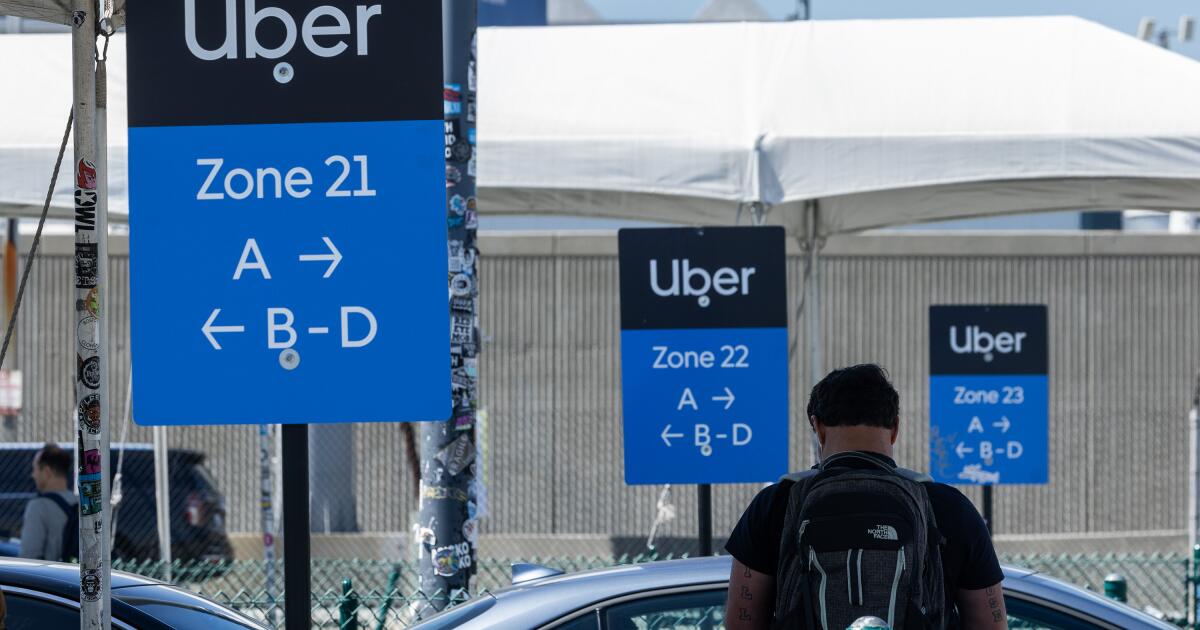
Gov. Gavin Newsom signed a law Thursday to crack down on inflated profits stemming from car crash lawsuits, blessing a hard-fought compromise between Uber and the state’s trial attorneys that averts a November showdown between two of California’s most powerful and moneyed lobbying forces.

The deal, the fruit of months of negotiations, takes aim at the lucrative way doctors can charge for procedures on patients referred to them by personal injury lawyers.

If a law firm has a client who was hurt in a car accident, the lawyer will often send them to a doctor who will perform surgery on a “lien” basis, meaning the doctor will be paid from money that comes from a lawsuit settlement rather than through insurance.

Uber contends this arrangement has created an incentive for doctors and attorneys to collude to dramatically inflate medical bills. The more expensive the bill, they say, the bigger the resulting payout.

The law, SB 623, caps how much these doctors can charge when their patient is involved in a lawsuit against a ride-share company, which are frequent targets of litigation due to their top-of-the-line insurance policies. The new law will also require Uber to ramp up background checks of its drivers.

“We’re going to have a much safer state both for medical patients and passengers in Ubers,” said Nicholas Rowley, a prominent Texas attorney who helped bankroll the fight and took a leading role in the negotiations.

The law only applies to cases that involve ride-share accidents that take place after Jan. 1, 2027.

“This legislation puts meaningful guardrails in place to better protect accident victims, increase transparency and accountability in the medical lien system and strengthen safety,” said Ramona Prieto, Uber’s head of public policy for the Western U.S., in a statement.

For months, Uber and lawyers from across the state poured tens of millions into dueling ballot measures that threatened to devastate the profits of whichever side lost.

Uber fired the first shot with a ballot measure that sought to cap how much attorneys can earn in lawsuits involving auto accidents. The company argued attorneys were swindling their own clients, inflating medical bills of car crash victims to increase the value of the settlement and then pocketing a hefty chunk of the payouts.

The state’s trial attorneys countered that the fee cap would make small or difficult cases a money-losing endeavor and block scores of accident victims from the courts. They shot back with their own ballot measure that would increase legal liability for ride-share companies if a passenger or driver is sexually assaulted while on a ride, seizing on investigative reporting that highlighted assaults in Ubers.

“They were waiting for us to blink and we didn’t,” said Douglas Saeltzer, the head of the Consumer Attorneys of California, the lawyer trade group that pushed for the measure against Uber. “Their starting place, I don’t believe, was in the interest of protecting victims — it was in the interest of protecting Uber.”

With the passage of Thursday’s law, both sides have agreed to pull their respective measures from the November ballot, halting campaigns that had both parties amassing tens of millions in funding and blanketing the airwaves with ads.

“Now we can stop seeing all the commercials,” said Assemblymember Blanca Pancheo (D-Downey) at a Tuesday hearing.

The law, put forward by Assemblymember Diane Papan (D-San Mateo) and Sen. Thomas Umberg (D-Santa Ana), also caps the amount that can be earned by third-party investors who buy out a doctor’s lien in a personal injury case. These companies will purchase a doctor’s stake in the case at a reduced rate, then pocket a share of the payout if the case settles.

“Private equity and hedge funds buy them at a steep discount, then turn around and collect the full inflated amount,” Saeltzer said at a Tuesday hearing on the bill. “That’s money flowing to Wall Street investors, not patients.”

The law will require annual background checks for ride-share drivers and expand the list of offenses that disqualify someone from the job.

In addition to the ballot battle, has Uber sued two of LA’s most well-known personal injury firms — the Law Offices of Jacob Emrani and Downtown L.A. Law Group — accusing them of inflating medical bills and forcing clients to undergo needless and expensive surgeries to inflate the value of the claim. The firms asked the judge to dismiss the case Wednesday, arguing Uber had failed to prove fraud. Both firms have vehemently denied wrongdoing.

The lawsuit, filed last year, has put the plaintiff lawyers in the unusual position of playing defense. Listening in the audience at Wednesday’s hearings were the partners of Downtown L.A. Law Group and Jacob Emrani.

“Let’s be clear about what this Uber case really is,” said John Hueston, outside counsel for Emrani. “It’s brought by a $150 billion dollar company … to intimidate the plaintiff’s bar, exhaust its resources and chill the suits that hold Uber accountable.”

Michael Huston, one of the lawyers who represents Uber, countered that the case is “not an attack on the plaintiff’s bar.”

“We have brought suit against the two in this state … that are engaged in naked fraud,” he said.

Source link

Supreme Court ruling blocks thousands of lawsuits against maker of Roundup weedkiller

The Supreme Court sided with the maker of the Roundup weedkiller Thursday in a ruling expected to block thousands of lawsuits alleging it failed to warn people the product could cause cancer.

The case came before the justices after a tidal wave of litigation that included some multibillion-dollar verdicts against the global agrochemical manufacturer Bayer, which acquired Roundup when it bought its original manufacturer Monsanto in 2018.

The decision is a victory for the Trump administration, but one that could be tricky politically since allies in the Make America Healthy Again movement want to rein in pesticide use.

The high court, in a 7-2 ruling, found that the company can’t be sued in state courts because federal regulations have found a cancer link unlikely and do not require a warning label.

The decision “is good for science, farmers, and industries that depend on regulatory clarity for innovation,” Bayer said in a statement. “It should help significantly contain the Roundup litigation after nearly a decade of legal battles.”

Though Bayer said the ruling should result in the dismissal of pending lawsuits containing failure-to-warn allegations, the company said it plans to proceed with a proposed $7.25 billion class-action settlement intended to resolve many of the remaining claims.

Lawyers for some residents pursuing Roundup litigation criticized the court’s decision.

“This Supreme Court ruling wrongly slams the courthouse door on Americans sickened by pesticides,” said attorney Christopher Seeger, who is proposed as a claimants’ representative in the settlement. But he said a settlement still would allow some people to receive compensation.

The case before the Supreme Court was filed by Missouri resident John Durnell. He developed a cancer called non-Hodgkin’s lymphoma after more than 20 years of serving as the neighborhood association’s “spray guy,” using Roundup on parks in his historic St. Louis community.

A jury agreed that the company failed to warn him about possible cancer dangers and awarded him $1.25 million. It’s one of thousands of similar cases, including some multibillion-dollar damage awards.

There’s still fierce debate about cancer and Roundup’s key ingredient, glyphosate. The World Health Organization’s International Agency for Research on Cancer classified the chemical as “probably carcinogenic” in 2015. The Environmental Protection Agency has determined that it’s not likely to cause cancer in humans when used as directed.

The agency approved a label without a cancer warning, and Bayer argues that it’s required to follow those federal standards — not the state laws that Durnell and others have sued under. The ruling still could allow other suits alleging problems with the way the product was designed, his attorney Ashley Keller has said.

Bayer disputes the cancer claims but previously set aside $16 billion to settle cases, and earlier this year proposed a $7.25 billion class-action settlement. A federal judge recently ruled that the proposed settlement will be heard in a Missouri state court, where many of the lawsuits have been filed. At the same time, the company has tried to persuade states to pass laws shielding it from liability in failure-to-warn lawsuits, and three states have agreed.

About 200,000 Roundup-related claims have been made against Bayer, mostly from home users. It has stopped using glyphosate in Roundup sold in the U.S. residential lawn and garden market.

The company has said it might have to consider pulling glyphosate from U.S. agricultural markets if it keeps getting sued. Agricultural industry group say could have a devastating effect on the food supply.

But pesticides have also created a rift between the Trump administration and members of Health Secretary Robert F. Kennedy’s MAHA movement, adding to their frustration with an executive order aimed at boosting glyphosate’s production.

Kennedy himself has said repeatedly that glyphosate causes cancer, even as he says he recognizes the executive order was necessary for food supply and national security reasons.

Whitehurst writes for the Associated Press. AP writer David A. Lieb in Jefferson City, Mo., contributed to this report.

Source link

France confirms first case of Ebola in doctor who had worked in Congo

Tedros Adhanom Ghebreyesus, director general of the World Health Organization, speaks to the media about Ebola and global health issues during a press conference in Geneva, Switzerland, Wednesday. France reported its first ebola case Wednesday. Photo by Martial Trezzini/EPA

June 24 (UPI) — A doctor who traveled to the Democratic Republic of Congo was being treated for Ebola at a hospital in France, French officials said Wednesday.

The doctor was admitted to a special health facility and is in stable condition, the country’s health ministry said in a statement. Health workers are tracing anyone who may have come into contact with the doctor. Any contacts will be isolated for 21 days and closely monitored.

The DRC has had an outbreak of Ebola in recent months that has rocked the region. Fighting in the area, which has caused displacement, has made the outbreak worse, and the disease has spread into neighboring Uganda.

More than 1,000 cases have been confirmed and more than 260 people have died from the disease.

It’s the first confirmed European case, though an American doctor was treated at a German hospital in May. Dr. Peter Stafford has recovered and been released from the hospital.

The doctor in France works for the Alliance of International Medical Action, which has been working on the Ebola response in Congo, Dr. Tedros Adhanom Ghebreyesus, director general of the World Health Organization, said in a news conference.

“This case is a reminder of the risks faced by frontline responders,” Tedros said. He added that 82 health care workers have become ill during the outbreak.

Last week the WHO said 17 health workers who had caught Ebola in Congo had died.

ALIMA said the ill doctor is a man who had been working in an area where the virus is.

“Contamination prevention measures have been in place since the beginning of our intervention to protect our teams,” ALIMA said in a statement.

The French health ministry said the risk of spreading the disease to the wider European population was low, citing the European Center for Disease Prevention and Control.

Ebola spreads only through direct contact with the bodily fluids of a sick person.

Source link

Greta Thunberg pleads not guilty in trespassing case over 2024 pro-Palestin | Newsfeed

NewsFeed

Activist Greta Thunberg appeared in a Copenhagen court on Wednesday to face trespassing charges stemming from a 2024 pro-Palestinian demonstration at Copenhagen University. Thunberg pleaded not guilty. A verdict is expected by Thursday.

Source link

France confirms first Ebola case in doctor returning from DR Congo | News

France has confirmed its first Ebola case in the country during the current outbreak, as a doctor returning from a humanitarian mission in the Democratic Republic of the Congo tested positive, French health authorities said.

In a statement on Wednesday, the French Health Ministry said the healthcare worker was operating in one of the areas where the virus was circulating.

Recommended Stories

list of 3 itemsend of list

“The patient is being treated at a leading healthcare facility, following strict biosafety protocols,” the ministry said. “All precautionary measures, including the patient’s isolation, were implemented upon arrival in France, with transfer to the hospital under secure conditions to prevent any risk of contamination,” it said.

An epidemiological investigation is under way to identify individuals who may have been in contact with the patient. They will be contacted by health authorities to self-isolate for 21 days, the statement added.

Since May, the northeastern Ituri province of the DRC has been the epicentre of an Ebola outbreak, which has killed more than 260 people and infected more than a thousand so far in the central African country. Cases have also been reported in neighbouring Uganda.

On May 17, the World Health Organization (WHO) declared the outbreak a “public health emergency of international concern”.

Most previous Ebola outbreaks in DRC were caused by a virus called Ebola Zaire, but this outbreak is caused by a different strain called Bundibugyo, for which there are currently no approved vaccines or treatments.

Source link

What it’s like to ride ‘Fast & Furious’ at Universal Studios Hollywood

When the creators behind Universal Studios Hollywood’s soon-to-open “Fast & Furious” coaster discusses the attraction, they speak of it not only as the most grown-up, intense ride at the park, but also as one of the most extreme coasters in Universal‘s global portfolio. That means, in theory, a ride as vaunted as its Florida coasters Jurassic World VelociCoaster and Stardust Racers.

For riders, some of the perception of danger will come from the coaster’s location. Fast & Furious: Hollywood Drift is set on a hill between the park’s upper and lower lots. It will careen over, under and around guest escalators, and take attendees on a journey that includes multiple inversions and speeds of 72 mph, making it the fastest coaster at any Universal park. A particularly unique facet is the ability for its cars, each meticulously designed after a real vehicle, to rotate 360 degrees.

You’re reading Mr. Todd’s Wild Ride newsletter

Todd Martens’ newsletter delivers news and commentary on the past, present and future of theme parks, right from the theme park capital of the world — Southern California.

Plenty of coasters have the capacity to spin, but Universal has been hyping the high-speed “drift” sensation of its cars. Each ride vehicle will have distinct programming along the coaster’s 4,100 feet of track, and the hope is to create the feel of a stunt car just barely maintaining its control.

I like a coaster, but I’m also, I’ll admit, a tad squeamish. Hollywood Drift is expected to open by mid-summer, and at the time of writing, only Universal stakeholders had been on the attraction. Jon Corfino, the park’s lead creative executive, was one of those riders, so as he gave me a tour of the coaster, I pressed him to describe what the experience is like. Here’s what I learned.
So Fast & Furious: Hollywood Drift is intense. But just how intense is it?

One of the inversions of Fast & Furious: Hollywood Drift.

A loop on Fast & Furious: Hollywood Drift.

(Todd Martens / Los Angeles Times)

The late, great theme dark designer Eddie Sotto once devised a simple formula for what makes a good coaster: Fear minus death equals fun. I wanted to ask Corfino just how scared I would be. Answer: Pretty frightened. Probably.

“It’s a high level of intensity, absolutely, for sure,” Corfino says.

And yet Corfino tried to calm my nerves. Hollywood Drift, he explained, is designed to feel relatively slick — polished, if you will.

“I’ve ridden coasters that I would say are high intensity, but they’re very aggressive,” he says. “They’re very rough. But if you look at what we tried to achieve here, it’s that you’re in a [car] vehicle. It’s very smooth. It’s not something that would be not natural for a car, if that makes sense.”

Well, except for the whole going upside down part. Based on Corfino’s assessment, we can expect some white knuckles, as Hollywood Drift will lift riders off their seats at multiple points.

“You definitely feel you’re coming out a couple times, and not the least of it is when you’re upside down,” Corfino says. The coaster will utilize a lap restraint that extends from the top.

“You’ll be holding on,” he says. “When you’re upside down, you’re holding on.”

What about the drops?

Rotating coaster cars coming down from a loop.

Unversal Studios’ Hollywood’s Fast & Furious: Hollywood Drift is set to open this summer.

(Todd Martens / Los Angeles Times)

Corfino didn’t pinpoint the exact steepness of the drops on Hollywood Drift, but riders will encounter one immediately after launch. When exiting the show building, designed to look like a warehouse garage, Hollywood Drift will take a sudden dip off a cliff. The sharp drop is one of many.

Riders will encounter, for instance, a so-called “bunny hop,” which is typically a series of small hills that provide airtime. But Hollywood Drift will play with riders’ expectations through its terrain. Those mid-ride hills are “actually pretty darn steep,” Corfino says. And then before the ride ends, riders will go up, over and under Universal Studios’ most recognizable feature (except perhaps Stuart the Minion): its escalators.

“When you go up over the loop, that’s very steep. You’re coming straight down over the stairway and then underneath the stairway,” Corfino says.

How real are the cars?

Coaster car vehicles on a track.

The minicars of Fast & Furious: Hollywood Drift.

(Todd Martens / Los Angeles Times)

The coaster will feature four heavily detailed miniature cars as ride vehicles. These four-seaters — mimicking a Dodge Charger, Mazda RX-7, Nissan Skyline GT-R and Toyota Supra — all come complete with working taillights. And each has its own distinct sound effects, engine and brake noises that match their real cars. Guests will hear brakes each time the vehicle drifts or turns.

The minicars aren’t complete tiny re-creations. The odometers in the coaster cars, for instance, are for show only.

“The truth is I was really laboring,” Corfino says of the accuracy of the coaster cars. “They all have realistic sound effects, and when you hit the bottom, the big launch, I wanted to hear the NOS kick in. But you’re going so fast, at 72 mph, and with the wind, you’re not hearing anything. Quite frankly, your vision is even kind of shaky because you’re going so fast.”

That sort of attention to detail is what separates a Universal or Disney coaster from so much of the industry — even if riders will be clutching their restraints too hard to notice the discrepancies in each car’s engine roar.

I’m eager to get on the ride. I will, however, pretend I didn’t hear Corfino say that thing about “shaky” eyesight.

This week in SoCal theme parks

Dataland is now open in downtown Los Angeles. Theme park fans should give it a look.

Dataland is now open in downtown Los Angeles. Theme park fans should give it a look.

(Carlin Stiehl / For The Times)

  • “Stranger Things” lives at Halloween Horror Nights. Universal Studios Hollywood’s trickle of announcing haunted houses for its Halloween event continues. After unveiling a “Sinners” house earlier this year, Universal has added “Stranger Things” to the roster. “Stranger Things” is no outsider to the festivities, but this house will be themed specifically to the show’s fifth and final season. Expect, of course, some Demogorgons and other nasty creatures. Halloween Horror Nights is set to launch on Sept. 3.
  • Theme park fans, pay attention to this new museum. Now open in downtown Los Angeles is Dataland, which was described by this outlet as a “25,000-square-foot immersive, environmental, generative, multisensory AI arts museum.” While there’s much to discuss and debate regarding the center’s use of AI, Dataland’s inaugural exhibition, “Machine Dreams: Rainforest,” is the kind of all-encompassing, wrap-around display theme parks are known for (I’d argue Dataland is, in fact, more indebted to theme parks than the world of fine arts, but that’s another column). No doubt those in the immersive space are paying close attention as to how Dataland is received.
  • “Toy Story 5” has arrived, in theaters and at the Disneyland Resort. Fans of the “Toy Story” franchise will want to make their way to Disneyland’s Pixar Place Hotel, where a second-floor exhibit features drawings and sculptures from the new film. And for hotel guests, coming July 2 is the “Disney Poolside Splash Bash,” a pool party with music, trivia and appearances from Jessie, Bo Peep and Woody. If you’ve seen the movie, I encourage you to check out Amy Nicholson’s review of the work. She found, perhaps, that the toys have overstayed their welcome.
  • Bag checks and metal detectors arrive at CityWalk. Universal Studio’s theme park adjacent shopping and dining area is home to a couple should-be cultural institutions: the Los Angeles outpost of Jimmy Buffett’s Margaritaville and one of the finer Imax theaters in the nation. Now getting to either comes with an extra hurdle, as Universal has placed CityWalk within the theme park’s security zone. Prepare for bag checks, metal detectors and extra time if you’re heading to a sold-out screening of Christopher Nolan’s “The Odyssey.” The local film community, as reported by The Wrap, is having a fit.

What I’m thinking about

An image of a Haunted Mansion Dooombuggy with AI art.

A media image distributed by Adobe and Walt Disney Imagineering is designed to show how AI software can be used in the design process.

(Adobe / Walt Disney Imagineering)

Generating attention this week was an announcement from Adobe and Walt Disney Imagineering, the creative arm of the company responsible for theme park designs, regarding a new AI partnership. AI is a term I generally believe is rightfully viewed with skepticism, especially when it comes to creative work. As a writer, I view utilizing AI to help craft a story as strictly forbidden; journalism, after all, is a storytelling art. But I’m not above tools that can help accelerate tedious aspects of the process, such as using AI to help transcribe an interview.

So places in which Adobe’s Firefly Foundry could, say, transform drawn 2D renderings into potential 3D models seem not entirely troublesome, especially for an industry in which one of the most time-consuming aspects is the build. And yet there were components of the announcement, as well as the press materials distributed with it, that made me cringe. The generation of on-demand, on-brand assets, for instance — one of the promised abilities of the software — is a job for an artist, not a computer.

And Adobe and WDI proved my point. Accompanying the press release was an image of Disneyland’s Haunted Mansion ride vehicles, the Doombuggies, as re-imagined by the program. A perfect, coffin-like design from Bob Gurr was now bedazzled with garish, grotesque imagery that had little similarity with anything in the Haunted Mansion. That the two companies viewed something this amateurish as a prime example of what the software could achieve should raise an eyebrow.

Tell us your stories. Ask us your questions.

Have a theme park tale to share? Whether it was a good day or less-than-perfect day, I would love to hear about it. Have a question? A tip? A fun photo from the parks to share? Email me at todd.martens@latimes.com. I may feature your note in an upcoming newsletter.

Ride on,

Todd Martens

P.S.

Changes are coming to Disneyland's classic Autopia ride.

Changes are coming to Disneyland’s classic Autopia ride.

(Allen J. Schaben / Los Angeles Times)

Disneyland’s classic Autopia attraction is facing a deadline. The Disneyland Resort has already stated that the gas-powered minicars of Autopia would be on the way out in early 2027. Disneyland officials confirmed just a few weeks ago that the park has an agreement with the California Air Resources Board to retire the current engines next year. No closing or reopening date has been announced, and no details on the new cars have yet been released.

But, thanks to new reporting from environmental reporter (and former Times staffer) Sammy Roth, it’s been revealed that the theme park faces a strict deadline to begin making the switch. In a recent edition of Roth’s Climate Covered Goggles, the writer noted that due to an agreement with the board, Autopia in its current form must shut down by Feb. 1, 2027.

While that doesn’t shed any clarity on when the ride may reopen with refreshed vehicles, it at least provides a timeline as to how long it will likely exist in its current form.


Source link

8 convicted of terrorism charges in Texas immigration center shooting sentenced to decades in prison

A demonstrator who shot and wounded a police officer outside a Texas immigration center last July 4 was sentenced to 100 years in federal prison Tuesday, while other protesters accused of having links to antifa were given multiple decades in federal prison.

Benjamin Song was convicted of attempted murder last March after prosecutors say he opened fire and wounded a police officer at the Prairieland Detention Center in Alvarado.

The seven other protesters sentenced Tuesday received prison terms ranging from 30 to 70 years.

“Our issue with this case has always been this isn’t a bunch of terrorists. This is a bunch of kids and young adults who really have a really big heart and really wanted their voice to be heard,” Philip Hayes, Song’s attorney, said outside the federal courthouse in Fort Worth. “It was never intended that anybody get hurt. It was never intended that any shots would be fired.”

He said his client would appeal the sentencing.

“Song, aside from this day, has had an impeccable life. A former Marine. A good student,” Hayes said. “He had a lot of good qualities that were just ignored. The judge went ahead and gave as much as he could.”

One of the defendants, Daniel Sanchez Estrada, was convicted of corruptly concealing a document and conspiracy to conceal documents. Others pleaded guilty to providing material support to terrorists rather than take their case to trial.

Prosecutors say the eight are members of antifa, a decentralized anti-fascist organization that has become a target of the Trump administration. They have denied any affiliation and maintain they attended the demonstration to show support for immigrants inside the detention center.

President Donald Trump last fall signed an executive order designating antifa a domestic terrorist organization, even though there is no domestic equivalent to the State Department’s list of foreign terror organizations.

Critics warn the case could have wide-reaching impact on protests given that organizations operating within the U.S. are supposed to be protected by First Amendment free-speech rights.

Short for “anti-fascists,” antifa is not a single organization but rather an umbrella term for far-left militant groups that confront or resist neo-Nazis and white supremacists at demonstrations.

Last week, federal prosecutors charged 15 people with impeding the Trump administration’s immigration crackdown in Minnesota. They claimed the demonstrators were members of antifa who conspired against the federal government to block arrests and deportations by setting up blockades around government buildings and throwing chunks of ice at federal vehicles, among other actions.

Stengle and Marcelo write for the Associated Press. Marcelo reported from New York.

Source link

A Disciplined Case For The A-10 The Air Force Won’t Make

The service says the Warthog will fly to 2030. Evidence shows a lack of commitment and the irreversible loss of A-10 combat capability is instead just months away.

This September, the A-10 “Warthog” Thunderbolt II was scheduled to make its final flight. Instead, the A-10 deployed again, this time supporting combat operations over the Strait of Hormuz, striking Iranian fast-attack craft and maritime threats near one of the world’s most important shipping chokepoints. The A-10 was also the “Sandy” escort that recovered two downed F-15E airmen from inside Iran. Then, later in April, the Air Force reversed course and announced it would keep the jet flying through 2030.

While the Air Force changed the headline, it has yet to follow through with the harder financial commitment needed to preserve actual A-10 combat power. Its fiscal 2027 budget, released shortly after the extension announcement, funds zero dollars of A-10 modernization, cuts depot maintenance below the service’s own stated requirement, and is crippled by “sunset” policy and institution resistance around the aircraft’s “upcoming divestment.” 

In other words, by the end of this year, the A-10 will be without depot support, without a training pipeline, without weapons-school instruction, and without operational-test capacity. To a community that was scheduled for final retirement this October, every month waiting for the promised extension makes rebuilding slower, costlier, and closer to infeasible. Without action, the A-10 will transition from a combat asset to a line item waiting for liquidation.

A U.S. Air Force A-10 Thunderbolt II aircraft assigned to the 66th Weapons Squadron, U.S. Air Force Weapons School, flies during a Weapons School Integration mission over the Nevada Test and Training Range, Nevada, May 28, 2026. The mission challenged Weapons School students to sharpen their mastery of weapons employment and tactics integration across combat and mobility forces. (U.S. Air Force photo by Airman 1st Class Jennifer Nesbitt)
A U.S. Air Force A-10 Thunderbolt II aircraft assigned to the 66th Weapons Squadron, U.S. Air Force Weapons School, flies during a Weapons School Integration mission over the Nevada Test and Training Range, Nevada, May 28, 2026. (U.S. Air Force photo by Airman 1st Class Jennifer Nesbitt) Airman 1st Class Jennifer Nesbitt

A-10 combat capacity requires a meaningful shift in priorities that brings back resources and overcomes institutional resistance. Saving a limited number of aircraft is wasteful unless it is matched with resources, personnel, and policy that make it clear the A-10 is a valuable combat asset. The justification for preserving the A-10 is measurable in combat utility and financially sound reasoning. 

I have no sentimental attachment to the A-10. I flew combat fighters as both an F/A-18 TOPGUN graduate and later as a U.S. Air Force F-22 Mission Commander with more than 2,000 flight hours, including combat deployments to Afghanistan, Iraq, and Syria. Since leaving the cockpit, I have worked closely alongside the A-10 community as it reinvented itself around modern warfare and Indo-Pacific priorities. I care about preserving combat capability and making disciplined present-value force-management decisions grounded in operational reality.

The A-10 was not preserved out of nostalgia. It was preserved because recent operations reminded the Air Force that immediate combat power still matters and the A-10 has proven useful in ways many planners underestimated. Today, it provides unique value unmatched by any of its peer tactical aircraft. It operates from austere locations, supports standoff and maritime strike, and validates emerging lower-cost weapons that reduces pressure on more expensive strike aircraft. 

A U.S. Air Force A-10 Thunderbolt II aircraft provides close air support to Independence-variant littoral combat ship USS Santa Barbara (LCS 32) during a training exercise in the Arabian Gulf, Feb. 2, 2026. Santa Barbara is deployed to the U.S. 5th Fleet area of operations to support maritime security and stability in the Middle East. (U.S. Navy photo by Mass Communication Specialist 2nd Class Iain Page)
A U.S. Air Force A-10 Thunderbolt II aircraft provides close air support to Independence-variant littoral combat ship USS Santa Barbara (LCS 32) during a training exercise in the Arabian Gulf, Feb. 2, 2026. Santa Barbara is deployed to the U.S. 5th Fleet area of operations to support maritime security and stability in the Middle East. (U.S. Navy photo by Mass Communication Specialist 2nd Class Iain Page) Petty Officer 2nd Class Iain Page

As noted in the opening of this article, the A-10 also fills a critical combat role many have discounted: Sandy missions supporting combat search and rescue. Recent recovery operations over Iran protecting two F-15E airmen demonstrated again that personnel recovery escort, permissive strike, armed reconnaissance, and low-altitude tactical coordination remain critical and complex combat skills. The A-10 community has been supporting these missions for over 50 years. That wealth of knowledge and experience is being displaced. Without a replacement, the Air Force carries a mission requirement it may prove unable to fulfill. 

Why Preserving The A-10 Was The Right Decision 

For years, the Air Force’s divestment logic rested on several assumptions: that future conflicts would prioritize different force packages, that replacement capability would mature on schedule, and that preserving the A-10 generated less value than retiring it. 

Recent events changed that projection. The A-10 has sustained operations in both Europe and the Middle East. Simultaneously, Air Force strategy in the Pacific has benefited from ongoing A-10 support developing distributed combat employment, maritime strike, and advanced weapons integration. The same platform once dismissed as a legacy close-air-support aircraft is now proving adaptable to several emerging operational problems and service priorities. 

An A-10 Thunderbolt II fires its GAU-8 Avenger 30mm Gatling gun at the Barry M. Goldwater Range near Gila Bend, Ariz., as part of the close air support competition during Hawgsmoke 2024 on Sept. 13, 2024. The A-10, known for its iconic role in protecting ground forces, continues to demonstrate its relevance in modern combat. (U.S. Air Force photo by Tech. Sgt. Tyler J. Bolken)
An A-10 Thunderbolt II fires its GAU-8 Avenger 30mm Gatling gun at the Barry M. Goldwater Range near Gila Bend, Ariz., as part of the close air support competition during Hawgsmoke 2024 on Sept. 13, 2024. (U.S. Air Force photo by Tech. Sgt. Tyler J. Bolken) Tech. Sgt. Tyler J. Bolken

The A-10 is not theoretical surge capacity sitting in storage. It remains active combat power supporting real operational demand today. Combat escort, personnel recovery, permissive strike, armed reconnaissance, and maritime interdiction remain ongoing Air Force missions and long-standing A-10 strengths. 

A less known strength of the A-10 is the leverage it provides as a modernization platform. The A-10 community has quietly become one of the Air Force’s most effective rapid integration ecosystems. Because the aircraft relies heavily on government-owned hardware and software architectures, operators and engineers have been able to test and field new capabilities in weeks instead of years. The community has been behind recent breakthrough integrations including AGR-20 APKWS, Small Diameter Bomb, ADM-160 MALD employment, beyond-line-of-sight communications, maritime strike weapons, and network-enabled command and control. 

A-10C with a load of Small Diameter Bombs. (U.S. Air Force photo by William R. Lewis)

Nobody is arguing the A-10 is the future of Pacific airpower. It doesn’t need to be. The aircraft has become a low-cost operational laboratory for rapid tactical adaptation fully integrated into real combat capacity. 

The Air Force is trying to solve exactly these problems across the broader force. It has built doctrine around Agile Combat Employment, dispersed basing, rapid combat regeneration, and operations from degraded infrastructure. The A-10 has honed these skills for more than 30 years, proving proficient in these missions as early as Operation Desert Shield, including highway landings, integrated combat turns, austere maintenance operations, and distributed basing experimentation. 

An A-10C Thunderbolt II assigned to the 74th Fighter Squadron flies with its new refueling probe at Moody Air Force Base, Georgia, May 19, 2026. The A-10 successfully refueled from an HC-130J Combat King II assigned to the 71st Rescue Squadron, demonstrating the new system’s effectiveness. (U.S. Air Force photo by Airman 1st Class Rachel Howell)
An A-10C Thunderbolt II assigned to the 74th Fighter Squadron flies with its new refueling probe at Moody Air Force Base, Georgia, May 19, 2026. The A-10 integrated the probe with the A-10, tested it and it was in combat in a matter of weeks. (U.S. Air Force photo by Airman 1st Class Rachel Howell) Airman 1st Class Rachel Howell

Preserving one of the few communities with real operational experience executing tactics the broader force is still learning is strategically wise. The A-10’s latest life extension was never simply about preserving an airframe. It was about preserving combat capability, operational experience, and one of the Air Force’s few proven rapid-integration ecosystems.

What The Air Force Will Lose 

The current plan has the service preserving a limited number of airframes while allowing the combat system behind the A-10 to collapse. A fleet that numbered more than 280 aircraft just a few years ago, and 162 at the start of fiscal 2026, is set to fall to 54 next year and just 36 by 2030. The cuts land hardest where the expertise is hardest to rebuild: the Air National Guard’s A-10 force, 47 aircraft as recently as last year, goes to zero, its flying hours swapped for a new cyber mission. What survives risks becoming a ghost-fleet. Of the “three squadrons to 2030” the Chief of Staff has promised, the active-duty force shrinks to a single squadron of 17 jets with no spares behind it. 

A U.S. Air Force A-10C Thunderbolt II flies over the Gulf of America, September 16, 2025. The A-10, from Detachment 1, 40th Flight Test Squadron at Davis-Monthan Air Force Base, Arizona, has an orange nose panel to represent an area or part of the aircraft that is undergoing test operations.  (U.S. Air Force photo by Tech Sgt. Jacob Stephens)
A U.S. Air Force A-10C Thunderbolt II flies over the Gulf of America, September 16, 2025. The A-10, from Detachment 1, 40th Flight Test Squadron at Davis-Monthan Air Force Base, Arizona, has an orange nose panel to represent an area or part of the aircraft that is undergoing test operations.  (U.S. Air Force photo by Tech Sgt. Jacob Stephens) Staff Sgt. Jacob Stephens

Combat capability does not reside in aluminum alone. It resides in maintainers, instructor pilots, operational test teams, weapons officers, logistics pipelines, and institutional continuity accumulated over decades. All of that is currently at risk. The capacity to produce, refine and retain this talent and experience is perishable. Airmen face irreversible career decisions. Maintainers transition to other fleets. Weapons instructors leave. Operational test is blocked. Once assignment pipelines close and personnel move on, the impact compounds quickly. To a community that was previously scheduled for final retirement this October, every month of uncertainty adds to the complexity of sustained readiness. Rebuilding later becomes expensive and slow, if not impossible. 

How perishable A-10 specific knowledge is was documented by the Air Force’s own testing. When the Pentagon ran a 2018–2019 flyoff to determine whether the F-35 could replace the A-10 in close air support, forward air control-airborne (FAC-(A)), and combat search and rescue (CSAR), F-35 pilots had no qualification or training requirement for the FAC(A) and CSAR missions. To make the comparison work, the test had to crew the F-35 with former A-10 pilots, aviators who carried their Sandy and weapons-school training over from the very aircraft being retired. The report demonstrated mission performance depended on the aircrew, not the airframe. 

Four Joint Terminal Attack Controllers assigned to the 6th Combat Training Squadron, Nellis Air Force Base, Nevada, display the Tactical Air Control Party flag after completing a mission on the Nevada Test and Training Range, Nevada, Aug. 3, 2022. As members of Air Force Special Warfare, TACP specialists imbed with Army and Marine units on the frontline with the incredible responsibility of calling in an air strike on the right target at just the right time. (U.S. Air Force photo by William R. Lewis)
Four Joint Terminal Attack Controllers assigned to the 6th Combat Training Squadron, Nellis Air Force Base, Nevada, display the Tactical Air Control Party flag after completing a mission on the Nevada Test and Training Range, Nevada, Aug. 3, 2022. (U.S. Air Force photo by William R. Lewis) William Lewis

Years later, in 2023 and 2024, the Air Force still had no close-air-support or CSAR training requirement for any F-35 pilot. In April 2026, the formal A-10 training unit at Davis-Monthan, the 357th Fighter Squadron, the schoolhouse that is home to the Sandy qualification, graduated its last class. On the same day, halfway across the world, A-10 flew the combat rescue mission saving downed aircrew inside Iran. The dissonance between real world combat value and misaligned budget politics will be on full display if the 357th schoolhouse and its Sandy training syllabus are allowed to fully inactivate in just a few months. The Air Force has confirmed there is no transition underway to move the Sandy mission to any other airframe, and no successor qualification program in development.

This is not a new concern. In 2021, the Senate formally recorded that A-10 combat search and rescue had been “100 percent effective” in Operation Allied Force, recovering a downed F-117 and F-16 pilot. The Warthog has now done it again over Iran. Congress has consistently levied the concern but the Air Force and its budget still haven’t made this a real priority.

The Air Force has already invested heavily to preserve A-10 viability well beyond 2030: roughly $1.1 billion to re-wing 173 aircraft, completed in 2019, and a follow-on contract worth up to $999 million to put new wings on the remaining 109, about $2.1 billion in total to extend the entire fleet’s structural life into the late 2030s. But even those investments faced similar institutional resistance inside the Air Force. The service repeatedly placed A-10 funding on its “unfunded requirements” list rather than in its base budget, while funding upgrades to other legacy fighters instead. Congress has consistently met Air Force resistance, such as in 2021 when the service spent just $15.6 million of $100 million Congress had appropriated to sustain the fleet into the 2030s. Allowing the enterprise behind those re-winged jets to collapse now would write off an investment the taxpayer and Congress already paid for and has barely begun to recoup.

U.S. Air Force Airmen assigned to the 309th Aircraft Maintenance Group Expeditionary Depot Maintenance team replace the wings on an A-10 Thunderbolt II assigned to the 357th Fighter Generation Squadron at Davis-Monthan Air Force Base, Arizona, Oct. 11, 2022. Due to the extensive in-depth work required to complete a wing swap, skilled professionals from the 309th AMXG Expeditionary Depot forward deployed to DM for this major component maintenance. (U.S. Air Force photo by Senior Airman Kaitlyn Ergish)
U.S. Air Force Airmen assigned to the 309th Aircraft Maintenance Group Expeditionary Depot Maintenance team replace the wings on an A-10 Thunderbolt II assigned to the 357th Fighter Generation Squadron at Davis-Monthan Air Force Base, Arizona, Oct. 11, 2022. Due to the extensive in-depth work required to complete a wing swap, skilled professionals from the 309th AMXG Expeditionary Depot forward deployed to DM for this major component maintenance. (U.S. Air Force photo by Senior Airman Kaitlyn Ergish) Staff Sgt. Kaitlyn Ergish

This is not a theoretical risk. When the F-22 production line closed at 186 aircraft, well short of the original requirement of 750, the assumption was that follow-on capability would arrive to fill the gap. The limited F-22 fleet now bears disproportionate sustainment costs awaiting delivery of the proposed F-47 sometime in the mid-2030s, and even then, the two could serve alongside each other for a period of time. Timing errors in force design can become effectively irreversible, especially once the infrastructure that sustains a capability is dismantled. In the A-10 case, that includes not only the aircraft but also the depot and integration ecosystem that support it. Once those are gone, the option value is gone with them. 

The financial logic behind accelerated divestment is also less straightforward than topline savings figures suggest. Retiring the A-10 does not eliminate operational demand. Combat search and rescue escort, permissive strike, armed reconnaissance, and distributed-operations requirements still exist. Those missions and their costs migrate elsewhere: more flight hours on higher-cost aircraft, additional maintenance burden, increased schoolhouse demand, and greater operational tempo across communities already under strain.

A U.S. Air Force A-10 Thunderbolt II aircraft assigned to the 66th Weapons Squadron, U.S. Air Force Weapons School, performs an austere landing at Delamar Dry Lake near Alamo, Nevada, May 28, 2026. The 66th WPS provided close air support and forward air control during a Weapons School Integration mission. (U.S. Air Force photo by Airman 1st Class Jennifer Nesbitt)
A U.S. Air Force A-10 Thunderbolt II aircraft assigned to the 66th Weapons Squadron, U.S. Air Force Weapons School, performs an austere landing at Delamar Dry Lake near Alamo, Nevada, May 28, 2026. The 66th WPS provided close air support and forward air control during a Weapons School Integration mission. (U.S. Air Force photo by Airman 1st Class Jennifer Nesbitt) Airman 1st Class Jennifer Nesbitt

The A-10 offers combat power at a discount through both cost per flight hour and cost per effect on target. Mission specialization means A-10 employing laser-guided rockets, gun, or other comparatively low-cost weapons provides a strong complement to high-end fighter packages and their standoff weapons. 

The Air Force mission, its airmen, and our nation’s combat capacity all stand to benefit from a more complete commitment to the A-10 and its community.

What The Air Force Should Do 

The Air Force must revisit their A-10 commitments to ensure the extension is real. 

Restore and protect the 357th Fighter Squadron at Davis-Monthan. The 357th is the Air Force’s formal A-10 training unit and the institutional home of the Sandy qualification, the schoolhouse where combat-search-and-rescue expertise is produced, refined, and passed to the next generation of aircrew. It graduated its last class in April 2026 and is set to inactivate this year. No successor Sandy qualification program exists across the Department of War, and the Air Force has confirmed none is in development. Inactivating the 357th severs the center of excellence that produces the very capability the service says it values. Reversing that decision is the single highest-leverage action available, and the clearest signal of whether the 2030 commitment is real. The squadron should be retained until a validated replacement for the Sandy mission is stood up and producing qualified aircrew on a replacement platform.

A U.S. Air Force HH-60 Pave Hawk and A-10 Warthog fly in support of the Air Force Weapons School over Nellis Air Force Base, Nev., May 23, 2012. The Air Force Weapons School is a five-and-a-half-month training course which provides selected officers with the most advanced training in weapons and tactics employment. Throughout the course, students receive an average of 400 hours of post graduate-level academics and participate in demanding combat training missions.
A U.S. Air Force HH-60 Pave Hawk and A-10 Warthog fly in support of the Air Force Weapons School over Nellis Air Force Base, Nev., May 23, 2012. (USAF) Staff Sgt. Matthew Bruch

Stabilize the rest of the enterprise through the extension timeline. If the service intends to preserve meaningful capability through 2030, the supporting structure has to survive with it. That means protected funding for depot maintenance, training, operational-test, and maintainer retention. Exempt the A-10 from “sunset” policy where budgets are still being slashed with justification of “upcoming divestment.” Instead, leverage the A-10 operational-test process as a rapid-integration and tactics pathfinder, capturing and transferring those lessons across the broader force before the capability disappears. 

Tie any future divestment to demonstrated replacement readiness, not the calendar. Do not divest the A-10 until there is a trained and capable replacement for each mission it performs. Build a deliberate plan for a clean handoff of mission responsibility and the community knowledge behind it, and gate future retirements on proven replacement capability rather than programmatic timelines.

The case for retiring the A-10 was always a timing argument: accept a measured reduction in near-term capacity in exchange for a better future force. The Air Force already announced the A-10 was back. Now it must fund the decision it already made before the combat capacity disappears anyway.


Paul “Gu$” Garcia is a TOPGUN Navy Fighter Weapons School instructor and graduate who flew combat missions in the F/A-18 across Iraq, Afghanistan, and Syria. He transitioned to fly the F-22 in the IndoPacific as a member of the Hawaii Air National Guard, leading the Homeland Defense mission for the Hawaii and Guam Air Defense Region for Operation Noble Eagle. He retired from the U.S. Air Force as the lead for PACAF modernization and innovation in 2025. He is Managing Partner and founder of Merge Combinator.

The opinions and views expressed in this article are those of the author and do not reflect the views or opinions of the U.S. Air Force, the U.S. Department of Defense, or any part of the U.S. government.

Source link

California commission forms to overhaul county public defender systems

A new commission made up of legislators, public defenders, academics and advocates seeks to push California — one of just two states that don’t pay for basic public defense — to begin providing resources and enforcing minimum standards for county public defender systems.

The California Independent Commission on Public Defense includes three assemblymembers and two senators — among them Jesse Arreguín and Nick Schultz, chairs of the Senate and Assembly Public Safety Committees — as well as chief public defenders from several counties, retired judges, the directors of criminal justice nonprofits, and the heads of organizations representing thousands of defense attorneys in the state.

“We have discussed the problem of our public defense system for years,” said Schultz, a Democrat from Burbank and former prosecutor who has sponsored legislation to improve public defense.

The goal is to “move past discussion and study, and come up with an actionable road map of what we need to do to really build out the robust public defense infrastructure that Californians are rightfully entitled to,” he said.

The commissioners plan to develop a five-year plan to phase in state funding, along with enforceable standards like caseload limits and access to defense investigators.

A CalMatters investigation last year found that criminal defendants across the state are routinely convicted without anyone investigating the charges against them, significantly increasing the likelihood of wrongful convictions. Many California counties do not employ a single defense investigator who can interview witnesses, review police reports, visit crime scenes and retrieve video surveillance footage. CalMatters also found that lawyers in some rural counties are handling caseloads that far exceed even the most permissive standards, making them less likely than other defense attorneys to challenge the prosecution’s evidence in legal motions and take their cases to trial.

But the state has resisted stepping in. After a proposed bill that would have created an official state commission to address the issue was abandoned, two advocacy groups, the Wren Collective and UC Berkeley’s Criminal Law and Justice Center, decided to form an independent commission and began assembling participants who could develop and act on reforms. These types of commissions, which have facilitated significant improvements in other states’ public defender systems, are usually established by the governor.

“It became clear that this was an issue that was not a high priority for Sacramento, especially during a budget crisis,” said Chesa Boudin, the Berkeley center’s founding director and a former San Francisco district attorney. It also became clear, Boudin said, that “there was a tremendous gap between what experts understood to be the crisis and the public perception of California government as a kind of progressive leader in the country.”

In the decades since the U.S. Supreme Court established the right to an attorney in state court criminal proceedings, California has saddled its counties with the responsibility of providing lawyers to poor people accused of crimes. Many of those counties have opted for the cheapest path: paying private lawyers and firms a flat fee to represent indigent defendants, regardless of how many cases they handle or how much time they spend on each case.

“You’ve got some offices that have an incredibly high caliber of representation that they can provide, and you have other offices that are doing these flat-fee contracts where the quality has been documented to be pretty bad,” said Eve Brensike Primus, a law professor at the University of Michigan.

Primus is the only member of the new commission from outside of California. She was asked to join because of her extensive research and writing about the structure of indigent defense.

An indigent defense commission in Michigan, which was formed by the legislature in 2013, has led to significant reforms and a substantial influx in state funding.

The California commission’s work, Primus said, can serve “as a catalyst for political actors to do the right thing and start to fund and improve indigent defense delivery, or as fodder for lawsuits that then can try to get the judiciary to push the political actors to do what is necessary to provide for effective representation.”

The commission is scheduled to hold its first in-person meeting, which will be open to the public, in Berkeley in October, with additional meetings planned for Los Angeles, the Central Valley and Northern California over the next 12 months. Commissioners say they will work in subcommittees in between these quarterly sessions to develop a concrete fiscal plan for the state, draft legislative language, and establish minimum standards for how counties should structure their public defender offices, compensate their attorneys, provide access to experts, and report on their work.

Anat Rubin writes for CalMatters.

Source link

Australia pledges action on H5N1 after bird flu case confirmed | Environment News

Tests confirm a migratory brown skua found in ‌Western ‌Australia had the virus.

Prime Minister Anthony Albanese says Australia will do “whatever we can” to curb H5N1 bird flu after the first mainland case was confirmed in a seabird, which means the virus has now spread to every continent.

Tests confirmed a migratory brown skua found in ‌Western ‌Australia’s Cape Le Grand National Park had the deadly virus, authorities said on Saturday, and a giant petrel found in the same area was also suspected to be infected.

Recommended Stories

list of 3 itemsend of list

“This is concerning,” Albanese told reporters in Sydney, adding his government would do “whatever we can to restrict any spread”.

Previously, Australia had been the only continent without a confirmed mainland case, although the virus was detected in late 2025 on Heard Island, a sub-Antarctic territory about 4,100km (2,550 miles) from the mainland.

Agriculture Minister Julie Collins said the virus had not yet been detected in Australia’s poultry or agriculture sector.

“We all knew we couldn’t be bird flu-free forever,” she said.

Human infections remain rare, but the highly pathogenic avian influenza has led to the culling of hundreds of millions of birds globally in recent years, disrupting food supplies and driving up prices.

Source link

Arizona prosecutors dismisses fake elector case, seeks new indictment

Arizona Atty. Gen. Kris Mayes is dismissing a sprawling criminal case that alleged President Trump’s former chief of staff Mark Meadows, former New York City Mayor Rudy Giuliani and others tried to overturn Trump’s 2020 loss in the state.

The decision, announced Thursday, marks the third such fake elector case filed by states to be dismissed, though the Democratic attorney general is vowing to bring it back to a grand jury in hopes of securing another indictment.

The legal maneuver is aimed at getting around a Friday deadline for starting new grand jury proceedings after Mayes lost an appeal earlier this month. The appeal was filed after defense attorneys argued successfully that the original grand jury hadn’t been shown the relevant parts of a law that governs how presidential contests are certified.

Courts have dismissed similar cases in Michigan and Georgia, and a special prosecutor dropped a federal case in late 2024 that charged Trump with conspiring to overturn the 2020 election. Those cases ended after Trump defeated Democratic Vice President Kamala Harris in 2024. Cases related to the fake elector scheme remain in Nevada and Wisconsin.

The Nevada charges were dismissed in 2024 after a judge concluded Clark County, the state’s most populous county and home to Las Vegas, was the wrong venue for the case. Later that year, though, the case was refiled in Carson City, Nevada’s capital.

The Arizona case had been stalled for well over a year while Mayes pursued the appeal.

In Arizona, defense lawyers argued the law allowed for multiple slates of electors to be submitted to Congress in case the results were disputed. Federal law was amended in 2022 to specify that any given state could put forward only one slate of electors and that state governors are responsible for signing off.

Joe Biden won Arizona in 2020 by 10,457 votes.

The state attorney general has faced steep challenges in making her case.

It was filed nearly three and a half years after the 2020 election and levels complicated conspiracy charges against the 18 defendants. A dozen dismissal requests filed by defense attorneys have slowed progress in court.

The first judge on the case recused himself in late 2024 after an email surfaced in which he told fellow judges to speak out against attacks on Harris’ campaign for the presidency. The next judge ordered the case to be sent back to a grand jury.

Of the 18 Arizona defendants, two were former Trump aides, five were lawyers working for Trump and 11 were Republicans who submitted a document falsely claiming Trump won Arizona.

Three defendants have resolved their cases, including one who pleaded guilty to a misdemeanor charge.

The rest pleaded not guilty. Some said they signed the certificate in case Trump won court challenges and a new slate of electors was needed urgently before Congress’ Jan. 6 deadline to tally votes.

The case has factored into Arizona’s attorney general race, where both Republican challengers to Mayes have publicly said they will dismiss the charges if they were elected to the post.

Billeaud writes for The Associated Press.

Source link

Bill to limit prison off-ramp for California’s mentally ill advancing

A bill to tighten California’s rules on mental health diversion — a process that allows certain criminal defendants to avoid prison for arrests linked to mental illness — is now on the verge of being signed into law by Gov. Gavin Newsom.

Assembly Bill 46, authored by Stephanie Nguyen (D-Elk Grove), gives judges much wider discretion to decide whether a defendant should be eligible for diversion. Under the current law, judges must presume mental illness was a factor if a defendant with a legitimate diagnosis seeks diversion. In order to defeat a diversion request, the burden is on prosecutors to prove mental health issues were not a factor in the alleged crime.

The new measure — which moved through the state Senate with no opposition last month and is expected to clear the reconciliation process in the Assembly this week — also gives judges more latitude to block diversion if a defendant poses “a risk of danger to public safety,” as opposed to the higher “unreasonable risk” standard that was passed in 2018. Defendants charged with attempted murder will no longer be eligible for diversion under the new bill.

Proponents of more inclusive diversion policies argue that many people with mental health issues are locked up in California prisons and jails, where they are unable to receive the help they need.

The pending bill’s supporters say its changes are designed to address cases like that of Gilberto Guttierrez, a Los Angeles County man who has been accused of attacking his wife four times over the last 12 years.

In 2014, a misdemeanor domestic violence allegation landed Guttierrez on probation. Three years later, Guttierrez was ordered to take anger management classes after prosecutors brought felony domestic violence charges against him. Last February, prosecutors allege, he carried out a “brutal attack” on his wife with a glass bottle, leaving her with “extensive injuries,” according to a motion filed in his current criminal case. That time, the court filings show, Guttierrez threatened to kill her.

Despite objections from prosecutors and L.A. County probation officials, a judge granted a request to give Guttierrez mental health diversion last July.

A month later, prosecutors allege, he beat his wife until she fell into a coma.

When it passed in 2018, the original mental health diversion law was heralded as a needed off-ramp for defendants suffering from serious psychological issues — offering treatment to those who need it rather than a prison cell. But with voters statewide souring on progressive criminal justice reforms, lawmakers have sought to make it harder for defendants to qualify.

“AB 46 preserves diversion as an important pathway to care while ensuring judges have a clearer and more workable standard when serious public safety concerns are present,” Nguyen said in a statement last month.

Under the existing rules, defendants who successfully argue for pretrial mental health diversion spend two years undergoing a court-appointed treatment plan instead of facing a conviction. Prosecutors must prove the defendant is likely to commit a serious violent crime, a so-called “super strike,” again in order to block diversion.

Los Angeles County Dist. Atty. Nathan Hochman, one of many prosecutors statewide who supported Nguyen’s bill, said that has been a nearly impossible standard to overcome.

“Guttierrez being your example: Judge, if you release him, he’s going to probably beat his wife up again, and if he does this time, he could kill her. But for the grace of God, he hasn’t killed her up until now,” Hochman said.

He added that due to the judge’s decision to grant diversion in Guttierrez’s case, “you have three little kids who likely won’t have their mom for the rest of their life.”

A spokesperson for Newsom did not respond to a request for comment about his plans for the legislation.

A 2020 Rand Corporation study found 61% of the nearly 5,500 mentally ill inmates housed in Los Angeles County at that time were “likely appropriate candidates” for diversion.

But a number of troubling incidents have led to pushback against the existing diversion law.

In a letter supporting Nguyen’s bill, the California District Attorneys Assn. rattled off a list of cases in which prosecutors say the law’s shortcomings had deadly consequences. They pointed to a case in Sacramento where a defendant stabbed a 40-year-old man to death after he was granted diversion in a robbery case. In Santa Clara, the letter said, a woman on mental health diversion for carjacking proceeded to steal another car and slam it into an outside table at a restaurant, leaving one person dead and others injured.

Nikhil Ramnaney, a former federal prosecutor who now works as a defense attorney in Southern California, said thousands of people benefit from mental health diversion every year without reoffending and chastised the bill’s supporters for cherry-picking horrible — but rare — cases to muster support for their proposal.

“This is their most effective strategy because it works. Pick up the most visceral, outrageous anecdotes and then repeat them and amplify them as much as possible,” he said. “That’s how we get bad policy.”

Defense attorney Alexandra Kazarian said California politicians are repeating age-old mistakes of trying to arrest their way out of a mental health crisis.

“Without this option, you throw them into prison for a couple of years, they get out, and nothing changes. I’ve seen real change in my clients who have been granted these and who have just been on horrific mental health breaks and who, two years later, fully have their lives together,” she said. “You’re always going to be able to find an outlier. You’re always going to be able to find somebody who ruins what is a great project or program.”

Hochman said the modified mental health diversion law is a “rebalancing” of the scales in California after years of attempts to lower the state’s overcrowded jail populations affected public safety.

“In the end, I’m not looking for pendulum swings,” he said. “I think we did have a pendulum swing when these laws were being passed and people weren’t really discussing, or at least understanding, the public safety impact of laws that seem on their surface to be very — I wouldn’t even use the word ‘progressive,’ but very helpful to people who are suffering.”

Source link

Luigi Mangione to use psychiatric defence in healthcare CEO murder case | Courts News

Mangione would face lighter sentencing if jury accepts he was in a state of ‘extreme emotional disturbance’ during act.

Luigi Mangione, the man suspected of fatally shooting United Healthcare CEO Brian Thompson in New York City, will argue a psychiatric defence during his trial.

Judge Gregory Carro said on Wednesday that Mangione’s lawyers informed him that they will assert that their client was in a state of “extreme emotional disturbance” when he allegedly carried out the shooting in December 2024.

Recommended Stories

list of 3 itemsend of list

New York state allows murder defendants to make the case that they cannot be held fully responsible for their actions because they were in a state of extreme emotional disturbance at the time of the killing.

Thompson’s slaying, which took place outside a hotel in midtown Manhattan, shocked the United States public. Grainy footage of the act quickly spread across social media.

It also drew attention to the widespread anger over sky-high healthcare prices. Police have said that the terms “delay”, “deny”, and “depose” were written on the suspect’s ammunition, a reference to how health insurance companies avoid paying claims.

If the jury concludes that Mangione was emotionally disturbed at the time of the alleged act, it could move to convict him of manslaughter rather than murder. Such a conviction generally results in a lighter sentence.

Relying on a claim of emotional disturbance means that Mangione would effectively admit that he carried out the act, but that he did so under circumstances of impaired judgement. It differs from an insanity plea, which would allow Mangione to serve his sentence in a psychiatric facility rather than a prison.

Mangione, who sat between two of his lawyers dressed in a blue suit, is set to go to state trial on September 8. The 28-year-old has previously pleaded not guilty to state and federal charges in connection to the killing.

His federal trial, which includes stalking charges, is set to begin on October 13. He faces a potential life in prison if convicted in either case.

US District Judge Margaret Garnett, who is overseeing the federal case, threw out murder and weapons charges against Mangione on technical grounds in January. That ruling eliminated the possibility of Mangione facing the death penalty.

Source link

What really happened during Corey Feldman’s airport health scare

Corey Feldman was rushed to an L.A. hospital after his plane arrived at Los Angeles International Airport on Monday.

The “Stand by Me” star, 54, started feeling unwell on his flight from Chicago to Los Angeles and was met by medical professionals at his gate. A doctor happened to be on board and checked on the former child star while in the air, but it was unclear what the issue was.

Doctors at a Los Angeles hospital were able to rule out gallstones, and on Tuesday, a representative for the “Goonies” star told The Times that they cracked the case, and Feldman is on the mend.

“Corey is doing much better and is now out of the hospital,” a rep for the actor and singer said. “They determined it was a really bad case of food poisoning (which no one ever wants to have on a plane!). Corey wants to thank everyone for all of the love and well wishes. He has definitely seen a lot of the messages and really appreciates everything.”

As for what soured Feldman’s stomach, his rep said, “Corey is vegetarian so I can definitely confirm it was not shrimp!”

Feldman was in Chicago to participate in a 40th anniversary celebration of the 1986 classic “Stand by Me,” one of the earlier films that put Feldman on the map as a young actor. He appeared at anniversary events alongside co-stars Jerry O’Connell and Wil Wheaton.

Feldman is dropping the single “What Am I Here 4” on Monday and is slated to perform two birthday shows, on July 25 at the Arrow Room in Rancho Cucamonga and on July 26 at the Garden Amp in Garden Grove.

Source link