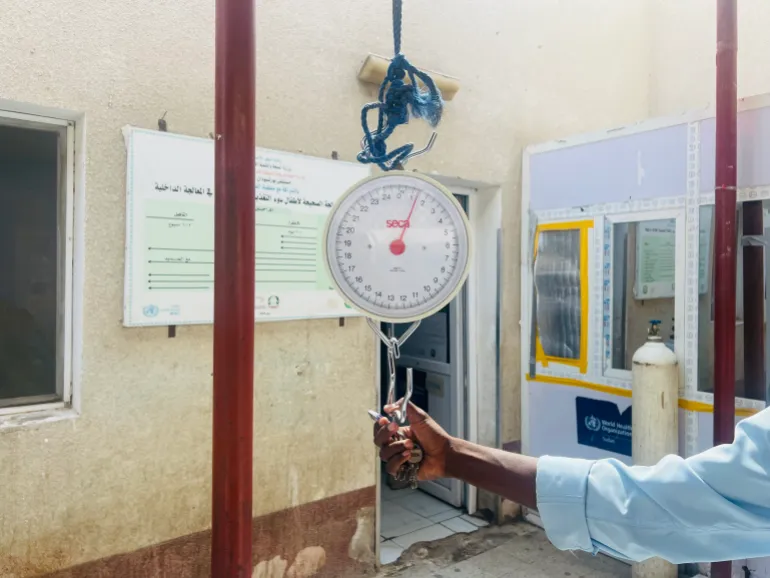
Port Sudan, Sudan – After a two-and-a-half-hour journey from the village of al-Lalouba, Layla Ali arrived in Port Sudan to get help for her five-year-old son, Adam. His severe malnutrition had left his ribs visibly protruding beneath his skin.
He had begun to lose his appetite two weeks earlier and became too sick to move. The distance to the hospital and Ali’s fears about the cost of treatment stopped her from rushing Adam for medical treatment. But when his condition deteriorated further, Ali had no choice but to rush him to hospital.
Recommended Stories
list of 3 itemsend of list
“We spent five days in hospital while my son received treatment. He suffers from recurring bouts of malnutrition, but this time we brought him to hospital because I was afraid he might die,” Ali told Al Jazeera.
“When Adam became ill, he would stop eating. I used to give him the usual meals we prepared at home, mostly porridge and milk. But the doctors have now helped me understand which foods are appropriate for his age and the nutrients he needs.”
Adam’s condition reflects a wider crisis facing children across Sudan, where a civil war has continued since April 2023 between the Sudanese Armed Forces (SAF) and the Rapid Support Forces (RSF) paramilitary.
The Integrated Food Security Phase Classification (IPC) estimates that 825,000 children under five will suffer from severe acute malnutrition in 2026, a 7 percent increase from 2025.

In the first six months of this year, UNICEF and its partners treated 174,700 children with severe acute malnutrition nationwide. The Port Sudan Teaching Hospital has recorded 433 cases between January and August this year.
Maryam Gadalsid, a nutrition counsellor at the hospital, said the number of children admitted with malnutrition continues to rise, forcing medical staff to accommodate as many as possible.
But this has led to overcrowding, with three children to a single bed in the hospital’s 17-bed malnutrition unit, Gadalsid told Al Jazeera, increasing the risk of disease spreading among patients.
“Medical staff assess each child’s condition before providing essential supplies, including therapeutic milk and other nutritional supplies free of charge, with support from the World Health Organization (WHO) and UNICEF,” Gadalsid said. “However, intravenous fluids and medication remain a significant financial burden for many families, struggling with the economic crisis caused by the war.”
Gadalsid added that inadequate nutrition among pregnant women, driven by displacement and economic hardship, was also putting their babies at risk of poor growth and malnutrition.
An increase in the numbers of flies, which can contaminate food and water, and mosquitoes, which transmit malaria, was worrying, she said. Malnourished children, in particular, are at risk of these diseases and viruses.
“With the onset of winter, malnutrition cases increase [and] … the number of flies rises, contributing to the spread of diseases that cause malnutrition,” she said.

Displaced children face worsening malnutrition
The situation is particularly bad in western Sudan’s Darfur region, which had already faced two decades of war before the 2023 nationwide conflict broke out.
Darfur has been an epicentre of the current conflict and is currently an RSF stronghold. Fighting there, combined with hunger and disease, has created an increasingly desperate situation for millions of civilians, particularly women and children.
In North Darfur alone, there were at least 40,000 cases of malnutrition between January and May 2025, according to UNICEF, when the RSF imposed a siege on the state’s capital, el-Fasher. The city was later taken by the RSF in October, and the paramilitary group is accused of killing thousands of civilians there.
Meanwhile, in Blue Nile State, southeastern Sudan, malnutrition is also taking a growing toll on displaced children.
Sabri Adam, deputy head of the committee overseeing al-Karama 3 displacement camp, which is located in the state capital al-Damazin, told Al Jazeera that cases of malnutrition had risen from 1,800 in September to 2,116 in November, accounting for more than a quarter of the camp’s children. Of those affected, 1,760 are under the age of five.
According to Adam, al-Karama 3 is home to more than 7,600 children under the age of 10, among almost 4,000 displaced families. They had fled areas in western Blue Nile State, including al-Tadamon, Bau and Kurmuk, where military operations between the SAF and the RSF have intensified.
“These families arrived at the camp in extremely difficult humanitarian conditions, amid limited funding and humanitarian assistance from organisations, and a lack of health monitoring despite the growing needs of displaced people,” he said to Al Jazeera.
Adam said the camp received cash assistance from the Red Crescent earlier this month to support people affected by malnutrition and pregnant women. Each eligible household received 620,000 Sudanese pounds (about $60 at the parallel market rate).
The situation is unfolding as the IPC warns of a growing risk of famine across parts of Greater Darfur and Greater Kordofan. Conflict, mass displacement, severe drought and inadequate humanitarian funding are driving a further deterioration in food security.
The El Nino climate phenomenon has led to reduced rainfall in Sudan during the rainy season, leading to drought that is affecting roughly half of the country.
According to the IPC, nearly two-thirds of farmland in North Darfur and roughly half in South Darfur and Kordofan states have had poor vegetation growth, threatening harvests and leaving families facing higher prices and worsening hunger.

War and poverty deepen Sudan’s malnutrition crisis
Back at the Port Sudan Teaching Hospital, Dr Ahmed Youssef, the medical director of the paediatric department, said increasing malnutrition was driven not only by the effects of war and displacement but also by limited nutrition awareness or accessibility among families, particularly in rural communities.
Many families in smaller villages across Sudan rely heavily on flour and milk as staple foods, with meat largely absent from their daily diets.
“We are working to provide families of children with malnutrition with basic nutrition education as a first step towards tackling the problem. However, we face difficulties reaching villages to deliver healthcare and raise awareness,” he told Al Jazeera.
Food contamination, particularly amid unreliable electricity supplies and a lack of refrigerators in many households, makes it difficult for families to store food safely and is also a major issue.
“Families often bring their children to hospital only when malnutrition has reached an advanced stage, either because of financial hardship and fears about treatment costs or because of limited education,” he said.